
For Nigerian freelancers, the main Upwork withdrawal options to compare are Direct to Local Bank, Direct to U.S. Bank where available, Payoneer and USD wire transfer.
Direct to Local Bank currently costs $0.99 per withdrawal and usually arrives within four business days. Direct to U.S. Bank now costs freelancers with a non-U.S. tax address $2.99 per withdrawal and normally takes two to five business days.
The cheapest Upwork fee is not automatically the cheapest route. Compare the withdrawal charge, the amount that reaches the receiving account, the FX rate, any later bank or cash-out fee and whether you need to keep part of your earnings in USD.
If you want naira directly in a Nigerian bank account, Direct to Local Bank is the simplest benchmark: Upwork currently charges $0.99 per withdrawal, with a $3,000 limit for Nigeria, and says funds should arrive within four business days.
If you want to keep your earnings in USD, an eligible U.S. bank account that Upwork accepts may give you more control over when you convert. For freelancers with a non-U.S. tax address, Direct to U.S. Bank now costs $2.99 per withdrawal and normally takes 2–5 business days.
Payoneer remains an integrated option for eligible Nigerian freelancers, but its full cost depends on the fees that apply after the money reaches Payoneer.
The useful comparison is:
Upwork balance → withdrawal fee → receiving cost → FX → cash-out cost → money you can actually use
If you are still deciding how international income should reach you in the first place, start with the walllet.com guides to receiving USD in Nigeria without PayPal and receiving payments from US, UK and EU clients. Upwork is different from a direct client because the platform controls which withdrawal methods you can add.

Upwork withdrawal methods in Nigeria compared
Method | Current Upwork-side fee | Typical timing | Currency you receive | Main FX question | Nigeria-specific limit | Main failure point | Best use case |
|---|---|---|---|---|---|---|---|
Direct to Local Bank | $0.99 | Within 4 business days | NGN | What exchange rate is used before the money reaches your bank? | $3,000 per withdrawal | Incorrect bank details, beneficiary-name mismatch or bank-side delay | You need naira directly in your Nigerian bank account, you spend most income locally, and you do not need to keep USD after withdrawal. |
Direct to U.S. Bank | $2.99 for a non-U.S. tax address | 2–5 business days | USD | What will receiving, holding and later converting the USD cost? | Depends on the eligible receiving account | Account not accepted by Upwork, ACH incompatibility or beneficiary mismatch | You want to keep your earnings in USD, pay USD expenses, receive other international income, or choose when to convert to naira. |
Payoneer | Check the current Upwork/Payoneer quote | Typically within 24 hours after setup | Depends on account and route | What do conversion and later bank withdrawal cost? | Account-specific | Payoneer verification, account-specific limits or downstream withdrawal issues | You already use Payoneer, need an established Upwork integration, and want a familiar payout workflow with additional payment features after receiving funds. |
USD Wire Transfer | $50 | Up to 7 business days | Usually USD | Are intermediary, receiving-bank or FX charges added? | Check your receiving bank | Correspondent-bank deductions, incorrect wire details or banking delays | You receive larger payments where the fixed $50 fee is relatively small, or your client/payment requirement specifically needs wire transfer. |
For Direct to Local Bank, Upwork currently lists a $0.99 withdrawal fee, a $3,000 limit for Nigeria, and delivery within four business days.
For Direct to U.S. Bank, freelancers with a tax address outside the United States now pay $2.99 per withdrawal. The receiving account must be a U.S.-based checking or savings account that can accept ACH payments.
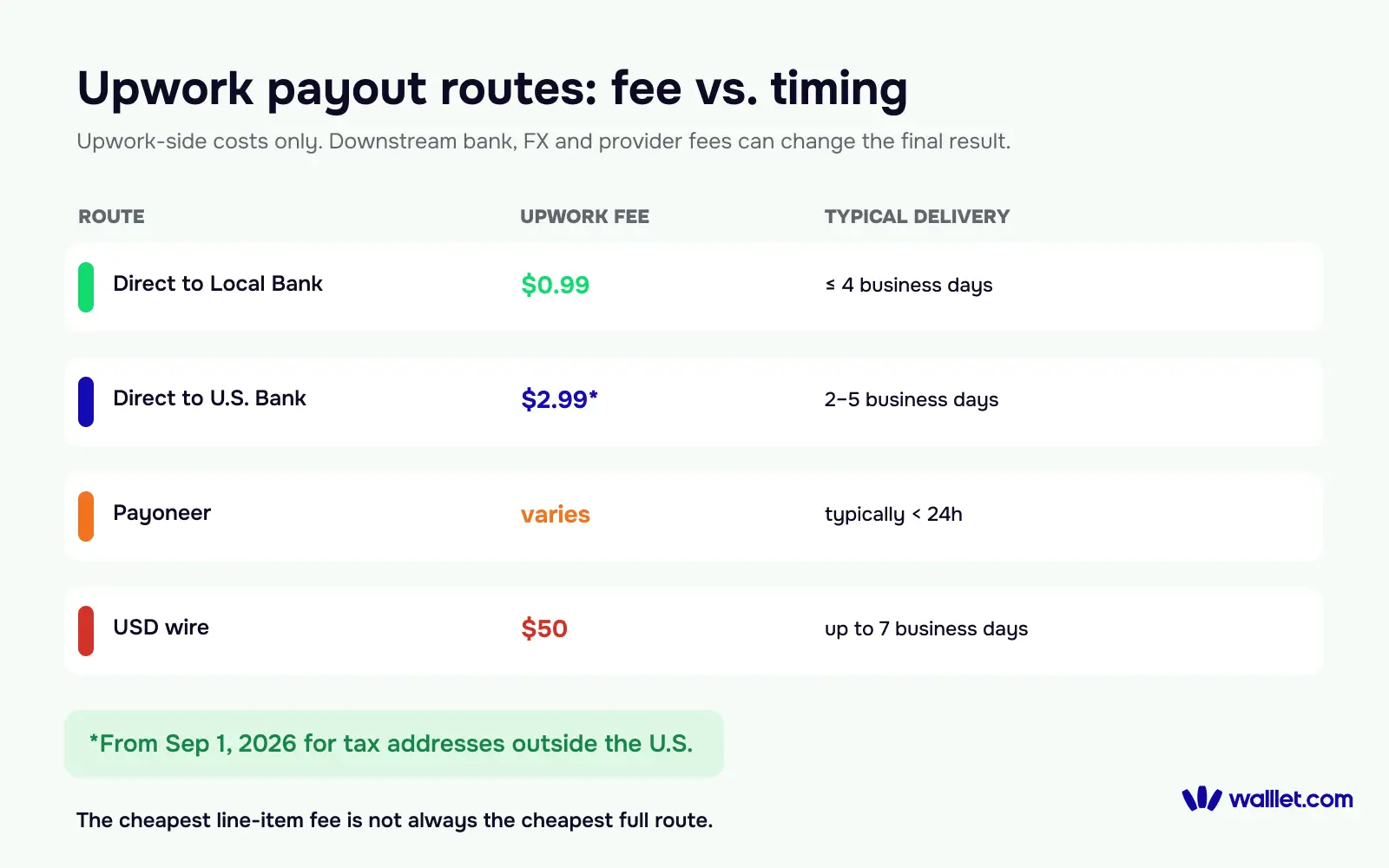
Upwork charges $50 per USD wire transfer, and intermediary or receiving banks may deduct additional charges.
Payoneer does not have one universal final cost for Nigerian freelancers. Check the current fee shown in your Upwork and Payoneer accounts before comparing it with another route.
Which Upwork withdrawal route fits what you need next?
If you need naira immediately, Direct to Local Bank is the first route to benchmark.
If you want to keep earnings in USD, compare an eligible Direct to U.S. Bank route with Payoneer and any other receiving account Upwork actually accepts.
If Payoneer is already connected to your Upwork workflow, switching only makes sense if the alternative solves a specific problem such as FX control, withdrawal cost or what you can do with the balance afterward.
If the payment is large enough for a $50 wire fee to become proportionally small, a USD wire can still be relevant, but intermediary and receiving-bank charges must also be considered.
If your Upwork account accepts the receiving route available to you, walllet.com can be worth checking when you want to keep part of your income in USD, spend internationally and cash out to naira without treating every payout as an immediate NGN conversion.
1. Direct to Local Bank: best when you need naira?
For many Nigerian freelancers, Direct to Local Bank is the shortest route:
Upwork balance → local-bank withdrawal → NGN bank account
Nigeria is currently listed among the countries supported by Upwork's Direct to Local Bank system.
You also need a bank account whose account-holder name matches your verified Upwork name.
What should you check before using Direct to Local Bank?
The $0.99 fee is only the visible Upwork charge. Before withdrawing, check the final NGN amount Upwork quotes, the effective USD/NGN conversion rate and any incoming fee charged by your bank.
If you intend to convert the entire payout to naira immediately, this route is the simplest benchmark to compare against other methods.
If you want to keep part of your earnings in USD, the lowest initial withdrawal fee may not produce the best overall outcome.
What makes Direct to Local Bank attractive?
There is no second payment provider to manage after Upwork.
You do not need to receive the money somewhere else and then initiate another withdrawal to your Nigerian bank.
For someone who earns USD but needs most of that income for rent, food, transport, family expenses or local business costs, that simplicity has real value.
Where can the cost hide?
The $0.99 fee does not tell you how much naira reaches your account.
Suppose you have $1,000 available for withdrawal on Upwork.
After Upwork's $0.99 withdrawal fee:
$1,000 − $0.99 = $999.01
But that is not your final answer. The next question is:
What NGN conversion rate is being applied to that $999.01?
A route with a $0.99 fee and a weaker exchange rate can leave you with less money than a route with a larger explicit fee but a better conversion outcome.
The walllet.com comparison of PayPal, Payoneer, Wise and stablecoins for freelancers uses the same principle: compare what you can actually hold, spend or withdraw after the route is complete, rather than choosing from the advertised fee alone.
2. Can you withdraw Upwork earnings to a USD account?
Yes, if Upwork offers Direct to U.S. Bank to your profile and accepts the U.S. bank details you add.
Direct to U.S. Bank uses ACH and requires a U.S.-based checking or savings account that can accept ACH payments.
For freelancers whose tax address is outside the United States, Upwork charges $2.99 per withdrawal as of September 1, 2026. Upwork says the payment normally reaches the receiving bank within 2–5 business days.
Having USD account details or an ABA routing number does not guarantee that Upwork will accept an account. Compatibility depends on the receiving account and the withdrawal methods available to your Upwork profile.
A USD route can be useful if you want to:
keep part of your income in USD;
pay USD-denominated work expenses;
avoid converting your entire payout to naira immediately;
combine Upwork income with other international income;
decide later when and how much to convert.
Before using a USD receiving account, confirm that the account accepts ACH, the beneficiary name matches your verified Upwork name, and you understand any receiving, transfer, FX or later cash-out fees.
Why would a Nigerian freelancer want a USD payout route?
Because receiving in USD changes what happens after payout.
Instead of:
Upwork → immediate NGN conversion → Nigerian bank
you may be able to use:
Upwork → eligible USD account → hold USD → convert or use later
That matters if you:
pay for software or work tools in USD;
want to avoid converting your entire income to naira at once;
receive other international income in the same account;
want to choose the timing of your conversion;
want to compare conversion routes before moving to NGN.
The walllet.com IBAN Account guide explains how foreign-currency receiving details work and why the exact receiving rail, payer type, beneficiary name and eligibility matter.
What can go wrong with a USD receiving account?
A digital USD account can add another provider or banking partner between Upwork and your final destination.
That matters when a transfer is delayed or missing. Before using one, check:
whether Upwork accepts the account details;
whether the account accepts marketplace payouts;
whether the beneficiary name matches;
whether ACH payments can be traced;
whether another fee applies when you move or convert the money.
Test a new receiving setup with a smaller withdrawal before sending a large Upwork balance through it.
3. How does Payoneer work with Upwork in Nigeria?
Payoneer is an Upwork withdrawal option for eligible freelancers outside the United States and India.
Your Payoneer account must be registered and verified in your own name, and that name must match your verified Upwork name.
A newly added withdrawal method has Upwork's standard three-day security activation period. Once Payoneer is fully set up, Upwork says withdrawals normally reach the Payoneer account within 24 hours. The route is:
Upwork → Payoneer → hold, convert, spend or withdraw
The advantage is flexibility after the payout reaches Payoneer. The disadvantage is that the withdrawal from Upwork is only the first part of the cost.
Compare:
Upwork/Payoneer transfer fee + currency conversion + bank withdrawal + any account-specific charges
Do not use a generic Payoneer percentage to estimate your final cost. Payoneer's public pricing varies by currency, country and withdrawal route, and your account should show the applicable fee before you complete the transaction.
What do you keep from a $100, $500 or $1,000 Upwork withdrawal?
The examples below include only known fixed Upwork-side withdrawal fees. They do not include FX spreads, receiving-bank charges, Payoneer fees or later cash-out costs.
Starting Upwork balance | Direct to Local Bank | Direct to U.S. Bank — non-U.S. tax address | USD Wire Transfer |
|---|---|---|---|
$100 | $99.01 before FX/bank costs | $97.01 before downstream costs | $50.00 before bank costs |
$500 | $499.01 before FX/bank costs | $497.01 before downstream costs | $450.00 before bank costs |
$1,000 | $999.01 before FX/bank costs | $997.01 before downstream costs | $950.00 before bank costs |
Payoneer is not included as a fixed-number column because the applicable fee can depend on the route and account.
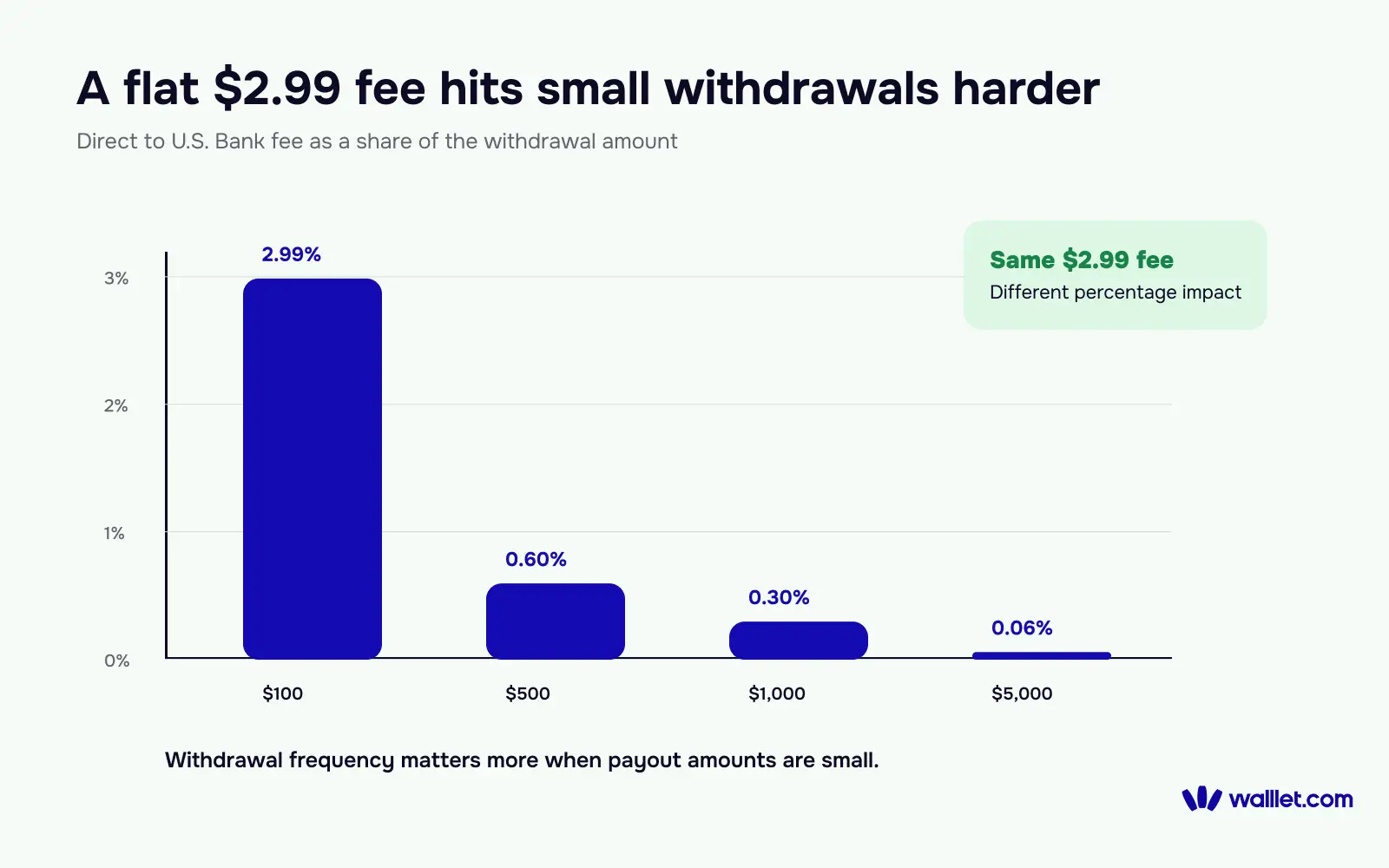
These examples also show why fixed withdrawal fees matter more on small payouts.
On a $100 withdrawal:
$0.99 equals 0.99% of the starting balance.
$2.99 equals 2.99%.
$50 equals 50%.
On a $1,000 withdrawal:
$0.99 equals 0.099%.
$2.99 equals 0.299%.
$50 equals 5%.
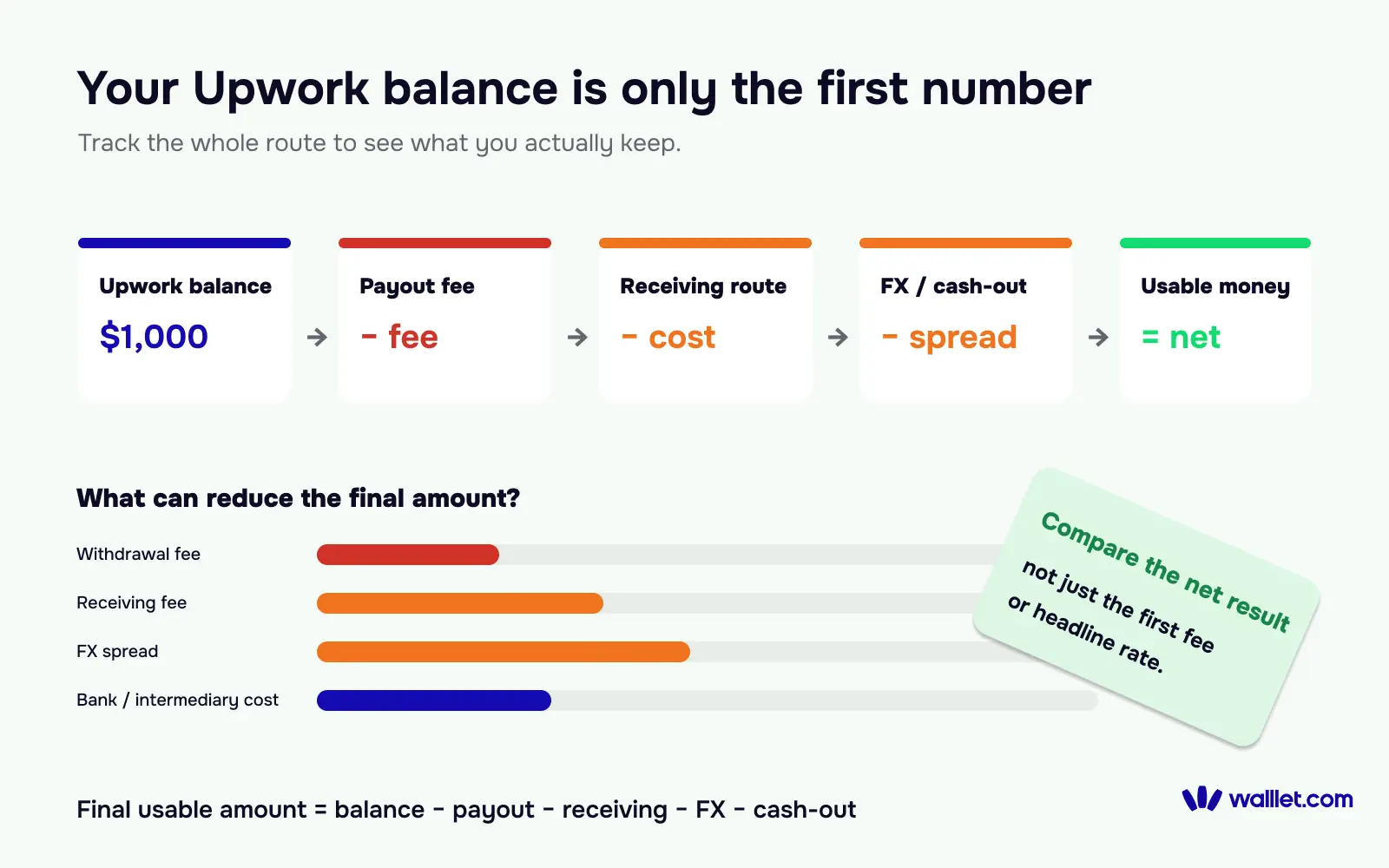
But the smallest Upwork fee does not automatically produce the most usable money. If a route converts your USD at a weaker rate or adds another withdrawal charge later, the final result can change.
Use this formula:
Usable money = Upwork balance − Upwork withdrawal fee − receiving fees − FX cost − cash-out or bank withdrawal fees
How much does Payoneer cost for Upwork withdrawals?
There is no single universal Upwork-to-Payoneer-to-Nigerian-bank fee.
Upwork says it charges a small fee for Payoneer withdrawals, while Payoneer may separately charge for services such as currency conversion, bank withdrawals and account-related services.
Payoneer's public pricing, last updated January 1, 2026, lists bank-withdrawal charges of 1.2%–4% for several cross-border routes, but the exact charge depends on the currencies, countries and route involved. For that reason, do not write: “Payoneer costs X%, so it is cheaper/more expensive.”
Instead, compare the live amount shown in your account:
Upwork balance → amount reaching Payoneer → conversion → amount reaching your Nigerian bank
That final amount is the number that should be compared with Direct to Local Bank or another USD route.

For freelancers who eventually move dollar-linked funds into a Nigerian bank account, the walllet.com guide to cashing out USDT or USDC to naira explains why the final bank amount, quoted rate and fees matter more than looking at one transaction cost in isolation.
Which Upwork withdrawal method is best for you?
Use Direct to Local Bank if you want naira in a Nigerian bank account, do not need to keep the payout in USD, your withdrawal is within Nigeria's current $3,000 limit, and the quoted conversion rate is competitive.
Use Direct to U.S. Bank if Upwork accepts your U.S. receiving account, you want to keep some or all of the payout in USD, and the $2.99 withdrawal fee plus later receiving and cash-out costs still make sense for you.
Use Payoneer if it is already part of your payment workflow, you value its direct Upwork integration, and its current conversion and withdrawal costs are competitive.
Consider USD wire transfer mainly for situations where the $50 Upwork fee and possible intermediary-bank charges are small relative to the size or requirements of the payment.
If your only goal is getting the most naira, compare the final NGN quote.
If you want to keep part of your income dollar-denominated, compare how much USD remains usable after every fee.
The best route is the one that leaves you with the most useful money for what you need to do next.
For a broader look at this problem, the walllet.com guide to why freelance payments get held, reviewed or delayed explains where payment routes tend to fail and what records to keep.
How to compare the real cost of an Upwork withdrawal
Do not compare payout methods using only the fee beside the withdrawal button.
Start with the same Upwork balance and calculate:
Usable money = Upwork balance − withdrawal fee − receiving fee − FX cost − bank or cash-out fee
If your final destination is a Nigerian bank account, calculate:
Final usable NGN = amount available for conversion × actual executable USD/NGN rate − remaining charges
Then record three other factors:
Time: When can you actually use the money?
Currency: Are you forced to convert everything to naira?
Failure ownership: If the transfer does not arrive, which provider can trace it?
A route that saves $2 on the initial withdrawal can still cost more after conversion.
Is a USD account better than Payoneer for Upwork?
It depends on what you need after the payout arrives.
If you want a directly integrated Upwork withdrawal provider, Payoneer has an established setup flow for eligible freelancers.
If you want to keep your payout in USD, an Upwork-compatible U.S. receiving account may provide a shorter USD route.
Direct to U.S. Bank is not free for a Nigerian freelancer with a non-U.S. tax address. Since September 1, 2026, Upwork charges $2.99 per withdrawal for freelancers whose tax address is outside the United States.
Payoneer's final cost is less predictable from public pricing alone because conversion and later withdrawal charges depend on the account and route.
If your end goal is naira, compare the actual amount that reaches your Nigerian bank account rather than choosing based on the account type.
Can you use walllet.com for an Upwork withdrawal?
Do not assume that any USD receiving account automatically works as an Upwork withdrawal method.
Upwork controls which withdrawal methods are available to each freelancer and whether the receiving details added to an account are accepted.
If you have eligible USD receiving details from walllet.com, check the withdrawal methods shown inside your Upwork account and confirm that the receiving details support the required payment rail before using them.
Before routing a large payout to any new receiving account:
Confirm that the account is issued in your own name.
Confirm that it supports the transfer rail Upwork requires.
Add it through Upwork's official withdrawal settings.
Wait for the required security activation period.
Test the setup with a smaller first withdrawal.
Receiving USD and being accepted as an Upwork withdrawal destination are two separate questions.
How long does an Upwork withdrawal take in Nigeria?
The timing depends on the withdrawal method.
Method | Current Upwork guidance |
|---|---|
Direct to Local Bank | Within 4 business days |
Direct to U.S. Bank | 2–5 business days |
Payoneer | Typically within 24 hours after the method is fully set up |
USD wire transfer | Up to 7 business days |
These are withdrawal delivery times, not the full time between doing work and having money available.
Your Upwork earnings must first become available for withdrawal. The availability schedule depends on the contract and payment type.
A newly added withdrawal method also normally goes through a three-day security activation period before you can use it.
Why hasn't my Upwork withdrawal arrived?
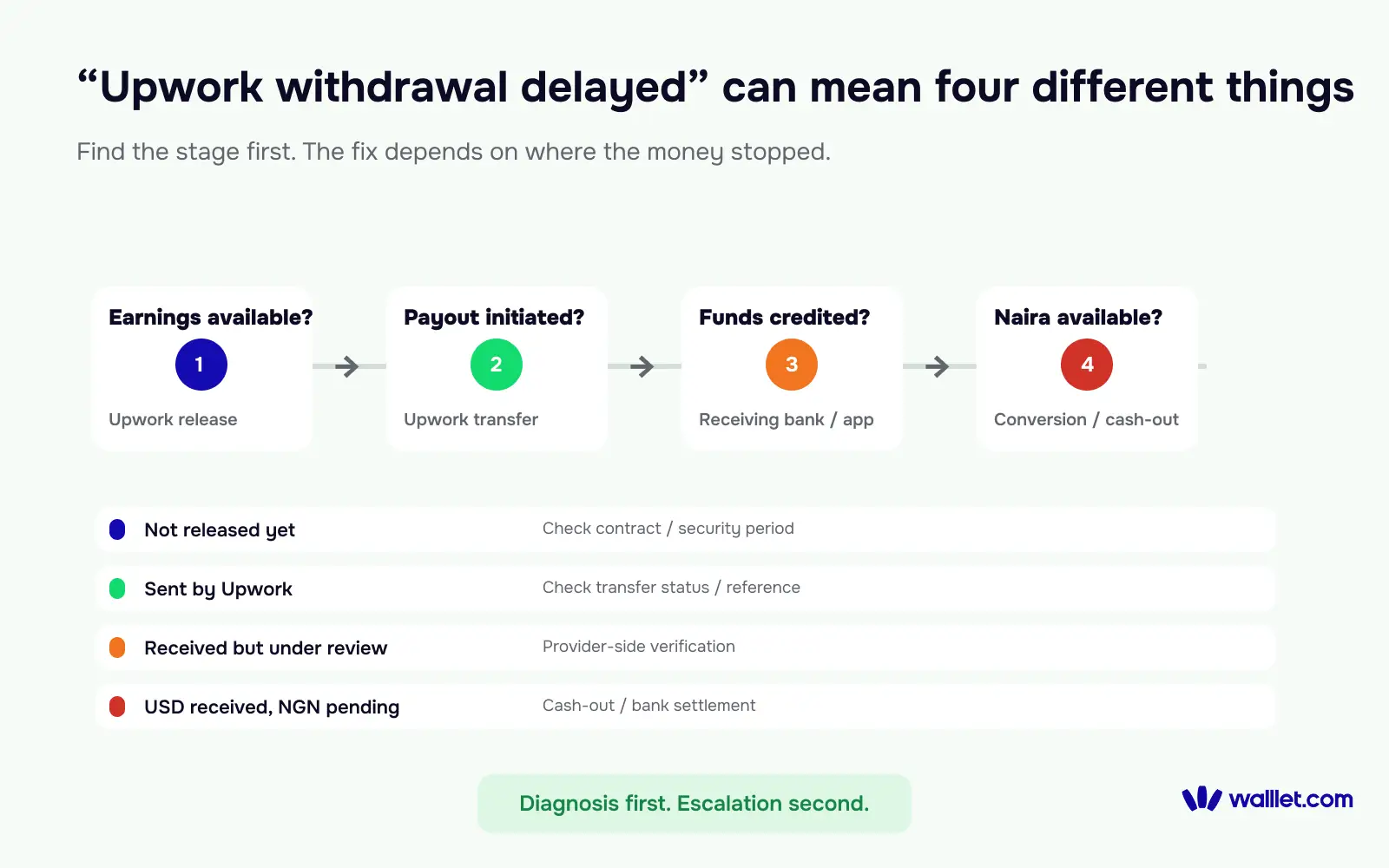
First identify where the payment stopped.
Upwork still shows the money as unavailable
This is not yet a withdrawal delay. Check the earnings availability date for the contract.
Upwork processed the withdrawal but the bank has not credited it
Check the payout date, beneficiary name, account details and bank information.
For Direct to Local Bank, Upwork says the payment should normally arrive within four business days. If it does not, contact your bank. Upwork says it can attempt a trace after eight business days.
A USD or digital receiving account has not credited the payment
Confirm that the account supports the required payment rail, the beneficiary details match and the receiving provider has not placed the transaction under review.
Payoneer has not received the payout
Upwork says Payoneer withdrawals normally arrive within 24 hours after setup. If the transfer is delayed, check with Payoneer and keep the Upwork transaction reference.
A wire transfer is missing
Upwork says wires can take up to seven business days and may pass through intermediary banks. Keep the wire details and ask the receiving bank whether it can trace the payment.
For any missing withdrawal, keep:
Upwork transaction ID;
withdrawal date;
amount and currency;
beneficiary details;
bank or provider reference;
any verification emails;
screenshots of the transaction status.
For bank-transfer problems beyond Upwork, the walllet.com guide to tracing a missing international wire with an MT103 or UETR explains what payment evidence can and cannot prove.
Checklist before your next Upwork withdrawal
Before confirming a withdrawal, check:
Available Upwork balance
Current withdrawal fee
Withdrawal limit
Beneficiary name
Receiving account and payment rail
Expected delivery time
Amount reaching the receiving provider
Actual FX rate
Any later bank or cash-out fee
Final amount you can use
If you are adding a new withdrawal account, verify the details before sending a large payout and remember that Upwork normally applies a three-day security period to a newly added withdrawal method.
