
The walllet.com IBAN Account is designed to give eligible users a bank-transfer receiving layer alongside the wider walllet experience. Instead of asking every payer to use crypto, you can use IBAN-formatted payment details for supported incoming payments. The exact currency, rail, eligibility, fees, limits, and review rules depend on what walllet.com currently shows for your account.
The walllet.com Bank Account currently has a $5 issuance fee. Incoming USD received through the supported bank route into your walllet.com wallet carries a 1% receiving fee. Other route-specific details, including eligibility, supported rails, limits and review requirements, should still be checked in your current account.
A client sends you one sentence:
Please send your bank details.
Simple request. Potentially annoying afternoon.
You now need to work out what details to share, which currency the client should send, whether the payer’s bank supports the route, whose name should appear, what reference to use, what happens if the transfer is reviewed, and when “sent” becomes “available.”
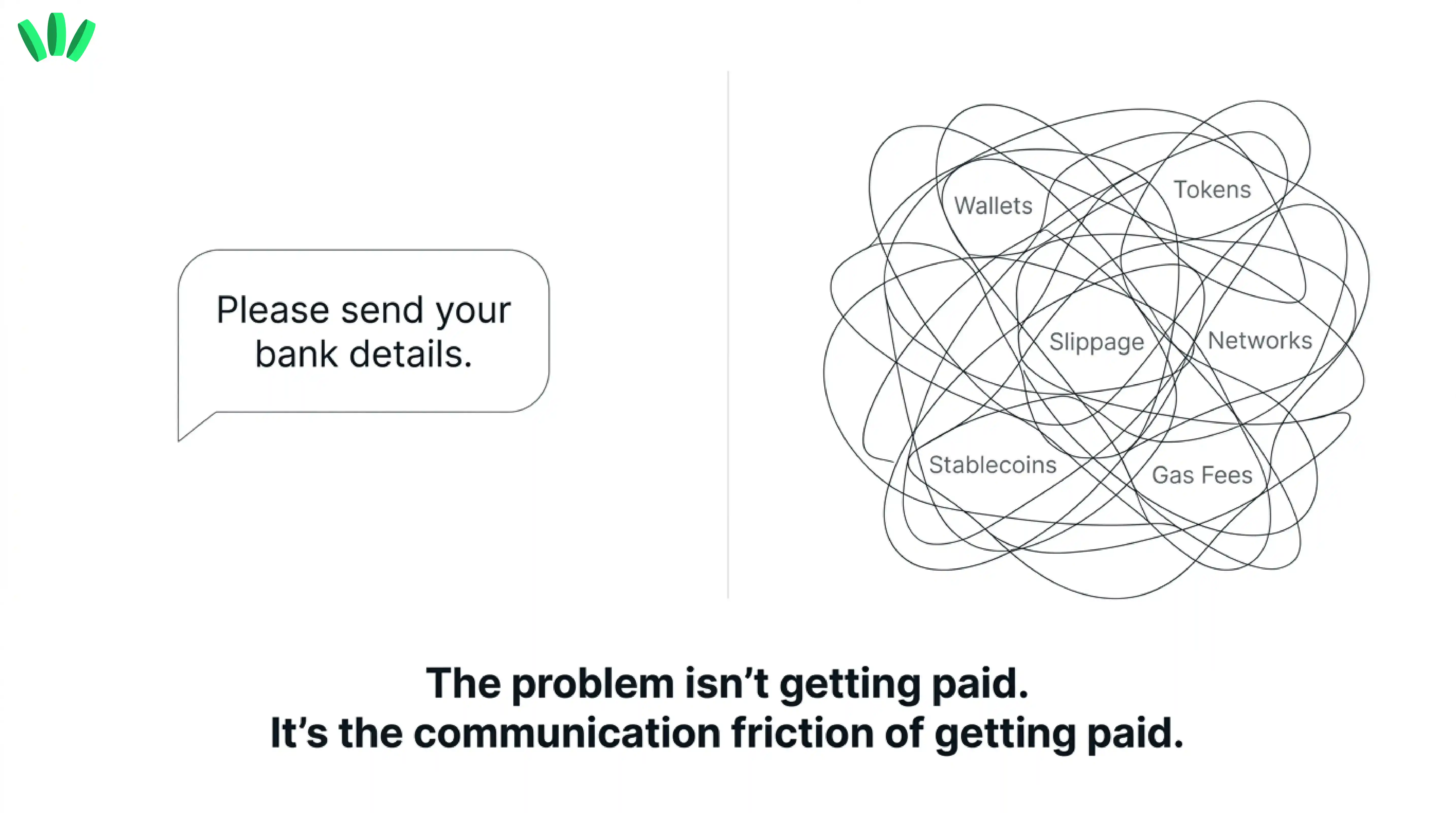
For a freelancer in Nigeria, the route can become even more fragmented. A foreign client pays in one currency. Your work expenses may be in another. Your daily life is mostly priced in naira. You may already use a mixture of bank accounts, payment platforms, stablecoins, wallets, and local transfer options.
That is why the useful way to understand an IBAN feature is not as another shiny account badge. It is one possible receiving layer inside a larger money route.
That larger route includes what happens after the payment arrives. If you expect to use a physical or virtual card, receiving the money does not guarantee that a later card transaction will be approved. Read our guide to why crypto cards and virtual dollar cards get declined before making a card your only spending route.
This matters whether you are a designer invoicing an agency, a developer working under a monthly contract, a marketer with recurring retainers, or a creator receiving international business income. Our guide to how Nigerian creators get paid through different global payment routes explores the same underlying problem from another angle: getting paid is rarely one step.
What is the walllet.com IBAN Account?
The walllet.com IBAN Account is designed to provide eligible users with IBAN-formatted receiving details for supported bank-transfer routes, while keeping that receiving experience connected to the wider walllet.com money workflow. The practical aim is simple: a client can use familiar payment instructions where supported, rather than being forced into a crypto-only payment process.
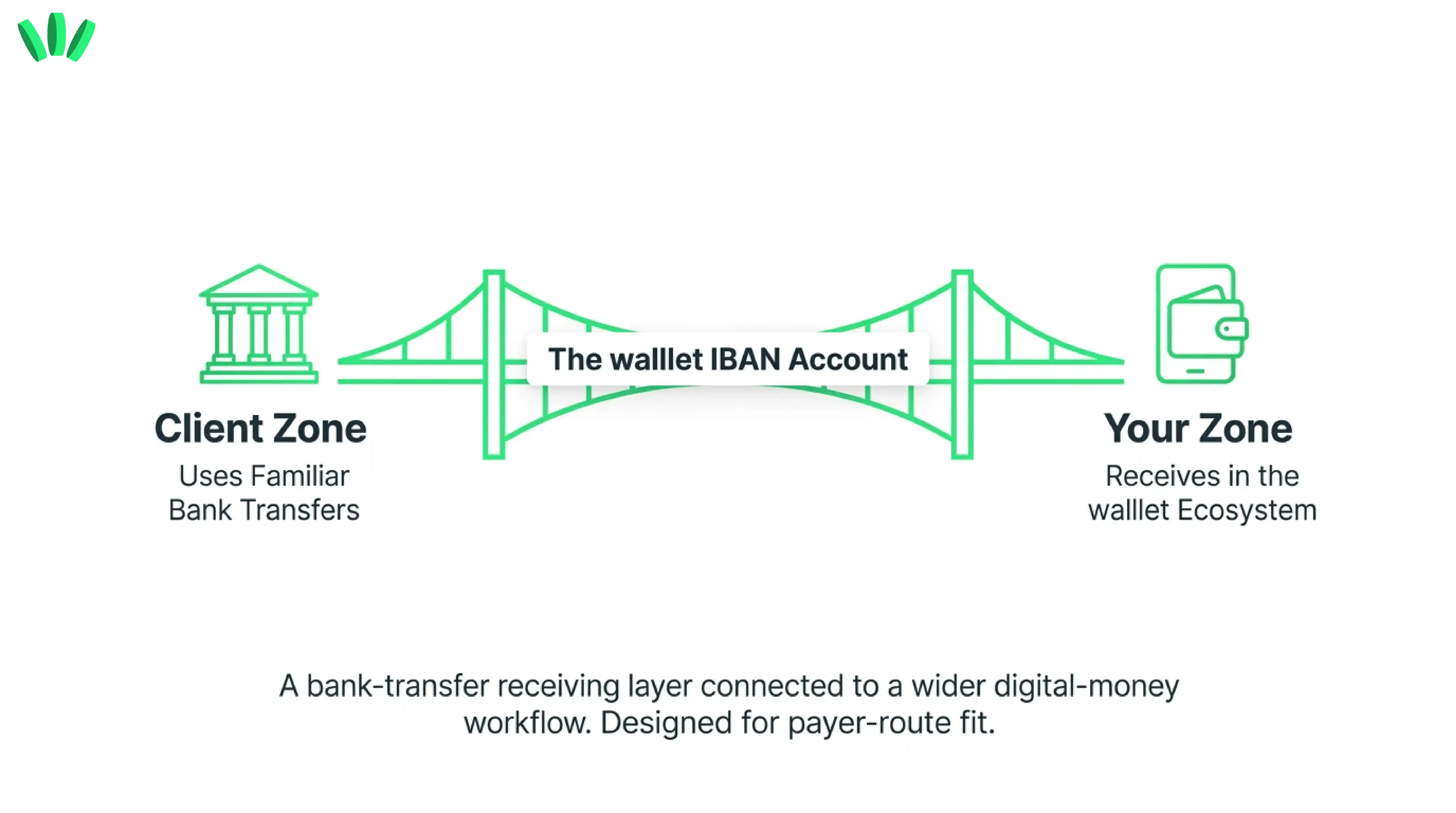
The exact details matter more than the label. Before relying on the feature, check what walllet.com currently shows for your account, including:
eligibility
beneficiary name
supported currency
supported incoming route
payment instructions
fees
limits
expected timing
review requirements
available next steps after funds arrive
For the current walllet.com Bank Account pricing, the account issuance fee is $5. When USD is received through the supported bank route and credited to your walllet.com wallet, a 1% receiving fee applies.
That caveat is not decorative legal confetti. It is part of using cross-border money tools responsibly.
What is an IBAN, exactly?
An IBAN, or International Bank Account Number, is a standardized account identifier used to help identify a specific account in cross-border and domestic payment processing where IBANs are used.
The European Central Bank’s glossary definition of IBAN describes it as an international standard that identifies an individual account at a specific financial institution and includes information used to identify the relevant country and bank.
The crucial word is identifier. An IBAN is not, by itself:
a promise of instant payment
a guarantee of low fees
proof of deposit insurance
proof that every currency is supported
proof that SEPA is supported
proof that SWIFT is supported
a substitute for KYC
a guarantee that every client or freelance platform can use it
Humanity has, naturally, managed to turn “send money to the right place” into an impressive collection of acronyms. The distinctions still matter.
Is an IBAN the same as a bank account?
No. An IBAN is an account identifier, while “bank account” describes a broader legal and operational relationship.
That distinction becomes especially important with fintech products and virtual IBAN arrangements. The structure behind an IBAN can differ, including who holds the underlying account, how funds are allocated, which institution provides the payment service, and what contractual rights the user has.
The European Banking Authority’s report on virtual IBANs explains that virtual IBAN structures vary and that there was no uniform EU-level legal definition of a virtual IBAN at the time of its 2024 report. Some arrangements link virtual identifiers to master payment accounts, while the underlying structure and account-holder relationship can differ.
So before calling any IBAN feature “my bank account,” check:
Who provides the payment service?
Who is the legal account holder?
Is the beneficiary name yours?
Which currencies are supported?
Which payment routes are supported?
How are funds held before and after availability?
What safeguarding or protection disclosures apply?
What happens if a payment is rejected or reviewed?
For the walllet.com IBAN Account, use the exact description shown in the current product and applicable terms. Do not infer legal bank status from the presence of an IBAN number alone.
How does the walllet.com IBAN Account compare with other ways to get paid?
There is no universally best route. The payer, currency, country, fee structure, urgency, review risk, and what you need to do next all change the answer.
Payment option | What the payer typically needs | What you should verify | Often useful when |
walllet.com IBAN Account | The exact supported payment details shown in walllet.com | Eligibility, beneficiary name, currency, route, fees, limits, review rules, next steps | You want a client-friendly receiving route connected to your wider walllet.com workflow |
Traditional bank account | Bank account details, sometimes additional international transfer information | Incoming transfer support, correspondent fees, FX, timing, restrictions | You already have suitable international banking access |
Payment-platform receiving account | Platform-issued receiving details | Allowed payer types, supported currencies, fees, withdrawals, reviews | Your work already depends on a particular payment platform |
Stablecoin wallet | Wallet address, token, and network | Token, network, sender competence, issuer risk, fees, off-ramp plan | Both sides understand crypto payments |
Marketplace payout route | Platform-specific payout setup | Country eligibility, payout schedule, fees, account-name rules | Your income originates inside the marketplace |
The table is a decision framework, not a claim that every walllet.com route or feature is available to every user.
Why could an IBAN account help freelancers and global earners?
An IBAN route can reduce friction when the payer already understands bank transfers and does not want a crypto lesson. That sounds almost painfully obvious. Yet it solves a real communication problem. Imagine you are a Nigerian product designer working with a small agency in Europe. The agency’s finance manager asks for payment details. You could send:
a wallet address
a token name
a blockchain network
warnings about using the wrong chain
instructions for buying a stablecoin
Or, where an eligible and supported IBAN route is available, you could provide the exact payment details required for that bank-transfer route.
For many clients, the second conversation is more familiar. The benefit is not “IBANs are better than crypto.” That would be lazy. The benefit is payer-route fit. A useful receiving option should fit the person sending the money as well as the person receiving it.
Why is this especially relevant for Nigerian freelancers?
For Nigerian freelancers, the payment problem often continues after the client presses “send.”
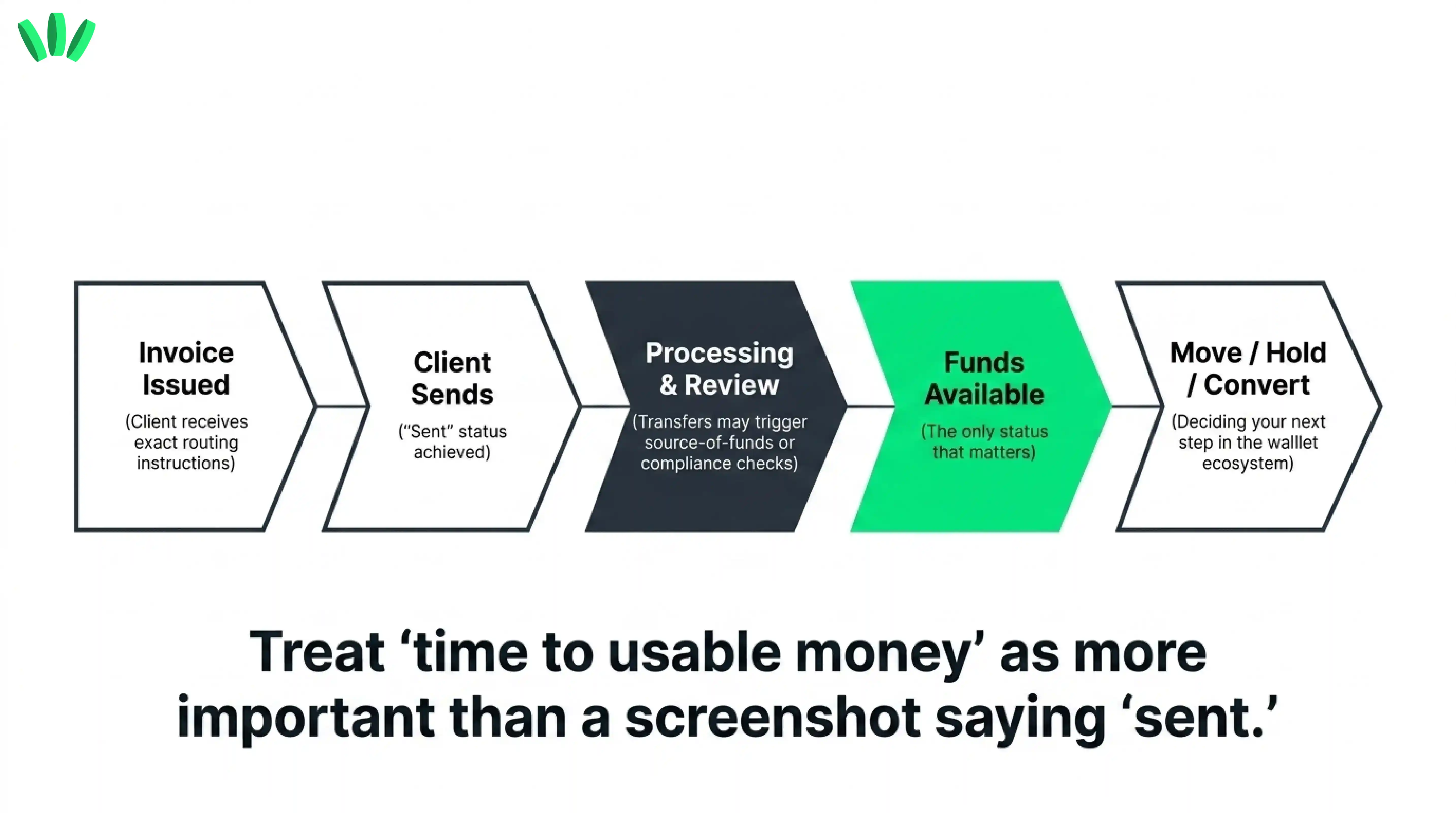
You may earn from a client abroad but plan expenses in naira. You may want to keep part of your income in dollar-linked value. You may need to pay for work tools. You may need proof for an invoice. You may need a fallback if one provider changes its rules. The full route can look like this:
Client chooses payment method → payment is sent → details are checked → transfer may be processed or reviewed → funds become available → you decide how to hold or move value → you pay work or local expenses
That is why we treat “time to usable money” as more useful than a screenshot saying “sent.”
Our guide to why freelance payments get held, reviewed, or delayed goes deeper into the uncomfortable middle of the route, where a payment exists but is not yet useful. For wider market context, what Nigeria’s stablecoin shift means for freelancers examines why many global earners are comparing bank routes, digital dollars, and mixed payment stacks rather than relying on one method for everything.
For an eligible Nigerian user, the practical value of a walllet.com IBAN route would be the possibility of giving a suitable client familiar payment instructions while keeping the wider money workflow easier to inspect.
Do not interpret that as a blanket claim of Nigeria availability. Check current eligibility and supported routes in walllet.com before sharing payment instructions.
How does an IBAN payment fit into the full client-payment route?
An IBAN is one checkpoint in a longer route. The payment is not complete merely because you copied an account number correctly. A sensible freelancer workflow looks like this:
1. Confirm that the route is available to you
Open the current product and check whether the IBAN feature is shown as available for your account. Do not rely on:
an old screenshot
a friend’s account
a social post
a launch announcement
a client’s assumption
Financial product availability has an irritating habit of being more complicated than marketing graphics.
2. Complete the required verification
If identity or business verification is required, complete it before promising a client that the route will work. Depending on the route and payment circumstances, financial service providers may need identity, transaction, or source-of-funds information. The exact requirement should come from the current walllet.com flow or provider instructions.
3. Copy the payment details exactly
Check:
beneficiary name
IBAN
currency
bank or institution information, where shown
BIC or SWIFT information, only where shown and required
payment reference instructions
payer restrictions
route restrictions
Do not manually “fix” a name, country code, or payment field because it looks strange.
4. Confirm the sender is using the supported route
A client saying “bank transfer” is not enough. You still need to know:
what currency they are sending
from which country
through which payment route
whether the payer type is accepted
whether the beneficiary name matches
whether a reference is needed
5. Save the invoice and payment proof
Keep:
the invoice
client name
agreed amount and currency
payment reference
payer confirmation
transfer receipt where available
relevant emails or contract records
A screenshot is evidence of a claim. It is not necessarily evidence that funds are final and available.
6. Wait for actual status
Do not mark an invoice “fully settled” merely because the client says the payment was sent. Check the status available to you.
7. Decide what happens next
Once funds are actually available, your next decision may involve holding value, transferring, converting, or using another supported route. That next step can create new fees, delays, reviews, FX exposure, or crypto risks. Compare the full route, not only the receiving step.
Curious how a bank-rail receiving layer could sit next to a simpler self-custodial wallet experience? Explore walllet.com and check the current options available to your account:
What should you check before giving a client your walllet.com IBAN details?
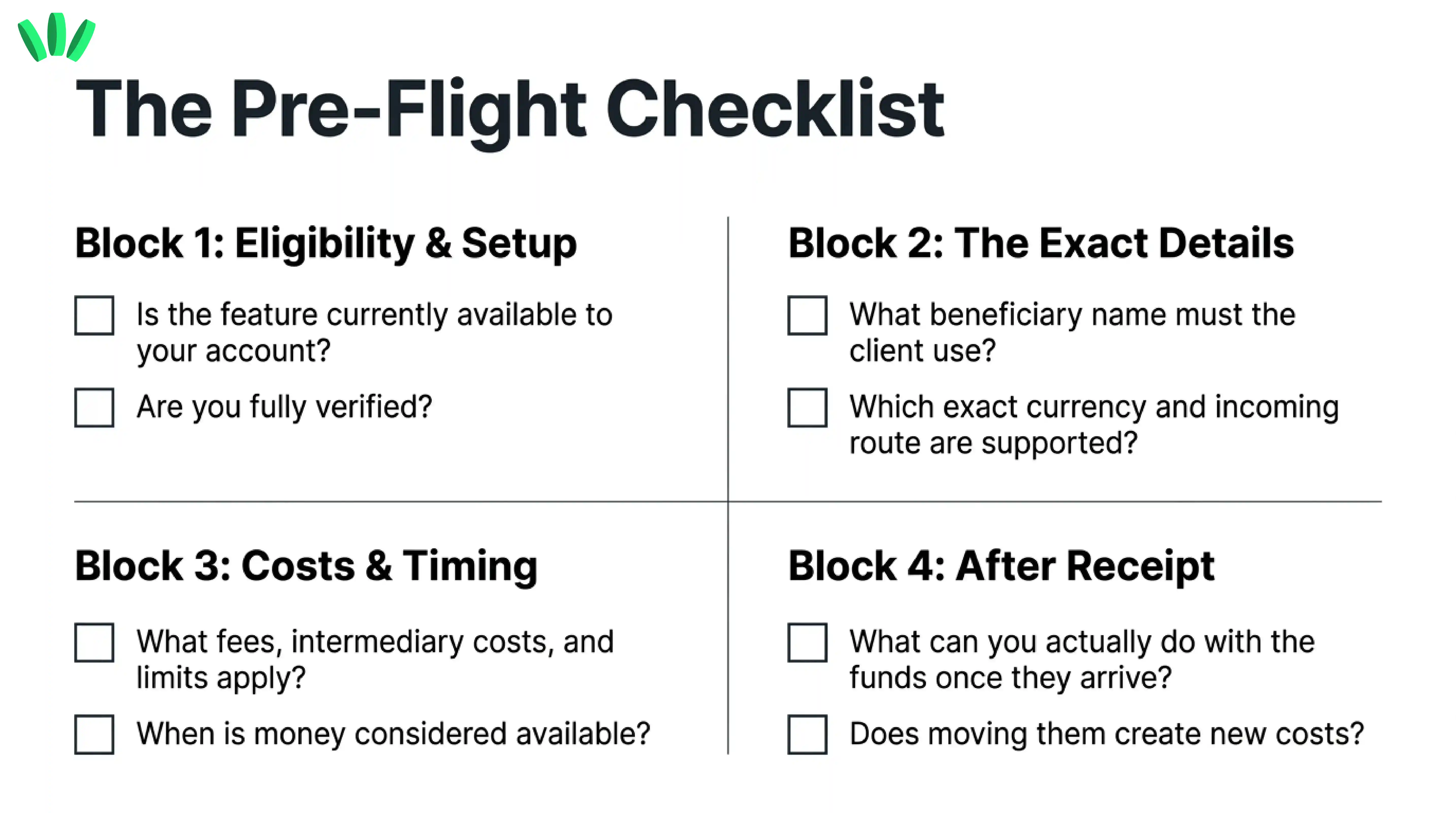
Before sharing any payment details, confirm:
that the feature is currently available to your account
the exact beneficiary name
the supported currency and incoming payment rail
which sender and payment types are accepted
the applicable fees, limits, timing, and review rules
what happens after the funds become available
where to get support if the payment needs attention
This is the pre-payment check. For the wider decision, including card access, cash-out, total cost, support, records, and fallback planning, use the spend-readiness checklist later in this guide.
One missing answer can matter more than a beautiful dashboard.
How should a freelancer put IBAN details on an invoice?
Use the exact information shown for your supported route. Keep the payment section separate from the rest of the invoice so the client’s finance team can copy it without guessing. A generic structure could look like this:
Payment method: Bank transfer
Beneficiary name:
[Use the exact name shown in walllet]
IBAN:
[Use the exact IBAN shown in walllet]
BIC/SWIFT:
[Include only if shown and required for this route]
Currency:
[Use the supported currency shown for this route]
Payment reference:
INV-2026-014
Payment note:
Please use the payment details exactly as provided.
Do not change the currency or payment route without written confirmation. That example is a formatting model, not a representation of which fields or routes walllet.com currently supports.
For recurring clients, keep a dated record of the details you sent. If account instructions change later, you need to know which version the client used.
What should you tell a client before they pay?
A good payment message is boring. Boring is underrated when money is involved.
Tell the client:
the exact amount
the exact currency
the exact payment details
the beneficiary name
the invoice or payment reference
any route-specific instruction shown to you
that they should confirm before using a different route
Avoid sending a dense paragraph about your entire financial life. A simple message could be:
Hi [Client Name],
Please use the payment details listed on invoice INV-2026-014 and send the agreed amount in the stated currency.
Please include INV-2026-014 as the payment reference where supported.
Before using a different currency or transfer method, please confirm with me so I can check the correct receiving details.
Thank you.
Clean instructions reduce the number of assumptions both sides make.
What happens if an IBAN payment is delayed, rejected, or reviewed?
A delayed payment does not automatically mean the money is lost. It also does not mean you should sit quietly for two weeks admiring the word “pending.” First identify the stage of the route. Ask:
Did the payer actually submit the transfer?
Is there a bank or provider reference?
Did they use the correct beneficiary name?
Did they send the supported currency?
Did they use the correct route?
Was the payment returned?
Is additional information required?
Is the payment under review?
Is there a stated next step?
Then collect evidence before contacting support:
invoice
sender name
amount
currency
date
payment reference
transfer confirmation
any status message shown in the app
Do not ask the client to send the payment again until you understand what happened to the first payment. Duplicating a cross-border transfer is a remarkably efficient way to turn one problem into two.
Can a payment be reviewed even when the IBAN is correct?
Yes. Correct account details do not remove every review condition. A payment may still require attention because of factors such as:
sender information
beneficiary mismatch
unsupported payer type
missing information
unusual transaction pattern
source-of-funds questions
compliance checks
provider rules
The exact reason and process depend on the route and provider. The sensible standard is not “reviews never happen.” Any company making that promise deserves a raised eyebrow. The better standard is whether you can understand:
that a review exists
what information is needed
what you should do next
where to get support
Is the walllet.com IBAN Account self-custodial?
Do not assume so. This is one of the most important distinctions in the article.
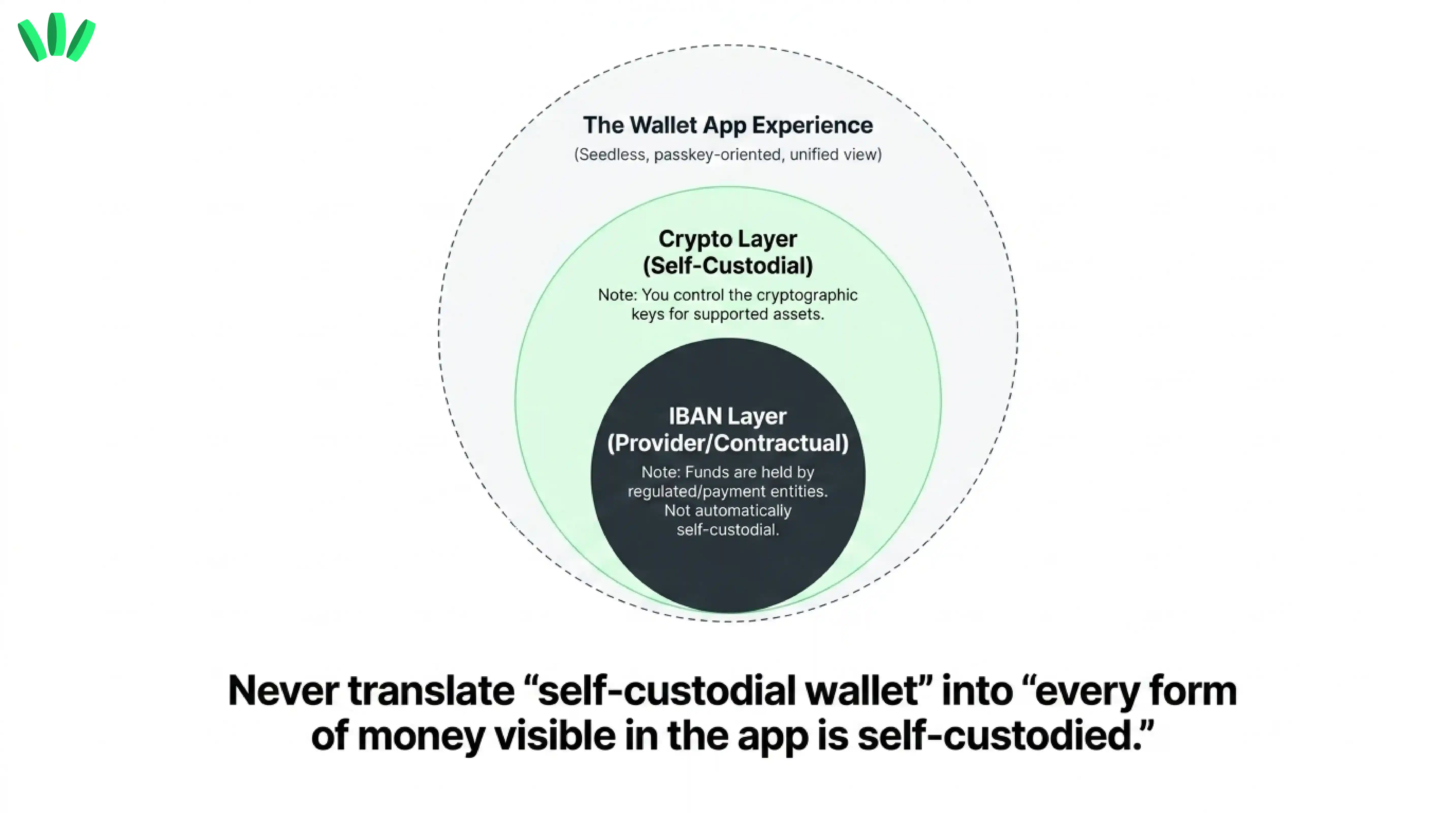
walllet.com publicly describes its crypto wallet experience as non-custodial and seedless, with passkey and biometric-based access. Its public website and App Store listing describe device-based control for supported crypto wallet functions.
But a bank-transfer receiving layer is not automatically self-custodial simply because it appears inside a self-custodial wallet app.
Those are different layers. For supported crypto assets, self-custody concerns who controls the cryptographic keys. For an IBAN or payment-account route, you need to understand:
which regulated or payment entity provides the route
how funds are held
when funds become available
what contractual relationship applies
what happens during review
what protections or safeguarding disclosures apply
Never translate “self-custodial wallet” into “every form of money visible in the app is self-custodied.” That sentence would be neat, convenient, and potentially wrong. The financial industry has produced enough neat, convenient, wrong sentences already. For a broader wallet decision, see our guide to choosing a crypto wallet for Nigerian freelance income.
IBAN vs SWIFT vs SEPA vs ACH: what actually changes?
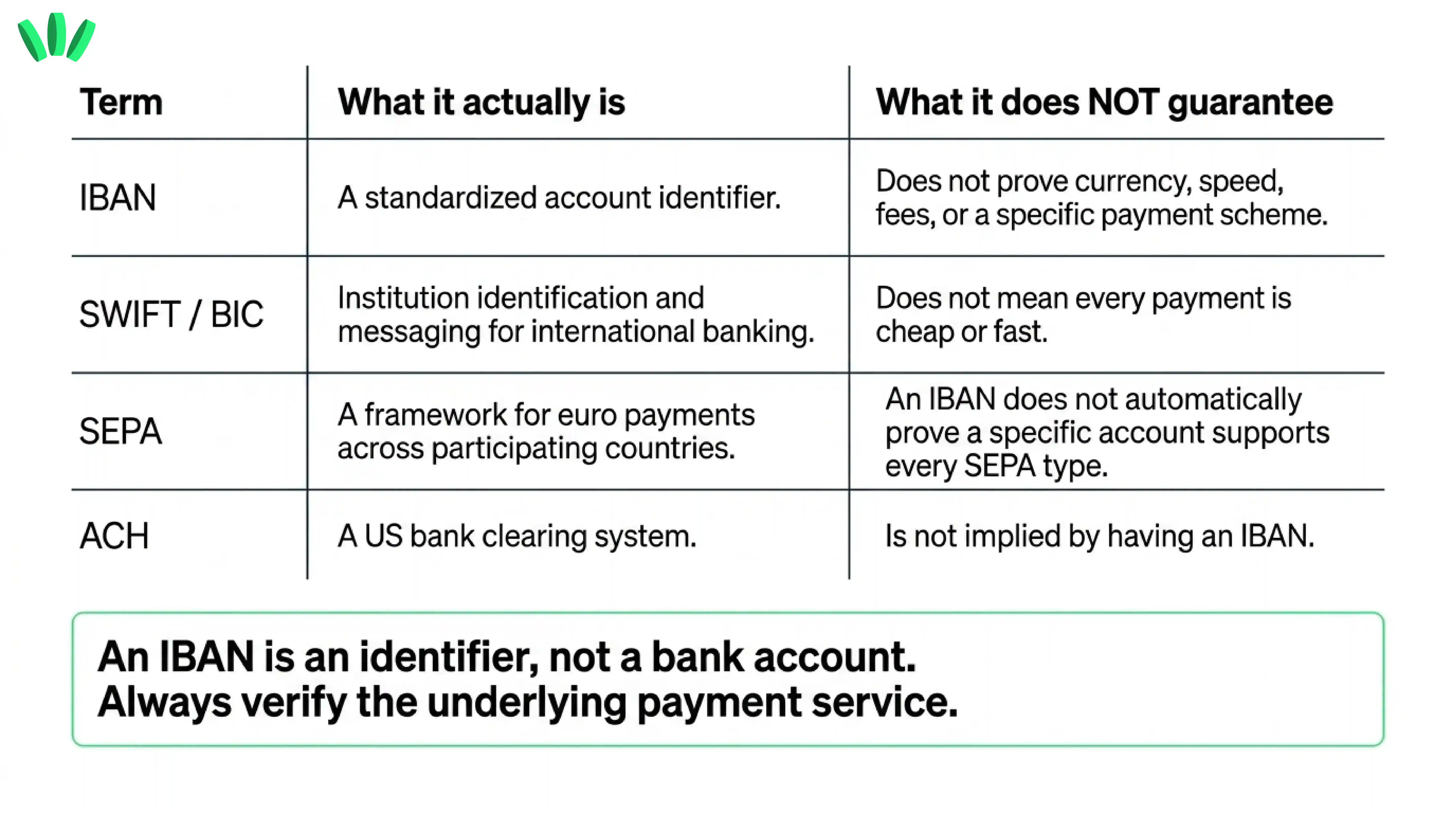
These terms describe different parts of payment infrastructure.
Term | What it is | What it does not prove |
IBAN | A standardized account identifier | It does not by itself prove currency, speed, fees, or a specific payment scheme |
SWIFT/BIC | Institution identification and messaging information used in international banking contexts | It does not mean every payment is cheap or fast |
SEPA | A framework and payment schemes for euro payments across participating countries | An IBAN does not automatically prove that a specific account supports every SEPA payment type |
ACH | A US bank clearing system | It is not implied by having an IBAN |
Stablecoin address | A blockchain receiving address used with a particular token and network | It does not remove network, issuer, wallet, or off-ramp risk |
The walllet.com IBAN Account should be evaluated according to the exact route currently shown to the user. Do not assume support for SEPA, SWIFT, ACH, or any other rail solely from the word “IBAN.”
When could an IBAN route be better than a stablecoin payment?
An IBAN route may make more sense when the payer is comfortable with bank transfers and uncomfortable with crypto. For example:
a small agency’s finance team needs familiar payment details
a direct client does not hold stablecoins
the payer’s accounting process expects bank-transfer records
you want clearer invoice-to-payment matching
asking the payer to choose a token and network would create unnecessary risk
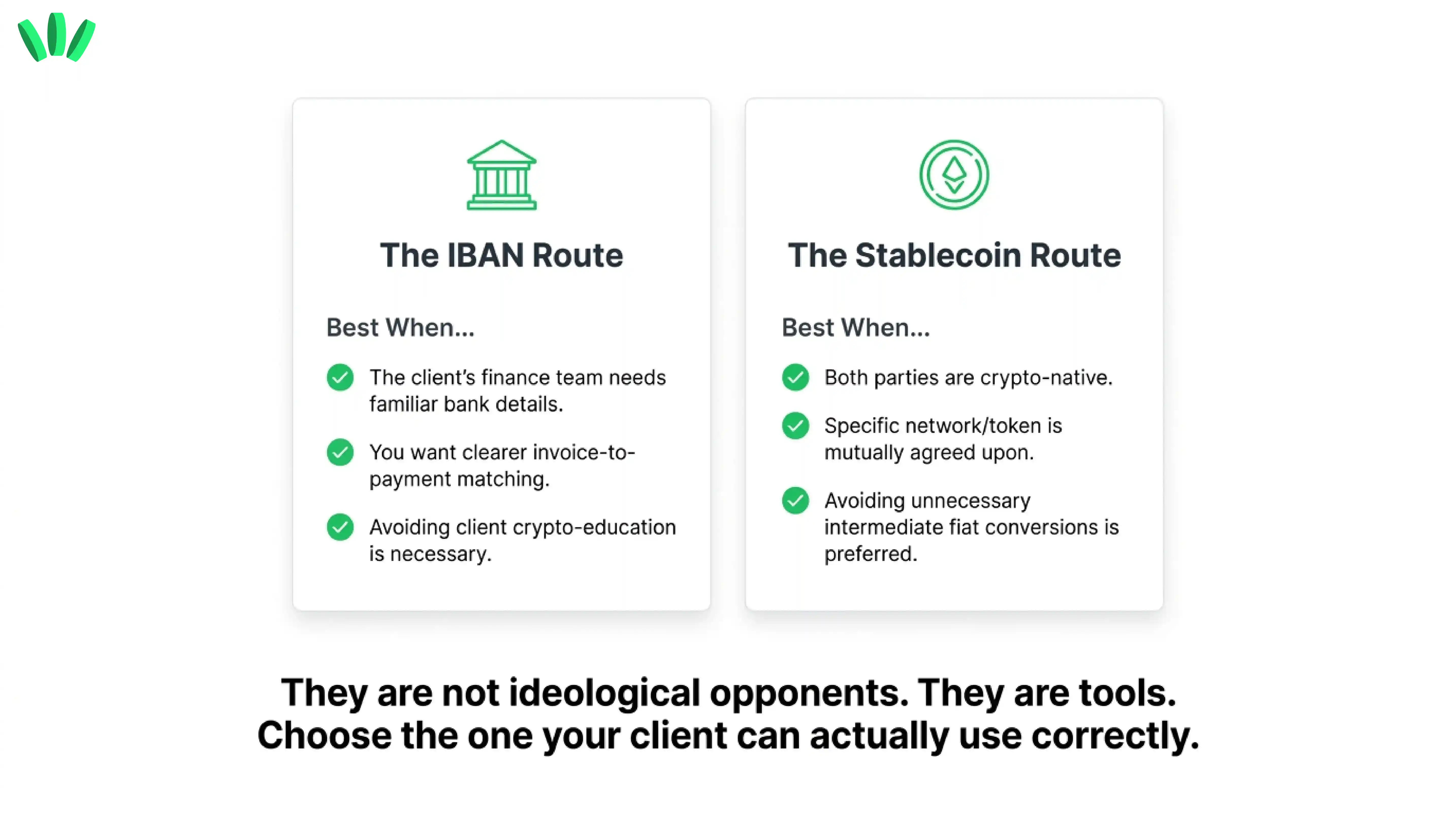
The benefit is familiarity. But “more familiar” does not mean universally better. You still need to examine:
fees
timing
currency
review risk
account structure
what happens after receipt
When could a stablecoin payment be better than an IBAN route?
A stablecoin route may make more sense when both parties already understand the token, network, wallet, and recordkeeping requirements. For example:
the client already holds the agreed stablecoin
both sides know the exact network
the recipient has a clear plan for holding or using the funds
the route avoids unnecessary intermediate conversions
the payment workflow is already crypto-native
But stablecoin payments create their own failure modes:
wrong token
wrong network
wrong address
issuer risk
wallet compromise
malicious approvals
off-ramp uncertainty
transaction finality
Before using that route for client income, work through our before-and-after USDT or USDC payment checklist. An IBAN route and a stablecoin route are not ideological opponents. They are tools. The useful choice depends on who is paying, what they understand, what you need after receipt, and which risks you are actually equipped to manage.
Can an IBAN account help with recurring freelance payments?
Potentially, yes, where the route is supported and the payer is eligible to use it. Recurring work is where good payment instructions become especially useful. Consider a remote contractor receiving a monthly payment from the same company. The freelancer may benefit from a repeatable process:
issue invoice
use verified payment details
include a consistent invoice reference
retain payer evidence
reconcile the incoming amount
review any fees
decide what portion to hold or move
The important part is not merely receiving money repeatedly. It is being able to reconcile:
who paid
for which invoice
in which currency
how much arrived
what costs occurred
what remains usable
That is how a payment feature starts becoming part of a real income system.
Can an IBAN account help when a client does not want to use crypto?
This is one of the clearest potential use cases. Many freelancers understand stablecoins better than their clients do. That does not mean the client’s accounts-payable team wants to learn about wallet addresses before lunch. A client-friendly route reduces the amount of education required from the payer.
The client should still receive precise instructions, but those instructions can be framed around the payment method they are expected to use. The wallet and stablecoin layer can then serve a different job in the wider money workflow where supported. This separation is useful:
The client should not need to become crypto-native merely because the freelancer uses crypto or stablecoins elsewhere in their financial stack.
Can an IBAN account be useful as a backup payment route?
Potentially, but a backup route only works if you verify it before the primary route fails. Do not wait until:
a client payment is due tomorrow
your usual provider is under review
a platform changes its policy
your account details stop working
Then begin researching alternatives in a mild state of financial panic. A useful backup route should be checked for:
current availability
verification status
accepted payer types
beneficiary name
currency
fees
limits
support path
recordkeeping
For freelancers with recurring global income, route diversification can reduce dependence on one provider. It does not eliminate risk. It changes the shape of the risk.
What are the biggest risks and limitations of using an IBAN route?
The main risks are usually not hidden in the letters I-B-A-N. They sit around the route.
1. Assuming support that has not been confirmed
Do not assume:
every currency works
every country works
every client can pay
every platform accepts the details
every transfer method works
2. Beneficiary-name mismatch
The sender may need to use the exact beneficiary information shown for the route. Small creative improvisations with payment names are rarely charming.
3. Using the wrong currency or transfer type
An account identifier does not automatically make every incoming payment compatible.
4. Ignoring review requirements
Cross-border payments can trigger requests for information. Keep invoices and payer evidence.
5. Comparing only the receiving fee
The full cost can include:
sender fee
intermediary fee
receiving fee
FX cost
spread
later transfer cost
later conversion cost
6. Treating “sent” as “available”
A sender confirmation is not the same as settled, available money.
7. Assuming the IBAN layer is self-custodial
It may not be. Check the structure of each money layer separately.
8. Relying on one route for all income
Any payment provider, account, app, bank rail, or blockchain route can face operational changes.
9. Ignoring the risks of what happens after receipt
Moving value into a stablecoin can introduce a different set of risks. For example, stablecoin issuers can have control mechanisms that differ from purely decentralized assets. Our guide to how issuer-level stablecoin freezes work explains that distinction.
Who is the walllet.com IBAN Account best suited for?
The strongest potential fit is a global earner who wants a more client-friendly receiving option while also using walllet.com for a broader digital-money workflow. That may include:
Direct-client freelancers
Designers, developers, marketers, writers, consultants, and operators who invoice clients abroad.
Remote contractors
People receiving recurring compensation from an overseas company.
Small agency owners
Teams or solo operators who need better invoice and payer reconciliation.
Crypto users with non-crypto clients
People who understand stablecoins but do not want to make every client learn them.
Freelancers building a multi-route payment stack
People who do not want their entire income to depend on one receiving method.
For Nigerian freelancers, the fit depends on actual current eligibility and route support. Check those details before treating the feature as part of your income system.
Who may not need it?
The walllet.com IBAN Account may be less relevant when:
your existing bank route already works well
your client only pays through a locked marketplace payout method
both sides already use stablecoins confidently
the current walllet route does not support your account, currency, payer type, or country
the fees or limits do not fit your payment size
you need a specific legal or banking structure the feature does not provide
A useful product guide should help some readers decide “this is not my route.” Otherwise it is an advertisement wearing glasses.
What should Nigerian freelancers check before relying on a USD, EUR, or GBP account?
A USD, EUR, or GBP account is only useful when the full payment route works. Your client must be able to send correctly, the payment must arrive under the expected name and transfer type, the costs must be clear, and you need a practical way to use or move the money afterward.
Before directing recurring freelance income through any foreign-currency account, check the following.
1. Account holder and payer name matching
Copy the account holder or beneficiary name exactly as the provider displays it.
Also check whether the name of the sender must match the client or legal entity shown on your invoice. A payment from a founder’s personal account may be treated differently from a payment sent by the company that hired you.
Do not assume that a familiar client name, trading name, agency name, and legal company name are interchangeable.
2. The exact currency the account can receive
Confirm whether the account can receive USD, EUR, GBP, or only one specific currency.
An app may display several currency balances while using different account details or receiving rules for each currency. Check what happens if the client sends a different currency. The payment may be converted, rejected, returned, delayed, or charged differently.
3. The supported transfer type and payment rail
“Bank transfer” is too vague for payment instructions.
Find out which transfer type the account accepts. Depending on the currency and provider, that could include ACH, wire, SEPA, Faster Payments, SWIFT, or another local or international rail.
Having an account number or IBAN does not mean every transfer type is supported. Give the client the instructions for the exact route shown in your account.
4. The receiving fee
Check whether the provider charges a fee for receiving the payment and whether it is deducted from the incoming amount.
There may also be fees charged by the sender’s bank or an intermediary institution. Agree with the client whether the invoice amount should arrive in full or whether transfer costs may be deducted.
For recurring payments, calculate the cost across several months. A small fee becomes less charming when it appears twelve times a year.
For walllet.com, incoming USD received through the supported bank route into your wallet carries a 1% receiving fee.
For example, if $1,000 is received through the supported USD bank route, the 1% receiving fee is $10, leaving $990 in the wallet before any later action such as spending or off-ramping.
5. A possible hold or review period
Check the normal processing time and what happens when a payment needs review.
Ask:
What can trigger a review?
Can funds appear as received but remain unavailable?
Which documents may be requested?
Where will the review status appear?
How often should you expect an update?
The useful standard is not that reviews never happen. It is that you can understand what is happening and what you need to do next.
6. Card and online-spending availability
A foreign-currency balance does not automatically give you a working card.
Confirm whether a physical or virtual card is available to your account and whether the card supports:
online payments
international transactions
recurring subscriptions
the merchant categories you use for work
the currency you intend to spend
Also check whether the card uses the same account balance or requires a separate funding or conversion step.
7. The rate and total cost before cash-out
Do not compare providers using only the displayed exchange rate.
Before converting or withdrawing, check:
the exchange rate used
any FX spread
the conversion fee
the withdrawal fee
any fee charged by the destination route
the final amount expected to reach your naira account
The useful number is the final amount you can use, not the rate displayed on the first screen.
8. The support and escalation path
Know where to go before a payment problem appears.
Check whether support starts through in-app chat, email, a ticket form, or another channel. Find out how to obtain a case or reference number and whether unresolved money-movement issues can be escalated to a human support or complaints team.
Save the support path somewhere outside the app. An inaccessible account is a poor place to store the instructions for recovering access to that account.
9. The records you need to keep
For each client payment, keep enough evidence to reconstruct what happened.
That may include:
the contract or written agreement
the invoice
the client’s legal name
the agreed amount and currency
the payment instructions you sent
the transfer reference or receipt
the receiving account statement
fees and exchange-rate records
relevant emails and support messages
A screenshot can support the record. It should not be the entire record.
10. An exit plan if the service changes or stops
Before making any account your main income route, decide how you would leave it.
Check how to:
withdraw or transfer the remaining balance
export statements and transaction records
update recurring clients with new payment details
handle a change in eligibility or account information
contact support during a closure or migration
move future payments to an independent backup route
Keep at least one tested alternative for important client income. A route that works today should not automatically become the only route your business can use.
Before making one account your default, compare the full payment route rather than the account label. Our guide to comparing freelancer payment routes looks at client familiarity, payment proof, control, fees, and what happens after the money arrives.
Where practical and permitted, test the route with a small, non-critical payment before using it for a large invoice or recurring monthly income.
How much does the walllet.com Bank Account cost?
The current walllet.com Bank Account pricing includes:
Bank Account issuance: $5
Incoming USD via bank to your walllet.com wallet: 1%
For example, receiving $1,000 through the supported USD bank route results in a $10 receiving fee, leaving $990 in the wallet.
These fees are separate from any later action you take with the balance. If you choose to cash out through the walllet.com off-ramp, the off-ramp fee is 0.5% and applies as a separate step.
How should you apply this checklist to the walllet.com IBAN Account?
Apply the checklist using the information currently shown in your walllet.com account and the applicable terms. Before using the route for client income, confirm:
whether the feature is currently available to your account
the exact beneficiary name, currency, and incoming payment rail
which sender and payment types are accepted
confirm the current $5 Bank Account issuance fee and 1% fee for incoming USD through the supported bank route, as well as any applicable limits, timing and review requirements
if you plan to cash out later, account for the separate 0.5% walllet.com off-ramp fee
what happens after funds become available
which spending, transfer, conversion, or withdrawal options are currently supported
where payment status and support updates appear
Do not rely on an old screenshot, a launch post, another user’s account, or payment details saved from an earlier transfer.
If any part of the route is unclear, resolve it before giving the details to a client. Do not make an untested route your only method for receiving recurring income.
A practical rule for freelancers
Do not choose a payment route because one feature sounds impressive.
Choose it because you can answer five questions:
Can the payer use it correctly?
What will the route cost?
When should the money become available?
What can interrupt or review the payment?
What can you actually do after the money arrives?
An IBAN can make one part of global payments more familiar. That is useful.
The bigger job is still the route from client payment to usable money.
Explore walllet.com if you want one place to examine your current receiving options, manage supported crypto and stablecoins in self-custody, and build a clearer route around global income:
This article is for general information only and is not legal, tax, banking, or financial advice. Product availability, eligibility, currencies, payment rails, fees, limits, timing, providers, verification requirements, and review processes can change. Check the current walllet product experience and applicable terms before sharing payment details or relying on a route for income.
