
For most recurring $1,000 payments from a US client, ACH is the better starting route when the freelancer has eligible US receiving details that accept ACH credits from that payer. Wire is worth its higher cost when same-day finality, a large one-off payment or international routing is necessary. A USD balance alone does not make an account ACH-compatible.
Your US client owes you $1,000.
They ask for bank details. You send a dollar account number. They choose “wire” because it sounds faster and more official.
The payment arrives as $970.
Nothing is missing from the invoice. The route deducted it.
Another client chooses ACH but sends the payment to a wire-only routing number. The transfer is rejected or returned. A third client sends ACH correctly, but the receiving provider does not accept that payer type.
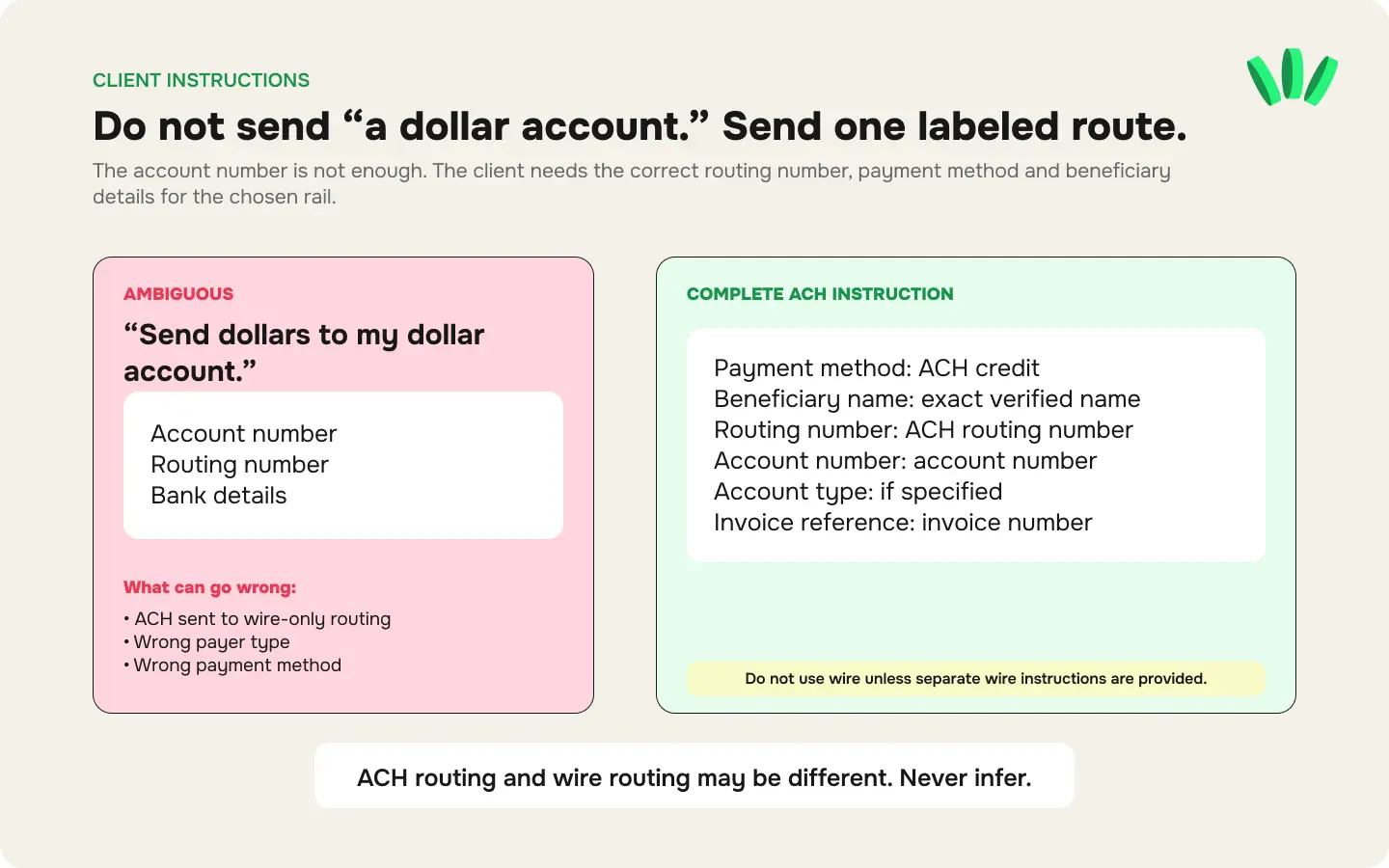
“Send dollars to my dollar account” is not a complete payment instruction.
The choice is:
ACH credit, US domestic wire or international wire
Each route uses different account details, costs, processing rules and support evidence.
This article was checked against information available on August 18, 2026. Provider fees, limits, payer restrictions and settlement times can change.
ACH and wire are not two versions of the same transfer
ACH is a US electronic payment network used for credits and debits between participating financial institutions. Payroll and direct deposit are common ACH credit use cases. The Federal Reserve’s ACH documentation describes ACH as a nationwide network through which institutions exchange batches of electronic credit and debit transfers.
A wire moves through a wire-transfer system. But “wire” can mean two different routes:
US domestic wire: A transfer between US financial institutions, often through Fedwire or another domestic system.
International wire: A cross-border transfer that may involve SWIFT messaging, correspondent banks and a receiving institution in another country.
For a Nigerian freelancer, those distinctions decide which account details the client needs.
The guide to receiving payments from US, UK and EU clients explains how the sender’s location, currency and available rail change the payment instruction.
ACH vs domestic wire vs international wire
Factor | ACH credit | US domestic wire | International wire |
Typical payer | US company, employer, payroll provider or platform | US client or institution sending to US wire-compatible details | Client sending to a Nigerian domiciliary or other international account |
Receiving details | ACH routing number and account number | Wire routing number and account number | Beneficiary, account number or IBAN, SWIFT/BIC and bank details |
Processing model | Electronic credits exchanged through ACH processing windows | Individually processed domestic wire | Cross-border chain that may include intermediary institutions |
Cost pattern | Often lower, but the receiving provider may charge | Sender and receiver fees may apply | Sender, intermediary and receiving fees may apply |
Speed | Standard or same-day ACH, subject to bank and provider processing | Often same business day before cut-off | May take several business days |
Finality | Can be returned or reversed under specific ACH rules | Generally final once processed | Recall may be requested but recovery is not guaranteed |
Best fit | Routine and recurring US payments | Urgent or larger US payments | Payer cannot use a US domestic route |
Main failure | Wrong routing number, unsupported payer, account mismatch or ACH return | Wrong wire details, missed cut-off or unsupported incoming wire | Intermediary delay, compliance review, SWIFT error or unexplained deduction |
Can a Nigerian freelancer receive an ACH payment?
A Nigerian freelancer can receive ACH when an eligible provider gives the freelancer US receiving details that explicitly support incoming ACH credits.
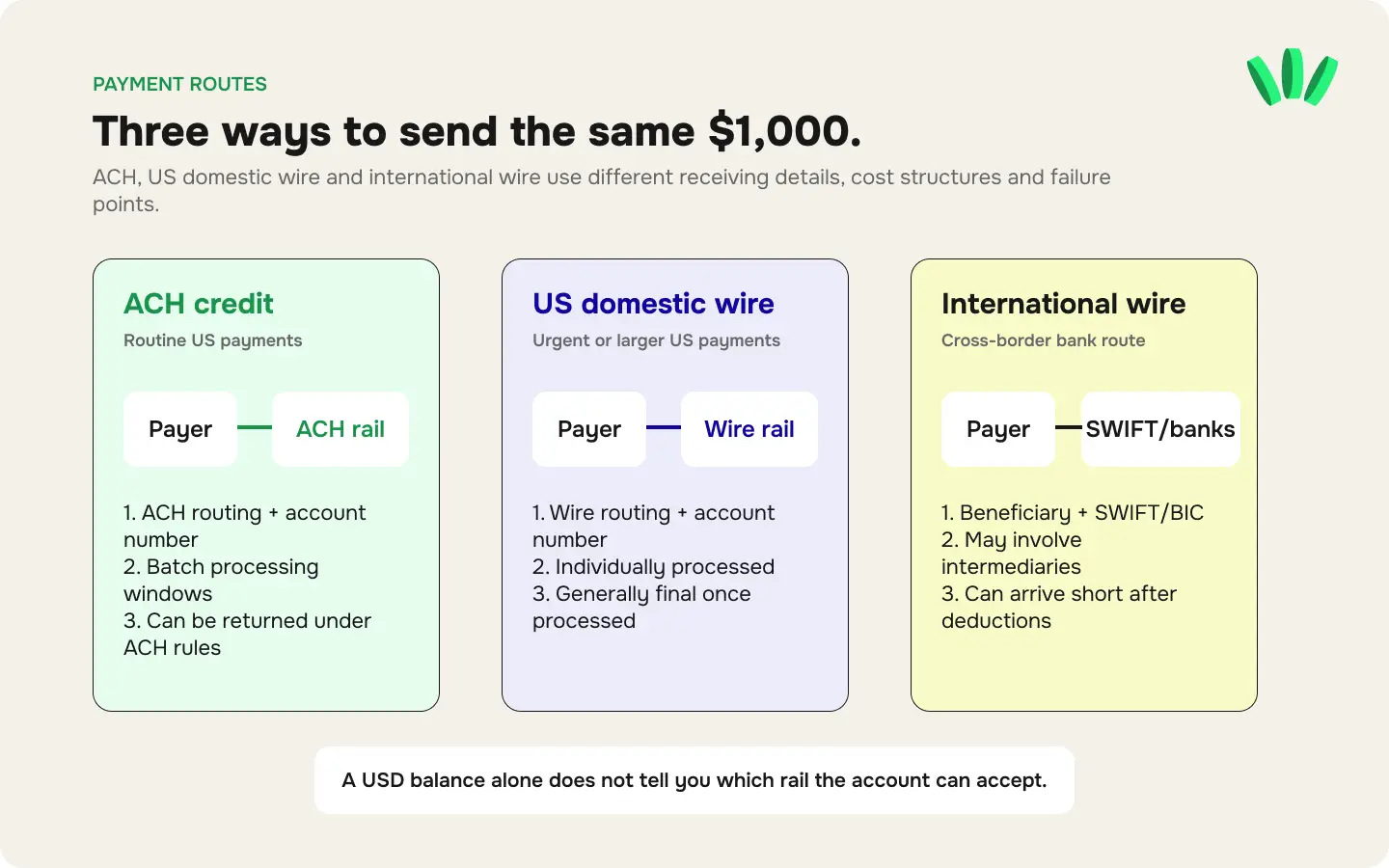
You do not receive ACH directly into an ordinary Nigerian naira account. A Nigerian domiciliary account that holds USD is also not automatically an ACH account.
Before giving a client ACH details, confirm:
The account is US-based or otherwise explicitly enabled for ACH.
The displayed routing number is for ACH, not wire.
The account accepts ACH credits.
The provider permits payments from the client’s payer type.
The beneficiary name matches your verified name or business.
The payment amount is within the account’s limits.
Client, employer or platform payments are permitted.
You know the receiving fee and the route after receipt.
The walllet.com IBAN account guide explains why an account number or IBAN does not establish rail compatibility by itself. The receiving screen and current provider terms control which payments the account can accept.
The $1,000 comparison
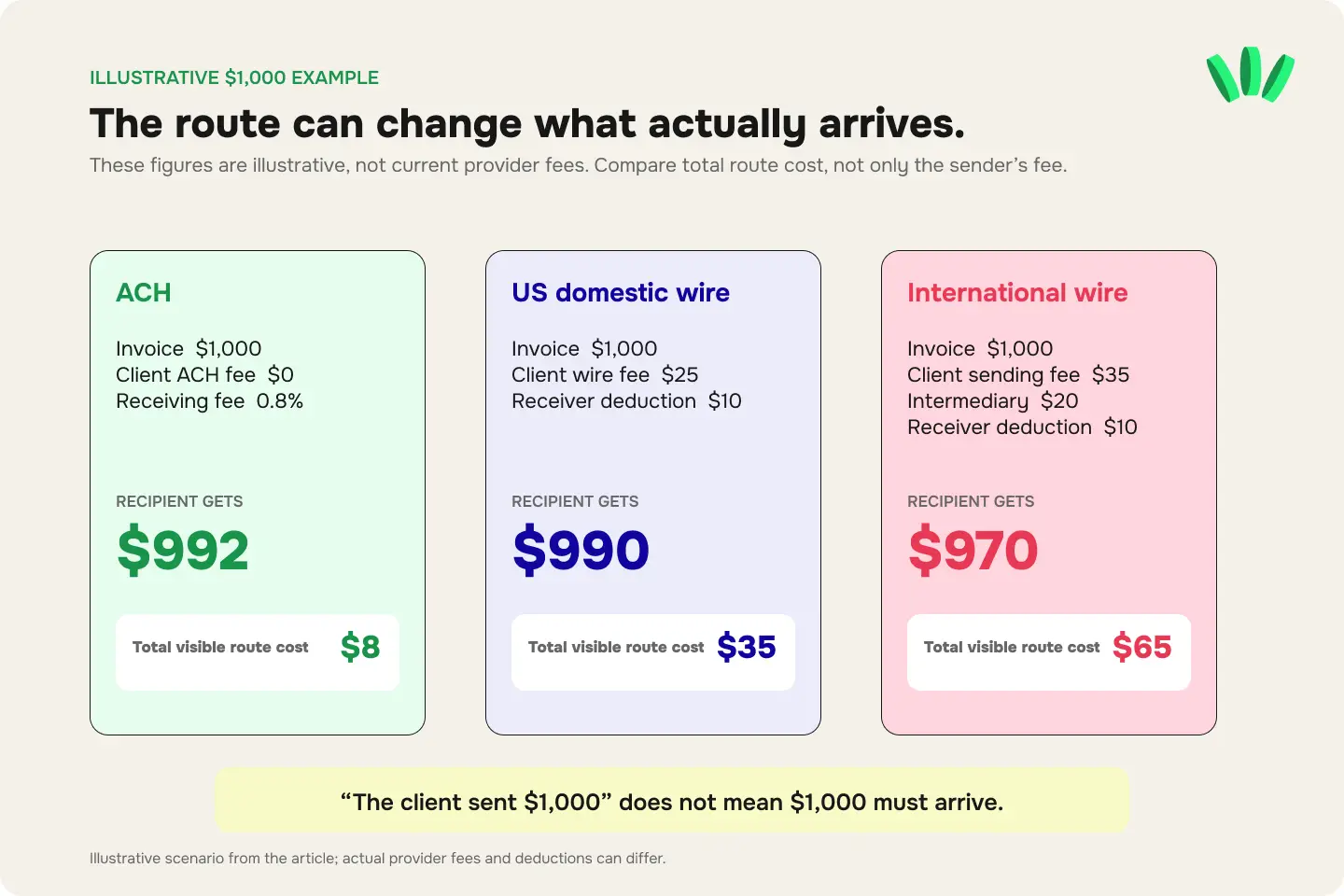
The following scenario is illustrative. It shows how to calculate the route, not the current fee of a specific provider.
Route A: ACH
Assume:
Invoice: $1,000
Client’s ACH fee: $0
Receiving-provider fee: 0.8%
Recipient receives: $992
Calculation:
$1,000 − ($1,000 × 0.8%) = $992
Total visible route cost: $8.
Route B: US domestic wire
Assume:
Invoice: $1,000
Client pays a $25 outgoing-wire fee separately
Receiving provider deducts $10
Recipient receives: $990
The client spends $1,025. You receive $990.
Total route cost across both parties: $35.
Route C: international wire
Assume:
Invoice: $1,000
Client pays a $35 sending fee separately
An intermediary deducts $20 from the transfer
The receiving institution deducts $10
Recipient receives: $970
The client spends $1,035. You receive $970.
Total route cost across both parties: $65.
Actual fees may be lower, higher or structured differently. The point is that “the client sent $1,000” does not mean $1,000 must arrive.
For other USD receiving options, compare the broader ways Nigerian freelancers can receive USD without PayPal.
Is ACH cheaper than a wire transfer?
ACH is usually the lower-cost route for routine US payments, but the receiving provider can change the result.
Compare:
Client fee + receiving fee + conversion cost + withdrawal cost
A virtual USD account may charge a percentage or flat fee for ACH receipt. A domestic wire may carry fees on both sides. An international wire can add intermediary deductions that neither the freelancer nor the client can predict precisely before sending.
The cheapest receiving fee can also lead to a worse final result if the provider’s USD-to-NGN quote is weaker.
For a $1,000 invoice, compare two endpoints:
USD remaining after receiving costs;
NGN credited after conversion and withdrawal.
If you intend to spend the money in USD, compare the amount available to the spending balance or card instead of forcing a naira comparison.

Check the receiving, holding, spending and naira options currently available in walllet.com before assigning your next client payment route.
ACH usually wins on recurring payments
ACH fits routine client payments when:
the payer is in the US;
the account accepts ACH credits;
the client or employer pays contractors through US banking;
the payment is not urgent;
the amount falls within the provider’s limits;
both sides want a repeatable monthly route.
A client can save the beneficiary and use the same verified instruction for future invoices. That reduces manual work and makes reconciliation easier.
ACH does not automatically work for every payment platform. A platform can restrict withdrawal methods, account types and beneficiary names. The Upwork withdrawal guide for Nigerian freelancers shows why a US dollar balance is not enough: the account must meet the platform’s requirements for Direct to U.S. Bank.
Wire earns its cost in narrower situations
A wire may be the better choice when:
the payment must reach the receiving institution on the same business day;
the amount is large enough that a fixed wire fee is proportionally small;
the receiving account does not support ACH;
the client cannot add the beneficiary to its ACH or payroll system;
the client is paying from outside the US;
a conventional bank-to-bank route is required;
the payment needs wire-specific bank records.
The Federal Reserve describes the Fedwire Funds Service as a real-time gross settlement system whose transfers are immediate, final and irrevocable once processed. Fedwire is generally used for large-value and time-critical payments.
That describes settlement between participating institutions. It does not guarantee that a Nigerian freelancer can immediately use the balance. A receiving provider may still need to identify the payment, apply account rules or complete a review before making the money available.
How long does ACH take compared with wire?
Wire is usually faster when comparing a correctly submitted US domestic wire with standard ACH.
A domestic wire sent before the bank’s cut-off may reach the receiving institution on the same business day. A standard ACH credit may take one or more business days. Same-day ACH can shorten that timeline when both the sending arrangement and receiving route support it.
International wire timing is less predictable. The payment may move through:
the client’s bank;
one or more correspondent banks;
the receiving bank or provider;
compliance or payment review;
final account credit.
A Friday initiation, US holiday, cut-off time or missing payment information can add delay to either route.
Do not promise a client that ACH takes one day or that a wire is instant. Ask the account provider for the current expected range and define when the clock starts: client submission, bank acceptance, settlement, account credit or balance availability.
ACH credit and ACH debit are different instructions
A freelancer normally wants the client to send an ACH credit.
An ACH credit is a push payment. The client or the client’s bank sends money into your account.
An ACH debit is a pull. Another party uses authorization to take money from an account.
Do not tell a client that they can “debit my account” when you mean “send an ACH payment.” Do not authorize an unfamiliar payer to pull funds merely because the account supports ACH.
Your instruction should say:
Payment method: ACH credit
That removes an avoidable ambiguity.
What details should you send a US client for ACH?
Send one complete instruction copied from the current account screen.
USD payment by ACH credit
Beneficiary name: [Exact verified name]
Routing number: [ACH routing number]
Account number: [Account number]
Account type: [Checking or savings, if specified]
Receiving institution: [If requested]
Invoice reference: [Invoice number]
Amount: $1,000
Payment purpose: [Service description, if required]
Add this warning:
Please send by ACH credit only. Do not use wire transfer unless I provide separate wire instructions. Do not send:
a cropped screenshot with unexplained numbers;
both routing numbers without labels;
an old account instruction;
details copied from a previous provider;
a nickname that differs from the beneficiary name;
a payment amount without the invoice reference.
Domestic-wire details are not ACH details
Some US accounts show one routing number for ACH and another for wire. Others use the same number. Never infer which applies. A domestic-wire instruction may require:
USD payment by domestic wire
Beneficiary name: [Exact verified name]
Wire routing number: [Wire routing number]
Account number: [Account number]
Receiving-bank name: [Bank name]
Bank address: [If required]
Beneficiary address: [If required]
Invoice reference: [Invoice number]
Amount: $1,000
If the account screen says ACH only, do not accept a wire to it. If it says wire only, do not substitute the ACH routing number.
International-wire details need another layer
A wire to a Nigerian domiciliary account or another international account may require:
beneficiary name;
account number or IBAN;
receiving-bank name and address;
SWIFT or BIC;
correspondent-bank details;
beneficiary address;
payment purpose;
invoice reference;
charge instruction;
agreed currency.
The sender should also confirm whether fees are charged as OUR, SHA or BEN when those options are available. Even when the sender intends to cover charges, intermediary handling can complicate the final amount.
The guide to why international wires arrive short explains where deductions can enter the payment chain.
Where ACH payments fail
An ACH payment can fail or be returned because:
the routing number is wrong;
the account number is wrong;
the account is closed or inactive;
the client used wire instructions for ACH;
the beneficiary name does not match;
the payer type is not permitted;
the amount exceeds a limit;
the provider rejects payments from that platform or industry;
the client initiated a debit instead of a credit;
the payment triggered a review;
the receiving details changed.
An ACH return code identifies the reason reported through the payment system. The ACH return-code diagnostic guide explains how to separate incorrect details, account status, authorization and provider restrictions before retrying.
Do not ask the client to send the same payment again until you know whether the first attempt was returned, pending or under review.
Where wire transfers fail
A wire can be delayed, rejected or credited short because:
the client used the wrong wire routing number;
the SWIFT or BIC is incorrect;
the beneficiary name does not match;
the sender omitted the invoice reference;
the payment currency is unsupported;
a correspondent bank cannot route the payment;
an intermediary deducts a fee;
the transfer misses the bank’s cut-off;
a compliance review needs more information;
the receiving account does not accept that type of wire;
the bank returns the payment.
A transfer receipt proves that the client submitted an instruction. It does not prove that the money reached your account.
Proof and tracing differ by route
For ACH, keep:
client payment confirmation;
ACH trace number where available;
amount and initiation date;
beneficiary details;
invoice reference;
return code if the payment fails;
provider support case number.
For an international wire, keep:
bank-issued transfer confirmation;
UETR where available;
MT103 or current ISO 20022 payment record where applicable;
value date;
sender, correspondent and recipient details;
invoice reference;
amount sent and amount credited.
The MT103 and UETR tracing guide explains which records can locate a missing international wire and why the sender’s bank usually starts the formal trace.
If the payment has reached the provider but remains unavailable, use the route-risk guide for held, reviewed or delayed freelance payments to identify which stage controls the next action.
Decision tree for a US client’s $1,000 payment
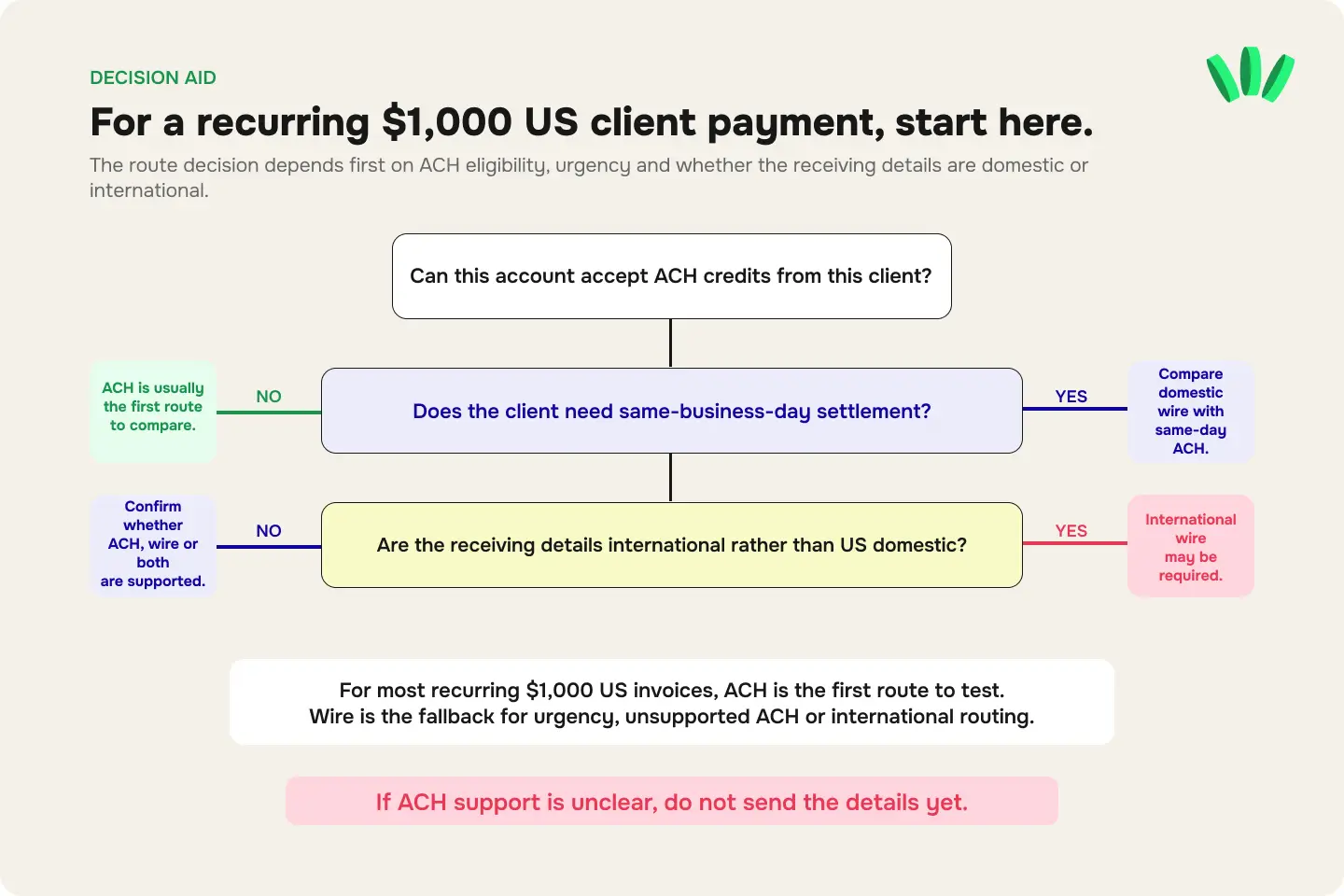
1. Can your receiving account accept ACH credits from this client?
Yes: Use ACH unless the payment has a genuine same-day deadline.
No: Continue to the wire checks.
Unclear: Do not send the details yet.
2. Does the client need the payment credited on the same business day?
Yes: Compare a US domestic wire with same-day ACH if both are supported.
No: ACH is usually the more economical route.
3. Are your receiving details US domestic or international?
US domestic: Confirm whether the account accepts ACH, wire or both.
International: The client may need an international wire rather than Fedwire or ACH.
4. Is the payment large enough to justify fixed wire fees?
Yes: Compare speed, finality and recipient deductions.
No: ACH is usually more proportionate.
5. Does the route leave the money usable?
Check:
USD remaining after receipt;
ability to hold the balance;
conversion quote;
withdrawal cost;
online spending route;
evidence and support if the payment fails.
For most recurring $1,000 invoices from a US client, ACH should be the first route tested. Wire is the fallback for urgency, unsupported ACH or international bank routing.
Test the route before the full invoice
Use a small test when the client, account or payment rail is new.
Copy the details from the current receiving screen.
Confirm the beneficiary name and payer type.
Label the routing number as ACH or wire.
Ask the client to send a small amount.
Save the payment confirmation and trace information.
Confirm the amount credited after fees.
Test the intended holding, conversion or withdrawal route.
Send the remaining invoice amount only after the route works.
Keep a separate backup account.
A test payment is not useful when fixed wire fees make the test disproportionately expensive. In that case, verify the instructions with both institutions before sending the full amount.

Open walllet.com to check your eligible global receiving details, hold supported dollar income, spend online and review the available conversion or naira cash-out route before your client pays.
