Nigerians can receive USD without PayPal through supported USD receiving accounts, freelance-platform payouts, international bank transfers, domiciliary accounts and stablecoins such as USDT or USDC.
The right route depends on the payer. A US client may be able to use ACH, a freelance platform may restrict you to its own withdrawal methods, and a crypto-native client may already prefer stablecoins.
Before choosing a provider, compare who can send to the account, which rail they must use, the total cost, whether you can keep the money in USD and how you eventually access naira.
What is the best way to receive USD in Nigeria without PayPal?
There are five common ways Nigerians receive USD without PayPal:
USD receiving accounts
Best for: freelancers and remote workers receiving recurring client payments.Freelance platform withdrawals
Best for: workers using platforms such as Upwork that control available payout methods.International bank transfers
Best for: businesses or clients already using traditional banking rails.Domiciliary accounts
Best for: people who need a traditional Nigerian foreign-currency banking setup.Stablecoin payments
Best for: crypto-native clients or users comfortable receiving USDT or USDC.
What are the main ways to receive USD in Nigeria without PayPal?
Nigerian freelancers can receive USD through six broad route types. Each solves a different version of the payment problem.
Route | Best for | Can hold USD? | Works for direct clients? | Speed | Main thing to check |
|---|---|---|---|---|---|
USD receiving accounts | Freelancers and remote workers who receive recurring international income | Usually yes, depending on provider | Yes, if payer supports the required rail | Depends on ACH/wire/provider | Whether the account accepts your client's payment method |
Freelance platform payouts | People earning through Upwork and similar platforms | Depends on withdrawal method | No, platform controls payout options | Depends on platform | Available withdrawal methods and final received amount |
International bank transfer | Businesses and professionals receiving larger payments | Usually yes | Yes | Depends on bank rail | Wire fees, intermediary banks and receiving charges |
Domiciliary account | Users who want traditional foreign-currency banking | Yes | Yes, depending on bank details | Depends on bank | Account requirements and access to funds |
Stablecoin payments | Crypto-native clients and digital workers | Yes, as crypto assets | Yes, if sender uses crypto | Often fast | Network fee, conversion route and cash-out method |
The route should fit both sides. A payment method that is convenient for you but unfamiliar or prohibited for the client is unlikely to survive the finance department. For a broader comparison of major payment categories, use the walllet.com guide to PayPal, Payoneer, Wise, and stablecoins for freelancers.
How to choose the right USD receiving method in Nigeria
Choosing a USD payment method is not only about receiving the money. The full journey looks like:
Sender → payment rail → receiving account → USD balance → conversion → final naira amount
A route with a lower receiving fee can still produce less usable money if the exchange rate, conversion cost or withdrawal fee is worse. Before choosing a provider, check:
Can my client or platform send money through this route?
Can I keep the money in USD?
What fees apply before I receive the funds?
What fees apply when I convert or withdraw?
How quickly can I access the money?
Can a US client pay me in USD from Nigeria?
Yes, but the available route depends on the payment method your client uses.
A US client may use banking rails such as ACH, wire transfers or other supported payment methods. The important question is not only whether you can receive USD, but whether your account accepts the exact payment rail your client wants to use. Before sharing payment details with a client, confirm:
supported currency
supported payment rail
account ownership requirements
receiving fees
conversion options
Can you receive USD from Upwork without PayPal?
Yes, but Upwork controls which withdrawal methods are available to each freelancer.
A freelancer may see options such as Direct to Local Bank, Direct to U.S. Bank where available, Payoneer or wire transfer depending on account eligibility.
Receiving USD directly and being accepted as an Upwork withdrawal destination are different questions. Always confirm the withdrawal methods shown inside your Upwork account before changing payment details.
Can you keep USD instead of converting immediately to naira?
Yes, when the receiving route supports USD holding. Keeping part of your income in USD can be useful if you:
pay for software subscriptions in dollars;
work with international clients regularly;
want flexibility over when to convert;
receive multiple foreign-currency payments.
However, compare the complete cost. Holding USD only helps if the route does not create unnecessary receiving, conversion or withdrawal costs later.
Can a client pay through SWIFT?
SWIFT transfers can be useful for international business payments, especially larger amounts. However, wire transfers may involve multiple parties:
Sender bank → intermediary bank → receiving bank
Each step can introduce timing differences or additional charges. For smaller freelance payments, compare whether the wire fee makes sense compared with other available payment rails.
When do stablecoins make more sense for receiving USD value?
Stablecoins such as USDT and USDC can be useful when the sender already operates in crypto. They can provide faster settlement and avoid some traditional banking limitations, but they introduce different considerations:
wallet security;
network fees;
exchange liquidity;
conversion route;
regulatory availability.
A stablecoin payment is not automatically cheaper. Compare the final amount you can use after every step.
USD account vs domiciliary account: what is the difference?
A USD receiving account and a traditional domiciliary account solve similar problems but work differently.
A USD receiving account is usually designed around receiving international payments through specific payment rails.
A domiciliary account is a bank account that lets you hold foreign currency with a traditional financial institution.
The better option depends on where your income comes from, how often you receive payments and what you need to do after receiving the money.
What happens if the sender uses the wrong payment rail?
A payment can fail even when the account details look correct. Common problems include:
ACH sent to an account that only accepts wires;
wrong beneficiary information;
unsupported currency;
sender using a payment method the provider does not support.
Before receiving a large payment, confirm the exact instructions with both the sender and receiving provider.
How much does receiving $1,000 USD in Nigeria really cost?
The visible receiving fee is only one part of the cost. Example:
$1,000 received − receiving fee − conversion cost − withdrawal/cash-out fee = final usable money
A provider with a lower advertised fee may still produce a worse final result if the exchange rate or later withdrawal cost is higher.
Is PayPal currently a reliable receiving route in Nigeria?
PayPal availability in Nigeria should be checked at the point of payment rather than assumed from an old article, video, or account screenshot.
As of July 20, 2026, Paga’s official PayPal page promotes international receipt and withdrawal to a Paga wallet, but the section describing broader payment acceptance is labelled “Coming soon.” That mixed wording means a freelancer should confirm the actual feature visible in the Paga app, account eligibility, applicable terms, withdrawal process, and payment type before placing PayPal instructions on an invoice.
A route is not ready for client income merely because a landing page exists. It is ready when:
Your verified account can receive the specific payment type.
The client can complete the payment from their country and account type.
You understand the fee and conversion quote.
You know how the funds become available in Nigeria.
You have a support and fallback path if the payment is held.
This article focuses on routes that do not require PayPal, so your invoice does not depend on one unresolved availability question.
Can Nigerians receive USD through Wise?
Wise currently lists Nigeria among the countries where users cannot obtain USD account details. A person whose registered address is in Nigeria should not assume that a Wise account will provide US routing and account details for receiving client payments.
A foreign client may still use Wise as the sending service for a transfer to a supported destination, but that is different from you having a Wise USD receiving account. Keep the distinction clear:
Sender-side Wise transfer: The client uses Wise to send money to details you provide.
Recipient-side Wise USD account: You receive using personal USD account details issued by Wise.
Local NGN receipt: The money is converted and delivered in naira.
USD receipt: You receive and retain USD or dollar-linked value.
Those are separate routes. The brand name alone does not tell you which one is happening.
Which route fits direct clients, platforms, and remote salaries?
Choose the route by payer type before comparing apps.
Direct clients
Direct clients need instructions they can understand and approve internally.
A small US startup may prefer an ACH-compatible receiving account. A UK agency may prefer GBP account details. An EU company may expect an IBAN for a euro transfer. A crypto company may already pay contractors in USDC.
Your route should reduce the client’s work. Do not send five alternatives and ask the finance team to solve your payment architecture. Give the client:
one preferred route;
one fallback route;
the exact beneficiary name;
the accepted currency;
the transfer rail;
the invoice number or reference;
a note about who bears transfer fees.
Freelance platforms
Platforms usually control the payout menu. You cannot replace a platform’s supported withdrawal methods by writing different instructions on an invoice. Compare:
the platform’s payout fee;
the receiving provider’s fee;
currency conversion;
bank withdrawal;
minimum payout thresholds;
expected review periods;
whether the receiving name must match your platform identity exactly.
If Payoneer is integrated directly with the platform, it may be easier than constructing a separate route. That does not make it universally cheaper. It makes it operationally compatible.
Remote salaries and recurring contracts
Recurring payments need consistency more than novelty. A remote worker should prefer a route that can be reused every month without sending new instructions, changing beneficiary details, or explaining an unusual payment process to payroll. Check whether the route supports:
recurring business payments;
salary or contractor inflows;
the expected monthly amount;
source-of-funds documentation;
statements or transaction history;
withdrawal or conversion when needed.
Crypto-native clients
A stablecoin route may be the shortest option when the payer already holds USDT or USDC.
It becomes a bad option when the client has to open an exchange account, learn blockchain networks, buy a token, and understand gas fees merely to settle one design invoice. Use the walllet.com guide to getting paid in USDT or USDC as a freelancer when the client is already comfortable with crypto payments.
How should you compare the total cost of receiving USD?
Compare the amount you can actually use, not the first fee shown on the provider’s homepage. A payment route can contain several cost layers:
Cost layer | What it means |
Receiving fee | Deducted when the payment enters the account |
Sender fee | Paid by the client or deducted before arrival |
Intermediary-bank fee | May appear on international wire transfers |
FX spread | Difference between the quoted conversion rate and a reference market rate |
Withdrawal fee | Charged when moving money to a Nigerian bank |
Card-funding or spending fee | Relevant when the balance is used through another product |
Failed-payment fee | Charged by some providers when a transaction is declined |
Time cost | The business cost of waiting, chasing support, or replacing a failed route |
Use this formula:
Usable money = invoice amount − receiving deductions − conversion cost − withdrawal cost − other route costs
Hypothetical example
If you receive a $1,000 bank payment through walllet.com, the 1% bank receiving fee is $10. That leaves $990 in your wallet.
If you later choose to off-ramp the full $990 balance, the 0.5% off-ramp fee is $4.95, leaving $985.05 before the effect of the applicable conversion rate.
The calculation is:
Bank receipt: $1,000 − 1% ($10) = $990
Off-ramp: $990 − 0.5% ($4.95) = $985.05
The 1.5% fee does not apply to this cash-out example. It applies to non-USD card transactions, where the transaction fee is 1.5%, subject to a minimum fee of $1 and a maximum fee of $10.
Should you use a foreign receiving account or a domiciliary account?
A foreign receiving account is usually easier for a client who wants to make a local-style payment in their own region. A domiciliary account is a conventional Nigerian bank account denominated in a foreign currency. The better option depends on the payer and the next step.
A foreign receiving account may fit when:
the client wants local payment details;
you receive recurring freelance income;
the provider accepts the client’s business type;
you want digital statements and payment notifications;
the account supports the required currency and transfer rail.
A domiciliary account may fit when:
the client prefers a traditional bank route;
the amount is large enough to justify a wire transfer;
you need to hold foreign currency inside a Nigerian bank;
your bank confirms the incoming-payment process;
you understand intermediary and withdrawal charges.
Do not assume that every “USD account” accepts every form of USD transfer. Some accept ACH but not cash deposits. Some accept business payments but reject personal transfers. Some support wires but require additional payer information.
The walllet.com IBAN Account guide explains how an eligible bank-transfer receiving layer can fit beside the wider walllet.com experience. Exact currencies, rails, eligibility, fees, limits, custody arrangements, and review rules depend on the details shown for the user’s account.
If an eligible walllet.com receiving route or a supported stablecoin route fits your client, review the current route and availability before adding it to an invoice: Explore walllet.com
When does a stablecoin payment make sense?

Stablecoins make sense when the client can already send them and you have a safe process for receiving, verifying, holding, and later using the funds. A stablecoin payment is not complete when the client says, “I can send USDT.” You still need to agree on:
USDT or USDC;
the exact blockchain network;
the amount;
who pays the network fee;
the receiving wallet address;
whether a test payment is required;
the invoice reference;
what transaction record both parties will keep.
A USDT payment on Ethereum is a different route from USDT on Tron, Base, Arbitrum, Polygon, or BNB Smart Chain. The token name is only half the instruction. Use the stablecoin payment checklist for freelancers before sharing a wallet address. Then check the walllet.com comparison of the best networks for sending USDT or USDC.
Stablecoins also carry risks that bank-account language can hide. USDT and USDC issuers can block addresses at the token-contract level in certain legal, sanctions, fraud, or security situations. Read whether stablecoins can be frozen before describing stablecoins as untouchable digital cash.
What should you check before sending payment details to a client?
Use one route, one instruction block, and one invoice reference.
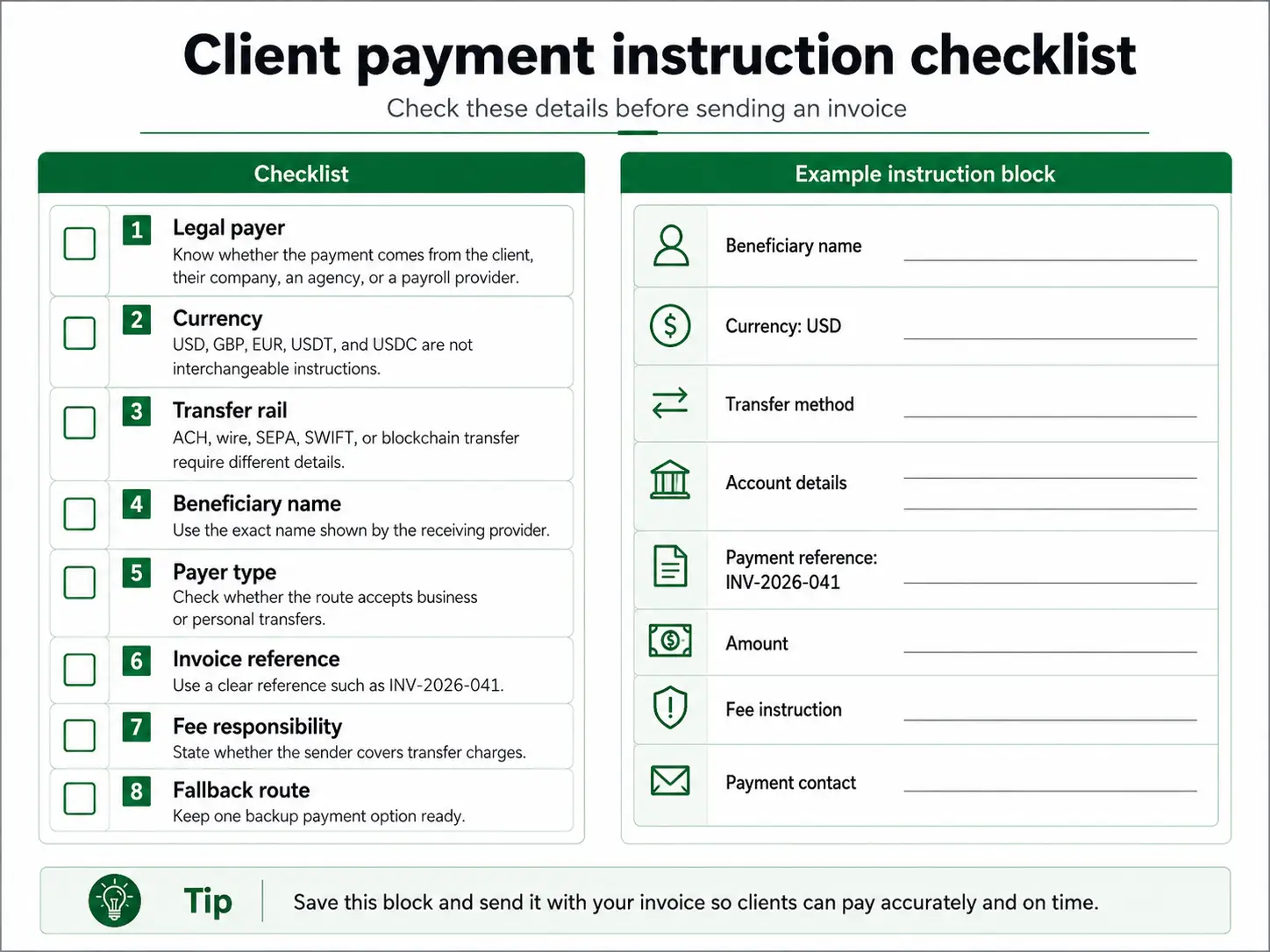
Before-you-send checklist
Confirm the legal payer.
Know whether the payment comes from the client personally, their company, an agency, or a payroll provider.Confirm the currency.
USD, GBP, EUR, USDT, and USDC are not interchangeable instructions.Confirm the rail.
ACH, wire, Faster Payments, SEPA, SWIFT, and blockchain transfers require different details.Match the beneficiary name.
Use the exact name shown by the receiving provider. Do not shorten, rearrange, or substitute it casually.Confirm the payer type.
Some receiving accounts accept business payments but not personal transfers. Others impose the opposite restriction.Set the invoice reference.
Use a clear reference such asINV-2026-041.State who pays fees.
Decide whether the client sends the invoice amount before fees or must ensure the full invoiced amount arrives.Keep a fallback route.
Do not wait until payroll day to discover the primary route has changed.
Client payment-instruction template
Beneficiary name: [Exact account holder name]
Currency: USD
Transfer method: [ACH / wire / supported route]
Account details: [Provider-generated details]
Payment reference: INV-2026-041
Amount: USD 1,000
Fee instruction: Sender covers transfer charges
Important: Do not use an unsupported transfer type or change the beneficiary name
Payment contact: [Your email]
For a crypto payment, replace the bank details with:
Asset: USDC
Network: Base
Wallet address: [Verified address]
Payment reference: INV-2026-041
Test payment: Required before the remaining balance
Why do USD payments get delayed or reviewed?
A payment may be delayed because the sending bank, receiving provider, intermediary bank, platform, compliance team, or blockchain network needs more information or processing time. Common triggers include:
beneficiary-name mismatch;
unsupported payer type;
incorrect routing details;
missing invoice or payment reference;
unusual amount or transaction pattern;
source-of-funds questions;
business payment sent through a personal route;
a transfer type the account cannot receive;
network congestion;
incorrect stablecoin network;
provider maintenance or banking downtime.
Do not treat a screenshot as proof that the route completed. For a bank payment, keep:
the invoice;
payer name;
sender bank or provider;
payment date;
transfer reference;
amount and currency;
any bank confirmation;
support case number.
For a stablecoin payment, ask for the transaction hash and verify it on the correct block explorer. The walllet.com guide to reading a crypto transaction on a block explorer explains how to check the status, network, token, amount, and receiving address.
For the wider troubleshooting process, read why freelance payments get held, reviewed, or delayed.
A practical route-selection framework
Choose the route that passes these five tests.
1. Sender fit
Can the client or platform use the route without opening an unfamiliar account or violating company policy?
2. Recipient eligibility
Is the route genuinely available for your country, identity, account type, and payment purpose?
3. Total usable amount
What remains after receiving fees, spread, conversion, withdrawal, and other deductions?
4. Evidence and support
Can you prove what happened, and is there a clear support path when the payment is delayed?
5. After-receipt usefulness
Can you hold, convert, transfer, spend, or withdraw the money in the way your work and life require?
A route that fails the fifth test has not finished the job.
Use walllet.com when a supported receiving or stablecoin route fits the payer and you want the money workflow connected to a seedless, self-custodial wallet experience. Verify current eligibility, assets, networks, fees, limits, and recovery assumptions before moving meaningful income:
