Your client says, “I’ve paid.”
You check your payment app. Nothing.
You refresh. Still nothing.
The client sends a screenshot, but it does not answer the real question: where is the money?
Is the issue on the client’s side? Is your receiving account under review? Is a bank still settling the transfer? If the payment was sent in USDT or USDC, is it pending, sent on the wrong network, or visible on-chain but not usable yet?
For Nigerian freelancers, this is not a small inconvenience. A delayed client payment can affect rent, electricity, data, software subscriptions, family expenses, and the next week of work. Payment anxiety is very real, even if the app interface looks calm and polite while it quietly ruins your afternoon.
That is why choosing a payment route by brand name or headline fee is risky. Before the next invoice, ask a better question:
Where can this payment route fail, what proof will I have, who controls support, and what can I do after the money arrives?
That is route risk.
If you are still comparing options at a high level, start with this guide to PayPal vs Payoneer vs Wise vs stablecoins for freelancers. If your client already wants to pay in crypto, this stablecoin payment checklist for freelancers is the safer place to begin before sharing any wallet address.
Payments get delayed because the route has more than one gate
A freelance payment route is rarely one clean movement from client to freelancer.
It may include the client’s payment method, the sending bank, the payment platform, your receiving account, verification checks, local banking rails, a wallet, a blockchain network, an exchange, a swap, a card, a withdrawal step, or a support team.
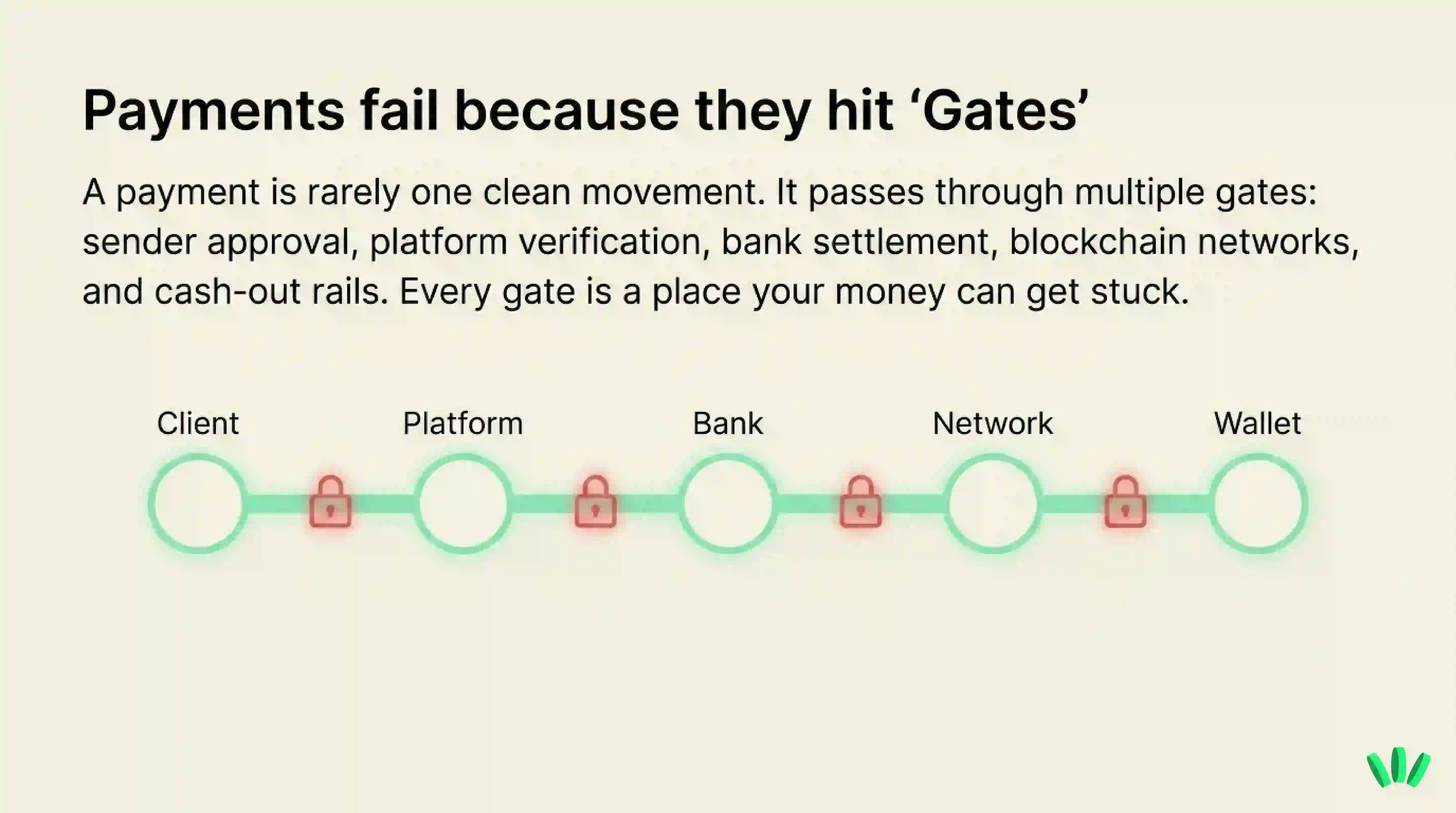
Each step is a gate.
And each gate can slow the money down.
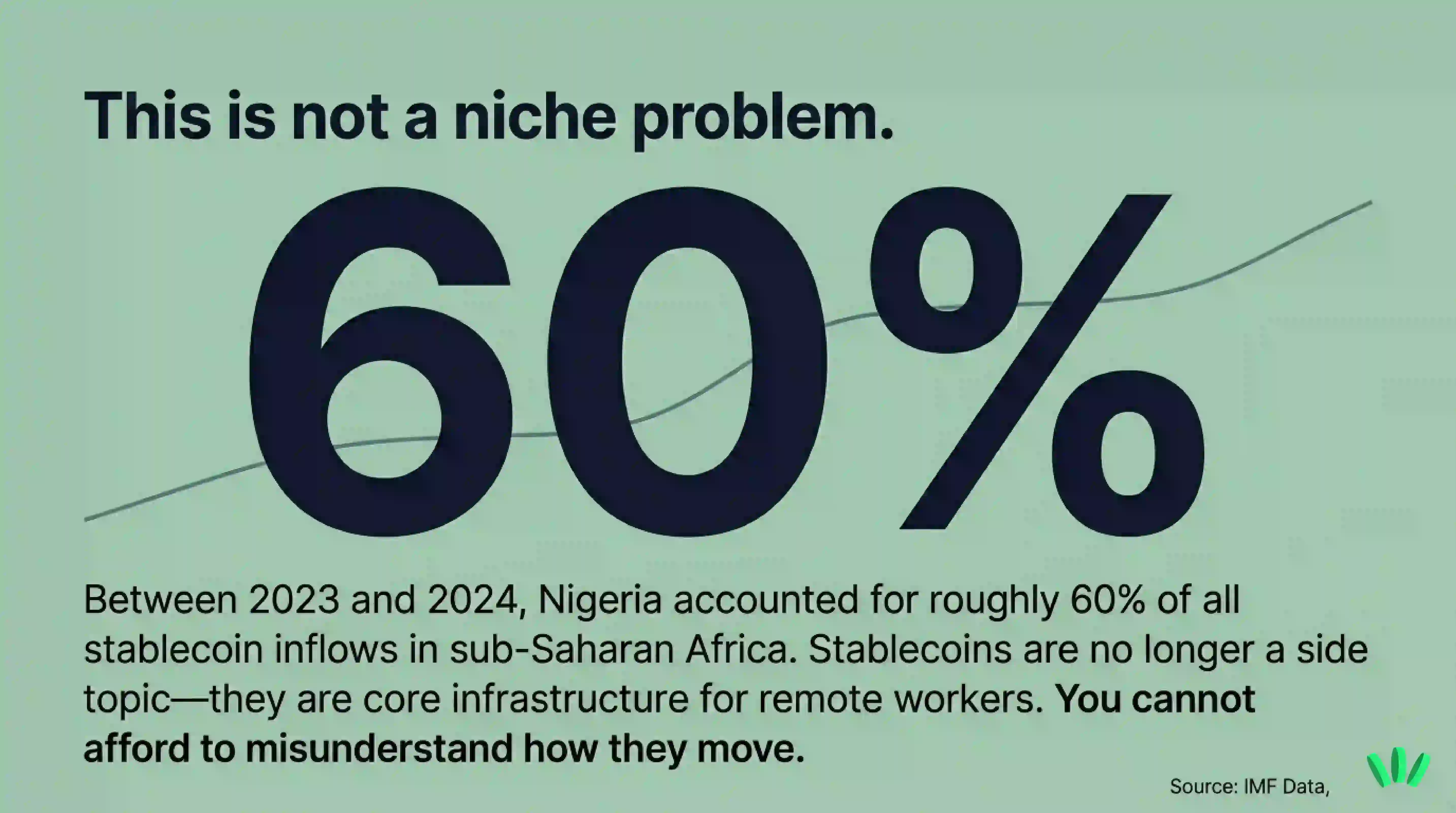
This matters more now because stablecoins are no longer a niche side topic for Nigerian freelancers and remote workers. The IMF reported in June 2026 that Nigeria received about $59 billion in crypto-asset inflows between July 2023 and June 2024, and that Nigeria accounted for roughly 60% of stablecoin inflows in sub-Saharan Africa since 2019. Stablecoins are being used because people want faster and more practical cross-border payment options, especially where traditional routes are slow or expensive.
Nigeria’s payment system is also moving toward more formal digital payment infrastructure. The Central Bank of Nigeria’s Payments System Vision 2025 includes consumer protection, interoperability, electronic payment adoption, and a regulatory framework for possible stablecoin implementation among its policy priorities.
For a freelancer, the takeaway is simple: more payment options can help, but they also create more ways for a payment to become unclear. The question is “which route can I explain, verify, and recover from if something goes wrong?”
The five places a freelance payment can get stuck
A delayed payment does not always mean the client lied. It does not always mean the platform failed. It does not always mean the money is gone. It usually means one part of the route is waiting, checking, settling, matching details, or asking for proof.
Before your next client pays, map the route like this:
Route gate | What can happen | What to check before the client pays | Proof to keep |
Client side | Wrong details, unsupported route, failed card or bank payment, internal approval delay | Can the client actually send this way? Do they need extra setup or approval? | Invoice, contract, client confirmation, payment instruction message |
Payment platform | Pending payment, account review, account limitation, missing verification | Is your account active? Are there pending verification requests? Does the payer need to confirm anything? | Transaction ID, reference ID, platform emails, timeline screenshots |
Bank or local rails | Settlement delay, weekend delay, intermediary bank delay, FX spread uncertainty | What is the expected timing? What details must match exactly? | Bank receipt, payment receipt, statement record, support ticket |
Stablecoin network | Pending transaction, wrong network, wrong token, wrong address, unsupported token contract | Which token, network, wallet address, and test-payment process will be used? | Transaction hash, block explorer link, wallet address, token contract, screenshots |
After-arrival step | Money arrives but is hard to spend, swap, withdraw, cash out, or move safely | What happens after the money lands? Can you use it without another risky step? | Fee quote, swap quote, route screenshot, support ticket |
The worst route is not always the most expensive one. Sometimes the worst route is the one where nobody can clearly answer, “What happens if the payment gets stuck?”
Low fee is not the same as safe route
A low visible fee is useful. Nobody wants to donate income to payment platforms. Freelancers already pay enough in time, stress, and “please resend the receipt” messages, because apparently earning money was not allowed to be the easy part.
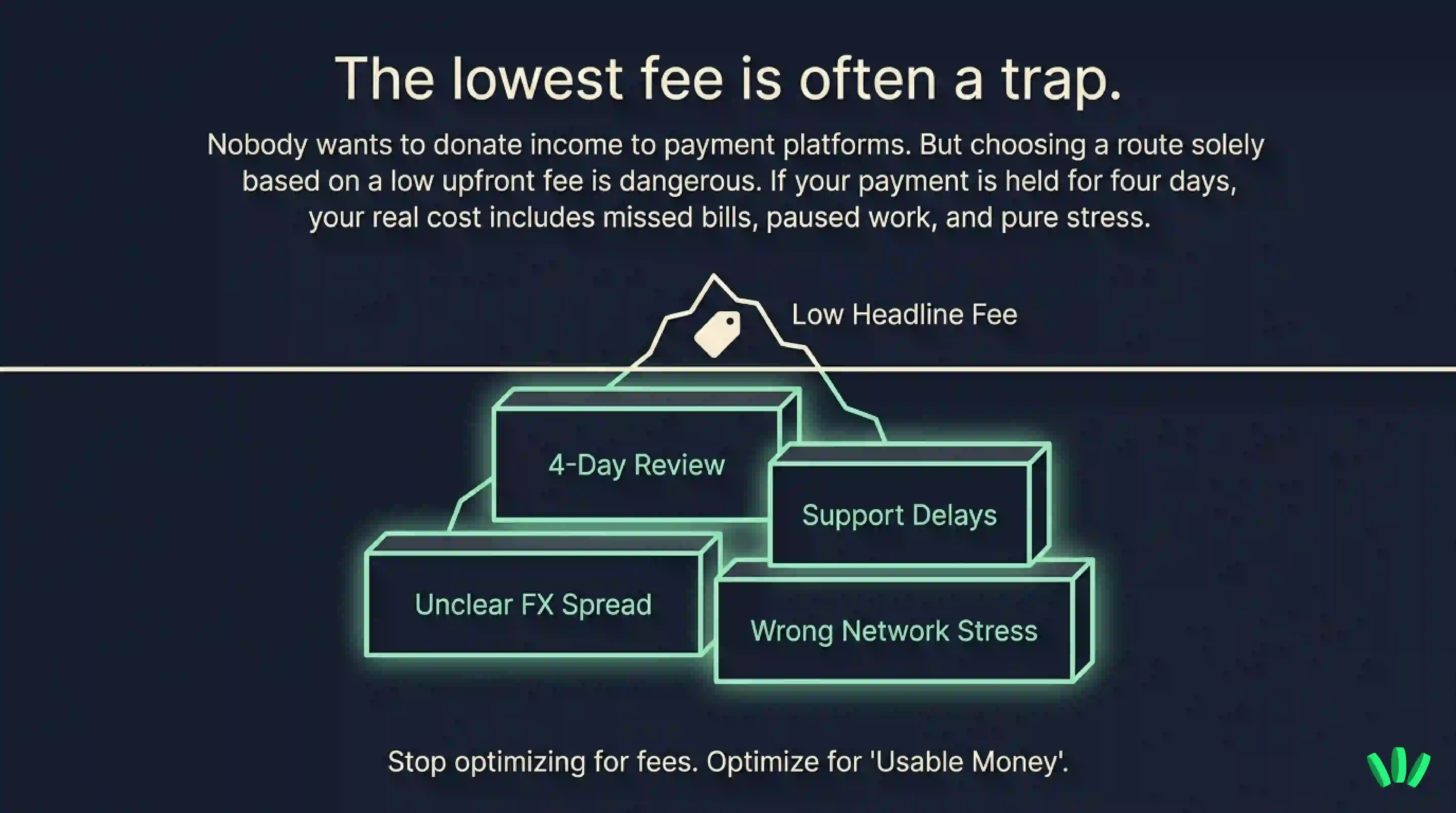
But low fee does not mean low risk. A payment route can look cheap at the start and become expensive later through:
account review
slow settlement
unclear FX spread
extra withdrawal fees
support delays
wrong-network mistakes
a costly swap
a cash-out route that does not work when you need it
A better way to think about this is cost to usable money. That means asking: after all fees, spreads, delays, proof problems, and next steps, how much money can I actually use? For example, a route may show a small upfront fee. But if the payment is under review for four days, your real cost includes uncertainty, follow-up messages, missed bills, delayed work, and time spent explaining the same issue to support.
A route is only good if it works beyond the first screen.
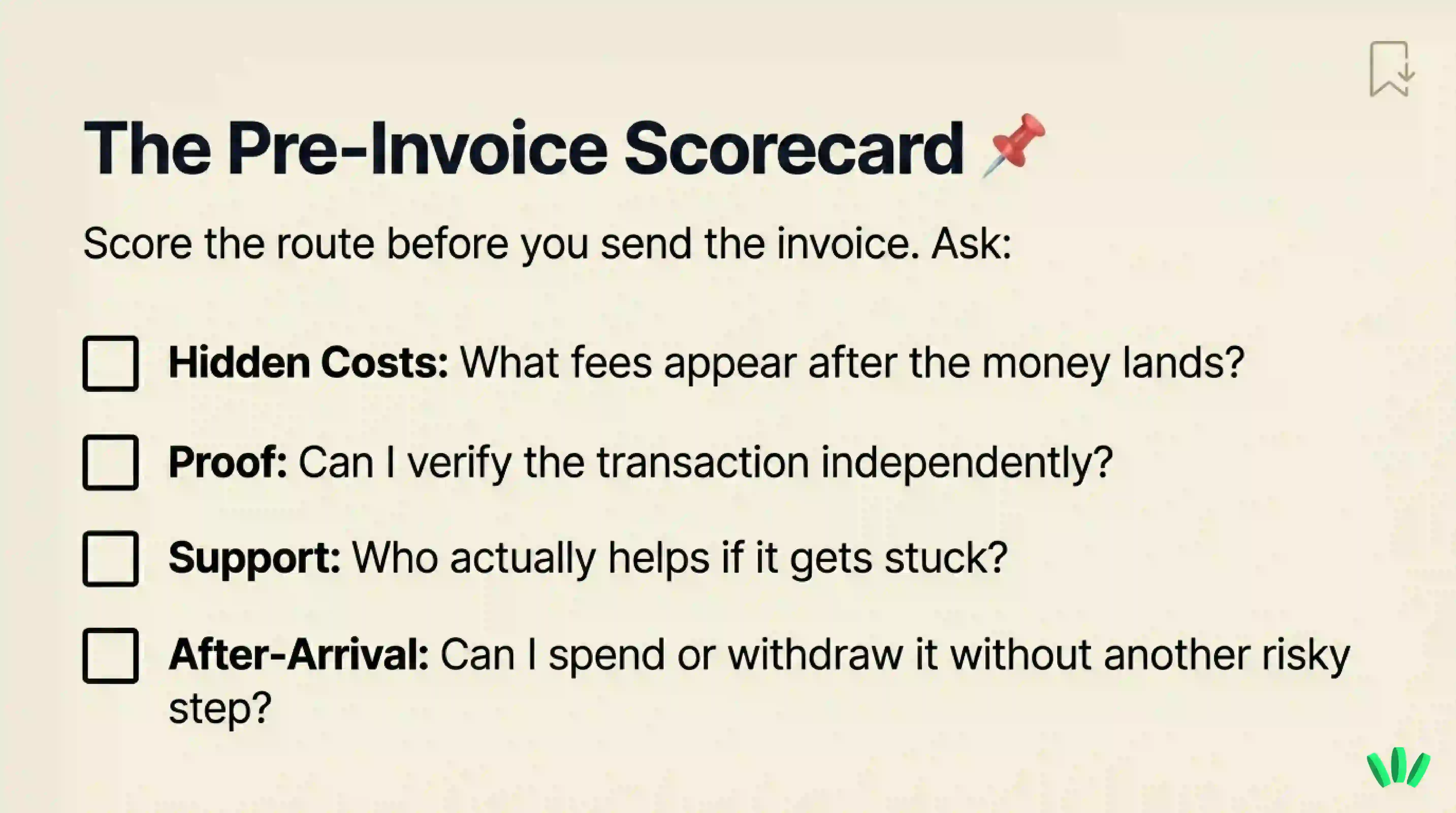
The route-risk scorecard before you invoice a client
Before you send payment details, score the route. Do this before the invoice goes out, not after the client says “sent” and everyone begins performing the ancient ritual of screenshot exchange.
Scorecard item | Question | Red flag |
Client ease | Can the client send this way without extra setup? | The client needs a route they do not understand. |
Fee visibility | What fee is visible before payment? | Only the first fee is shown. |
Hidden cost | What fee, spread, or extra step might appear after payment? | You cannot estimate the final usable amount. |
Review risk | What can trigger a hold, review, or limitation? | No clear records, mismatched details, or incomplete verification. |
Proof | What proves the client actually sent the payment? | Only a screenshot, with no reference ID or transaction hash. |
Support path | Who can help if it gets stuck? | The client says it is your problem, and the provider says it is the client’s problem. Delightful. |
After-arrival | Can you use the money after it lands? | Money arrives, but it needs another risky or expensive step. |
Recovery path | What is the worst-case next move? | Nobody can explain how to trace, reverse, recover, or document the issue. |
The rule is plain:
Do not choose a route only because another freelancer recommended it. Choose it because you understand the proof, the support path, the delay risk, and the after-arrival step. If stablecoins are part of your payment stack, compare your wallet setup before you send payment details. Explore walllet’s seedless self-custody approach.
If you use stablecoins, proof is different
Stablecoin payments can be useful for freelancers because they can make cross-border payments more direct. But they also make payment details less forgiving. With a bank or payment platform, your proof may be a receipt, transaction ID, reference number, or email confirmation. With stablecoins, proof is different. You need to know:
the transaction hash
the network
the token
the token contract
the receiving wallet address
the block explorer status
whether the receiving wallet supports that token and network
A transaction hash matters because it lets you check what happened on-chain. This guide explains how to read a crypto transaction on a block explorer and verify the network, status, destination address, and token movement.
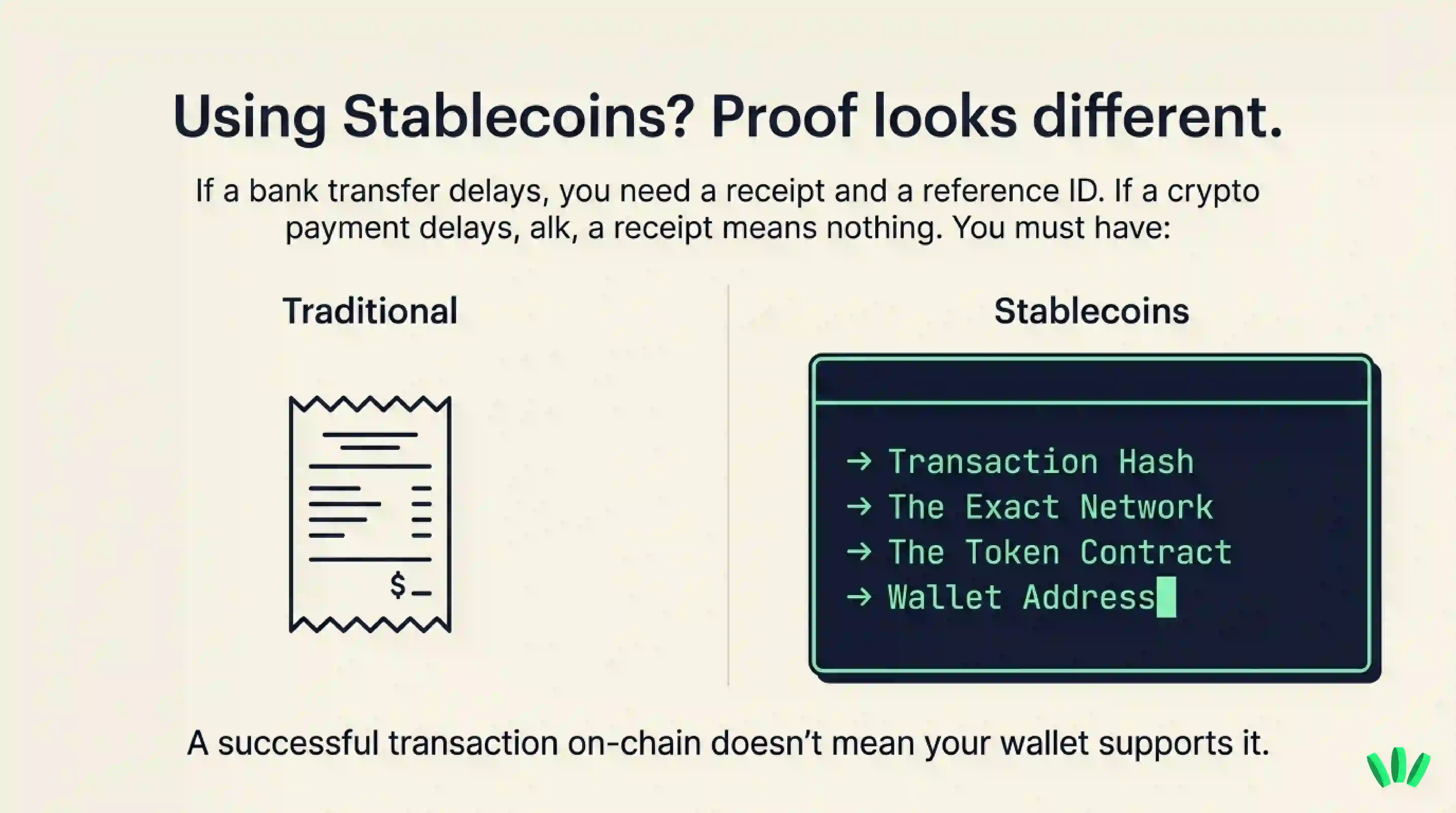
But a successful on-chain transaction does not automatically mean the whole payment route is solved.
The client may send the right token on the wrong network. The transaction may be confirmed, but your wallet interface may not show it. The token may arrive, but you may still need a safe way to hold, swap, spend, or move it.
If a crypto payment does not appear where you expect, check whether it was sent through the wrong chain. This guide on wrong-network payment recovery limits is useful before you panic or trust a random “recovery expert” in a Telegram DM, humanity’s preferred habitat for regret.
If the issue is that your wallet shows zero even though the funds are on-chain, this article explains why a crypto wallet may not show your balance even when the funds still exist.
And if you are choosing between USDT and USDC, this guide to USDT, USDC, and DAI can help you understand the trade-offs before the client sends money.
If your payment is under review now, do this first
If your payment is delayed, pending, held, frozen, or under review, do not start by guessing. Start by building a clean timeline.
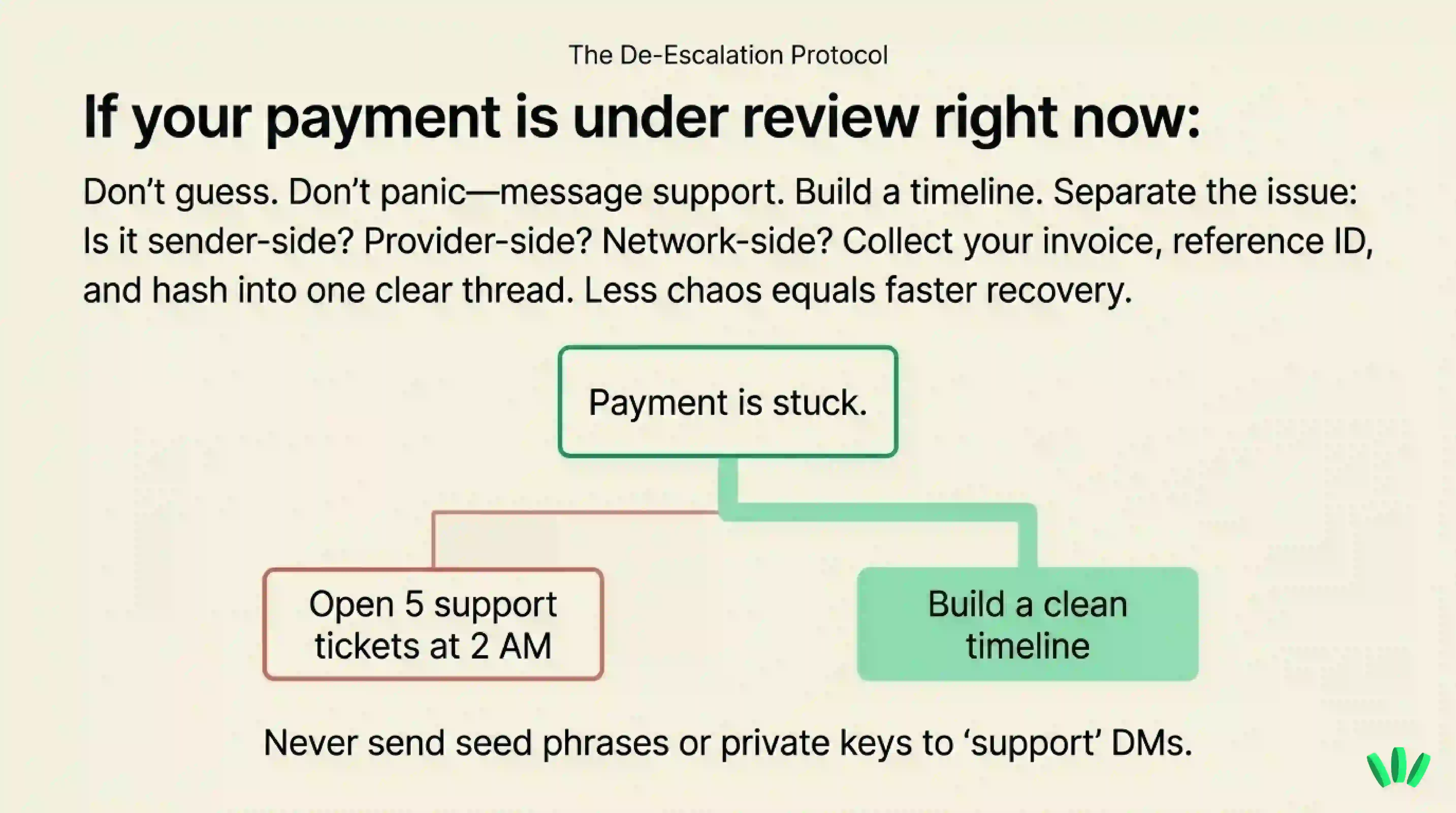
Do not create five conflicting support tickets unless the provider asks you to. One clear thread is usually easier to handle than a pile of emotional messages written at 2 a.m. while your blood pressure negotiates with your browser tabs.
Collect the invoice, contract, client name, client company, payment amount, currency, payment route, reference ID, transaction ID, screenshots, and platform emails.
Ask the client for their payment receipt or transaction proof. If they used a payment provider, ask for the provider’s reference ID. If they used a stablecoin, ask for the transaction hash and exact network. Then separate the possible issue location.
Is it sender-side?
Is it provider-side?
Is it bank-side?
Is it network-side?
Is it after-arrival?
Check whether you or the client received any verification request. Sometimes the freelancer is waiting for the platform, the platform is waiting for the client, the client is waiting for their bank, and everyone is politely wasting oxygen.
Do not send private keys, seed phrases, full KYC files, or sensitive screenshots into random support chats, WhatsApp groups, Telegram DMs, or AI tools. Write down every step: date, time, amount, provider, support ticket number, and response.
This will not guarantee that funds are released faster. It will give you a clearer case, better proof, and less chaos.
How to choose the route for your next client payment
There is no single best route for every Nigerian freelancer. The right route depends on the client, amount, urgency, proof needs, fee sensitivity, and what you need to do after the money arrives.
If the client is not crypto-friendly, use a route the client already understands. The easiest route for you can still create friction for the client, and client friction often becomes payment delay.
If payment proof matters, choose a route with clear reference IDs, downloadable receipts, platform records, or on-chain transaction proof.
If timing matters, ask what happens when a payment is reviewed. Do not only ask the normal delivery time. Ask what happens when things are not normal.
If fees matter, compare final usable amount, not headline fee. Include visible fees, FX spread, withdrawal fees, swap fees, network fees, and any extra step needed after the money arrives.
If stablecoins are used, confirm token, network, address, and test-payment expectations before the client sends the full amount. This practical guide on how freelancers can get paid in USDT or USDC goes deeper into that setup.
If cash-out or spending matters, confirm the next step before the money arrives. A payment is not truly solved when it appears in an app. It is solved when you can use it safely and predictably.
What this means when choosing a wallet for client payments
If stablecoins are part of your freelance payment stack, the wallet is one part of the route.
It is not the whole route. A self-custodial, seedless wallet can help you think about control, recovery, and payment proof without turning every client payment into a technical setup. But you still need to confirm supported networks, supported tokens, fees, availability, support paths, and what happens after the money arrives.
A wallet can help with control and proof. It cannot remove every provider review, issuer-level stablecoin risk, client-side error, wrong-network mistake, or cash-out problem. So when you evaluate a wallet for client payments, ask practical questions:
Can I clearly show the wallet address?
Can I verify the transaction?
Can I understand the network and token?
Can I recover access according to the wallet’s actual recovery model?
Can I explain the setup to a client without sounding like I am recruiting them into a secret internet religion?
Can I use the money after it arrives?
If stablecoin freeze risk is part of your concern, this guide explains what stablecoin freezes can and cannot mean without turning the issue into cheap fear.
A $500 client payment: what can go wrong before it becomes usable?
Imagine a client owes you $500. On paper, that sounds simple. In real life, the route decides how simple it actually is.
If the client pays through a platform, the payment may be held for review. You may need a reference ID, proof of work, invoice, or payer confirmation.
If the client pays by bank transfer, the payment may move through banks, settlement windows, currency conversion, and receiving account checks.
If the client pays in USDT or USDC, the client must send the right token to the right address on the right network. A tiny mistake can create a large headache, because blockchains are famously bad at pity.
If the money arrives in a wallet, you still need to know what happens next. Will you hold it? Swap it? Move it? Spend it? Withdraw it? What fees apply? Which route do you trust for that next step?
This is why the best question is not “What is the cheapest way to get paid?” The better question is: What is the safest route from client sent to money usable?
Quick answer: why do freelance payments get held or delayed?
Freelance payments can be held or delayed because a payment provider, bank, wallet, exchange, or stablecoin route may need to check sender details, recipient details, source of funds, route rules, network status, payment references, or risk signals.
Freelancers cannot remove every review risk. But they can reduce avoidable delays by choosing the route before invoicing, confirming exact payment details, saving records, checking proof after payment, and knowing who controls support if the money gets stuck.
Before the next invoice
Before your next client payment, do not only ask: Which app should I use?
Ask:
Where can this route fail?
What proof will I have?
Who controls support?
What happens after the money arrives?
That shift can save you from choosing a route that looks cheap, familiar, or convenient at the start, then becomes slow, confusing, or expensive when the payment matters most. Score the route, not the logo. Try walllet if you want a simpler way to control your crypto without dealing with seed phrases.
