PayPal, Payoneer, Wise and stablecoins solve different parts of the freelance payment problem.
PayPal may be familiar to a client. Payoneer often fits marketplace and business payouts. Wise is built around bank-style transfers and currency conversion where the required account features are available. Stablecoins can move directly to a wallet, but the freelancer must handle the token, network, address and next step correctly.
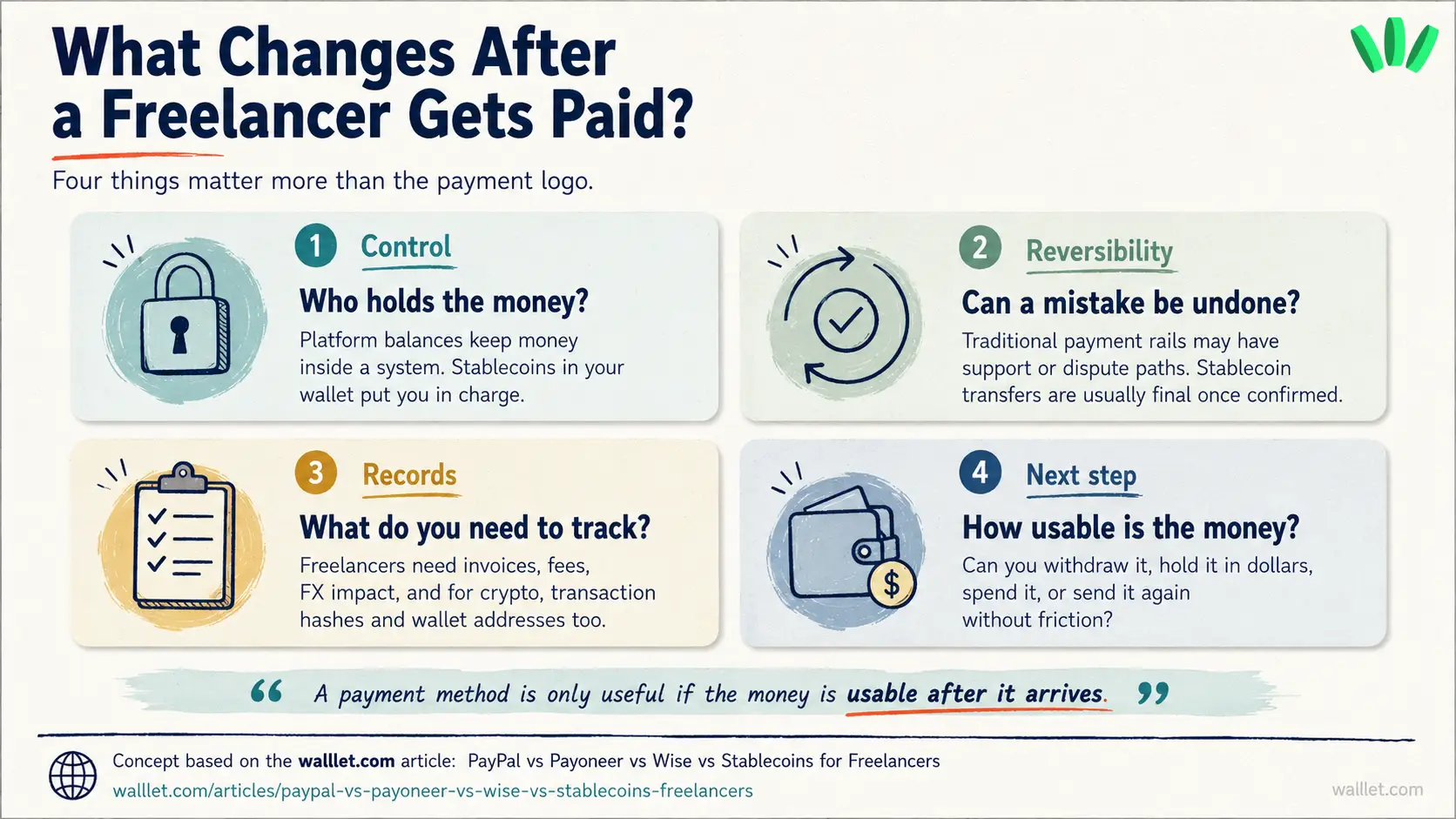
The useful comparison is not “Which app has the lowest advertised fee?” It is:
How much of the payment can I actually hold, spend or withdraw, how long will that take, and where can the route fail?
Freelancers considering crypto payments should first understand how to get paid in USDT or USDC safely. For the checks required before sharing an address, use the stablecoin payment checklist for freelancers.
Quick comparison
Method | Often fits | Main advantage | Main limitation |
PayPal | Clients already using PayPal, smaller direct payments and familiar checkout flows | Low explanation cost for the payer | Country features, fees, FX, disputes and withdrawal access can affect the route |
Payoneer | Marketplace payouts, agencies and recurring business payments | Familiar business receiving and payout structure | Platform rules, account reviews, withdrawal costs and supported routes |
Wise | Eligible bank-style transfers and currency conversion | Familiar bank details and clearer currency conversion where available | Account features depend on residence, currency and eligibility |
Stablecoins | Crypto-native clients, Web3 teams and clients already holding USDT or USDC | Direct onchain receipt and greater control after arrival | Network mistakes, wallet responsibility, issuer risk and cash-out planning |
walllet receiving route | Eligible freelancers who need client-friendly account details connected to a wider money workflow | Receive supported global income, hold value and choose what happens next inside one product flow | Eligibility, currency, fees and route availability must be checked in the current account |
No row is universally best. The answer changes with the client, payment source, country support, payment size and what you need to do after receiving the money.
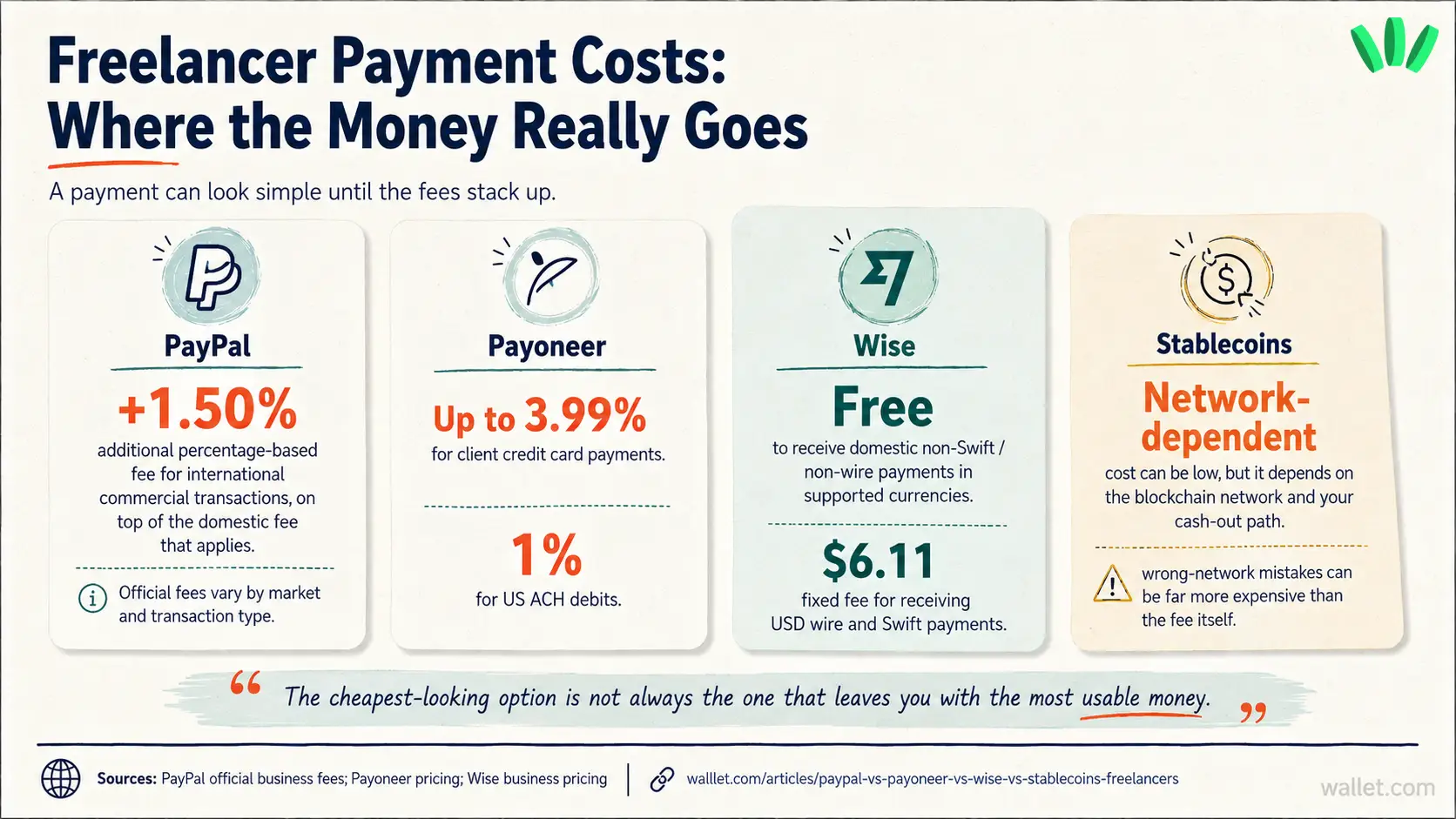
Compare usable money, not the invoice amount
Suppose a client owes you $1,000.
The invoice amount is not automatically the amount you can use. Your actual result may be:
Invoice amount − receiving fee − conversion cost − withdrawal fee − network fee − spread = usable money
The route may also create non-monetary costs:
Waiting for a review
Asking the client to resend information
Moving money through another service
Converting more than once
Losing access to a required withdrawal method
Keeping records across several platforms
A method with a low receiving fee can still be expensive when withdrawal, conversion or cash-out adds another layer. A higher visible fee may be acceptable when the route is reliable, familiar to the client and easy to document.
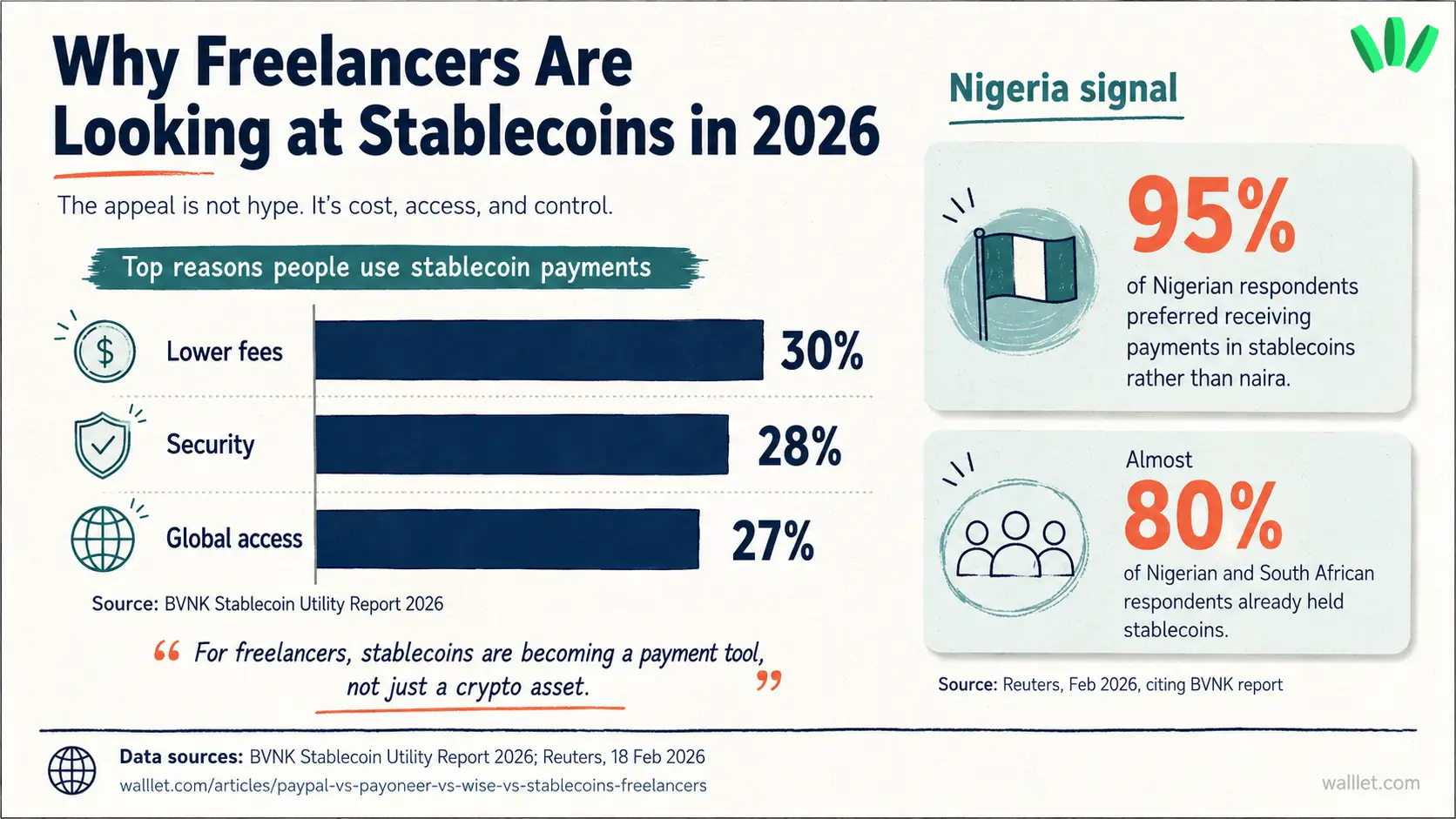
Do not compare providers using one headline percentage. Compare the complete route for the exact payment you expect to receive.
PayPal
PayPal is often easiest when the client already uses it and does not want new payment instructions.
A freelancer may prefer PayPal when:
The client expects a PayPal invoice or checkout
The project is relatively small
The payer values dispute and payment-platform processes
The freelancer already has a working withdrawal route
Speed and payer familiarity matter more than direct control
The main questions are country support, receiving functionality, transaction fees, currency conversion, withdrawal access, holds and disputes. These details may differ by location, account type and transaction.
PayPal controls the balance while it remains inside the platform. The freelancer gains direct control only after the funds reach another account or supported spending route.
Payoneer
Payoneer often fits income that starts inside a marketplace, agency, affiliate network or company payout system.
It may make sense when:
A platform already lists Payoneer as a payout method
A business client can use the receiving details provided to the account
The freelancer expects repeat international payments
Statements and business-payment records matter
The withdrawal route to a bank or another supported destination works
The important distinction is between direct-client payments and platform-originated payouts. A method that works for one may not support the other under the same conditions. Before relying on Payoneer, check:
Who is allowed to send to the account
Which currencies and receiving routes are available
The beneficiary-name requirements
Withdrawal fees and exchange rates
Minimums and limits
Review and verification requirements
What happens when a payment is rejected
Payoneer can reduce payment friction when it already sits inside the client’s or marketplace’s workflow. It becomes less useful when the freelancer must add several withdrawals and conversions before the money becomes usable.
Wise
Wise can work well when a client prefers bank details and the freelancer is eligible for the required account and currency features.
Wise states that receiving account details depend on the user’s registered address, supported currencies and account eligibility. It also notes that account details are part of the Wise account rather than separate bank accounts. Check the current product before assuming that a specific receiving or holding feature is available in Nigeria.
Sources: Wise account-detail eligibility and where Wise users can hold money.
Wise may fit when:
The client wants a bank-transfer experience
The user has access to the required account details
Currency conversion is part of the route
The payer does not use crypto
The freelancer can move or spend the received balance through an available route
Do not confuse “Wise can send money to a country” with “a resident of that country can open every Wise account feature.” Sending, receiving, holding, account details and card availability are separate capabilities.
Stablecoins
Stablecoins change the route because USDT or USDC can arrive directly in a wallet rather than remain inside a traditional payment platform. They may fit when:
The client already holds USDT or USDC
The payer understands blockchain networks
Both sides can document the invoice and transaction
The freelancer wants to hold dollar-pegged value
The receiving wallet and later cash-out route support the same asset
Direct control after receipt matters
The operational burden is higher.
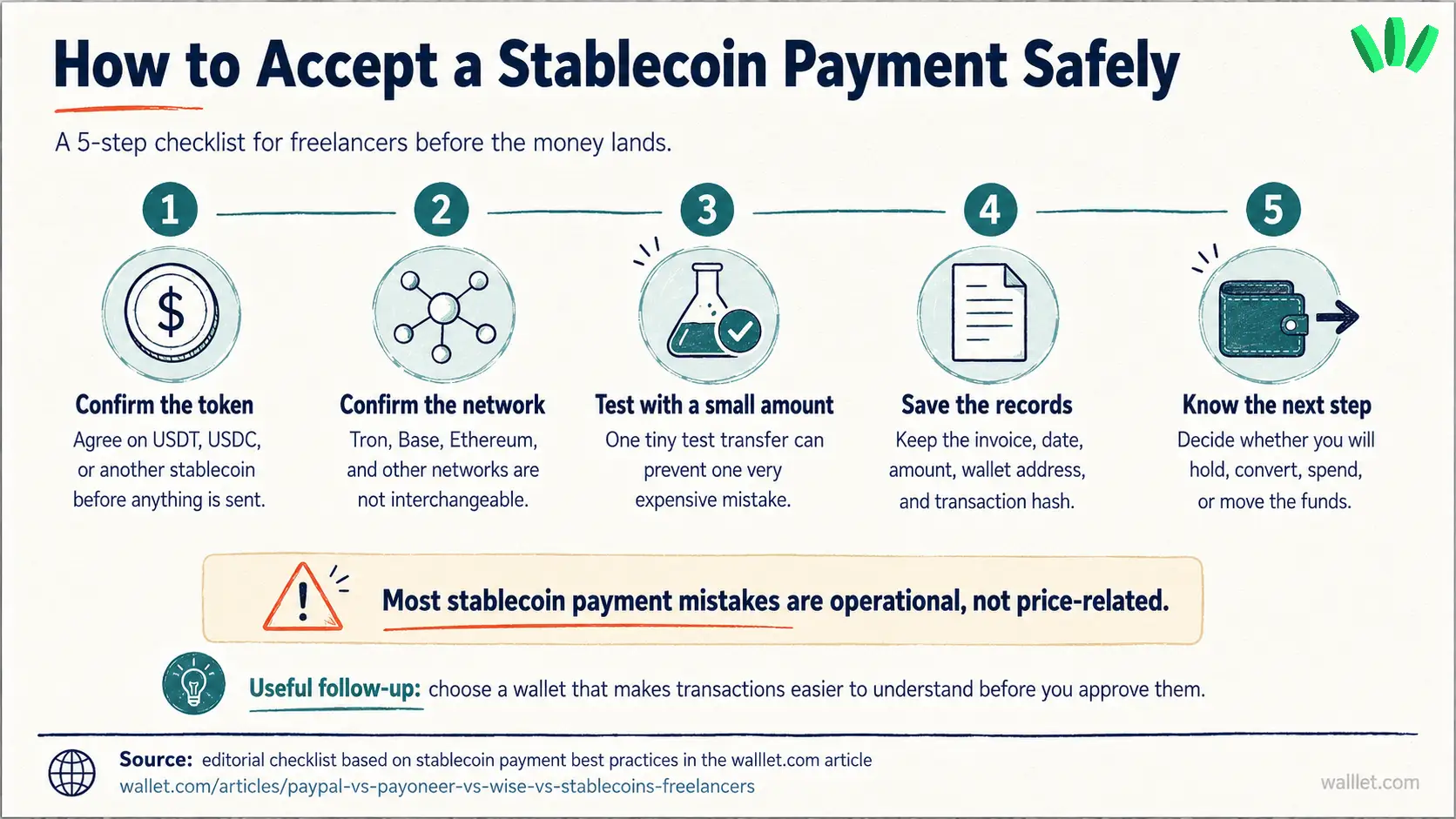
The payment instruction must include:
USDT or USDC
Exact blockchain network
Receiving address
Invoice amount and reference
Fee responsibility
Test-transfer requirement
Transaction hash after payment
The freelancer must also decide what happens after receipt. Holding, swapping, spending and cashing out can create different fees and risks.
For a Nigeria-specific wallet evaluation, use the guide to choosing a crypto wallet for Nigerian freelancers. If the network is the main uncertainty, compare the available networks for USDT and USDC.
If you want to see how seedless self-custody can fit alongside a broader income workflow, explore walllet.com.
Which method gives you the most control?
Control changes at different stages.
Stage | PayPal, Payoneer or Wise | Self-custody stablecoin wallet |
Before payment | Provider decides account eligibility and supported routes | Sender and receiver choose the token, network and address |
During payment | Provider processes and records the payment | Blockchain processes the transaction |
After arrival | Provider controls access until withdrawal or spending | Wallet owner controls transaction signing |
Dispute or error | Platform support may review the case | Confirmed blockchain transfers are generally irreversible |
Account restriction | Provider may limit account activity | Wallet access remains with the owner, but token issuers may still restrict some stablecoins |
Self-custody does not eliminate every restriction. USDT and USDC issuers can apply token-level controls in specific cases. The distinction is explained in the guide to USDT and USDC freeze risks.
Control is useful only when the freelancer can manage it. A wallet owner must protect access, verify addresses, understand approvals and keep enough information to trace payments.
Which method is easiest for the client?
The payer’s workflow often determines the realistic options.
A small business that already uses PayPal may reject a crypto request. A marketplace may only support its listed payout methods. A European agency may prefer bank details. A Web3 company may already pay every contractor in USDC.
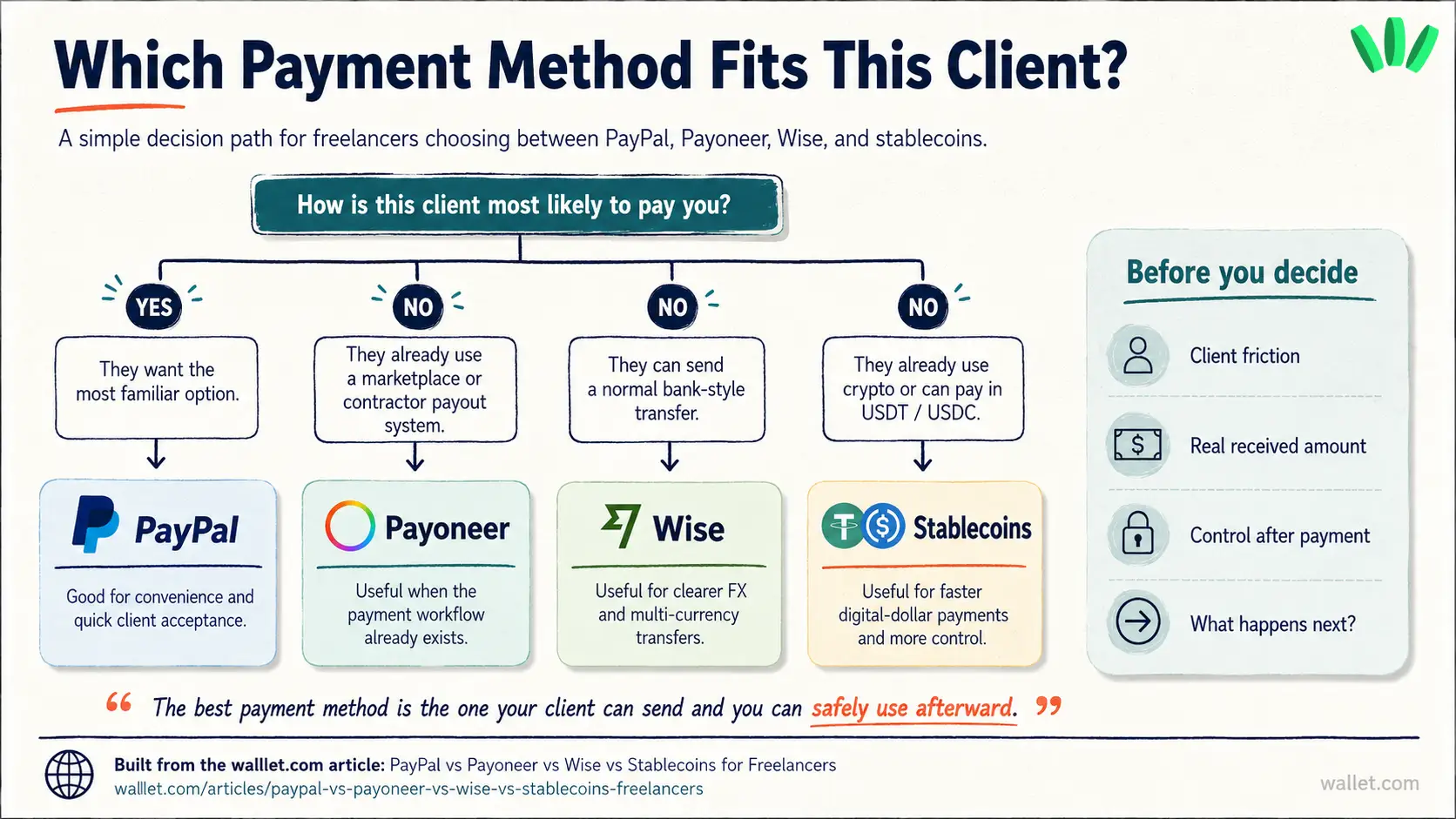
The best route usually requires the least new operational work for both sides. Use this order:
Ask which methods the client can use.
Remove any method unavailable to you.
Compare total cost and timing.
Check how you will use the funds after arrival.
Keep a backup route for important or recurring clients.
Do not force every client into one method. A freelancer may use Payoneer for marketplace income, bank details for agency payments and stablecoins for crypto-native clients.
Which method creates the clearest payment record?
All four methods can produce useful records, but the documents differ. PayPal, Payoneer and Wise can provide platform payment confirmations, statements and withdrawal records. Stablecoin payments provide transaction hashes, wallet addresses, timestamps and onchain status.
None of these records automatically explains the commercial purpose of the payment. Keep:
Client name
Contract or project reference
Invoice
Payment amount and currency
Payment method
Platform transaction ID or blockchain hash
Date received
Fees
Conversion record
Withdrawal or cash-out record
A transaction hash proves that an onchain transfer occurred. It does not replace an invoice or service description. Use the guide to reading a crypto transaction on a block explorer when verifying stablecoin payments.
Where can each route fail?
Method | Common failure point |
PayPal | Country limitation, hold, dispute, conversion or withdrawal issue |
Payoneer | Unsupported payer, review, payout restriction or withdrawal issue |
Wise | Eligibility, account-detail availability, transfer restriction or currency-route issue |
Stablecoin | Wrong token, wrong network, wrong address, failed transfer or unavailable cash-out |
Any method | Incomplete KYC, unclear source of funds, name mismatch or missing payment records |
A payment marked “sent” may still be pending, reviewed or unavailable. The article on why freelance payments get held, reviewed or delayed explains how to locate the actual failure point.
When walllet.com Makes More Sense Than a Single Payment App
PayPal, Payoneer, Wise and stablecoins usually solve one stage of the payment process. A freelancer may still need another service to hold the balance, convert it, spend online or move money locally.
walllet.com is more relevant when the problem is broader than receiving one payment. Its intended workflow connects several stages:
Receive global income → hold value in USD → spend online → convert what you need locally
This can be useful for freelancers who receive foreign income regularly and want fewer handoffs between separate payment, wallet and cash-out tools.
The comparison still depends on the actual route available in the user’s account. Before choosing walllet, check:
Which receiving currencies are currently available
Whether the client can use the provided payment details
The fees and settlement time
Available spending and conversion options
Eligibility and account requirements
The rate and limits for local cash-out
walllet.com should not be treated as automatically cheaper or suitable for every client. It makes the most sense when its available receiving, holding, spending and conversion features match the freelancer’s complete income workflow.
Which payment method should a Nigerian freelancer choose?
Use PayPal when the client already depends on PayPal and your receiving and withdrawal route works.
Use Payoneer when the payment starts from a supported marketplace, agency or business payout flow.
Use Wise when you are eligible for the required account features and the client prefers a bank-style transfer.
Use USDT or USDC when the client already understands crypto and you can manage the full Token, Network, wallet and cash-out route.
Use walllet.com when the currently available receiving and money-management features match the client, currency and way you plan to use the income.
The practical choice may involve more than one method. The goal is not to collect payment apps. It is to build a route that reliably turns completed work into usable money. Use walllet.com when you want a global-income workflow designed around receiving, holding, spending and converting supported income from one place.
