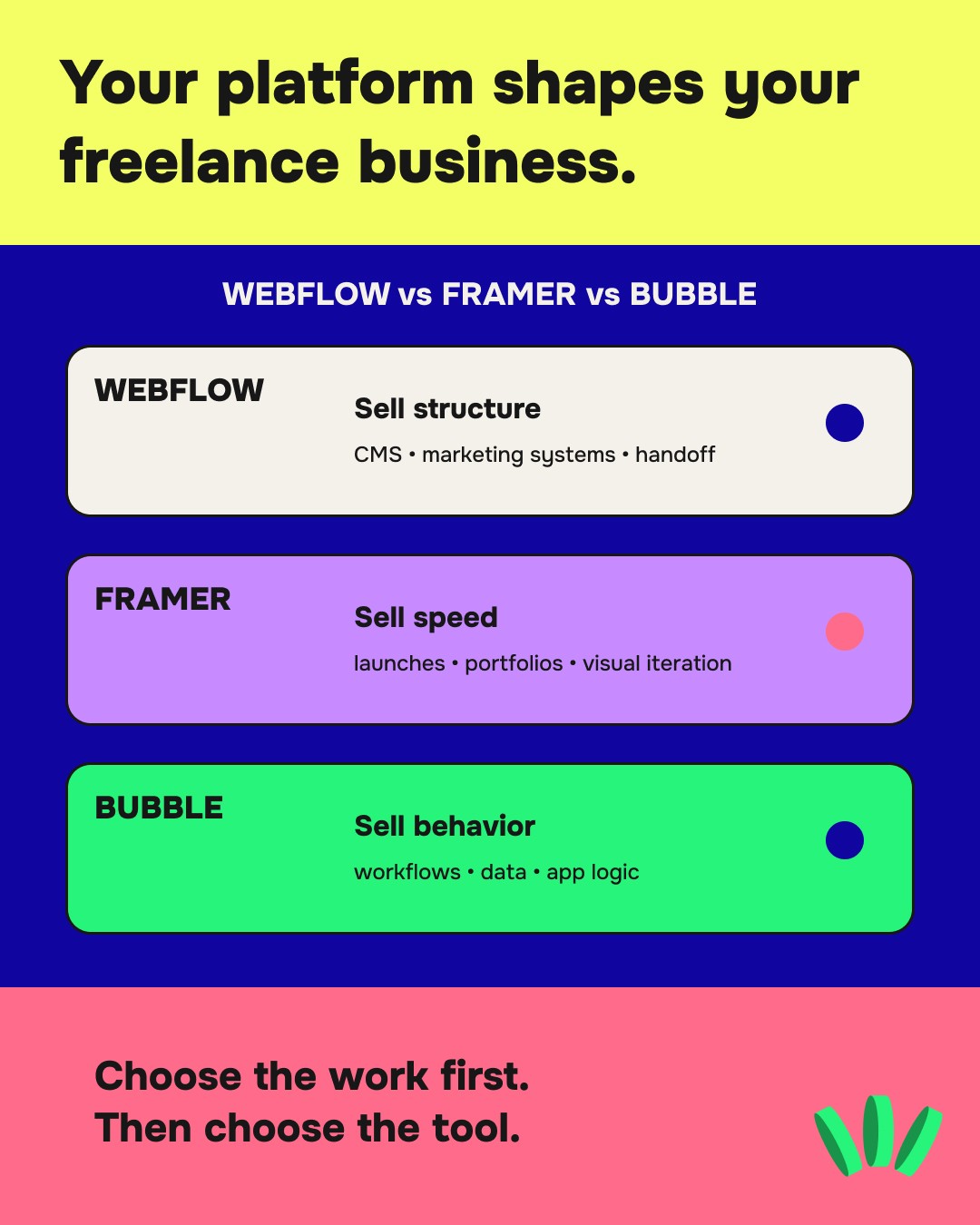
Choose Webflow, Framer or Bubble based on the client work you want to sell. Webflow is strong for structured marketing and CMS-heavy sites. Framer is well suited to design-led marketing sites and fast visual publishing. Bubble is built around application logic, workflows and data, making it a different category of freelance project. The best platform is the one that matches your client, handoff and maintenance model.
The worst way to choose a no-code platform is to ask which one is “most powerful.” Power for what?
A startup landing page, a 2,000-page content site and a two-sided marketplace are three different jobs.
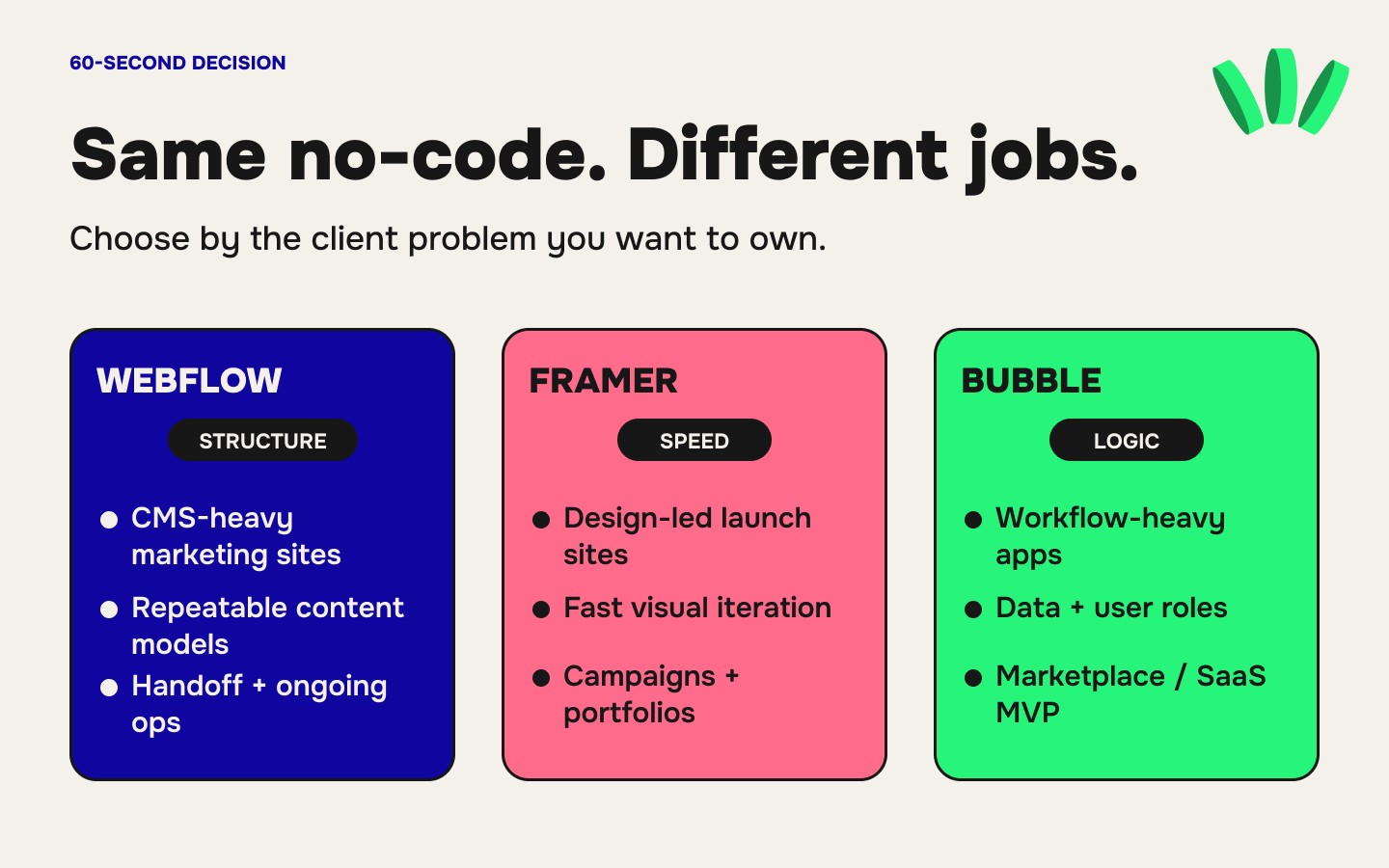
Official Webflow documentation describes its CMS as structured dynamic content built around Collections. Framer’s current help center documents CMS collections and dynamic detail pages. Bubble’s manual describes workflows as the engine that responds to events, changes databases and can call external APIs. Those differences matter because the tool changes what kind of freelance service you can credibly sell.
60-second decision table
If the client mainly needs… | Strong first choice | Why |
|---|---|---|
Marketing site with structured CMS | Webflow | CMS, design control and content structure |
Fast design-led startup site | Framer | Visual workflow and rapid publishing |
Workflow-heavy web application | Bubble | Database + event/action workflows |
Content site with many repeatable templates | Webflow | Structured collections and dynamic content |
Design-forward portfolio or campaign site | Framer | Strong design-to-live-site workflow |
Marketplace, internal tool or SaaS MVP | Bubble | Application logic and persistent data |
This is not a permanent ranking. Platforms change quickly. Check current official documentation for the feature that matters to your project before promising it to a client.
Choose Webflow when content structure is part of the problem
Webflow becomes especially useful when a client needs repeated content types such as articles, team members, case studies, locations, resources or products.
Its CMS uses Collections to store structured content and reuse it across dynamic pages.
That creates freelance services beyond “build a website”:
CMS architecture;
marketing-site build;
redesign and migration;
landing-page system;
localization setup;
ongoing site operations;
conversion and content iteration.
A good Webflow portfolio project
Build a B2B SaaS site with:
homepage;
product pages;
resource CMS;
customer-story CMS;
reusable components;
responsive states;
a documented handoff.
Show the CMS model, not only the homepage screenshot.
If a foreign startup hires you for this type of work, decide how the invoice will be paid before kickoff. The walllet.com guide to receiving payments from US, UK and EU clients explains why payer location and transfer rail affect the instructions you send.
Choose Framer when visual speed is the core value
Framer can be a strong fit when a client wants a modern marketing site, founder-led launch page, portfolio, campaign or other design-led web presence that needs fast visual iteration.
The freelance value proposition is often speed from design decision to live page.
A good Framer service can be:
Design and launch a conversion-focused startup website in a defined sprint.
That is clearer than “Framer development.”
A good Framer portfolio project
Create a fictional AI startup launch site with:
clear positioning;
responsive design;
CMS-backed resources or updates;
reusable sections;
conversion path;
handoff notes.
The portfolio should show why Framer was appropriate for the project, not only that you know the interface.
Choose Bubble when you are selling application behavior
Bubble is different because the client may be buying software behavior rather than a marketing site.
Bubble’s documentation describes workflows as event-driven sequences of actions. Those actions can create or update database records, send emails, navigate, load data and use plugins or external calls. That means a Bubble project can include:
user accounts;
permissions;
databases;
workflows;
dashboards;
scheduling;
APIs;
business logic.
The commercial risk is therefore larger too. A “simple marketplace MVP” can hide dozens of states, roles and edge cases.
A good Bubble portfolio project
Build a small service marketplace with:
two user roles;
profiles;
listings;
search/filter;
request workflow;
status changes;
admin view;
basic notifications.
Then document the data model and key workflows.
Do not quote a no-code project before mapping the system
For a marketing site, map:
pages;
CMS types;
forms;
integrations;
animations;
responsive requirements;
migration;
SEO requirements;
handoff.
For an app, add:
user roles;
permissions;
database objects;
workflows;
edge cases;
external APIs;
notifications;
admin operations;
privacy/security requirements;
test and acceptance criteria.
The tool may be no-code. The project is not no-thinking.
Price by project risk, not by “number of screens”
A five-screen app with complex business logic can be harder than a 30-page marketing site. Estimate:
discovery + architecture + build + integrations + QA + revisions + launch + handoff + risk buffer
Then decide whether you should sell:
a fixed build;
a paid discovery sprint;
a day-rate engagement;
a monthly maintenance retainer.
For uncertain apps, paid discovery before a fixed build can prevent a dangerous quote based on assumptions.

Recurring revenue is usually in maintenance and iteration
After launch, clients still need:
new CMS structures;
landing pages;
experiments;
bug fixes;
workflow changes;
integration updates;
content operations;
analytics review.
Package that work instead of waiting for random requests.
Your no-code business has dollar expenses too
No-code freelancers often pay for their own platform plans, domains, plugins, automation tools, AI and other SaaS. That creates a two-way money route:
client pays you globally → you keep operating funds → you pay global tools → you convert what you need locally
If you convert every foreign payment immediately and then rebuild a dollar spending route for your tools, you can add avoidable friction.
The walllet.com guide to why virtual dollar cards get declined is useful before relying on a single card for critical subscriptions.
The PayPal vs Payoneer vs Wise vs stablecoins comparison helps compare the whole income route, including what happens after receipt.
Treat your freelance stack like a system, including the money layer
walllet.com is designed for Nigerian global earners who need to manage supported international income after the invoice is paid: hold dollar-linked value, use supported spending routes, convert and cash out locally where available. Check current product eligibility, card acceptance, fees and limits before depending on a route for business expenses.

Client handoff should decide part of the platform choice
Ask before building:
Who will update content?
Who owns the workspace/account?
Who pays platform fees?
Does the client have internal design or engineering support?
How much can they safely change after handoff?
What happens when an integration breaks?
A platform that is perfect for you but impossible for the client to operate can create an endless maintenance burden.
Do not forget the payment handoff either
Your client should not have to guess how to pay you.
Use one invoice, one currency and one complete instruction block for the agreed route.
If PayPal is unavailable or unsuitable, the walllet.com guide to receiving USD in Nigeria without PayPal explains alternative route logic.
If a transfer gets stuck, use the freelance payment delay and review guide to identify the actual state before opening multiple support tickets.
If a crypto-native startup wants to pay you in USDT or USDC, use the stablecoin payment checklist before sharing an address.
The simplest platform rule
Choose the tool that makes the client’s core problem easier to deliver, maintain and hand over.
Webflow, Framer and Bubble can all be profitable freelance specializations. The mistake is trying to turn them into interchangeable answers.

