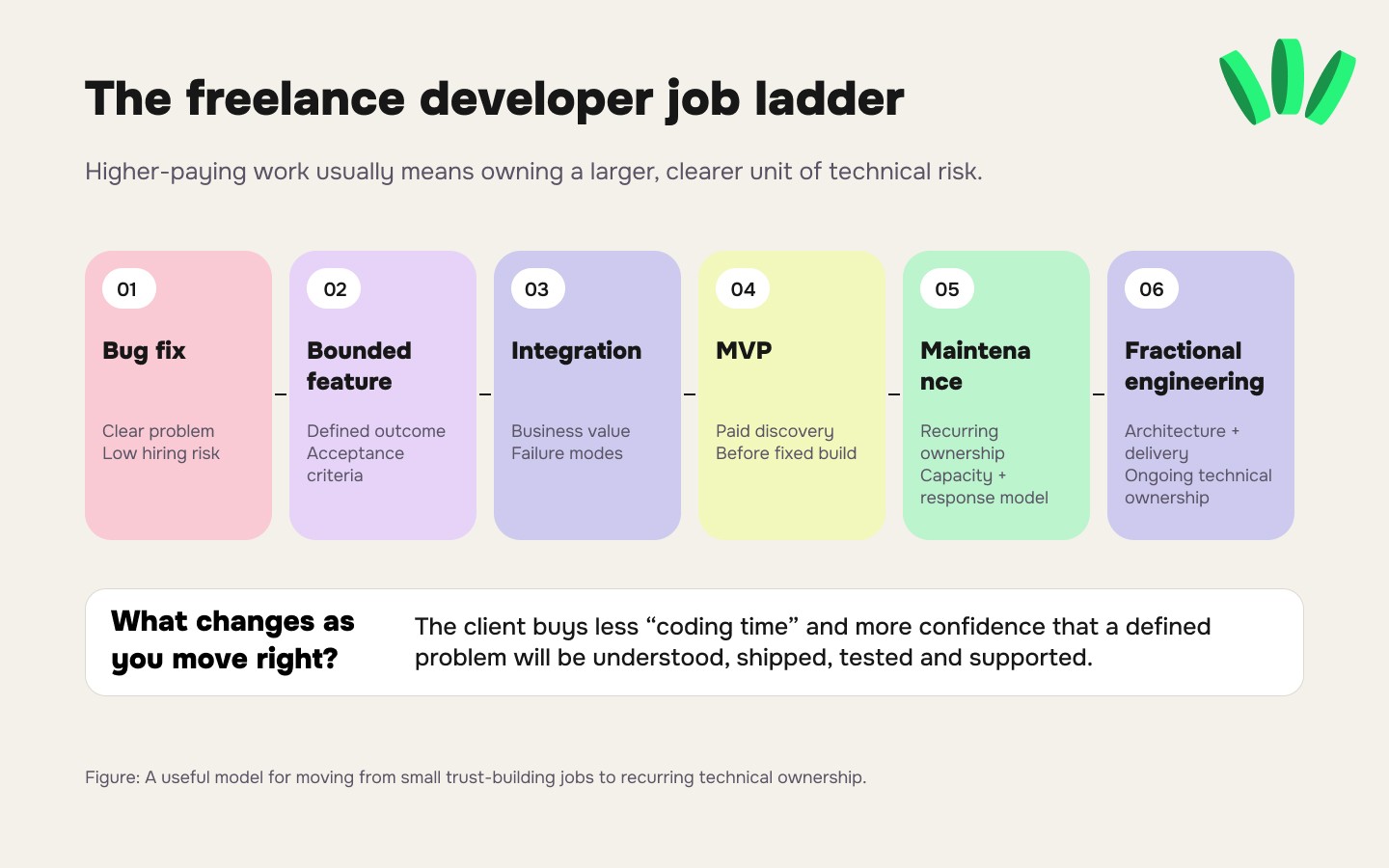
Freelance software developers usually earn more when they move from selling generic coding time to owning larger, clearer units of risk: a bug fix, a bounded feature, an integration, an MVP, a maintenance system or fractional engineering capacity. High-paying clients are not buying your framework list. They are buying confidence that a defined technical problem will be understood, shipped, tested and supported.
There is a useful piece of evidence behind this idea.
The SWE-Lancer benchmark assembled more than 1,400 real freelance software-engineering tasks from Upwork with a combined value of $1 million. The work ranged from $50 bug fixes to $32,000 feature implementations. That spread is a good picture of the market: “freelance software development” is not one product.
Software development is a kind of work that includes analyzing user needs, designing systems, maintaining software and documenting applications, not merely writing code.
The freelance developer job ladder
Think of the market as a ladder:
bug fix → bounded feature → integration → MVP → recurring maintenance → fractional engineering
You do not need to climb it in a straight line. The model helps you understand why two developers with similar technical skills can sell very different contracts.
Level 1: Bug fixes are useful when you use them as trust builders
A small bug can be a good entry point because the client has a clear problem and low hiring risk. Bad positioning: I am a full-stack developer available for tasks. Better:
I diagnose and fix production issues in React/Node applications, with a written cause and verification steps after the fix.
The second offer has boundaries and proof. A bug-fix engagement can lead to larger work if you communicate well and understand the system instead of patching blindly.
Level 2: Bounded features are easier to price than “development help”
A bounded feature has a clear user outcome and acceptance criteria. Example:
Add team invitations to the existing SaaS product. Admins can invite a user by email, invited users can accept or reject, expired invitations cannot be used, and the feature includes automated tests for the core states.
Now the client can evaluate delivery. Before quoting, identify:
current architecture;
dependencies;
data model changes;
permissions;
UI states;
test expectations;
deployment responsibility;
documentation/handoff.
If the client is international, settle the payment route in the same commercial conversation. The walllet.com guide to receiving payments from US, UK and EU clients explains why the payer’s country, currency and transfer rail affect your receiving instructions.
Level 3: Integrations can become a valuable specialization
Integrations have obvious business value and obvious failure modes. Examples:
CRM integration;
payment integration;
analytics/event pipeline;
identity provider;
messaging service;
data sync between two systems.
A strong integration freelancer does more than connect APIs. They handle authentication, retries, error states, webhooks, idempotency, logging and ownership after launch.
That makes the offer more defensible than “I know APIs.”
Level 4: MVP work needs paid discovery more often than developers admit
“Build our MVP” can mean anything.
A founder may have a deck and twelve screenshots but no settled roles, data model, workflows or acceptance criteria. Do not solve that uncertainty for free inside a fixed quote. A discovery sprint can produce:
scope;
system diagram;
user roles;
data model;
API/integration map;
risk register;
milestone plan;
cost range.
Then quote the build based on evidence.
Level 5: Maintenance turns one project into recurring revenue
Clients need someone to own:
dependency updates;
production bugs;
small improvements;
monitoring review;
incident follow-up;
technical debt;
release support.
Package maintenance with a response model and capacity limit. “Unlimited support” is not a product. It is an undefined liability.
Level 6: Fractional engineering is about ownership
Senior contractors can sell a recurring block of engineering capacity when a company needs experienced technical ownership without a full-time hire.
This work can include architecture decisions, delivery planning, code review, incident response, mentoring and implementation.
At this level, the client values reliability, communication, documentation and availability as much as raw coding speed.
That fits walllet.com’s core senior-contractor persona particularly well: higher-value global earners care about limits, invoices, reliability, support and transparent money movement, not only the lowest payment fee.
Your GitHub is not a client case study
A repository proves code exists. A case study should explain:
what problem existed;
what constraints mattered;
what you owned;
what trade-offs you made;
how you tested it;
what changed after delivery.
A client trying to hire you for a $10,000 implementation should not have to inspect twenty repositories to guess whether you can manage a production project.
Technical discovery should happen before a serious quote
Use a pre-quote checklist:
Product
What user outcome must change?
System
What exists now?
Dependencies
Which services, libraries, accounts or teams are required?
Risk
What could materially change the estimate?
Acceptance
How will both sides know the work is done?
Deployment
Who ships and supports it?
A quote without acceptance criteria invites conflict.

Milestone payments should track technical risk
For larger builds, break the project into deliverable milestones. Example:
discovery and architecture approved;
core feature complete in staging;
integrations and QA complete;
production release and handover.
This makes payment and technical progress easier to reconcile.
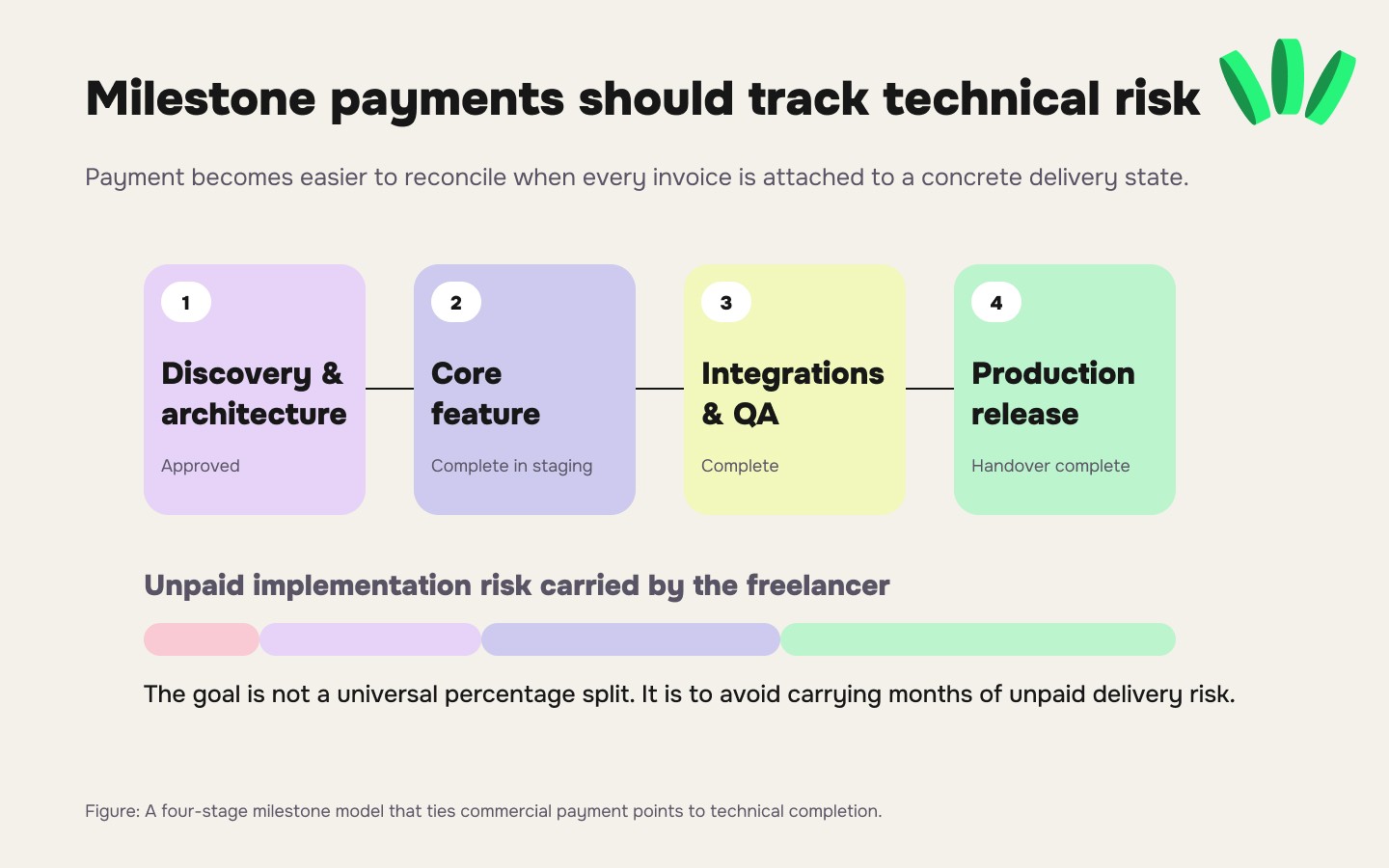
The exact percentage split is a contract decision. The principle is to avoid carrying months of unpaid implementation risk.
A $5,000 contract needs a better payment operating system than a $100 fix
As contract value rises, payment reliability matters more. Keep:
signed scope or contract;
invoice;
payer legal name;
currency;
payment reference;
transfer proof;
support case details if anything is delayed.
If a payment is sent but unavailable, use the walllet.com guide to freelance payments that are held, reviewed or delayed to identify the actual state instead of treating every delay as the same problem.
If the client cannot use PayPal, the guide to receiving USD in Nigeria without PayPal explains how to evaluate alternatives by payer fit, eligibility and total usable money.
Keep a backup route before the invoice is due
Payment platforms change rules. Banks have outages. Accounts can require review. A client’s finance team can reject a route their predecessor accepted.
Do not wait until the final day of a milestone to discover the only payment method no longer fits.
For recurring clients, keep one tested backup route and document which one should be used for which currency or payer type.

The walllet.com IBAN account guide explains the checks to make before sharing eligible receiving details, including beneficiary name, currency, sender type, fees, limits and timing.
Stablecoin payments can fit technical clients, but the instructions must be technical too
A Web3 company may offer to pay in USDT or USDC.
“Send USDC to this address” is not enough.
Confirm:
exact token;
exact network;
receiving address;
invoice amount;
fee responsibility;
test payment policy;
transaction hash after payment.
Use the walllet.com stablecoin payment checklist for freelancers before the first transfer.
If network choice is uncertain, compare the best network routes for USDT and USDC before the client sends meaningful value.
Run your income like production infrastructure
walllet.com is designed around the full money route for Nigerian global earners: supported receiving, dollar-linked holding, spending or conversion, and cash-out where available. Treat it like any other dependency. Verify current eligibility, limits, fees, partner availability and fallback behavior before putting a route into a recurring contract.

AI changes the shape of freelance engineering, not the need for ownership
Coding tools can make implementation faster. They do not remove the need to understand the product, define acceptance criteria, integrate with production systems, protect data, test edge cases and own failures after deployment.
That is also the commercial opportunity. The more commodity implementation becomes, the more valuable clear ownership becomes. Sell the unit of responsibility you can reliably own.
Questions freelance developers ask
How do I get higher-paying freelance software clients?
Move from a generic “developer for hire” profile to a narrower problem you can show evidence for. Use smaller jobs to build trust, then sell bounded features, integrations, maintenance or recurring technical ownership.
Should I charge hourly or per project?
Use hourly/day pricing when priorities are open-ended. Use fixed project pricing when acceptance criteria and dependencies are clear. For uncertain product builds, charge for discovery before giving a fixed implementation quote.
What should a software-development contract define?
At minimum: scope, milestones, acceptance criteria, client dependencies, change process, IP terms, payment schedule, deployment responsibility, support after launch and what happens when either side delays the project.
How should a Nigerian developer receive a large international payment?
Use a route the payer can use, that you are eligible to receive through, and that gives you clear records, predictable costs and a practical next step. For larger recurring contracts, keep a tested backup rather than depending on one provider.
The best freelance developers sell fewer unknowns
Clients pay more easily when they understand the problem you own, the result they will receive, the conditions for acceptance and the payment schedule.
Build that discipline into the technical work and the business around it.

