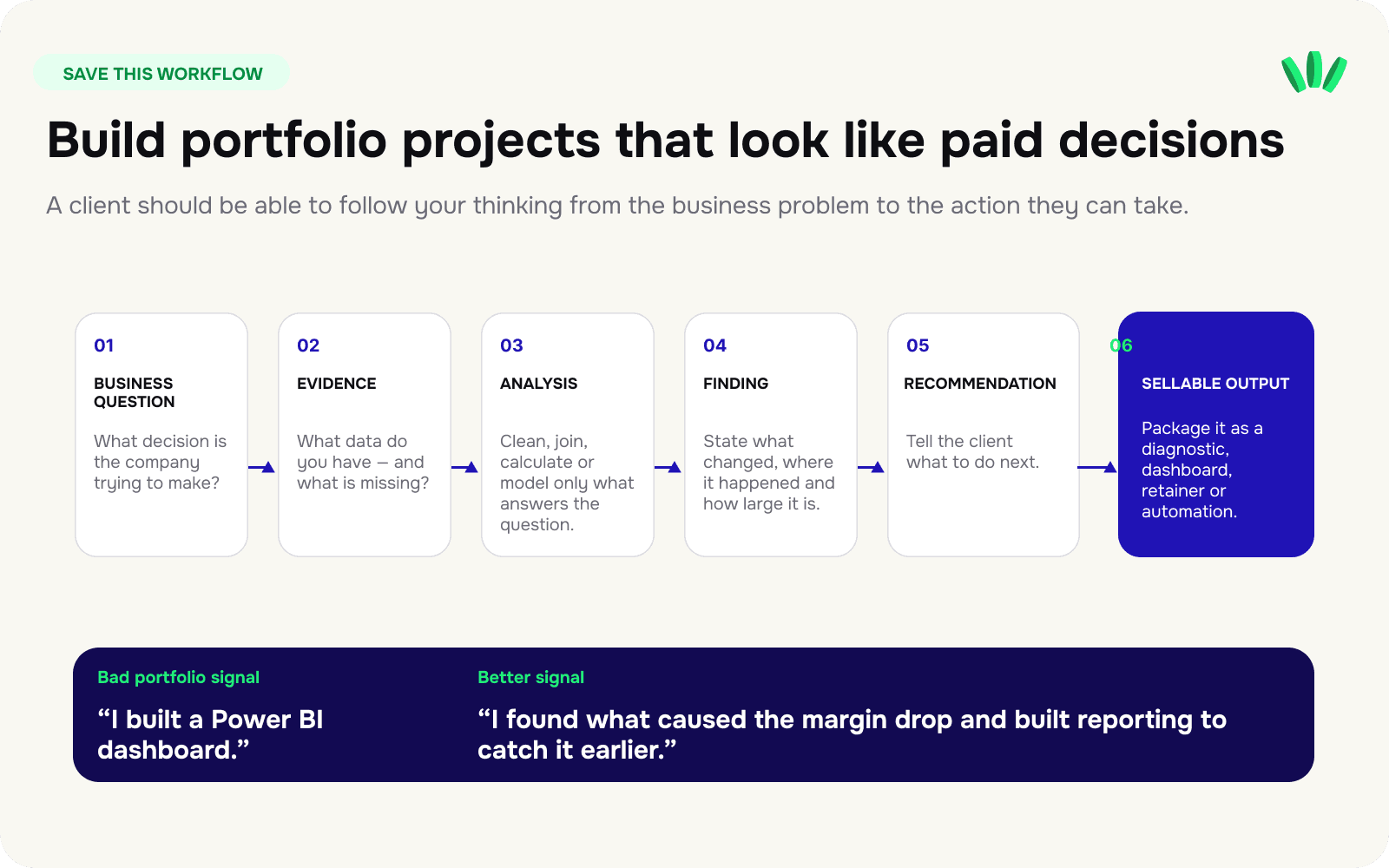
The best data analyst portfolio projects answer business questions, not software questions. “I built a Power BI dashboard” tells a client which tool you opened. “I found which product category caused a margin drop and built a weekly dashboard to catch it earlier” tells the client why your work matters.
If you want freelance data-analysis work, build projects that look like paid decisions.
The U.S. Bureau of Labor Statistics describes data scientists as professionals who identify useful data, collect and analyze it, build or validate models, visualize findings and make business recommendations. A freelance data analyst may work at a different technical depth, but the commercial pattern is similar: clients pay for an answer they can act on.
The seven projects at a glance
Project | Business question | Useful stack | What it proves |
|---|---|---|---|
E-commerce revenue dashboard | Why did revenue change? | SQL + Power BI | KPI analysis and reporting |
SaaS churn investigation | Who is leaving and why? | SQL + Python | Cohort and retention analysis |
Marketing attribution audit | Which channels create useful customers? | SQL + Tableau | Marketing analytics |
Pricing and margin analysis | Where is profit leaking? | Excel + Python | Commercial analysis |
Operations bottleneck dashboard | Where do delays start? | Power BI | Process analysis |
Customer segmentation | Which customers behave differently? | Python | Segmentation and recommendations |
Cash-flow model | When could the business run short of cash? | Excel + SQL | Forecasting and financial thinking |
The point is not to complete all seven. Pick two or three that match the clients you want.
1. Build an e-commerce revenue dashboard that explains a change
Do not build a dashboard full of every metric you can calculate.
Give yourself a business question:
Revenue fell 12% last month. Was the problem traffic, conversion, average order value, product mix or refunds?
Then create the analysis around that question.
Useful fields might include order date, customer, product, category, quantity, price, discount, refund status and traffic source.
Your deliverable should have two layers:
an executive page that answers what changed;
a diagnostic page that lets someone investigate why.
Turn it into a freelance service
“Power BI dashboard” is generic.
“Weekly revenue and margin reporting for Shopify brands” is easier to buy.
That service can become recurring work because the report updates every week or month.
If you start receiving regular payments from clients abroad, plan the receiving route before the first invoice. The walllet.com guide to receiving international payments from US, UK and EU clients explains why sender country and transfer rail matter.
2. Investigate churn like a SaaS operator
Create a fictional or public subscription dataset with signup date, plan, activity, cancellation date, acquisition source and monthly revenue.
Answer:
Which cohorts retain best?
When does churn spike?
Which plans have the weakest retention?
Are high-churn users less active before cancellation?
Which acquisition sources produce customers who stay?
The portfolio output should not stop at a chart.
Write a recommendation such as:
Annual-plan customers retain well, but monthly users acquired through paid social churn heavily during the second billing cycle. The next test should target activation during the first 14 days rather than increasing acquisition spend.
That final sentence is the difference between analysis and reporting.
Turn it into a freelance service
“Retention and churn diagnostic for early-stage SaaS companies.”
Now a founder can understand what they would hire you to do.
3. Build a marketing attribution audit that admits uncertainty
Marketing attribution is a good portfolio project because it forces you to handle imperfect data.
Create a dataset with campaign, source, spend, sessions, leads, purchases and revenue. Then show the limits of the attribution model.
You can compare:
last-click performance;
blended customer acquisition cost;
conversion rate by source;
revenue by campaign;
assisted or multi-touch signals if the data supports them.
Do not pretend an attribution model knows more than the underlying data.
Turn it into a freelance service
“Monthly paid-media performance audit for teams spending across Google and Meta.”
This is especially useful if you want digital-marketing agencies as clients.
4. Analyze pricing and margin, not only revenue
A business can grow revenue and still make less money.
Build a dataset with products, unit cost, selling price, discount, shipping or service cost and returns. Calculate gross margin by product, category and customer segment.
Then test a decision:
What happens to gross margin if the business removes a 10% blanket discount and keeps discounts only for slow-moving products?
This moves your portfolio closer to commercial decision-making.
Turn it into a freelance service
“Pricing and margin analysis for e-commerce and digital businesses.”
The money theme should also apply to your own freelance work. A $1,000 invoice is not automatically $1,000 of usable income. Receiving fees, conversion and withdrawal can change the final amount. The walllet.com comparison of PayPal, Payoneer, Wise and stablecoins for Nigerian freelancers shows how to evaluate the complete route rather than one fee line.
5. Find an operations bottleneck
Create an order, ticket or delivery dataset with timestamps at each stage. Ask:
Where does the queue build?
Which team or category has the longest cycle time?
Are delays concentrated on certain days?
Which cases get reopened?
What would happen if the slowest stage improved by 20%?
A good dashboard highlights exceptions. It does not make the user scan twenty charts to discover one late process.
Turn it into a freelance service
“Operations performance dashboard for service businesses.”
That can fit logistics, customer support, agencies, recruiting teams or field operations.
6. Segment customers in a way a marketer can use
A technically elegant cluster is useless if nobody knows what to do with it.
You can use RFM analysis, rule-based segments or a clustering method if the dataset supports it. The output needs plain-language groups. For example:
high-value repeat buyers;
recent one-time buyers;
discount-dependent buyers;
dormant high-value customers.
Then attach an action to each group.
Turn it into a freelance service
“Customer segmentation for retention and lifecycle campaigns.”
This creates a natural bridge into work with e-commerce brands and marketing teams.
7. Build a cash-flow model a small business could actually use
Use monthly inflows, payroll, software, rent, tax reserves, contractor costs and irregular expenses. Then model a rolling cash balance. The useful questions are practical:
Which month creates the tightest cash position?
What happens if the largest client pays 15 days late?
How much buffer does the business need?
Which recurring expenses can be delayed without affecting delivery?
Turn it into a freelance service
“Cash-flow reporting and scenario planning for small agencies.”
This project is especially credible for freelance analysts because it mirrors your own operating reality. International income can arrive through different providers, on different dates, with different fees.
How to present a data project so a client understands it in 90 seconds
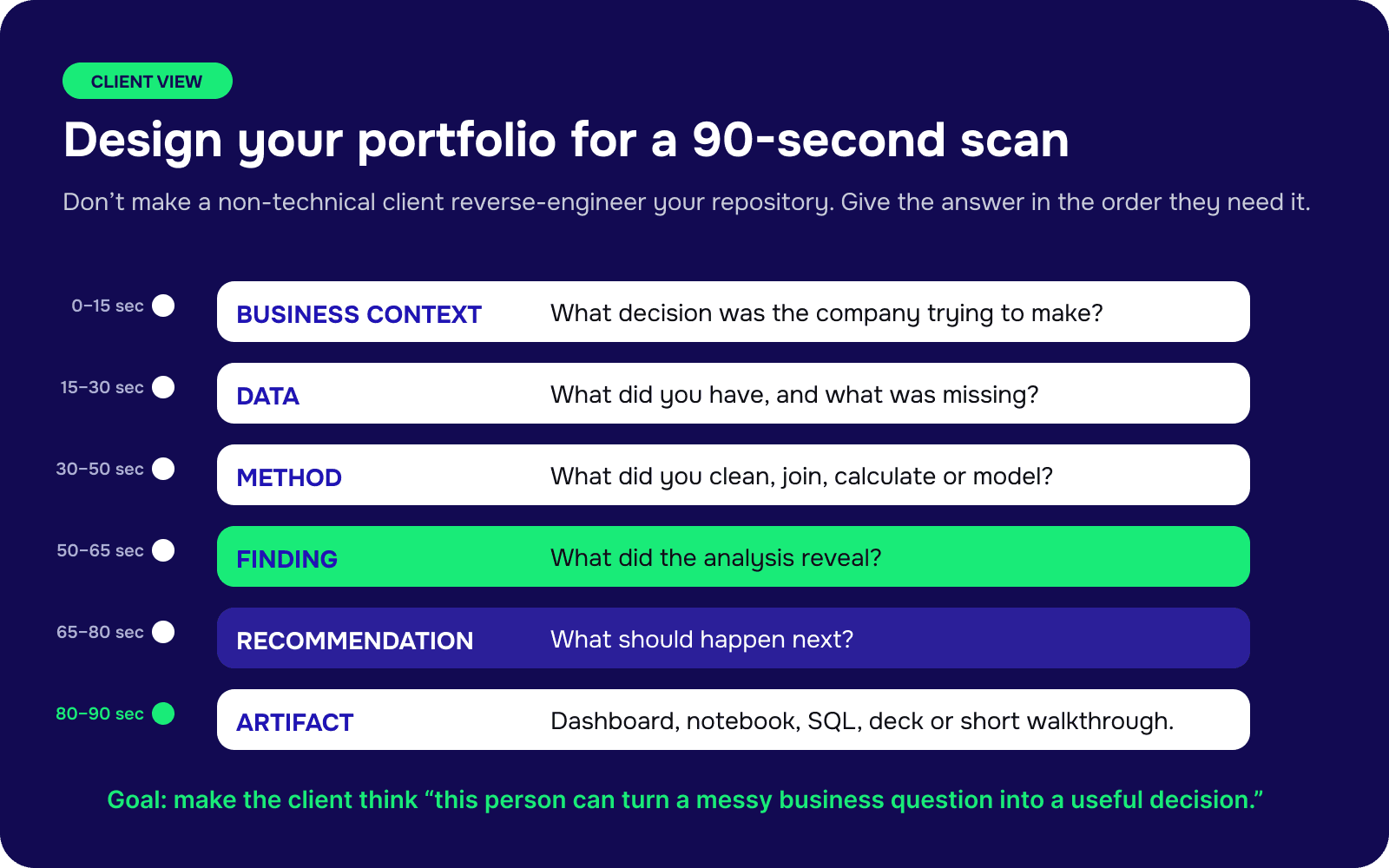
Use this order:
Business context
What decision was the company trying to make?
Data
What did you have, and what was missing?
Method
What did you clean, join, calculate or model?
Finding
What did the analysis reveal?
Recommendation
What should happen next?
Artifact
Dashboard, notebook, SQL, presentation or short walkthrough.
Do not lead with a repository full of files and expect a non-technical client to reverse-engineer your value.
SQL, Power BI, Tableau or Python: which one matters most?
Clients buy outcomes, but the tool still affects fit.
SQL is foundational when the work depends on structured data. Power BI is common in Microsoft-heavy business environments. Tableau is useful when visual analysis and sharing are central. Python becomes valuable when the work needs automation, statistical analysis, machine learning or data processing beyond a BI tool.
A strong early stack is often simpler than people think:
SQL + spreadsheet + one BI tool + clear communication.
Add Python when the project earns the complexity.
Price the project around the decision
Do not calculate a fee from “how long the dashboard will take” alone.
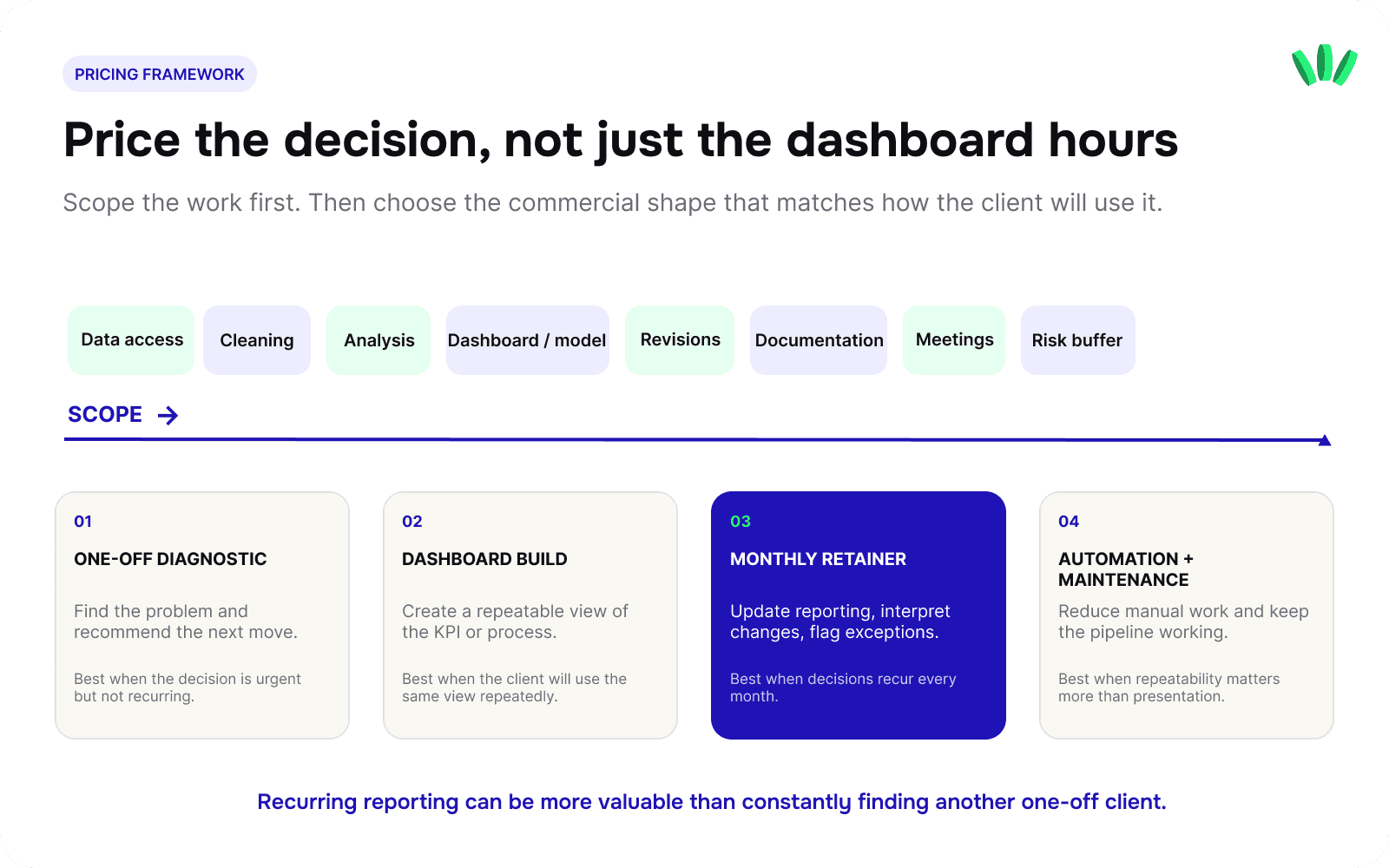
Estimate:
data access + cleaning + analysis + dashboard/model + revisions + documentation + meetings + risk buffer
Then decide whether the work is:
a one-off diagnostic;
a dashboard build;
a monthly reporting retainer;
an automation and maintenance engagement.
Recurring reporting can be more valuable than constantly finding another one-off dashboard client.
Protect your payment evidence as carefully as your data
If a foreign client pays you, keep the invoice, payer name, amount, currency, transfer reference and the evidence required by the route you use.
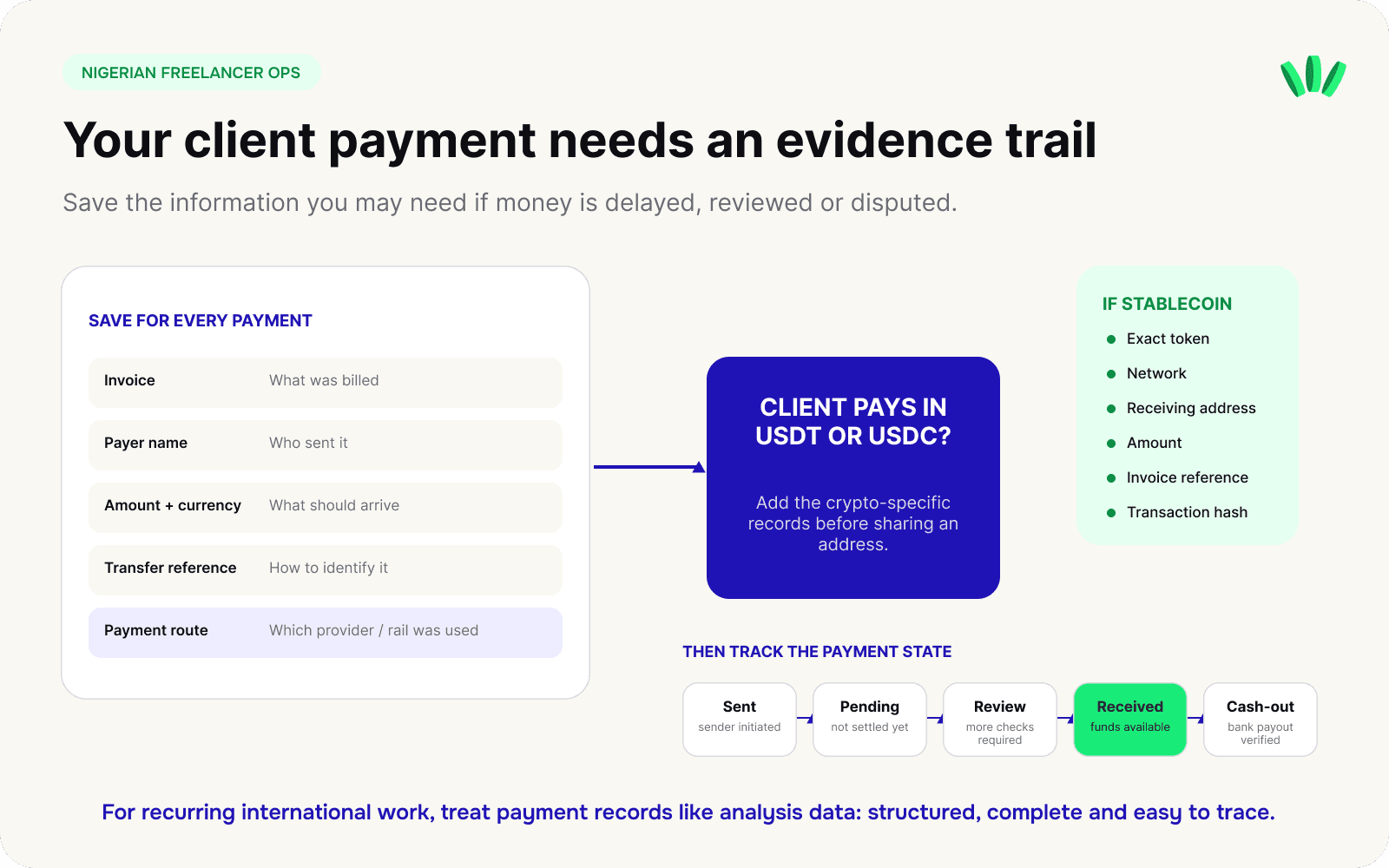
When payments become delayed, the worst response is “the client sent a screenshot.” A screenshot may show intent without showing where the transfer is. The guide to freelance payments that are held, reviewed or delayed explains how to distinguish payment states and collect useful evidence.
If the client wants to pay in USDT or USDC, the payment data should be just as structured as your analysis data. Confirm token, network, address, amount, invoice reference and transaction hash. Use the USDT/USDC payment checklist for freelancers before sharing an address.
Build a money workflow that can handle recurring client work
A freelancer with one $200 project can improvise. A data analyst with several recurring international clients needs an operating system for income. walllet.com is built around connecting supported receiving, dollar-linked holding, spending or conversion, and Nigerian cash-out routes where available. Check current eligibility and route terms before using it for client instructions.
What your portfolio should make a client think
Not:
This person knows Power BI.
Better:
This person can take a messy business question, find the relevant data, explain what changed and tell us what to do next.
That is the portfolio that wins work.
If you receive part of your earnings in stablecoins and later need naira, do not treat cash-out as an afterthought. The walllet.com guide to cashing out USDT or USDC to naira breaks the process into supported asset/network checks, quote review and bank payout verification.
Before your next portfolio project, change the question
Do not ask, “What dashboard can I build?”
Ask, “What decision would someone pay to make with better data?”
That question produces better projects, clearer services and stronger client conversations.
