A freelance UX designer gets paid to reduce product uncertainty: what users need, where they get stuck, what should change, and whether the change works. The strongest freelancers do not sell Figma screens by the hour. They sell a clear research-and-design process, document the evidence, scope the work properly, and make it easy for an international client to hire and pay them.
A polished interface can get attention. A case study that shows how you think gets the contract.
If you are a UX designer in Nigeria trying to move from local jobs, platform gigs or an in-house role into international freelance work, the difficult part is rarely learning one more design tool. The harder questions are commercial: What exactly are you selling? What belongs in your portfolio? How do you price an ambiguous project? How do you protect yourself from endless revisions? And once a client abroad approves the invoice, how does that money become usable income in Nigeria?
The U.S. Bureau of Labor Statistics describes web and digital interface designers as professionals who develop and test interface layout, functions and navigation for usability. It also notes that employers may accept demonstrated ability through projects instead of one fixed education path. That is useful context for freelancers because a portfolio is not decoration. It is evidence of how you solve interface and usability problems.
What does a freelance UX designer actually sell?
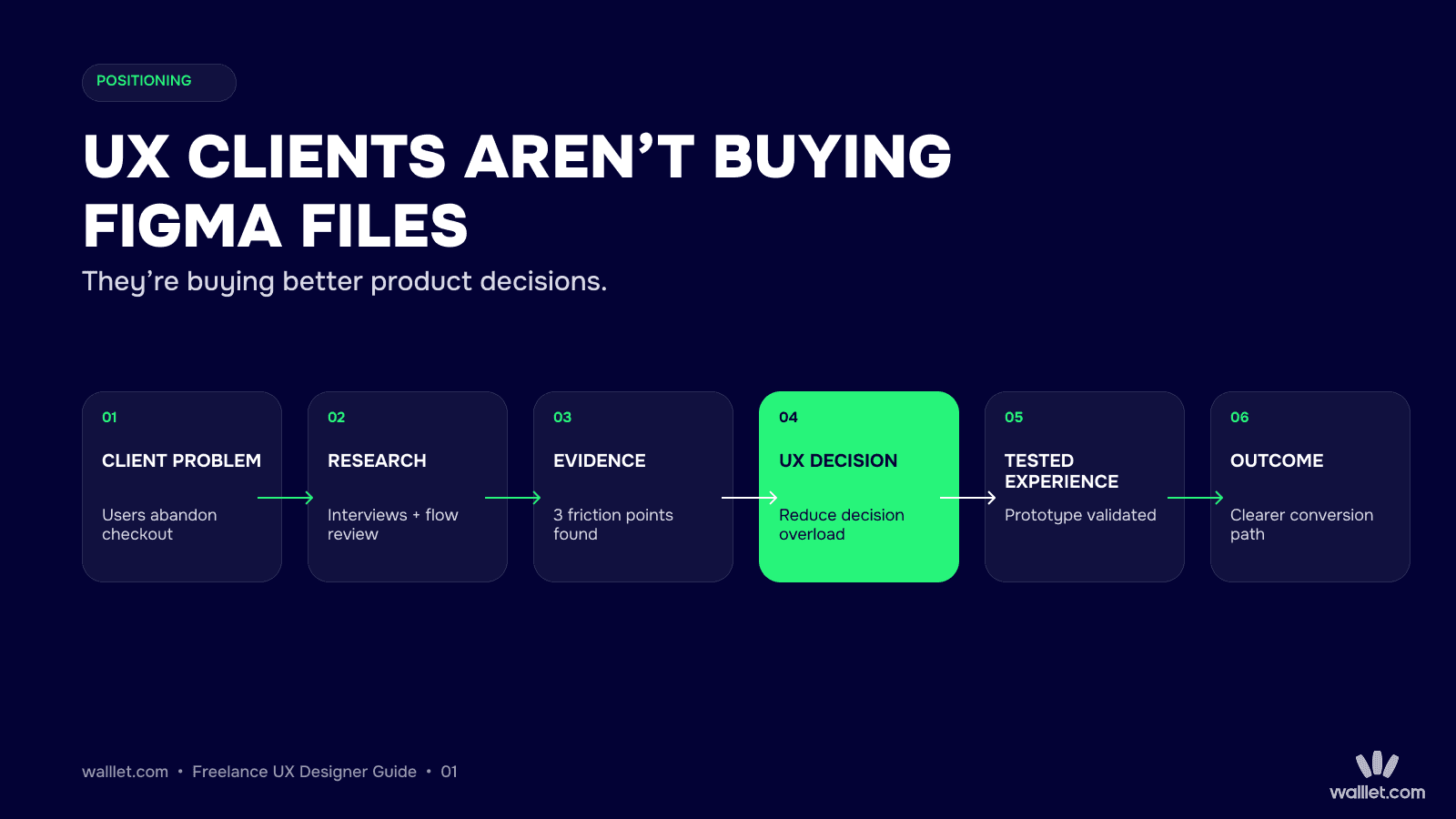
A freelance UX designer sells decisions that make a product easier to understand and use. Depending on the client, that may include user research, journey mapping, information architecture, wireframes, prototypes, usability testing, UX audits or product-design support.
The mistake is packaging all of that as “I design apps.” That sentence gives a client no reason to choose you over another portfolio with cleaner mockups.
A stronger offer names the problem and the outcome:
Weak offer | Stronger freelance offer |
|---|---|
UX/UI design | UX audit for SaaS onboarding flows |
App redesign | Mobile checkout redesign backed by usability testing |
Figma design | Research, wireframes and tested prototype for an MVP |
Product design | Fractional UX support for a product team shipping weekly |
Your first positioning decision is therefore not “Which tool do I know?” It is “Which expensive product problem can I make easier to solve?”
Your portfolio should prove decisions, not taste
A strong UX portfolio answers five questions quickly:
What problem existed?
What was your role?
What evidence did you collect?
What changed because of your work?
What would you do differently with more time or data?
That fifth question matters. Real UX work is messy. A case study that pretends every research insight perfectly led to the final screen feels less credible than one that shows a constraint, an abandoned idea or a trade-off.
A useful case-study structure is:
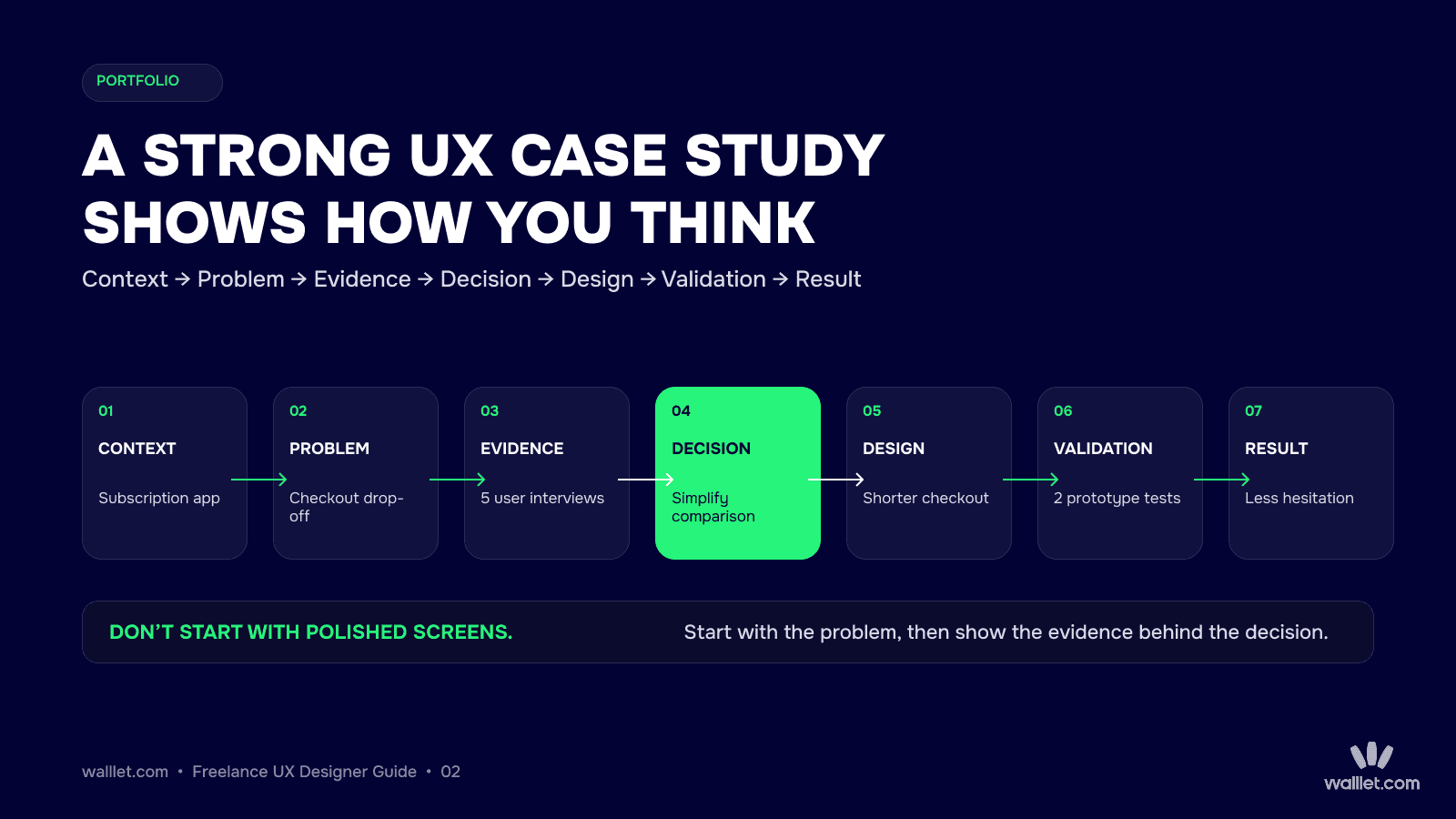
Context → problem → evidence → decision → design → validation → result
Do not begin with twelve screens of polished UI. Begin with the thing the client is paying you to understand.
For example:
A subscription app had a high drop-off between plan selection and checkout. I reviewed the flow, interviewed five target users, mapped the points of hesitation, tested two revised prototypes and recommended a shorter comparison step before payment.
Even if the project was self-initiated, the logic is legible. The reader can see what you would do on paid work.
Three portfolio projects are enough if they are different enough
You do not need fifteen case studies. You need enough evidence to show range without making a client hunt for the relevant example. A practical early portfolio could contain:
one research-heavy case study;
one product-flow redesign;
one shipped or realistically prototyped project with measurable or observable results.
If all three projects are visually impressive fintech dashboards, the portfolio still has a range problem. Show different decision types.
How to get freelance UX clients without living on job boards
Freelance platforms can be useful, especially when you need early proof and structured contracts. They should not become your only source of work. The better long-term pipeline is usually a mix of:
referrals from designers, founders and engineers;
targeted LinkedIn outreach;
design communities;
relationships with small product agencies;
startup founders who have a specific UX problem;
former colleagues and clients.
The outreach message should diagnose something small, not pitch your biography.
Bad:
Hi, I am a UX/UI designer with five years of experience. I would love to work with you.
Better:
I tried your signup flow on mobile. The plan comparison asks users to make three decisions before they understand the difference between tiers. I have worked on similar onboarding problems. If that flow is on your roadmap, I can show you how I would audit it.
The second message demonstrates attention before asking for attention.
If the client is outside Nigeria, think about the payment route before the work starts. walllet.com’s guide to receiving payments from US, UK and EU clients explains why the sender’s country, currency and transfer rail affect which receiving instructions make sense.
How much should a freelance UX designer charge?
There is no useful universal rate for freelance UX design. A one-hour expert review, a two-week research sprint and a four-month product-design engagement are different products.
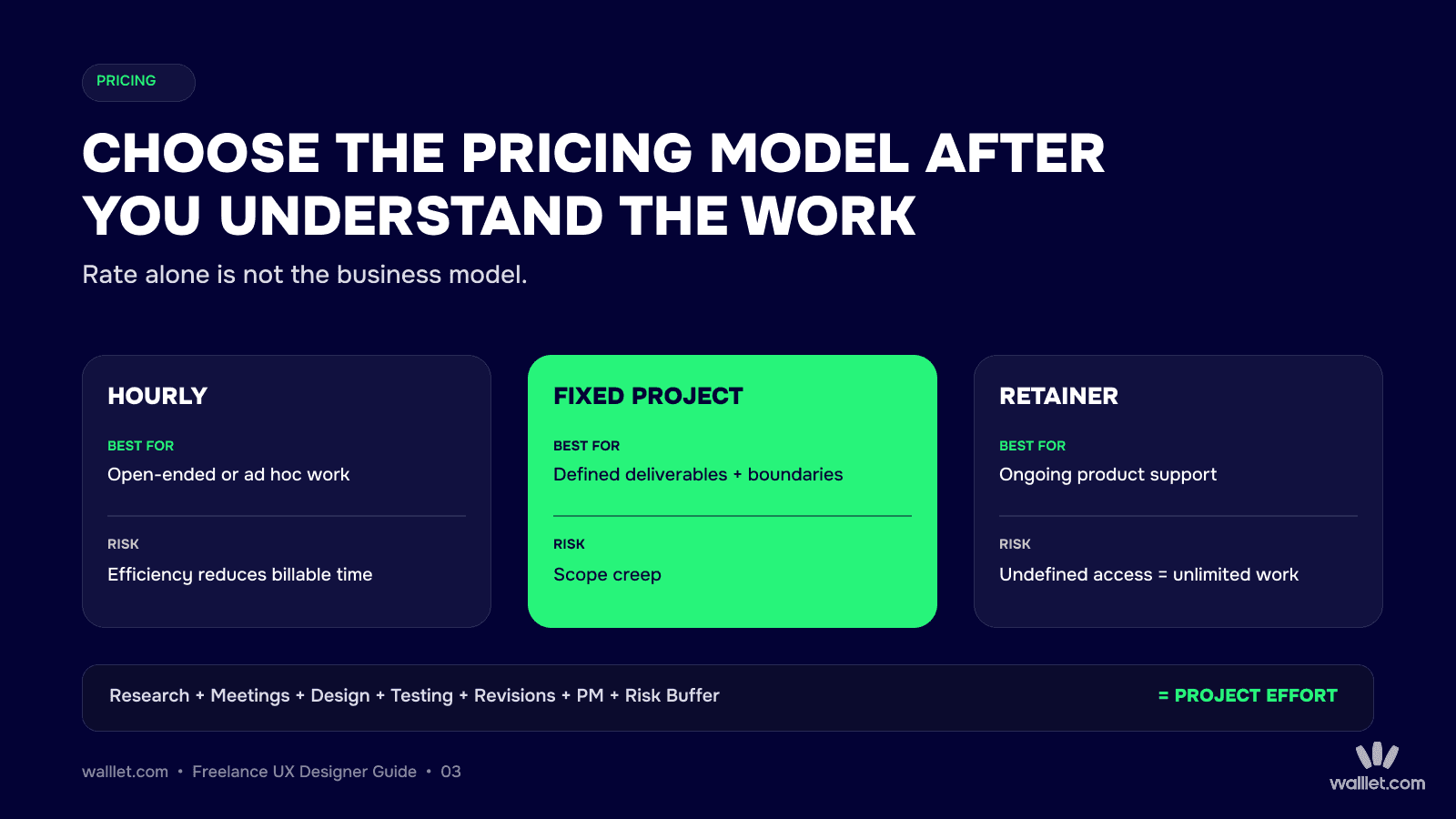
Use three pricing models deliberately:
Hourly
Best when the scope is genuinely uncertain or the client needs ad hoc support. The risk is that you get punished for becoming faster.
Fixed project
Best when the deliverable and boundaries can be defined. Price for the full effort and risk, not only design time.
A simple internal estimate:
research + meetings + design + testing + revisions + project management + risk buffer = project effort
Then convert the effort into a fee that makes business sense.
Retainer
Best when the client needs ongoing product support. A retainer should define access, expected capacity and what falls outside the agreement. “Unlimited design” is an invitation to turn one client into five jobs.
The rate itself is only one part of your income. If you invoice a foreign client, compare the amount that becomes usable after receiving fees, currency conversion and withdrawal. The PayPal vs Payoneer vs Wise vs stablecoins comparison for Nigerian freelancers is useful when you need to compare the whole route rather than one advertised percentage.
Scope UX work before the first wireframe
UX projects expand easily because the work uncovers new questions. Your proposal needs to make that visible.
Define:
research methods included;
number of user interviews or tests, if fixed;
screens or flows included;
number of review rounds;
stakeholder meetings;
prototype fidelity;
what “handoff” includes;
what counts as a new request.
For example, “redesign checkout” is vague. “Audit the current mobile checkout, run five moderated tests, redesign the checkout and payment-confirmation flow, deliver one clickable prototype and two review rounds” is a scope. That clarity makes the invoice easier to defend too.
A professional invoice makes payment easier to reconcile
Your invoice should connect the payment to real work. Include the client’s legal name where known, your own details, invoice number, issue date, due date, currency, project description, amount and the exact payment instructions for the agreed route.
If you are using foreign receiving details, do not improvise the beneficiary name or transfer type. The guide to the walllet.com IBAN account for freelancers shows why beneficiary details, currency, rail, payer type and eligibility should be checked before you send instructions to a client.
If a client cannot use PayPal, that does not end the conversation. There are other routes, but each has its own rules. See the guide to receiving USD in Nigeria without PayPal before assuming every USD account works the same way.
When “the client paid” is not the end of the payment
A payment can be sent and still be unusable.
It may be pending at the sending bank, in settlement, under review, returned because of a name mismatch or waiting for additional evidence. If the money is delayed, treat the status precisely. “Sent,” “pending,” “under review,” “returned” and “available” are different states.
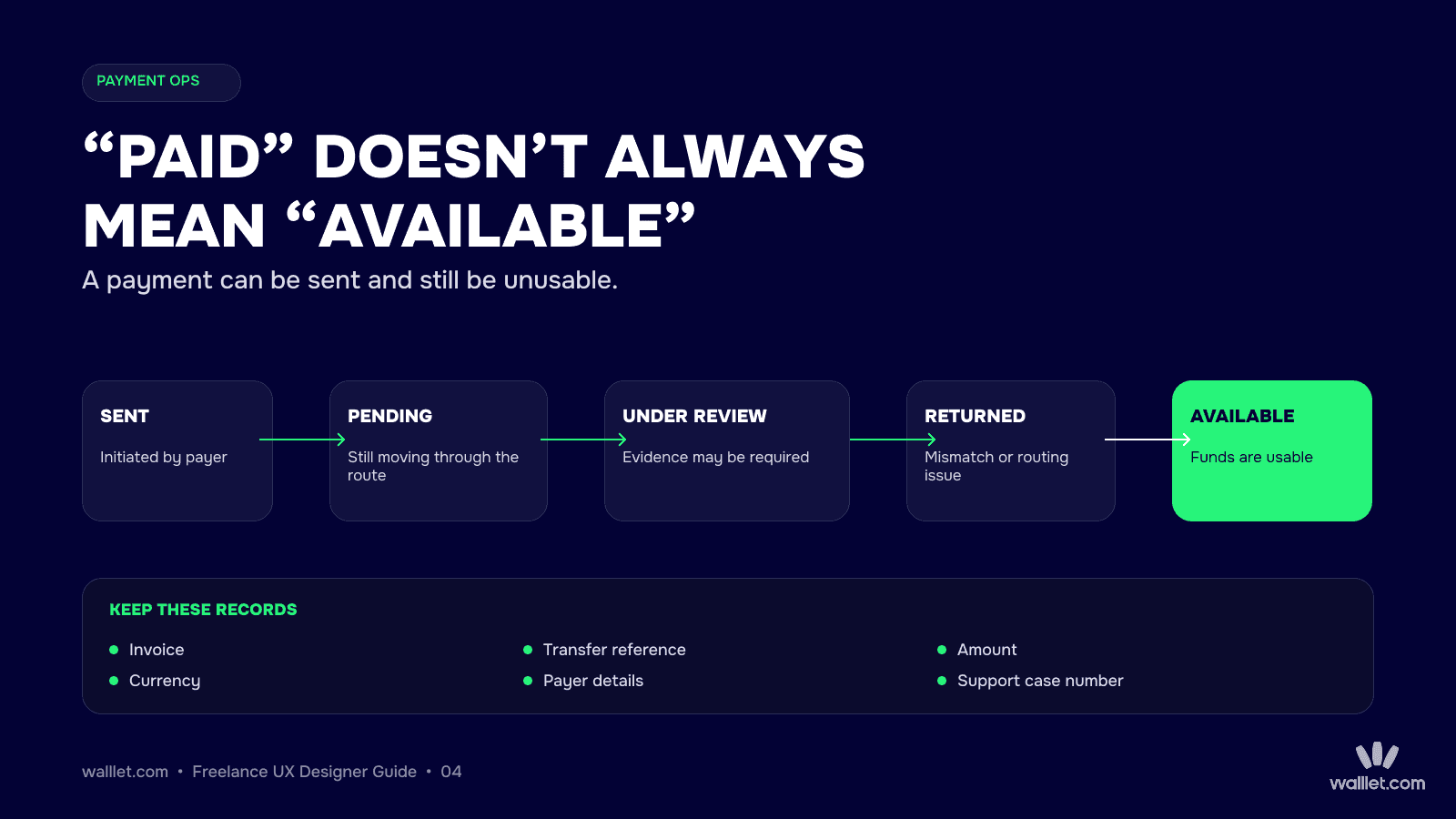
Keep the invoice, transfer reference, amount, currency, payer information and any support case number. The walllet.com route-risk guide explains why freelance payments get held, reviewed or delayed and what evidence helps you locate the failure point.
This is where experienced freelancers behave differently from beginners. They do not wait until payday to discover how the route works.
Manage the money route before it becomes a client problem
If you work with international clients, walllet.com is designed around the wider income workflow: receiving supported global income, holding dollar-linked value, spending or converting where those features are available, and cashing out through supported routes in Nigeria. Check current eligibility, fees, limits and route availability before you make any payment method part of a client contract.
Build a UX business clients can trust repeatedly
The freelancers who build durable businesses are easier to buy from.
Their offer is clear. Their case studies show decisions. Their scope prevents arguments. Their invoice makes sense to a finance team. Their payment instructions do not change halfway through the project. When something goes wrong, they have records.
That operational competence is part of your professional reputation.
If you eventually receive part of your income in USDT or USDC, treat that as another payment route with its own operating rules. The stablecoin payment guide for Nigerian freelancers explains how to agree on the token, network, address, invoice reference and transaction record before money moves.
Questions freelance UX designers ask before going independent
Do I need a degree to become a freelance UX designer?
Clients care about whether you can understand a problem and show credible evidence of your process. Formal education can help, but a portfolio, relevant experience and strong communication often carry more weight in freelance buying decisions.
How many UX case studies should I have?
Three strong, distinct case studies are enough to start if they show different kinds of problems and make your reasoning clear. Add more only when they improve the evidence for a client type you want.
Should I charge hourly or per project?
Use hourly pricing when the work is open-ended. Use project pricing when scope and deliverables can be defined. Use a retainer when the client needs recurring access to your time and product thinking.
How can a Nigerian UX designer receive money from a foreign client?
Options can include platform payouts, eligible foreign-currency receiving routes, bank transfers, domiciliary accounts, payment providers or stablecoins. The right route depends on the payer, currency, eligibility, total cost and what you need to do with the money after receipt.
Your design business deserves a payment workflow that is designed too
You already think in flows. Apply the same discipline to income: define the route before the client pays, keep proof, understand the final usable amount and keep a fallback for recurring clients.
Explore walllet.com for a more connected way to manage global freelance income ➡️
