Getting paid through one app is convenient.
Depending on one app is something else.
If your monthly income comes from clients, employers or freelance platforms outside Nigeria, your payment setup is part of your business infrastructure. An account review, changed receiving details, unsupported transfer method or payout problem can become a cash-flow problem surprisingly quickly when every invoice points to the same place.
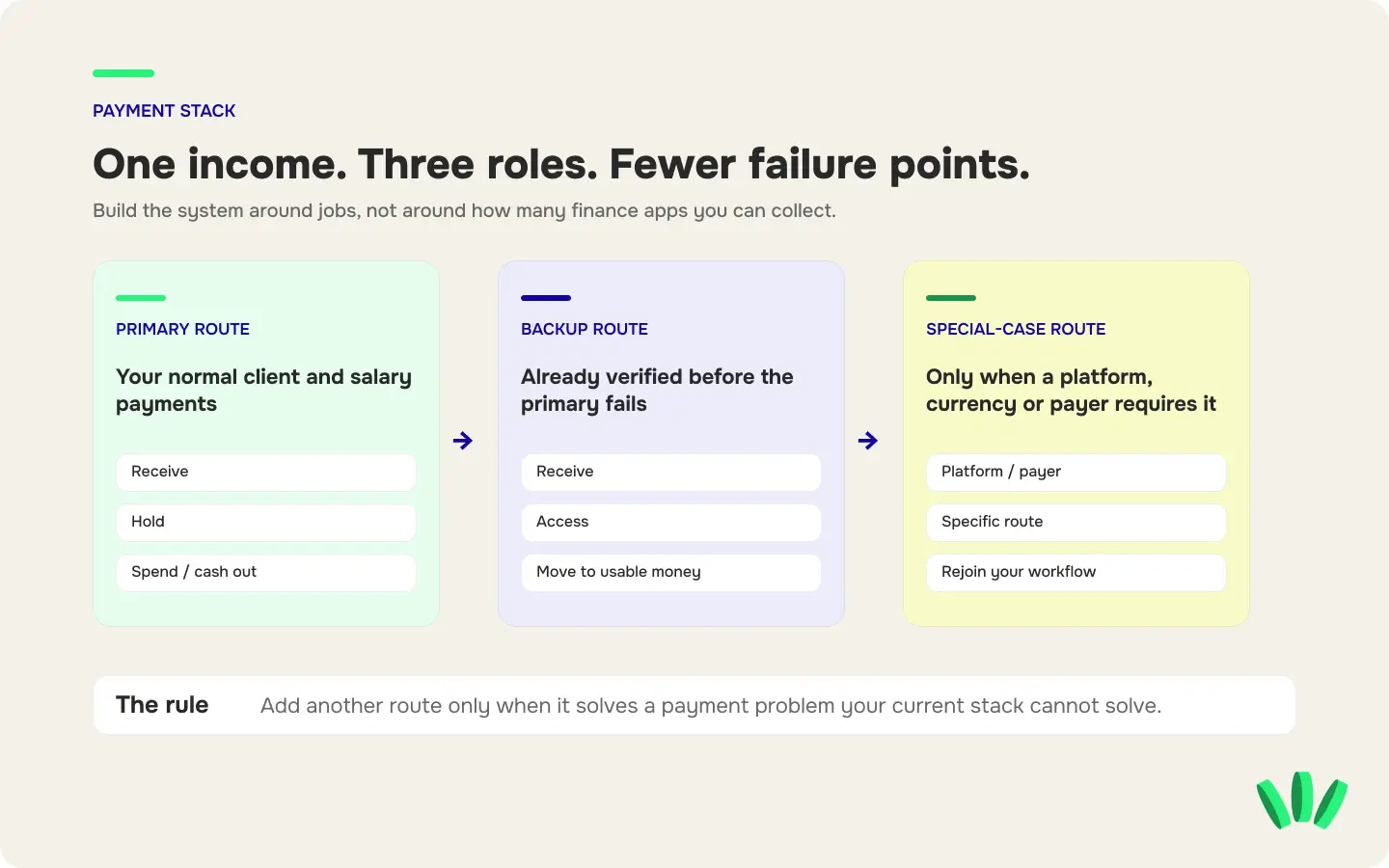
The fix is building a payment stack with a job for each route:
Primary route → receive → hold → spend or cash out
Backup route → ready when the primary route cannot do its job
Records + support → tell you where the money is and what to do when something fails
That distinction matters because getting paid is not a single transaction. It is a chain.
A client has to choose the right way to send the money. The receiving details have to work for that payment method. The payment may pass through verification or review. Then you still need to hold, convert, spend or withdraw what arrived.
If you work with clients in several markets, the first thing to understand is how Nigerian freelancers receive payments from US, UK and EU clients. The right setup depends heavily on where the payer is, what currency they use and which payment rail they can access.

A payment stack is not a list of payment apps
A freelancer payment stack is the system you use to get money from the payer to a form you can actually use.
For a direct US client, the payment may begin with ACH or wire. For a UK client, the route may use local GBP payment details. A freelance marketplace or payroll platform may control which withdrawal methods are available. A crypto-native client may prefer USDT or USDC.
The receiving method changes, but the operational questions stay remarkably similar:
Layer | Question your stack must answer |
Receive | Can this exact client, employer or platform send money through this route? |
Verify | What name, account, KYC or source-of-funds requirements apply? |
Hold | Can you keep the value in the currency or form you need? |
Use | Can you spend the money without another unnecessary transfer? |
Cash out | Can you reach your Nigerian bank when you need naira? |
Backup | What works if the first route becomes unavailable? |
Records | Can you connect the payment to its invoice, client and reference? |
Support | If money gets stuck, do you know what evidence to provide? |
This is why it’s pretty important to know:
What payment setup still works when one part of the route fails?
The simplest useful setup: primary, backup, optional special-case route
For most recurring freelance income, start with roles rather than brands.
Role | What it does | When you use it |
Primary route | Handles your normal recurring income | Most direct-client, salary or recurring payments |
Backup route | Replaces the primary when it cannot receive or release a payment | Route problem, account change, unsupported payer or provider issue |
Special-case route | Handles a payer with its own payment system | Marketplace, payroll platform or crypto-specific client |
The third route is optional.
If two routes cover everything you actually receive, stop there.
More accounts create their own operational cost: more verification, more fee schedules, more statements, more support teams and more places where transaction history becomes fragmented.
The goal is minimum dependency without unnecessary complexity.
If you are still deciding what type of account should sit at the centre of the stack, the comparison of the best dollar account options for Nigerian freelancers is a better starting point than choosing an app from its headline fee alone.
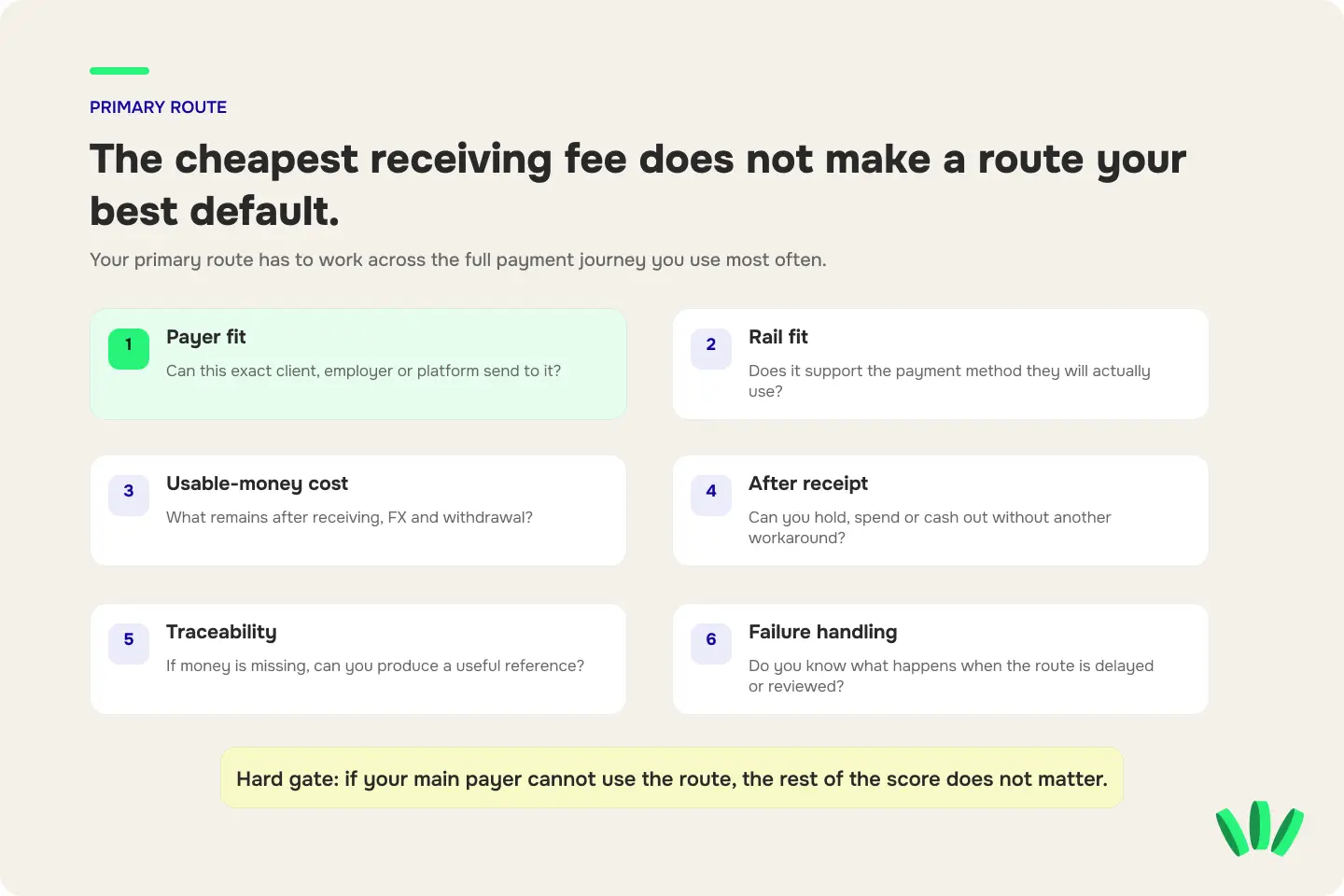
Your primary route should win on the whole payment journey
Your primary payment route is not automatically the provider with the cheapest receiving fee. It should be the route that performs best across the payment journey you use most often. Before making anything your default, check these eight areas.
1. Payer fit
Can the person or organisation paying you actually use the route? A product may let you hold USD but still not support the exact payment type your client wants to send. A route may also distinguish between payments from:
businesses
individuals
employers
marketplaces
accounts in your own name
third-party senders
Do not assume “USD account” means “anyone can send USD to it.”
For freelancers primarily paid by US clients, this is where the distinction between ACH and wire transfers becomes operational rather than academic. If the client wants ACH and your receiving route only works for wires, the account is not a good primary route for that client.
2. Rail fit
“International payment” is not one payment method. Neither is “USD account.” A US client may ask for:
routing number
account number
ACH details
domestic wire details
international wire instructions
A UK or EU payer may expect something completely different. Verify the actual payment rail before adding receiving instructions to an invoice.
If your main goal is simply finding workable USD receiving routes, how to receive USD in Nigeria without PayPal breaks down the broader options and the trade-offs between them.
3. Account type and ownership
A domiciliary account, virtual dollar account, wallet balance and card are not interchangeable.
They can all touch the same money while doing completely different jobs.
Your receiving route should answer questions such as:
Whose name appears as the beneficiary?
Can a business client send money to it?
Can the account receive the payment rail you need?
Does the money remain in USD?
How do you get the money out?
Can the account be connected to a platform?
Is the receiving account actually yours, or provided through a partner structure?
If those distinctions are still blurry, compare a domiciliary account with a virtual dollar account for freelance income before choosing your primary route.
4. Cost to usable money
Do not compare payment routes using only the first visible fee.
The useful comparison is:
invoice amount → receiving deductions → conversion → withdrawal/cash-out → usable money
Imagine Route A charges nothing to receive a payment but gives you a worse conversion rate.
Route B charges a visible receiving fee but gives you a better rate and cheaper withdrawal.
Route A can still be more expensive.
The same problem appears when comparing PayPal, Payoneer, Wise and stablecoin payment routes. The cheapest-looking first step is not necessarily the route that leaves the freelancer with the most usable money.
Compare the whole journey.
5. What happens after the payment arrives
Receiving money is only the first step. Ask:
Can I keep part of the balance in USD?
Do I have to convert immediately?
Can I pay for international work tools?
Can I move the money to my Nigerian bank?
Does another app have to sit between receiving and spending?
How many additional fees appear after the balance arrives?
A route becomes less useful each time your money has to move somewhere else before you can actually use it.
6. Limits and restrictions
Check the limits that matter for your normal invoices. Do not evaluate an account based only on a large theoretical maximum. If your invoices are usually $500, your requirements may be very different from those of a consultant regularly receiving $5,000 or $10,000. Before a larger-than-normal payment, check:
receiving limit
transaction limit
withdrawal limit
payer restrictions
verification status
supporting-document requirements
currency restrictions
payment rail restrictions
A route that worked for three $300 invoices is not automatically ready for a $6,000 payment.
7. Traceability
If the client says “I sent it” and the money is nowhere in your balance, what can you actually trace? Depending on the transfer, useful evidence may include: Invoice number, payment reference, transfer receipt, ACH trace information, wire reference, platform withdrawal ID, transaction ID, account statement, and payment status.
For international wires specifically, knowing how to trace a missing wire with an MT103 or UETR can turn a vague “where is my money?” support request into an actual payment investigation.
A good payment route does not merely tell you that something is pending. It gives you enough information to investigate what happened.
8. Failure handling
Ask this before the first problem:
What happens if this route stops working on payday?
Payment problems do not all mean the same thing. A transaction can be:
pending
under review
rejected
returned
reversed
delayed by the sender
delayed by the receiving provider
delayed somewhere between the two
Those cases require different responses.
The guide to why freelance payments get held, reviewed or delayed is useful here because it maps the failure points across the route rather than treating every delay as the same problem.
Your primary provider does not need to be perfect. It needs to be understood.
A backup route is not “another app on my phone”
A real backup is already capable of doing the job.
If you opened an account six months ago but never finished verification, never checked its current receiving details and never worked out how to withdraw from it, you do not have a backup payment route.
You have an account.
A usable backup should meet five conditions:
It is verified and currently accessible.
It accepts the payer type you depend on.
You know the correct receiving instructions.
You know how money becomes usable after receipt.
It does not duplicate every important failure point of your primary route.
That last point matters.
If both your “primary” and “backup” depend on exactly the same provider account, account review or receiving infrastructure, the second route may not protect you from the event you are trying to survive.
Should your backup use a different provider?
Usually, yes, when the purpose is continuity.
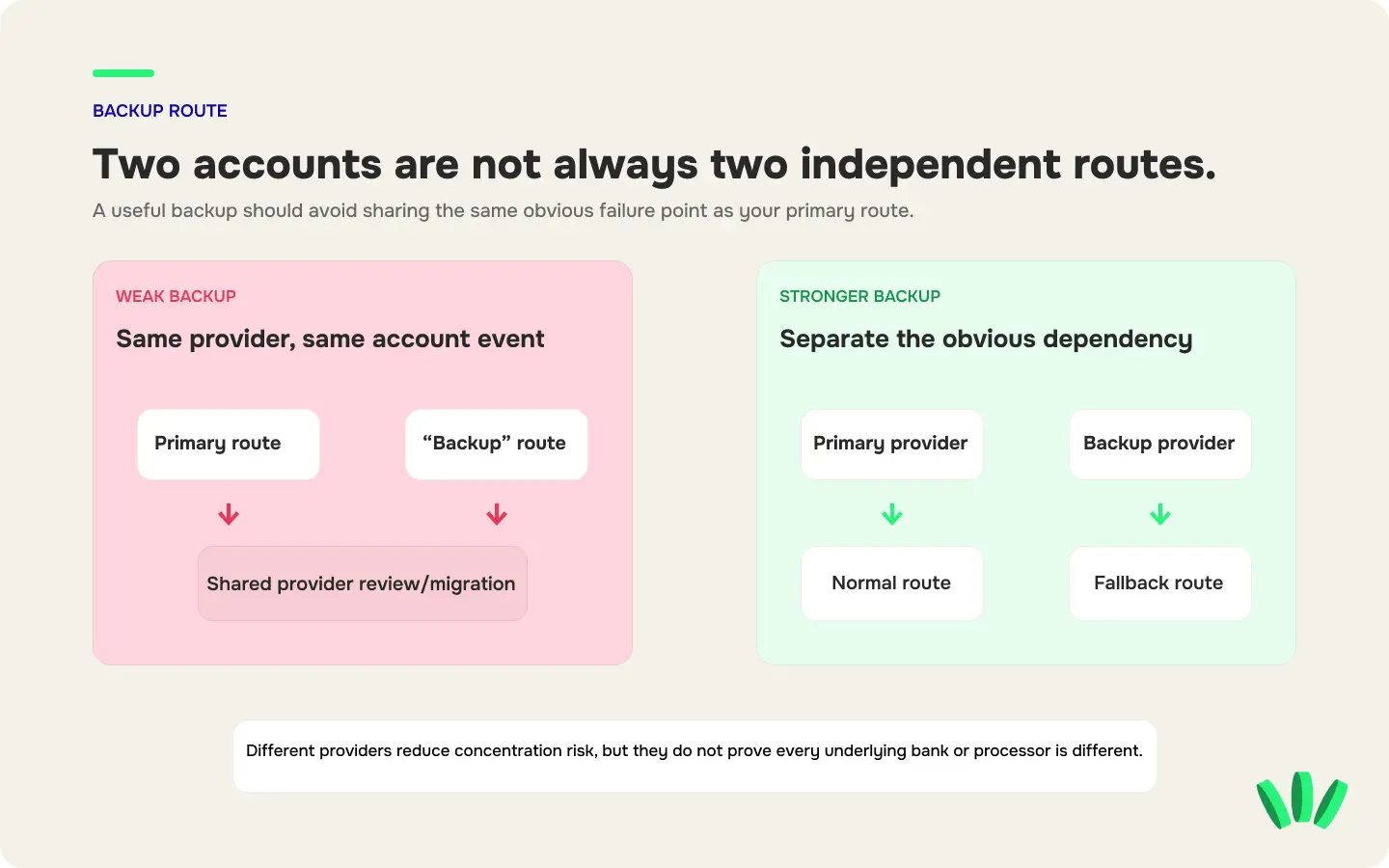
Two receiving methods under one provider can still be useful. They may solve a narrow problem, such as supporting two currencies or two transfer types.
But they may share larger dependencies.
A provider-wide account review, change in receiving details, service interruption or banking-partner migration can affect more than one route at once.
That does not mean you need to investigate every hidden bank, processor and vendor behind every financial app. In many cases you cannot.
It means your backup should be genuinely separate where reasonably possible.
A useful rule is: Primary and backup should not fail for exactly the same obvious reason.
Test the backup before a real invoice depends on it
The worst time to discover your fallback route has a problem is after your primary route has already failed. Before treating a route as your backup:
Complete verification → Confirm the beneficiary name → Confirm the supported currency → Confirm the receiving method → Check which payer types are accepted → Understand the receiving cost → Understand conversion and withdrawal costs → Verify your naira exit or spending path → Save the official support channel → Confirm account access and recovery → Test the route with a small legitimate transaction where appropriate → Save the resulting payment record.
A test is not only about whether the money arrives. Check what happens afterward.
If a small payment can enter the account but you cannot withdraw, convert or use it the way you need, you have not validated the full route.
Some clients need their own branch of the stack
Not every payer should be forced through the same route. Suppose you have:
two US clients paying invoices;
one European client;
occasional marketplace work;
one crypto-native client.
You may reasonably use different receiving methods.
That means each payer can enter your stack through the most appropriate front door.
For stablecoin-paying clients, for example, the risk is different from a bank transfer. The main operational checks include the asset, network, receiving address and transaction verification. The stablecoin payment checklist for freelancers covers those checks before you share a wallet address with a client.
The principle stays the same:
different entry point, controlled payment workflow.
Build a payment control sheet before you need support
A backup route solves only half the continuity problem. The other half is remembering exactly how your system works. Create one private payment control sheet with a row for every route you maintain.
Field | What to record |
Route role | Primary / backup / special-case |
Provider | Current provider |
Currency | USD / GBP / EUR / supported asset |
Beneficiary name | Exact receiving name |
Receiving method | ACH / wire / local transfer / platform payout / stablecoin |
Account details | Secure reference to the current details |
Allowed payer type | Client / employer / platform / first-party / other |
Important restrictions | Relevant limits or exclusions |
Receiving cost | Current fee or link to current pricing |
Conversion path | How and where conversion happens |
Naira exit | Final withdrawal route |
Support channel | Official support path |
Last verified | Date you last checked the setup |
Last tested | Date a payment last completed |
Clients using it | Which recurring payers have these details |
Open invoices | Payments that may still arrive through this route |
Do not turn this sheet into a security liability.
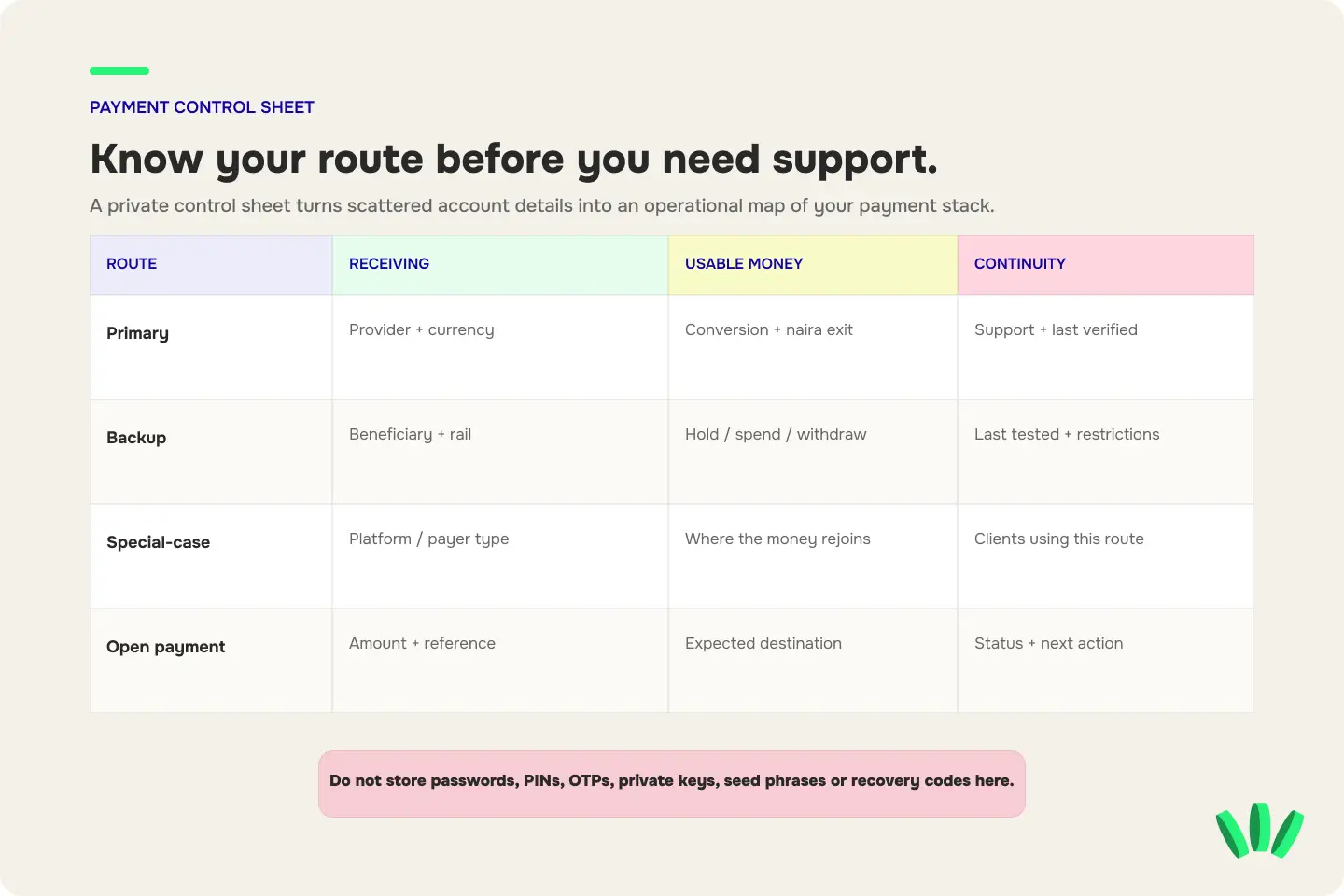
Do not store:
passwords
PINs
OTPs
private keys
seed phrases
recovery codes
The control sheet is a map of your payment system, not a vault.
Keep a payment evidence pack beside the control sheet
When a payment is reviewed, returned or missing, support may need evidence. Build the evidence trail while payments are working. For each material client payment, retain the records that apply.
Commercial evidence
contract or scope of work
invoice
client or company name
service description
Payment evidence
payment reference
sender confirmation
amount
currency
transaction ID
platform withdrawal ID
transfer confirmation
Settlement evidence
receiving-account record
statement
conversion record
withdrawal or cash-out record
A client screenshot saying “paid” is useful context. It is not always enough to trace the underlying transfer. If an ACH payment is returned, for example, the ACH return code often tells you what failed and who needs to fix it. That is more actionable than asking the client to resend the same payment immediately.
Know when to switch before emotion makes the decision
A backup does not mean moving every payment the first time your primary route feels slow. Set switching triggers in advance.
Trigger | First response |
Receiving details changed | Stop issuing old details, identify in-flight payments and update affected clients |
Required rail is no longer supported | Move that payer to a verified route supporting the required method |
Payment is repeatedly returned | Diagnose the return reason before asking the client to resend |
Account enters review | Follow the review process and avoid directing new payments there if acceptance is uncertain |
Client cannot use the route | Give the client your prepared alternative |
Costs materially change | Compare the full cost to usable money |
Withdrawal path stops fitting your needs | Evaluate the entire replacement route |
Platform changes payout requirements | Update the relevant special-case route |
Provider changes receiving details | Update records, invoices and recurring payers before the next payment |
This prevents two bad reactions.
Reaction one: sending the client three new account options because one transaction is late.
Reaction two: continuing to send invoices with obsolete details because nobody remembers which clients have them saved.
A continuity plan should make the next action obvious.
One client should usually get one preferred instruction, not your entire stack
Having multiple routes does not mean turning every invoice into a payment menu.
For a recurring client, choose the route that best matches their normal payment process and send complete instructions for that route. Keep the backup in reserve.
If the client cannot use the primary route, then provide the alternative. The distinction is simple:
Internally: maintain redundancy.
Externally: give the client clarity.
This also improves reconciliation. When money arrives, you already know which invoice was expected through which route.
Do you actually need three, four or five payment methods?
Usually not. Add another payment method when it solves a problem your current stack cannot solve. Good reasons include:
a client needs a payment rail your existing routes do not support;
a marketplace has limited payout methods;
you regularly receive another currency;
you need a genuinely independent backup;
a client can only use a specific payment method;
one route is unsuitable for larger payments;
you need a separate business workflow.
Weak reasons include:
the app is trending;
someone on social media recommended it;
signup is free;
the homepage says “global”;
you are worried that two accounts do not look like enough.
Every route you add becomes another system you need to understand.
The freelancer payment stack worksheet
Score every candidate route from 0 to 2:
0: does not meet the requirement or has not been verified
1: works with a meaningful limitation
2: clearly fits the requirement
Criterion | Primary | Backup |
Works for my main payer type | /2 | /2 |
Supports the required payment rail | /2 | /2 |
Receiving details are valid and current | /2 | /2 |
Total cost is acceptable | /2 | /2 |
I can hold or use the money as needed | /2 | /2 |
I have a working naira exit | /2 | /2 |
Normal invoice size fits current limits | /2 | /2 |
Payment can be traced | /2 | /2 |
Support path is known | /2 | /2 |
Route has been tested | /2 | /2 |
Does not duplicate the primary route's main dependency | N/A | /2 |
Do not choose purely by total score. Some criteria are hard gates.
A payment route can score well on fees, interface and conversion while still being useless if your largest client cannot pay into it.
A backup scoring highly everywhere else is still a bad backup if it cannot receive the payment rail your recurring client uses.
Example: a Nigerian freelancer with direct clients and platform income
Consider a UX designer in Lagos with:
two recurring US clients;
occasional UK work;
marketplace income;
local expenses in naira;
international software subscriptions.
A practical stack could look like this.
Primary route
A verified receiving account supporting the payment method used by the two recurring US clients.
The freelancer understands:
beneficiary details
receiving method
costs
holding options
naira exit
support process
Backup route
A second verified provider that can accept the critical direct-client payment type.
The freelancer has already checked:
receiving instructions
account name
withdrawal path
limitations
support channel
It is ready before anything goes wrong.
Platform-specific route
The withdrawal method currently available and appropriate for the freelancer's marketplace account.
This route is tracked separately because the marketplace controls the first part of the payment journey.
UK client
If the primary or backup route already supports the required GBP receiving method, use it.
If neither does, the new requirement may justify adding another route.
That is a real reason to add complexity.
“Everyone is using this new app” is not.
Five payment-stack mistakes that look harmless until payday
1. Relying on one account for every client
Simple while it works. A single operational dependency when it does not.
2. Opening four backup apps but testing none
Account creation is not continuity planning.
3. Choosing the backup because it is cheap
The backup's first job is to work when the primary cannot.
Cost matters after payer fit, access and usability.
4. Forgetting which client has which details
When receiving details change, this turns a manageable update into an inbox search. Document it.
5. Comparing only the receiving stage
A payment is not finished because a number appeared in an app. Compare the route until the income becomes money you can actually hold, spend or cash out.
Where walllet.com fits in the payment stack
The useful way to evaluate walllet.com is the same way you should evaluate every other route: by the job it performs in your actual income workflow. Do not start with the technology underneath it. Start with questions such as:
Can my payer use the receiving route available to me?
What receiving details do I get?
What currency can I receive?
What happens after the money arrives?
How do I spend or cash out?
What fees and conversion rates apply?
What happens when a transaction needs attention?
For the receiving side specifically, the walllet.com IBAN Account guide explains how the account is intended to fit into international freelance and global-income payments.
Whether walllet.com becomes your primary route, backup route or does not fit a particular client should depend on the same framework used throughout this article.
A financial product earns a place in your stack by doing a defined job.
Not by being another icon on your phone.
If you are trying to reduce the number of handoffs between receiving income, holding dollars, spending and cashing out to naira, compare your worksheet against the receiving routes currently available in walllet.com. Verify the payer type, rail, fees, limits and exit path shown for your account before adding any payment details to an invoice.

