A client sends you $1,000. One provider calls its dollar account free. Another charges $1 to receive the payment.
The free account can still leave you with less money.
Its exchange rate may be weaker. It may charge for conversion, withdrawal or card funding. It may accept ACH from a company but reject a personal transfer from your client. It may receive the money successfully while giving you no practical way to spend USD or cash out to naira.
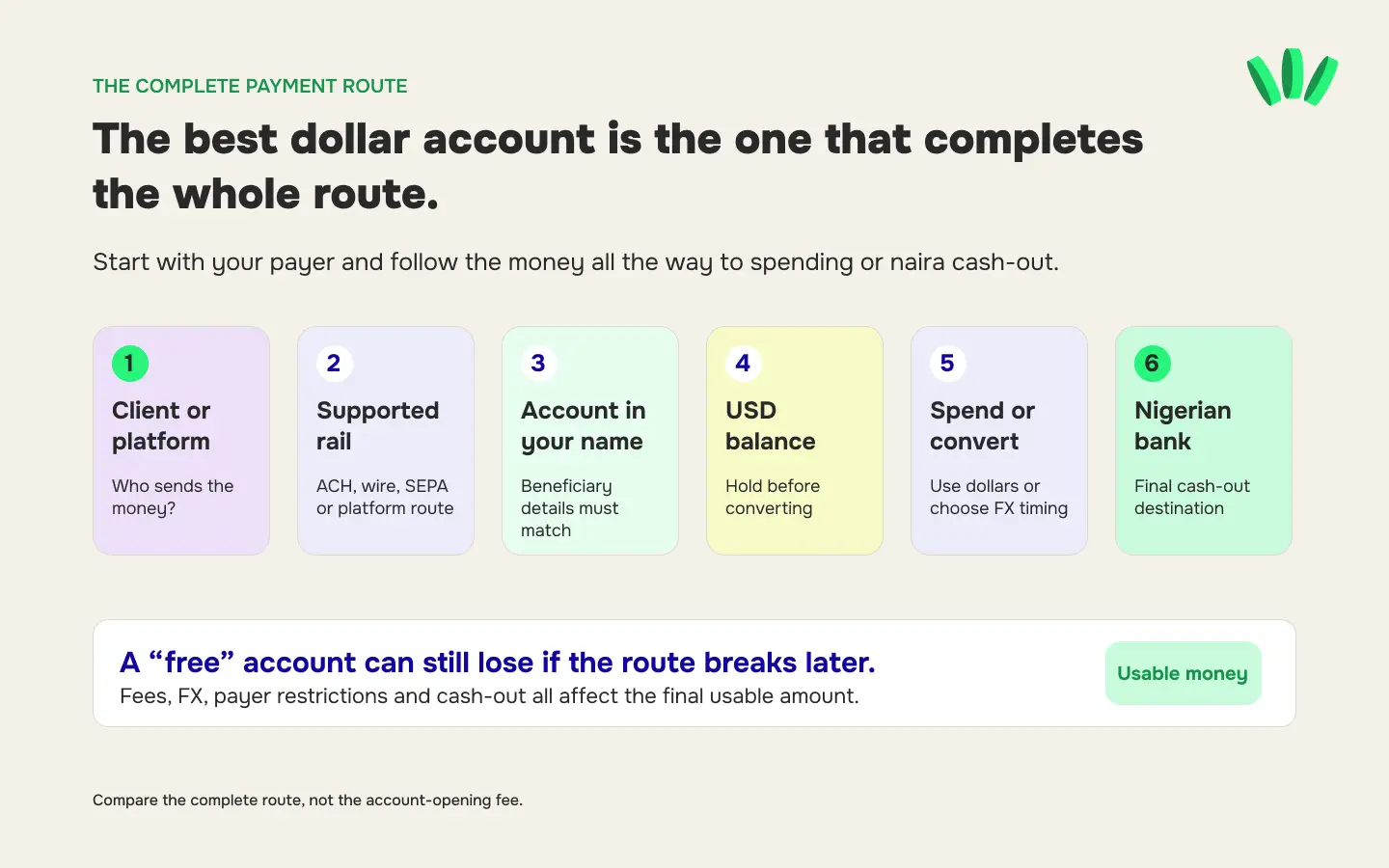
For a Nigerian freelancer, the best dollar account is the account that completes the whole route:
Client or platform → supported payment rail → account in your name → USD balance → spending or conversion → Nigerian bank account
This article was checked against public product information available on August 18, 2026. Provider fees, eligibility, limits and payment routes can change. Verify the current terms and the quote shown inside your account before moving a full invoice.
Start with the payer, not the app
Your client’s location and payment method narrow the choice before fees enter the discussion.
A US client may want to send ACH or a domestic wire. A UK client may use Faster Payments or Bacs. A European client may ask for an IBAN and send through SEPA. A platform such as Upwork controls which withdrawal methods you can add.
The guide to getting paid by US, UK and EU clients in Nigeria explains the account details and transfer rails each payer may need.
If PayPal is unavailable or unsuitable, compare the wider set of ways to receive USD in Nigeria without PayPal. A dollar account is only one possible route.

Quick answers
What is the best dollar account in Nigeria?
There is no unconditional winner. The strongest option for a freelancer is the account that supports the actual payer, currency and transfer rail, keeps the account in the freelancer’s legal name, permits USD holding and provides a workable spending or naira cash-out route.
Can Nigerian freelancers receive ACH?
Yes, when an eligible provider gives the freelancer US receiving details that explicitly accept incoming ACH payments. A routing number alone does not prove ACH support. Confirm the accepted payer types and use the ACH routing number shown for that account.
Can a dollar account hold money without conversion?
Some accounts let users retain a USD balance until they choose to spend, transfer or convert it. Others automatically convert certain incoming currencies or settle directly into naira. Check the treatment of each currency before sending payment instructions.
Which fees should be checked first?
Check the receiving fee, executable exchange rate, FX spread, conversion charge, withdrawal fee and any card-funding or spending cost. The cheapest route is the one that leaves the highest usable amount, not the one with the lowest account-opening fee.
Best dollar account shortlist for nigerian freelancers
The following options solve different payment problems. “Best for” means the provider is worth checking first for that use case. It does not guarantee eligibility, approval, acceptance by a particular platform or the lowest final cost.
Option | Best starting point for | Main strength to verify | Main risk or limitation to check |
walllet.com | Nigerian freelancers who want receiving, USD holding, online spending and naira use in one route | USD, EUR and GBP details in the user’s own name; supported card and cash-out options | Account, card, platform and cash-out eligibility may vary |
Cleva | USD-first freelancers receiving from Upwork, US clients or US platforms | ACH, FedNow and wire receiving; public pricing currently distinguishes Upwork deposits from other deposits | GBP and EUR deposits are converted to USD; check the live fee and conversion treatment |
Grey | Freelancers paid in several currencies | USD, GBP and EUR account options, plus several US payment rails | Receiving, conversion and withdrawal charges are separate; compare the complete quote |
Raenest | Recurring earners who value predictable public receiving fees | USD ACH and wire receiving alongside GBP and EUR options | Receiving cost alone does not show the conversion rate or final naira amount |
Payoneer | Freelancers who rely on established marketplace and business-payment connections | Broad platform relationships, local receiving details and payment-request options | Pricing can depend on country, account, payment method and withdrawal route |
Nigerian domiciliary account | Freelancers who want a conventional Nigerian bank relationship or receive international wires | Foreign-currency bank balance and bank documentation | Do not assume the account accepts US ACH, offers inexpensive wires or includes an online USD spending route |
A freelancer with three US clients may choose differently from a remote worker paid in GBP. An Upwork specialist may care more about platform acceptance than an agency receiving international wires. Someone paying for software in USD should care about the spending route before converting everything to naira.
The 11 checks that matter more than “free”
1. Can your payer use the account?
A dollar balance does not prove that a client can pay it. Confirm:
whether the account accepts ACH, FedNow, domestic wire or SWIFT;
whether payments can come from individuals, companies or both;
whether third-party business payments are permitted;
whether the account accepts recurring salary or platform payouts;
whether the sender’s country is supported;
whether the payer must include an invoice reference.
For Upwork income, compare the withdrawal methods available inside Upwork rather than assuming any US account will work. The Upwork withdrawal guide for Nigerian freelancers compares local-bank, US-account and Payoneer routes.
2. Is the account in your legal name?
The beneficiary name should match the identity or business name attached to your contract, invoice and platform profile.
Name matching matters because a payer, platform or compliance team may need to confirm that the receiving account belongs to the person who earned the money. A third-party or pooled account can create problems during platform verification, payment review or a dispute. Ask whether the provider can supply:
the exact beneficiary name;
account details showing that name;
an account confirmation document;
statements or transaction records;
business-name details if you invoice through a registered company.
The walllet.com IBAN account guide explains why account ownership and supported payment rails must be checked separately.
3. Does the account accept the correct rail?
ACH, domestic wire and SWIFT are different routes.
An ACH routing number may not accept a wire. A wire routing number may not accept ACH. SWIFT transfers can involve intermediary banks even when both parties describe the payment as a bank transfer.
Before invoicing, send the client one exact instruction:
Currency: USD
Payment method: ACH credit
Beneficiary: [Exact legal name]
Routing number: [ACH routing number]
Account number: [Account number]
Reference: [Invoice number]
Amount: [Invoice amount]
Do not send every routing number on the account screen and ask the client to choose.
4. Can you keep the income in USD?
Holding USD gives you control over when conversion happens.
That matters when you:
pay for software, hosting, advertising or subscriptions in dollars;
keep part of your income for future USD expenses;
want to convert only the amount needed for local bills;
receive a large payment but do not need the full naira value immediately.
Check whether the provider holds a true USD-denominated balance, automatically converts incoming money or gives you a different dollar-linked balance. Also check whether GBP or EUR payments remain in their original currencies or are converted on receipt.

If you want to compare the full receive-hold-spend-cash-out route, check the walllet.com account options available to you.
5. What is the complete cost?
“Free account” usually describes account opening or maintenance. It says little about the cost of using the account. Calculate:
Invoice amount − receiving deductions − FX cost − withdrawal cost − spending cost = usable money
Two current public pricing examples show why the fee model matters:
Cleva lists ACH and FedNow deposits at 0.8%, with a $2 minimum and $5 maximum, while eligible Upwork deposits are listed separately as free.
Raenest lists a $1 flat fee for USD ACH deposits and $10 for USD wire deposits in Nigeria.
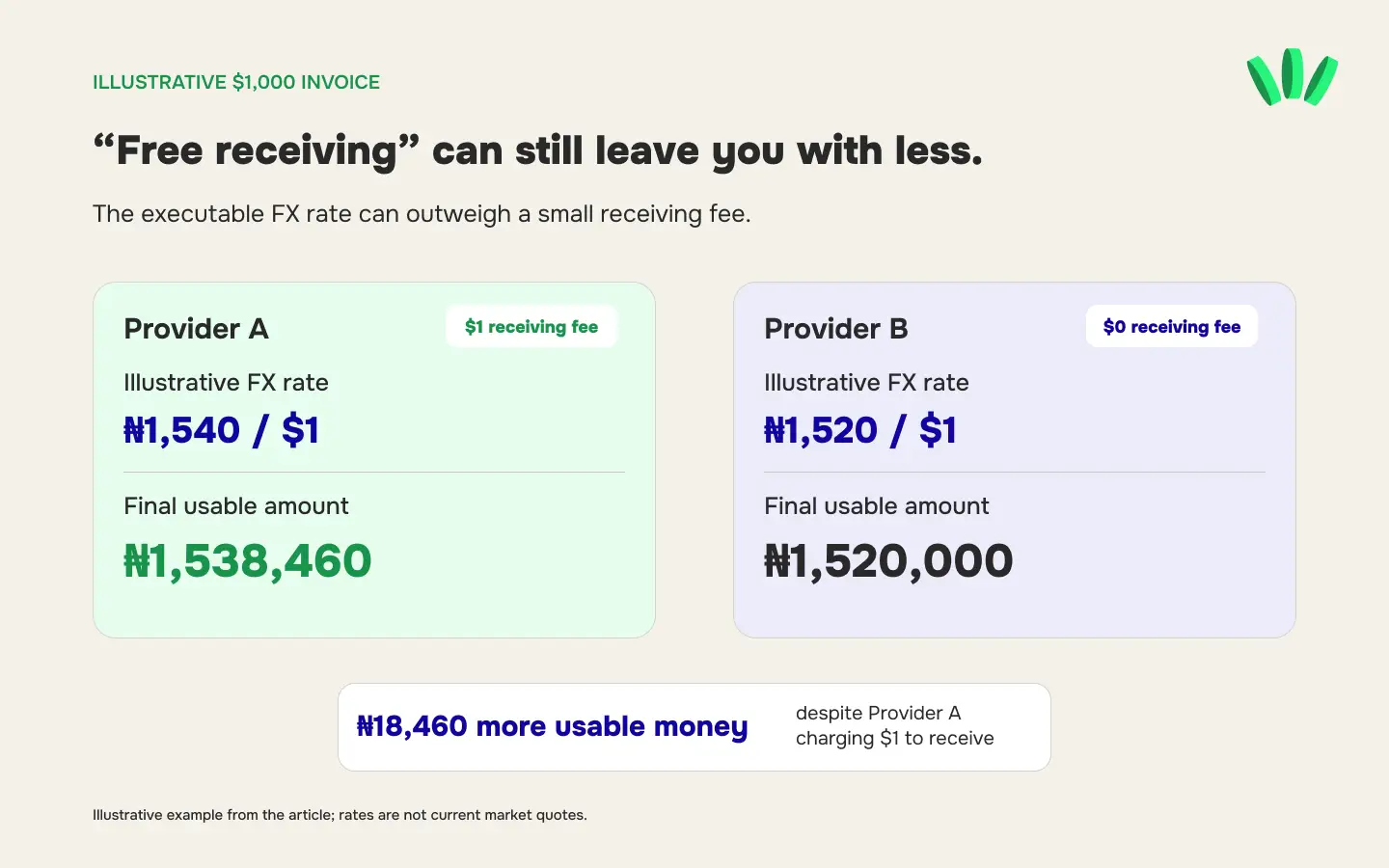
Those figures describe receiving charges, not the complete value of either route. Consider an illustrative $1,000 invoice:
Route | Receiving deduction | Illustrative executable rate | Withdrawal cost | Final amount |
Provider A | $1 | ₦1,540 per USD | ₦0 | ₦1,538,460 |
Provider B | $0 | ₦1,520 per USD | ₦0 | ₦1,520,000 |
Provider B advertises free receiving but leaves ₦18,460 less in this example. The rates are illustrative, not current market quotes. The calculation shows why the conversion quote can matter more than a small deposit fee.
6. What exchange rate will you execute?
A provider can advertise a competitive rate without showing the rate available for your transaction.
Compare the quote at the same time, for the same USD amount and the same destination. Record:
USD amount being converted;
displayed USD-to-NGN rate;
separate conversion fee;
final NGN amount;
withdrawal fee;
quote expiry time.
The practical comparison is:
Final NGN amount ÷ USD amount deducted = effective naira received per dollar
This calculation captures visible fees and rate differences in one number. It does not capture later bank charges or failed-payment costs, so record those separately.
7. Can you use the dollars before converting them?
A dollar account should support the next job your money needs to do.
Possible next steps include:
paying for international work tools;
funding a supported virtual dollar card;
sending USD to another permitted account;
paying a contractor or supplier;
retaining part of the balance;
converting only what you need to naira.
A virtual card does not guarantee that every merchant will accept it. Card programme rules, merchant category, billing details, transaction currency and account status can affect authorization. The walllet.com virtual USD Mastercard guide explains the current card fees, eligibility conditions and intended online-payment use.
8. How does cash-out work?
Check the route from the dollar balance to your Nigerian bank account before the first large payment arrives. You need to know:
whether NGN withdrawal is currently available;
which Nigerian banks are supported;
whether the destination account must be in your name;
minimum and maximum amounts;
the executable conversion quote;
withdrawal charges;
expected processing stages;
what reference appears on the bank credit.
If part of your income arrives as USDT or USDC, the guide to cashing out stablecoins to naira covers the additional token, network and bank-destination checks.
9. What happens to larger or unusual payments?
A route that worked for $200 may require additional checks for $5,000. Providers may review:
unusually large payments;
rapid changes in payment volume;
a new payer;
a mismatch between the account name and invoice;
unclear payment references;
payments from restricted industries or countries;
source-of-funds evidence;
repeated attempts after a failed transaction.
Keep the contract, invoice, payer details, payment instruction, transfer confirmation and account statement together. Splitting an invoice into smaller payments to avoid a review can create more problems and may breach provider rules.
10. Can you trace a missing or short payment?
Support quality matters most when the normal route fails.
A useful provider should give you a payment reference and tell you what evidence support needs. For a bank transfer, that may include the sending-bank confirmation, trace number, amount, currency, date and beneficiary details.
International wires can arrive short because sender, intermediary and receiving institutions may each deduct charges. The guide to why international wires arrive short explains how to document and investigate those deductions.
For reviews and delays, use the freelance payment route-risk guide to identify where the payment may be stuck and which proof to save.
11. Can the route survive a provider problem?
No payment provider should be your only route to income. Maintain:
one primary receiving route;
one independent backup with a different provider or banking partner where possible;
current payment instructions for both;
exported statements and transaction records;
a process for notifying clients;
a small successful test on the backup route.
Do not wait for an account restriction, service outage or policy change before testing the alternative. A backup account that has never received a payment is an assumption.
Which option fits your income pattern?
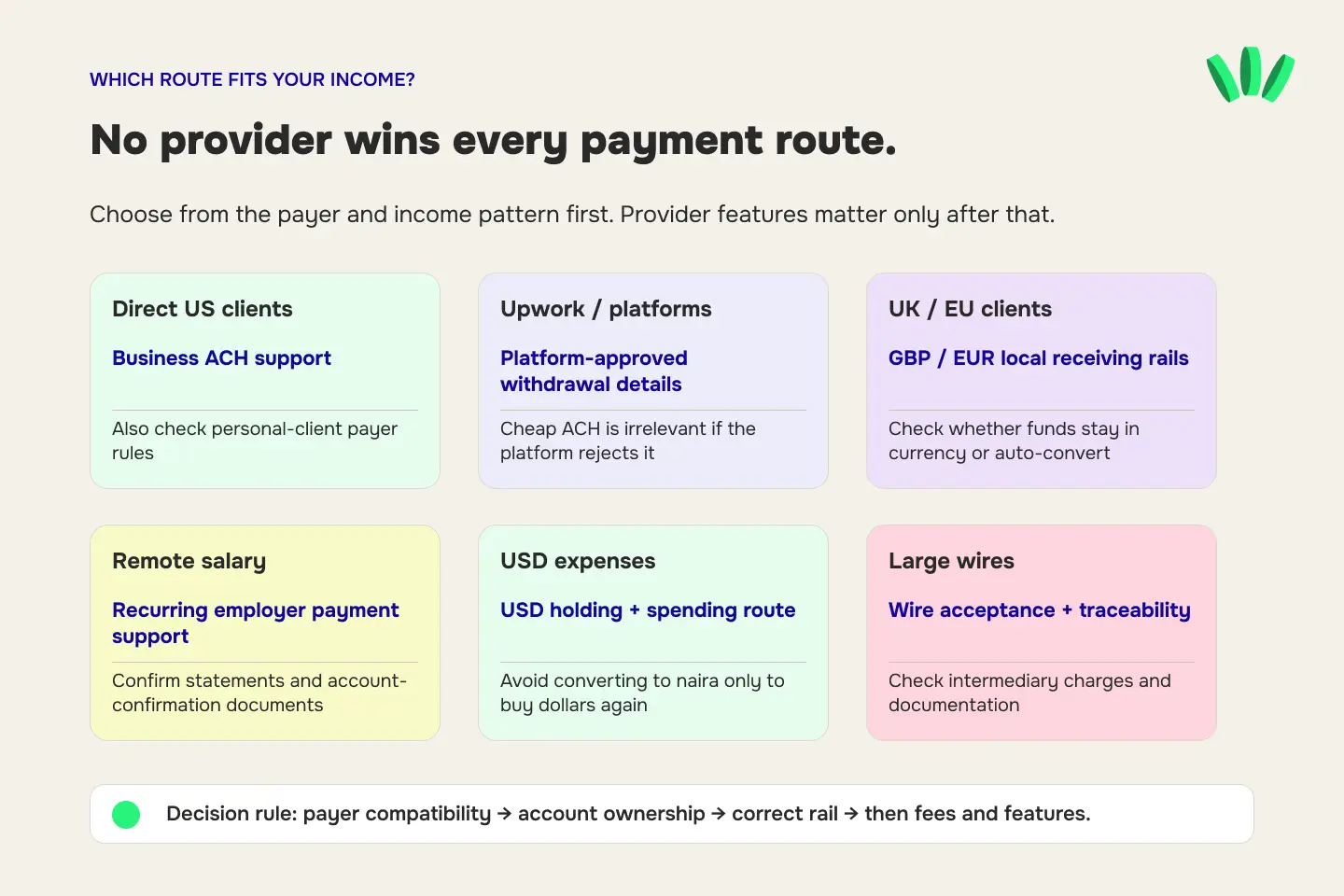
Direct US clients
Prioritize an account in your name that explicitly accepts business ACH payments. Confirm whether payments from personal US bank accounts are also accepted when a client operates as an individual.
Compare ACH receiving cost, USD holding, documentation and the final naira quote.
Upwork and other platforms
Start inside the platform’s withdrawal settings. Confirm which account types, countries and beneficiary names the platform accepts.
A provider with inexpensive ACH receiving is irrelevant if the platform will not approve the account.
UK and European clients
Prioritize GBP and EUR receiving details that match the client’s normal local payment route. Check whether those currencies remain separate or are automatically converted to USD.
Automatic conversion may simplify the account but remove control over timing and rate.
Remote salary
Check whether recurring employer payments are permitted and which payroll details the employer needs. Ask whether the provider can issue account-confirmation documents and statements suitable for HR, payroll and compliance reviews.
USD income with regular dollar expenses
Prioritize USD holding and a supported spending route. Converting income to naira and later buying dollars to fund another card creates an extra conversion cycle.
Large or occasional international wires
Compare a domiciliary account and providers that explicitly accept domestic or international wire transfers. Confirm intermediary charges, incoming-wire fees, documentation and tracing procedures.
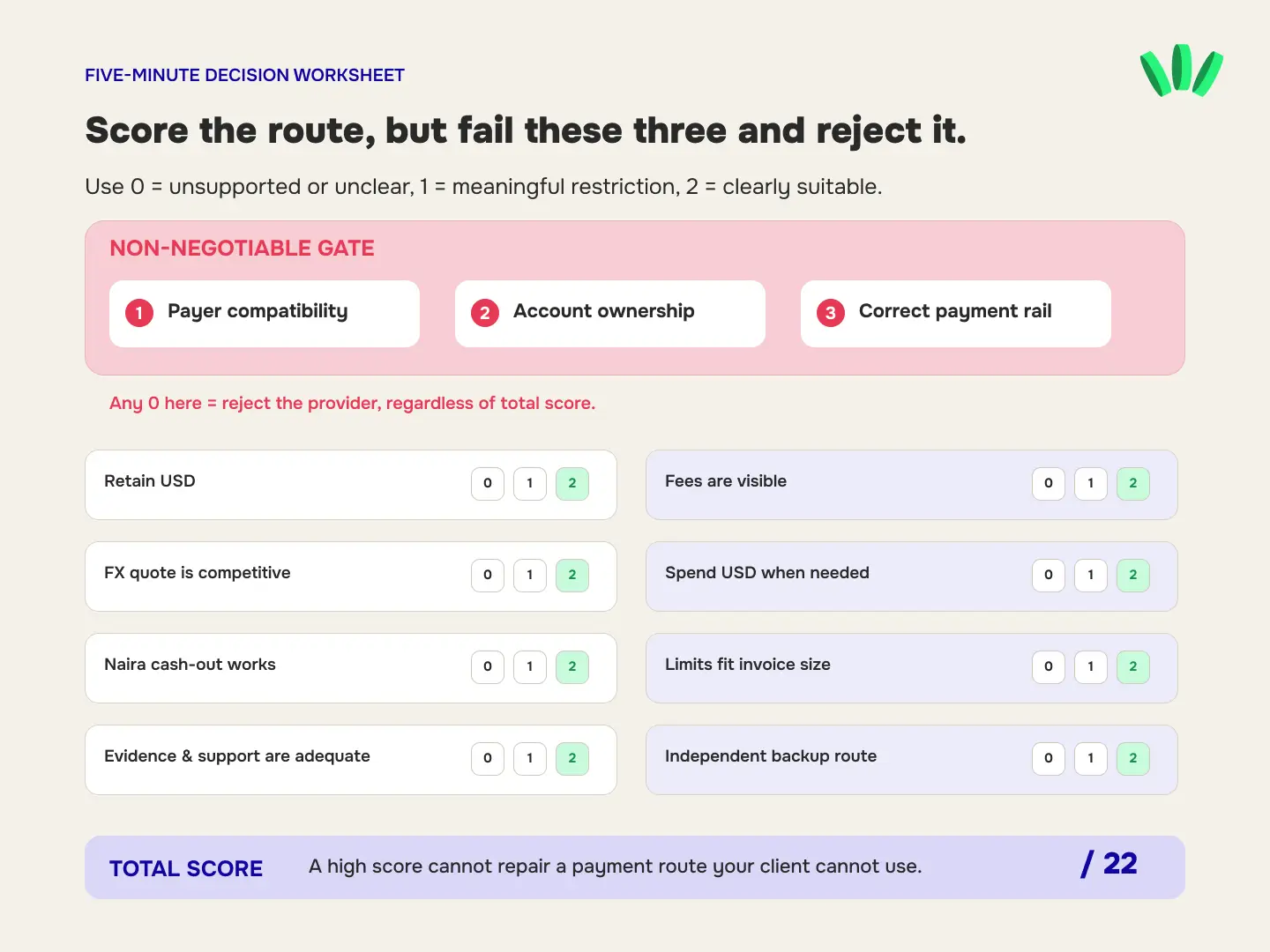
A five-minute decision worksheet
Score each provider from 0 to 2:
0: unsupported or unclear
1: supported with a meaningful restriction
2: clearly supported and suitable
Criterion | Score |
My client or platform can pay it | /2 |
The account is in my legal or business name | /2 |
It accepts the correct payment rail | /2 |
It lets me retain USD | /2 |
Total fees are visible | /2 |
The executable FX quote is competitive | /2 |
I can spend USD when needed | /2 |
Naira cash-out works for my account | /2 |
Limits fit my normal invoice size | /2 |
Payment evidence and support are adequate | /2 |
I have an independent backup route | /2 |
Total | /22 |
Reject any provider that scores zero on payer compatibility, account ownership or the required payment rail. A high total cannot repair a route that your client cannot use.
Test the route before moving recurring income
Run one small payment through the complete journey:
Confirm your account name and payment rail.
Send the client the exact instructions.
Receive the payment.
Save the payment reference and statement.
Keep part of the balance in USD.
Review a conversion quote.
Test the intended spending or withdrawal route.
Confirm the bank credit and final usable amount.
Contact support once if any status is unclear.
Keep the backup route active.
A dollar account earns its place in your payment stack only after the full route works under your own account, payer and eligibility conditions.

Open walllet.com to check your available USD, EUR and GBP receiving details, hold foreign-currency income and review the supported spending or naira cash-out routes before your next invoice.
