
A domiciliary account is a foreign-currency account at a Nigerian bank, usually suited to foreign-currency deposits and international bank transfers. A virtual dollar account gives eligible users foreign receiving details through a financial provider and may support local rails such as US ACH. The better option depends on who pays, which rail they use and what happens after receipt.
A client asking for your “dollar account” may mean one of two completely different things.
They may want Nigerian bank details for an international wire into a domiciliary account. Or they may want US account and routing details for a domestic ACH payment into a virtual dollar account.
Both routes can deliver USD. They are not interchangeable.
A domiciliary account can be the better route for a conventional international wire, a long-term Nigerian bank relationship or access to foreign-currency cash. A virtual dollar account can be easier for US clients, remote employers and platforms that pay through local rails such as ACH.
The right comparison is:
Who is paying → which currency → which payment rail → whose name appears → how the money is held → how you spend, convert or cash out
The difference in one table
Comparison point | Domiciliary account | Virtual dollar account |
Provider | Nigerian bank | Fintech or financial provider, often working with a banking partner |
Account location | Nigeria | Depends on the account and issuing partner |
Common receiving route | International wire, SWIFT or bank-specific foreign-currency inflow | ACH, domestic wire, SEPA, Faster Payments or another supported local route |
Currency | Usually one foreign currency per account or bank product | May provide USD only or several currency accounts |
Beneficiary name | Usually the bank customer’s verified name | May be in the user’s name, a business name or a provider-controlled structure |
USD holding | Normally holds USD without automatic NGN conversion | Depends on the provider and balance structure |
Foreign cash access | May permit branch withdrawal under current bank rules | Usually no physical USD cash withdrawal |
Card or online spending | Depends on the bank and linked-card availability | Often available through a separate virtual card or spending balance |
Conversion to naira | Bank conversion, transfer or another permitted route | Often available inside the app or through a connected cash-out route |
Main risk | Wire costs, intermediary deductions, branch processes and limited local-rail support | Provider eligibility, account changes, payer restrictions and partner dependence |
Best fit | International wires and conventional Nigerian banking | Local foreign payment rails and app-based income management |
What is a domiciliary account?
A domiciliary account is a Nigerian bank account denominated in a foreign currency such as USD, GBP or EUR. It can receive and hold foreign currency instead of converting every inflow to naira.
The exact product depends on the bank. For example, GTBank’s official domiciliary account page lists accounts in US dollars, pounds and euros and describes funding through cash inflows and deposits, with branch withdrawals available.
That does not mean every domiciliary account has identical features. Check:
supported currencies;
incoming transfer route;
SWIFT or correspondent-bank details;
minimum opening balance;
account-maintenance charges;
incoming-transfer fees;
foreign-currency withdrawal rules;
online banking and card access;
personal or business account requirements.
A domiciliary account is useful when the payer can send an international bank transfer and you want the funds to arrive within a Nigerian banking relationship.
For a wider view of the available routes, compare the main ways to receive USD in Nigeria without PayPal.
What is a virtual dollar account?
A virtual dollar account gives eligible users USD receiving details through a fintech or another financial provider. Depending on the product, the details may include a US account number, ACH routing number, domestic-wire routing number or other bank-transfer information.
“Virtual” describes how the account is opened and accessed. It does not tell you:
which institution issues the account;
whether the account is legally held in your name;
whether the balance is a bank deposit or another form of stored value;
whether ACH, wire or both are supported;
which payer types are accepted;
what happens if the provider changes banking partners.
Some providers give individual receiving details in the user’s legal name. Others use pooled, reference-based or partner-controlled structures. Confirm the ownership model instead of assuming that seeing your name in the app answers every legal or operational question.
The walllet.com IBAN account guide shows the checks required before using provider-issued receiving details: beneficiary name, currency, rail, payer type, fees, limits and eligibility.
Can both accounts receive USD?
Both domiciliary and virtual dollar accounts can receive USD, but the payer may need a different transfer method.
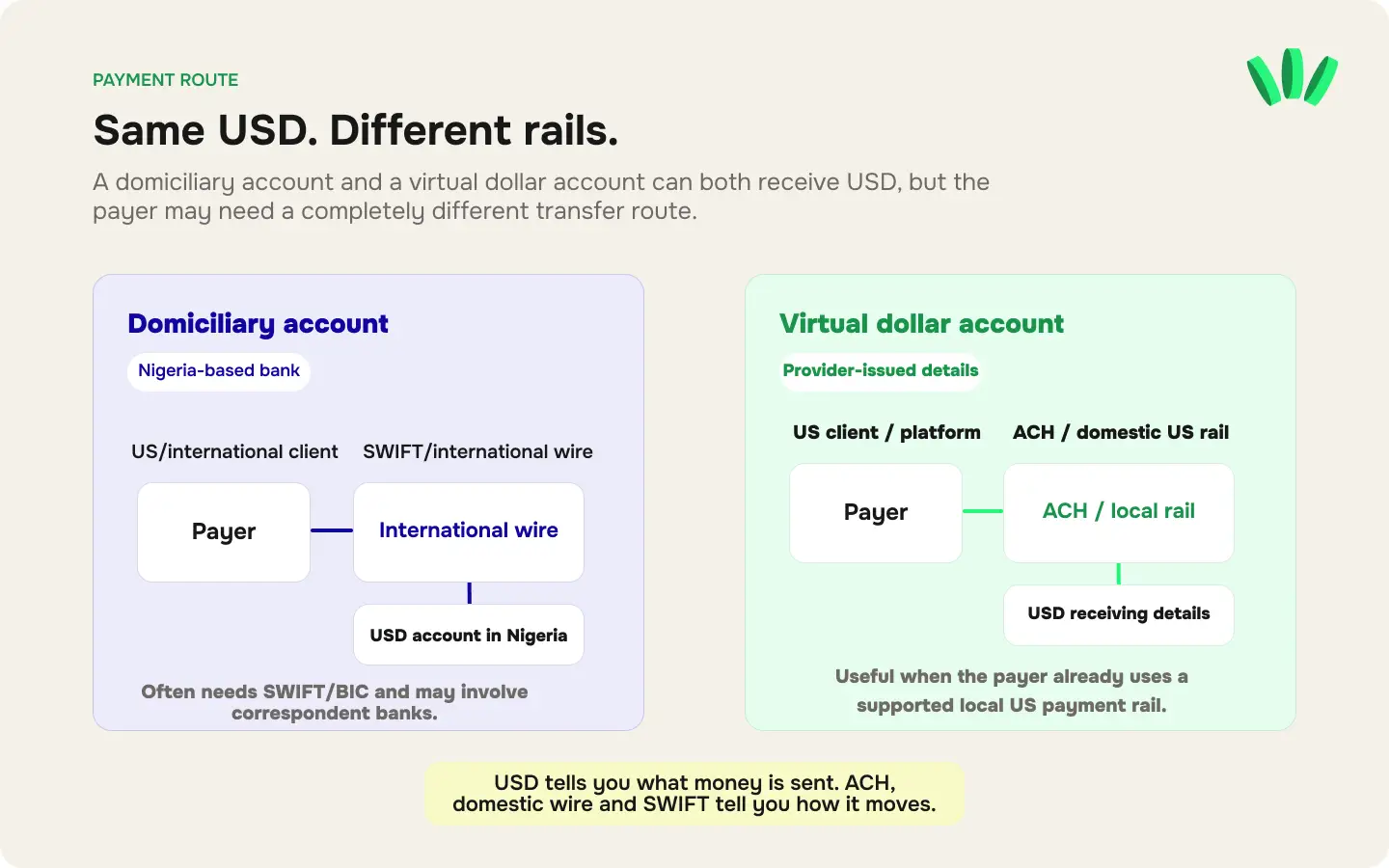
A domiciliary account commonly receives USD through an international bank-transfer route. The sender may need:
beneficiary name;
Nigerian account number;
receiving-bank name and address;
SWIFT or BIC code;
correspondent-bank information where applicable;
payment purpose or invoice reference.
A virtual USD account may accept a domestic US transfer. The sender may need:
beneficiary name;
US account number;
ACH routing number or wire routing number;
account type;
invoice reference;
confirmation that the payer type is permitted.
The Federal Reserve’s description of ACH services explains that ACH payments are processed between participating US depository institutions through national ACH operators. A Nigerian domiciliary account does not become an ACH account because it holds US dollars.
Currency and rail are separate questions:
USD tells you what money is being sent. ACH, domestic wire and SWIFT tell you how it moves.
The country-by-country payment guide for Nigerian freelancers explains which details US, UK and European clients may expect.
Which account works better for US clients?
A virtual dollar account usually fits a US client better when the account explicitly accepts ACH payments from that client type.
ACH lets a US company pay through a familiar domestic process. The client may only need your beneficiary name, routing number and account number. This can be easier for a small agency, employer or finance team than arranging an international wire to Nigeria.
A domiciliary account may still work when the client can send an international wire. The client must be willing to handle the additional bank details, transfer cost and possible intermediary chain.
Use this rule:
US payer situation | Route to compare first |
Client normally pays US contractors by ACH | Eligible virtual USD account with ACH support |
Employer uses US direct deposit | Eligible virtual USD account permitted for salary or payroll credits |
Platform offers Direct to U.S. Bank | Eligible US receiving account accepted by the platform |
Client can only send an international wire | Domiciliary account or another SWIFT-compatible receiving route |
Payment is large and documentation matters more than convenience | Compare domestic wire, SWIFT and domiciliary options before invoicing |
Do not tell a US client to use ACH until the provider confirms that the account accepts ACH credits from that payer type.
Which account is easier for freelance income?
A virtual dollar account is often easier to open and use for routine freelance payments. Onboarding may happen inside an app, and the account may connect receiving, USD holding, conversion and spending.
That convenience has conditions. The provider may restrict personal transfers, marketplace payouts, salary payments, unsupported countries or particular business categories. Account access also depends on the provider and its banking partners.
A domiciliary account may require more documents or branch interaction. It can still be the cleaner option when:
the client wants to send a formal international wire;
you need a Nigerian bank statement;
you want access to foreign-currency cash;
the payment belongs inside an established business-banking relationship;
your accountant or client requires conventional bank documentation.
Neither account is easier when the payer cannot use it.
If you want one app-based route for receiving eligible global income, holding supported foreign currencies, spending online and moving money toward naira, check which walllet.com account features are currently available to you:

Account ownership matters more than the label
The account name should match the person or business named on the invoice, contract and platform profile.
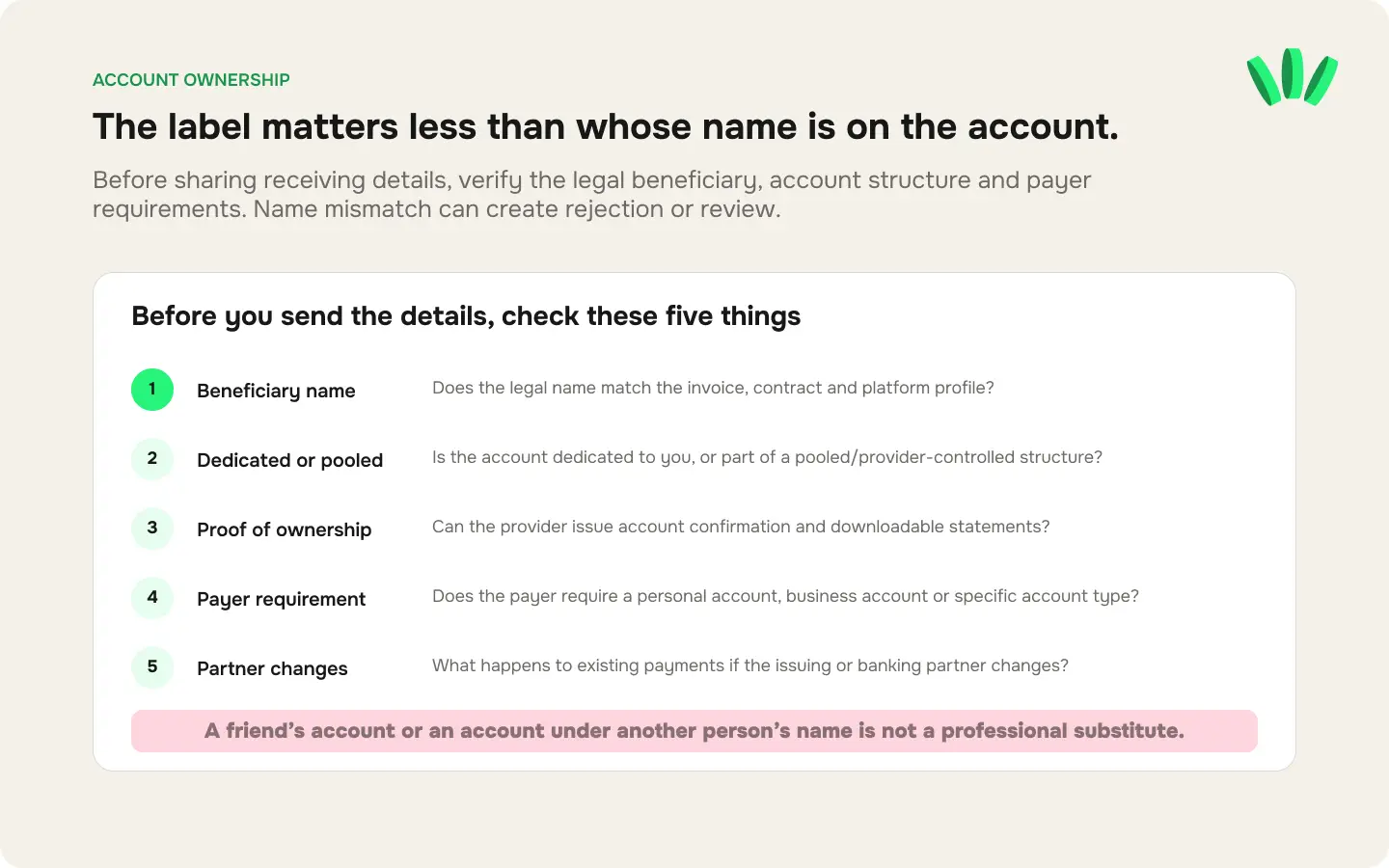
Before sharing either account, check:
Whose legal name appears as beneficiary?
Is the account dedicated to you or part of a pooled structure?
Can the provider issue proof of account ownership?
Can you download statements?
Does the payer require a personal or business account?
Will a name mismatch cause rejection or review?
What happens if the issuing partner changes?
For platform payouts, name matching can be a hard requirement. The Upwork withdrawal comparison explains why holding USD is not enough: an account must also be eligible for the platform’s selected withdrawal rail.
A friend’s domiciliary account and a provider account under another person’s name are not professional substitutes. They can create payment disputes, compliance questions and weak accounting records.
Holding USD is only one part of the decision
Both account types may let you retain USD, but the next step differs.
With a domiciliary account, possible actions can include:
keeping USD at the bank;
receiving another foreign-currency transfer;
withdrawing foreign currency where permitted;
sending a bank transfer;
converting through an available bank route;
using a linked card if the bank offers one.
With a virtual dollar account, possible actions can include:
holding a USD balance;
converting part of the balance;
withdrawing to a Nigerian bank;
funding a supported virtual card;
paying another eligible user or account;
receiving another supported client or platform payment.
Every feature is provider-specific. A visible USD balance does not prove the money can fund a card, move to another account or cash out at the rate you expect.
If online spending matters, review why a virtual dollar card can decline despite sufficient balance before treating a card as the final proof that the route works.
Compare the complete cost
A domiciliary account and a virtual dollar account expose different fees.
Domiciliary-account costs may include
incoming-wire fee;
intermediary-bank deduction;
correspondent-bank charge;
account maintenance;
cash-withdrawal charge;
outgoing-transfer fee;
currency-conversion spread.
Virtual-account costs may include
receiving fee;
ACH or domestic-wire fee;
conversion fee;
exchange-rate spread;
local withdrawal fee;
card issuance or funding fee;
card transaction fee;
inactivity or account charge.
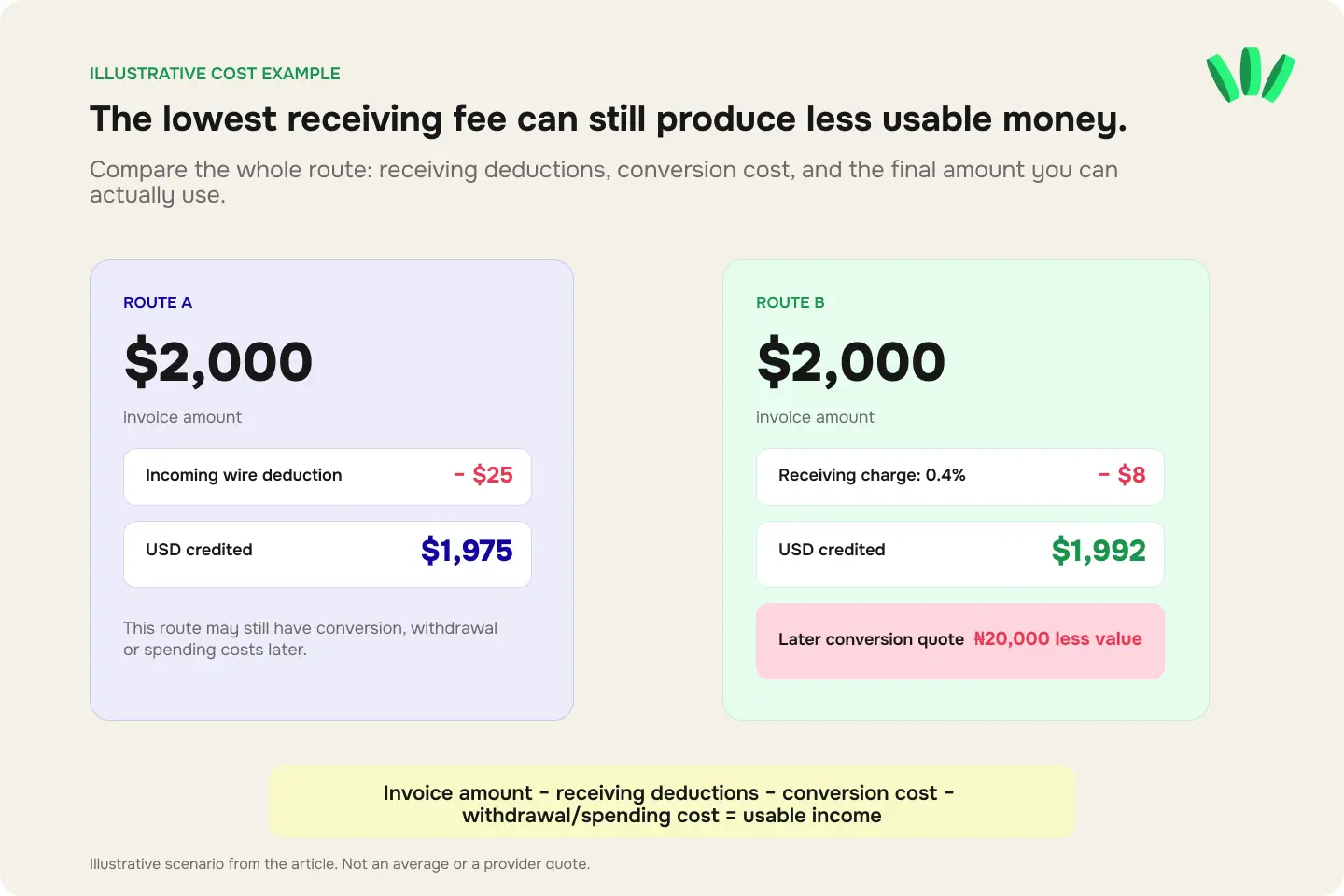
The usable-money calculation is:
Invoice amount − receiving deductions − conversion cost − withdrawal or spending cost = usable income
Consider an illustrative $2,000 invoice.
Route A credits $1,975 after a $25 wire deduction.
Route B credits $1,992 after a 0.4% receiving charge.
Route B then uses a weaker conversion quote that removes another ₦20,000 of value.
The receiving fee alone cannot identify the cheaper route. Compare the same amount, at the same time, through the action you intend to complete.
International wires may pass through intermediary institutions. The guide to why an international wire can arrive short explains how sender, intermediary, receiving and conversion charges can affect the credited amount.
Conversion and cash-out need separate checks
Receiving USD successfully does not answer how the money reaches your Nigerian bank account.
For a domiciliary account, ask:
Can I convert inside the bank?
What rate and charges apply?
Can I transfer USD to another eligible account?
Can I withdraw foreign currency?
Does the bank impose channel or transaction limits?
For a virtual dollar account, ask:
Is NGN cash-out currently available?
What rate appears before confirmation?
Is there a separate conversion fee?
Which Nigerian bank accounts are permitted?
Must the destination account match my name?
What are the minimum, maximum and daily limits?
What happens if the payout is delayed?
Do not compare a domiciliary balance with a virtual balance until both have been taken to the same endpoint. If you need naira, compare final NGN credited. If you need to pay for software, compare the final amount available to the card or merchant.
Support and payment tracing work differently
A delayed domiciliary payment may require the sending bank, correspondent bank and receiving bank to investigate. An international-wire confirmation, MT103 or UETR may help locate the transfer.
A delayed virtual-account payment may require the provider to check the issuing bank, ACH operator, partner bank or internal review. You may need an ACH trace number, payment reference, sender confirmation and account statement.
The MT103 and UETR wire-tracing guide explains the records needed when an international transfer is missing.
For virtual accounts, ask support:
Has the payment reached the issuing partner?
Is it pending settlement or under review?
Does the sender or payer type violate a route rule?
Was the payment returned?
Which trace or reference number identifies it?
Which document is missing?
What is the next status and who controls it?
The freelance payment delay and review guide helps separate a sender problem, bank delay, provider review and cash-out delay.
The practical decision
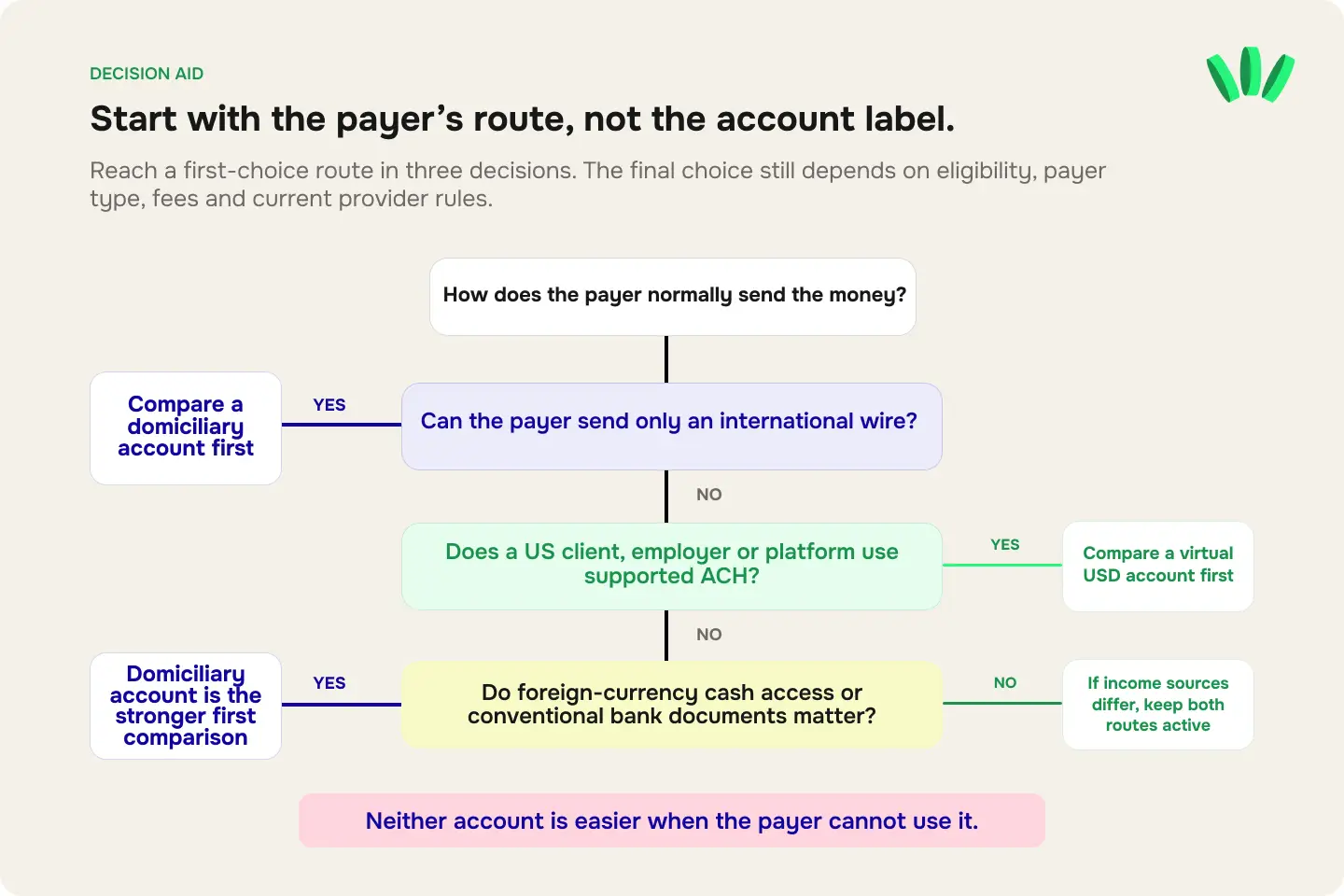
Choose a domiciliary account first when:
your payer sends international wires;
you want a Nigerian bank relationship;
foreign-currency cash access matters;
you need conventional bank documentation;
you receive large or occasional foreign transfers;
the payer cannot use ACH or another local foreign rail.
Choose a virtual dollar account first when:
US clients pay through ACH;
an employer uses a supported local payroll route;
a freelance platform accepts the issued account;
remote onboarding matters;
you want to hold, convert and spend through one app;
you need USD, GBP or EUR receiving details from different regions.
Use both when your income sources differ.
A workable freelance payment stack might be:
Primary route: virtual account for recurring ACH payments
Backup route: domiciliary account for international wires
Local route: Nigerian bank account for NGN expenses
Records: invoices, statements, payment references and support contacts
The backup should use a genuinely different route. Two apps relying on the same banking partner may fail at the same time.
Test before changing every invoice
Run a small payment through the full route before directing recurring income to either account.
Confirm the beneficiary name.
Confirm the incoming currency and payment rail.
Check permitted payer types.
Send one exact payment instruction.
Receive a small test payment.
Save the transfer reference and statement.
Hold part of the balance in USD.
Test the intended spending, transfer or conversion action.
Confirm the final amount received or used.
Keep the alternative route active.
The right account is the one that works for your payer and the next job your money needs to do.

Open walllet.com to check your eligible USD, EUR and GBP receiving options, hold supported foreign-currency income, spend online and review the available route to naira.
