
A freelancer can receive USDT or USDC by agreeing on the exact stablecoin, choosing one network supported by both sides, sharing verified receiving instructions, checking the payment onchain and saving a record that matches the invoice.
The wallet address is only one part of that process.
Before accepting stablecoins, confirm that the client already knows how to send them and that you can use the funds after they arrive. A payment route that works for the sender but leaves you unable to cash out, spend or move the balance is incomplete.
For the exact checks to complete before sharing an address, use the USDT and USDC payment checklist. If the main uncertainty is the chain, compare the available networks for sending USDT or USDC.
Should you accept USDT or USDC from this client?
Stablecoins are usually a practical option when the client already uses crypto, pays other contractors in digital assets or can send from a wallet, exchange or payroll platform without creating a complicated new process.
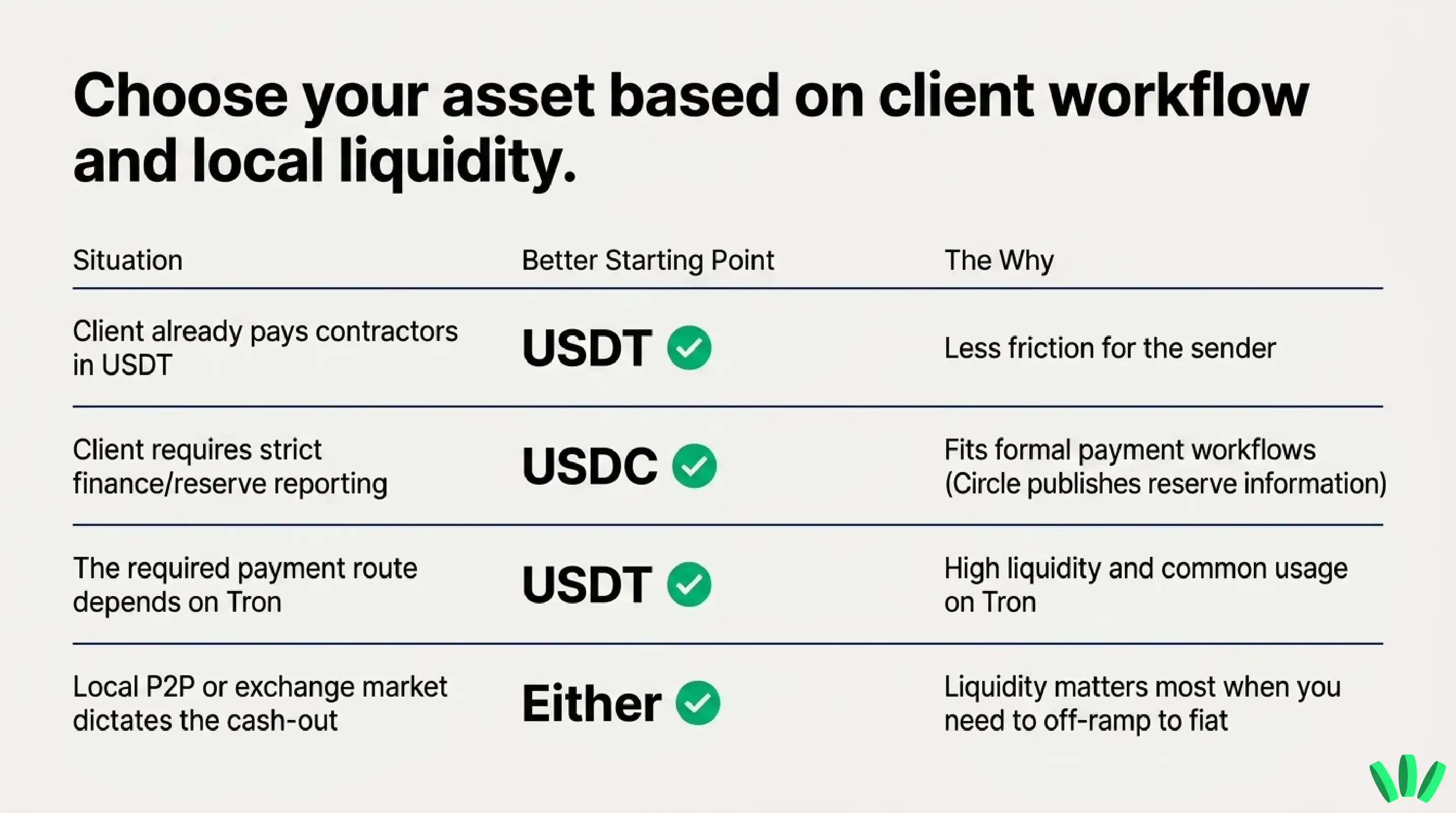
They may be a poor fit when:
The client’s accounting team requires a bank transfer
The payer cannot confirm the network before sending
The client expects you to absorb an unclear fee
Your wallet does not support the exact Token and Network
You do not have a reliable way to use or cash out the funds
The payment structure creates tax, compliance or bookkeeping problems you have not reviewed
Do not ask a client to learn an unfamiliar crypto workflow for one invoice unless both sides understand the extra steps. A familiar bank or payment-platform route may be simpler. The comparison between traditional platforms and Stablecoins is covered in PayPal vs Payoneer vs Wise vs Stablecoins for freelancers.
Choose the Token and Network as one decision
“Send USDT” is incomplete.
USDT and USDC exist across multiple Blockchain networks. USDT on Tron and USDT on Ethereum are separate routes. USDC on Base and USDC on Arbitrum are also separate routes. A similar address format does not mean the balances exist on the same chain. Agree on:
Payment detail | What must be confirmed |
Stablecoin | USDT or USDC |
Network | The exact Blockchain network |
Amount | The agreed invoice amount |
Sender | Client wallet, exchange or payment platform |
Destination | Wallet address for that Token and Network |
Fee responsibility | Whether the sender or recipient absorbs the transfer cost |
Test payment | Whether a small first transfer is required |
Circle publishes separate official contract addresses for USDC on its supported networks. This is one reason the Token name alone is not enough to identify the correct asset and route.
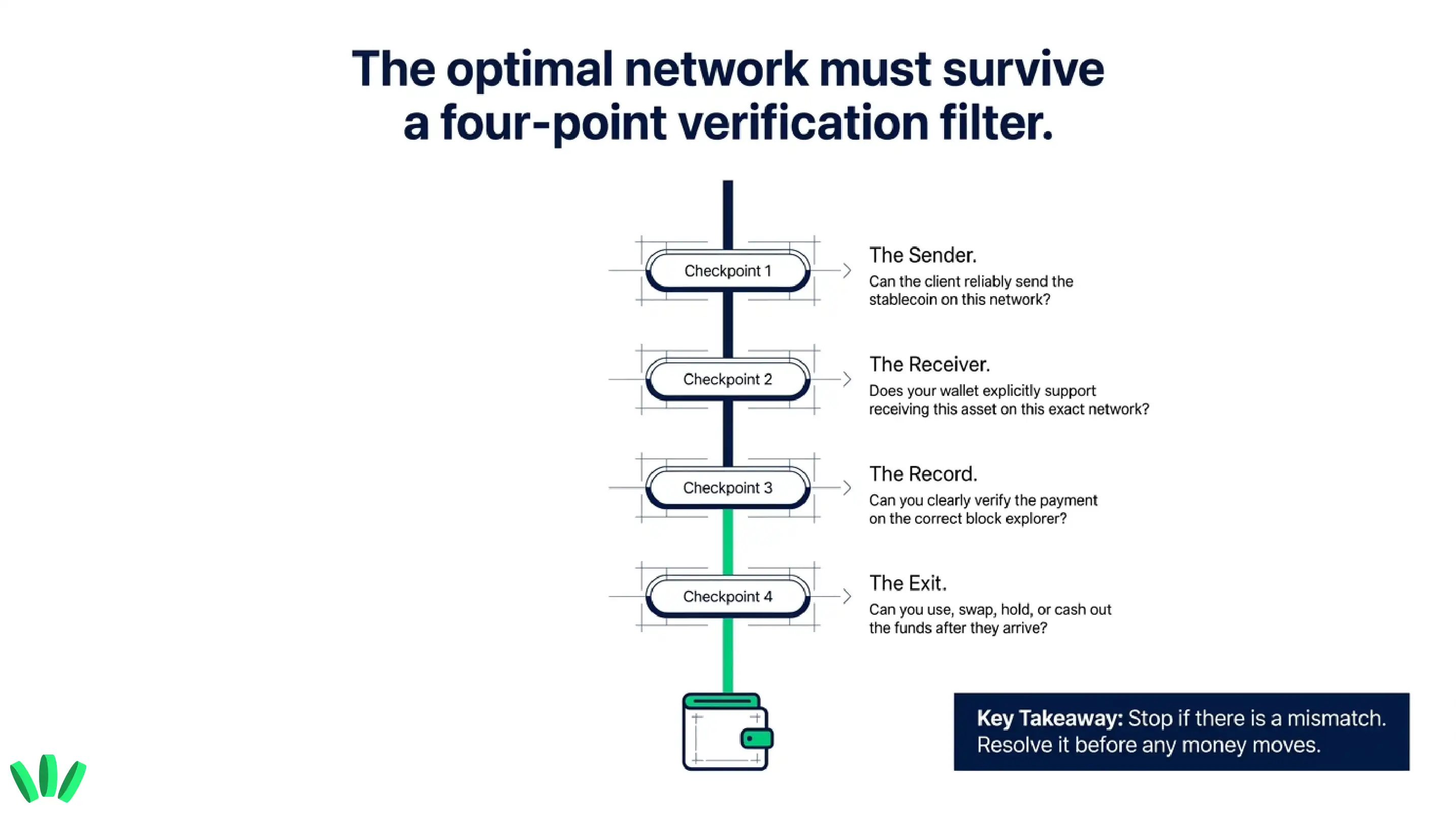
Choose the route based on the complete payment path:
Client → Sending platform → Token → Network → Receiving wallet → Next use
The cheapest network is not automatically the best one. It must be supported by the sender, your wallet and any destination you plan to use afterward.
Set up the receiving wallet before invoicing
A wallet used for client income should make four things clear:
Which Stablecoins it supports
Which networks are available for each Stablecoin
How to copy the correct receiving address
How access can be recovered if the phone or device is lost
For Nigeria-specific wallet selection, use the guide to choosing a crypto wallet for freelancers receiving USDT or USDC.
Do not infer live support from a logo, an old article or a familiar 0x address. Check the current Receive screen before each new route. EVM-compatible chains may use the same address format while keeping balances and transactions on separate networks.
Keep client income separate from experimental DeFi activity, unknown Token approvals and high-risk swaps. A clean receiving address makes payment verification and recordkeeping easier.
Send complete payment instructions
Do not send only a wallet address. A usable payment instruction should include:
Invoice: [invoice number]
Amount: [amount]
Token: USDT or USDC
Network: [exact network]
Receiving address: [full address]
Test payment: [required or not required]
Fee responsibility: [sender or recipient]
Payment reference: [client or project reference]
After sending: Please share the transaction hash
Copy the address from the wallet’s current Receive screen. Do not retrieve it from an old chat, screenshot or transaction history.
Check the first and last characters after pasting it into the invoice or message. Address-poisoning scams can place similar-looking addresses in transaction history, making careless copying dangerous.
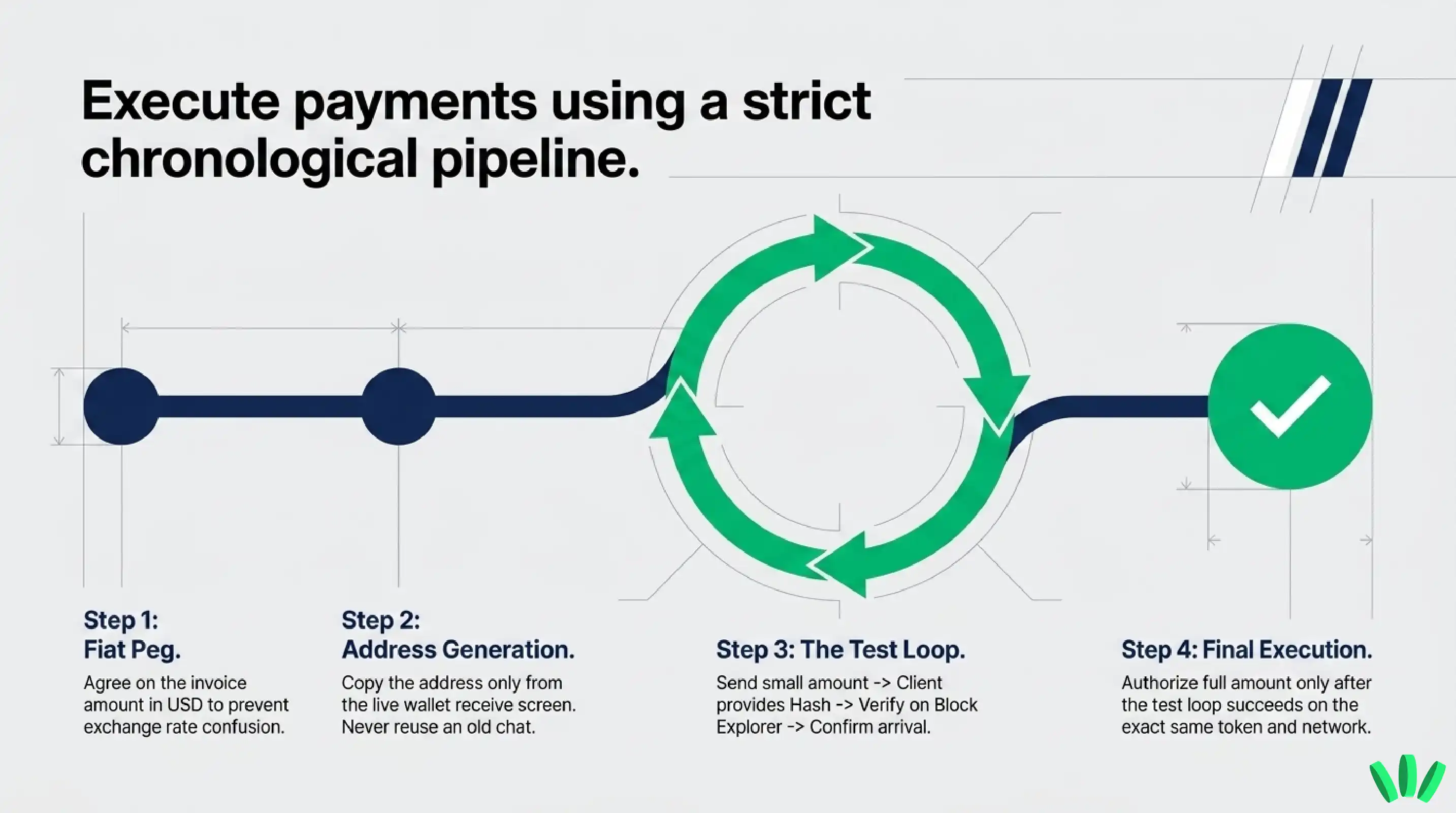
Use a test payment when the route is new
A test payment is useful when:
The client has not used this address before
Either side is uncertain about the Network
The payment amount is large
The sender is withdrawing from an exchange
The receiving route has not been tested
The next destination has strict deposit requirements
The test must use the same Token, Network, sender route and receiving address as the full payment. A successful USDC test on Base does not validate a later USDC transfer on Ethereum.
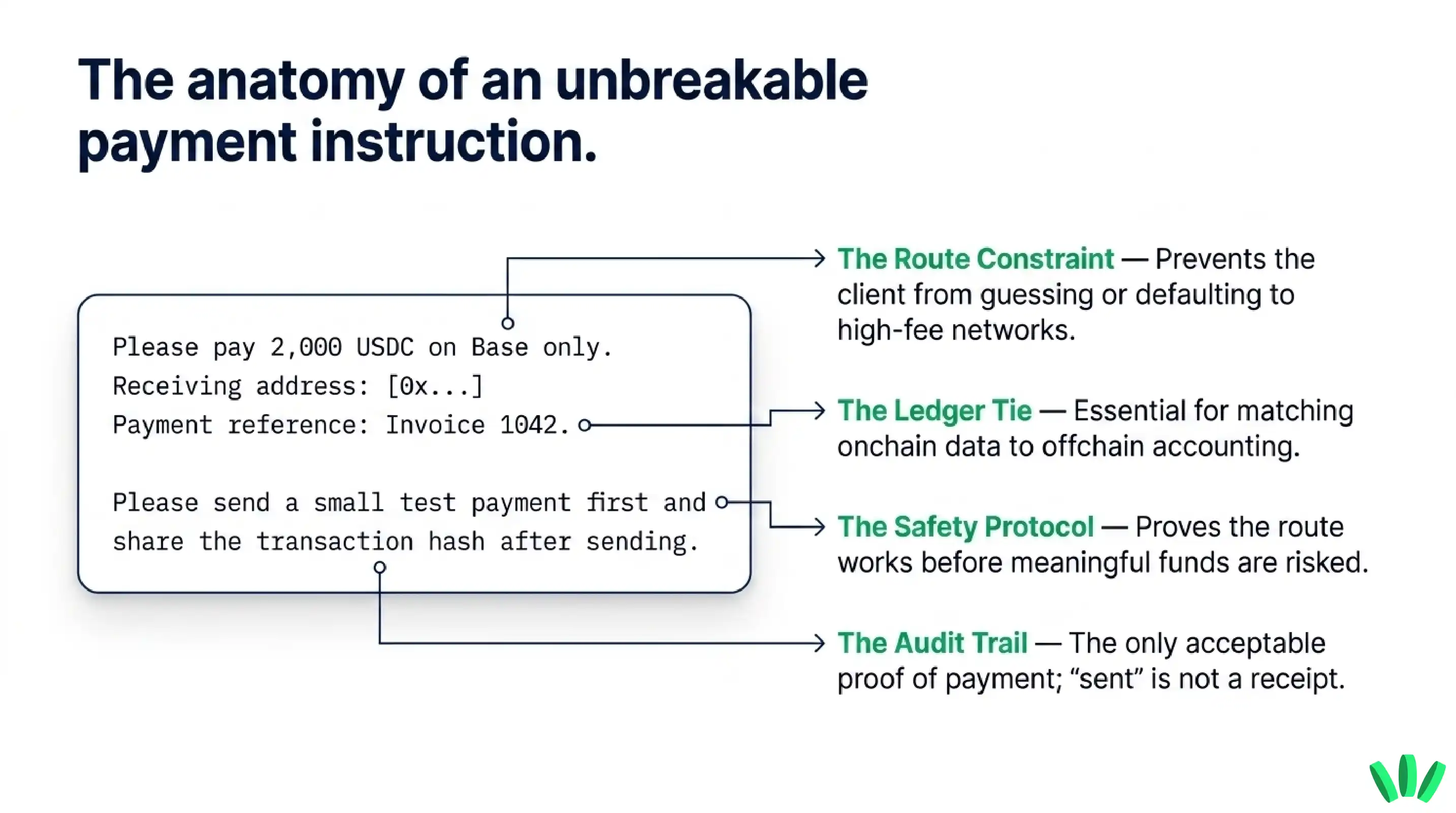
A test payment adds another fee, but it can expose a wrong Network, unsupported route or incorrect address before the full invoice amount moves.
If you want a wallet experience built around seedless self-custody and clearer transaction flows, explore walllet.com.
Verify the payment before marking the invoice as paid
A screenshot from the client is not final proof. Ask for the transaction hash and open it on the correct Block Explorer. Check:
Transaction status
Token
Network
Receiving address
Amount
Timestamp
Token contract when relevant
The transaction must match the invoice and the instructions you sent.
A successful onchain transaction means the Network processed the transfer to the specified address. It does not always mean an exchange or payment platform has already credited the balance.
For a field-by-field verification process, use the guide to reading a crypto transaction on a Block Explorer.
If the Explorer shows the correct Token at your address but the wallet still shows zero, follow the wallet balance troubleshooting guide.
Save a payment record
For each client payment, save:
Record | Purpose |
Invoice number | Connects the transfer to the work |
Client name | Identifies the payer |
Token | Records USDT or USDC |
Network | Identifies the payment route |
Amount received | Confirms settlement |
Receiving address | Shows the destination |
Transaction hash | Provides the onchain record |
Date and time | Supports bookkeeping |
Fiat value when required | Supports accounting or tax records |
Client confirmation | Preserves the communication trail |
A Blockchain record shows what moved onchain. It does not replace an invoice, contract, description of services or other records required for accounting and tax purposes.
Situation | Likely point of failure |
No transaction hash exists | Client or sending platform has not completed the transfer |
Transaction is pending | Network or sender-side transaction issue |
Transaction failed | Funds did not complete the intended onchain transfer |
Explorer shows success, wallet shows nothing | Wallet display, Token import or Network-view problem |
Exchange has not credited the deposit | Platform confirmation, memo, minimum deposit or compliance issue |
Platform marks payment under review | Provider-side account or compliance review |
Do not ask the client to send again until the first transfer has been traced. For delays outside the Blockchain transaction itself, use the guide to why freelance payments get held, reviewed or delayed.
Can USDT or USDC be frozen?
USDT and USDC are issuer-backed Stablecoins. Under specific conditions, their issuers may restrict addresses or Token movement. Self-custody does not remove controls built into the Stablecoin contract. That risk is different from:
An exchange holding a withdrawal
A wallet failing to display a Token
A client using the wrong Network
A payment remaining pending
The guide to USDT and USDC freeze risks explains those differences in detail.
Where walllet fits
walllet combines a seedless self-custodial wallet experience with broader money-management features available to eligible users.
For Stablecoin payments, the relevant questions are practical:
Does the app currently support the exact Token and Network?
Can you copy and verify the receiving address clearly?
Can you inspect the transaction after payment?
Do you understand the recovery model?
Can the received balance fit into the way you hold, move or use income?
walllet does not make wrong-network transfers reversible, remove Stablecoin issuer controls or guarantee that every cash-out route will remain available. Check the live receiving options and account conditions before giving payment details to a client.
Use walllet.com to manage supported Stablecoin payments through a seedless self-custodial wallet, while checking the exact Token, Network and receiving route before every transfer.
