There is no single best network for sending USDT or USDC.
The safest choice is usually the network that the sender and recipient both explicitly support, with an acceptable total cost, confirmation time and recovery risk.
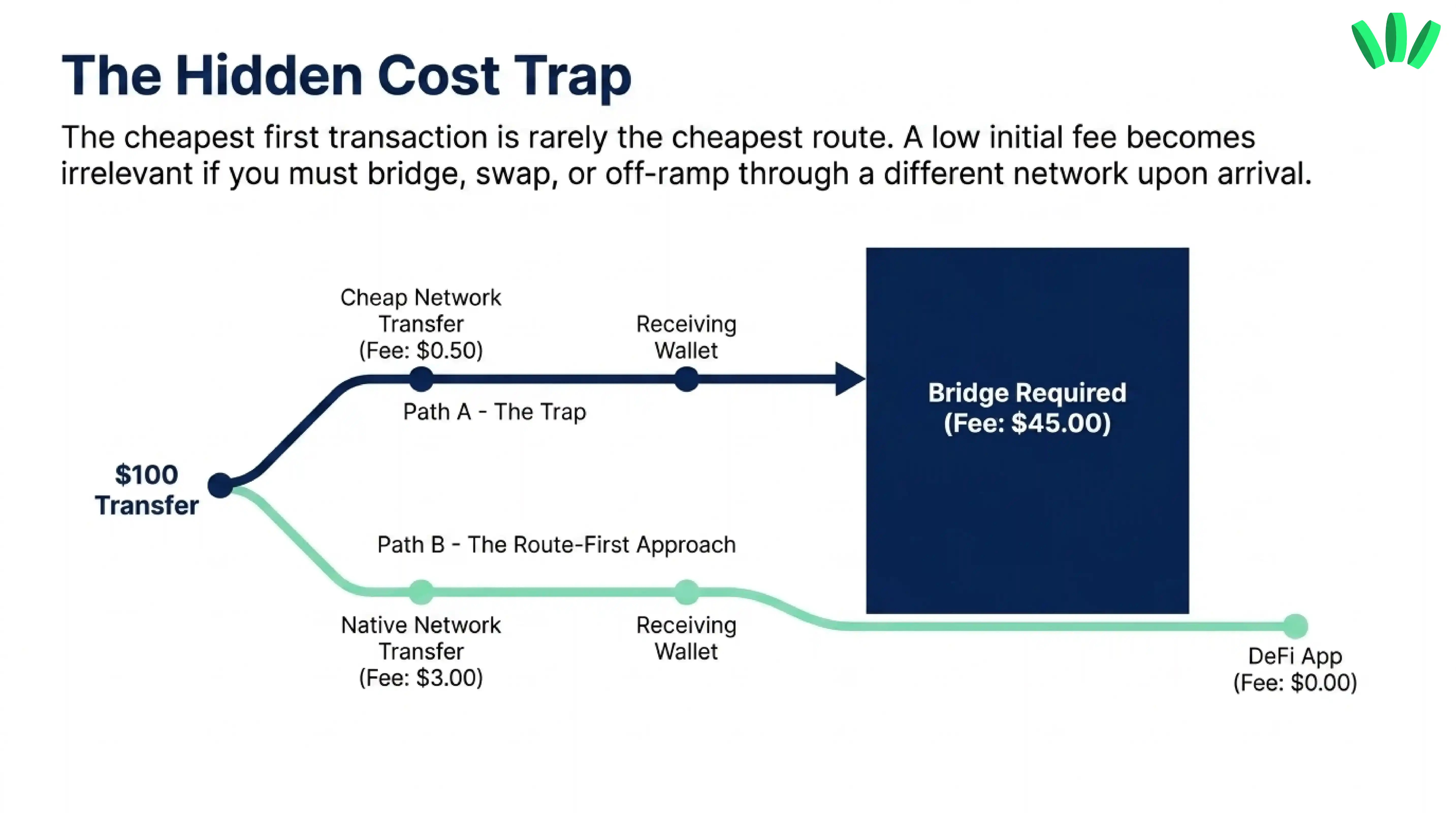
A low network fee does not make a route cheap if you later need to bridge the token, swap it, pay a high withdrawal fee or use a more expensive cash-out route.
Before sending, match all four:
Token → Network → Sending platform → Receiving platform
If any one of them does not match, choose another route.

Short Answer: Which Network Should You Choose?
Situation | Better decision |
|---|---|
Both sides explicitly support the same low-cost network | Usually use that direct route |
Recipient supports only one network | Use the supported network even if another network has lower gas |
Cheapest network would require a bridge after receiving | Compare the full bridge and recovery risk before choosing it |
You need USDT specifically | Verify the network against Tether’s current supported-protocol list |
You need native USDC | Verify the network against Circle’s current supported-network list |
The receiving service does not clearly list the token/network pair | Do not send until support is confirmed |
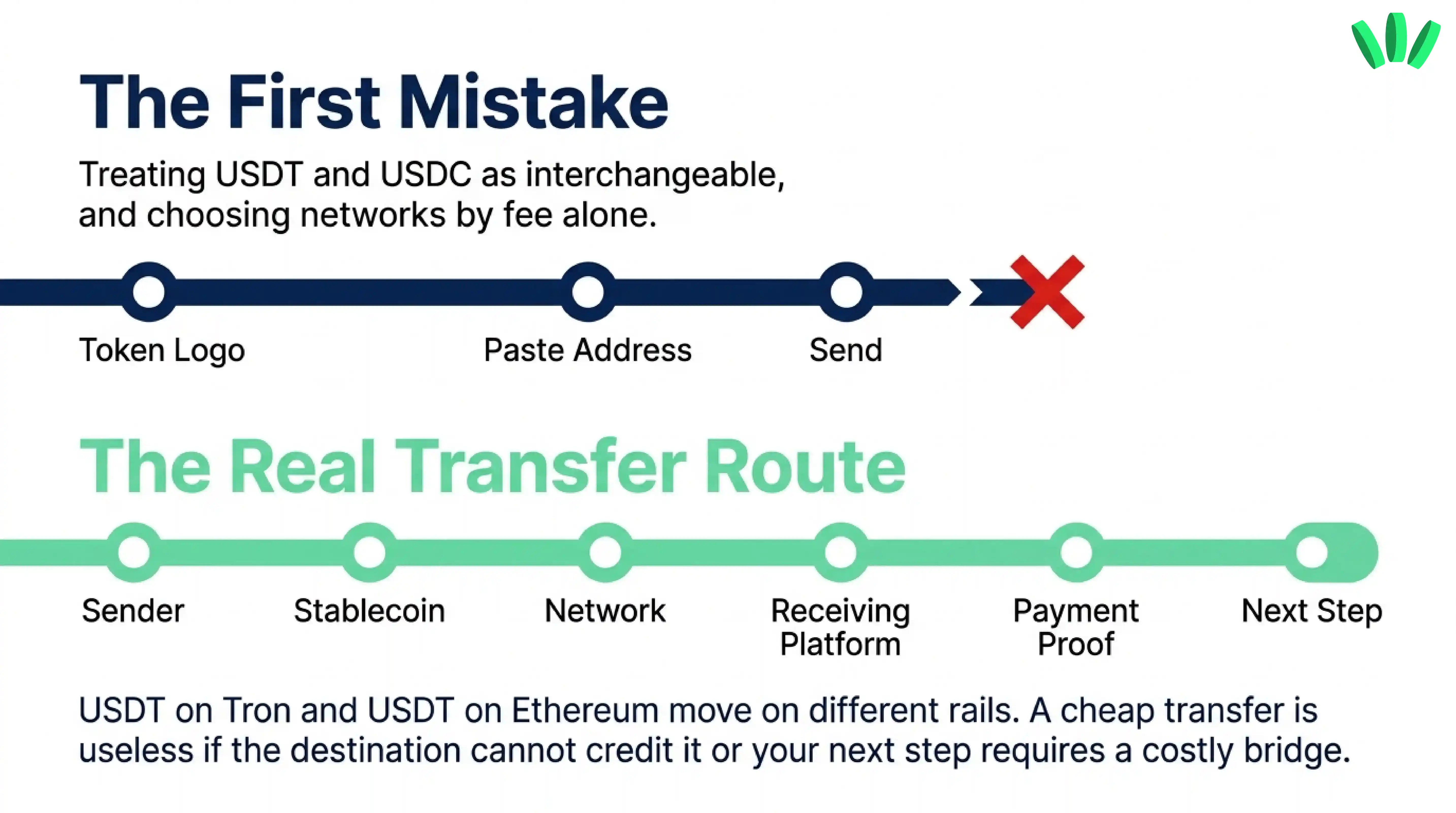
USDT on Tron, USDT on Ethereum, and USDT on Polygon move on different rails. The same is true for USDC on Base, Arbitrum, Polygon, or Ethereum. A cheap transfer is not useful if the sender cannot use that network, the destination cannot credit it, the payment is hard to verify, or you immediately need another costly move after the funds arrive.
If you are still comparing the stablecoins themselves, start with Stablecoins 101: USDC vs USDT vs DAI. This guide answers a different question: which route should you actually use when sending or receiving USDT or USDC?
USDT and USDC are starting to play different roles
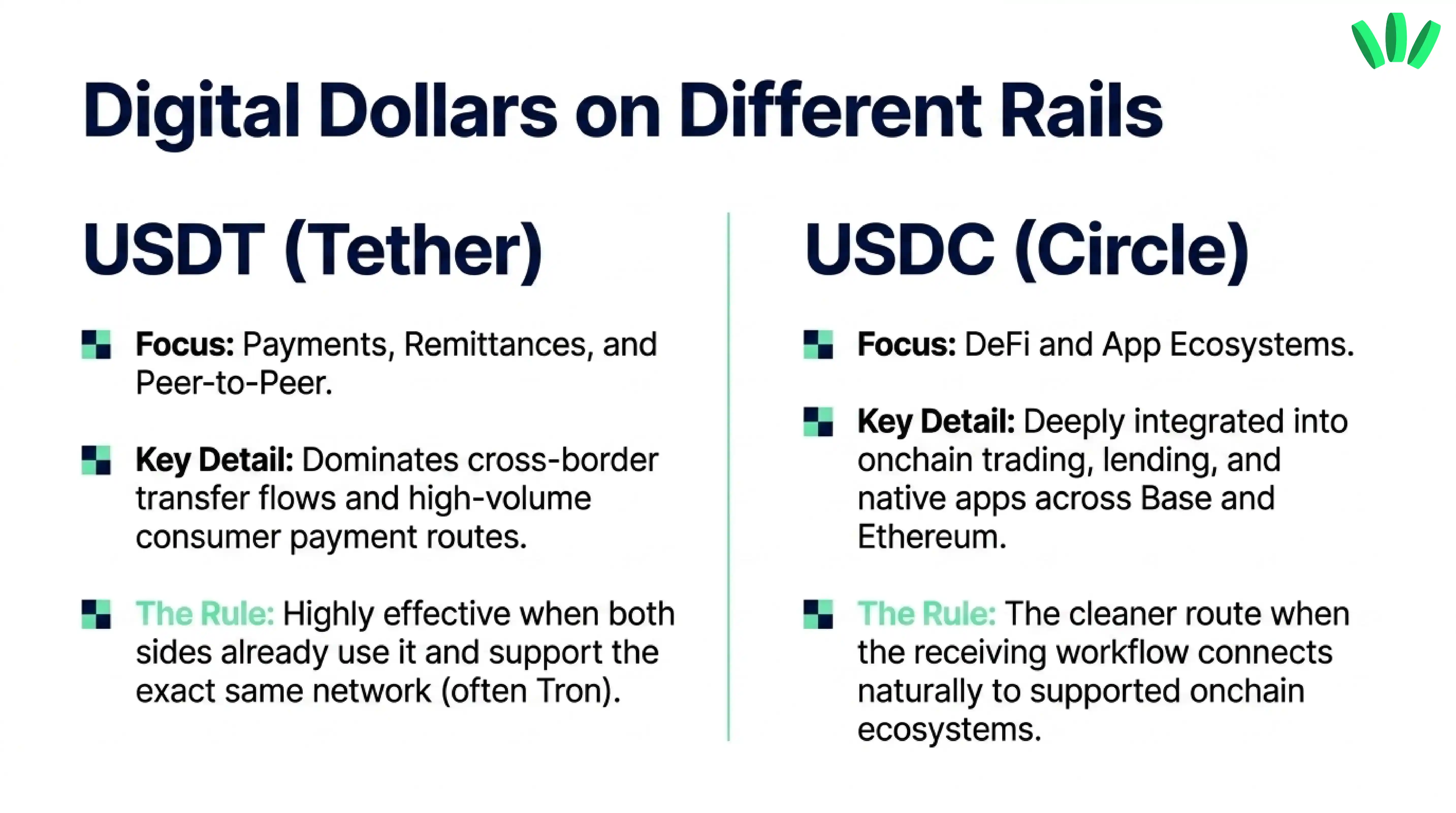
USDT and USDC both aim to move dollar-like value onchain. But in practice, they are increasingly showing up in different kinds of routes.
USDT is especially visible in some payment, remittance, peer-to-peer, and cross-border transfer flows. Tether’s own market reporting lists payments and remittances among active USDT use cases, and recent integrations show USDT being used in high-volume consumer transfer and P2P payment routes.
USDC, meanwhile, is deeply integrated into DeFi and app ecosystems. It has native support across networks including Base and Ethereum, and it is widely used in onchain trading, lending, liquidity, and app-based financial flows.
That does not mean USDT is always better for payments.
It does not mean USDC is always better for freelancers.
And it definitely does not mean you should choose by logo.
For a freelancer, creator, remote worker, or small team, the better question is:
Which route will actually work from sender to usable money?
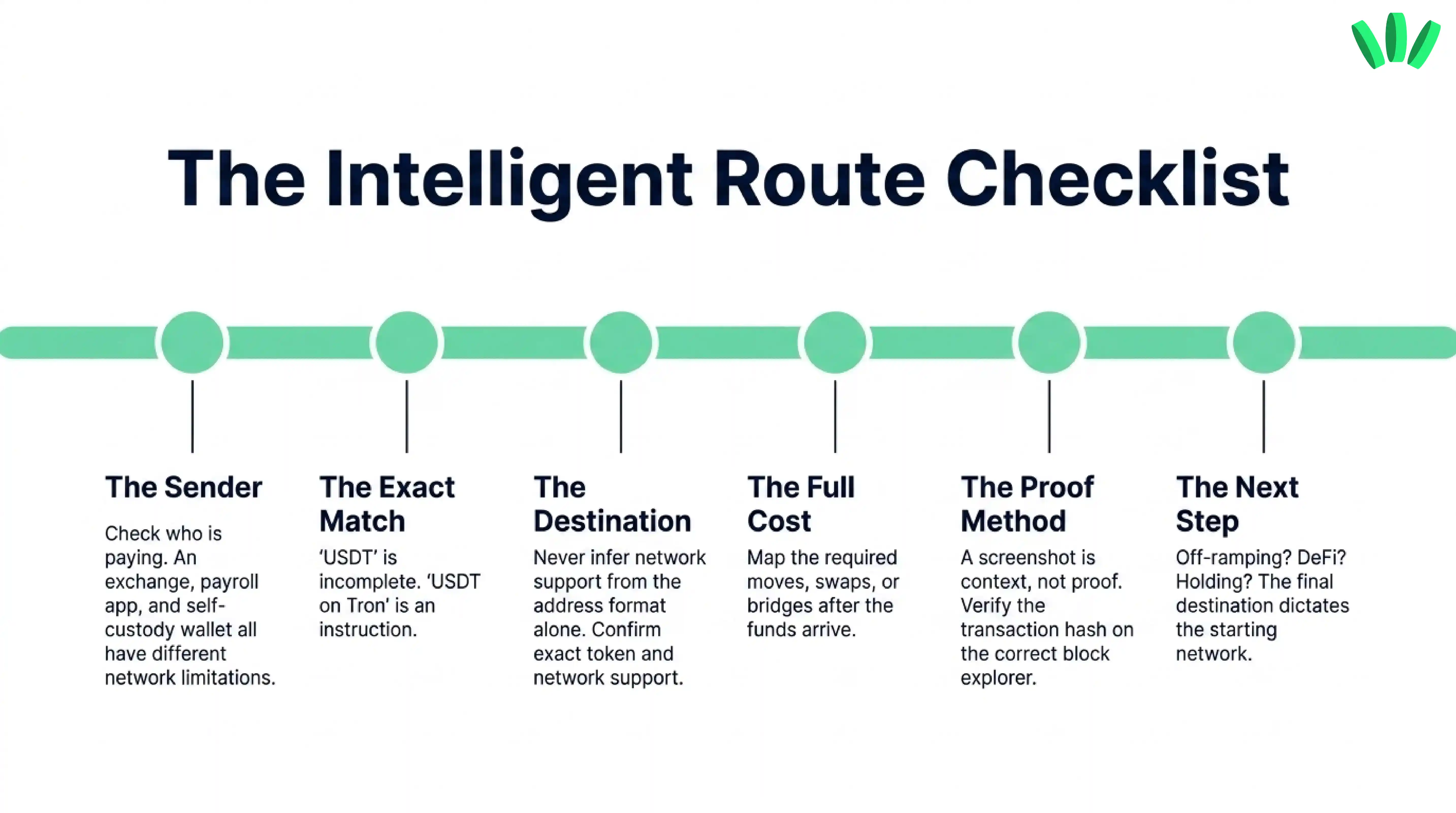
Check five things before choosing:
Who is sending? A client sending from an exchange may have different options from a payroll platform or self-custody wallet.
Which exact network can they use? “I can send USDT” is incomplete. You need to know whether they can send USDT on Tron, Ethereum, Polygon, or another supported network.
What does the full route cost? Do not check only the first transfer fee. Consider what it may cost to move, swap, bridge, or off-ramp the funds after they arrive.
How will you verify the payment? A screenshot is context, not complete proof. You should be able to check the transaction hash on the correct block explorer and match the network, token, address, amount, and status. If you have never done that before, use this guide to reading a crypto transaction on a block explorer
What happens after the money arrives? Will you hold it, move it to another wallet, use it in DeFi, swap it, fund another service, or off-ramp it? The next step can change which route makes sense.
That is the practical difference between choosing a stablecoin and choosing a payment route.
If you are receiving client income, use the full How to Receive USDT or USDC Safely checklist before sharing an address. If you are setting up a Nigeria-focused freelance payment workflow, read Best Crypto Wallet for Freelancers in Nigeria before deciding which network to give a client.
And if you are still asking why stablecoins are being used for payments in the first place, read Why Stablecoins Are Becoming the Default Payment Asset in Crypto.
USDT and USDC Network Availability
Checked: September 3, 2026
Network | Tether-issued USDT | Native USDC | What to check before sending |
|---|---|---|---|
Tron | Supported by Tether | Do not assume native Circle USDC support | Confirm the recipient accepts USDT-TRC20 |
Ethereum | Supported by Tether | Supported by Circle | Compare sender withdrawal fee and Ethereum gas |
Base | Not listed in Tether’s current USD₮ protocol list | Supported by Circle | Verify that the recipient accepts native USDC on Base |
Arbitrum | Not listed in Tether’s current USD₮ protocol list | Supported by Circle | Verify Arbitrum USDC support at both endpoints |
Polygon PoS | Not listed in Tether’s current USD₮ protocol list | Supported by Circle | Verify native USDC and the exact token contract |
Solana | Supported by Tether | Supported by Circle | Verify the recipient supports the Solana version of the token |
Third-party or bridged versions of a token may exist on networks that are not listed by the issuer. Do not treat a token with the same ticker as equivalent to the issuer-supported version without checking its contract and the receiving platform’s support.
Which network is best for your USDT or USDC route in 2026?
There is no universal best network for USDT or USDC. The better route depends on what the sender can use, what the destination supports, how much the full route costs, and what you need to do after the funds arrive.
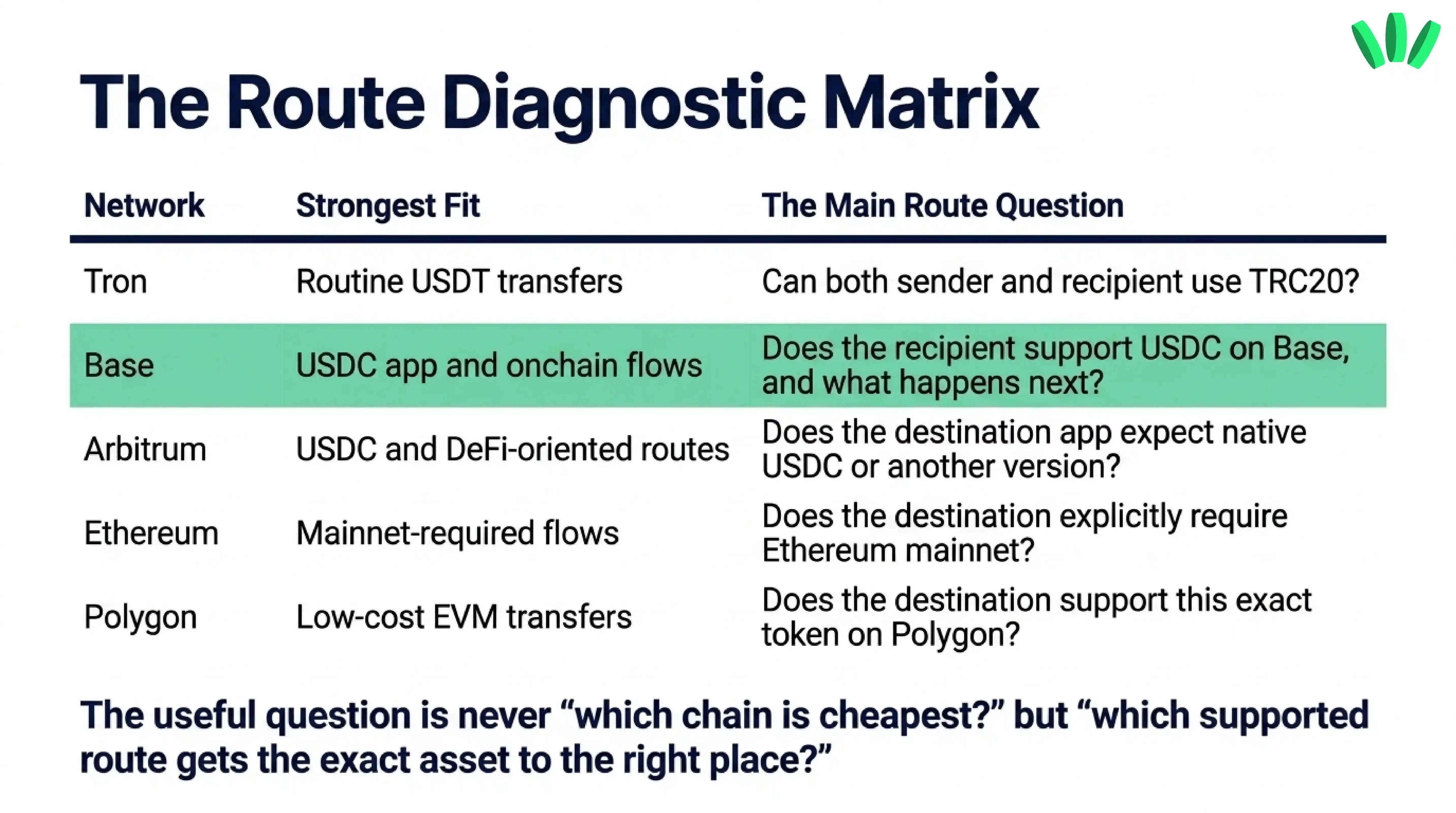
For routine USDT transfers, Tron is often a practical option when both sides support TRC20. For USDC, Base or Arbitrum can be strong low-cost options when the receiving wallet or app already supports those networks. Ethereum still matters when the destination explicitly requires Ethereum mainnet or when the next step happens there.
The useful question is not:
Which chain is cheapest?
It is:
Which supported route gets the right token to the right destination, gives me usable proof, and still works for my next step?
Network | Often a stronger fit for | Why people use it | Main route question |
|---|
Tron | Routine USDT transfers | Common USDT payment and transfer route | Can both sender and recipient use TRC20? |
Ethereum | Mainnet-required USDT or USDC flows | Broad Ethereum ecosystem support | Does the destination explicitly require Ethereum mainnet? |
Polygon | Low-cost stablecoin transfers where supported | Lower-cost EVM-style movement | Does the destination support this exact token on Polygon? |
Base | USDC app and onchain flows | Native USDC support and low-cost Ethereum-style apps | Does the recipient support USDC on Base, and what happens next? |
Arbitrum | USDC and DeFi-oriented routes | Strong Ethereum L2 app ecosystem | Does the app expect native USDC or another version? |
The best network is the one that works across the full route. Cheap is useless if the sender cannot use it, the recipient cannot credit it, or you immediately need another expensive move after arrival.
Curious what this route-first approach looks like in a self-custody wallet? Explore walllet.com and check whether its supported setup fits the way you actually send, receive, and use crypto.

Compare Total Cost, Not Just Gas
For a $1,000 transfer, calculate:
Total route cost = sender withdrawal fee + network fee + receiving fee + swap/bridge cost + cash-out fee + FX cost
Compare routes using the same transfer amount.
Cost | Route A | Route B |
|---|---|---|
Amount sent | $1,000 | $1,000 |
Sender withdrawal fee | Current quote | Current quote |
Network fee | Current quote | Current quote |
Receiving fee | Current quote | Current quote |
Swap or bridge required | Yes/No | Yes/No |
Swap/bridge cost | Current quote | Current quote |
Cash-out cost | Current quote | Current quote |
Final amount available | Calculate | Calculate |
Do not substitute an estimated blockchain gas fee for an exchange withdrawal fee. They are different costs.
Is Base or Arbitrum better for USDC?
Base and Arbitrum can be strong routes for USDC when the receiving app or next step already lives on those networks.
That is not because USDC is automatically better than USDT. It is because native support, app integration, liquidity, and the next action after receipt can make USDC the cleaner route.
Base can make sense when:
The recipient supports native USDC on Base.
The app or wallet already works on Base.
You want a low-cost Ethereum-compatible route.
Your next step happens inside the Base ecosystem.
Arbitrum can make sense when:
The recipient supports USDC on Arbitrum.
You are moving into an Arbitrum-based app or DeFi flow.
You have confirmed whether the destination expects native USDC or another token version.
You have checked the gas requirement before the transfer.
Do not choose Base or Arbitrum only because the fee looks low. Confirm the complete route first.
Which network is cheapest for stablecoin transfers?
The cheapest first transaction is not always the cheapest route.
For USDT, Tron is often a practical low-cost option when TRC20 is supported.
For USDC, Base, Arbitrum, or Polygon can offer low-cost routes when the receiving wallet or app supports the exact token and network.
Ethereum mainnet can cost more, but it still makes sense when the destination explicitly requires it or when moving to another network would add more friction, fees, or risk.
Before comparing fees, ask:
What will this route cost from sender to usable money?
A route with a cheap first transfer can still become expensive if you need to bridge, swap, move to another wallet, or off-ramp through a different network after the funds arrive.
How should you choose before sending USDT or USDC?
Use this route check before every stablecoin transfer.
1. Check who is sending
Ask where the funds are coming from: an exchange, payroll platform, payment app, or self-custody wallet.
The sender can only use the token and network options their route actually supports.
2. Match the exact token and network
“USDT” is not a complete instruction.
“USDT on Tron” is.
“USDC” is not a complete instruction.
“USDC on Base” is.
3. Check the receiving destination
Confirm that the wallet, exchange, app, or platform supports that exact token on that exact network.
Do not infer network support from the address format alone.
4. Check the full cost
Look beyond the first transfer fee.
Ask whether you will need to move, swap, bridge, or off-ramp the funds after arrival.
5. Decide how proof will be checked
For client payments, ask for the transaction hash and verify it on the correct block explorer.
Match the network, token, receiving address, amount, and transaction status before marking the payment complete.
6. Check what happens after arrival
Will the funds stay in the wallet? Move to another wallet? Enter a DeFi app? Get swapped? Get off-ramped? Fund another service?
Your next step is part of the route decision.
For Nigerian freelancers receiving international income, Best Crypto Wallet for Freelancers in Nigeria explains how wallet support, network clarity, proof, recovery, and the post-payment route fit together.
Final recommendation: pick the route, not the logo
Do not start with:
Should I use USDT or USDC?
Start with:
Who is sending, which network can they use, what does my destination support, how will I verify the payment, and what happens after the money arrives?
USDT can be a strong fit for payment or transfer routes where the sender already uses it and both sides support the same network.
USDC can be a strong fit when the receiving route connects naturally to ecosystems such as Base, Ethereum, or other supported onchain apps.
Tron can be practical for routine USDT transfers when TRC20 is supported.
Base or Arbitrum can be practical for USDC when the receiving app or next step already works there.
Ethereum still matters when mainnet support is explicitly required.
Polygon can work well when both sides support the exact token on Polygon.
The answer changes with the route.
Before sending a meaningful amount, confirm the token, network, destination, fee, proof method, and next step. Then use a small test transfer when appropriate.
The best network is not the one with the lowest fee on a comparison table.
It is the one that gets the right asset to the right place, leaves you with verifiable proof, and still works after the money arrives.
Speed Is More Than “How Fast the Transaction Appears”
Compare three separate timings:
1. Sender processing time
How long the wallet, exchange or payment provider takes to submit the withdrawal.
2. Blockchain confirmation time
How long the network takes to confirm the transaction.
3. Recipient crediting time
How long the receiving platform takes to recognize and credit the deposit.
A network may confirm quickly while an exchange still requires additional confirmations before crediting the balance.
Recovery Risk Matters
The cheapest route can become the most expensive route if it increases the chance of a wrong-network deposit. Before sending, confirm:
exact token
exact network
exact recipient address
token contract when relevant
whether the recipient supports that token/network combination
whether a memo or tag is required
For an unfamiliar route, a small test transfer can reduce operational risk, provided the platform’s minimum deposit and withdrawal fees do not make the test impractical.
Is USDT or USDC better for freelancer payments?
Neither is always better.
USDT may be the more practical choice when the client already sends it, the agreed network is supported, the transfer cost works, and your next step can use the funds without unnecessary conversion.
USDC may be the better route when the sender supports it and your receiving or next-step workflow already uses ecosystems such as Base, Ethereum, or other USDC-supported apps.
For freelancers, the decision should follow the full route:
Sender → stablecoin → network → receiving wallet → proof → next step
Choose the route that works end to end, not the logo that looks more familiar. Ready to put that route-first approach into practice? Explore walllet.com for a simpler way to manage crypto in self-custody, then check whether its supported networks fit how you actually send, receive, and use stablecoins.

Three Practical Examples
Example 1: The Client Can Send USDT on Tron and Your Cash-Out Route Accepts USDT on Tron
A direct USDT-TRC20 transfer may be simpler than receiving on another network and bridging afterward.
The decision should still be based on the sender’s actual withdrawal quote and the receiving platform’s current support.
Example 2: The Client Can Send USDC on Base, but Your Cash-Out Provider Does Not Accept Base
The low first-hop fee is not enough to make Base the better route.
If you must bridge the USDC before cashing out, include the bridge cost, additional transaction risk and additional steps in the comparison.
Example 3: Both Sides Support USDC on Arbitrum
A direct USDC-on-Arbitrum route avoids an unnecessary bridge. Verify the native token contract and recipient support before sending.
