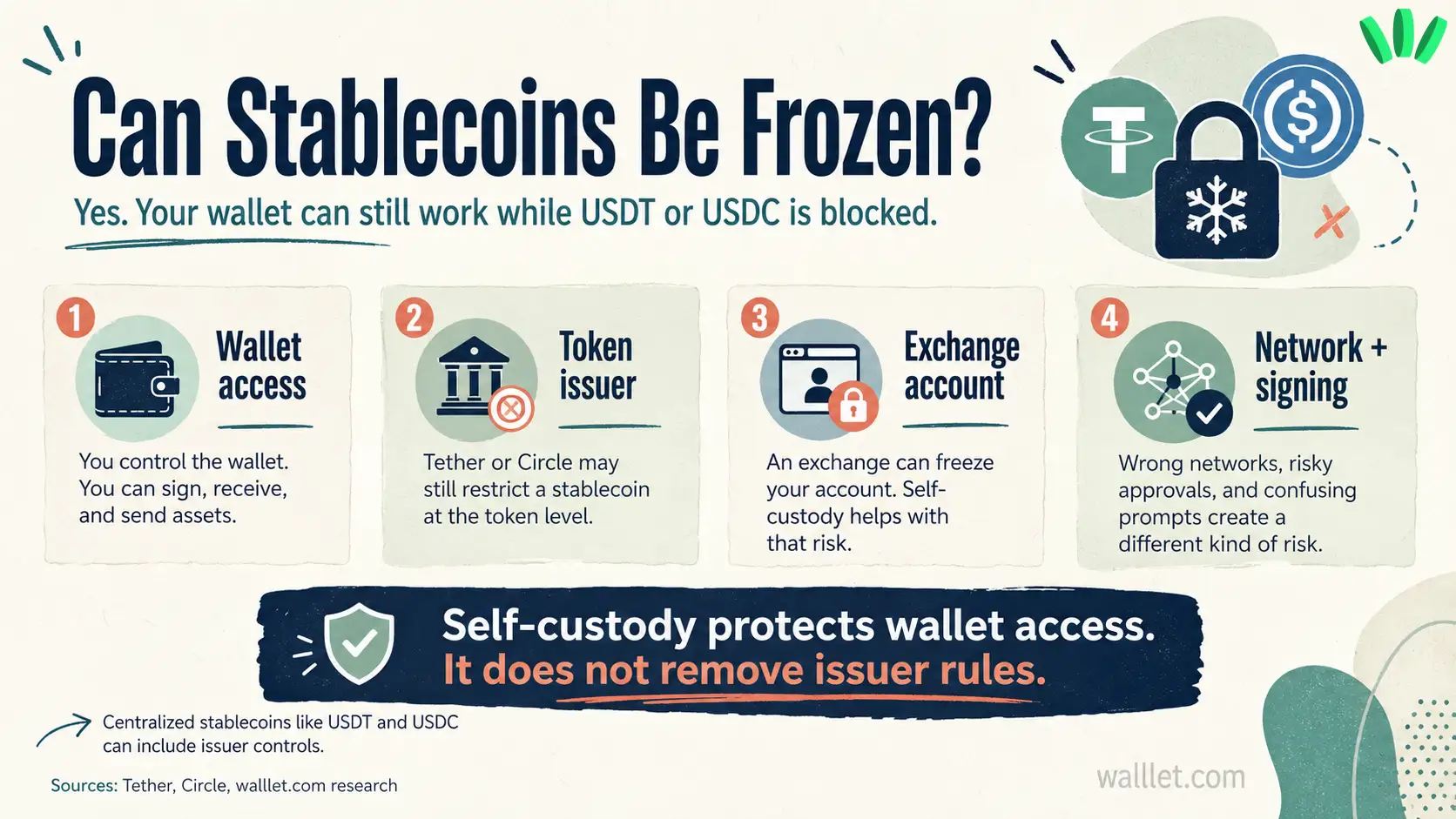
Yes. Some centrally issued stablecoins include smart-contract controls that allow the issuer to restrict specific addresses or tokens under circumstances described in its legal terms and policies.
Self-custody changes who controls your wallet keys. It does not remove controls built into the stablecoin contract itself.
That means three different questions must be separated:
Can someone control your wallet keys?
Can the stablecoin issuer restrict its token?
Can an exchange or payment provider restrict your account?
They are not the same risk.

Before assuming a stablecoin has been frozen, separate four different problems:
What happened | What it usually means |
USDT or USDC cannot move from an address | Possible issuer-level block or token restriction |
An exchange will not let you withdraw | Platform account review, compliance hold or withdrawal restriction |
The wallet does not show the balance | Network, token-import, RPC, indexing or price-data problem |
A client payment has not arrived | Pending withdrawal, wrong network, wrong address or incomplete transfer |
If your concern is a missing balance rather than a confirmed token restriction, use walllet.com’s guide to fixing a crypto wallet balance that is not showing.
For a broader comparison of issuer, network and payment risks, see USDT vs USDC vs DAI. Freelancers preparing to accept stablecoins should also use the USDT and USDC payment checklist before sharing a receiving address.
What does it mean when a stablecoin is frozen?
A stablecoin freeze usually means the token contract prevents a specific address from transferring the affected asset.
The wallet itself may continue working. You may still be able to:
Open the wallet
View the address
Sign unrelated transactions
Move other supported assets
Review the transaction history
The restricted USDT or USDC may remain visible but become non-transferable.
This distinction matters because three separate parties can control different parts of the experience:
Layer | Who controls it | Possible restriction |
Wallet access | Wallet owner, wallet provider or custody platform | Login, recovery or account-access problem |
Platform account | Exchange, payment app or service provider | Deposit, withdrawal or compliance hold |
Stablecoin token | Stablecoin issuer and token contract | Address-level block or token freeze |
Blockchain network | Validators and protocol rules | Congestion, failed transaction or network disruption |
Owning the wallet credentials gives you direct control over the wallet. It does not remove controls that exist inside an issued token.
Can Tether Freeze USDT?
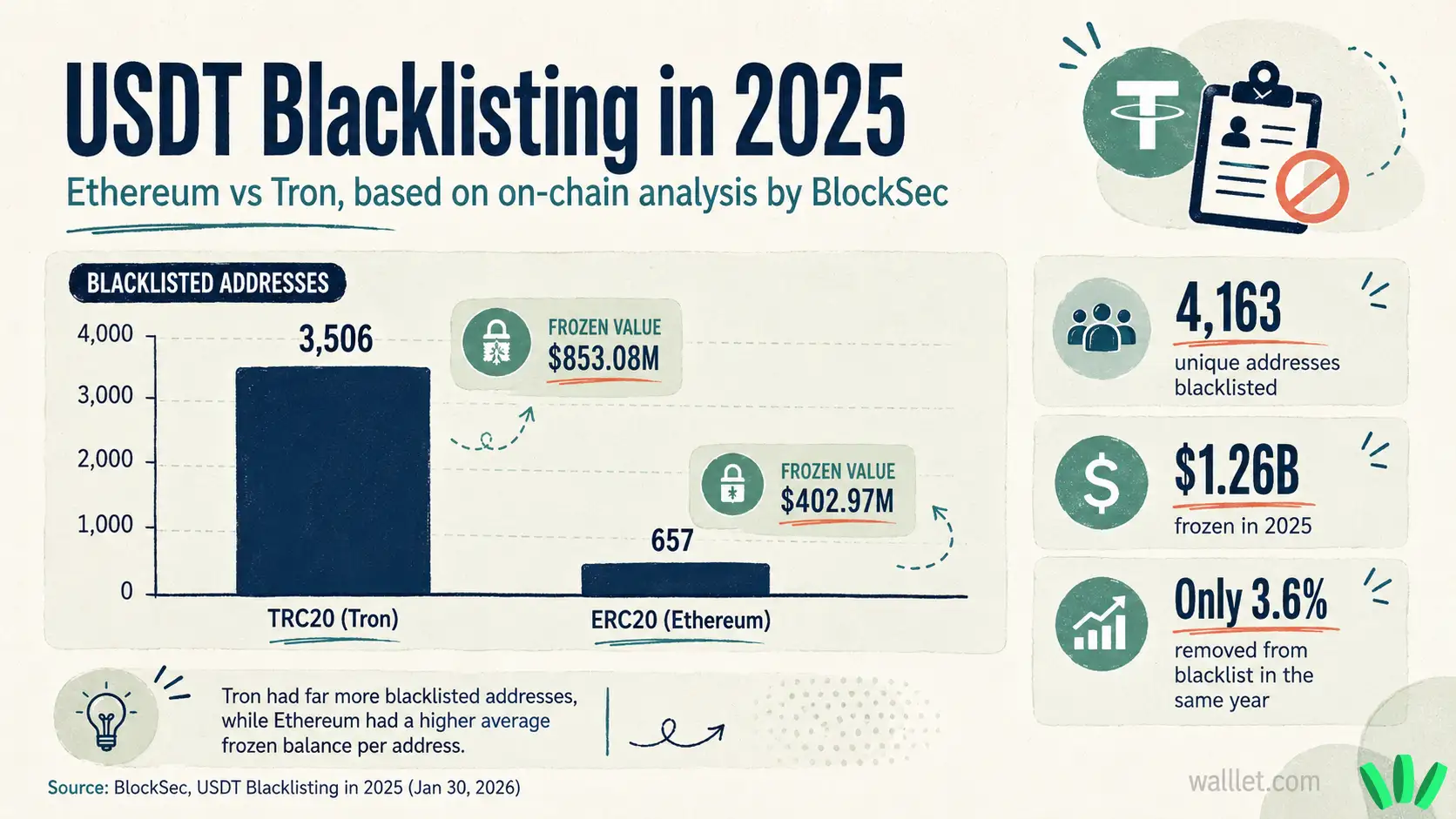
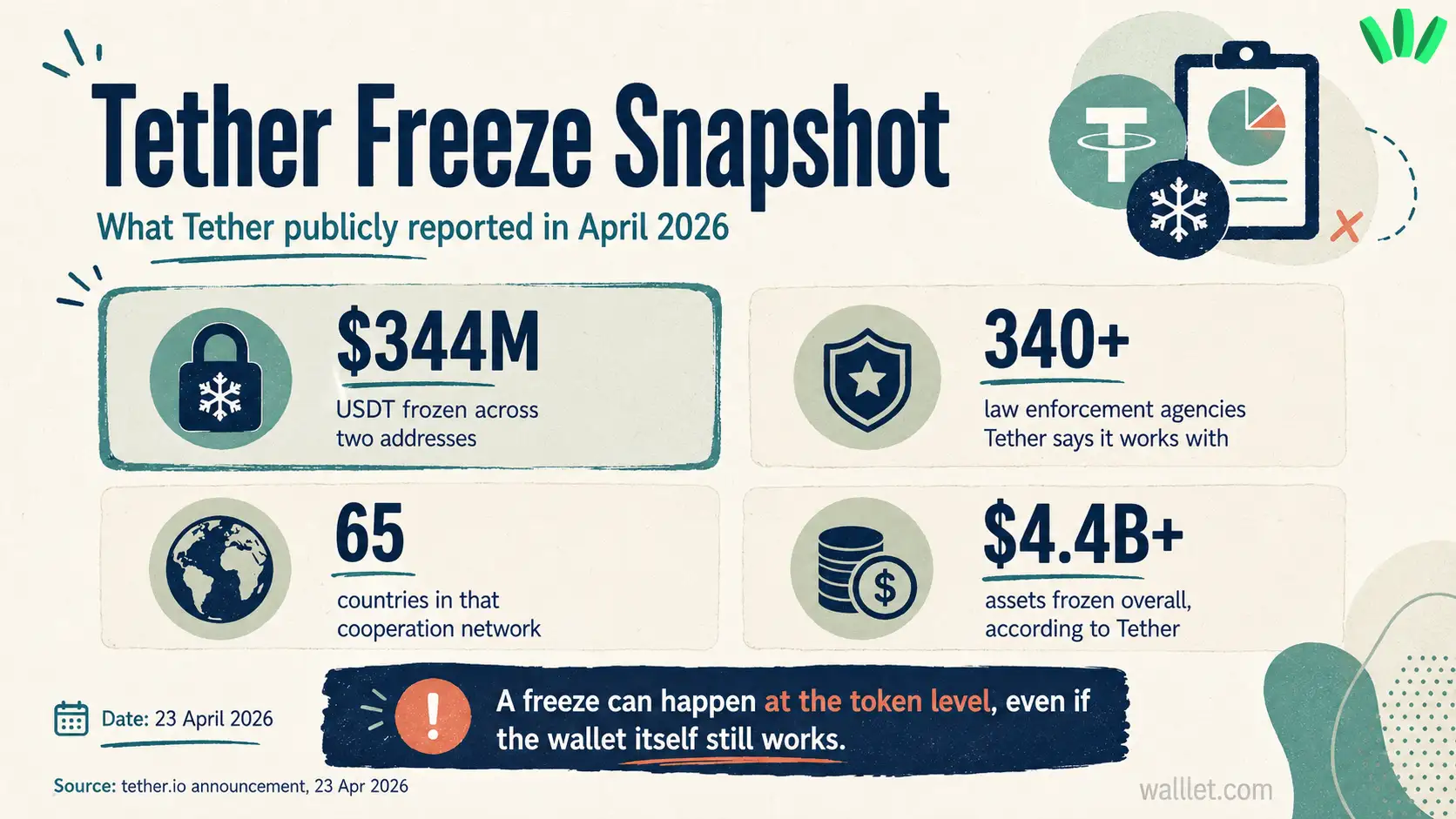
Tether’s current legal terms state that it may freeze Tether Tokens and blacklist digital-token addresses in circumstances covered by its terms and applicable legal requirements.
A blacklist action concerns Tether’s token controls. It does not give Tether the private key to the wallet and does not automatically give it control over unrelated assets held at the same address.
Can Circle Freeze USDC?
Circle’s current USDC terms state that it can block certain addresses and freeze associated USDC in circumstances including legal requirements, illegal activity and violations covered by its terms.
Again, this is a control over USDC—not possession of the wallet’s private key or automatic control of unrelated assets.
Three Different Layers of Control
Layer | Who controls it? | What can be affected? | What self-custody changes |
|---|---|---|---|
Wallet/key control | User or custodian | Ability to sign transactions from the wallet | Self-custody gives the user control of the keys |
Stablecoin issuer control | Stablecoin issuer through token contract mechanisms | The issuer’s token at specified addresses | Self-custody does not remove issuer-level token controls |
Platform/account control | Exchange, fintech or payment provider | Deposits, withdrawals, account access or internal balances | Moving to self-custody reduces platform custody but does not remove issuer controls |

Is a frozen exchange account the same as frozen USDT or USDC?
No.
An exchange can stop withdrawals from your account without the stablecoin issuer freezing the underlying token. This may happen because of:
Identity or source-of-funds reviews
Unusual account activity
Withdrawal security checks
Regional restrictions
Legal or compliance requests
Platform maintenance
Deposit or network-support problems
In this case, the exchange controls access to the account or withdrawal route. The USDT or USDC token itself may still function normally elsewhere.
A self-custody wallet reduces dependence on an exchange’s withdrawal system, but it adds responsibility for address verification, network selection, recovery and transaction approvals. The full comparison is covered in self-custody wallet vs exchange.
Can self-custody prevent a stablecoin freeze?
Self-custody protects control of the wallet credentials. It does not make centralized stablecoins permissionless.
With a self-custody wallet:
An exchange cannot independently stop you from signing an ordinary wallet transaction.
You do not need platform approval for every supported onchain transfer.
You remain responsible for wallet access and transaction approval.
But:
A USDT or USDC issuer may still restrict the token at a specific address.
A recipient may reject the network or token version you used.
A blockchain transaction remains irreversible after confirmation.
A wallet cannot override a token contract or legal order.
Self-custody solves custody risk. It does not eliminate issuer, smart-contract, network, depeg or counterparty risk.
If you want to see how seedless self-custody works without assuming it removes issuer controls, explore walllet.com.
What Does a Stablecoin Freeze Actually Mean?
A freeze or blacklist can restrict the affected stablecoin’s ability to move according to the issuer contract’s controls. It does not automatically mean:
your wallet seed phrase has been compromised; every asset in the wallet is frozen; the entire blockchain address has stopped existing; another token issuer has taken the same action; the wallet application itself controls the restriction.
Always identify which layer is responsible before diagnosing the problem.
Self-Custody Solves a Different Problem
Self-custody means you—not an exchange or custodial provider—control the keys required to sign transactions from the wallet. That reduces custody risk at the wallet layer.
It does not make centrally issued assets censorship-resistant by default. A useful way to think about it is:
Self-custody answers: “Who controls my keys?”
Issuer controls answer: “What can the token contract allow the issuer to restrict?”
Those are separate questions.
What should freelancers check before accepting USDT or USDC?
Most freelancers are unlikely to encounter a direct issuer freeze during an ordinary legitimate payment. More common problems include wrong-network transfers, unsupported deposit routes, unclear payer information and payments that cannot be matched to an invoice.
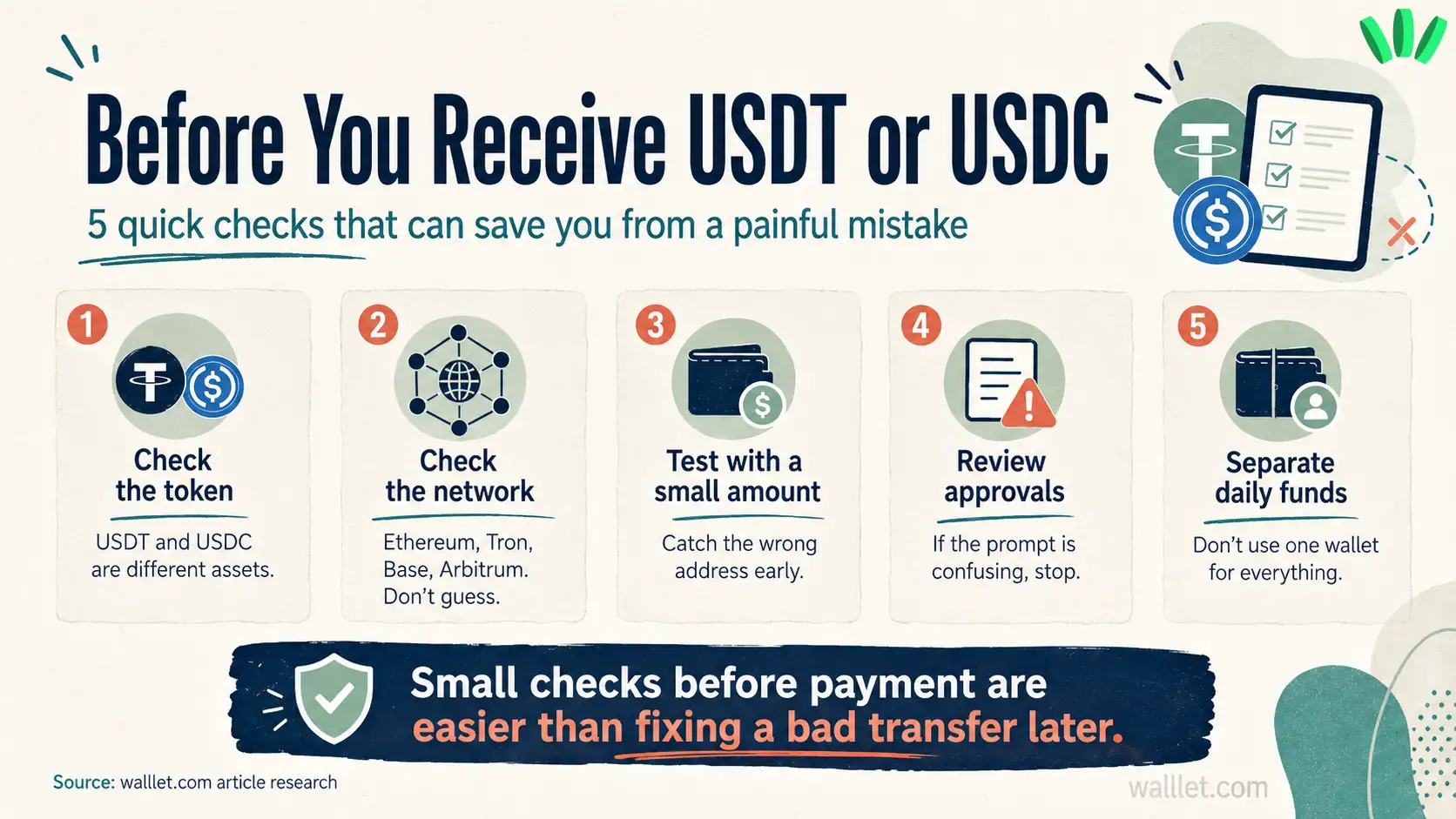
Before accepting a payment, confirm:
The client’s legal or business identity
The invoice amount and payment purpose
Whether the payment will use USDT or USDC
The exact blockchain network
The receiving address taken from the current wallet screen
Whether a memo or destination tag is required
Who pays the network fee
Whether a small test payment is appropriate
How the transaction hash will be recorded
Whether you can hold, spend, swap or cash out the asset after receipt
A wallet address alone is not a complete payment instruction. For the full process, use the guide to getting paid in USDT or USDC as a freelancer.
The network must also work across the complete route. A cheap transfer is useless when the sender can use the network but your wallet or cash-out destination cannot. Compare the available routes in the guide to choosing a network for USDT or USDC.
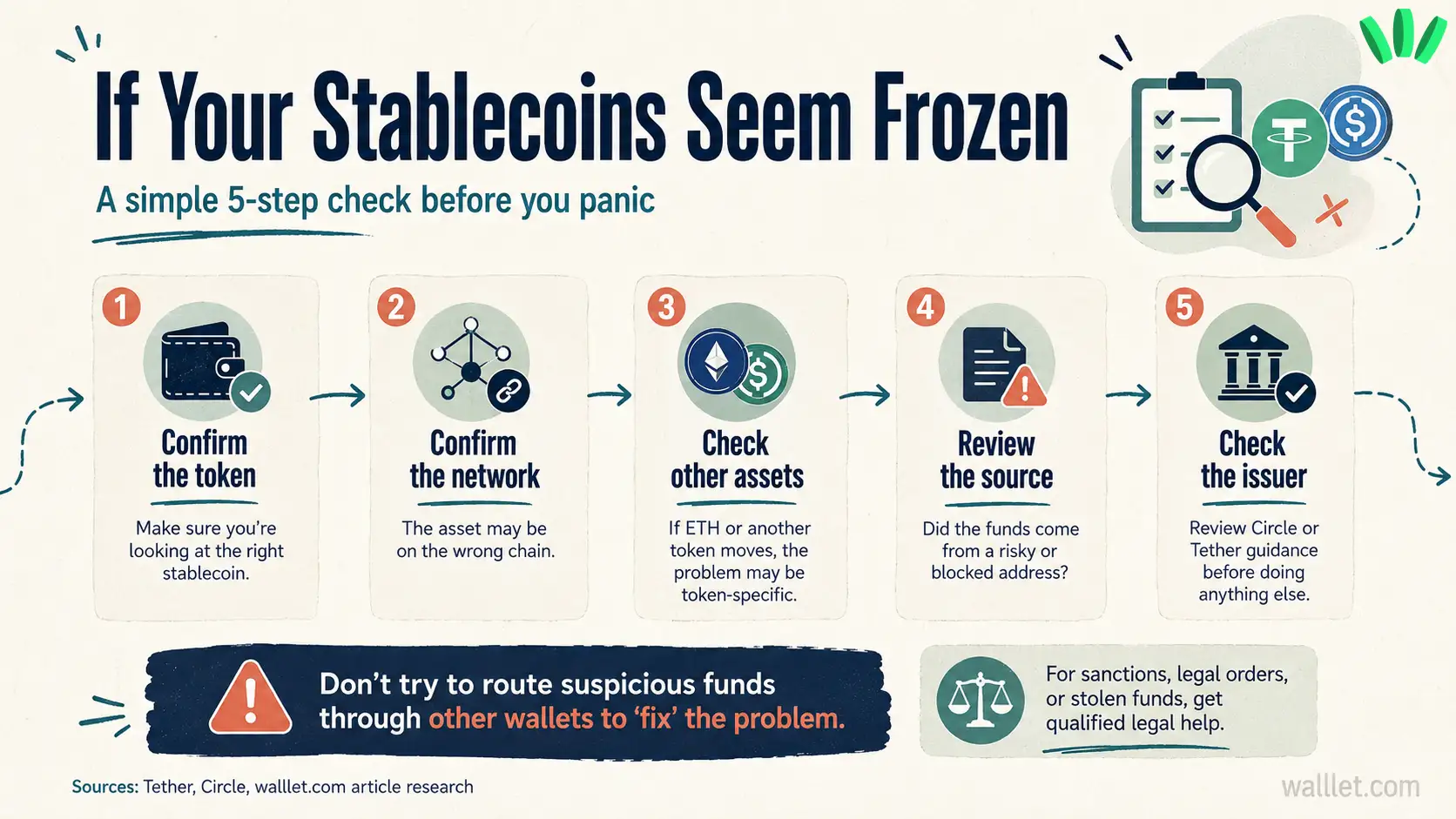
What should you do if you think your stablecoin is frozen?
Start by identifying the layer where the problem exists.
1. Check the address and transaction on a block explorer
Confirm:
The correct blockchain network
The token contract
The sending and receiving addresses
The transaction status
The token balance
Any failed transfer attempt
A screenshot from a wallet or exchange is not enough.
2. Test whether only one asset is affected
Check whether the wallet can move another supported token. Do not make unnecessary transfers from an address under investigation. The purpose is to determine whether the issue concerns wallet access, network fees or one specific stablecoin.
3. Check the provider’s official notices
Review the official support or status pages for:
The stablecoin issuer
The exchange or payment platform
The wallet provider
The relevant blockchain network
Avoid links sent through direct messages, unofficial support accounts or search ads.
4. Contact the correct party
Problem | Contact |
Exchange withdrawal blocked | Exchange or platform support |
Wallet cannot open or recover | Wallet provider |
Transaction pending or failed | Sending platform or wallet provider |
Possible issuer-level restriction | USDT or USDC issuer through official channels |
Wrong address or network | Sender, receiving platform and relevant wallet provider |
Legal or compliance notice | Qualified legal adviser in the relevant jurisdiction |
5. Preserve records
Save:
Transaction hashes
Wallet addresses
Token contracts
Network
Amount
Date and time
Invoice or payment purpose
Sender details
Platform messages
Official notices
Do not send more funds to “unlock” frozen tokens. Do not share a private key, seed phrase, passkey or remote device access with anyone offering recovery.
How walllet fits.com into this risk?
walllet uses a self-custodial wallet layer for supported onchain assets. Self-custody can reduce reliance on an exchange for access and withdrawals, but it cannot remove controls built into USDT, USDC or another issued token.
walllet can help users manage supported assets and review transaction details through its available wallet interface. It cannot:
Guarantee that a stablecoin issuer will never restrict an address
Reverse a confirmed blockchain transaction
Recover funds sent to an incompatible address
Override an exchange or payment provider’s compliance review
Remove legal or regulatory requirements
The useful distinction is simple: walllet can change how you control and use the wallet. It cannot rewrite the rules of the asset held inside it.
Use walllet.com if you want direct control of supported crypto assets through a seedless self-custody wallet, while keeping the limits of issuer-controlled stablecoins in view.
How to Reduce Legitimate Payment Risk
Use stablecoins and payment routes with clear documentation. Keep records of:
invoices
contracts
payment purpose
sender identity where appropriate
transaction hashes
wallet addresses
exchange or provider receipts
source-of-funds documentation for larger payments
Before accepting a large payment, also verify that the token contract is the official one and that your intended receiving and cash-out services support it.
Do not rely on techniques intended to conceal the source or destination of funds. They can create additional compliance and counterparty risk rather than reducing it.

