walllet.com is designed around a self-custodial security model, which means walllet does not hold your crypto or private keys. For a large amount such as $10,000, the remaining risks depend mainly on what asset you hold and which payment, blockchain or third-party service you use.
The important distinction is between walllet.com's own security model and the external services or assets you may use through it. Crypto held in the walllet self-custodial wallet remains under your control. Fiat receiving, card and conversion services may involve licensed third-party providers with their own rules and protections.
If the $10,000 is USDT, USDC or another supported crypto asset in the self-custodial wallet, walllet’s current Terms say walllet does not hold your assets or private keys. You control the wallet credentials, but you still carry device, recovery, smart-contract, blockchain and token risk.
If the $10,000 is an incoming USD, EUR or GBP payment, the structure is different. walllet’s Terms say the virtual receiving account is provided by a third party, the received fiat can be converted by that provider into a supported stablecoin, and walllet itself does not maintain a fiat balance for you.
If the money is loaded onto a card, the card provider, issuer, programme rules, limits and applicable protection become another separate layer. So the right question is:
“At each stage, what does walllet control, what remains under my control, and which external provider or network is responsible for the transaction?”
If you have not already separated wallet security from financial-provider risk, start with how to tell whether a crypto wallet is safe before you use it and how private keys work on walllet.com.

First, identify what your $10,000 actually represents
The number is the same. The legal and technical risk is not.
Your $10,000 is… | Who primarily controls or processes it? | Where the value sits | What protection applies? | Risks outside walllet’s custody model |
USDT/USDC/crypto in the self-custodial wallet | You, through your wallet credentials | On-chain at the wallet address | Self-custody, not bank deposit insurance | User credential loss, malicious signing, token issuer, smart-contract or blockchain risk |
Incoming USD/EUR/GBP payment | Applicable third-party provider during payment and conversion | Fiat during processing, then supported stablecoin after conversion under the current Terms | Depends on the third-party provider and applicable banking/payment protections. | Bank, payment-provider or compliance delays; conversion risk |
Stablecoin after receiving-account conversion | You once credited to your self-custodial wallet, subject to the actual transaction structure | Blockchain | Self-custody plus token issuer structure | Stablecoin issuer, depeg, blockchain and user credential risk |
Fiat cash-out in progress | Applicable off-ramp provider and banking/payment network | In the conversion and settlement route | Depends on provider and banking structure | Off-ramp provider, banking-network or compliance delays |
That table is the core of the decision.
“walllet.com” is the interface the user sees, but the same app can connect you to several different financial and technical layers. walllet’s Terms explicitly separate the non-custodial wallet from virtual accounts, payment cards, off-ramp services and other third-party financial services.
Scenario 1: $10,000 of USDT, USDC or crypto in the walllet.com self-custodial wallet
For on-chain crypto, custody is the first question.
walllet’s current Terms describe its wallet as non-custodial. They say users remain in control of their digital assets, private keys and wallet credentials, while walllet.com does not hold, custody or control those assets or keys. The Terms also state that walllet does not store private keys, passkeys or recovery phrases on its servers.
That means $10,000 of crypto held through the self-custodial wallet is structurally different from $10,000 deposited with a bank or held in a custodial exchange account.
walllet is not supposed to be holding a pot of your crypto in a corporate account and updating an internal database to say you own part of it. The wallet address and blockchain state matter.
This reduces one major risk: custodial control by walllet.com.
This is the central security advantage of walllet’s architecture: walllet cannot independently move a user's crypto simply because it operates the app interface. Control remains tied to the user's wallet credentials rather than to a conventional custodial account controlled by the company.
The remaining risks are different from walllet custody risk. They come from how the user secures the wallet, the assets they hold, the blockchain they use and the transactions they sign.
What risks remain outside walllet’s custody?
Self-custody removes walllet as the custodian, but it cannot remove risks inherent to crypto itself. These include user mistakes, malicious transactions, smart-contract vulnerabilities, blockchain issues and stablecoin issuer controls.
A smart-account implementation can contain a vulnerability.
A third-party dApp can be compromised.
A blockchain can experience technical problems.
A stablecoin can lose its peg.
A token issuer can have its own address-level controls.
Self-custody answers the question “Who holds my keys?” It does not answer “Can anything else affect the asset?”
The distinction becomes particularly important with stablecoins. USDT and USDC can still be subject to issuer-level controls, even when the wallet holding them is non-custodial.
Circle’s current USDC terms, for example, describe circumstances in which Circle can block addresses or freeze USDC in response to its policies or valid legal orders.
Does walllet.com have access to your $10,000 in crypto?
According to walllet’s Terms, walllet does not possess the private key or passkey needed to independently control your wallet assets.
Scenario 2: a $10,000 USD, EUR or GBP payment received through walllet
Receiving fiat introduces a separate financial-services layer. This does not change walllet’s self-custodial model; it means the fiat portion of the transaction is handled through an applicable third-party provider before the resulting digital asset reaches the user's wallet.
The current walllet.com Terms say the virtual receiving account is not issued or operated by walllet or PrimeUp LTD. The account details are issued or made available by an applicable third-party provider or its banking/payment partner.
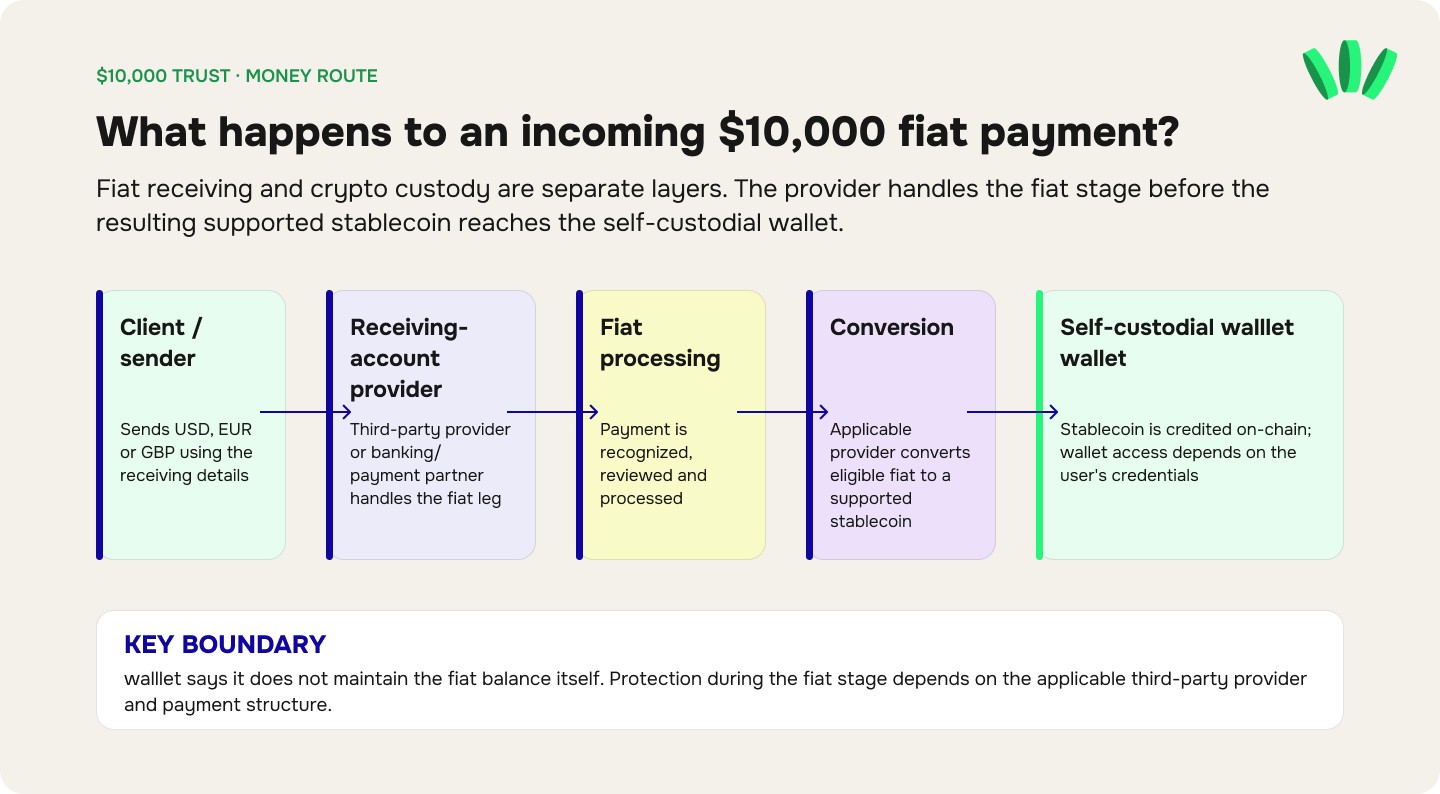
The Terms also say that when an eligible fiat payment is successfully received, the applicable provider can convert the fiat into a supported stablecoin, which is then transferred or credited to the user's walllet wallet. walllet says it does not hold or maintain the fiat funds itself.
That means a $10,000 incoming USD payment should not automatically be understood as: “I have deposited $10,000 into a conventional walllet.com bank account.”
The actual route is closer to:
Client or sender → receiving-account provider / banking route → fiat processing → conversion by the applicable provider → supported stablecoin → self-custodial walllet.com wallet
Once the supported stablecoin is credited to the self-custodial wallet, control returns to the user’s wallet credentials rather than remaining with walllet. The exact provider, timing and legal structure matter.
If this is the route you intend to use, read how the walllet IBAN Account works before treating receiving details like a normal current or savings account.
What protection applies while fiat is being processed?
Do not assume it is.
walllet itself is not a bank and does not present the self-custodial wallet as a bank deposit. During the fiat stage, any banking, safeguarding or payment protection depends on the applicable third-party provider and the legal structure of that payment route.
This distinction does not reduce the security of walllet’s self-custodial wallet. It means that fiat processing and crypto custody are two separate layers with different protections.
For example, the FDIC warns that non-bank fintech companies are not themselves FDIC-insured. If a fintech places customer funds at an FDIC-insured bank, pass-through insurance may apply only when the relevant conditions are satisfied. Consumers are advised to identify the actual bank and understand how funds are held.
That does not mean walllet's receiving service is or is not FDIC-insured. It means you cannot infer deposit protection merely from the existence of a banking partner. Until those fields are public, the responsible statement is simply that the protection depends on the actual provider and structure.
Before moving a serious amount, inspect the route rather than trusting the label. Check the receiving details available to your account, the rate, the fees, the provider disclosures and the amount you expect to receive before you test the flow.
See the walllet money flow and available account features
Scenario 3: $10,000 connected to the walllet.com Card
Card risk is different again.
walllet.com currently documents a virtual USD Mastercard for eligible users. Its card guide lists a $5 issuance fee, a 0.5% top-up fee, a 1% fee for USD transactions subject to stated minimums and maximums, and a 1.5% fee for non-USD transactions under the conditions described on that page. The guide currently says there is no monthly card fee.
You can review the current walllet.com virtual USD card guide for those fees and eligibility details. Do not infer that because a card is a Mastercard, Mastercard itself insures or holds the user's balance.
The network, issuer, programme manager and app are separate entities.
Does the amount itself make walllet.com less safe?
Not technically.
The same wallet architecture does not become weaker because the balance changes from $100 to $10,000.
What changes is the cost of failure.
A mistaken $20 transfer is irritating.
A mistaken $10,000 transfer can materially affect your finances.
The larger the balance, the less sensible it is to rely on assumptions you have never tested. That is why due diligence should become stricter as the amount becomes more important to you. A user considering $10,000 should know, before moving it:
how recovery works;
how the money enters and leaves;
which entity handles each financial step;
which limits apply;
what fees apply;
which protections actually exist;
what happens if access is restricted;
what happens if the provider or walllet becomes unavailable.
For Nigerian users, the current walllet.com Nigeria guide explains how availability, verification, account features and cash-out can vary by user and service.
How should you test walllet.com before moving a large balance?
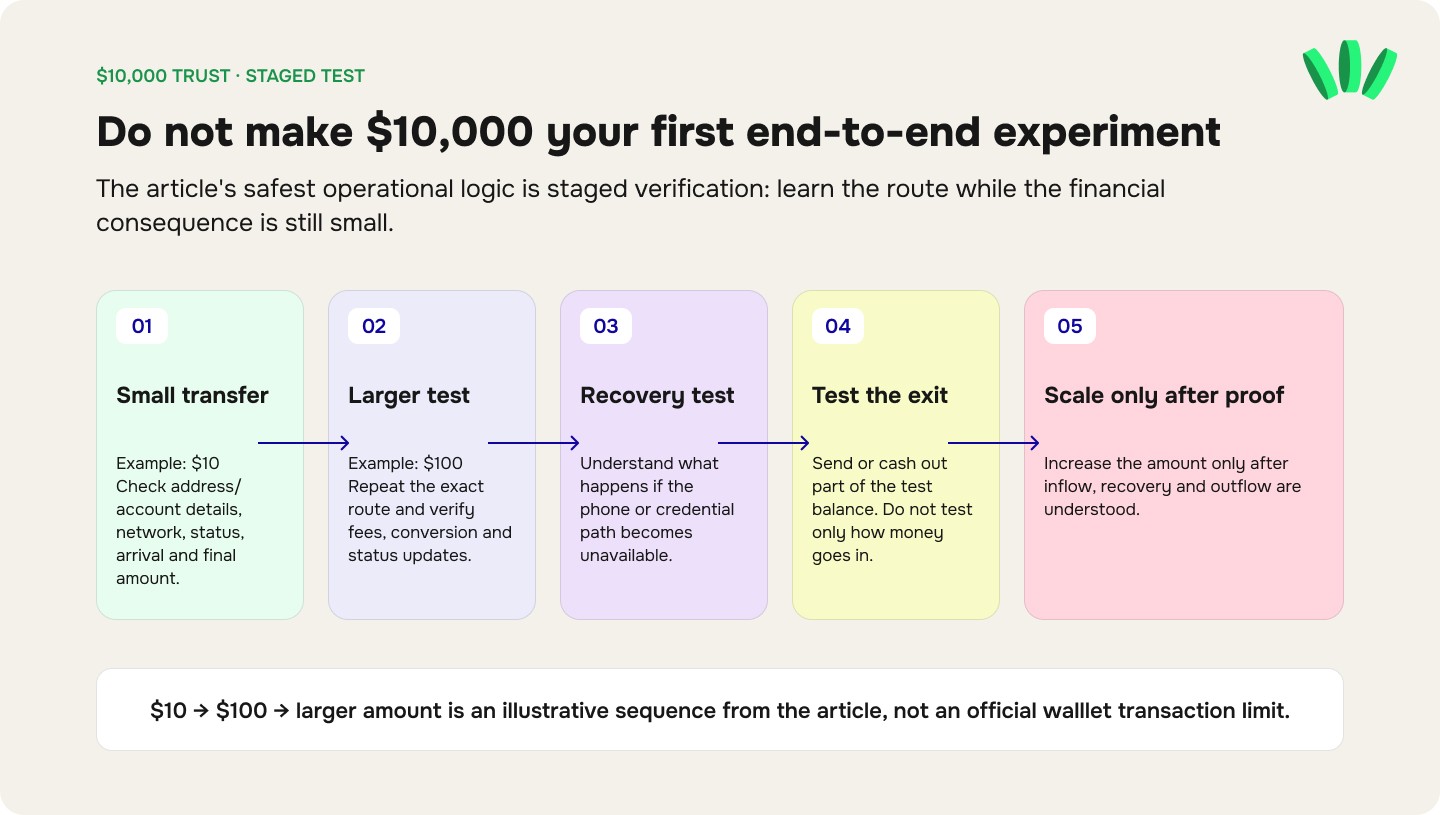
Do not make $10,000 your first end-to-end experiment. A staged test lets you learn where the friction and failure points are while the financial consequence is still small.
A practical staged test
Stage 1: Small transfer, for example $10
Use an amount that meets the applicable minimums and fees. Verify:
the address or account details;
the network;
transaction status;
actual arrival;
final amount after fees.
Stage 2: A larger test, for example $100
Repeat the exact route you expect to use later. Check whether:
the fee behaves as expected;
conversion matches the quoted rate;
status updates make sense;
the receiving or cash-out route completes normally.
Stage 3: Recovery test
Before storing meaningful self-custodial funds, understand what happens if your phone disappears. The walllet new-phone and lost-phone recovery guide explains the current recovery model. A recovery process you have never understood is not a recovery plan.
Stage 4: Test the exit
Send or cash out part of the test balance.
Do not test only how money goes in. Verify how it comes back out.
Stage 5: Increase only after the complete route is understood
The numbers $10 → $100 → larger amount are examples, not official walllet limits.
The purpose is staged verification.
What happens if a $10,000 payment is delayed?
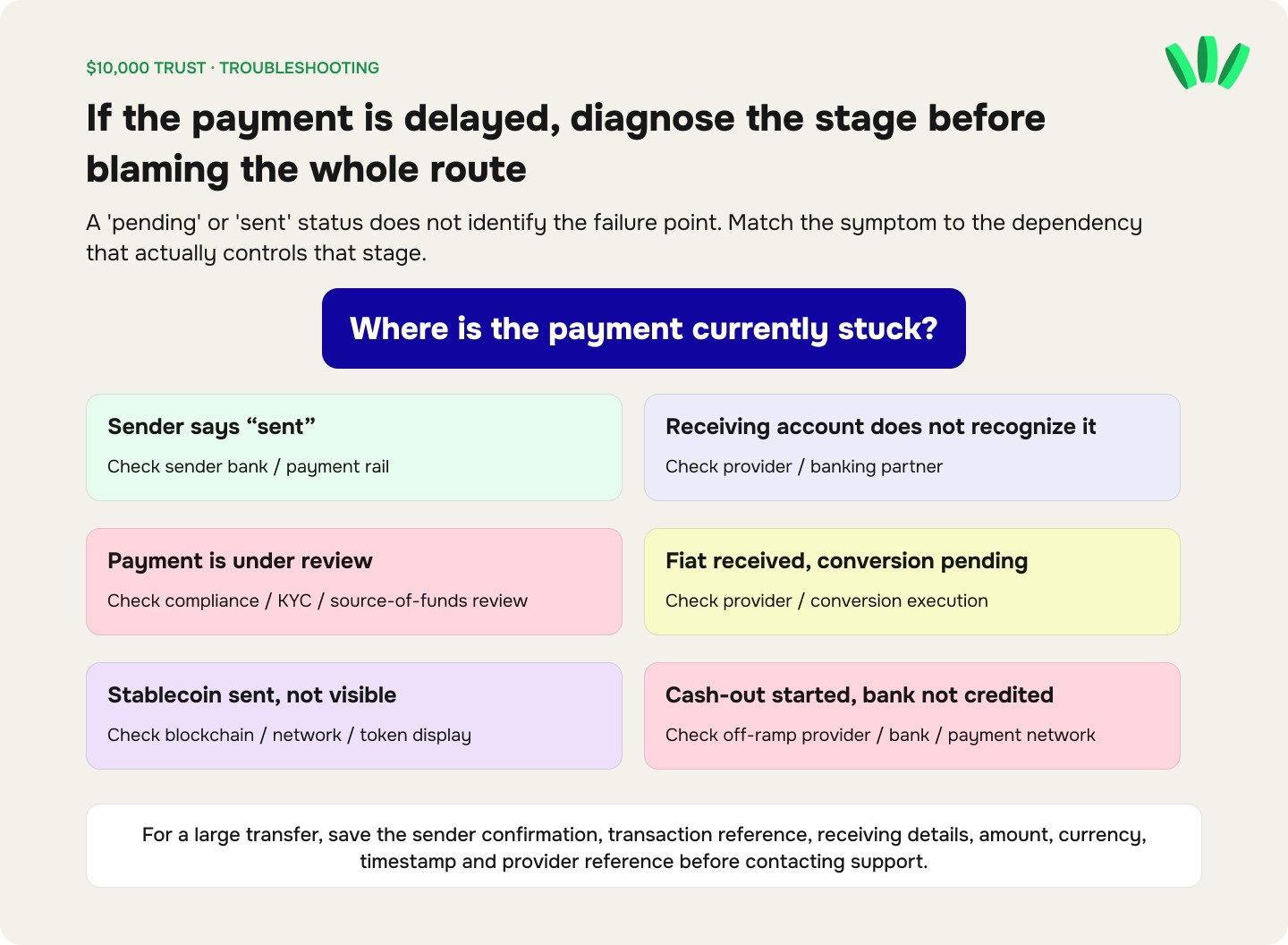
The answer depends on where the payment is in the route.
walllet’s Terms say a payment displayed as pending, initiated or received does not necessarily mean it has been finally settled, converted and credited. Processing may depend on the sender's bank, intermediary institutions, payment networks, compliance reviews, technical systems and the applicable provider. This creates several possible failure points:
Status | Likely dependency to investigate |
Sender says payment was sent | Sender bank / payment rail |
Receiving account has not recognized payment | Provider / banking partner |
Payment is under review | Provider compliance / KYC / source of funds |
Fiat received but conversion pending | Provider / conversion execution |
Stablecoin sent but not visible | Blockchain/network/token display |
Cash-out initiated but bank has not received it | Off-ramp provider / bank / payment network |
For a large transfer, save the transaction reference, sender confirmation, receiving details, amount, currency, timestamp and any provider reference before contacting support.
If identity checks become part of the delay, the walllet.com verification guide covers common KYC and review states.
What fees could affect $10,000?
There is no responsible single fee number for every $10,000 walllet.com transaction.
walllet’s Terms say applicable rates, conversion amounts, processing fees and provider fees are displayed before confirmation and can vary with location, amount, asset, currency, payment method and provider. Third-party banks or intermediaries can also impose charges outside walllet's control.
This means you should compare the final amount received, not only the advertised fee percentage.
For a useful model of how fees stack, the existing article what a $1,000 freelance payment really costs separates receiving fees, conversion costs, card costs and one-time charges.
For $10,000, verify these separately:
receiving fee;
conversion fee;
exchange-rate spread, if any;
blockchain gas or network cost;
off-ramp fee;
bank/intermediary fee;
card top-up fee;
spending or foreign-currency card fee.
Never multiply a headline percentage by $10,000 and assume you have calculated the complete route.
What protection applies to $10,000 in each scenario?
There is no single walllet-wide protection label.
Self-custodial crypto
The protection comes primarily from control of the signing credentials and the security architecture.
That is not the same thing as deposit insurance.
Fiat during a receiving-account transaction
Protection depends on the third-party provider, banking partner, jurisdiction and exact legal structure.
Stablecoin after conversion
Once the supported stablecoin reaches the self-custodial wallet, custody changes again. The user controls the wallet credentials, while token and blockchain risks remain.
Card balance
Protection depends on the issuer/programme structure.
Using one phrase such as “your funds are protected” across all four scenarios would hide material differences.
Can walllet.com or its provider restrict access?
The answer depends on the layer.
For the self-custodial crypto wallet, walllet says it does not hold the private keys needed to independently move the user's assets.
Third-party financial services work differently.
walllet's Terms say providers can independently apply identity verification, sanctions screening, fraud checks, source-of-funds reviews and transaction monitoring. Providers may delay, reject, restrict or terminate access under their own terms and risk controls. walllet says it cannot guarantee or override those provider decisions.
So:
Self-custodial crypto control ≠ guaranteed access to every fiat, card or payment service.
That distinction should be clear before the user sends a large payment, not discovered during a compliance review.
What remains outside walllet.com’s control?
walllet’s security model protects one specific thing: custody and control of the user’s crypto credentials. It cannot control external blockchains,
walllet does not guarantee that a fiat payment will be accepted, processed, converted or credited within a specific period. Third-party providers, banks and payment networks can delay or reject transactions.
The Terms also describe stablecoin, blockchain, bank, provider and technical risks.
For self-custodial assets, walllet says it cannot reset or recover your private key or passkey if you lose access to the necessary credentials.
The current Terms also contain a limitation-of-liability clause that, subject to applicable law and the qualifications in those Terms, limits aggregate liability to the greater of fees paid for the service during the preceding 12 months or $100. That legal clause is not an insurance policy and should be read in the current Terms before relying on the service with a material amount.
Trust does not require pretending those limits do not exist. It requires knowing them before the transaction.
Should you keep your savings in walllet.com?
That question needs a definition of “savings.”
If you mean emergency cash that must be predictably accessible, compare walllet's actual custody and protection structure with the protections, liquidity and access offered by the alternatives available to you.
If you mean USDT or USDC that you deliberately want to self-custody, the relevant questions shift toward credential security, recovery, smart-account risk, stablecoin risk and blockchain access.
If you mean money temporarily passing through a receiving account before becoming stablecoin, the provider and settlement route matter.
The product label does not make these scenarios equivalent. A financially careful user should decide based on the failure mode they are willing and able to handle.
Is walllet.com designed for holding larger crypto balances?
walllet’s self-custodial architecture does not become less secure simply because the balance is larger. Whether the amount is $100 or $10,000, walllet does not become the custodian of the user's crypto.
What changes with a larger balance is the consequence of user error or external asset and network risk. That makes wallet security, recovery and transaction verification more important as the amount increases.
A $10,000 loss might be manageable for one person and catastrophic for another. The decision threshold should therefore rise with the importance of the money. For a material amount, a reasonable standard is:
Verify identity → verify custody → verify provider → verify protection → test inflow → test recovery → test outflow → increase gradually
This matches how walllet's target users tend to evaluate unfamiliar financial tools: research first, test independently, then adopt after the process becomes predictable.
So, is walllet.com safe?
Yes, walllet.com is designed around a secure self-custodial model: walllet does not hold users’ crypto or private keys, and users retain control through their own wallet credentials.
That does not make crypto itself risk-free. Blockchain networks, stablecoin issuers, user actions and third-party financial providers each introduce their own risks. Those risks should be evaluated separately from walllet’s custody model.
For a large amount such as $10,000, the strongest approach is to secure your credentials, understand recovery, verify the payment route when using fiat services and test the complete transaction flow before moving the full amount.
The key distinction is simple: walllet provides the wallet infrastructure, but it does not take custody of your crypto.
If you have checked the route, the provider, the fees, the recovery path and the limits, test the complete flow before you scale the amount up.
Test how receiving, holding, converting and accessing money works in walllet

