
A client pays your $1,000 invoice. That does not necessarily mean $1,000 reaches your balance. And even if $1,000 does reach your balance, it does not mean you have $1,000 worth of usable money by the time you convert it to naira, withdraw it or spend it.
The number worth comparing is not the advertised fee. It is what you can actually use at the end of the route.
For Nigerian freelancers, that route can include a receiving fee, intermediary-bank deduction, currency-conversion fee, FX spread, withdrawal fee and, in some cases, card-related costs. If you are still deciding how the payment should reach you in the first place, How Nigerian Freelancers Receive Payments From US, UK, and EU Clients breaks down ACH, UK transfers, SEPA, wire, IBAN and stablecoin routes before the fee calculation even begins.
For freelancers trying to avoid PayPal specifically, How to Receive USD in Nigeria Without PayPal in 2026 compares practical alternatives and the costs and trade-offs that come with them.
For Nigerian freelancers, this is where walllet.com becomes particularly useful. Instead of treating receiving, holding, spending and cashing out as separate problems, walllet.com brings them into one flow. Eligible users can receive supported USD, EUR and GBP payments, keep part of their income in dollar value, spend through a USD Mastercard where supported, and convert only the amount they need to naira.
That matters because the cheapest payment route is not always the one with the smallest receiving fee. The better question is how much of the original payment remains useful after receiving, conversion, spending and cash-out are taken together.
A $1,000 payment can lose money at several different points
A typical international freelance payment can pass through some or all of these stages:
$1,000 invoice → payment rail → receiving account → USD balance → currency conversion → NGN withdrawal or card spend
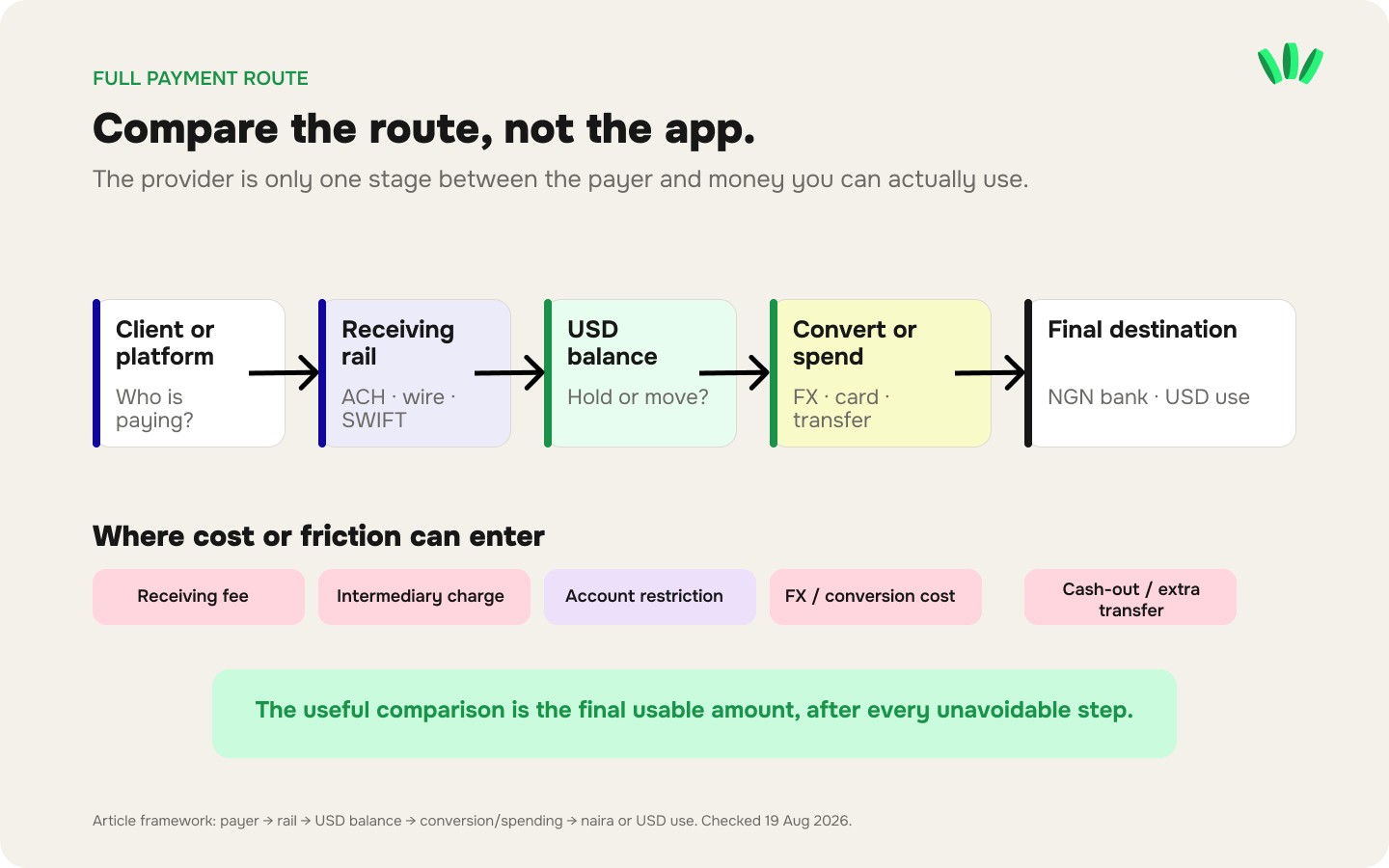
Each stage can introduce a different cost.
Cost layer | What it means | What to check |
Receiving fee | A fee for accepting the incoming payment | Percentage, fixed fee, minimum or maximum |
Sender or bank fee | A charge applied before the payment reaches you | Whether the sender pays it or it is deducted from the transfer |
Intermediary-bank fee | A deduction by a correspondent bank on some international wires | Whether the rail can involve intermediary banks |
Conversion fee | A separately disclosed charge for converting USD to NGN | Percentage, cap and minimum |
FX spread | The difference between a useful reference rate and the rate you are actually offered | Executable rate at the same timestamp |
Cash-out fee | The cost of withdrawing to a Nigerian bank account | Fixed or percentage fee |
Card cost | Issuance, funding, FX or transaction charges associated with spending | Whether you are spending the existing USD balance or converting/funding first |
The important distinction is that a fee can be visible while the larger cost sits inside the exchange rate.
If your $1,000 payment has more than one job, some for local expenses, some to keep in dollars and some for international tool, walllet.com lets you receive, hold, spend and cash out from one place. You can keep what you do not need to convert, spend through a USD card where supported, and see the rate, fee and exact naira amount before confirming a cash-out.

What can happen to $1,000 after a few small-looking charges
Consider a simple illustrative route:
Your client sends $1,000.
A 1% receiving fee removes $10.
You now have $990.
An effective 1.5% currency-conversion cost on that remaining amount removes the equivalent of $14.85.
A $1 withdrawal charge is applied.
Your usable value is now equivalent to $974.15.
That is a total economic cost of $25.85, or about 2.6% of the original payment.
Why the FX spread can matter more than the fee you notice
A withdrawal fee is easy to see. An FX spread is easier to miss because it appears inside the rate.
Suppose the useful reference rate at the moment you convert is: ₦1,500 per $1
A provider offers: ₦1,477.50 per $1
The difference is ₦22.50 per dollar, or 1.5%.
On $990, that 1.5% difference has the economic effect of about $14.85.
A $1 withdrawal fee gets your attention because it is labelled “fee.” The exchange-rate difference in this example costs almost fifteen times as much.
A simple way to measure the spread for a USD-to-NGN conversion is:
FX spread % = (reference rate − offered rate) ÷ reference rate × 100
But use the formula carefully. If you calculate the final NGN amount against a reference rate, the FX effect is already included in the difference. Do not add the same spread again and double-count it.
Compare the final NGN amount, not the prettier fee page
Cost-to-usable-money is the more useful benchmark for this comparison because headline fees alone do not show what finally reaches you.
It also requires provider comparisons to use dated/live data and the total received rather than undated fee claims. That distinction matters when you look at current public pricing.
Public fee snapshot for a $1,000 US ACH payment
The table below uses public provider information checked on August 19, 2026. It does not declare a cheapest route because an exact comparison requires executable USD/NGN quotes from the same moment.
Route | Receiving $1,000 by US ACH | Published USD→NGN conversion cost | NGN bank payout | What the public data still does not tell you |
Grey | 0.8% = $8 | 1%, capped at $6 | ₦35 | The executable USD/NGN rate for your exact conversion |
Raenest | $1 flat | 0.5%, capped at $2.70 | ₦0 | The executable USD/NGN rate for your exact conversion |
Payoneer | Generally 0–1% for qualifying USD local-bank payments | Varies by account/transaction | Varies | The full Nigeria-specific rate and withdrawal quote shown to that account |
Grey's current public documentation lists a 0.8% ACH receiving fee with a $2 minimum and $10 maximum. Grey also publishes a conversion charge of 1% capped at $6 and a ₦35 NGN bank-transfer fee. Grey states that the exact conversion rate is shown to the user, and its help material describes a conversion spread within the rate.
Raenest's current documentation lists a $1 flat charge for USD ACH deposits. Its published USD-to-NGN conversion fee is 0.5%, with a $0.25 minimum and $2.70 cap, while Nigerian bank payouts are currently listed at ₦0. The USD/NGN rate itself is supplied through the product and can change, so the fee table alone cannot tell you the final NGN amount.
Payoneer's public pricing says USD payments received through eligible local receiving-account rails can carry a fee ranging from 0% to 1%, while other bank-withdrawal and conversion costs vary by location, currency and account conditions. That makes an exact Nigeria $1,000-to-NGN total impossible to reconstruct responsibly from the public headline pricing alone.
If your payment is arriving through ACH and something goes wrong before you even reach the conversion stage, ACH Payment Returned? What R01, R02, R03, R04 and Other ACH Return Codes Mean explains why an ACH credit can be returned and who usually needs to fix the problem.
What the fee table does tell us
If you look only at explicit charges, the arithmetic appears simple:
Grey: $8 receiving + up to $6 conversion + ₦35 payout.
Raenest: $1 receiving + up to $2.70 conversion + ₦0 payout.
Payoneer: the public information does not expose enough Nigeria-specific variables for the same calculation.
But this still does not establish which route leaves the most naira. The missing number is the executable exchange rate.
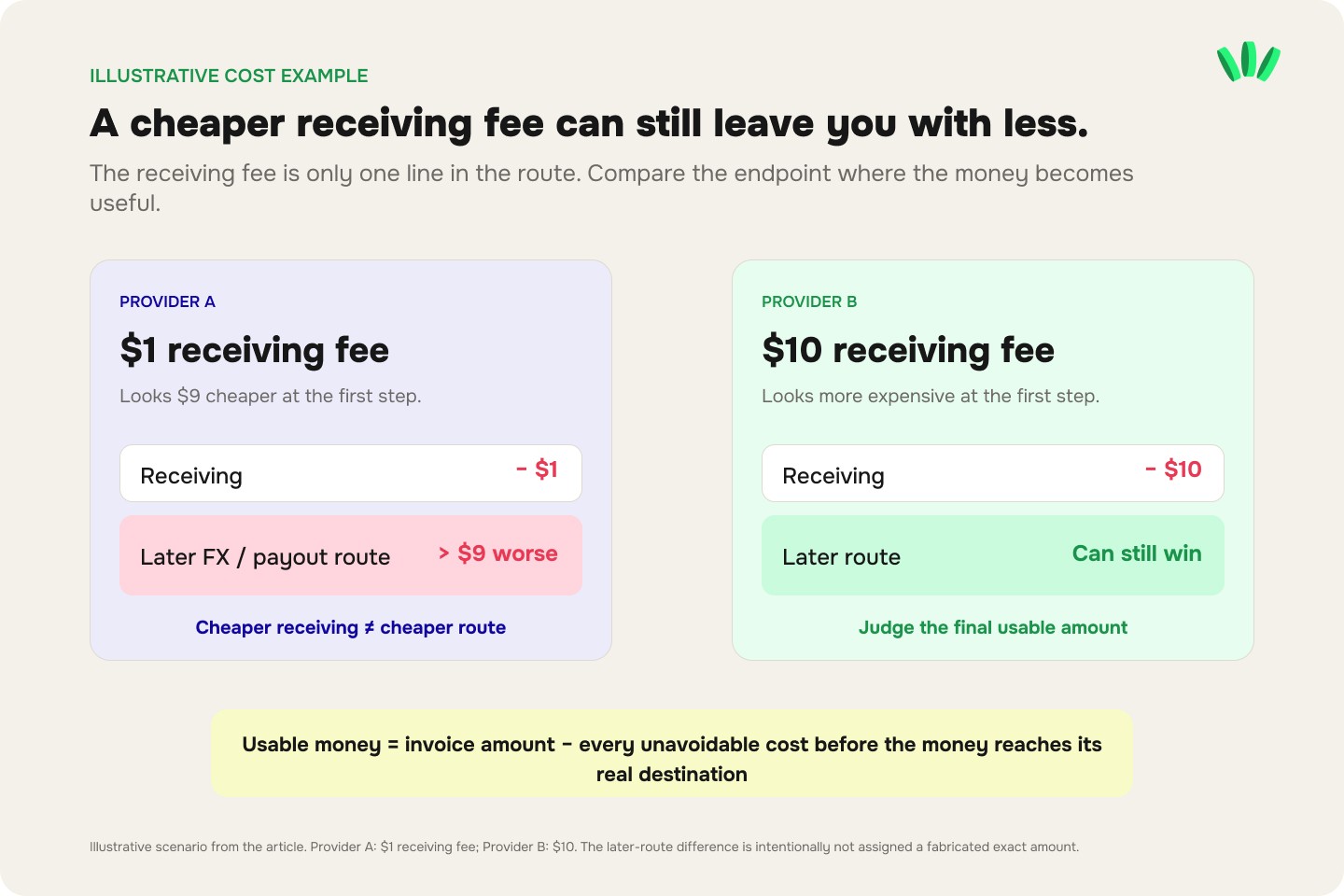
A provider charging $3.70 in visible fees can still leave you with less NGN than a provider charging $14 if its conversion rate is sufficiently worse. The reverse can also happen.
This is why “lowest fee” and “lowest total cost” are not interchangeable.
Where walllet.com fits in the $1,000 comparison
walllet.com is more useful to compare at the full-route level than by looking at one receiving fee.
Before a supported USD-to-NGN cash-out, walllet.com shows the applicable exchange rate, fee and exact naira amount before you confirm. That makes it possible to judge the transaction by the number that matters: what you actually receive.
walllet.com also states that naira cash-outs typically reach the user's own Nigerian bank account in about two minutes.
That does not mean walllet.com will automatically be the cheapest route for every $1,000 payment. A fair comparison still requires checking live quotes from every provider at the same time.
Its bigger advantage for freelancers is what happens around the conversion. You can receive supported foreign income, keep part of it in dollar value, spend through a USD Mastercard where supported, and convert only the amount you actually need in naira.
So instead of comparing:
lowest receiving fee = cheapest option
compare:
receiving cost + conversion cost + FX rate + spending cost + cash-out cost = actual cost of using your income
How to compare two payment routes properly
Run the comparison at the same time and with the same starting amount. For a $1,000 payment, record these numbers for each route:
Invoice/payment amount: $1,000
Incoming fee: how much is deducted before or when the USD balance is credited
USD available after receiving: the amount you can actually convert or spend
Executable USD/NGN rate: the rate you can confirm now, not a marketing rate from yesterday
Conversion fee: any separate charge in addition to the rate
Withdrawal or payout fee: what it costs to reach your Nigerian bank account
Final usable NGN: what lands after the whole route
Then compare:
Reference NGN value = $1,000 × chosen reference USD/NGN rate
Effective route cost = reference NGN value − final usable NGN
Effective cost % = effective route cost ÷ reference NGN value × 100
The same reference rate and timestamp must be used for every provider. Otherwise, a rate movement can make one route look artificially cheaper.
“How much do I receive?” depends on what you want to do with the money
Final NGN is the right benchmark only when your goal is to cash out to naira.
Freelancers do not use every payment the same way. The walllet.com audience commonly needs to receive foreign income, keep some of it dollar-linked, convert some to naira and spend some on international services.
The cost benchmark should change with the job.
If you need naira
Measure:
$1,000 sent → final NGN in your bank account
Include receiving, conversion, FX and withdrawal costs.
If the money reaches you as USDT or USDC instead of bank USD, How to Cash Out USDT or USDC to Naira in Nigeria covers the separate off-ramp step, including rate checks, fees and common cash-out mistakes.
If you want to keep the money in dollars
Measure:
$1,000 sent → usable USD balance
A USD-to-NGN spread does not belong in this calculation if you are not converting to NGN.
If your route uses dedicated international receiving details, What Is the walllet IBAN Account? A Practical Guide for Freelancers and Global Earners explains how IBAN payment details fit into receiving international client income and what to check before sharing them.
If you want to pay for international software or subscriptions
Measure:
$1,000 sent → total cost of the USD purchase
Converting USD income to NGN and later converting NGN back into dollar spending power can create unnecessary currency friction. Check whether the card spends directly from the relevant balance and whether funding, FX, cross-border or transaction charges apply.
If card spending is part of your route, Why Crypto Cards and Virtual Dollar Cards Get Declined: A Freelancer Checklist covers another cost that does not appear in the advertised fee table: failed or restricted card transactions that leave money unusable for the purchase you intended to make.
If you want to send the money elsewhere
Measure the complete second transfer too. An inexpensive receiving route can become expensive if moving the funds onward carries another fee.
“Usable money” is therefore a destination-specific number.
Why the lowest fee is not always the cheapest route for a freelancer
Suppose you receive $1,000.
You need the equivalent of $400 for rent and local expenses, but the remaining $600 will pay for software, hosting, subscriptions or other dollar-priced expenses.
A payment route that forces the whole $1,000 through a USD-to-NGN conversion may look inexpensive on its fee page, but it can make you convert money you never needed in naira. If you later need dollars again, you have introduced another conversion into the journey.
walllet.com is designed around a different flow.
You can keep the portion you still need in dollar value, convert only the amount required for local expenses, and use a supported USD Mastercard for international spending.
That can remove an unnecessary conversion step.
This is why the cost of a freelance payment should include avoidable conversions, not just the fees listed on a pricing page. A lower headline fee can still produce a more expensive workflow if the same money has to cross currencies twice.
Do not treat one-time card costs as a fee on every payment
Another common comparison error is mixing recurring transaction costs with one-time account or card costs.
As of August 2026, the walllet.com virtual USD Mastercard has a $5 one-time issuance fee, with no monthly card fee currently listed. Card top-ups carry a 0.5% fee, while card transactions carry a 1% fee subject to the applicable minimum and maximum. Additional costs can apply in cases such as non-USD transactions or insufficient-balance declines.
These charges should not be confused with the cost of receiving a freelance payment. The $5 issuance fee is paid once; it is not deducted from every $1,000 you receive.
For freelancers who already earn in dollars and also have dollar-denominated expenses, the more useful question is whether keeping and spending part of that balance directly can avoid an unnecessary USD-to-NGN-to-USD conversion. The walllet.com virtual dollar card guide covers its issuance fee, KYC requirements and online-payment limits.
If you receive four $1,000 payments and use the same card, assigning the entire $5 issuance charge to each payment would overstate the route's cost.
Separate:
one-time costs,
recurring account costs,
per-payment costs,
conversion costs,
and per-purchase costs.
What makes walllet.com a credible option for freelancers?
Cost is only one part of choosing where to receive and use freelance income. You also need to know who operates the service, how access to your money is secured and what happens before you confirm a transaction.
For conversions and cash-outs, the important transparency feature is simpler: walllet.com shows the exchange rate, applicable fee and amount you are expected to receive before confirmation.
None of these signals means a financial product is risk-free. But they give freelancers concrete things to verify instead of relying only on a claim that a service is “cheap” or “fast.”
Why a bank wire can arrive short before you even convert it
Some international wires create another problem: the receiving provider may not be the only institution touching the payment.
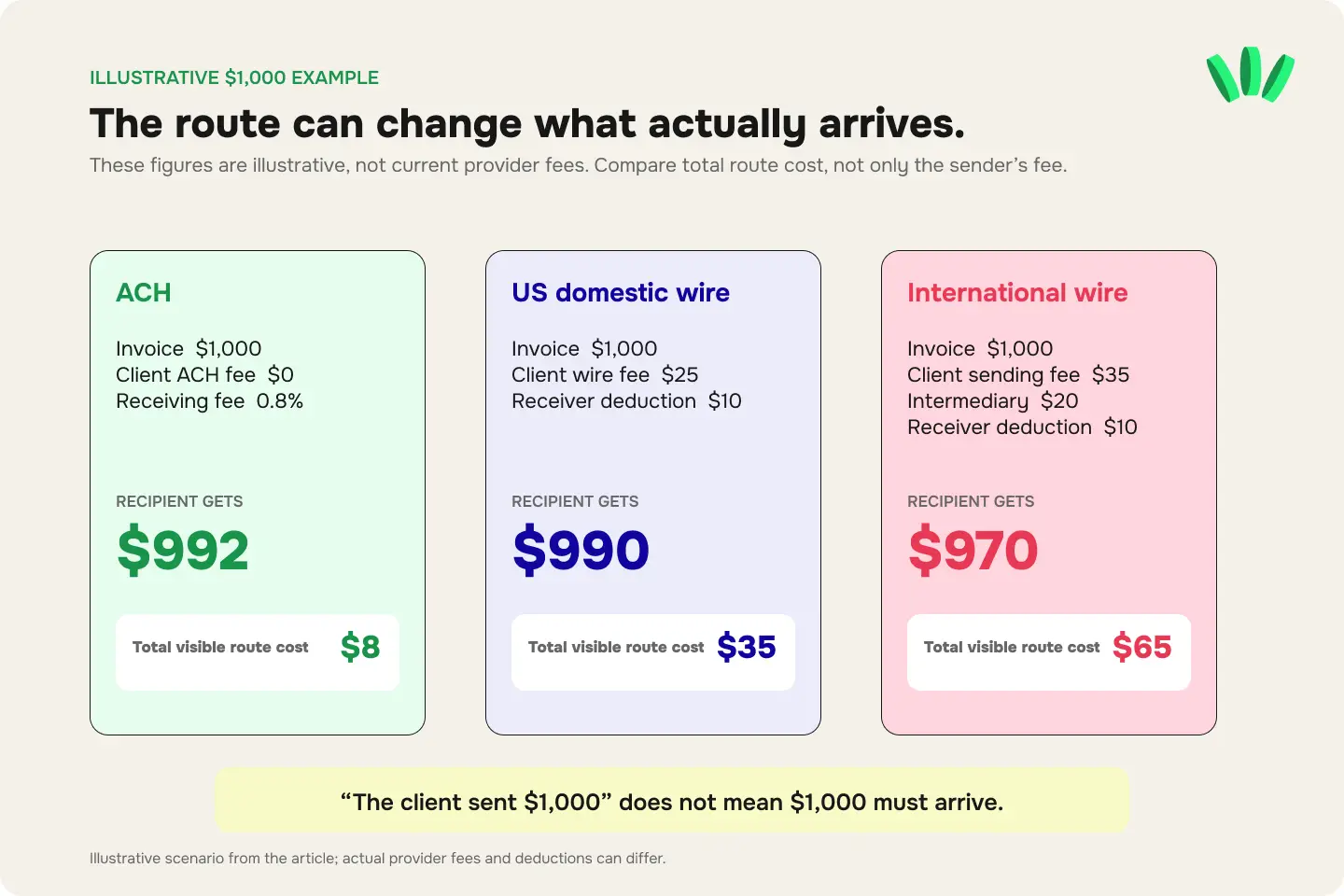
A SWIFT transfer can involve intermediary or correspondent banks. Depending on how charges are allocated, fees may be paid by the sender, shared, or deducted from the amount in transit. The common charge instructions are OUR, SHA and BEN. Intermediary fees can make a payment arrive below the amount shown on the original instruction.
So a client saying, “I sent $1,000,” and your account showing $982 does not automatically mean your receiving platform charged $18.
The deduction may have occurred earlier in the banking chain.
If a wire is missing or has not reached the expected account, How to Trace a Missing International Wire With an MT103 or UETR explains what an MT103 and UETR can tell you and how the sender and recipient can start tracing the payment.
Which fee usually matters most?
There is no universal winner, because transaction size and route change the answer. But the structure gives you a useful rule:
Percentage costs and FX differences grow with the payment amount. Fixed fees do not.
A $5 charge on a $100 payment is 5%. The same $5 charge on a $1,000 payment is 0.5%.
On the other hand, a 1% exchange-rate disadvantage costs roughly 1% regardless of whether the payment is $100, $1,000 or $5,000, assuming the same rate structure.
For larger recurring freelance income, a small-looking FX difference can therefore matter more than a small fixed withdrawal charge.
For small payments, the opposite can be true.
And for some international wires, an unexpected intermediary-bank deduction may dominate both.
A route that looks cheap can also become expensive in time rather than explicit fees if the payment gets held or reviewed. Why Freelance Payments Get Held, Reviewed, or Delayed explains the review and delay risks freelancers should factor into payment-route decisions.
A “free” withdrawal can cost more than a paid withdrawal
Consider two hypothetical cash-out options:
Route A
Withdrawal fee: $0
Exchange-rate disadvantage: 2%
Route B
Withdrawal fee: $3
Exchange-rate disadvantage: 0.5%
On a $1,000 conversion, the rate difference can easily outweigh the $3 visible fee. This is why “free withdrawal” tells you almost nothing about total cost unless you also know the conversion rate.
What to check before choosing how to receive a freelance payment
For every payment route, compare the same set of variables:
Check | Why it matters |
Receiving fee | Tells you how much reaches the first usable balance |
Minimum and maximum fee | A percentage may stop increasing after a cap |
Payment rail | ACH, wire, local transfer and stablecoin routes have different cost structures |
Intermediary deductions | Relevant especially to some international wires |
Executable exchange rate | Shows what your dollars are really worth at conversion |
Separate conversion fee | May sit on top of the rate |
Withdrawal fee | Determines what it costs to reach your bank |
Card/funding fees | Matter when spending rather than cashing out |
Limits | A cheap route is useless if your payment exceeds its allowed amount |
Settlement time | A slower route may affect access to working capital |
Review/KYC conditions | Holds and reviews can change when money becomes usable |
Final amount | The only number that captures the full cash-out route |
Fee comparisons should also be dated. Providers can change pricing, caps, payout rules and exchange-rate mechanics.
The $1,000 benchmark that is actually useful
A useful comparison should look like this:
Client sends: $1,000
USD credited: $___
Receiving cost: $___
Executable USD/NGN rate: ₦/$
Conversion cost: $ or ₦___
Withdrawal cost: ₦___
Final bank credit: ₦___
Time to usable money: ___
Effective total cost: ___%
Anything less leaves part of the route invisible.
For Nigerian freelancers, walllet.com is particularly strong when the same payment has more than one destination.
Instead of forcing the entire balance through one path, walllet.com connects the main stages around global freelance income: receive supported USD, EUR or GBP payments, keep dollar value, spend through a supported USD Mastercard, and cash out the amount you actually need to your Nigerian bank account.
Before a supported cash-out, you see the rate, applicable fee and exact naira amount before confirming. walllet.com currently states that naira payouts typically arrive in the user's own Nigerian bank account in about two minutes.
That makes the comparison straightforward: do not judge walllet.com or any other provider by one advertised fee. Compare the live quote and the complete journey from $1,000 sent to money you can actually keep, spend or withdraw.
Check the current walllet.com USD-to-NGN rate and cash-out amount before you convert.

