Foreigners can apply for USD bank accounts in Armenia, including through banks that publish terms for non-resident customers. Approval depends on the bank, your identity and residence, the source of your money, and your intended transactions. Start by confirming eligibility, obtaining the correct document checklist and fee schedule, and checking how you will receive and withdraw dollars. A USD account in Armenia does not automatically provide a U.S. bank account or access to U.S. domestic payment methods.
That last distinction can determine whether opening the account is useful at all. A bank may accept your application and hold dollars, yet the account may not work with the withdrawal method your employer or freelance platform uses.
This guide covers personal USD current accounts for foreign applicants. Business accounts, individual entrepreneur accounts, cards and term deposits have separate requirements. The figures below come from official sources reviewed on the date above; they are published terms, not a personal approval or price quotation.
Looking for a simpler way to manage international money flows? If your goal is receiving international income, holding digital dollars, or spending online without depending on multiple payment routes, explore how walllet.com works.

Can a foreigner open a bank account in Armenia without residency?
Non-resident applications are possible. For example, Evocabank’s account-opening page explicitly covers resident and non-resident individuals, while ACBA and Inecobank publish non-resident pricing. These policies establish that Armenian residency is not a universal prerequisite across every bank and product.
They do not establish that every tourist, passport holder or applicant without Armenian ties will be accepted. A bank can require more evidence than its short public checklist suggests. Its compliance team may need to understand why you want an Armenian account and whether your expected activity fits its services.
Keep four details separate when describing your situation:
Citizenship: the country or countries that issued your passports.
Immigration status: your permission to enter or stay in Armenia.
Banking classification: the resident or non-resident category the bank applies to your application and tariff.
Tax residence: the jurisdiction or jurisdictions in which you are considered tax resident.
A foreign citizen can live in Armenia. An Armenian citizen can live abroad. A bank’s non-resident tariff should not be treated as a tax ruling.

Before booking a trip, tell the bank your actual citizenship, country of residence, intended account use and whether you have Armenian employment, property or business ties. Obtain an answer for that profile. Another applicant’s experience is useful background, but it cannot confirm your eligibility.
What does an Armenian USD account let you do?
An Armenian USD current account holds a balance denominated in U.S. dollars at an Armenian bank. Depending on the account agreement and approved services, it can support incoming transfers, outgoing transfers, currency conversion and cash transactions.
The currency alone does not tell you which payment methods are available. Ask separately about international USD wires, card access, cash withdrawals and payments from businesses or platforms.
Your requirement | What to establish before applying |
|---|---|
Hold dollars between payments | The account is denominated in USD and incoming USD can remain in USD |
Receive a client’s international wire | The bank accepts the sender, originating country, payment purpose and transfer route |
Receive U.S. domestic ACH payments | The product provides eligible U.S. domestic receiving details; an Armenian USD account alone does not establish this |
Spend through a debit card | A suitable card is available to your applicant category and its settlement currency suits your spending |
Withdraw physical dollars | USD cash is available through the intended branch or channel, with acceptable fees and notice requirements |
Collect business revenue | The bank authorizes that activity under the account type you are opening |
This distinction also matters when comparing banks with financial apps. The walllet.com guide to domiciliary accounts versus virtual dollar accounts explains why account structure, payment routes and access to funds need separate checks. Its country-specific examples concern Nigeria, but the comparison questions are useful here too.

Why a USD account may not work with a U.S. bank withdrawal option
Upwork’s Direct to U.S. Bank method requires a U.S. bank account that accepts ACH. Holding dollars in Armenia does not satisfy that requirement by itself. Use only the withdrawal method that matches your bank’s actual receiving instructions and the platform’s rules. Source: Upwork’s Direct to U.S. Bank requirements.
The same discipline applies to any payment provider: confirm the destination country, currency and supported transfer method before adding the account. A form that accepts your details is not proof that a payment will settle successfully.
Which Armenian banks should foreigners compare?
The following shortlist covers banks with publicly accessible account or foreign-applicant information. It is not a ranking of approval rates, safety or service quality. No bank was contacted to pre-approve an individual applicant.
Published account fees for non-resident applicants
Fees are in Armenian drams, abbreviated AMD. The rows describe different account arrangements and should not be read as identical packages.
Bank and service | Published opening charge | Published ongoing charge or condition |
|---|---|---|
ACBA personal current account | AMD 15,000 when a non-resident individual opens their first account, subject to the stated share-purchase exception | AMD 300 monthly if waiver conditions are unmet; one waiver uses an average daily balance of AMD 50,000 or equivalent for non-residents |
Inecobank start package | AMD 25,000 for a non-resident’s AMD current account; opening each foreign-currency account at a branch costs AMD 1,000, or is free through InecoOnline/Mobile | No monthly account service fee is listed |
Evocabank general current-account tariff | AMD 10,000 for non-resident foreigners; the opening charge is one-time regardless of the number of accounts opened | Individual account maintenance and minimum balance are listed as zero |
Evocabank dedicated remote non-resident service | AMD 50,000 | AMD 250,000 annual service; the page also lists 0.5% for non-cash incoming funds and client transfers |
Sources: ACBA current-account terms, Inecobank start terms, Evocabank general account tariffs and Evocabank remote non-resident service.
ACBA’s balance waiver has detailed conditions, including how qualifying balances across accounts may satisfy the threshold. Obtain the bank’s calculation for your intended combination of accounts. A waiver balance remains your money; a service fee is a cost.
For Inecobank, confirm whether your onboarding requires an AMD account alongside USD. Opening an additional currency account inside online banking is different from completing your initial identity checks remotely.

Evocabank’s general and dedicated remote pages describe materially different pricing. Request the exact service name and tariff that will appear in your agreement. Do not combine the lower general-account fees with the dedicated remote package’s onboarding process.
Ameriabank
Ameriabank’s current-account page lists USD among its account currencies and states that there is no minimum account balance. It also links to a section for non-citizens of Armenia.
Its publicly accessible document checklist, effective May 12, 2022, identifies proof of identity and address for non-citizens, with additional employment, banking or business evidence. Because that document is older, obtain the current checklist and applicable foreign-applicant tariff directly before paying or travelling. No current opening fee is quoted here from an old tariff.
IDBank
IDBank’s foreign-passport onboarding guide describes submitting documents for review before arranging a branch visit. It lists USD accounts, identity and income evidence, and an Armenian residence permit.
The same guide still refers to income-tax certificates for 2021–2022. Treat it as evidence of the bank’s documented process, not a complete 2026 checklist. Request current eligibility rules, accepted income documents and pricing. Sending documents by email is not the same as opening a fully operational account online.
What documents should you prepare?
Use the bank’s written checklist as the authority. The preparation list below helps you assemble evidence, but it does not mean every item is compulsory at every bank.
Identity and address
Prepare a valid passport, clear copies of the requested pages and evidence of your actual residential address. Where applicable, have your Armenian residence document or proof of lawful stay available.
Ask which address the bank needs: your permanent overseas address, an Armenian address, or both. Also confirm acceptable document types, how recently they must have been issued, and whether an electronic statement is acceptable. Do not assume a hotel reservation meets a residential-address requirement.
Ameriabank’s older checklist, for example, names a utility receipt, a residence reference or an equivalent address document. It also mentions at least a year of statements if you have an account elsewhere. Other banks may use different periods.
Income and the source of your money
Prepare evidence that connects your work or assets to the money entering the account. Depending on your situation, useful documents may include employment records, payslips, client contracts, invoices, tax returns or the agreement behind a property sale.
For freelance income, an invoice alone may leave questions unanswered. A clearer file connects the client contract, the work invoiced and the matching receipt on a bank or platform statement. For savings, show how the balance accumulated and which account will send it.
The purpose is to make your explanation verifiable. A short, accurate description of your expected monthly activity is more useful than a long account-opening justification filled with vague terms.
Tax information and Armenian identification numbers
Have your tax-residence details and relevant tax identification numbers ready for the bank’s questionnaire. Ask whether a Personal Public Service number, or a reference confirming its absence, applies to your status.
Inecobank’s published terms attach that document requirement to specified groups, including Armenian citizens and foreign citizens with a right of residence. They do not present it as an identical requirement for every visitor.
Translation and certification
Confirm the language requirements before paying for translations. Obtain written instructions on whether the bank needs an ordinary translation, a notarized translation, certified copies or originals. Requirements may differ between your passport, overseas bank statement and business documents.
Keep the spelling of your name consistent across the application and supporting evidence. Explain legitimate differences, such as a former surname or a bank statement that abbreviates part of your name.
If you are comparing an Armenian bank with walllet.com, its verification guide and explanation of review statuses covers that separate application process. Approval by one provider does not carry over to another.
How to open a USD bank account in Armenia step by step
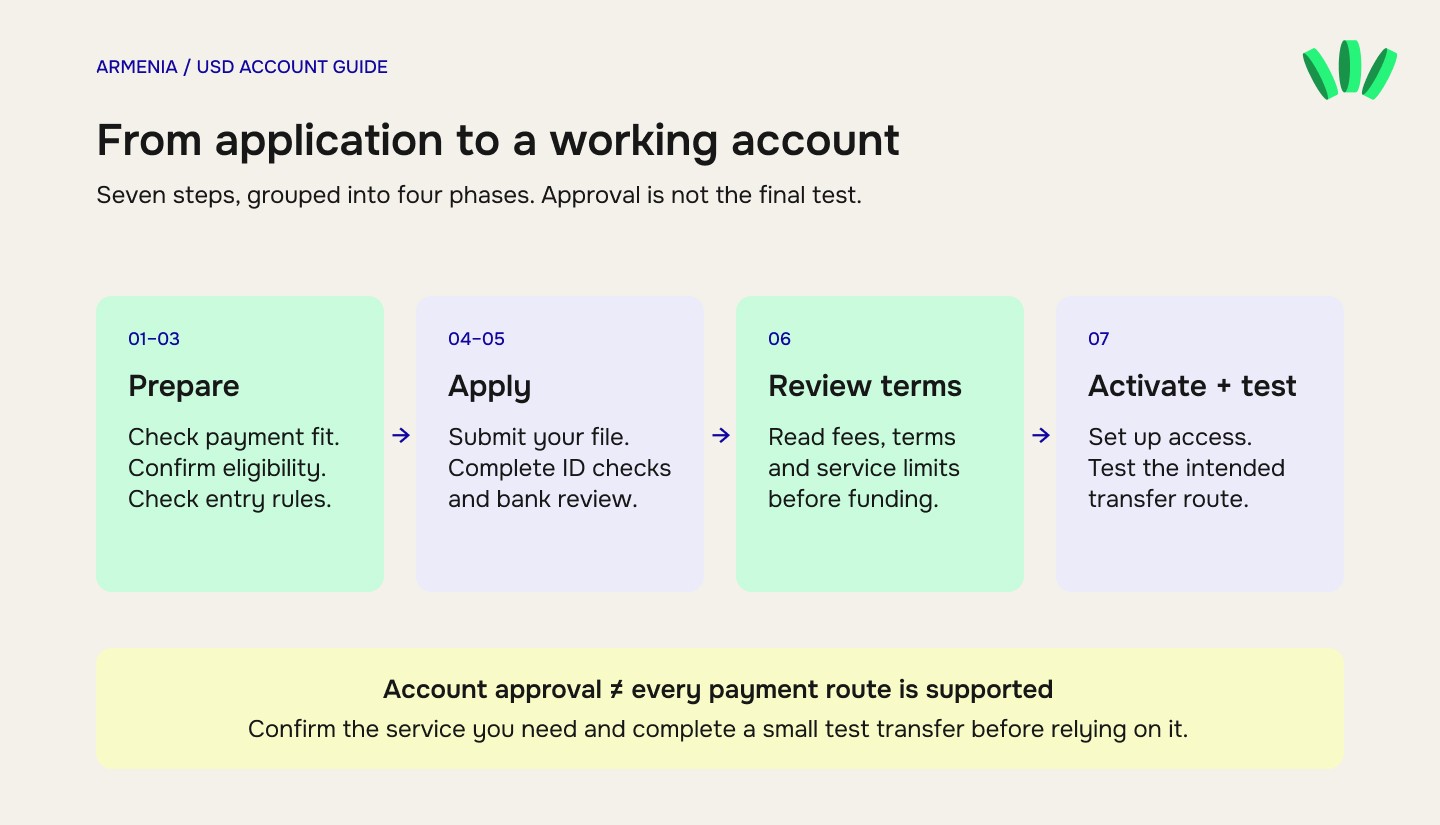
1. Confirm that the account fits your payment flow
Write down who will pay you, from which country, in what currency and through which method. Include the approximate number and size of payments and how you intend to use the money afterwards.
For example, receiving one monthly employer wire is a different use case from collecting frequent payments from unrelated clients. Ask the bank to confirm that your intended activity is acceptable for a personal account.
2. Obtain preliminary eligibility guidance
Contact the bank through its official website or published contact channel. Describe your citizenship, residence, occupation and connection to Armenia. Ask for the current foreign-applicant checklist, the relevant tariff and the required application channel.
Establish whether any application or review fee is charged before approval, and whether it is refundable. Keep the bank’s reply with your application records.
An invitation to submit documents is preliminary guidance. It does not mean the compliance review is complete.
3. Check entry requirements separately
If a branch visit is necessary, verify your visa or entry position with Armenia’s Ministry of Foreign Affairs. Use the rules for your own passport and circumstances. Visa eligibility and bank-account eligibility are separate decisions.
Do not make a non-refundable trip depend on a promised same-day account opening.
4. Submit one complete and consistent application
Use the bank’s current forms and requested submission channel. Supply readable documents and answer questions about account purpose and expected activity accurately.
Keep a copy of what you submitted and a list of outstanding requests. If the bank asks for clarification, address the specific gap. Sending several inconsistent versions of the same application makes the evidence harder to assess.
5. Complete identification and review
Attend the branch appointment or follow the bank-approved remote identification process. Be ready to explain the source of your opening funds, expected payers and reason for using Armenia.
Separate the milestones: document submission, identity verification, approval, account creation, activation and card delivery. Completion of one does not establish completion of the others.
6. Check the agreement before funding
Confirm the USD account number, account-holder name, charges and authorized services. Ask whether an AMD account is also needed for fees or local transactions. If ordering a card, check its currency, maintenance fee, delivery arrangements and replacement process.
Download the tariff and account agreement you accepted. They are more useful for a later fee query than a screenshot of a general marketing page.
7. Activate access and test the intended transfer route
Set up online banking, transaction alerts and the bank’s authentication method. Obtain the official USD receiving instructions, including any intermediary-bank details.
Where practical, test with a modest transfer through the route you intend to use regularly. Check the amount received, fees deducted, currency credited and time taken. A successful small transfer tests the instructions; larger or different payments can still require further review.
Compare your options for receiving and managing USD: Opening a bank account is only one part of managing international payments. See how walllet.com helps freelancers and remote workers receive, hold, and use digital dollars.

Can you open the account online from outside Armenia?
Some remote options exist, but availability and pricing are specific to the service and applicant.
Evocabank publishes a dedicated non-resident route involving documents, video identification and activation after an approved applicant’s transfer of at least USD 50 is received and accessible. Its page lists Armenian property, business or shareholder ties and a deposit-related qualification. The English deposit wording uses “up to” amounts and duration; obtain written clarification rather than interpreting it as a universal minimum. Source: Evocabank’s remote service conditions.
Before choosing remote onboarding, resolve four points: whether your profile qualifies, which package applies, whether originals must be delivered, and how account access or a card will reach you abroad.
An app download, an online enquiry and opening another currency account as an existing customer are all different from completing first-time onboarding remotely.
How long does opening an account take?
There is no verified universal timeframe for foreign applicants across Armenian banks.
Evocabank’s general account page describes opening an account within one business day after checking the authenticity and validity of the submitted documents. That wording should not be interpreted as a promise to finish the entire foreign-applicant review within a day.
Ask the bank for separate estimates for document review, the appointment, account activation and card availability. Confirm what happens if further documents are requested after you leave Armenia. For trip planning, an account number matters less than having a usable account and a working way to authenticate transactions.
What is the real cost of opening and using the account?
The opening fee is only one part of the decision. Compare the cost of the activity you expect over a year.
Your comparison should include application charges, account maintenance, cards, incoming and outgoing wires, intermediary deductions, cash withdrawals, currency conversion, document certification and any travel or delivery expenses.
Keep three amounts separate:
Fees: money you pay for the service.
Required funding: money placed in an account or deposit, subject to its withdrawal conditions.
Qualifying balances: money retained to meet a package or fee-waiver condition.
Only the first category is automatically an expense. The other two can still affect how much money is available for daily use.
A realistic way to compare payment costs
The following is an illustration, not a bank quotation. Suppose you receive USD 2,000 each month, and your actual quoted terms include a USD 15 receiving charge, a USD 20 intermediary deduction and USD 5 in allocated monthly account costs.
The visible monthly cost is USD 40, or 2% of that payment. If you then convert USD 1,000 at a rate that delivers 1.5% less value than your comparison benchmark, that adds USD 15 of conversion cost. The combined effect is USD 55, or 2.75% of the original USD 2,000, before any other charges.
Small fixed fees matter more when payments are small. Repeat the calculation using your expected transaction sizes and the bank’s written quote. The walllet.com breakdown of what a USD 1,000 freelance payment really costs provides a fuller framework for separating transfer charges from conversion costs.
Read minimum charges as carefully as percentages
Inecobank’s start page lists paper-instructed international transfers in USD, EUR and other currencies at 0.2%, with an AMD 12,000 minimum and AMD 60,000 maximum. It states that remote instructions receive a 20% tariff reduction. Intermediary and optional service charges still need checking.
A low percentage can be misleading when the minimum charge applies to most of your payments. Obtain a quote for the actual amount and destination you expect to use.
How do you receive USD from abroad?
Request a bank-generated USD receiving instruction sheet. Depending on the route, the sender may need your exact beneficiary name and address, account number, receiving bank’s name and address, SWIFT/BIC, intermediary details and payment purpose.
Copy the fields exactly. An intermediary bank’s account number is not necessarily your personal account number. If the sender’s form does not have the required fields, have the sender’s bank confirm how to enter the instructions.
For an invoice payment, use a truthful reference that connects the transfer to the invoice or contract. Keep that supporting record available.
Does an Armenian bank account have an IBAN?
Do not generate an IBAN from an Armenian account number or add an “AM” prefix yourself. Armenia is not listed in the SWIFT IBAN Registry reviewed for this guide. Use the format your receiving bank supplies.
If a payment platform requires an IBAN and offers no account-number alternative, confirm that it supports your Armenian destination before sending. SWIFT/BIC and IBAN describe different parts of a payment instruction.
The walllet.com guide to its IBAN receiving account concerns a separate partner-provided product. It should not be used as evidence that an Armenian USD account supports the same payment methods or account format.
Who pays international transfer charges?
Ask the sending bank to explain its available charge options. Where offered, OUR generally allocates transfer charges to the sender, SHA splits responsibility between sender and beneficiary, and BEN allocates charges to the beneficiary. The final result also depends on the banks involved and any guaranteed-full-amount service.
For a client invoice, agree on the required net amount and obtain the sending bank’s explanation of how to deliver it. Evocabank, for example, lists USD OUR and a separate Guaranteed OUR service, describing the latter as delivering the full amount.
What if the payment is delayed or arrives short?
Obtain the sender’s transfer confirmation, transaction reference, sending date, amount, currency and beneficiary details. For a SWIFT payment, request the available tracking reference or UETR from the sending bank.
Give both banks a consistent record. A screenshot saying “sent” does not show whether funds reached the beneficiary bank, were held for clarification or were returned. The walllet.com missing-payment evidence pack explains how to organize the information support teams need.
Can freelancers receive client payments into a personal account?
Confirm this with the bank before giving your details to clients. Describe the work, expected payer types, countries and monthly activity. Ask whether the bank permits that activity through a personal account or requires an individual entrepreneur or business account.
The administrative distinction is real: Ameriabank’s document list has separate sections for individuals, private entrepreneurs and legal entities, with registration and tax documentation for business-related applicants.
For platform payouts, verify both sides of the payment. The platform must support the destination and method, and the bank must accept the payment’s origin and purpose. Neither side’s approval replaces the other’s.
If your main need is income management while living in Nigeria, compare the Armenian account’s travel, administration and transfer costs with locally relevant receiving options. A foreign bank account may add useful capabilities, but its location alone does not make it the most practical route.
Can you use a debit card and withdraw dollars?
Treat the card as a separate product decision. Check which account funds it, the settlement currency, online-payment support, foreign-exchange charges, cash limits and replacement arrangements.
Holding USD does not establish that every ATM will dispense USD. Ask which branches or machines support the currency you need, whether you must reserve cash, and which withdrawal tariff applies to your account and the source of the funds.
If the objective is online subscriptions rather than local cash access, compare that requirement separately. The walllet.com virtual dollar card guide for Nigeria addresses a different card product and its own eligibility conditions; it is not an Armenian bank-card substitute for every applicant.
Before leaving Armenia, test the authentication method you will use abroad. Establish how the bank handles an expired passport, a lost phone, a changed number and card renewal. A low annual fee is less useful if essential maintenance requires an unexpected return trip.
Are USD deposits protected in Armenia?
Armenia’s Deposit Guarantee Fund covers eligible individual deposits, including those of individual entrepreneurs. Its definition includes balances in current accounts. Coverage is subject to statutory exclusions and limits, and applies separately at each bank. Compensation is paid in AMD, with foreign-currency balances converted using the prescribed exchange rate at the payout event.
The currency mix matters:
Eligible deposits at the same bank | Published maximum guarantee treatment |
|---|---|
Only AMD deposits | Up to AMD 16 million |
Only foreign-currency deposits | Up to AMD 7 million equivalent |
Both currencies, with AMD deposits above AMD 7 million | Only the AMD component is guaranteed, up to AMD 16 million |
Both currencies, with AMD deposits below AMD 7 million | AMD is covered first; foreign-currency coverage is limited to the remaining part of AMD 7 million |
The bank’s published explanation of mixed-currency guarantees sets out these cases. Have the bank calculate any boundary case and confirm which of your balances are eligible. Do not add the AMD 16 million and AMD 7 million ceilings together.
A USD-denominated account remains subject to Armenia’s protection framework. The currency does not turn it into a U.S.-insured deposit. Deposit protection also does not guarantee uninterrupted payment access or prevent a compliance review.
What tax issues should foreign account holders understand?
Opening an Armenian account does not, by itself, determine your tax residence or make income tax-free.
Armenia’s State Revenue Committee explains that individual tax residence can arise from spending at least 183 days in Armenia during the tax year or having a centre of vital interests there. Its guidance distinguishes residents’ Armenian and foreign-source income from non-residents’ Armenian-source income. Your work arrangements and applicable treaty rules can require a more detailed assessment.
Keep records of account balances, income, interest, currency conversions and any tax withheld. Ask a qualified adviser about your actual residence and work situation before relying on a general statement about “foreign income.” The country of the payer, the location of the bank and where work is performed are separate facts.
U.S. taxpayers and foreign-account reporting
An Armenian account can trigger U.S. reporting obligations for a U.S. person. The IRS states that an FBAR is generally required when a U.S. person has a financial interest in or signature authority over foreign financial accounts whose aggregate value exceeds USD 10,000 at any time in the calendar year. That threshold applies across the relevant accounts, not separately to each account. Form 8938 has separate rules.
What can cause an application or transfer problem?
Bank onboarding requires the information in your application to match the evidence and intended use. Potential gaps to resolve include missing address proof, unclear income records, inconsistent names, an unsuitable account category or a payment route the bank does not support.
Ask the bank whether a problem concerns missing evidence, your applicant category, the product or a particular transaction. This distinction determines whether another document could help.
Do not pay an intermediary who promises guaranteed approval. An agent cannot replace the bank’s decision. Never give someone your banking password or authentication codes as part of an account-opening service.
If your circumstances change after opening, update the bank as required. A new residence, business activity or source of payments may make your original customer profile inaccurate.
Before you commit to an account
Use this checklist to turn a general offer into a decision you can evaluate:
The bank has assessed your actual citizenship and residence profile.
The account permits your intended personal or business activity.
You have the current document checklist and understand translation requirements.
You know whether the application requires a branch visit.
Your tariff identifies all opening, ongoing and transaction charges.
Your payer or platform supports the account’s actual receiving route.
You can use the account and complete authentication after returning abroad.
You understand cash access, currency conversion and card conditions.
You have checked deposit protection against your planned currency balances.
Your tax and foreign-account reporting obligations have been considered separately.
If you receive payments from abroad and want more flexibility after your money arrives, explore walllet.com for receiving, holding, converting, and spending digital dollars.
