
Yes, you can receive a salary in USD in Nigeria without converting the whole payment to naira immediately. The workable setup is to receive the payment through a USD-compatible route, keep the portion you want in dollar-denominated or dollar-linked value, and convert only the amount needed for local expenses. The right receiving route depends on how your employer actually pays: ACH, domestic wire, international wire, a payroll platform or another supported method.
That last detail matters. Having a “dollar account” does not automatically mean your employer can pay it.
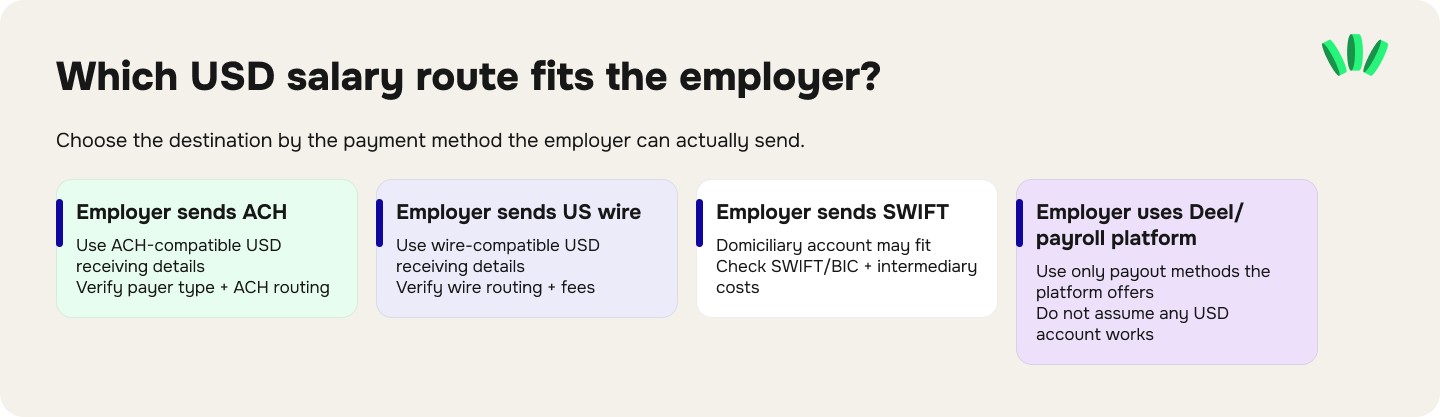
A US employer may use ACH for payroll. Another company may only support wire transfers. A global employer may run payroll through Deel or another platform and give you a fixed list of withdrawal methods.
If you are still mapping the receiving side, how Nigerian freelancers receive payments from US, UK and EU clients explains how ACH, wire and other payment rails differ. For a broader look at available USD routes, see how to receive USD in Nigeria without PayPal.

The salary route to build
A reusable USD salary setup looks like this:
Foreign employer → supported payment rail → USD receiving destination → hold USD → convert only the amount needed → Nigerian bank account

The important step happens before you send your employer any account details. Ask payroll:
What currency will you send?
Which payment rail do you use?
Are payments sent as payroll, business payments or contractor payments?
Is the sender a company account or a payroll provider?
Can you pay an account in the employee or contractor's own name?
What bank fields does your payroll system require?
Can the same receiving details be reused every month?
A receiving account should fit the employer's process. Your employer should not have to redesign payroll because you opened an account that accepts a different type of transfer.
Four common ways to receive a USD salary in Nigeria
Route | How the employer pays | Can the money remain in USD? | Main thing to verify | Best fit |
USD receiving account supporting ACH | US ACH/direct-deposit-style transfer | Usually, depending on provider | ACH support, payer type and beneficiary details | Recurring US employer or contractor payments |
USD receiving account supporting domestic wire | US domestic wire | Usually | Wire routing details, fees and sender eligibility | Employer whose bank prefers wire |
Nigerian domiciliary account | Usually international/SWIFT transfer | Yes, subject to bank rules | SWIFT route, correspondent fees and employer capability | Conventional international bank transfer |
Payroll platform | Employer pays through platform; worker selects supported payout route | Depends on the payout method | Nigeria availability, withdrawal options and downstream conversion | Employers already using global payroll software |
The Central Bank of Nigeria continues to recognize foreign-currency domiciliary accounts within Nigeria's FX framework, but the exact account rules, incoming-payment process and fees depend on the bank and transfer route.
For the practical difference between traditional Nigerian domiciliary accounts and fintech-issued USD receiving routes, compare domiciliary accounts and virtual dollar accounts for freelance income.
ACH can be useful, but only if payroll can send ACH
ACH is a US domestic bank-transfer network. Many US companies use it for payroll and recurring business payments. A Nigerian remote worker does not receive ACH into an ordinary Nigerian naira account. The worker needs eligible US receiving details issued by a provider that accepts the specific incoming payment. Before sending ACH details to HR or payroll, verify:
Beneficiary name: Does the receiving account show your own verified name?
Routing number: Is it specifically an ACH routing number?
Account number: Is it the correct receiving account?
Account type: Does payroll require checking or savings?
Payer type: Can the account accept salary or business payments from your employer?
Limits: Will your normal monthly salary fit the receiving limits?
Reference: Does the provider require a particular memo or payment description?
A failed monthly payroll is more disruptive than a failed one-off client invoice. Test the route before making it your only salary destination. If you are comparing account products for this purpose, the dollar-account checklist for Nigerian freelancers covers ACH support, account ownership, USD holding, limits, cash-out and support.
Receiving in USD does not mean you need to keep 100% in USD
Assume your monthly remote salary is $2,000.
Your local budget for rent, food, transport and other Nigerian expenses may require the equivalent of only $650 this month. A full-conversion setup does this:
$2,000 received → $2,000 converted to NGN
A partial-conversion setup does this:
$2,000 received → keep dollar value → convert $650 for current NGN expenses → leave the rest unconverted
The second route separates two decisions:
How you receive your salary
How much of that salary you convert to naira
They do not need to happen at the same time. This is especially useful when you also pay expenses priced in dollars, such as software, hosting, professional tools, subscriptions or travel-related costs. Converting the full salary to naira and later buying dollar value again adds another conversion step.

What does partial conversion cost in practice?
Use actual provider fees rather than assuming that “keeping dollars” or “cashing out” is free.
For example, walllet.com's current public payment flow lists a 1% incoming USD fee for its supported bank receiving route and a 0.5% off-ramp fee when supported funds are cashed out to naira. The exchange rate is a separate part of the cash-out quote.
For an illustrative $2,000 salary received through that bank route:
Incoming salary: $2,000
1% receiving fee: $20
Balance after receiving fee: $1,980
Suppose you need to cash out $600 for local expenses:
Amount selected for cash-out: $600
0.5% off-ramp fee: $3 equivalent
USD value not selected for conversion: $1,380
The final naira credited for the $600 cash-out also depends on the executable USD/NGN rate shown before confirmation.
The one-time $5 Bank Account issuance fee is separate from the monthly incoming-payment fee and should not be treated as a recurring $5 salary deduction.
This is the same discipline used in walllet.com's $1,000 freelance-payment fee breakdown: receiving fees, FX effects and cash-out fees belong to different stages.

What details should you give a foreign employer?
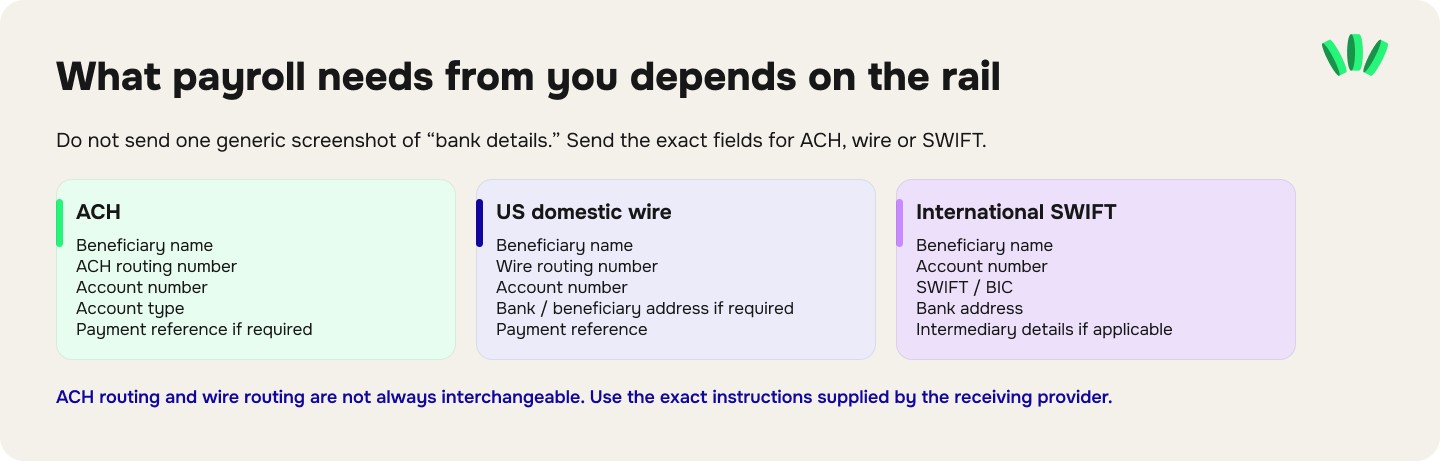
Do not send payroll a screenshot of an account page and assume they can work it out. Send only the fields required for the payment rail.
For ACH
Your employer may need:
Beneficiary/account-holder name
Bank name
ACH routing number
Account number
Account type
Payment reference, if required
For a US domestic wire
Your employer may need:
Beneficiary name
Bank name
Wire routing number
Account number
Bank address or beneficiary address where required
Payment reference
An ACH routing number and a wire routing number are not always interchangeable.
For an international SWIFT payment
A traditional international transfer may require:
Beneficiary name
Account number
Bank name
SWIFT/BIC
Bank address
Intermediary-bank information where applicable
Payment purpose or reference
The receiving provider or bank should supply the exact fields. Do not construct transfer instructions yourself.
Employee salary and contractor income are not always processed the same way
“Remote worker” can describe two different arrangements.
An employee may appear on the foreign company's payroll and receive payslips, payroll deductions and employee benefits.
An independent contractor may invoice the company and receive a recurring contractor payment.
That distinction can affect the employer's payment process and the documents available when a provider asks for source-of-funds evidence.
Your receiving account does not change the underlying employment relationship. Receiving an employee salary into a particular account also does not, by itself, determine tax treatment. Keep the records that match the real arrangement.
For employees:
employment contract;
payslips;
employer payment advice;
bank or account statements;
correspondence explaining unusual payments such as bonuses.
For contractors:
signed contract or statement of work;
invoices;
payment confirmation;
receiving-account statement;
records linking each incoming payment to the relevant invoice.
The distinction between those documents is covered in more detail in the proof-of-income and source-of-funds guide for Nigerian freelancers.
Should you use a domiciliary account for a foreign salary?
A domiciliary account can make sense when your employer already sends international wires and you want to hold foreign currency within a Nigerian bank. Its strength is conventional banking compatibility.
Its weakness can be the payment route. A US employer whose payroll system sends only ACH cannot necessarily send payroll directly to a Nigerian domiciliary account. The employer may need an international-wire process instead, potentially involving SWIFT and correspondent banks.
Compare:
Employer already uses international wire → domiciliary account may fit naturally
against:
Employer uses US ACH payroll → ACH-compatible USD receiving details may be easier
Do not choose the account first and force the employer into the wrong rail afterward.
Should you convert your salary monthly or only when you need naira?
There is no universal percentage you should convert. Start from your actual obligations. Suppose the monthly salary is $2,000 and your next 30 days contain:
rent and household expenses: NGN;
family support: NGN;
local transport: NGN;
Adobe subscription: USD;
hosting: USD;
professional software: USD;
emergency reserve: preferably kept in a currency you deliberately choose.
Estimate the NGN amount required for local obligations, add an appropriate buffer, and convert that portion. Do not mechanically convert 100% on payday merely because payday happened.
Also avoid assuming that holding USD guarantees a better financial outcome. Exchange rates can move in either direction, providers can change fees, and the appropriate currency mix depends on the expenses you expect to pay.
What should you compare before choosing a salary account?
For recurring salary, reliability matters more than a promotional headline. Check these nine items:
Check | Why it matters |
Employer's payment rail | The account must accept how payroll actually sends money |
Beneficiary ownership | Payroll and compliance teams may require the account in your name |
Supported payer type | Some accounts restrict personal, business or platform payments |
Receiving fee | This applies every payday if charged per incoming payment |
USD holding | Determines whether conversion is optional |
FX quote | Determines how much NGN a partial conversion produces |
Cash-out fee | Affects the amount reaching your Nigerian bank |
Monthly/transaction limits | Your salary must fit consistently |
Records and support | Recurring income needs statements and a clear escalation route |
A route that works for one $150 freelance payment may be unsuitable for a $3,000 recurring salary.
Use the same route every payday once it works
Recurring salary should become boring. After the first successful payment:
Save the exact receiving instructions given to payroll.
Record the beneficiary name and payment rail.
Keep the first successful payment reference.
Save payslips or invoices beside corresponding transaction records.
Note the actual receiving fee.
Record the rate and NGN amount whenever you convert.
Avoid changing receiving details without telling payroll.
Keep a tested backup route for cases where your primary provider is unavailable.
This also makes it easier to explain recurring foreign inflows if a bank or provider asks for evidence later.
What happens if your salary is marked “paid” but has not arrived?
First identify the payment rail.
For ACH, ask the employer for the payment date, amount, originating account or payroll provider, and transaction reference.
For a wire, ask for the transfer confirmation and any reference that the sending bank can use to trace it.
For a payroll platform, check whether “paid” means the employer funded payroll, the platform released your balance, or the payout has already been sent to your receiving account. Those can be separate events.
Then verify:
beneficiary name;
account number;
routing or SWIFT details;
receiving currency;
payment status;
requests for additional verification;
whether the receiving account placed the transaction under review.
Do not ask the employer to resend the salary until you know what happened to the first payment.
Build the salary route before the first payday
The cleanest setup is one your employer can reuse every month:
Employer → supported USD receiving route → hold the portion you want → convert the amount needed for NGN expenses → preserve payment records
Changing currencies should be a deliberate money-management decision, not an automatic consequence of getting paid.

