Your client pays a $1,000 invoice. Their bank confirms that $1,000 was sent. You check your account and find $972.
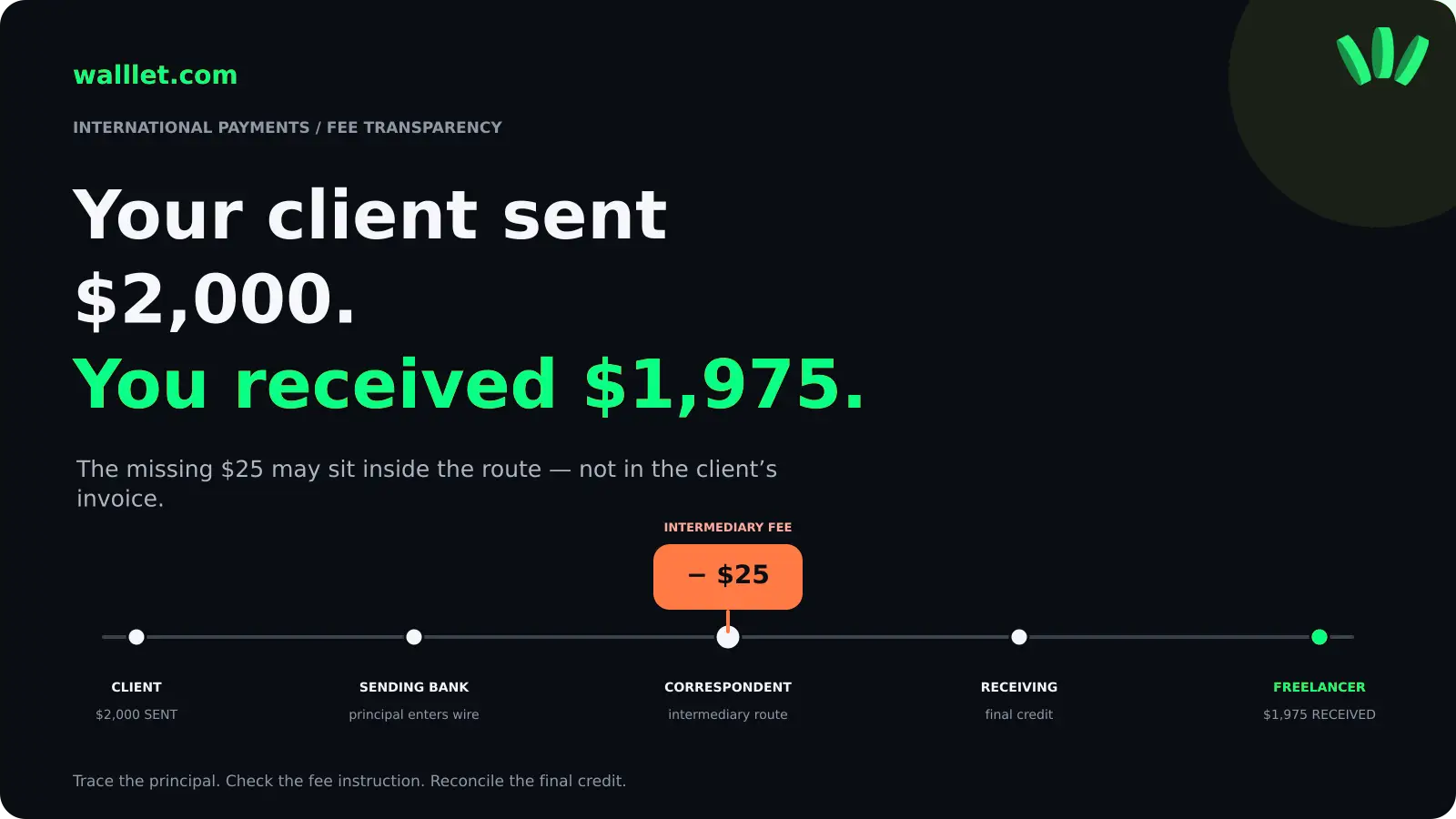
The missing $28 does not automatically mean your client underpaid, your receiving provider charged a hidden $28 fee, or the transfer went wrong.
An international wire can pass through one or more banks before it reaches you. An intermediary or correspondent bank may deduct a fee while handling the payment. Your receiving bank or provider may also charge an incoming-wire fee. If those charges are taken from the payment itself, the amount credited to you can be lower than the amount your client sent.
For freelancers and remote workers who get paid internationally, this distinction matters. A $1,000 invoice, a $1,000 payment instruction and $1,000 of usable income are not always the same number.
If you are still deciding which route a foreign client should use, start with how Nigerian freelancers receive payments from US, UK and EU clients. It compares ACH, UK bank transfers, SEPA, wire and other receiving routes before the payment leaves the client.
Key takeaways
Intermediary bank fees are charges that may be deducted while an international wire moves between the sender's bank and your receiving bank.
A correspondent or intermediary bank may be involved when the sending and receiving institutions do not have a direct relationship.
The sender's transfer fee is only one possible cost. Intermediary deductions and receiving-bank fees can affect what you actually receive.
SWIFT does not set one universal "SWIFT fee." The banks and payment providers involved can apply their own charges.
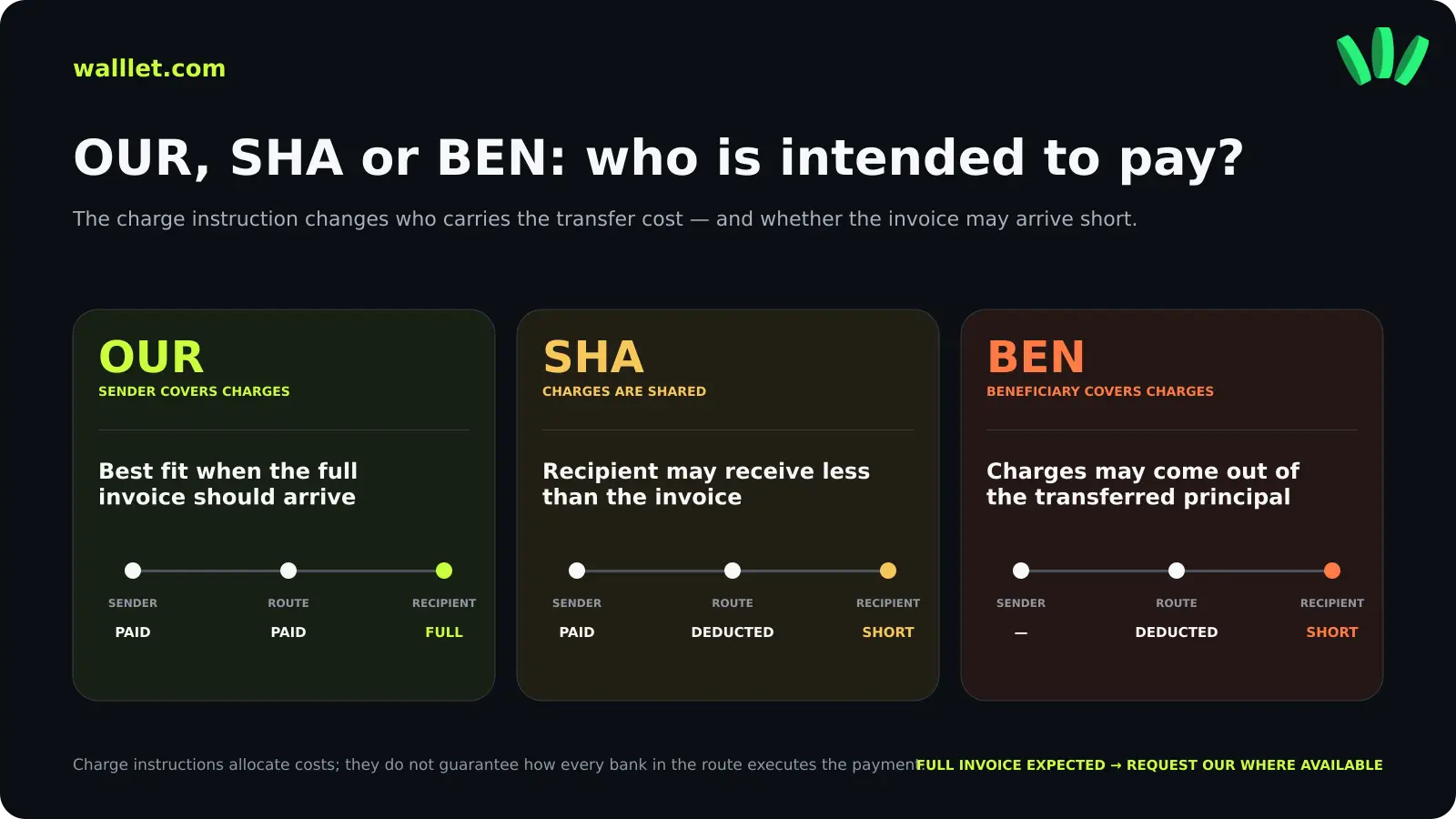
OUR, SHA and BEN tell the banks who is expected to bear transfer charges. Their ISO 20022 equivalents are DEBT, SHAR and CRED.
Asking the sender to use OUR can reduce the risk of deductions from the amount sent when the route supports it, but availability and treatment depend on the banks, route and applicable rules.
Before accepting a payment route, compare the amount you expect to receive, not only the fee advertised at the beginning.
If a wire arrives short and the deduction is unclear, the payment's MT103 or pacs.008 details and UETR can help the banks investigate what happened. A UETR is the unique 36-character reference used to identify a Swift payment across the payment chain.
If the wider problem is choosing a USD receiving route in the first place, compare the practical ways to receive USD in Nigeria without PayPal, including foreign-currency receiving accounts, domiciliary accounts, international wires and stablecoins.
Why can a $1,000 international wire arrive as $972?
Consider a hypothetical $1,000 client payment:
Payment stage | Amount |
Invoice | $1,000 |
Amount client sends | $1,000 |
Intermediary bank deduction | -$18 |
Receiving-bank incoming fee | -$10 |
Amount credited | $972 |
Total deducted from the payment | $28 |
Effective deduction | 2.8% |
This is an illustration, not a quote for a particular bank or payment provider.
The calculation is simple:
Amount received = amount sent − deductions taken from the payment
In this example:
$1,000 − $18 − $10 = $972
And:
Effective deduction rate = ($1,000 − $972) ÷ $1,000 × 100 = 2.8%
There may also be a separate outgoing-wire fee on the sender's side. If your client pays that fee separately, it does not reduce the $1,000 principal. If the route takes charges from the principal instead, your balance can arrive short.
That distinction is why "My client paid the fee" is not always enough information.
If the money has not arrived at all rather than arriving short, use the separate guide to tracing a missing international wire with an MT103 or UETR. It covers what evidence to request, who should start the trace and why a client screenshot is not enough to establish final credit.
What happens to an international wire after your client sends it?
A cross-border bank payment does not necessarily travel directly from your client's bank to yours. A simplified route can look like this:
Client → sending bank → intermediary/correspondent bank → receiving bank or provider → your account
Sometimes the chain is shorter. Sometimes more than one correspondent institution is involved.
Correspondent banks help move payments when the sending institution cannot settle directly with the receiving institution. Those banks may charge for their role, and the institutions used for one payment may not be identical to those used for the next one.
For a freelancer, the practical consequence is straightforward: the fee shown by the service you use to receive money may not describe the full economics of the transfer.
The same problem becomes more important when a payment route is also exposed to account reviews, settlement delays or verification checks. The guide to why freelance payments get held, reviewed or delayed maps those failure points across the client, provider, bank and after-arrival stages.
Want fewer surprises between “client sent” and money you can actually use? See how walllet.com connects global income, dollar holding, spending, conversion and cash-out in one workflow.

What is an intermediary bank?
An intermediary bank is a bank that helps move an international payment between the sender's bank and the final receiving institution when the payment cannot move directly between them.
Imagine that your US client uses Bank A and your receiving account uses Bank C. Bank A may not have the relationship or settlement arrangement needed to send the payment directly to Bank C.
The route could therefore become:
Bank A → Bank B → Bank C
Bank B is acting as an intermediary in that payment.
If Bank B charges $18 for processing the transfer and the applicable charge arrangement allows that fee to come out of the payment, a $1,000 transfer could continue toward Bank C as $982.
Your receiving institution might then apply another fee.
Is an intermediary bank the same as a correspondent bank?
The terms are often used interchangeably in everyday discussions about international wires, but they describe the situation from slightly different angles.
A correspondent banking relationship is the broader relationship through which one financial institution provides payment or settlement services for another.
An intermediary bank describes the institution sitting between the originating and receiving institutions in a particular payment route.
For a freelancer trying to understand a short payment, the distinction rarely changes the immediate problem: another bank in the route may have processed the transfer and applied a charge.
This is why searches for intermediary bank fees, correspondent bank fees and SWIFT deductions often describe the same practical pain point.
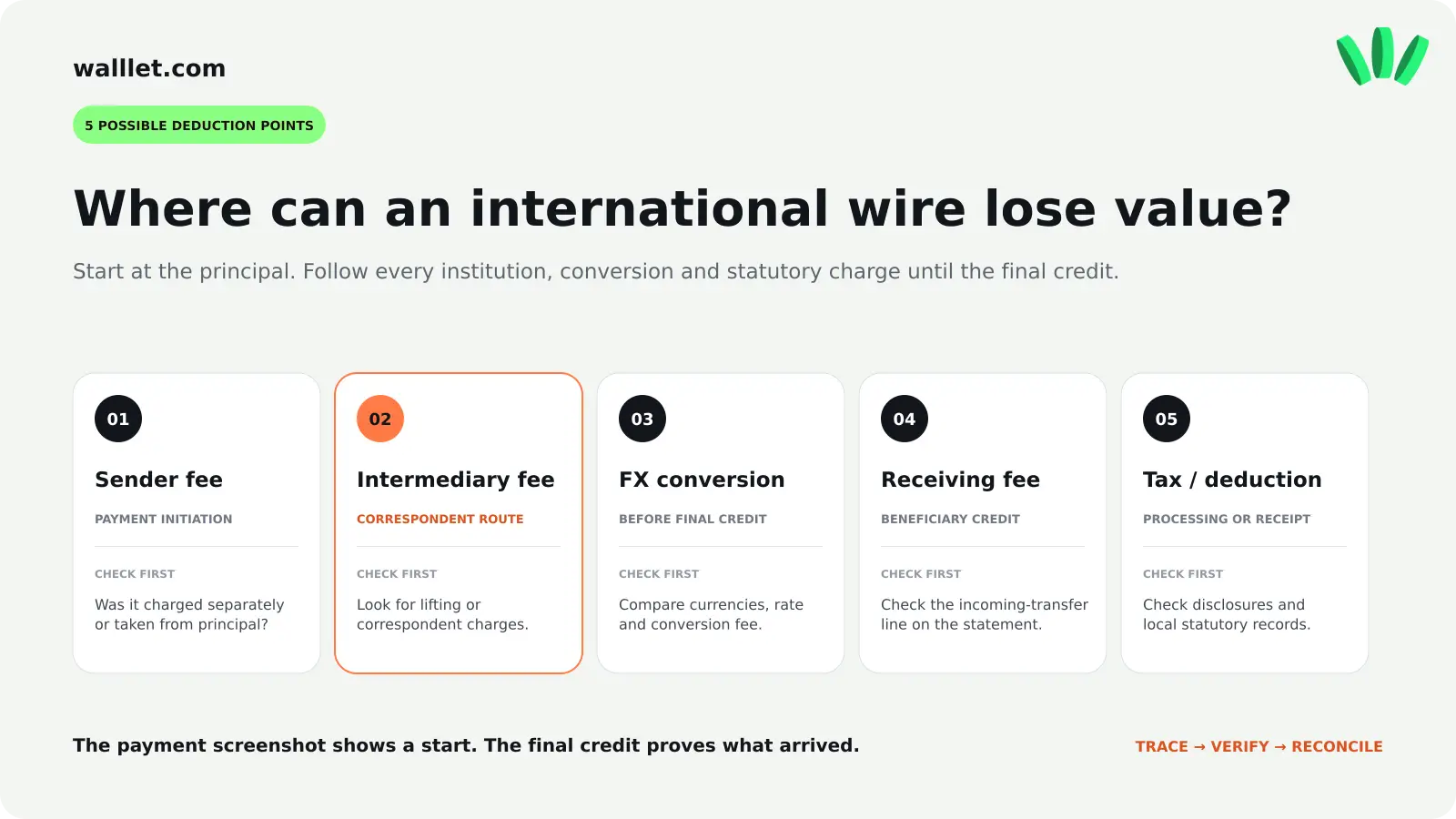
Who can charge you during an international wire?
Several institutions can create costs around one transfer.
Cost | Who may charge it? | Does it necessarily reduce the amount you receive? |
Outgoing wire fee | Sender's bank or provider | No. It may be charged separately to the sender |
Intermediary/correspondent fee | Bank handling the payment between institutions | It can |
Incoming wire fee | Receiving bank or provider | It can |
Currency-conversion cost | Bank or FX provider | Yes, if conversion occurs |
Other provider-specific charges | Payment provider | Depends on the route |
This is why the phrase "the wire costs $20" can be misleading.
Which $20?
A sender fee? An intermediary deduction? A receiving fee? A fixed provider charge?
The number that matters to a freelancer is eventually:
How much of the invoice becomes usable money?
That becomes even more important when comparing different services. The PayPal vs Payoneer vs Wise vs stablecoins comparison for Nigerian freelancers uses the same total-route logic: what matters is how much you can actually hold, spend or withdraw, how long it takes and where the route can fail.
What do OUR, SHA and BEN mean on a wire transfer?
International transfer instructions can specify who bears bank charges.
In an MT103, this information traditionally appears in Field 71A. Under ISO 20022 payment messaging, you may instead see DEBT, SHAR or CRED.
Charge instruction | ISO 20022 equivalent | General meaning |
OUR | DEBT | Sender bears the relevant transfer charges |
SHA | SHAR | Charges are shared between sender and beneficiary |
BEN | CRED | Beneficiary bears the transfer charges |
OUR
With OUR, the sender asks to bear the bank charges associated with the payment. HSBC describes OUR as the sender paying fees applied by the banks involved, including intermediary and beneficiary banks.
For an invoice that needs to arrive in full, this is usually the charge instruction worth discussing with the client's finance team when their bank and route support it.
SHA
SHA means the charges are shared.
The sender normally bears their own bank's charge, while charges on the beneficiary side may still affect the recipient. This creates an obvious problem for an invoice:
Invoice: $1,000
Client sends: $1,000
You receive: less than $1,000
Both parties can truthfully say they handled the payment correctly while still disagreeing about whether the invoice has been paid in full.
BEN
With BEN, the beneficiary bears the charges.
If fees are deducted from the payment, the amount arriving can therefore be lower than the amount initiated by the client.
Does OUR guarantee that every payment arrives without a deduction?
Do not treat OUR as a universal guarantee.
It is the charge instruction designed to place the relevant bank charges on the sender, and some providers explicitly recommend it when the recipient must receive the full payment. But available charge options and their treatment can depend on the payment type, banks and regulations.
For an important invoice, the sender should confirm with their bank what the selected charge instruction means for that specific route.
Why did I receive less money even though my client sent the full invoice?
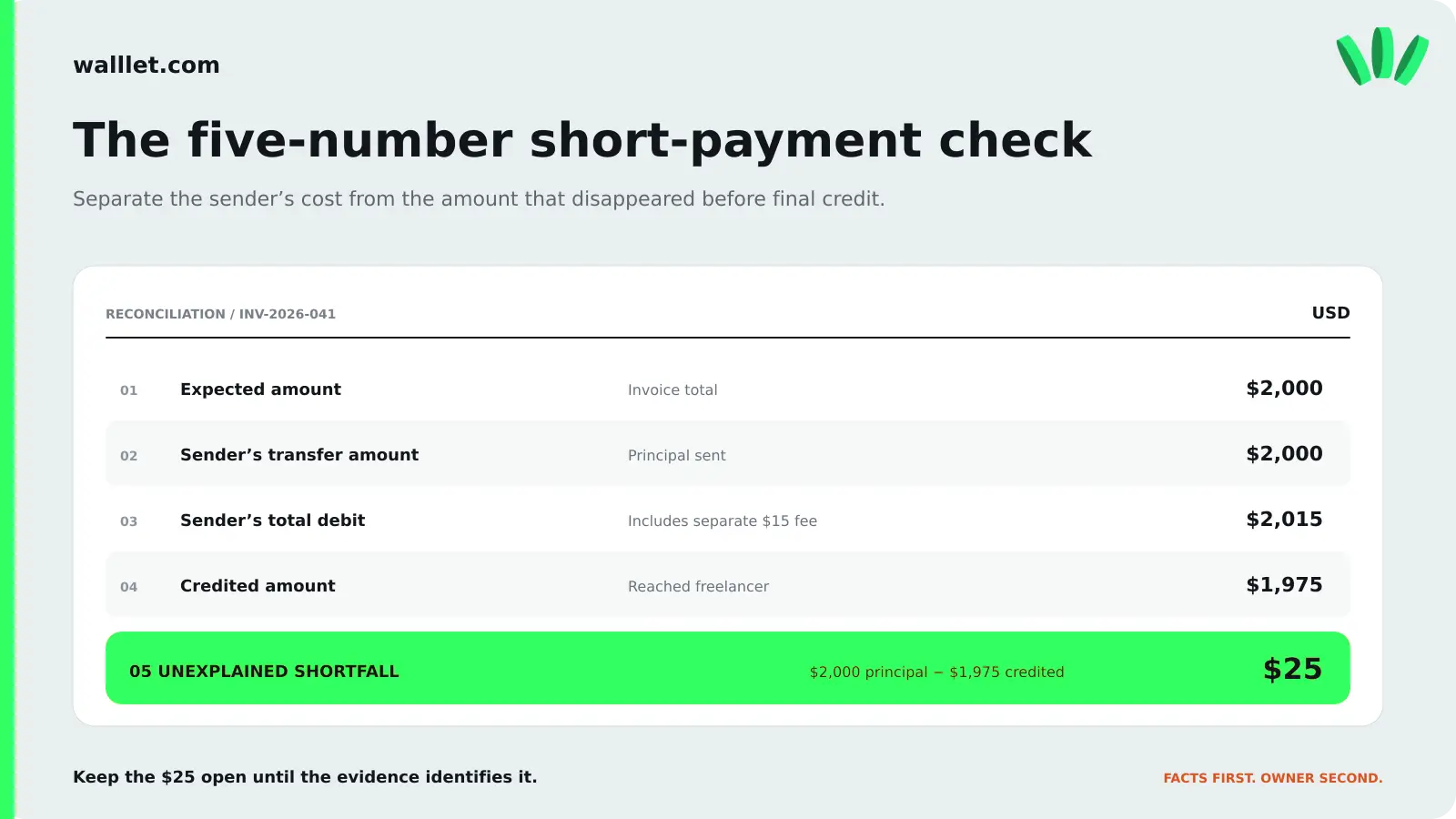
There are several possibilities.
1. An intermediary bank deducted a fee
The payment passed through another institution and a processing charge came out of the transfer amount.
2. Your receiving institution charged an incoming-wire fee
The beneficiary institution can have its own fee even after the wire reaches it.
3. The client selected SHA or BEN
The payment instruction may allow some or all charges to fall on the beneficiary.
4. Currency conversion happened somewhere in the route
A $1,000 payment and the equivalent value of a converted payment are different calculations. If a bank converts the funds, the exchange rate and FX markup may become part of the gap.
5. The amount sent was not actually the invoice principal
A client's screenshot might show a total debit that includes their own transfer charge rather than prove that the full invoice amount entered the payment chain.
If the difference matters, look at the actual transfer document rather than relying only on a screenshot.
Is a correspondent bank fee the same as a SWIFT fee?
No single universal fee is charged by "SWIFT" simply because your client made an international transfer.
SWIFT provides the messaging infrastructure banks use for many cross-border payments. The sender's bank, correspondent institutions, receiving bank and payment providers can each have their own pricing.
Calling every deduction a "SWIFT fee" hides the useful question:
Which institution charged it, at what stage, and under which charge instruction?
That is what you need to find out if you want to prevent the same deduction on the next invoice.
Can you know intermediary bank fees before the transfer?
Sometimes you can obtain an estimate or use a route with more predictable pricing. Sometimes the exact intermediary deduction is difficult to know beforehand because the route can depend on the banks involved.
Before accepting a wire route, ask:
What does the sender's bank charge?
Does the bank expect intermediary or correspondent institutions?
Can the sender select OUR?
Does your receiving account charge incoming wires?
Will the payment remain in the invoice currency?
Does a cheaper local payment rail exist?
What amount should be credited if everything works as expected?
If nobody can give a clear answer to questions 2, 3 and 4, treat the final cost as uncertain rather than assuming the visible sending fee is the total fee.
If you are considering an IBAN-based receiving route, the walllet.com IBAN Account guide explains why an IBAN, the supported currency and the actual incoming payment rail are separate questions, and why eligibility, fees, limits and review rules still need to be checked before sharing the details with a client.
International payment fee calculator: calculate what you actually receive
For a simple payment with fixed deductions:
Estimated amount received = invoice amount − deductions from principal
Example:
Invoice: $1,000
Expected intermediary deduction: $18
Expected receiving fee: $10
Estimated receipt = $1,000 − $18 − $10 = $972
For the effective cost:
Effective deduction % = (invoice amount − amount received) ÷ invoice amount × 100
For the $1,000 → $972 example:
($1,000 − $972) ÷ $1,000 × 100 = 2.8%
If you later convert the funds to naira or pay another withdrawal fee, calculate that separately. Do not mix the wire shortfall with the later cost of converting or cashing out.
A useful full-route calculation is:
Usable money = invoice amount − receiving deductions − conversion cost − withdrawal cost − other route costs
A $10 fee and a $10 deduction are not always the same thing
Suppose your client owes you $1,000.
Scenario A:
Client sends $1,000
Client separately pays a $25 outgoing-wire fee
You receive $1,000
Your invoice is paid in full. The payment cost the client $1,025.
Scenario B:
Client sends $1,000
$25 is deducted from the principal during the route
You receive $975
The transaction may have started at $1,000, but your invoice is still $25 short from your perspective.
That difference should be settled before the client sends the payment, especially for recurring contracts.
How can freelancers reduce unexpected intermediary bank deductions?
1. Choose the payment rail before you send the invoice
Do not give a client "bank details" without specifying how those details should be used.
A US receiving account might support ACH, wire, both, or neither for a particular payer type. An IBAN may support an eligible SEPA route or require a different transfer method.
2. Use a local payment rail when the account and client support it
If a US client can make an eligible ACH payment to your receiving details, there may be no reason to route the payment as an international SWIFT wire.
For an eligible euro account, a supported SEPA transfer may similarly be more direct than an unnecessary international wire.
For a UK payer, supported domestic routes may be available.
Do not assume your account supports a rail because it has the right currency or a familiar-looking account number. Confirm the exact payment method first.
3. Agree who pays bank charges before payment
Your contract or invoice can make the commercial expectation clear.
For example:
Payment amount: USD 1,000
Payment method: [specified rail]
Bank charges: Sender to cover transfer charges so the agreed invoice amount is received, where supported by the sending bank and payment route.
This does not control what every bank will do. It does make the agreement between you and the client less ambiguous.
4. Ask about OUR for SWIFT wires
If the invoice needs to arrive in full, ask the client or their finance team whether their bank supports an OUR charge instruction for that payment.
Do this before the transfer, not after discovering a $28 gap.
5. Check the receiving fee separately
Even if the sender understands their charges, your own receiving institution may have a fee.
Check the current terms for the exact receiving route you are using.
6. Keep the currency unchanged where possible
If the invoice is in USD and you intend to hold USD, unnecessary conversion introduces another cost layer.
The cheapest wire fee can still produce a poor result if the route forces conversion at an unattractive rate.
7. Test recurring routes
For an important recurring client, the first payment gives you useful operational data:
amount initiated;
sender's charge;
amount credited;
any intermediary deduction;
receiving fee;
settlement time;
payment reference;
documents available if something fails.
Do not assume the second payment will always follow exactly the same correspondent route, but the first transfer tells you whether the payment setup is workable.
8. Compare final money, not headline fees
A route advertised with a $5 fee can cost more than a route advertised with a $15 fee if the first route introduces another intermediary deduction or an expensive currency conversion.
The useful comparison is:
Invoice → amount received → amount usable
Prevention checklist before your client sends an international payment
Use this before sending payment instructions:
Confirm the exact invoice currency.
Confirm the payment rail, not only the account currency.
Use the beneficiary name exactly as issued.
Check whether ACH, SEPA, Faster Payments or another supported local route can replace an international wire.
If SWIFT is necessary, ask whether intermediary banks are expected.
Check the sender's outgoing fee.
Check your own incoming-wire fee.
Agree who bears transfer charges.
Ask whether OUR is available when the invoice must arrive in full.
Confirm whether any currency conversion will happen.
Put the invoice reference in the payment instruction.
Save the sender's bank-issued transfer confirmation.
For recurring payments, record what actually arrived after the first transfer.
What should you do if your international wire already arrived short?
Start with evidence. Do not ask the client to send another payment simply because the credited amount is wrong. First compare:
invoice amount;
amount instructed by the sender;
sender's separate bank fee;
amount shown in the transfer confirmation;
amount your receiving institution says it received;
amount ultimately credited to you.
Then ask for the bank-issued transfer record.
Depending on the messaging format, this may be an MT103 or pacs.008 payment document. The fee instruction may also appear there.
For a Swift payment, get the UETR as well.
Swift describes the UETR as a 36-character unique reference included in payment instruction messages. It allows participating institutions in the chain to identify and track the payment.
Can the recipient track the intermediary bank deduction directly?
Usually, your first useful contacts are the sender's bank and your receiving institution.
The UETR helps banks identify the payment across the Swift chain, but it should not be confused with a universal public parcel tracker that gives every freelancer direct access to every bank's internal transaction data.
If you need a formal trace, the sender's bank is often in the best position to initiate it because it originated the payment and holds the original instruction.
Ask for:
the payment date;
original amount and currency;
beneficiary details;
transaction reference;
MT103 or pacs.008 details where available;
UETR;
charge instruction;
confirmation of what amount left the sending institution.
Then ask your receiving institution what amount it received and what fee, if any, it applied.
The two sides of that comparison can narrow down where the shortfall occurred.
Should a Nigerian freelancer use SWIFT for every foreign client?
No.
The best route depends on the client, currency, available receiving details and what the receiving account actually supports.
For example:
Client | Possible payment route |
US client | ACH, eligible domestic wire, international wire |
UK client | Faster Payments, Bacs, CHAPS, international transfer |
EU/SEPA client | SEPA Credit Transfer, SEPA Instant where supported, SWIFT |
Other cross-border situations | SWIFT may be required |
These are route categories, not guarantees that a particular account can receive through them. The provider issuing your receiving details determines eligibility and supported rails.
For a recurring $1,000 invoice, a predictable route with clear total costs can be more useful than a route that appears cheap at the first step but creates an unknown deduction in the middle.
Where does walllet.com fit?
walllet.com is designed around the full international-income journey for Nigerian freelancers and remote workers, rather than treating receiving, holding, conversion and cash-out as unrelated transactions.
When using any walllet.com receiving route, check the exact currency, payment rail, fees, limits, eligibility and review rules currently shown for your account before putting those details on an invoice. Those conditions can vary by provider and availability.

Getting paid should not end with another chain of apps, rates and withdrawal steps. See how walllet.com is built to help Nigerian freelancers receive global income, hold dollar-linked value, spend online, convert funds and cash out when needed.
