A viral post is not income until the payout route works.
You can land a brand deal with a company in London, earn platform revenue from an audience in the US, sell a digital product to someone in Toronto, or agree to a campaign fee in dollars. None of that answers the question that eventually matters:
How does the money actually reach you in Nigeria?
That question has more layers than it first appears. A platform may let you monetize but give you a limited set of payout methods. A brand may approve your invoice but ask for bank details you do not use. A client may offer USDT, while neither side has agreed on the network. A payout may arrive in one currency and lose value during conversion. A screenshot may say "paid" while giving you almost no useful evidence about where the money is.
Creators tend to talk about income sources and payment methods as if they are the same thing. They are not.
YouTube revenue is an income source. A wire transfer is a payout method.
A brand campaign is an income source. USDC on a specific blockchain network is a payment route.
An affiliate commission is an income source. The balance sitting in a processor account is still one step away from money you can actually use.
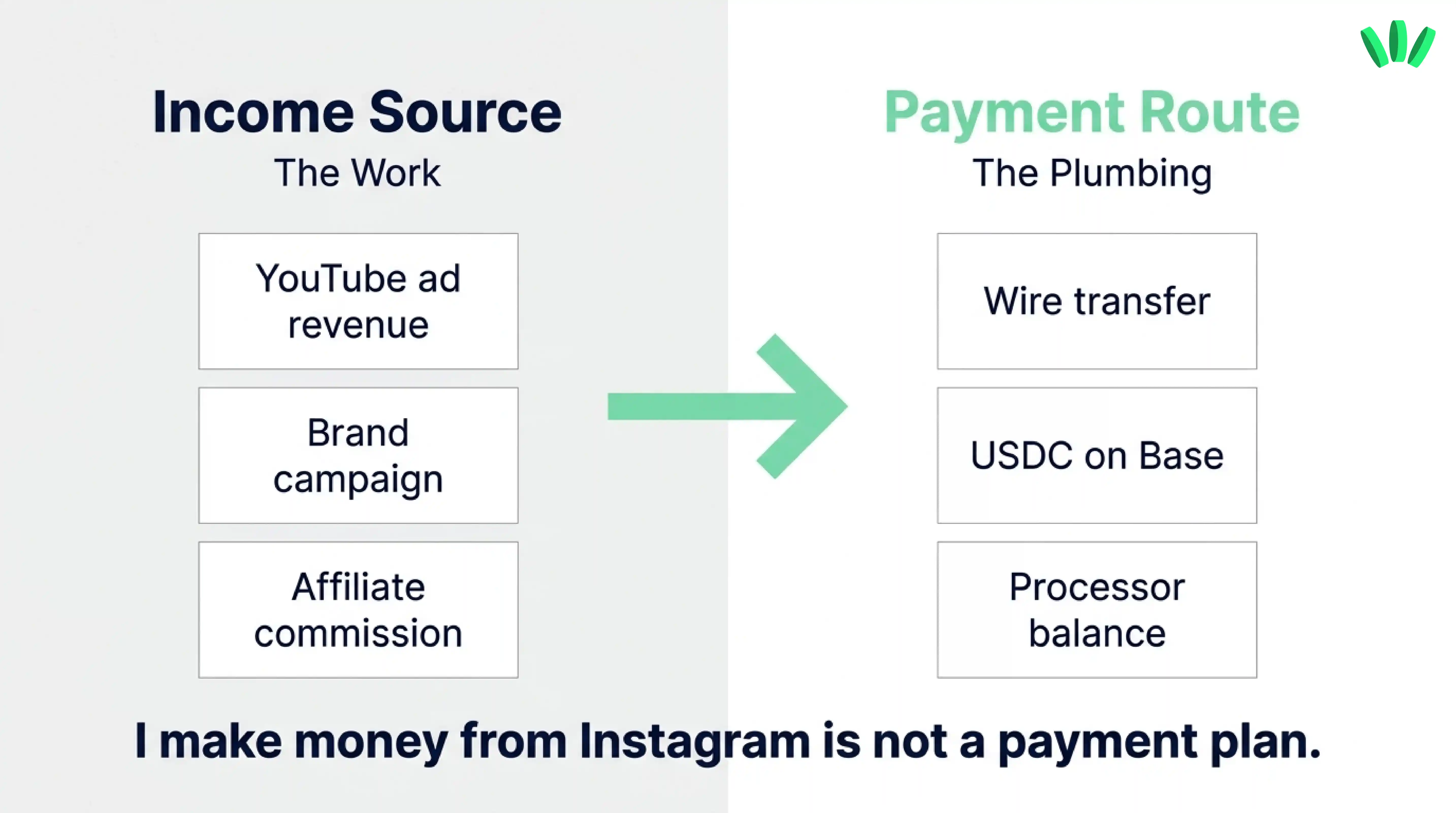
For Nigerian creators in 2026, the practical skill is learning to see the full route.
This guide covers how creators earn, why platform payouts can still fail, what to put on a brand-deal invoice, when stablecoins may fit, what risks they introduce, and which records you should keep before marking any payment as complete.
If a payment has already been held, reviewed, or delayed, start with walllet's guide to why freelance payments get stuck across different payment routes. The same route-risk logic applies to creators.
How do Nigerian creators get paid in 2026?
Nigerian creators get paid through several different income routes: platform-native monetization, direct brand deals, affiliate commissions, audience support, digital products, licensing, agency work, and services such as UGC production or consulting. The payout can then move through a bank transfer, platform-supported processor, local or foreign-currency receiving account, agency, or direct stablecoin transfer. The best route depends on who pays, which currency is used, what Nigeria-based options are supported, and what happens after the money arrives.
That distinction is the foundation of the whole article.
A creator payment usually looks more like this:
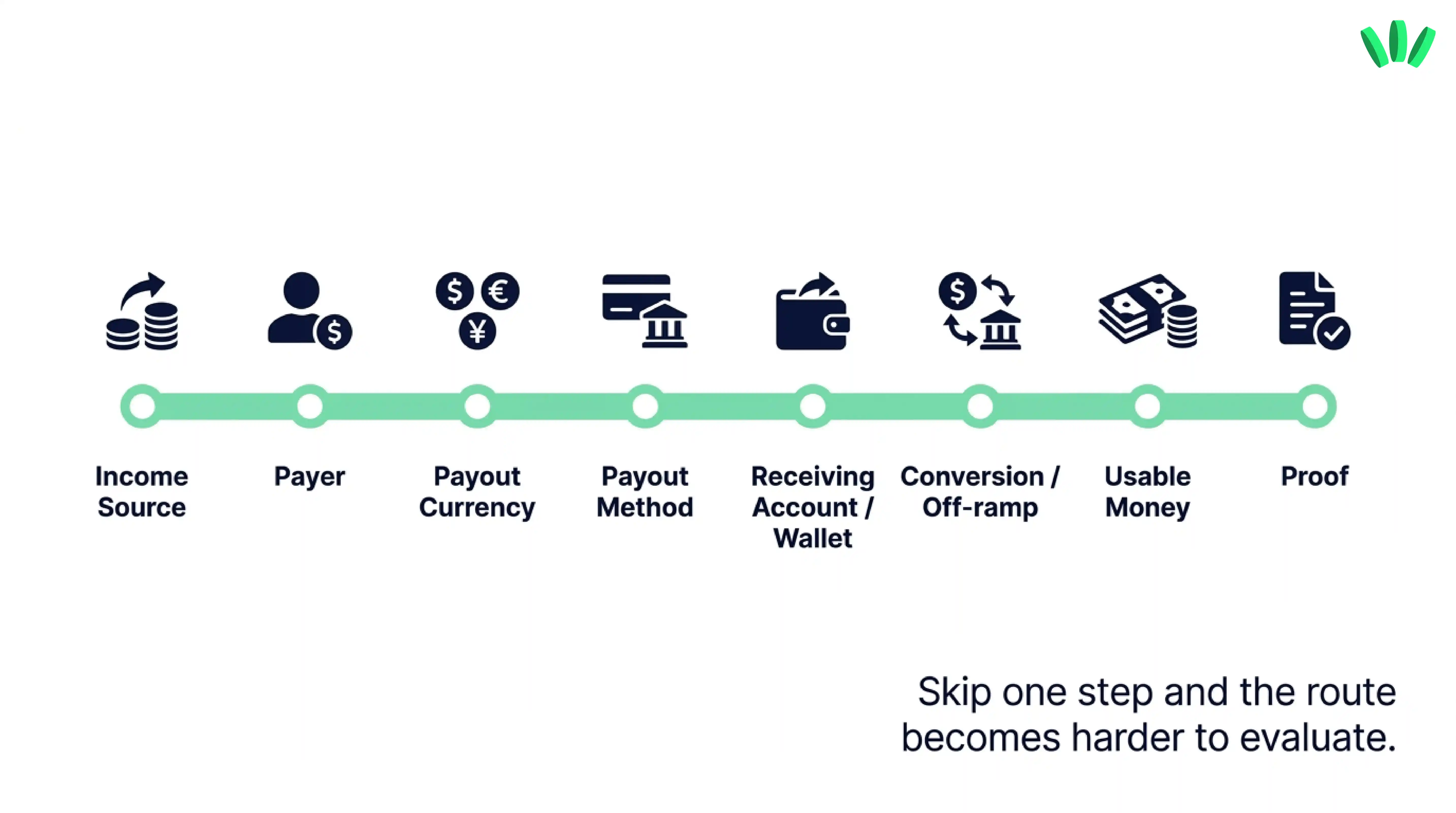
Income source → payer → payout currency → payout method → receiving account or wallet → conversion or off-ramp → usable money → proof
Skip one step and the route becomes harder to evaluate. Imagine a Nigerian video creator earns $1,000. That single number tells you very little. Was it:
YouTube revenue?
A TikTok-related campaign paid by an agency?
A direct sponsorship from a US software company?
An affiliate commission?
A USDC payment from a crypto brand?
A local campaign priced in naira?
Each one can have a different payer, payout schedule, verification process, fee structure, dispute path, and payment record. Before comparing payment apps, map the income source.
Where does creator income actually come from?
Most independent creators build income from more than one source. That is sensible because platform revenue can fluctuate, brand deals are irregular, and audience spending changes. Unfortunately, diversification also means more payout systems to understand. Humanity solved one dependency by creating seven dashboards. Progress. Here are the main routes.
Income source | Who usually pays | Common route question | Proof worth keeping |
Platform monetization | Platform or its payout partner | Is Nigeria supported, and which payout methods are available? | Earnings statement, payout ID, payout email, account statement |
Brand deal | Brand, agency, or finance team | Which currency and payment method does the contract allow? | Contract, invoice, remittance advice, bank reference or transaction record |
UGC production | Brand or agency | Is payment tied to delivery, approval, or publication? | Brief, delivery approval, invoice, payment record |
Affiliate income | Affiliate network or merchant | What is the threshold, cycle, and supported withdrawal method? | Commission report, payout statement, receiving record |
Audience support | Platform or direct supporter | Does the platform support your country and payout setup? | Platform statement, payout record |
Digital products | Storefront or payment processor | Who collects the customer payment and who pays you? | Order report, processor statement, payout record |
Licensing | Brand, publisher, agency, or media company | What exactly is being licensed, for how long, and where? | Signed agreement, invoice, payment confirmation |
Direct stablecoin payment | Brand, client, agency, or supporter | Which token, network, address, and proof standard apply? | Invoice, transaction hash, network, receiving address, explorer record |
The table is deliberately route-focused. "I make money from Instagram" is not yet a payment plan. Neither is "the brand will pay in dollars." You need the next layer.
Platform monetization and platform payout are different problems
A platform can support creators in Nigeria while still limiting how money leaves the platform. This is one of the easiest mistakes to make when researching creator income. People ask:
"Does this platform pay Nigerians?"
That question compresses several separate checks into one sentence:
Can a Nigerian account join the monetization program?
Does your specific account meet the eligibility rules?
Is the monetization feature available for your account and content type?
Which payout methods are available in Nigeria?
Does the payout method accept your actual account details?
Do your legal name, address, tax information, and bank details match?
What happens to the money after payout?
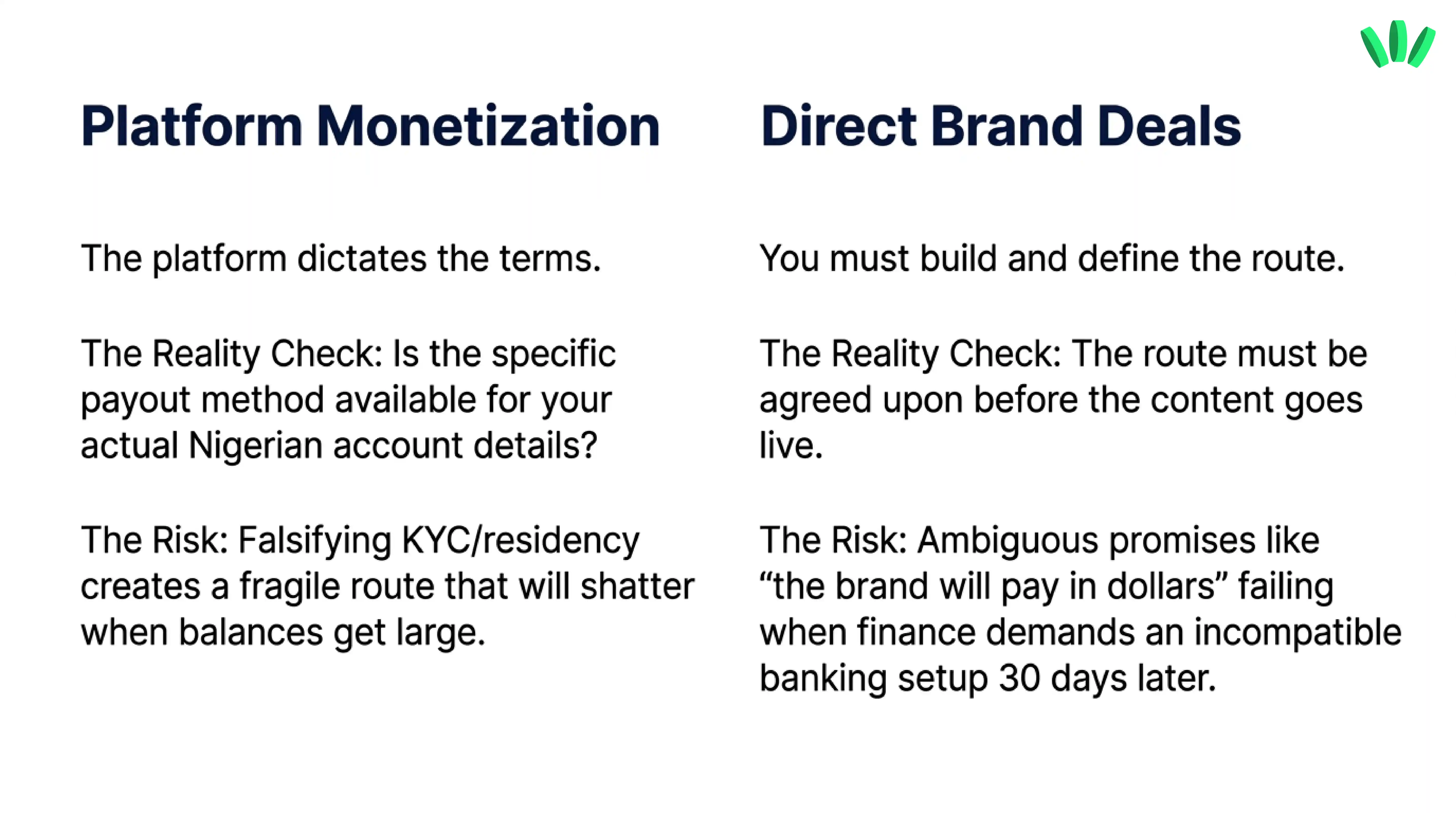
YouTube is a useful example. Google's current AdSense for YouTube payment-method table lists Nigeria with check and wire transfer available, while EFT and Hyperwallet are not listed for Nigeria. The same official page also says available payment forms depend on country and that bank-location rules apply to bank transfers. So "YouTube pays Nigerian creators" and "every Nigerian creator can use any convenient payout method" are very different claims. That gap matters.
Before building a business around platform income, check the payout settings inside your own account. Do not rely on a two-year-old tutorial, a creator in another country, or a screenshot from someone's cousin's monetization dashboard. Digital folklore has already caused enough damage.
Check these before depending on a platform payout
For each platform, write down:
Monetization program
Your eligibility status
Country availability
Minimum payout threshold
Payout frequency
Available payout methods
Required identity verification
Required tax information
Name-matching rules
Payout currency
Possible conversion step
Estimated fees you can verify
Hold or review conditions
Support route
Proof generated after payout
One more rule: do not falsify residency, identity, tax information, or account location to access a monetization feature. A workaround that depends on incorrect KYC information is a fragile income route and may violate platform terms. It can also create a spectacular mess precisely when the balance becomes large enough to matter.
For a broader comparison of payment routes, see PayPal vs Payoneer vs stablecoins for freelancers. Creators face many of the same questions around country support, conversion, withdrawal, control, and what happens after receipt.
Brand deals need a payment route before the content goes live
Brand deals are different from platform payouts because you usually have more room to negotiate the payment terms. That freedom helps. It also means you need to define the route yourself.
A campaign can be creatively successful and financially awkward at the same time. The creator delivers the Reel. The brand approves it. The post goes live. Thirty days later, finance asks for "banking details for USD settlement." Now everyone discovers that the payment route was never actually agreed. The better time to solve this is before production begins. For every brand deal, confirm:
Who is legally responsible for payment?
Is it the brand or an agency?
Which legal entity will appear on the invoice?
What is the exact fee?
Which currency is the deal priced in?
Is tax included or handled separately where applicable?
When can you invoice?
What starts the payment clock?
Is the due date based on invoice date, campaign approval, or publication?
Which payment methods are accepted?
Who absorbs transfer or network fees?
Which reference should appear on the payment?
What proof will the payer provide after sending?
A DM saying "$1,500 confirmed 🙌" is useful evidence that everyone was cheerful. It is a poor substitute for complete commercial terms.
What should a creator put on a brand-deal invoice?
A creator invoice should tell the client's finance team who is requesting payment, what the payment covers, how much is due, when it is due, and how to send it through the agreed route. It should match the contract, campaign approval, purchase order, or other commercial record. The invoice is a payment request. It does not replace the agreement that defines deliverables, usage rights, revisions, exclusivity, cancellation, or licensing.
A practical creator invoice can include:
Your legal or registered business name
Your business address, where applicable
Client or agency legal name
Client billing address, if required
Invoice number
Invoice date
Due date
Contract, campaign, or purchase-order reference
Description of the work
Deliverables
Agreed usage or licensing line where relevant
Amount due
Currency
Tax information required for your setup, where applicable
Agreed payment method
Payment details
Fee responsibility
Contact information for payment questions
Keep the service description specific.
Creator fee for Campaign AC-204: one 45-second Instagram Reel and two Instagram Story frames, as agreed in the campaign contract dated [date].
The second description is easier to match with a campaign, approval thread, and payment.
A simple brand-deal invoice structure
Invoice number: INV-2026-014
Invoice date: [date]
Due date: [date]
From:
[Creator legal or business name]
[Address or required business details]
[Contact email]
Bill to:
[Brand or agency legal entity]
[Billing details]
Campaign:
[Campaign or project name]
Services:
[Specific approved deliverables]
Amount due:
[Amount and currency]
Payment method:
[Agreed bank transfer, supported payment route, or stablecoin instruction]
Payment reference:
[Invoice number]
Fee responsibility:
[As agreed by both parties]
Do not add random late-payment penalties, tax statements, or legal clauses because a template on the internet had them. Use terms that actually apply to your agreement and business setup. For jurisdiction-specific tax or invoicing requirements, get local professional advice.
The payment route matters more than the payment app
Creators often compare payment products by brand name. That is understandable. It is also incomplete. A route is the full chain between the person who owes you and the money you can finally use. For a brand deal, the route may be:
Brand finance team → USD wire → receiving bank account → conversion → Nigerian bank account → business expenses
Another deal may be:
Crypto-native brand → USDC → agreed blockchain network → self-custodial wallet → hold, swap, or separate off-ramp → usable funds
A platform payment may look like:
Platform earnings → payout threshold → payout processor → supported account → currency conversion → Nigerian bank account
The route is where fees, delays, verification checks, and evidence problems appear.
A low headline fee does not rescue a route that the payer cannot use.
A fast transfer does not help if the receiving account is under review.
A cheap blockchain does not help if your wallet or later off-ramp does not support the token on that network.
A dollar balance is not automatically a usable dollar balance.
Before choosing a route, ask four blunt questions:
Can the payer send through it?
Can I receive through it correctly?
What can stop, delay, or reduce the payment?
What can I actually do with the money after it arrives?
That last question is where many comparisons fall apart.
Four common payment routes for Nigerian creators
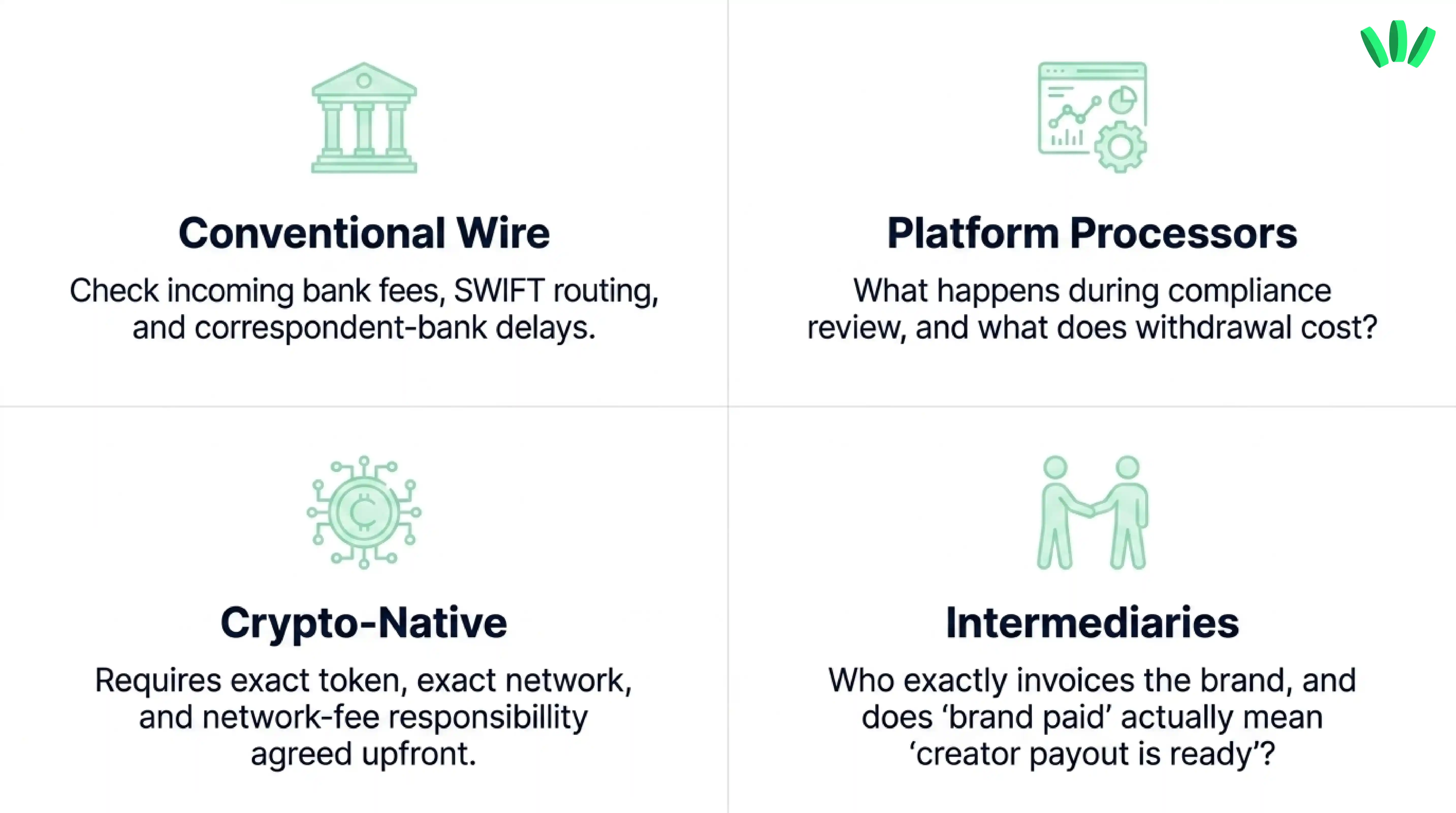
1. Direct bank or wire transfer
This route may fit when an international brand has a formal finance team and wants conventional bank details. Check:
Supported destination country
Required account currency
SWIFT or other routing details
Correspondent-bank fees where applicable
Incoming bank fees
Name matching
Expected settlement time
Conversion rate
Proof available if the transfer is delayed
A wire can be familiar to a finance team while still creating uncertainty for the recipient. Ask for a payment reference or remittance advice after the brand sends it.
2. A supported receiving account or payment service
Some creators use payment services that provide local or foreign-currency receiving options. The right question is not whether a service has a USD balance on the screen. Check the real route:
Can this specific brand or platform pay into it?
Are business payments accepted?
Is your account type eligible?
What payer types are restricted?
What happens during compliance review?
Which documents may be requested?
What does withdrawal cost?
What exchange rate applies?
Can the account details change?
What proof do you receive?
Provider rules change. Verify them directly before putting the details on an important invoice.
3. Direct stablecoin payment
This may fit when the brand or client already operates in crypto and both sides can agree on the exact payment instruction. A stablecoin route needs exact token, exact network, current receiving address, invoice amount, invoice reference, test-payment rule, network-fee responsibility, and transaction-hash requirement
For the complete workflow, use walllet's guide to getting paid in USDT or USDC as a freelancer. The mechanics apply directly to independent creators receiving brand or client payments.
4. Agency or intermediary payment
Some creators work through talent managers, influencer agencies, production companies, or campaign platforms. In that case, confirm:
Who contracts with the brand?
Who invoices whom?
Does the agency deduct commission before paying you?
What is the payout schedule?
Does "brand paid" mean "creator payout is ready"?
Which currency reaches you?
Which records will the agency provide?
Who handles a payment dispute?
The extra layer can simplify commercial work, but it creates another gate in the route. Know what that gate does.
A practical payment route checklist before you accept the deal
Before saying yes to a payment route, run through this list.
Payer
Who owes the money?
Do you know the legal entity?
Does the payment contact match the brand or agency relationship?
Has the payment contact changed unexpectedly?
Amount
What is the exact fee?
Which currency is used?
Is the amount gross or net of agreed fees?
Who pays transfer costs?
Timing
When can you invoice?
What triggers payment?
What is the due date?
Is there a payout threshold?
Can the route be held for review?
Receiving method
Is the method supported for your real country and account?
Does the payer accept it?
Does your name need to match exactly?
Are there account-type restrictions?
After receipt
Will you hold the currency?
Convert it?
Move it elsewhere?
Pay local expenses?
Pay software or contractors?
Proof
What record proves the amount was owed?
What proves payment was initiated?
What proves it reached the destination?
What proves conversion or withdrawal?
Can you match everything back to one invoice?
This is the point where payment decisions become less exciting and far more useful. If you want to explore a self-custodial route for managing supported crypto and stablecoins without manually handling a traditional seed phrase, you can explore wallet.com here.
Why stablecoins are part of the Nigerian creator payment conversation
Stablecoins are relevant because many Nigerian creators work across borders while their income, audience, and expenses sit in different currency systems.
This is no longer an obscure edge case. In June 2026, the International Monetary Fund reported that Nigeria received about $59 billion in crypto-asset inflows between July 2023 and June 2024. The IMF also said Nigeria accounted for roughly 60% of stablecoin inflows in sub-Saharan Africa since 2019, while noting that measurement remains imperfect and that stablecoins bring regulatory and financial risks alongside their practical uses. For creators, the relevant question is narrower:
Can a stablecoin create a workable route between a payer abroad and a wallet you control? Sometimes, yes.
For example, a crypto company may already pay contractors and creators in USDC. A Web3 agency may already hold USDT. A creator may want to receive dollar-pegged value without routing the payment through several traditional intermediaries.
But "stablecoin" is not a complete payment method. USDT on one network is a different route from USDT on another. USDC on Base is a different route from USDC on Ethereum. A client who says "I can pay in crypto" has given you a category, not an instruction.
Are stablecoins safe for creator payments?
Stablecoins can be useful for creator payments when the payer, token, network, wallet, amount, and next step are agreed before money moves. They reduce exposure to the price swings of assets such as BTC or ETH, but they are not risk-free cash or bank deposits. Creators still face issuer risk, depeg risk, token-level controls, wrong-network mistakes, wallet compromise, fake tokens, approval scams, and problems converting or using funds after receipt.
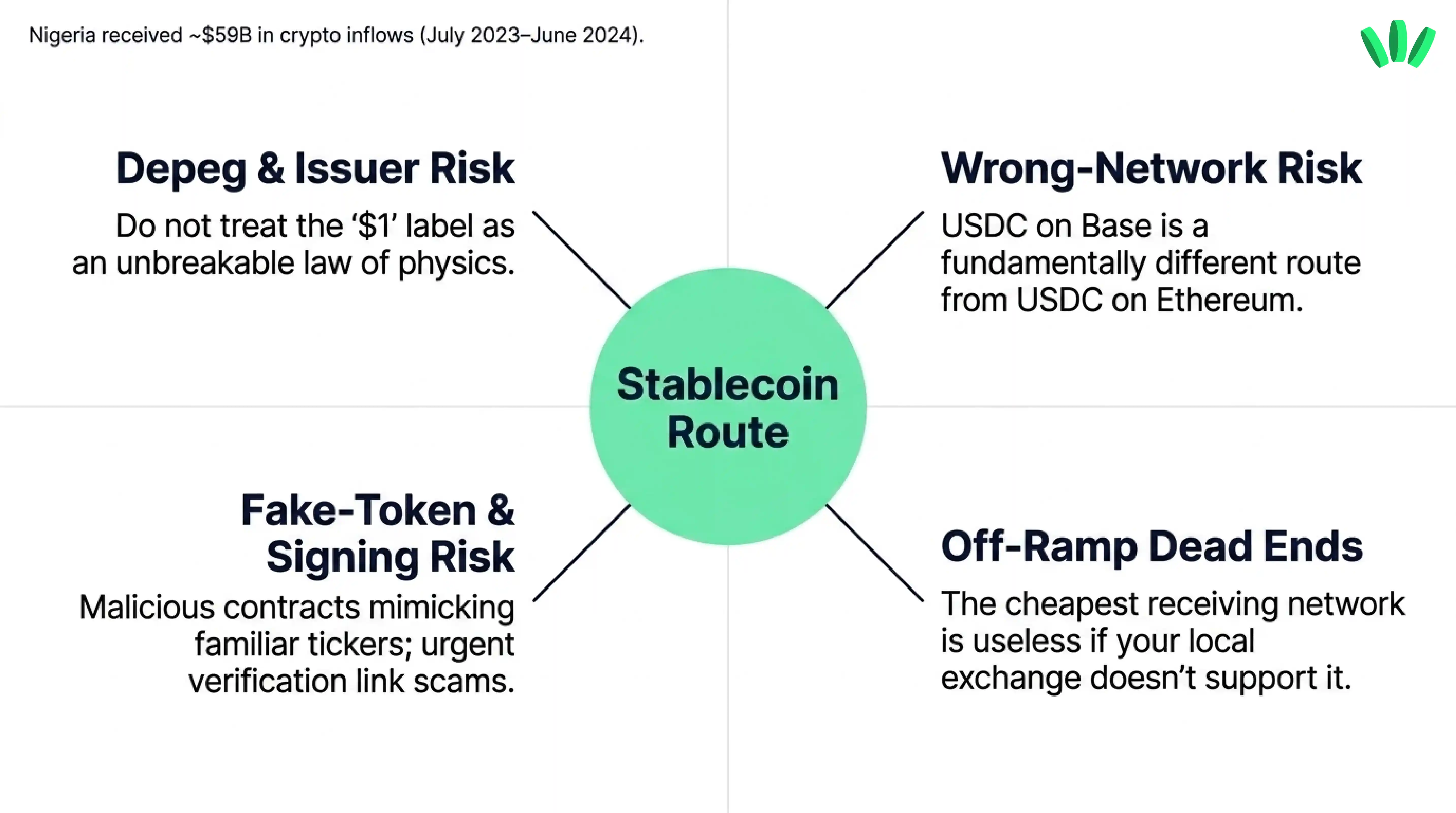
That honest answer matters. A stablecoin can solve one problem while introducing another.
1. Issuer risk
Major centralized stablecoins depend on an issuer and the systems around the token. You need to understand:
Who issues it?
What supports its value?
What reserve information is available?
What control powers exist?
What happens during a market or regulatory event?
For a deeper explanation, read whether USDT and USDC can be frozen and what that actually means. A self-custodial wallet gives you control of the wallet, but it does not remove every power built into an issued token.
2. Depeg risk
A stablecoin is designed to track a reference value, usually the US dollar. Designed to is not the same as guaranteed to. Do not treat the "$1" label as a law of physics.
3. Wrong-network risk
This is one of the easiest ways to turn a routine payment into a support case. Before receiving:
Confirm the stablecoin
Confirm the exact network
Confirm your wallet supports that token on that network
Confirm the sender can use the same route
Use a test payment for a new or important route
For a reusable pre-payment and post-payment process, see the USDT and USDC payment safety checklist.
4. Fake-token risk
A familiar ticker is not enough. A malicious or worthless token can use a familiar name. Check the actual asset and network through a trusted wallet interface or verified source. Do not accept a random token contract from a stranger in a payment chat.
5. Wallet and signing risk
Receiving a stablecoin does not require you to approve every link someone sends afterward. Be cautious with:
Unknown wallet connections
Unexpected token approvals
"Verification" links
Fake support accounts
Requests to share recovery information
Blind signatures
Urgent messages asking you to move funds
A payment conversation can become a phishing opportunity because the attacker already knows you are expecting money.
6. Off-ramp risk
Before accepting the stablecoin, decide what happens next. Will you:
Hold it?
Convert it?
Move it to another wallet?
Use an exchange?
Pay business expenses?
Convert some amount to naira?
Check the later route before the payment arrives. The cheapest receiving network is a poor choice if your next destination does not support it.
What should a stablecoin invoice include?
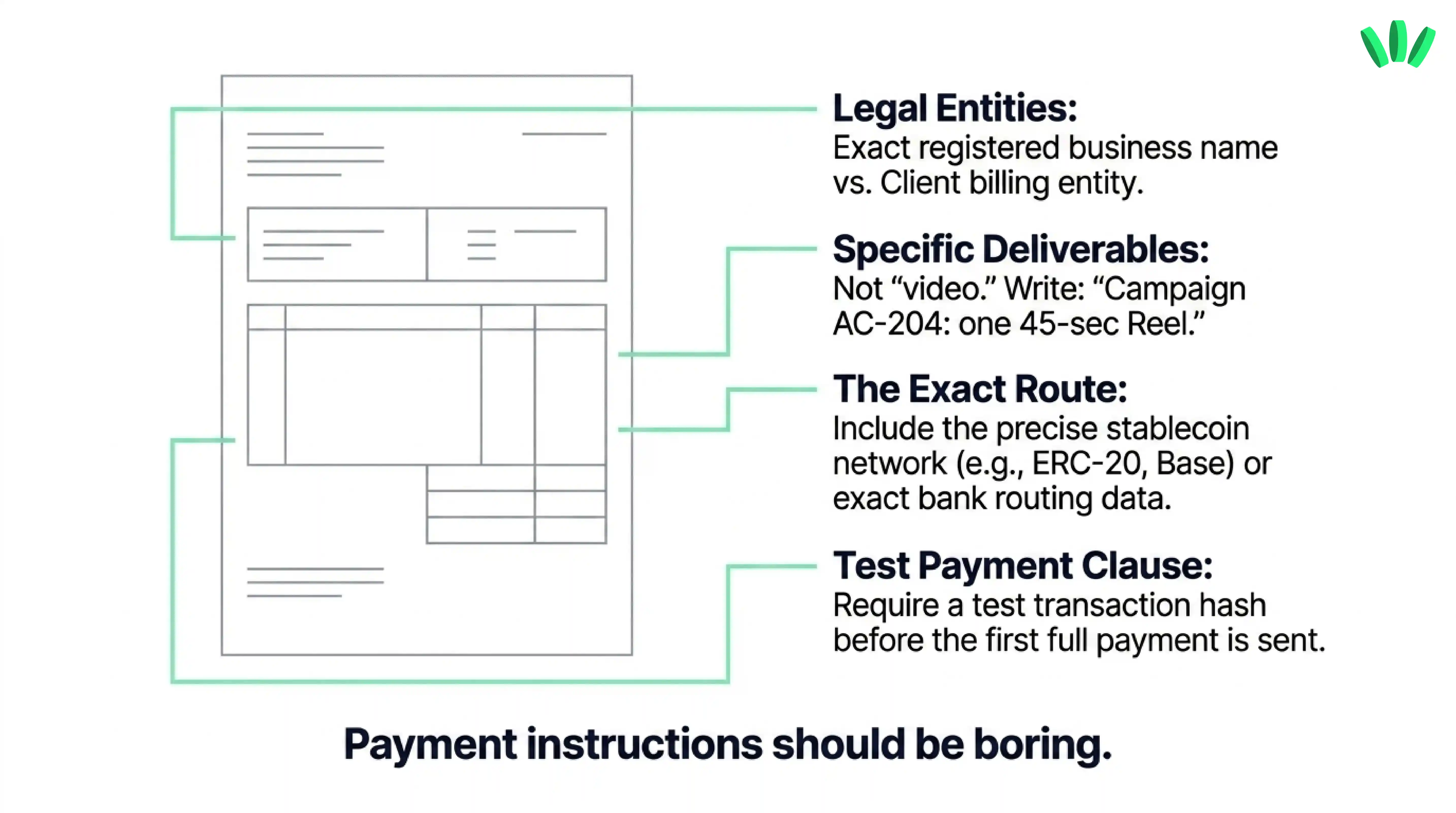
For a direct brand or client payment, add a precise payment block to the invoice. Example:
Amount: 1,500 USDC
Network: [exact agreed network]
Receiving address: [address copied from the current wallet receive screen]
Payment reference: INV-2026-014
Test payment: Required before the first full payment
Network fee: [agreed responsibility]
After sending: Please provide the transaction hash
Then add a clear instruction:
Please do not use a different token or network. For a first payment or changed route, send the agreed test amount first. The invoice will be marked paid after the full payment reaches the stated receiving address on the agreed network and matches the invoice amount.
That sentence is boring. Excellent. Payment instructions should be boring.
How do you prove that a creator payment was actually received?
A creator should keep evidence across the whole payment route, not only a screenshot of the final balance. The useful proof depends on the route. For a brand deal paid by bank transfer, your records may include:
Signed contract or written commercial agreement
Approved campaign brief
Invoice
Purchase-order reference, if used
Remittance advice
Bank transfer reference
Receiving account record
Conversion record, where applicable
For a platform payout:
Platform earnings statement
Payout ID
Payout date
Payout method
Platform email or dashboard record
Receiving account statement
Fee or conversion record
For a stablecoin payment:
Contract or written agreement
Invoice
Token
Network
Receiving address
Transaction hash
Block explorer record
Date and time
Amount received
Later conversion or off-ramp record, where relevant
If you have never checked a transaction hash yourself, use walllet's guide to reading a crypto transaction on a block explorer. A screenshot can support the record. It should not carry the whole burden.
A practical proof checklist for creators
Think of proof in stages.
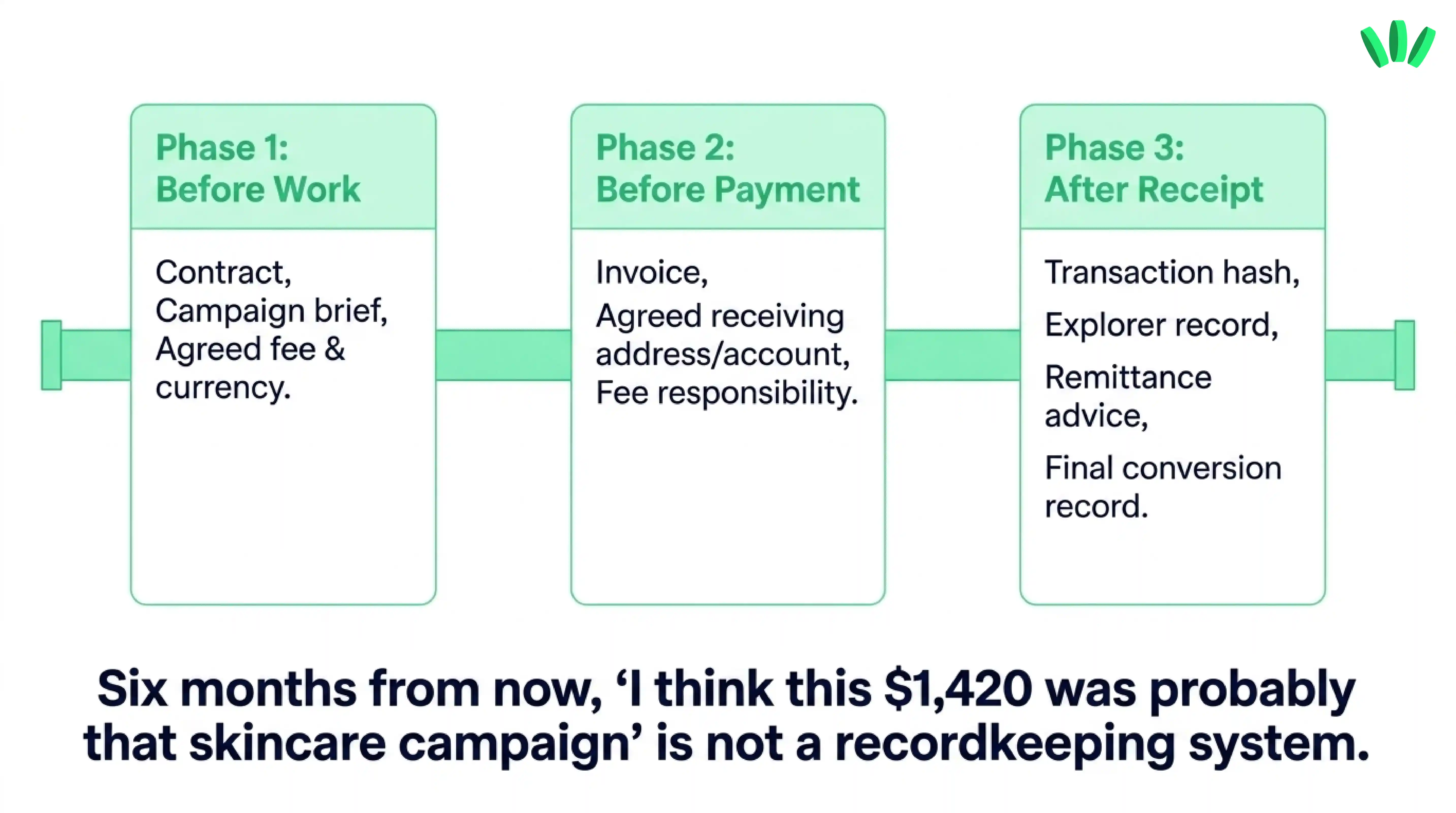
Before the work
Keep: Contract, Campaign brief, Agreed fee, Currency, Deliverables, Usage rights, Payment terms, Payer identity, and Agency relationship, if one exists
Before payment
Keep: Invoice, Invoice number, Amount due, Due date, Payment instruction, Agreed account or wallet details, Fee responsibility, and Any required purchase-order reference
When the payer says "sent"
Ask for the evidence appropriate to the route: Remittance advice, Transfer reference, Platform payout ID, Transaction hash, and Agency payment confirmation "Sent" is a status update. Verification comes next.
After receipt
Confirm: Correct amount, Correct currency or token, Correct receiving account or address, Correct network for stablecoins , Payment date
Any deducted fees, and Final status
After conversion or withdrawal
Save: Conversion amount, Exchange rate where relevant, Fees, Destination account, Withdrawal reference, and Date. This creates a chain you can reconstruct later. That matters for accounting, tax work, disputes, delayed payments, and basic business memory. Six months from now, "I think this $1,420 was probably that skincare campaign" is not a recordkeeping system. It is a cry for help.
Example: a $1,500 international brand deal
Consider a Nigerian creator in Lagos who agrees to produce campaign content for an overseas software company. The fee is $1,500.
Step 1: Confirm who pays
The creator checks whether the payer is: The software company, Its marketing agency, A separate payment entity, and The invoice uses the correct billing entity.
Step 2: Confirm the commercial terms
The agreement records: Deliverables, Fee, Currency, Usage rights, Approval process, Payment timing, and Payment route
Step 3: Issue the invoice
The invoice includes: Unique invoice number, Campaign reference, Specific service description, $1,500 amount, Due date, and Agreed payment method
Step 4: Map the route
Suppose the brand offers two methods:
Route A
USD transfer → creator's supported receiving account → conversion if needed → local use
Route B
USDC → exact agreed network → creator-controlled wallet → hold or later conversion
The creator compares the full routes, not the logos.
Step 5: Check the next action
For Route A:
What fees apply?
Is the payer allowed to send?
Will the account accept the payment type?
What conversion follows?
For Route B:
Can the brand send USDC on the agreed network?
Can the wallet receive it?
Is a test payment needed?
How will the creator use or convert it later?
Step 6: Keep proof
For a bank route:
Invoice
Remittance advice
Transfer reference
Receiving record
For a stablecoin route:
Invoice
Token
Network
Address
Transaction hash
Explorer verification
The content work may be identical in both cases. The payment risk is not.
What is the best payment route for a Nigerian creator?
There is no single best route for every creator because the payer, income source, currency, account setup, timing, and next use of funds differ. A practical starting point is:
For platform-native revenue
Use the payout methods officially supported for your real account and country. Verify them inside the platform dashboard. Do not design the route around a feature that appears only in someone else's region.
For a formal international brand deal
A supported bank or business-friendly payment route may be easier when the client's finance team needs conventional invoice and payment records. Check the entire cost and settlement path.
For a crypto-native brand or Web3 client
A direct stablecoin payment may reduce unnecessary layers if both sides already understand the route. Use an exact token, network, address, test-payment rule, and transaction record.
For local Nigerian brand work
A local naira payment may be the simplest route when the agreement, invoice, payer, and business needs are local. Do not add international payment complexity to a problem that does not need it.
For recurring income
Consistency matters. A route that works once is useful. A repeatable route needs:
Stable account details
Clear support
Predictable records
Known fees
A fallback method
A process for changed payment instructions
Repeat clients should not renegotiate the plumbing every month.
The route checklist to use before your next payout
Before accepting a platform, brand, agency, or stablecoin route, answer these questions in writing.
Income
What exactly generated the money?
Platform revenue, brand deal, affiliate income, audience support, licensing, product sale, or service?
Payer
Who legally owes you?
Brand, agency, platform, processor, network, or client?
Currency
What amount was agreed?
In naira, USD, GBP, EUR, USDT, USDC, or something else?
Payout
Which methods are actually available to your account?
Are there thresholds or payout cycles?
Can the payout be held?
Receiving destination
Bank account?
Payment account?
Agency?
Exchange?
Self-custodial wallet?
Conversion
Does the money need to change currency?
Who sets the rate?
Which fees apply?
Next use
Can you pay rent?
Buy equipment?
Pay software?
Save?
Move the funds?
Pay tax obligations?
Pay collaborators?
Proof
What proves the money was earned?
What proves it was sent?
What proves it arrived?
What proves any later conversion?
Fallback
What happens if the route fails?
Who provides support?
Is there another approved payment method?
A route that cannot answer these questions is not ready for an important payment.
One final rule: keep income, route, and proof separate in your head
Creators often collapse three different questions:
How did I earn the money?
How will the money move?
How will I prove what happened?
Keep them separate. For a YouTube payment:
Income source: platform monetization
Route: platform payout through an available method
Proof: earnings and payout records plus receiving statement
For a brand deal:
Income source: sponsorship or campaign work
Route: agreed bank, payment-service, agency, or stablecoin path
Proof: contract, invoice, sending reference, receipt record
For a direct USDC deal:
Income source: creator service or campaign
Route: payer wallet → USDC on agreed network → receiving wallet
Proof: invoice, transaction hash, explorer record, receiving address
That mental model makes payment decisions easier because you stop asking one app to answer every problem. The work creates the income. The route moves it. The records prove it. A million views can create attention. A signed campaign can create an obligation to pay. A platform dashboard can show earnings.
But your business runs on the money that reaches a usable destination through a route you understand. A viral post is not income until the payout route works. Explore walllet.com if you want a simpler self-custodial way to receive and manage supported crypto and stablecoins while keeping control of your wallet:
This article is for educational purposes and is not legal, tax, accounting, or investment advice. Platform rules, payout availability, payment-provider terms, stablecoin risks, and Nigerian regulatory requirements can change. Verify the current rules that apply to your account, business, payment route, and jurisdiction before moving meaningful funds.
