
If you are a Nigerian freelancer getting paid by clients abroad, stablecoins may no longer feel like a side option used only by crypto people.
The International Monetary Fund's June 2026 analysis of stablecoins in Nigeria described stablecoins as a growing cross-border payment channel in the country. TechCabal also reported that stablecoins appear repeatedly in the Central Bank of Nigeria's Payments System Vision 2028. That does not mean stablecoin payments are suddenly risk-free, officially simple, or automatically better than every other payment route.
It means something more practical: stablecoins are now visible enough that freelancers should treat them like a serious payment workflow, not an improvised wallet address sent at the last minute.
What changed for freelancers?
For Nigerian freelancers, the stablecoin shift means three things.
First, more clients, platforms, and payment services may be willing to discuss USDT or USDC as a payment option.
Second, regulators and financial institutions are paying more attention to stablecoin activity, so the service providers around stablecoins may become stricter about identity checks, compliance, and transaction monitoring.
Third, the personal responsibility on the freelancer does not disappear. You still need to confirm the stablecoin, network, wallet address, transaction proof, records, and cash-flow plan before you depend on stablecoins for income.
Stablecoins can help with cross-border payment friction. Wallet risk, legal uncertainty, tax responsibility, exchange-rate pressure, and tool choice still need separate checks.
Why this became a serious topic in Nigeria
Nigeria has a real cross-border money problem.
Freelancers invoice clients in dollars, euros, pounds, or stablecoins, but everyday expenses are usually in naira. Traditional routes can involve platform limits, withdrawal delays, FX spread, failed payments, and a lack of control once money is sitting inside a third-party account.
That is why stablecoins became attractive. They give many users a way to receive dollar-linked value through digital wallets, often without waiting for a traditional bank transfer to settle across borders.
The IMF's June 2026 analysis said stablecoins have become a meaningful cross-border payment channel in Nigeria, especially for households and small firms moving money across borders. The same report highlighted that Nigeria accounts for a large share of stablecoin inflows in sub-Saharan Africa, while also warning that fast growth creates policy and regulatory concerns. For broader official background, the CBN's Payments System Vision 2025 page already referenced exploration of a stablecoin framework as part of Nigeria's payments modernization agenda.
For a freelancer, the important point, beside the headline, is the behavior underneath it.
People are using stablecoins because they are trying to solve payment problems that ordinary financial rails have not solved well enough.
What freelancers should take from the IMF signal
Do not read the IMF signal as "stablecoins are now safe for everything." A better reading is:
Stablecoins are now important enough in Nigeria's cross-border money flow that freelancers should build safer habits before more of their income depends on them.
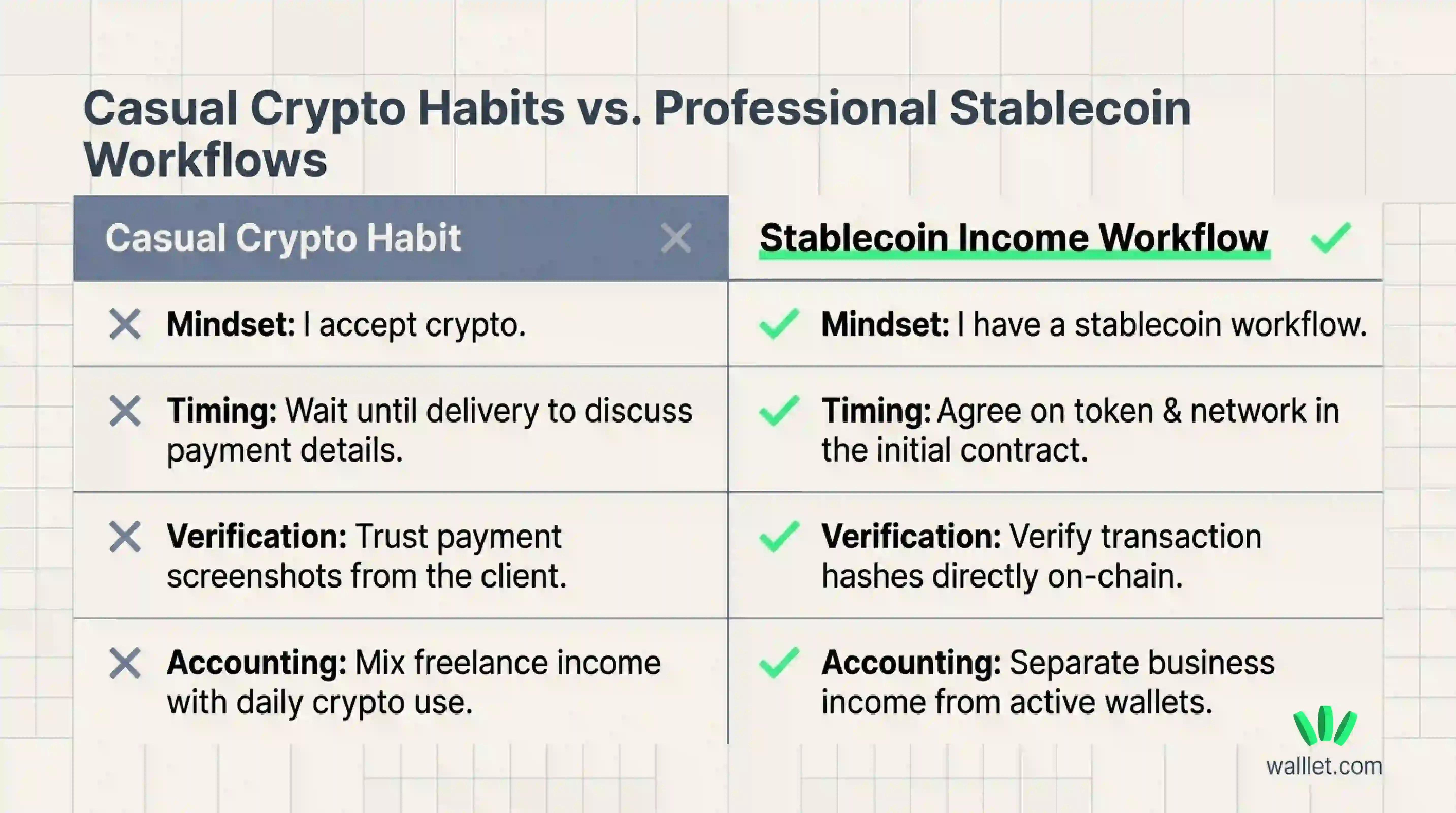
That means you need a stablecoin payment process, not just a wallet app. A safer process includes:
Confirming whether the client will pay USDT, USDC, or another stablecoin.
Confirming the exact blockchain network before sending an address.
Checking that your wallet supports the exact asset and network.
Using a wallet setup you can recover under stress.
Verifying the payment on a block explorer before you deliver final work.
Keeping invoice, transaction hash, client, date, and amount records.
Separating money you need soon from money you plan to hold longer.
Treating cash-out, conversion, tax, and local compliance as separate decisions.
This is the difference between "I accept crypto" and "I have a stablecoin income workflow."
If you are building that workflow now, explore walllet.com as a stablecoin account experience for self-custodial control. Use it as one part of the setup, then still confirm token, network, records, and recovery before client payments depend on it.
What may change for freelancers as regulation catches up
More attention from the IMF, CBN, and SEC does not automatically create a clear rulebook for every freelancer. It can, however, change the environment around the tools you use. You may see more:
KYC checks from exchanges and payment providers.
Restrictions on certain wallets, counterparties, or transaction patterns.
Stablecoin providers and platforms explaining risk more clearly.
Local fintechs experimenting with stablecoin settlement or regulated digital-asset products.
Clients asking whether stablecoin payment is acceptable for invoices and records.
You may also see more confusion. Some people will turn a complex policy discussion into simple claims like "stablecoins are now approved" or "stablecoins are banned" or "no one can touch your money."
Avoid those shortcuts.
For everyday freelancers, the safer statement is this:
Stablecoins are increasingly part of Nigeria's cross-border payment conversation, but the rules, providers, and practical risks still need careful checking.
What not to assume
Do not assume stablecoins are automatically cheaper.
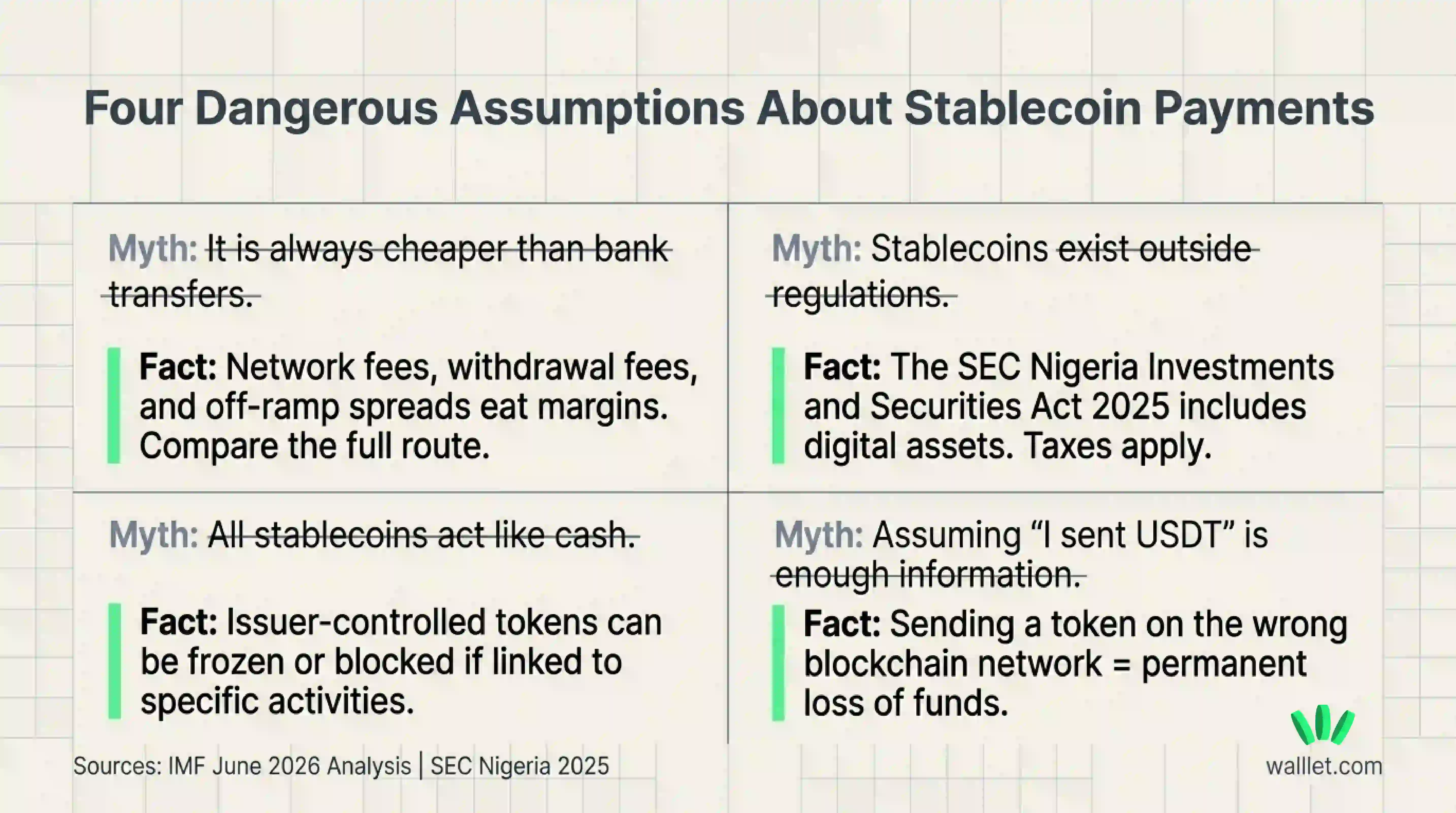
Network fees, exchange spreads, withdrawal fees, off-ramp costs, and conversion rates can still reduce what you receive. The only honest comparison is the full route from client payment to usable money.
If you are comparing payment routes, walllet's PayPal vs Payoneer vs stablecoins for freelancers guide gives a better frame than looking at one fee in isolation.
Do not assume stablecoins are legally simple.
Nigeria's Investments and Securities Act 2025 includes virtual and digital assets in its securities definition, and SEC Nigeria has a regulatory perimeter for virtual asset operators. That does not mean this article can tell you your exact legal or tax position. It cannot. Treat legal and tax questions as needs confirmation with a qualified professional.
Do not assume every stablecoin behaves the same.
USDT, USDC, DAI, and other stablecoins have different issuers, reserves, liquidity, networks, and controls. Some issuer-controlled stablecoins can be frozen or blocked in specific circumstances, especially when addresses are linked to illegal activity or valid legal orders. If this risk is new to you, read walllet's guide on whether stablecoins can be frozen before you depend on one asset for client income.
Do not assume your wallet supports every network.
Before receiving money, check the exact asset and chain. A client saying "I sent USDT" is not enough. You need to know which network they used.
Do not assume cash-out is solved.
How you turn stablecoins into local spending money depends on the services you use, their rules, liquidity, KYC requirements, limits, and current availability. For walllet.com, any claim about cash-out, card support, supported networks, fees, or country availability is needs confirmation unless verified before publication.
A practical stablecoin workflow for Nigerian freelancers
Use this workflow before accepting a stablecoin payment from a client.
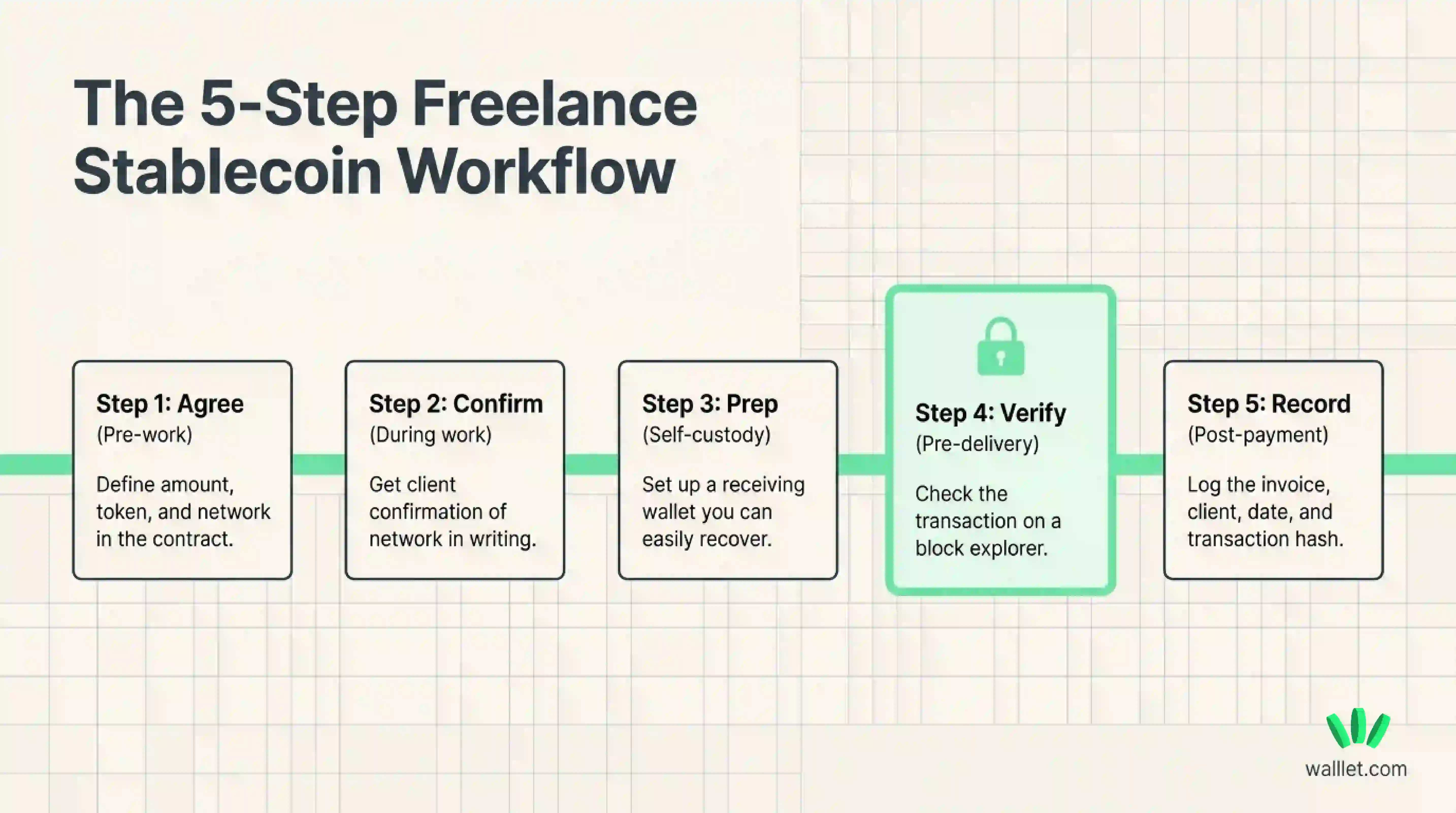
For the full receiving flow, pair this article with walllet's guide on how to get paid in USDT or USDC as a freelancer. That article owns the step-by-step payment setup, while this one explains why the Nigeria stablecoin shift matters now.
1. Agree on the payment route before work begins
Do not wait until delivery day to discuss payment details. Add the payment method to your contract or invoice:
Amount.
Stablecoin.
Network.
Wallet address.
Payment deadline.
Who pays network fees.
What counts as payment confirmation.
What happens if the client sends to the wrong network or wrong address.
This is not about sounding technical. It is about avoiding disputes.
2. Confirm token and network in writing
Use a short message:
Please confirm whether you will pay USDT or USDC, and which network you will use before I send the receiving address.
If the client cannot answer, pause.
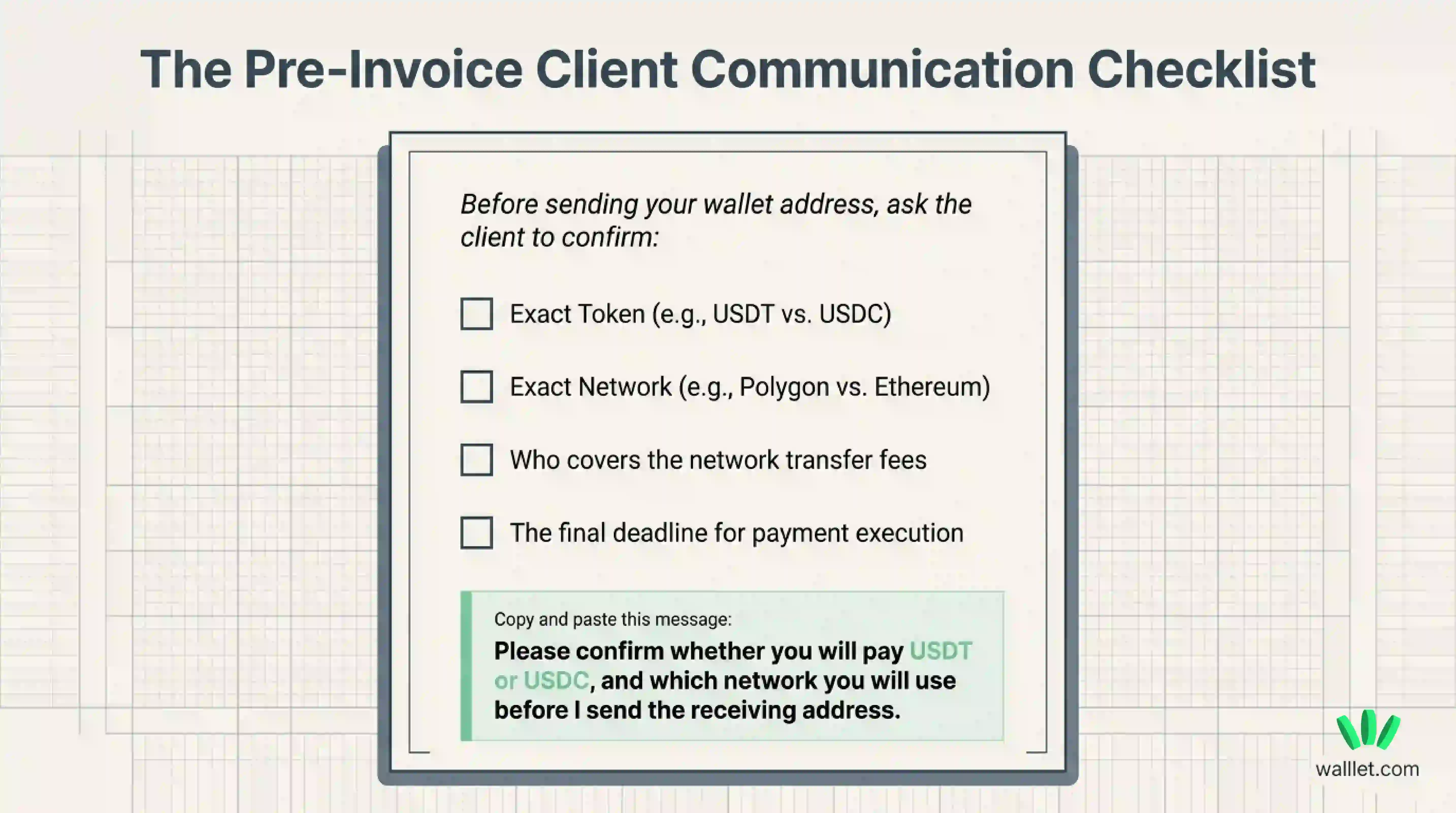
The wrong network can create a support problem, a recovery problem, or a permanent loss. Stablecoin payments are professional only when both sides know what is being sent.
If you need a reusable pre-payment script, use the stablecoin payment checklist for freelancers before sharing your wallet address.
3. Use a receiving wallet you understand
For freelancers, the best wallet is not simply the one with the longest feature list. You need:
Clear asset and network labels.
Easy address copying.
A recovery process you understand.
Strong warning screens before risky actions.
A practical separation between receiving money and using apps.
A way to verify transaction history.
If you use a self-custodial wallet, remember the tradeoff: you control the wallet, but you also carry more responsibility for recovery and transaction mistakes.
If you use a seedless or passkey-based wallet, check how recovery works before you receive meaningful income. "No seed phrase" should reduce one type of anxiety, not create a mystery about device loss or account recovery.
If you are comparing wallet setups, walllet's guide to the best crypto wallet for freelancers in Nigeria explains the receiving, recovery, network, and self-custody checks in more detail.
4. Verify the payment before delivery
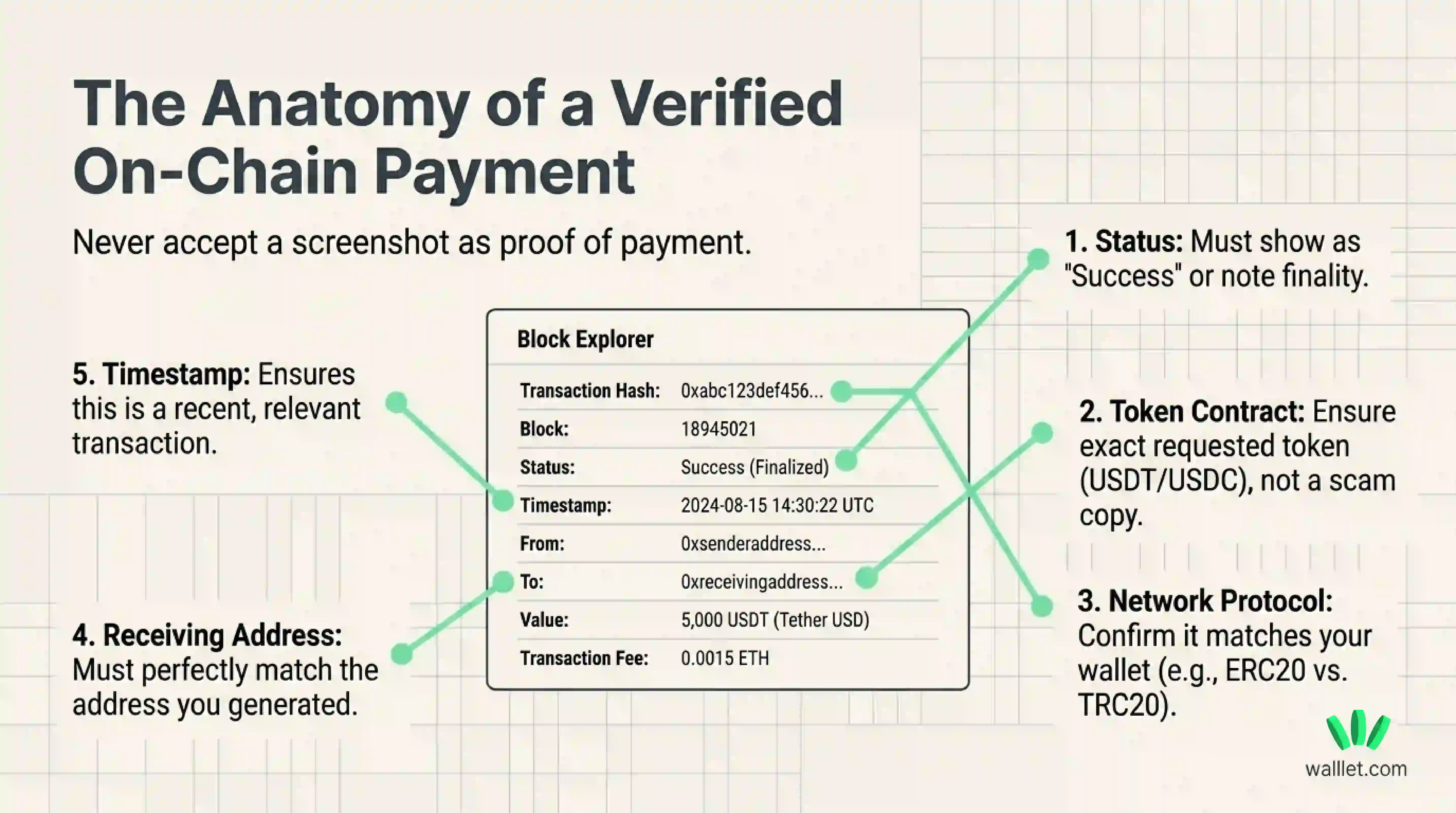
A screenshot is not payment proof. Ask for the transaction hash, then check it on the correct block explorer. Confirm:
The transaction status.
The token.
The amount.
The receiving address.
The network.
The timestamp.
The number of confirmations or finality status.
Only then should you treat the payment as received.
5. Keep records like a business owner
Stablecoin payments are easier to lose track of if you treat them like casual wallet activity. For every client payment, record:
Client name.
Invoice number.
Date.
Amount in invoice currency.
Stablecoin received.
Transaction hash.
Network.
Wallet address used.
Conversion or transfer notes, if any.
This helps with disputes, accounting, client trust, and future compliance questions.
Can walllet.com help with this workflow?
For this reader, walllet.com is most useful as a stablecoin account experience built around self-custodial control, seedless access, and passkey-based control.
That matters because a freelancer does not only need to hold tokens. They need to receive income, understand what they are approving, reduce recovery anxiety, and keep control without becoming a full-time crypto operator.
Before using any wallet for client income, check the exact supported assets, networks, country availability, fees, cash-out options, and recovery assumptions. Those details are needs confirmation before publication if they are not verified by the product team.
The freelancer checklist
Before you accept your next stablecoin payment:
Decide whether stablecoin payment is appropriate for this client and invoice.
Confirm the token and network before sharing an address.
Use a wallet that clearly shows the receiving network.
Ask for the transaction hash after payment.
Verify the payment on a block explorer.
Record the invoice, amount, network, address, and tx hash.
Separate receiving money from savings or risky onchain activity.
Treat conversion, tax, and local rules as separate checks.
Before your next client payment
The stablecoin conversation in Nigeria is becoming more serious because real people and small businesses are already using stablecoins to solve cross-border money problems.
For Nigerian freelancers, the practical response is to make stablecoin payments more disciplined. Before the next client pays, decide the token, network, wallet, proof standard, records, and risk checks. That is what turns a wallet address into a payment workflow.
If you want a stablecoin account experience built around self-custodial control and easier recovery, explore walllet.com for a clearer stablecoin wallet setup.
