The best crypto wallet for a Nigerian freelancer is one that supports the exact stablecoin and network used by clients, makes payment verification clear, has a recovery process you understand and lets you control the funds after they arrive.
A popular trading app is not automatically a good wallet for client income. An exchange may be useful for converting or cashing out, but it can hold withdrawals, review accounts or limit supported deposit routes. A self-custody wallet gives you more direct control, but you become responsible for addresses, networks, approvals and recovery.
Before choosing a wallet, use the complete guide to receiving USDT or USDC from international clients. For the checks required before sharing any address, follow the stablecoin payment checklist for freelancers.
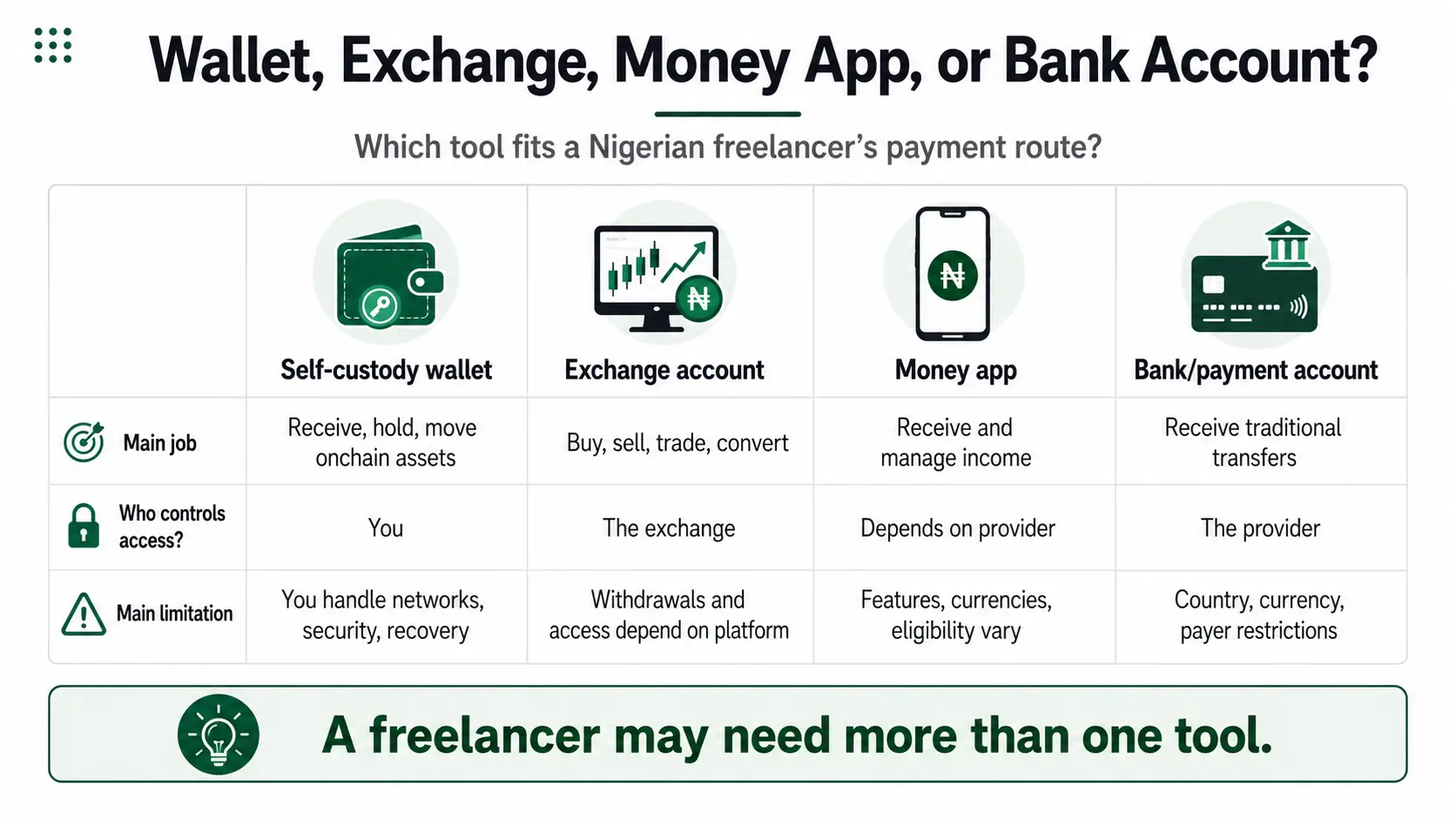
Wallet, exchange or money app?
These tools solve different problems.
Tool | Main job | Who controls access? | Main limitation |
Self-custody wallet | Receive, hold and move onchain assets | The wallet owner | User must manage networks, security and recovery |
Exchange account | Buy, sell, trade and convert assets | The exchange | Withdrawals and account access depend on the platform |
Money app | Receive and manage income across supported payment routes | Depends on the product layer | Features, currencies and eligibility may vary |
Bank or payment account | Receive traditional transfers | The provider | Country, currency and payer restrictions may apply |
A freelancer may need more than one tool. The wallet can receive and hold Stablecoins. An exchange or another route may still be needed for conversion. A money app may combine parts of the process, but the user must understand which balance is onchain and which balance depends on a payment provider.
For the custody decision, compare using a self-custody wallet with keeping funds on an exchange.
Best Wallet and Dollar Apps for Nigerian Freelancers
The closest alternatives are not all crypto wallets. Cleva, Grey and Raenest focus mainly on receiving and managing foreign income, while Cenoa is closer to a self-custodial digital-dollar wallet. walllet combines both sides of the problem.
App | Best for | Main strength | Main limitation |
walllet | Freelancers who want one route from global payment to local use | Receive supported USD, EUR or GBP income, hold value in dollars, spend online and cash out to naira within one income workflow | Availability, fees and supported routes must be checked in the current account |
Cleva | Freelancers mainly receiving and spending USD | Simple USD-focused account, dollar card and naira conversion | Less suitable when the user needs broader multi-currency receiving or a self-custodial stablecoin layer |
Grey | Users who need several foreign-currency balances | USD, EUR and GBP accounts, currency conversion and a virtual card | It remains a provider-controlled account rather than a self-custody wallet |
Raenest | Professional freelancers who need invoices and platform payout tools | Multi-currency accounts, cards, invoices and support for several income routes | The broader feature set still depends on provider eligibility, reviews and account controls |
Cenoa | Users who prioritize non-custodial digital dollars | Self-custodial USDC and USDT access, with international account features | More dollar-wallet focused and less specifically built around the full Nigerian freelancer income cycle |
walllet.com designed around the complete income route:
Receive → Hold → Spend → Cash out
Its advantage is not having the longest list of crypto networks. It is reducing the need to combine a foreign account app, a separate stablecoin wallet, a virtual-card provider and another naira cash-out service.
Cleva is a strong option when the user mainly needs a straightforward USD account and card. Grey is more relevant when multi-currency access is the priority. Raenest fits freelancers who value invoices and platform-connected payout features. Cenoa is the closest alternative for users who specifically want non-custodial digital dollars.
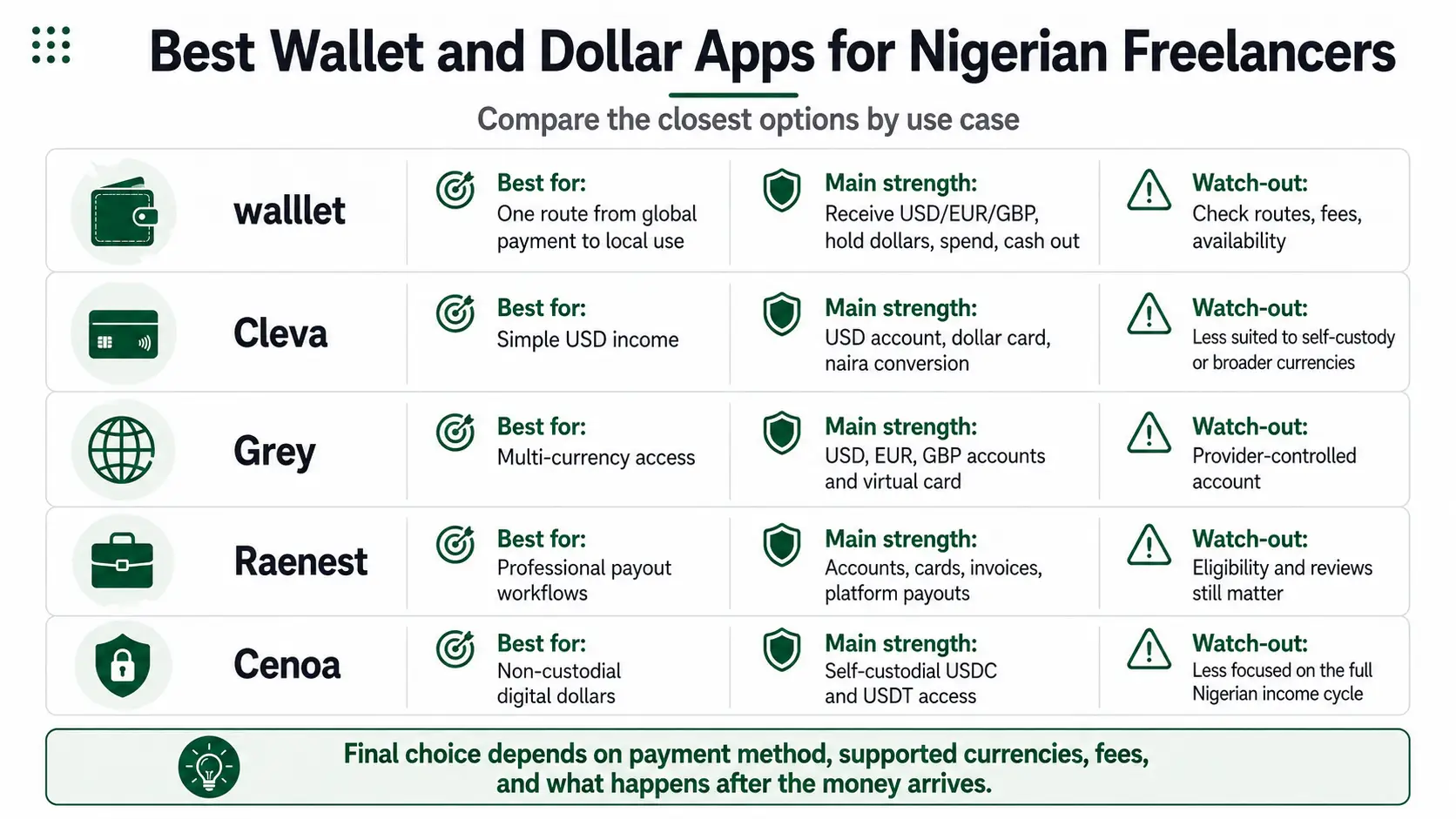
The final choice still depends on the client’s payment method, supported currencies, account eligibility, fees and the route used after the money arrives.
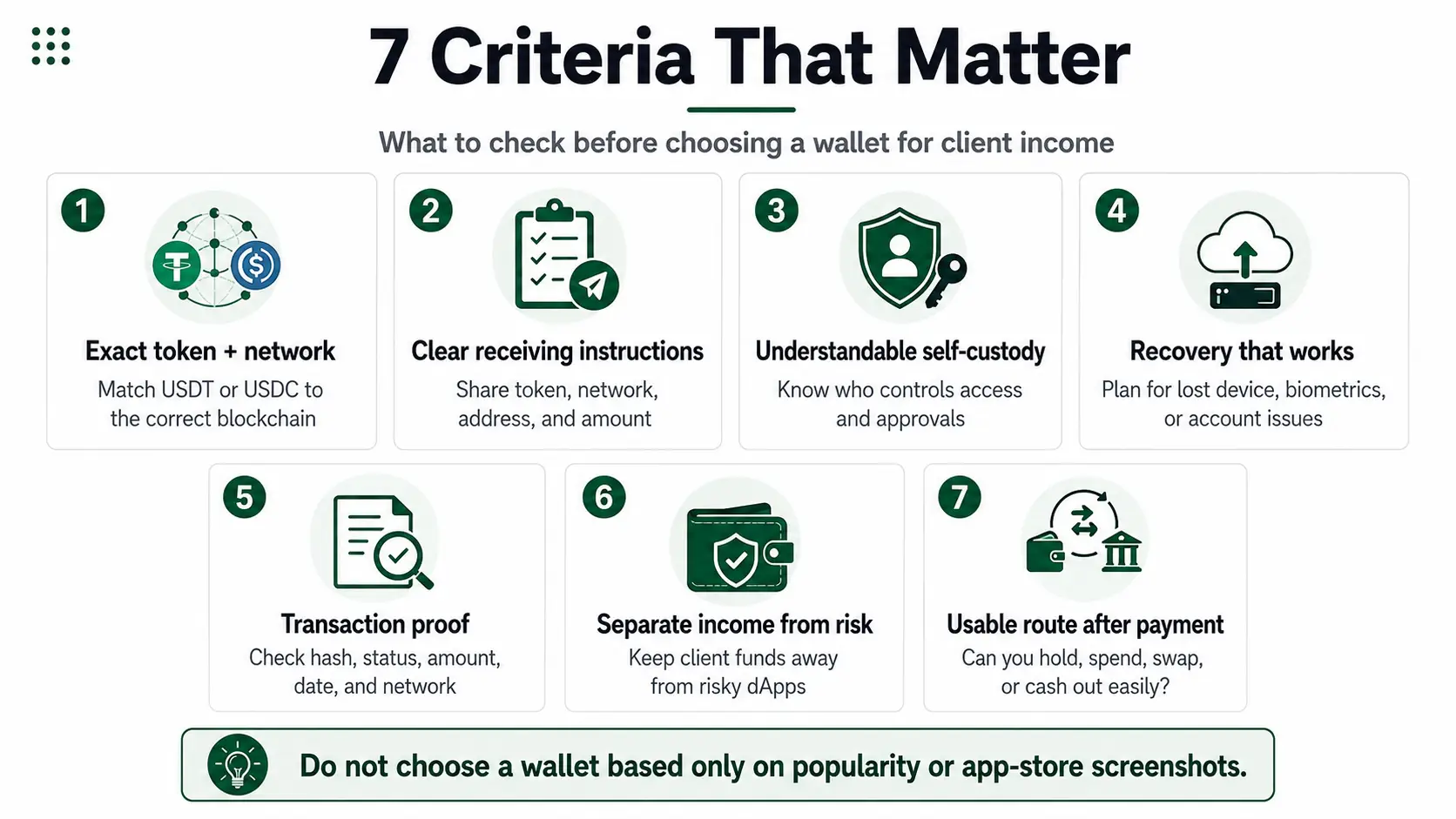
The seven criteria that matter
1. Exact USDT and USDC network support
A wallet must support the Token and the Blockchain network used by the client.
“Supports USDT” is not specific enough. USDT may exist on Ethereum, Tron, BNB Smart Chain, Arbitrum or another network. USDC also has separate contract addresses across supported chains.
Circle’s official documentation lists different USDC contract addresses for different networks. The same Token name does not make those routes interchangeable.
Before selecting a wallet, confirm:
Which Stablecoin you expect to receive
Which Network your clients or platforms can send through
Whether the wallet currently supports that exact combination
Whether your later spending or cash-out route supports it
Which native Token is required for Network fees
Do not rely on an old review or a Wallet logo. Check the current Receive screen before sending payment instructions.
The full network decision is covered in the comparison of networks for sending USDT or USDC.
2. Clear receiving instructions
A suitable wallet should show the asset, Network and receiving address together. The screen should make it difficult to confuse:
USDT with USDC
Ethereum with Tron
Base with Arbitrum
A wallet address with a Memo or Destination Tag
A supported Token with a similar-looking fake Token
A client should not have to guess which Network to use. The freelancer should be able to copy a complete instruction into the invoice or payment message. The instruction should include:
Token: USDT or USDC
Network: Exact blockchain network
Address: Full receiving address
Amount: Invoice amount
Test payment: Required or not required
After sending: Share the transaction hash
The wallet address alone is not a payment instruction.
3. Self-custody that is understandable
Self-custody means the user controls the Wallet credentials and authorizes transactions directly. It reduces dependence on an exchange for ordinary withdrawals, but it does not remove every risk. A user can still:
Approve a malicious contract
Send to the wrong address
Choose the wrong network
Lose access through poor recovery setup
Receive a Token that cannot be used through the intended route
Hold an issuer-controlled Stablecoin that can be restricted in specific cases
The label self-custody is not enough. Check how the wallet creates, stores and recovers access.
Traditional wallets often use a Seed Phrase. Newer Smart Wallets may use Passkeys, device security and account-abstraction recovery models. Neither model should be accepted blindly. The recovery process must be clear before meaningful income is stored.
4. Recovery that works outside the ideal scenario
A recovery system should answer practical questions:
What happens if the phone is lost?
What happens if biometric access stops working?
Can access be restored on another device?
Does recovery depend on one email, phone number or cloud account?
Is a Seed Phrase required?
Can the Wallet provider move the funds?
What support is available if the user loses access?
A setup that feels easy during onboarding can still fail when the device disappears. Test the recovery process with a small balance. Do not wait until several months of client income are inside the wallet. Humans famously prefer emergency testing during emergencies, which remains a poor operating model.
5. Transaction proof and readable history
A freelancer needs more than a visible balance. The wallet should make it easy to identify: Incoming token network, amount, sender and recipient, transaction hash, date and time, transaction status, and relevant Network fee. This information should be saved with the client invoice and project reference.
A screenshot from the sender is not enough. The payment should be checked on the correct Block Explorer. Use the guide to reading a crypto transaction on a Block Explorer for the verification process. If the Explorer shows the Token at the correct address but the Wallet shows zero, follow the crypto wallet balance troubleshooting guide.
6. Separation between income and risky activity
Do not use one Wallet address for every purpose. A practical structure may include:
One address or wallet for receiving client income
A separate balance for spending
A separate wallet for experimental DeFi activity
An exchange only when conversion or withdrawal is needed
Separate long-term storage for funds that should not be used regularly
This separation keeps payment records cleaner and limits the impact of risky approvals. Connecting the main income wallet to unknown dApps creates unnecessary exposure. A freelancer’s payment wallet should have a boring transaction history. Boring is underrated when rent money is involved.
7. A usable route after payment
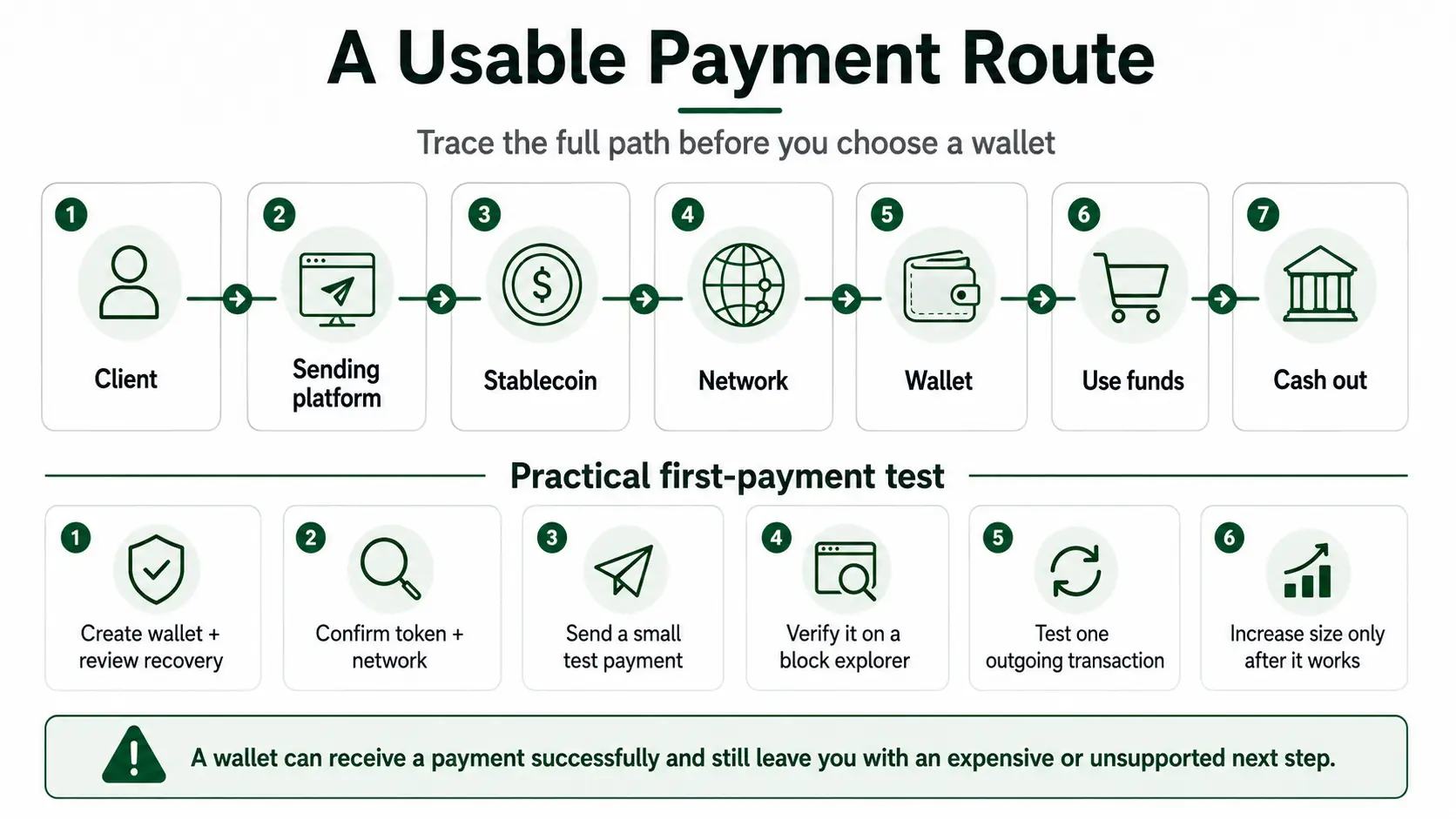
The Wallet is only one part of the income route. Before choosing it, trace the full path:
Client → Sending platform → Stablecoin → Network → Wallet → Hold, spend, swap or cash out
Check:
How much the client pays to send
Whether the Wallet supports the route
What Network fee is needed later
Whether the balance can be spent directly
Whether a Swap is required
Whether a cash-out provider accepts the same Token and Network
The likely Spread and withdrawal cost
What records remain after conversion
A wallet can receive a payment successfully and still leave the user with an expensive or unsupported next step.
Comparing wallet types
Exchange wallets
An exchange account may be convenient when the freelancer wants to receive and sell Stablecoins quickly.
Advantages: Trading and conversion are already available. Fiat or local withdrawal routes may be integrated. Account recovery may resemble a conventional platform. The user may not need to manage gas for internal transactions
Limitations: The exchange controls custody. Deposits may require minimum amounts. Some networks may not be supported. Withdrawals may be reviewed or delayed. Account access depends on the provider. Client payments may conflict with platform rules
An exchange can be part of the route. It should not be mistaken for direct control of the Wallet.
Traditional self-custody wallets
Traditional wallets often support many Tokens, networks and dApps. They can work well for users who understand:
Seed Phrase storage
Network selection
Gas Tokens
Token contracts
Approvals
dApp permissions
Wallet separation
The flexibility is useful, but broad feature coverage can create more places for an inexperienced user to make a payment error.
Seedless smart wallets
Seedless Smart Wallets aim to keep self-custody while replacing the traditional Seed Phrase workflow with Passkeys, biometrics or another account-recovery design. The useful question is not whether the setup feels modern. Check whether the wallet:
Gives the user direct transaction control
Explains recovery clearly
Shows the Network before receiving
Makes signing requests readable
Supports the required assets
Lets the user verify transaction history
Seedless access does not remove wrong-network risk, issuer controls or irreversible transfers.
Can walllet.com Replace a Separate Wallet and Payment App?
walllet is relevant when the freelancer needs more than a place to store Tokens.
Its current positioning combines global-income receiving features for eligible users with a self-custodial wallet layer for supported onchain assets. The public product page states that eligible users may receive supported USD, EUR and GBP payments through account details shown in the app, while the Wallet layer is used for supported Crypto and Stablecoin activity.
That creates two separate routes inside one broader product:
Client bank payment → supported receiving account → income balance
Client stablecoin payment → supported network → self-custodial wallet
The distinction matters. A bank-transfer balance depends on the receiving provider, account eligibility and settlement process. A self-custodial Stablecoin balance depends on the Blockchain, Wallet address and Token contract.
walllet may reduce the need to manage a separate income app and Crypto Wallet when its available routes match the client and the user’s needs. Before relying on it, confirm:
Which fiat receiving details are available in the account
Which Stablecoins and networks are currently supported
Whether the client can use the receiving route
How Wallet access and recovery work
Which spending, conversion and local withdrawal options are available
Applicable fees, limits and settlement times
This is the relevant test for this article: does walllet cover enough of the freelancer’s real income route to replace two separate tools? Explore the current walllet receiving and Wallet experience.
Warning signs when choosing a wallet
Avoid a Wallet when:
Supported networks are unclear
The official website does not explain custody
Recovery depends on instructions you do not understand
The app encourages large deposits before testing
It shows Token names without clear Network information
Transaction signing prompts are unreadable
Support agents request a Seed Phrase or private key
Product claims cannot be verified
Cash-out is presented as guaranteed
The Wallet mixes client income with high-risk promotional features
Do not choose based on Download count, influencer endorsements or a long list of supported Tokens. The payment route matters more than the App Store screenshot.
A practical first-payment test
Before using a Wallet for regular client income:
Create the Wallet and review recovery.
Confirm the exact Token and Network.
Copy the address from the current Receive screen.
Send a small test payment through the intended route.
Verify it on the correct Block Explorer.
Test one outgoing transaction.
Save the transaction record.
Confirm how the remaining balance can be used or withdrawn.
Keep risky dApp activity separate.
Increase payment size only after the route works.
This test reveals more than a Wallet comparison table. It shows whether the full payment route works under real conditions. Use walllet.com when its supported receiving routes, Stablecoin networks and recovery model match the way you get paid and use your income.
