The moment crypto becomes something you might actually use, custody stops being a background detail and becomes the whole game.
For everyday crypto use, a self-custody wallet usually makes more sense than leaving spendable assets on an exchange, because you control access, can use onchain apps directly, and reduce platform risk. An exchange is still useful for buying, selling, and quick trading. The smartest setup for many people is both, with different jobs.
TL;DR
If your crypto is mainly for trading, an exchange can make sense.
If you want to send, receive, use, or hold crypto with more direct control, a self-custody wallet usually fits better.
Many people need both. Exchange for buying and selling. Wallet for crypto they actually want to use.
Start small, check the network, and do not move serious funds just because one article made you feel productive.
Is it better to keep crypto on an exchange or in a wallet?
Keeping crypto on Binance, Coinbase, or another exchange can feel easy because everything lives inside one account. You log in, see your balance, buy, sell, and trade. Familiar enough.
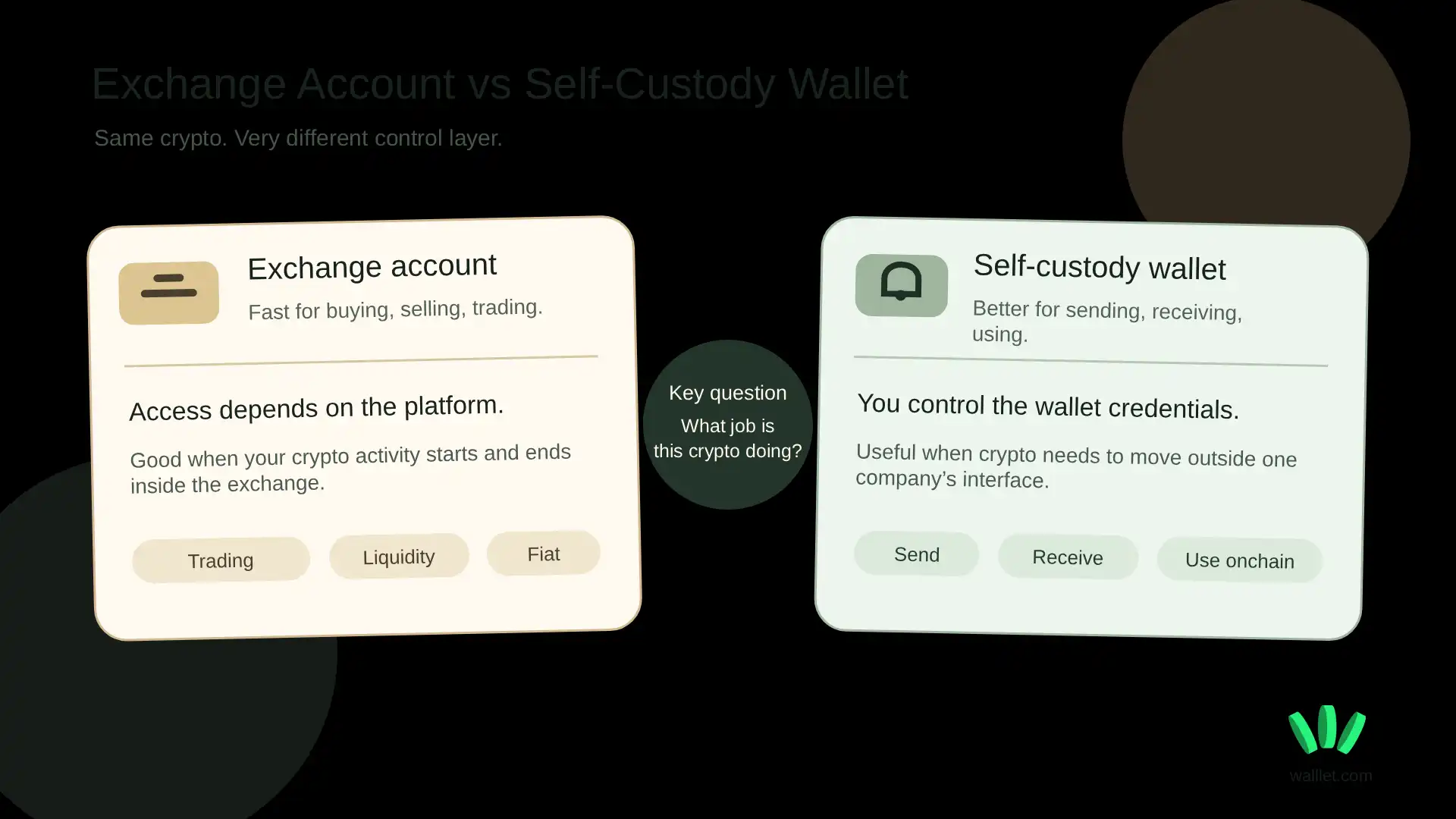
The catch: the exchange controls the custody layer. Your access depends on the platform, its rules, its withdrawal systems, its risk checks, and whatever happens when the market gets weird.
A self-custody wallet gives you more direct control. You can send, receive, swap, connect to apps, and manage assets from your own wallet. More control. More responsibility. Less hand-holding.
If you are still new and choosing your first wallet, start with this guide to the best crypto wallet for beginners. It explains what to check before downloading anything with a shiny logo and vague promises of freedom. Crypto loves those. Very healthy ecosystem.
Question | Exchange account | Self-custody wallet | What it means in real life |
Who controls access? | The platform controls the custody layer. | You control the wallet credentials. | Account convenience vs direct control. |
Best for | Buying, selling, active trading, fiat on/off ramps. | Sending, receiving, swapping, using apps, holding with control. | Different tools for different jobs. |
Main risk | Platform limits, withdrawal delays, account restrictions, company failure. | User mistakes, risky approvals, weak recovery habits, device issues. | You choose which risk you can manage better. |
Recovery feel | More like a normal account. Support may help. | More ownership-like. Recovery depends on your setup. | Easier support on exchanges, stronger control in wallets. |
Everyday crypto use | Often stuck inside the platform first. | Already ready for onchain use. | Wallets feel closer to actually using crypto. |
What does self-custody mean in practice?
Self-custody means you control the wallet that controls your crypto. The platform is not holding the private key material for you.
That sounds technical. In normal language: your wallet becomes the tool you use to move and manage your crypto directly. You are not just looking at a balance inside an exchange account.
If you receive USDC, send funds to someone, swap tokens, or connect to an app, your wallet is the place where that action happens.
This matters because a crypto balance is only useful if you can actually use it when you need it.
If the term “passkey wallet” is new, read what a passkey wallet is. It explains how passkeys can make wallet access feel closer to unlocking a modern app, while still keeping the self-custody model.
What are the risks of leaving crypto on an exchange?
An exchange is useful. No need to pretend otherwise.
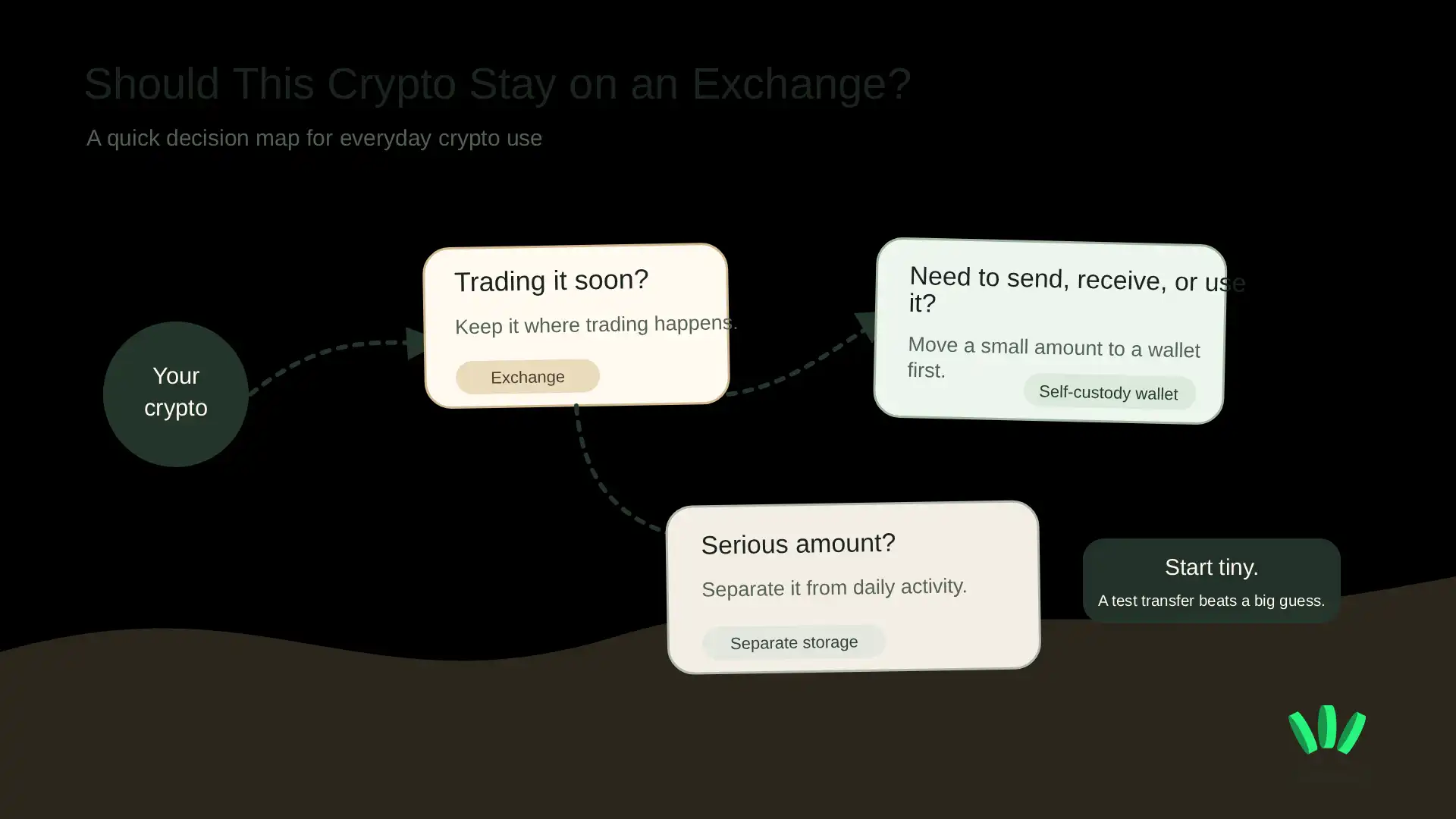
It can be good for buying crypto, selling crypto, converting between assets, checking prices, and trading quickly. If your crypto activity starts and ends inside that exchange, that setup may feel fine.
The risk is that your crypto access still depends on the platform.
According to Coinbase’s own explanation of exchanges and self-custody wallets, an exchange holds crypto on your behalf and manages the private keys. That is the basic custody tradeoff.
So the real question is simple: what happens when you want to move the money?
You may face withdrawal reviews, network choices, account limits, maintenance, compliance checks, delays, or frozen access. Sometimes nothing goes wrong. Sometimes the timing is awful. Crypto has a gift for making simple things dramatic at the worst possible moment.
If your crypto is sitting on Binance and you are thinking about moving it into a wallet, read this guide on how to move crypto from Binance to a wallet safely. Especially before moving anything large. Seriously. The network menu is where confidence goes to die.
Why does spending from a wallet feel different from spending from an exchange balance?
An exchange balance can look ready, but it often only feels ready inside that exchange.
To use it somewhere else, you may need to withdraw first. Then choose the right network. Then paste an address. Then wait. Then hope you did not choose the cheap network that your receiving wallet does not support. Tiny detail. Giant headache. A wallet feels different because the crypto is already in the place where action happens. You can send it. Receive it. Swap it. Connect it. Use it with apps. Still carefully, obviously. A wallet does not turn the blockchain into customer support.
This is the key difference: an exchange account is mainly an account. A self-custody wallet is a control tool.
Curious what self-custody feels like when setup does not start with a seed phrase and a tiny panic attack?
See how walllet.com handles wallet access with Face ID or fingerprint.
What risks do you take when you use a self-custody wallet?
Self-custody gives you more control. It also gives you more ways to make your own mess. Humanity’s oldest product feature.
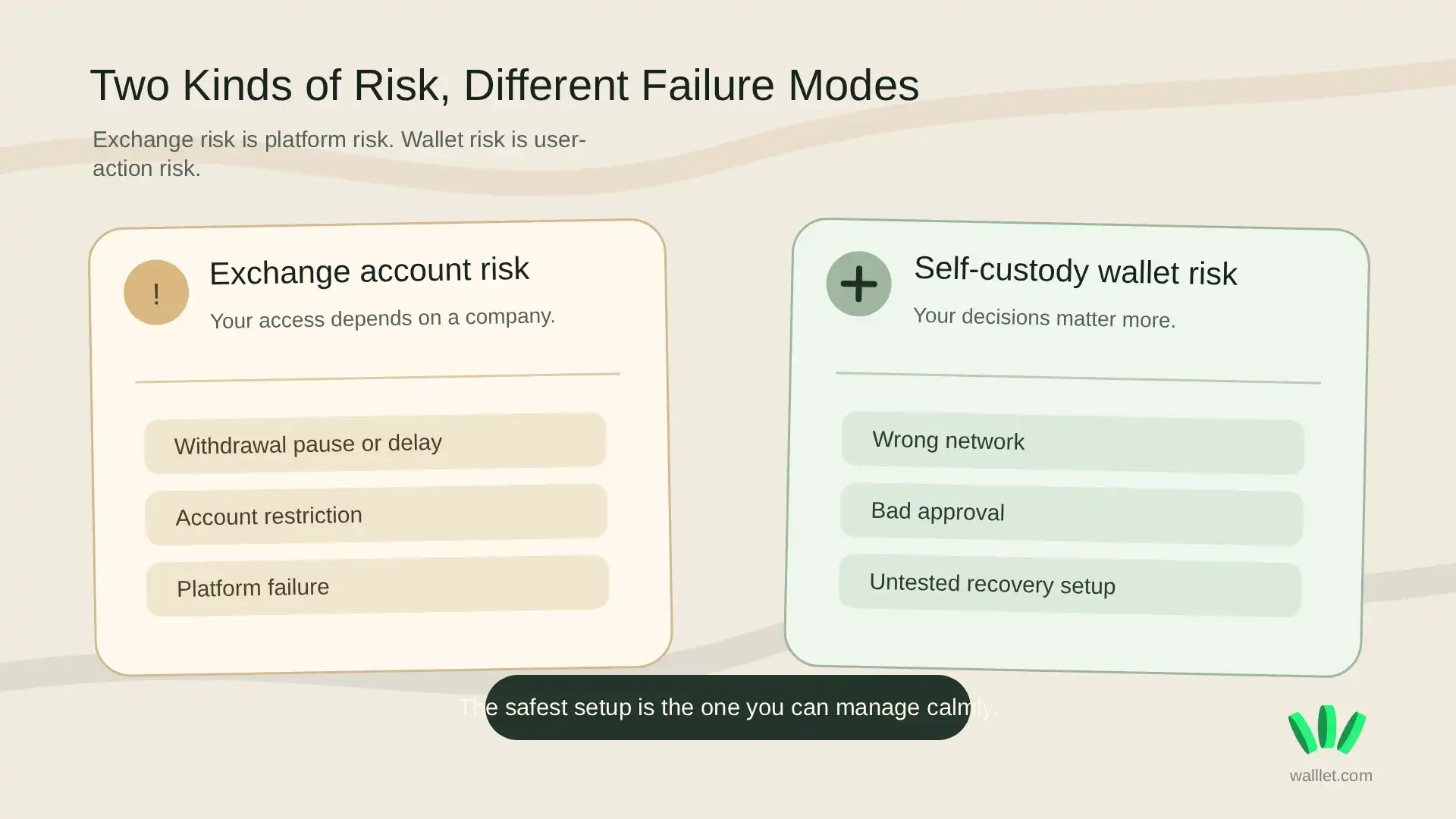
You need to protect your device. You need to understand recovery. You need to read what you approve. You need to avoid fake apps, fake support, random links, suspicious approvals, and the very human urge to tap quickly because the screen looks boring.
The risk is not always a hacker breaking the blockchain. Usually it is simpler.
A bad link.
A rushed approval.
A wrong network.
A wallet used for too many things.
A recovery setup nobody actually tested.
For a practical setup, read how to protect your crypto wallet. It covers device security, passkeys, recovery, approvals, and the boring habits that save people from exciting disasters.
How does passkey-based self-custody change the equation?
Older self-custody often started with a seed phrase. Twelve or twenty-four words. Write them down. Never lose them. Never show anyone. Never store them online. Also, good luck sleeping.
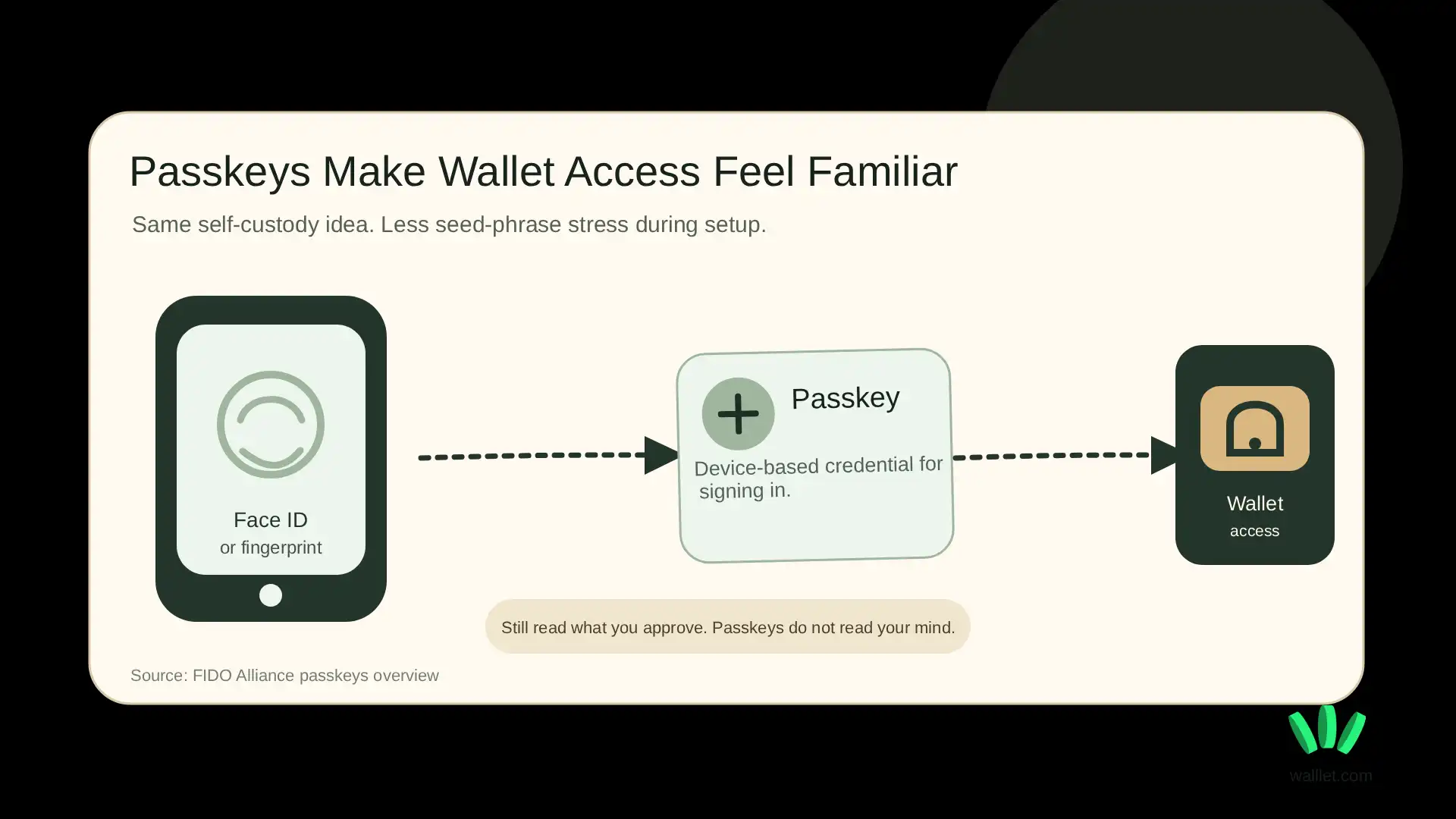
Passkeys change the access experience.
The FIDO Alliance passkeys overview explains passkeys as passwordless credentials designed around phishing-resistant authentication. In plain English: you can approve access with the same unlock method you already use on your device, like Face ID, fingerprint, PIN, or device password.
For crypto wallets, that can make self-custody feel less alien.
It does not remove responsibility. It changes where the pressure sits. Less manual seed phrase handling during setup. More attention on device security, credential sync, recovery settings, and what you approve inside the wallet.
Passkeys can make wallet access feel familiar. They do not make crypto consequence-free.
That part matters.
Can a self-custody wallet still feel simple?
Yes, if the simplicity is real.
A wallet is not simple because the onboarding screen is pretty. A wallet is simple when the scary parts are easier to understand.
Can you tell what you are signing?
Can you see what asset is moving?
Can you understand the network?
Can you spot a suspicious approval?
Can you recover access if your phone disappears?
This is where many older wallets made people freeze. They gave users control, then buried the meaning under weird prompts, raw contract data, seed phrase rituals, and warnings that sounded like they were translated by a toaster.
A good everyday wallet should reduce confusion at the exact moment confusion becomes expensive.
Which wallet setup makes self-custody less scary for everyday use?
If your real question is “Should I move crypto out of an exchange?”, the answer should not be “move everything right now.”
That is how people turn a good idea into a support ticket with blood pressure.
A better first step is using a wallet that makes self-custody easier to test. walllet.com is built around that idea: self-custody without the old seed phrase setup, using passkeys and biometrics for access, clearer transaction prompts, and warnings around risky interactions.
That is why walllet.com belongs in this specific conversation. The main problem is not just where the crypto sits. The problem is whether the user can actually manage self-custody without feeling like one tap will ruin their week.
For everyday users, especially people who receive, hold, or move stablecoins, the question becomes more practical:
Can I control my crypto without needing to become a wallet engineer?
Can I start small?
Can I understand what is happening before I approve it?
That is the space walllet.com is trying to make less painful.
What is the smartest setup for everyday crypto use?
For many people, the cleanest setup is split by use.
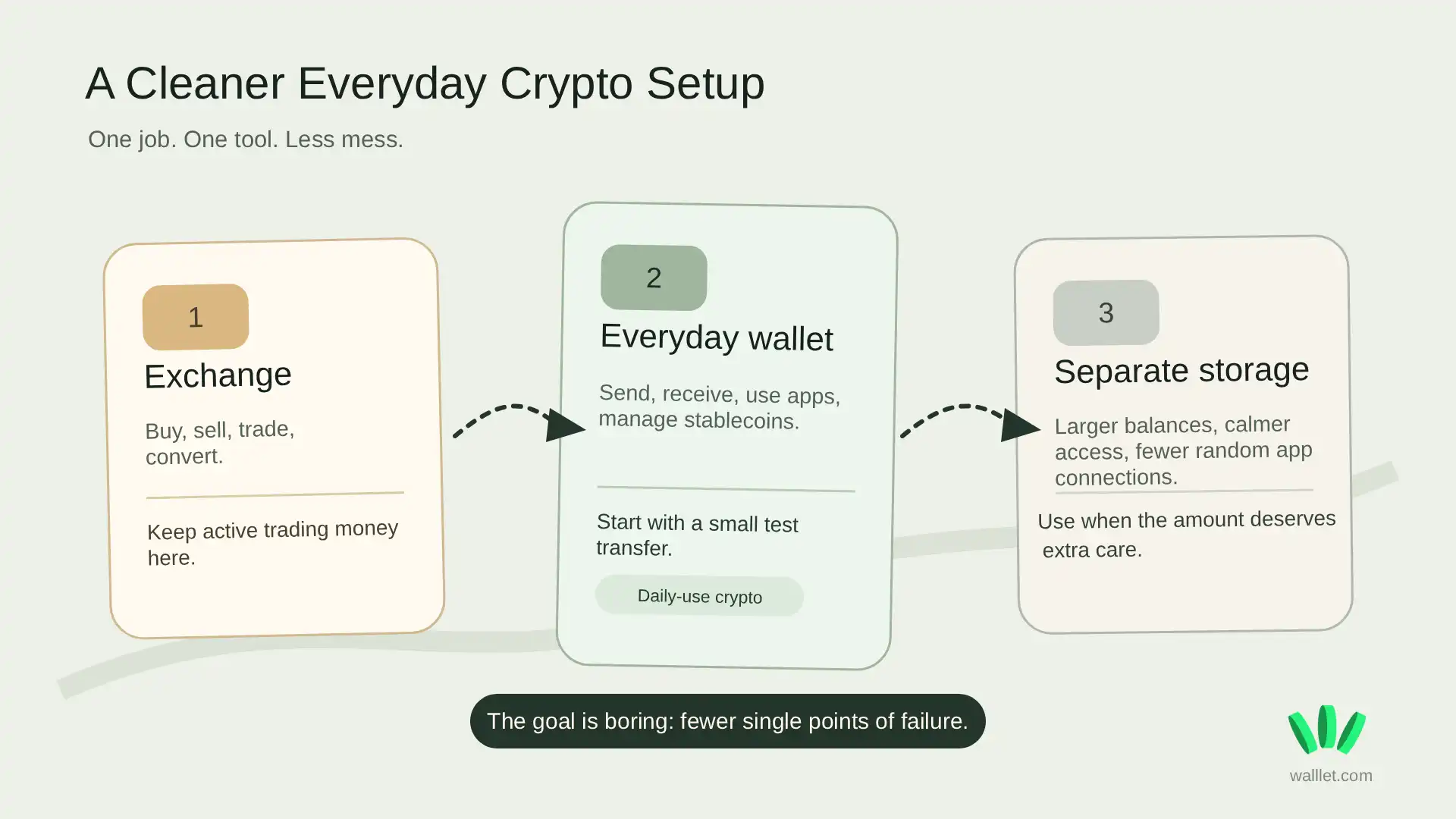
Keep trading money where trading happens. Keep everyday-use crypto in a wallet you control. Keep long-term holdings somewhere more separated if the amount is serious.
You do not need one wallet for your entire crypto life. That gets messy fast. This guide on how many crypto wallets you should have explains how to separate daily use, higher-risk activity, and longer-term storage without building a ridiculous system you will abandon in two weeks.
A simple setup could look like this:
Use case | Better fit | Why |
Buying crypto with fiat | Exchange | Usually easier and faster. |
Active trading | Exchange | Better liquidity and trading tools. |
Receiving payments | Self-custody wallet | More direct control over received funds. |
Sending stablecoins | Self-custody wallet | Easier to use once funds are already onchain. |
Trying apps or swaps | Self-custody wallet | Needed for direct onchain activity. |
Long-term storage | Separate wallet or colder setup | Keeps daily activity away from larger balances. |
The important part is matching the tool to the job.
If all your crypto sits on an exchange, you carry platform risk. If all your crypto sits in one hot wallet, you carry user and activity risk. If you split things too much, you create a new problem called “where did I put that again?”
Lovely little industry.
Final thought
If you only trade crypto, an exchange may be enough for now.
If you want to use crypto, receive it, send it, hold it directly, or stop depending on a platform for every move, self-custody starts to make more sense.
Start with a small amount. Test the wallet. Send a tiny transfer. Check recovery. Read the approval screen. Notice how it feels.
Create your walllet with Face ID or fingerprint, move a small amount first, and see whether self-custody feels usable for you.
No grand declaration needed. Just a clean test.
