A wallet is only smart if it removes friction without taking control away. Not every wallet that looks modern is actually smart. Here’s what really matters, what account abstraction changes, and how to tell the difference. In this article you will learn what makes a smart crypto wallet truly smart, from account abstraction and gas flexibility to recovery, batching, and safer approvals.
TL;DR
A smart crypto wallet is not just a wallet with a nicer interface.
It is a wallet that can follow rules, reduce manual steps, and give you more flexible security than a traditional EOA wallet.
Ethereum’s account abstraction work and ERC-4337 are what make features like gas sponsorship, batched actions, and custom recovery possible.
In practice, the wallets people call “smart” usually stand out in a few ways. They can let you recover access without relying on one fragile secret, reduce the need to hold native gas on every chain, batch actions into one flow, and support more flexible security models than a classic seed-phrase wallet. That is also the direction major wallet players and smart account docs point to.
walllet.com fits this category because it is a self-custodial, passkey-powered smart wallet built on ERC-4337 account abstraction, with seedless access, gas flexibility on supported flows, and a human-readable transaction experience.
If you spend a little time in crypto, you’ll hear the same word everywhere: smart.
Smart wallet. Smart account. Smart contract wallet. Smart recovery. Smart security.
But “smart” has become one of those slippery terms that sounds useful until you ask a simple question: what does it actually change for me?
Related: Account Abstraction and Smart Contract Wallets: A Beginner-Friendly Deep Dive.
That question matters because a lot of wallets look polished now. Plenty of them have clean screens, slick onboarding, and a modern brand. None of that, by itself, makes a wallet smart.
A wallet becomes smart when it stops behaving like a simple key holder and starts behaving more like a programmable account. That is the real shift. Instead of forcing you to do everything manually, a smart wallet can enforce rules, simplify flows, and reduce the number of fragile rituals crypto users have had to put up with for years. Ethereum’s account abstraction roadmap and ERC-4337 were built to unlock exactly that kind of flexibility.
A regular wallet is not broken. It is just limited.
To understand what makes a wallet smart, it helps to start with what most wallets have traditionally been.
A classic crypto wallet is usually an EOA, short for Externally Owned Account. In plain English, that means one private key controls the account. If you have that key, you can sign transactions. If you lose it, you lose access. If someone else gets it, they control the account. That model works, but it also creates familiar pain points: seed phrases, one-signature dependency, manual approvals, and the constant need to keep native gas tokens around just to make basic actions work.
That is why people still run into problems like writing down a seed phrase incorrectly, getting blocked because they do not have the right gas token, or having to approve and confirm the same intent through multiple transaction steps. None of those problems are side effects. They come from the account model itself.
A smart wallet changes the account model, not just the interface
The real difference is under the hood.
With account abstraction, the account can be controlled by smart contract logic instead of behaving like a bare account tied to one private key. ERC-4337 introduced the infrastructure for this without changing Ethereum consensus, using UserOperations, bundlers, and optionally paymasters to handle execution and gas payment logic. That design is what makes features like custom validation, sponsored gas, and bundled actions possible.
From a user’s point of view, that technical change leads to a simpler truth: a smart wallet can do more of the thinking that old wallets pushed onto you.
So what should you actually look for?
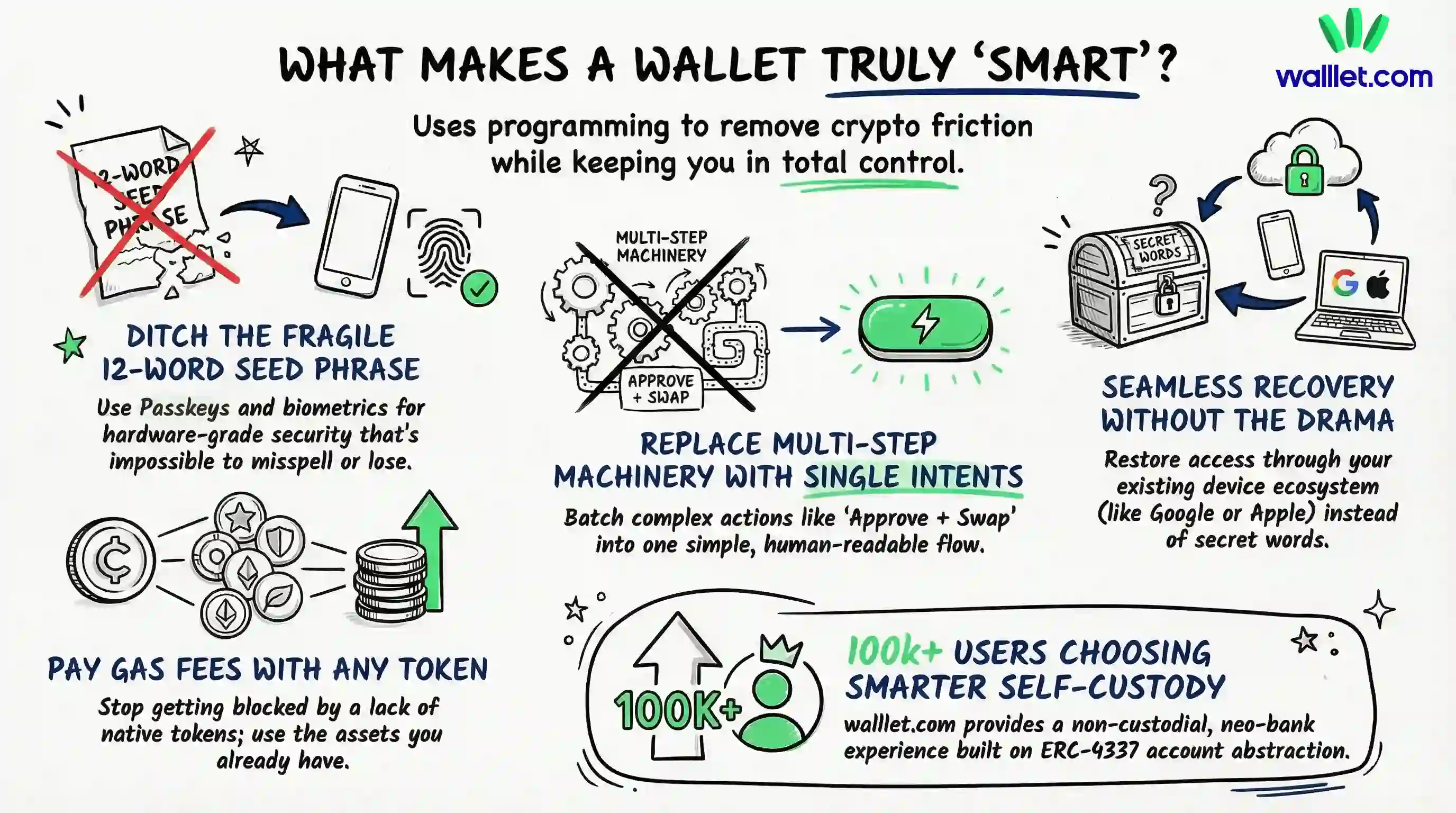
1. A smart wallet should reduce your dependence on one fragile secret
This is the first real test.
A regular wallet often turns one secret into your whole life raft. Protect the seed phrase. Never lose it. Never expose it. Never photograph it. Never type it into the wrong place. That model may be familiar, but it is brittle.
Smart wallets are different because they can separate access, recovery, and authorization into more flexible rules. Ethereum’s own account abstraction documentation highlights recoverable accounts, shared security across trusted devices or people, and custom security logic as core benefits of smart contract wallets. Safe’s smart account model is another example of this flexibility, with configurable owners and thresholds instead of one all-powerful secret.
This is also where passkeys matter. Apple, Google, and FIDO all describe passkeys as phishing-resistant, based on public-key cryptography, and designed so the private credential stays on the user’s device rather than becoming a reusable secret copied across services.
In other words, a wallet starts feeling smart when your security model stops depending on perfect memory and perfect behavior.
Related: How passkeys work on iPhone and How passkeys work on Android
2. A smart wallet should make gas less annoying
Ask almost any real user what annoys them about crypto, and gas will show up fast.
Not gas as a concept. Gas as a workflow problem. You have funds, you know what you want to do, but the action stops because you do not hold the right native token on that specific chain. That is not a security feature. It is friction.
One of the headline benefits of account abstraction is gas flexibility.
smart accounts can support sponsored gas, paymaster flows, or paying network costs in tokens other than the default native coin, depending on the implementation and network.
That does not mean every smart wallet supports every gas trick on every chain. It does mean the account model finally allows a better user experience.
This is one reason walllet.com’s approach stands out. We on walllet describe ourselves as a smart contract wallet built on ERC-4337, and our product pages and swap guide emphasize that supported flows can work without forcing users to top up native gas tokens in the usual way.
3. A smart wallet should compress multi-step actions into simpler flows
A lot of crypto complexity is really just too many steps pretending to be necessary.
Approve. Confirm. Swap. Confirm again. Bridge. Confirm again. Maybe come back because something failed halfway through.
A smarter account model can reduce that. Transaction batching is a core smart account benefit. In practice, that means multiple actions can be grouped into one user intent instead of being broken into separate pieces that the user has to manage manually.
This is one of those features that sounds technical until you feel it. Then it just feels normal. And that is the point. A smart wallet should make crypto feel less like operating machinery.
4. A smart wallet should support better recovery, not just prettier warnings
A lot of wallets talk about safety. Fewer improve recovery in a meaningful way.
With a traditional seed-phrase model, recovery often means one thing: did you preserve the exact backup words correctly? If yes, great. If not, game over.
Smart wallets can change that because recovery can be programmed. Ethereum.org calls out recoverable accounts and backup keys as part of the account abstraction value proposition.
That said, not all recovery models are equal. This is where users should slow down and ask better questions. Is recovery tied to a seed phrase? A passkey synced through your device ecosystem? Trusted guardians? Multiple owners? A backup device? The smartest wallet for one person may not be the smartest wallet for another if the recovery assumptions do not fit how they actually live.
walllet.com’s model is different from a classic seed-phrase wallet here too. Its terms and onboarding content describe a passkey-based, seedless setup where keys and credentials are not stored by walllet and stay tied to the user’s device and credential manager. That changes the recovery experience completely, but it also means the user should understand the role of their Apple, Google, or Samsung credential environment.
5. A smart wallet should help you understand what you are approving
Here is the uncomfortable truth: a wallet is not that smart if it still asks you to sign something you cannot understand.
Strictly speaking, human-readable transaction design is not the same thing as account abstraction. But from a real user’s perspective, the distinction only goes so far. If the wallet still turns every important moment into a trust fall, it is not doing its job.
A smarter wallet experience should explain intent. What are you doing? What token is moving? How much? On which network? What approval are you granting? Is anything about this unusual?
This is a big part of walllet.com’s product positioning. Its product and launch materials emphasize human-readable transaction summaries rather than opaque signing prompts, which is exactly the kind of user-facing intelligence people actually feel.
Put simply, smart should mean fewer blind signatures and fewer moments where the user has to guess.
6. A smart wallet should make control more flexible, not more confusing
There is another difference between smart and merely new.
A truly smart wallet gives you more control over how the account behaves. That can include spending rules, delegated permissions, multi-owner security, subscriptions, or temporary session keys depending on the design.
The common thread is not one exact feature. It is flexibility.
A regular wallet asks: do you have the key or not?
A smart wallet asks: under what conditions should this action be allowed?
That is a much better question.
Smart wallet vs regular wallet: the shortest useful comparison
Question | Regular wallet | Smart wallet |
What controls the account? | Usually one private key or seed phrase | Smart contract logic plus signer rules |
Can it support flexible recovery? | Usually limited | Often yes, depending on implementation |
Do you always need native gas? | Usually yes | Not always, depending on gas abstraction support |
Can actions be batched? | Usually not natively | Often yes |
Can security rules be customized? | Limited | Much more flexible |
Does “smart” guarantee safety? | No | Also no, implementation still matters |
That comparison reflects the way ecosystem docs describe the difference between EOAs and smart accounts.
What “smart” does not mean
This part matters too.
A smart wallet is not automatically safer just because it uses newer tech. It is not automatically simpler on every chain. And it is definitely not smart just because the landing page says it is.
You still need to ask practical questions.
Who controls upgrades, if upgrades exist? What recovery model is being used? Which features are live today versus just promised? Which networks support those features? What happens if you lose your device? What part is enforced onchain, and what part is just product design?
The smartest wallet is not the one with the longest feature list. It is the one whose rules, tradeoffs, and recovery model you actually understand.
walllet.com expresses smartness that help real users
walllet.com is a good example of where the category is going.
Wallet is a self-custodial smart-contract wallet that uses passkeys instead of seed phrases and is controlled through ERC-4337 account abstraction. Its user-facing promise is not “more knobs and settings.” It is simpler everyday crypto: create a wallet with device-backed credentials, avoid the usual seed-phrase anxiety, reduce gas friction on supported flows, and understand transactions before you sign them.
That is why the more useful question is not “is walllet.com a smart wallet?”
It clearly is.
The better question is whether it expresses smartness in ways that help real users. For most people, that means less seed-phrase risk, less gas friction, fewer blind approvals, and a wallet that feels closer to how modern apps already work.
That is where smart stops being a buzzword and starts being product design.
The real test
If you remember one thing from this article, make it this:
A wallet is not smart because it sounds futuristic. It is smart if it removes painful steps, gives you more flexible security, and keeps you in control without making you babysit crypto infrastructure all day.
That is the standard worth using.
And it is also why this category matters. Smart wallets are not just a nicer wrapper around the old model. They are a shift away from the idea that self-custody must always feel stressful, manual, and fragile. The future wallet will just help them act with confidence.
See what a smarter wallet actually feels like at walllet.com, where self-custody, passkeys, and simpler transaction flows come together in one place.
