A Nigerian freelancer invoicing a US client should include the correct legal names, invoice number, service description, USD amount, issue date, due date, agreed payment terms, contract or PO reference, and the exact ACH, wire, portal, or payment-provider instructions the client should use. The invoice should match the contract and clearly state who absorbs transfer fees.
A client owes you USD 1,500. They approve the work and ask for an invoice.
The invoice itself is easy. The part that causes delays is everything around it: the wrong legal entity, a vague service description, a missing due date, ACH details used for a wire, or payment instructions that do not match the account holder’s name.
For a Nigerian freelancer, a good international invoice must do two jobs:
Give the client’s finance team enough information to approve the bill.
Give the payer a clear, verified route for sending the money.
A polished PDF cannot fix an unclear payment route.
If you have not agreed on that route yet, first check how Nigerian freelancers can get paid by US, UK and EU clients. If the client is paying specifically in dollars, how to receive USD in Nigeria without PayPal covers the main receiving-route questions.
This guide focuses on the next step: what to put on the invoice, how to format it, what to confirm before sending it, and what records to keep afterward.

What should a Nigerian freelancer include on an invoice for a US client?
A Nigerian freelancer’s invoice should identify the seller and buyer, describe the agreed work, state the amount in USD, show the due date, reference the contract or purchase order, and provide payment instructions that match the agreed transfer method.
Include tax or registration details only when they apply to your actual legal and tax position.
Invoice field | What to include |
Document label |
|
Your details | Legal name or business name, address where applicable, email, and contact details |
Client details | Correct legal company name, billing address, and accounts-payable contact |
Invoice number | A unique reference such as |
Invoice date | Date the invoice was issued |
Due date | Specific calendar date |
Payment terms | Due on receipt, Net 7, Net 14, Net 30, or the agreed milestone |
Contract reference | Contract, SOW, project, vendor, or PO number |
Service description | Specific deliverable, milestone, retainer period, or service period |
Quantity and rate | Hours, units, milestones, or fixed fee where relevant |
Currency |
|
Total due | Final amount the client should pay |
Tax information | Only applicable tax, registration, or withholding information |
Payment method | ACH, wire, payment platform, or vendor portal |
Payment details | Current instructions for that specific payment method |
Payment reference | Usually the invoice number |
Fee responsibility | Who pays transfer or intermediary charges, if agreed |
Payment contact | Email for accounts-payable questions |
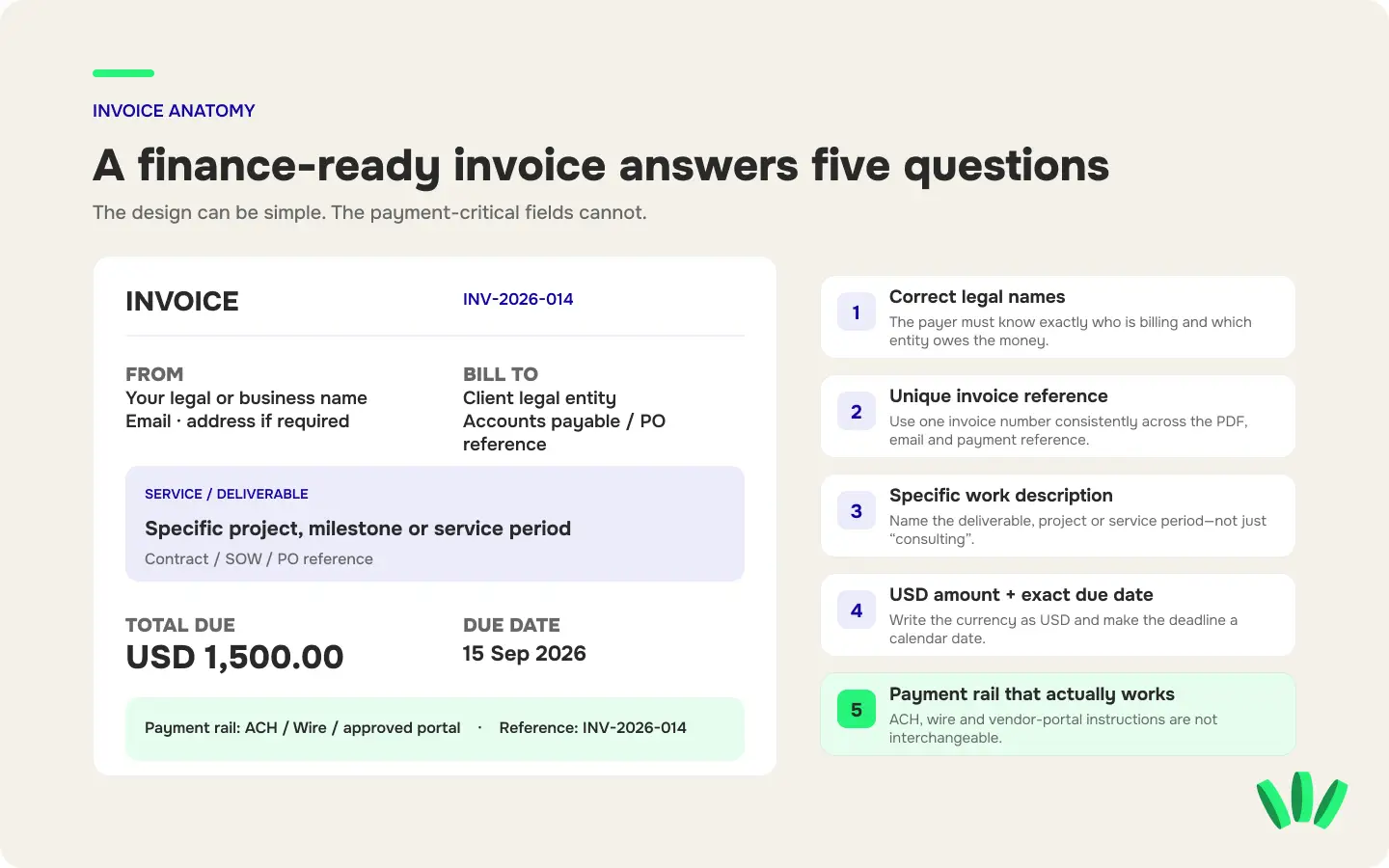
The invoice should let a finance employee answer five questions without contacting you:
Who is billing? What was delivered? How much is due? When is it due? Where should the payment go?
Confirm these four details before creating the invoice
Do not start with a template. Start with the agreement.
1. Confirm the client’s legal billing entity
The brand name used in meetings may not be the company that pays you. You may work with “Bright Labs,” while the invoice must be addressed to:
Bright Labs Inc.
Ask for:
the legal company name;
billing address;
accounts-payable email;
purchase-order number, if required;
vendor or project reference;
any invoice-submission portal.
If the client uses an agency, parent company, or payroll entity, invoice the entity that the contract or vendor team identifies as responsible for payment.
2. Confirm the billing currency
If the agreement is priced in US dollars, write:
Total amount due: USD 1,500.00
Do not rely on $1,500, because the dollar sign is used by several currencies.
Do not convert the invoice to naira because the exchange rate changed after you agreed the fee. The contract, proposal, and invoice should use the same currency unless both parties approve a change.
3. Confirm the payment rail
“Bank transfer” is too vague for an international invoice. The client may mean:
ACH;
domestic US wire;
international wire;
a payment platform;
a vendor portal;
another route agreed during onboarding.
ACH routing details are not automatically the same as wire instructions. A receiving account that accepts one rail may not accept the other.
Ask the client which method its finance team will use, then provide only the instructions for that method.
If you are still choosing between different payment setups, the comparison of PayPal, Payoneer and stablecoins for freelancers helps separate the payment method from the fees, conversion and cash-out that happen afterward.
4. Confirm the due date
“Pay as soon as possible” is not a useful payment term. Use the term in the contract and add the actual date. For example:
Payment terms: Net 14
Due date: September 15, 2026
A calendar date removes the need for the client to calculate the deadline.
How to write the service description
The service description should help someone outside the project connect the invoice to an approved piece of work.
Weak:
Consulting services — USD 1,500
Stronger:
Product UX audit and recommendation report for Project Atlas, completed in August 2026 under SOW-04 — USD 1,500
Useful details include:
project name;
deliverable;
milestone;
service period;
number of hours;
retainer month;
campaign;
contract or SOW reference.
Do not turn the invoice into a project report. Add enough detail for accounts payable to reconcile it without guessing.
Freelance invoice template for a Nigerian freelancer billing a US client
Copy this structure into your invoice software, document, or spreadsheet and adapt it to the agreement.
INVOICE
Invoice number: INV-2026-014
Invoice date: [Date]
Payment terms: [Due on receipt / Net 7 / Net 14 / Net 30 / agreed milestone]
Due date: [Exact date]From
[Your legal or business name]
[Address, where applicable]
[Email]
[Phone, if needed]
[Registration or tax information, only if applicable]Bill to
[Client’s legal company name]
[Billing address]
[Accounts-payable contact]
[PO, contract, SOW, or project reference]Services
[Specific description of work]
[Service period, milestone, or deliverable]
[Quantity or hours, if applicable]
[Rate]Subtotal: USD [amount]
Tax or adjustment: [Only if applicable]
Total amount due: USD [amount]Payment method: [ACH / Wire / Other agreed route]
Beneficiary or account name: [Exact verified name]
Bank or payment provider: [If required]
Routing, account, or SWIFT details: [Only the fields required for this route]
Payment reference: INV-2026-014
Transfer-fee arrangement: [As agreed]Payment note:
Please includeINV-2026-014as the payment reference. If your finance team cannot use the payment method above, please confirm the alternative route before sending funds.
The payment note gives the client a way to flag a route problem before money is sent.
Can a Nigerian freelancer invoice a US client in USD?
Yes. A Nigerian freelancer can state a USD fee on an invoice when the freelancer and client agreed to price the work in US dollars.
Use USD beside the amount:
Project fee: USD 1,800.00
Do not add a naira conversion unless the contract requires one.
The currency on the invoice describes what the client owes. It does not determine whether you later hold the funds, convert them to naira, spend them, or cash them out through a supported route.
ACH versus wire: which payment details belong on the invoice?
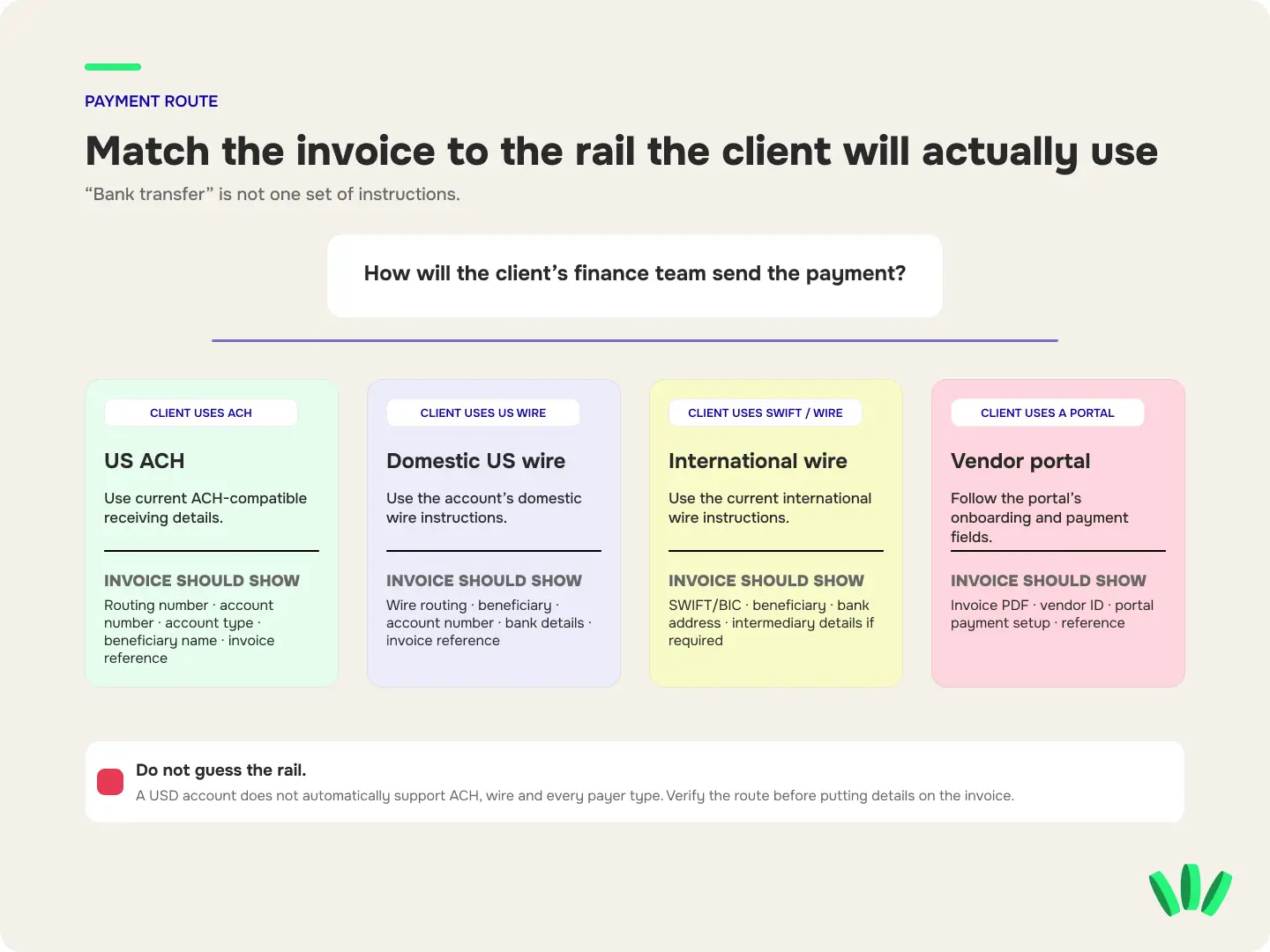
The correct payment details depend on the transfer rail. ACH instructions should not be substituted for wire instructions, and wire fields should not be added simply because a template contains empty boxes.
Payment route | Details the payer may need | Main caution |
ACH | Account name, routing number, account number, account type, bank or provider name, payment reference | Confirm that the receiving account supports ACH |
Domestic US wire | Beneficiary name, account number, routing number, bank name, payment reference | Domestic wire instructions may differ from ACH instructions |
International wire | Beneficiary name, account details, SWIFT/BIC, bank address, intermediary details where required, payment reference | Use only the current instructions supplied for that account |
Vendor portal | Invoice PDF and portal-specific vendor information | The client may not want bank details inside the invoice |
Payment platform | Platform-generated payment request or approved account details | Confirm the client’s procurement policy and supported payer type |
If you are using IBAN-based receiving details, read the walllet.com IBAN Account guide before putting them on an invoice. An IBAN, an ACH routing number and a SWIFT/BIC are not interchangeable payment instructions.
If the client is paying by ACH
Use the current ACH details supplied by the receiving account or payment provider. The client may need:
beneficiary or account-holder name;
routing number;
account number;
account type;
bank or provider name;
invoice reference.
Do not assume that a USD account supports ACH. Confirm the route before sending the invoice.
If the client is paying by wire
Use the wire instructions for that account. The client may need different routing information, a SWIFT/BIC code, an intermediary bank, or a bank address. Never invent a SWIFT code or intermediary bank because an invoice template has a blank field.
If the client uses a vendor portal
Follow the portal’s instructions. Some companies require vendors to submit invoices in one system and payment details in another authenticated system. In that case, the invoice can state the payment method and reference without exposing every bank field in the PDF.
If payment details change
Treat a change in payment instructions as sensitive. Send the change through the agreed business channel and ask the client to verify it with a known contact. Do not rely on a casual WhatsApp or Slack message for a high-value payment-detail change.
What payment terms should a freelancer use?
Use the payment term agreed before the work began. If no term was agreed, confirm one before sending the invoice rather than assuming the client’s internal policy.
Payment term | Where it may fit |
Due on receipt | Small completed jobs where immediate payment was agreed |
Net 7 | Short projects or smaller client relationships |
Net 14 | Projects with a short internal approval cycle |
Net 30 | Larger companies with established procurement processes |
Deposit plus final payment | Projects where you do not want to finance all delivery costs |
Milestone billing | Longer projects with separate deliverables |
Monthly retainer | Recurring work with a fixed billing schedule |
A client that normally pays vendors in 45 days may not make an exception because your invoice says Net 14. Discuss the term before accepting the work.
Late-payment fees, deposits, cancellation fees, and early-payment discounts should come from the contract or written agreement. Do not add a new commercial condition only because an invoice template contains a line for it.
Who pays international transfer fees?
The invoice should reflect the fee arrangement already agreed with the client. For a USD 1,500 invoice, clarify whether:
the client must send enough for you to receive USD 1,500;
the client pays sending and intermediary charges;
receiving fees may be deducted;
conversion costs are your responsibility;
the client may use a payment route with its own platform fee.
A simple invoice note can say:
Amount due: USD 1,500.00
Transfer fees: As agreed under the contract.
Keep these costs separate:
sending fee;
receiving fee;
intermediary-bank deduction;
FX spread;
conversion fee;
withdrawal or cash-out fee.
A route with a low advertised receiving fee can still leave you with less naira if its exchange-rate spread is wider.
How to calculate what you actually receive
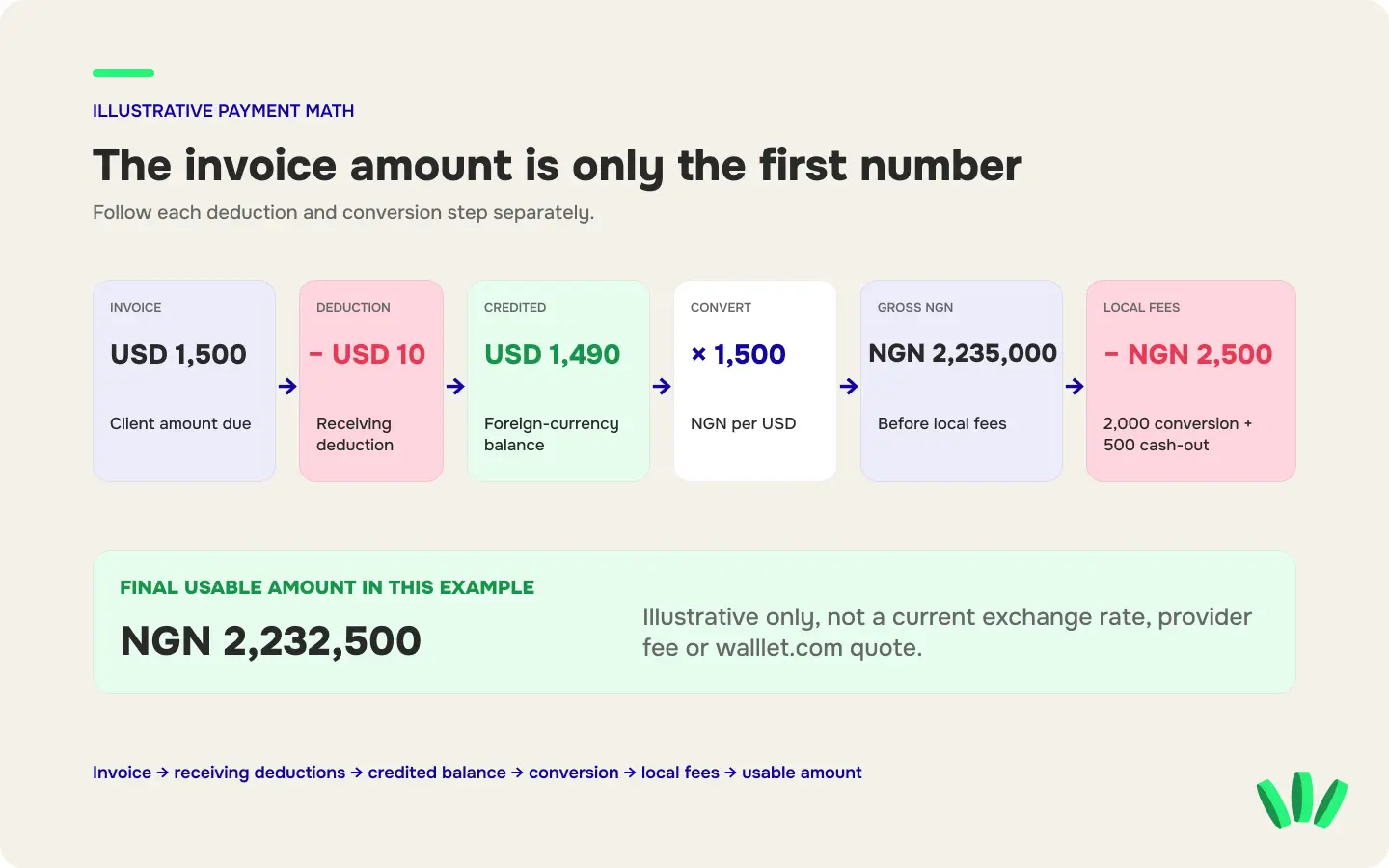
The invoice amount is not always the same as the amount you can spend in Nigeria. A useful calculation is: Invoice amount − receiving deductions − transfer deductions = foreign-currency balance
Then:
Foreign-currency balance × applicable conversion rate − conversion fee − cash-out fee = naira received
For an illustrative example:
Invoice: USD 1,500
Receiving deduction: USD 10
Amount credited: USD 1,490
Conversion rate: NGN 1,500 per USD
Conversion fee: NGN 2,000
Cash-out fee: NGN 500
Calculation:
USD 1,490 × NGN 1,500 = NGN 2,235,000
NGN 2,235,000 − NGN 2,000 − NGN 500 = NGN 2,232,500
This is an illustration, not a current walllet.com rate or a market quote. Check the rate and fee shown for the actual transaction before confirming a conversion.
If your income arrives as USDT or USDC, how to cash out USDT or USDC to naira in Nigeria explains the next stage of the route, including network checks, conversion quotes and bank-credit verification.
Does a US client need a W-8BEN from a Nigerian freelancer?
A US payer may ask a Nigerian freelancer who is an individual to provide Form W-8BEN as part of vendor onboarding or tax documentation.
Form W-8BEN is separate from the invoice. The IRS says foreign individuals should give the form to the withholding agent or payer when requested rather than send it directly to the IRS. Foreign entities generally use Form W-8BEN-E instead.
Use the form that matches your actual status and the client’s request. Do not add a tax form to every invoice package without a reason.
What Nigerian tax details belong on the invoice?
The correct tax treatment depends on your legal status, the service, the client arrangement, and current Nigerian rules.
A tax identification number, VAT treatment, withholding notation, or registration detail may be relevant in one situation and wrong in another. Do not copy VAT, WHT, or tax exempt from a generic template without confirming that it applies to you.
The Nigeria Revenue Service publishes the current tax legislation and administration framework, including the Nigeria Tax Act 2025 and Nigeria Tax Administration Act 2025.
This article explains invoicing and payment operations; it is not individual tax or legal advice.
What if the client wants to pay in USDT or USDC?
A stablecoin payment needs more information than a wallet address. The invoice should state:
asset: USDT or USDC;
network;
receiving address;
amount;
invoice reference;
network-fee responsibility;
whether a test transaction is required;
evidence the client should send after payment.
Example:
Amount: 1,500 USDC
Network: [Exact agreed network]
Receiving address: [Current verified address]
Reference: INV-2026-014
Network fee: [Agreed responsibility]
After payment: Please send the transaction hash.
The asset and network must match the receiving route. A client choosing a cheaper network without confirming compatibility can create a payment problem that is far harder to fix than an incorrect invoice field.
Before accepting the first payment, use the stablecoin payment checklist for freelancers to verify the token, network, address, reference and payment evidence.
For the wider Nigerian context, Nigeria’s stablecoin shift and what it means for freelancers getting paid globally explains why stablecoins are becoming part of cross-border payment workflows without making them the right route for every client.
What records should you keep after sending the invoice?
Keep a payment folder for each meaningful client payment. Include:
signed contract, SOW, or written agreement;
approved deliverable or completion record;
final invoice PDF;
email or portal submission record;
client remittance advice or payment confirmation;
bank or payment reference;
receiving-account credit record;
conversion or cash-out record;
transaction hash and network details for an on-chain payment.
These records help you reconcile income, answer a source-of-funds request, resolve a payment dispute, identify a delayed transfer, and prepare accurate bookkeeping.
A screenshot saying “payment sent” does not prove that the correct amount reached the correct account.
If a client says the transfer has been sent but the money is unavailable, use the guide to freelance payments that are held, reviewed, or delayed before opening multiple support tickets or asking the client to pay again.
Ten invoice mistakes that create avoidable delays
1. Sending only an account number
An account number is a payment detail. It is not an invoice.
2. Writing $2,000 without the currency
Use USD 2,000.00.
3. Describing the work as “consulting”
Name the project, deliverable, milestone, or service period.
4. Omitting the due date
Add the exact calendar date, even when the invoice also says Net 30.
5. Using the wrong legal company name
The person who hired you may not be the entity that pays you.
6. Mixing ACH and wire instructions
Use the payment details for the route the client will actually use.
7. Contradicting the contract
The invoice amount, scope, currency, and payment terms should match the agreement.
8. Reusing invoice numbers
Use a simple sequence such as:
INV-2026-001
INV-2026-002
INV-2026-003
9. Changing payment details casually
High-value payment changes should be verified through a trusted channel.
10. Keeping no payment evidence
Save the invoice, payment reference, receiving record, and conversion record.
A 60-second invoice check
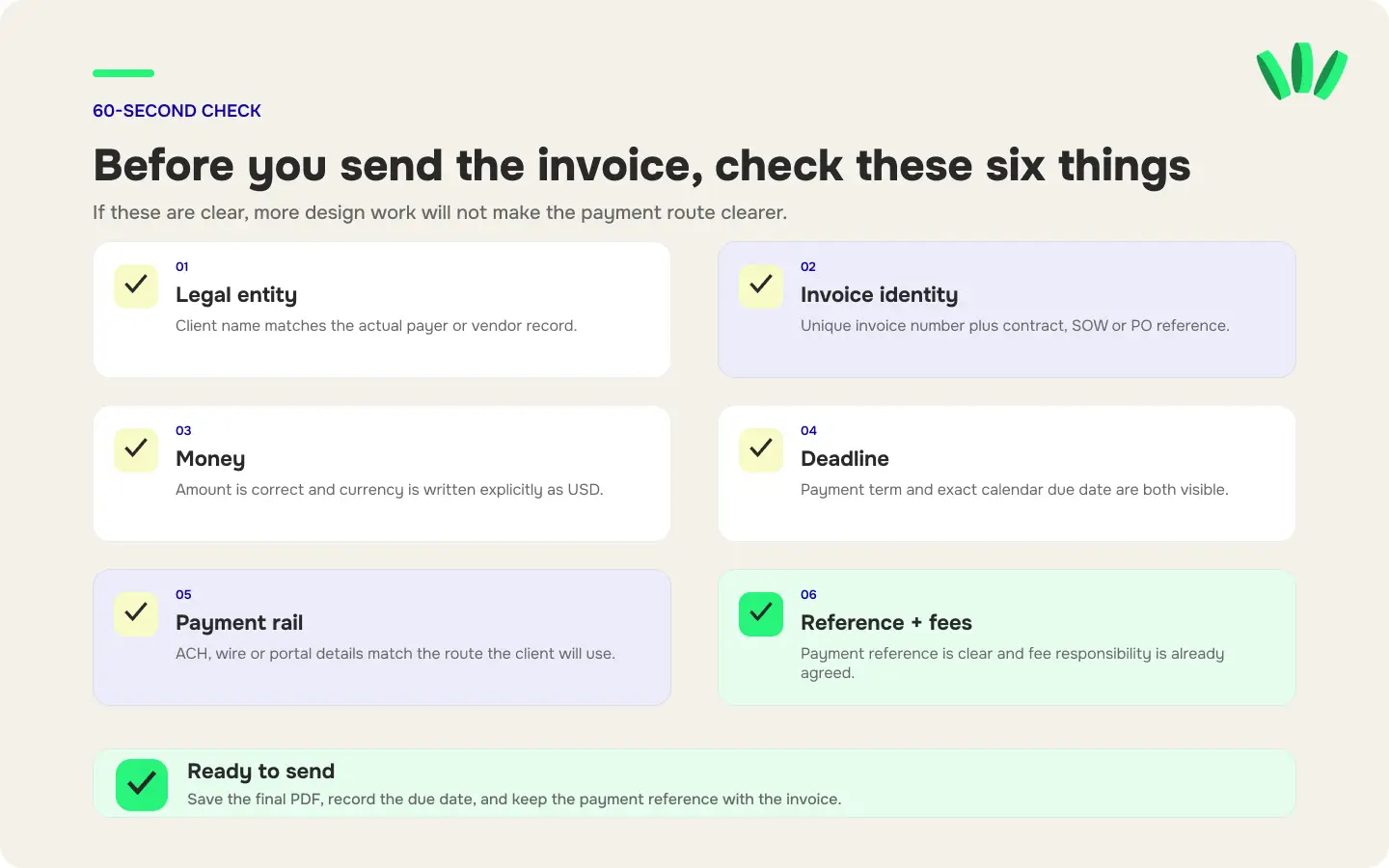
Before sending the PDF, confirm:
the client’s legal entity;
your legal or business name;
invoice number;
invoice date;
exact due date;
contract, SOW, or PO reference;
specific service description;
USD currency;
correct amount;
agreed payment terms;
correct payment rail;
current payment details;
matching beneficiary name;
fee responsibility;
payment reference;
saved copy of the final invoice.
If those details are correct, the invoice is ready. More design work will not make the payment route clearer.
What to do after sending the invoice
Save the final PDF and record the due date.
Watch for a response from accounts payable, not only from your project contact. If the client requests a correction, issue a revised invoice with a clear version or replacement reference rather than silently editing your local copy.
When payment is sent, request the remittance or transaction reference if the client does not provide it. When the money arrives, reconcile the amount against the invoice before marking it fully settled.
If the amount is lower than expected, separate the possible causes:
client sent the wrong amount;
receiving fee was deducted;
intermediary bank deducted a charge;
conversion rate differed from your estimate;
cash-out fee applied;
payment was sent through the wrong rail.
That breakdown tells you what to fix next.

