Not all dollar-pegged crypto works the same, and the differences matter most when markets get messy. Learn what stablecoins are, how depegs happen, and how USDC, USDT, and DAI compare on transparency, liquidity, decentralization, and everyday use.
TL;DR
USDT is usually the practical choice for liquidity and exchange access.
USDC is usually the cleaner choice if you care about transparency and everyday self-custody. DAI fits DeFi-native users who understand protocol risk.
None of them is automatically “safe.” The right stablecoin depends on what you want to do with it, which network you use, and how much risk you can actually explain.
Stablecoins look simple from the outside.
One token. One dollar. Done.
Not quite. Very annoying, because apparently even “digital dollars” needed homework.
USDT, USDC, and DAI are all designed to stay close to $1, but they work in different ways. They have different issuers, reserve models, liquidity profiles, chain support, and risk points. If you are choosing one for payments, savings, DeFi, or getting paid as a freelancer, those details matter.
If you are also choosing where to hold them, read this guide on the best crypto wallet for beginners before moving serious money. Wallet choice affects recovery, network selection, transaction clarity, and all the tiny places where users usually get ambushed.
For freelancers and remote workers, the question gets even more practical. If a client wants to pay you in stablecoins, this guide on how to get paid in USDT or USDC as a freelancer is the better next step after this comparison.
USDT vs USDC vs DAI at a glance
Stablecoin | Core model | Best fit | Main strength | Main tradeoff |
USDT | Reserve-backed stablecoin issued by Tether | Trading, exchange transfers, broad market access | Deep liquidity and wide support | More debate around transparency and reserve composition |
USDC | Fiat-reserve-backed stablecoin issued by Circle | Self-custody, payments, cleaner reporting | Stronger transparency profile | More dependent on issuer and regulated financial rails |
DAI | Crypto-collateralized stablecoin inside the Sky ecosystem | DeFi users and onchain-native flows | More protocol-based design | More complex risk model |
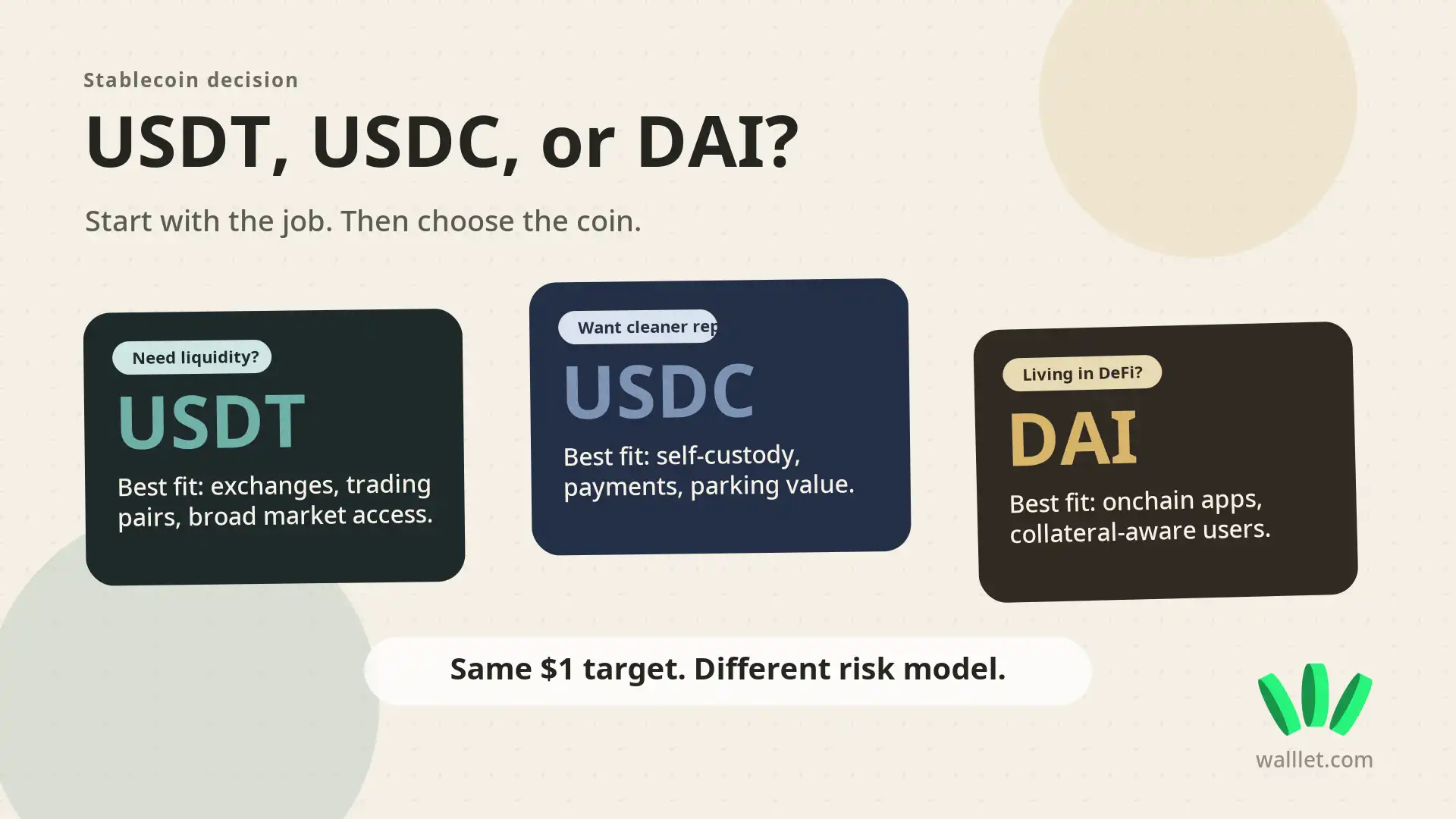
The short version: USDT wins on liquidity, USDC wins on cleaner reporting, DAI wins on DeFi-native design. Still, “wins” depends on the job. A trader, a freelancer, and a DeFi user may choose different coins for perfectly reasonable reasons. Humanity survives another dropdown menu.
What is the difference between USDT, USDC, and DAI?
A stablecoin is a crypto asset designed to track another asset, usually the U.S. dollar. That means 1 USDT, 1 USDC, or 1 DAI is designed to trade near $1.
The key word is designed.
Stablecoins can move above or below $1. That movement is called a depeg. Sometimes it is tiny. Sometimes it gets ugly. The risk depends on what backs the coin, who manages it, where it trades, and what happens when people rush to exit.
If the custody part still feels blurry, start with custodial vs non-custodial wallets. It explains who controls the crypto, which is kind of important when real money enters the chat.
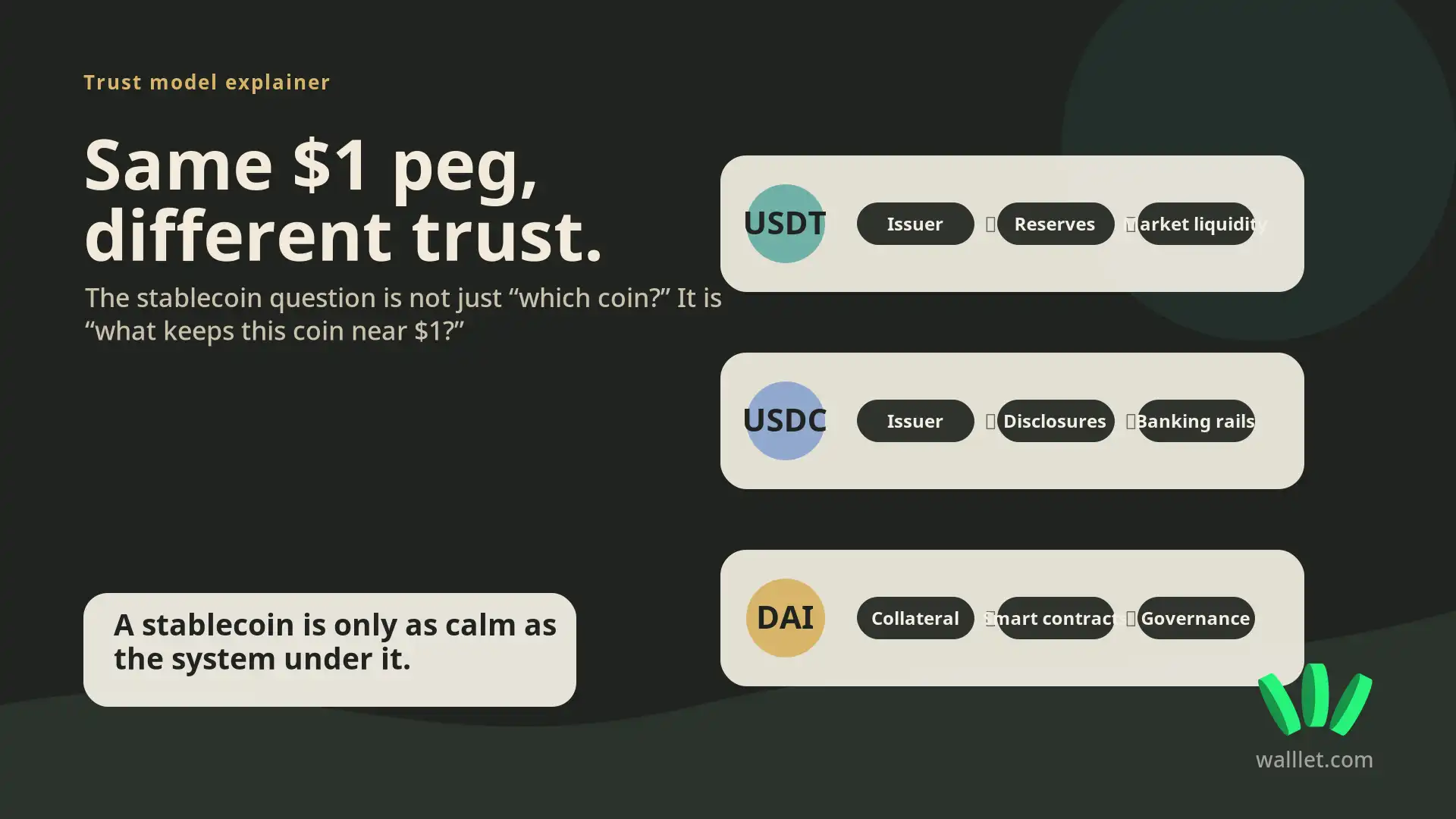
USDT, USDC, and DAI answer the trust question differently.
USDT asks you to trust Tether’s reserve model, market reach, and redemption infrastructure.
USDC asks you to trust Circle’s reserve model, disclosures, banking relationships, and regulated structure.
DAI asks you to trust collateral, smart contracts, governance, and the Sky Protocol system around it.
Different trust models. Different headaches. Same fake simplicity.
Which stablecoin is safest in 2026?
There is no single safest stablecoin for everyone.
If you care most about reserve transparency, USDC is usually easier to defend. Circle says USDC reserve holdings are disclosed weekly, with monthly third-party assurance from a Big Four accounting firm. You can check the current reserve information on Circle’s USDC transparency page.
If you care most about liquidity, USDT is usually the default answer. It is deeply used across exchanges, trading pairs, and global crypto flows. Tether says its tokens are pegged 1:1 and backed by reserves, with current reserve information available on Tether’s transparency page.
If you care most about DeFi-native design, DAI is the serious option. It lives inside the Sky ecosystem and depends more on collateral, protocol rules, and governance. Sky’s docs also explain the current DAI and USDS relationship, including 1:1 conversion through the DAI-USDS converter.
So the real question is this: Which risk do you understand best?
Issuer risk. Reserve risk. Liquidity risk. Smart contract risk. Governance risk. Wrong-network risk. Pick your mess carefully. Crypto loves hiding the hard part one layer below the easy answer.
When should you use USDT?
USDT usually makes sense when you need liquidity first.
It is widely supported on exchanges, trading pairs, wallets, and many blockchain networks. If you trade often, move funds between platforms, or deal with people who already use USDT, it can be the easiest option. USDT is often useful when:
You need the most common trading stablecoin.
You use exchanges where USDT pairs dominate.
You receive payments from people who already use USDT.
You care more about market access than clean reporting.
The tradeoff is trust. USDT has faced years of scrutiny around transparency and reserve composition. That does not make it useless. Far from it. It does mean you should understand why some users avoid holding large balances in one stablecoin for too long.
For many users, USDT is the market’s workhorse. Busy, messy, accepted everywhere. Like an airport with money rails.
When should you use USDC?
USDC usually makes sense when transparency and everyday usability matter more.
Circle’s reserve disclosures make USDC easier for many users to understand. It is also widely supported across major chains and wallets, especially for people who want to hold, send, receive, or use stablecoins without living inside an exchange all day. USDC is often useful when:
You want a stablecoin for everyday self-custody.
You care about reserve disclosures.
You want clearer issuer information.
You are parking value between crypto actions.
You are receiving stablecoin payments and want a cleaner reporting story.
USDC still has risks. It depends on Circle, reserve assets, banking relationships, regulatory decisions, and network support. Cleaner does not mean risk-free. It means easier to inspect.
For many normal users, USDC feels more understandable. That matters. A lot of crypto losses start with confusion pretending to be confidence.
If you want a wider guide on holding, sending, and spending stablecoins, read best way to use stablecoins in 2026.
When should you use DAI?
DAI makes more sense if you actively use DeFi and understand protocol risk.
DAI is different from USDT and USDC because it is not mainly an issuer-backed stablecoin in the same style. It is tied to collateral, smart contracts, governance, and the Sky Protocol system. That makes it more onchain-native. It also makes it harder to explain in one clean sentence. Naturally.
DAI is often useful when:
You use DeFi protocols.
You care about a more decentralized stablecoin design.
You understand collateral-backed systems.
You are comfortable checking protocol mechanics.
You do not want all your stablecoin exposure tied to one company-issued model.
The tradeoff is complexity. With DAI, you are not only thinking about reserves. You are thinking about collateral quality, governance decisions, liquidation systems, smart contracts, and the broader Sky ecosystem.
If you are swapping between stablecoins or using DeFi without a centralized exchange, this guide on how to swap crypto without a CEX explains the wallet-based flow in plain language.
Does the blockchain network matter when choosing a stablecoin?
Yes. The network matters almost as much as the stablecoin.
This is where people get burned.
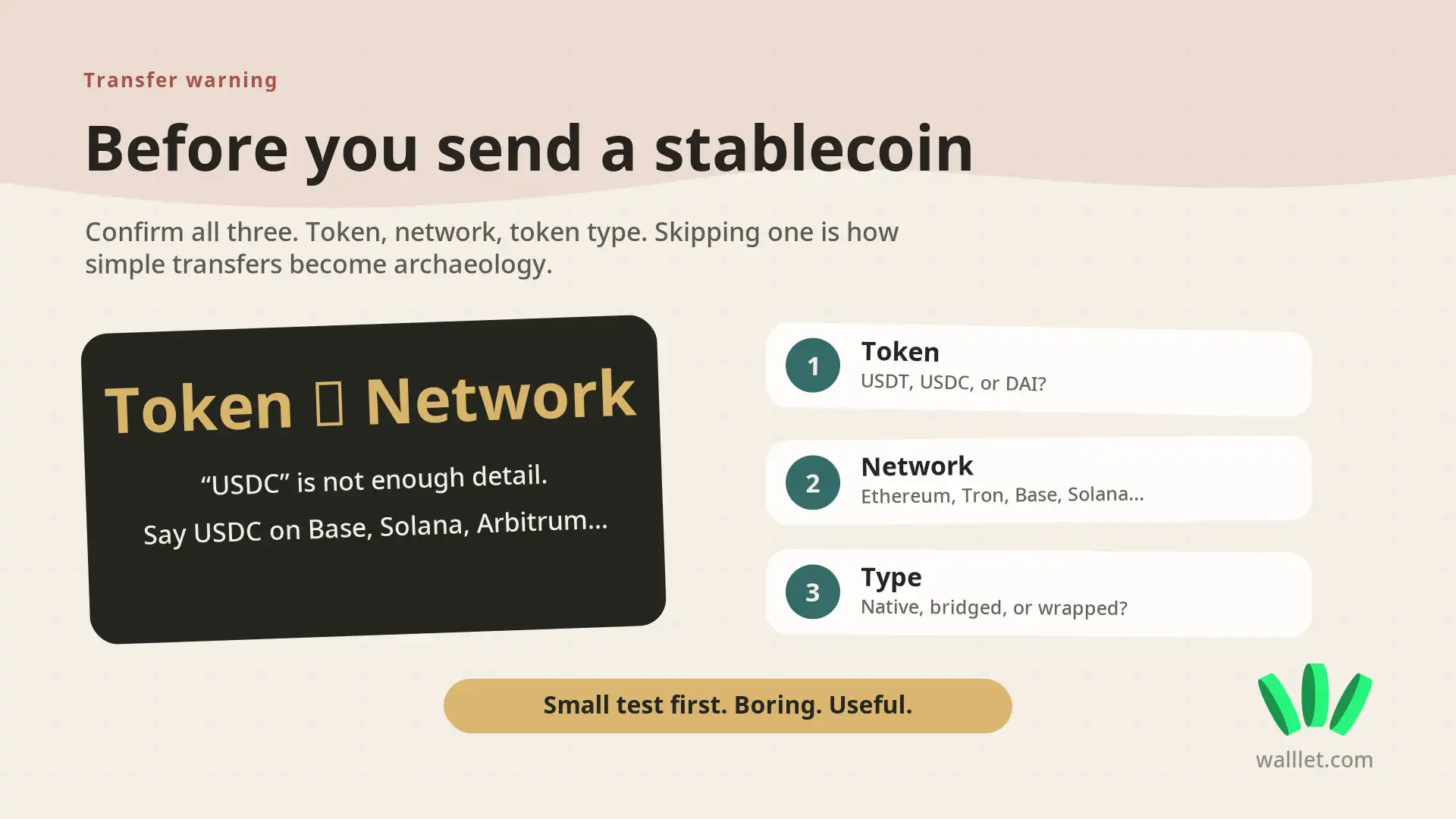
USDT on Tron is not the same practical experience as USDT on Ethereum. USDC on Base is not the same as USDC on Solana. DAI on Ethereum may behave differently from bridged versions on other chains.
Before sending or receiving any stablecoin, check three things:
Token: Is it USDT, USDC, or DAI?
Network: Is it Ethereum, Tron, Base, Arbitrum, Solana, Polygon, or something else?
Token type: Is it native on that chain, or is it bridged/wrapped?
This is not nerd trivia. This is the difference between a normal payment and a long afternoon staring at block explorers like you are decoding ancient ruins.
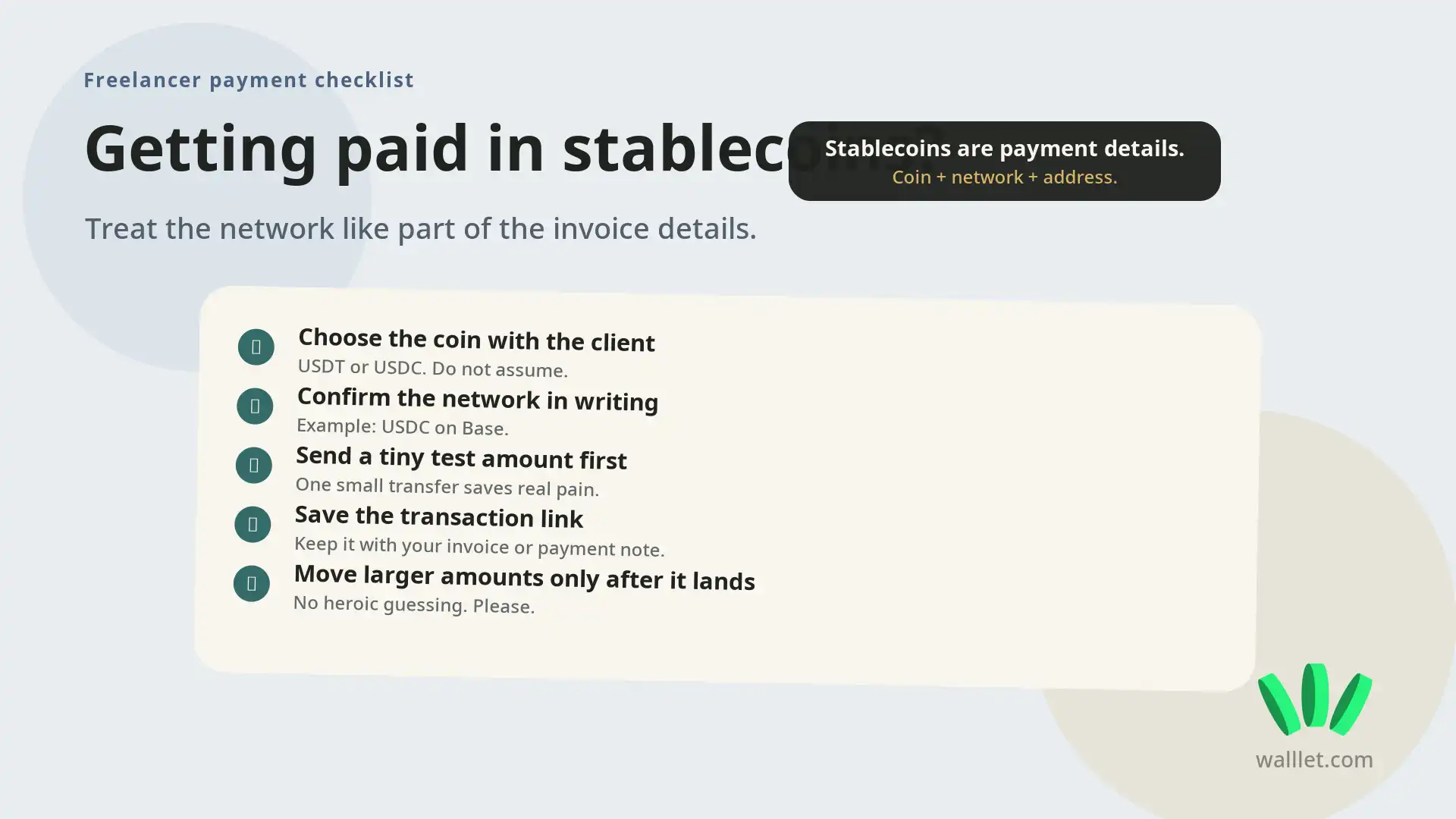
If someone is sending you stablecoins, do not just send an address. Confirm the token and network first. Then send a small test amount. Boring. Effective. The two words crypto users hate most because they prevent drama.
Curious how a cleaner wallet flow changes this part? Explore walllet.com and look at stablecoin handling with a tiny test amount in mind. No grand commitment. Just see whether the token, network, and transaction details feel easier to understand.
How can you use stablecoins without choosing the wrong token or network?
The safest habit is to treat the coin and the network as one decision.
Do not say “send USDT” and stop there. Say “send USDT on this network.” Do not say “I accept USDC” and assume the sender knows which chain. Say the chain out loud. Type it in the payment note. Confirm it before funds move.
This is where wallet UX matters.
A wallet cannot make stablecoins risk-free. Magical thinking remains unavailable, tragic news for everyone. What a good wallet can do is reduce confusion around the parts users actually touch: receiving, sending, checking networks, reading transaction prompts, and avoiding rushed approvals.
walllet.com is a self-custodial crypto wallet designed around that problem. It uses passkeys and biometric-friendly access instead of forcing users into the old seed phrase setup from the first minute. It also focuses on clearer transaction prompts, which helps when you are moving stablecoins and need to understand what is happening before you approve.
If passkeys are new to you, read what is a passkey wallet. If seedless wallets sound too convenient to trust, read are seedless wallets safe?. Both questions are fair. Blind trust in crypto is how people end up writing sad threads.
The practical point is simple: stablecoin mistakes usually happen at the edge of the transaction. Wrong network. Wrong token version. Fake address. Bad approval. A wallet with clearer flows can make those moments less brittle.
Which stablecoin should you choose for payments, savings, or DeFi?
For payments, USDT and USDC are usually the main choices. USDT may be easier if the other person already uses it or if the market around you prefers it. USDC may feel cleaner if you care about transparency and a more straightforward issuer story.
For short-term savings or parking value, USDC often makes sense for users who want clearer disclosures. Some users split between USDC and USDT instead of keeping everything in one coin. That can reduce single-issuer exposure, though it also adds more things to manage.
For DeFi, DAI still matters. It is more native to that world, especially for users who understand collateralized systems and protocol risk. USDC and USDT are also widely used in DeFi, so the answer depends on the app, chain, liquidity, and risk you are accepting.
For freelancers and remote workers, the stablecoin choice usually starts with the payer. If clients prefer USDT, you may need USDT. If you can choose, USDC may be easier to explain for records and self-custody. Either way, confirm the network before payment. Every time. Yes, every time. Humans do love skipping the one step that prevents chaos.
Final takeaway
USDT, USDC, and DAI are all useful. They just solve different problems.
Use USDT when liquidity and market access matter most.
Use USDC when transparency and everyday self-custody matter more.
Use DAI when you want a DeFi-native stablecoin and you understand the extra complexity.
The habit that matters most: do not choose by brand name alone. Choose by use case, network, and risk model.
Before moving larger amounts, create a wallet setup you can actually understand. Try walllet.com with a small stablecoin test transfer, check the token and network, and only scale up when the flow makes sense.
The answer may change later. Different client. Different chain. Different risk. Annoying. Real.
