
A Deel payment marked or described as “paid” does not always mean the money is already usable in your Nigerian bank account. For contractors, check whether funds are available in your Deel Balance and then track the withdrawal to the receiving provider or bank. Employees follow a different payroll flow, where salary is generally paid directly to the registered bank account in local currency.
Your employer says payroll is paid. Deel shows progress. Your Nigerian bank balance has not changed. That does not automatically mean something is wrong.
A Deel payment can pass through several stages before the money becomes usable, and the route depends first on one thing many guides blur together: are you a Deel employee or an independent contractor?
For contractors, money can become available in a Deel Balance before you choose a withdrawal route. For employees, Deel's payroll flow works differently, with salary generally paid directly to the employee's registered bank account in local currency.
So before chasing a missing payment, identify the flow you are actually on.
If your wider problem is choosing where international income should land, ways to receive USD in Nigeria without relying on PayPal covers the main receiving routes. If keeping part of your income in dollars matters, what to check before choosing a dollar account in Nigeria is the more useful next comparison.

First, are you a Deel contractor or a Deel employee?
This changes almost everything about what happens after payday.
Your Deel setup | What normally happens | Do you choose a withdrawal method? | What to track |
Independent contractor | Payment becomes available in your Deel Balance, then you withdraw it | Yes, from the methods available to your account and location | Balance availability → withdrawal → provider/bank settlement |
Employee through Deel payroll/EOR | Salary is processed through payroll and generally deposited to your registered bank account in local currency | Not through the normal contractor withdrawal menu | Payroll completion → bank payout → bank credit |
Contractor using automatic withdrawal | Available balance is automatically sent using your configured rule | Yes, during setup | Auto-withdrawal status → provider/bank settlement |
Deel's current contractor documentation lists withdrawal methods including bank transfer, Wise, Payoneer, PayPal, Revolut, instant card transfer and supported digital-currency routes. Availability varies by jurisdiction and account.
For employees, Deel's employee documentation describes salary being paid to the employee's bank account in local currency. That is a different workflow from a contractor holding a balance and choosing how to withdraw it. This distinction is also why a generic answer to “How does Deel pay Nigerians?” can be misleading.

What does “Paid” actually tell you?
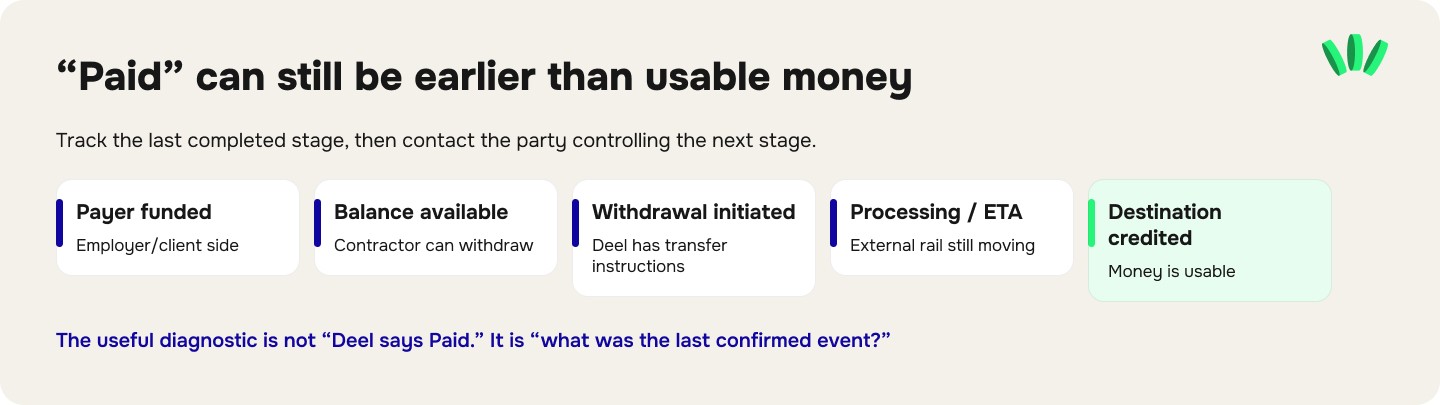
“Paid” is not a universal guarantee that money has landed in the final bank account. Different Deel screens and payment workflows can describe different stages. The safest way to read the situation is to identify the last completed event.
Stage | What you know | What you do not know yet |
Employer/client initiated or funded payment | The payer has started or funded its side of the process | Whether the worker can withdraw yet |
Funds available in Deel Balance | A contractor can access the funds for withdrawal | Whether the receiving bank/provider has received them |
Withdrawal initiated | Deel has instructions to move the money | Whether the external provider or bank has settled it |
Withdrawal processing | The transfer is moving through the selected route | The exact moment the destination will credit it |
ETA shown in Withdrawal Tracker | Deel has an estimated arrival date | That the bank will necessarily credit at that exact moment |
Destination credited | The receiving provider or bank has posted the funds | Nothing material remains for that transfer |
Deel now uses a Dynamic ETA for contractor withdrawals rather than one universal delivery promise. The estimate can move because of bank processing, compliance checks, banking holidays or provider outages. Deel says a transfer may also arrive one or two business days after the displayed estimate because of external bank processing. The useful question is therefore: What is the last confirmed stage, and which company controls the next one?
Deel withdrawal methods for Nigerian contractors
The withdrawal methods visible in your own Deel account are the relevant options. Deel explicitly says not every method is available in every jurisdiction. Its current contractor fee schedule includes:
Withdrawal method | Current Deel-side fee | Minimum withdrawal | What to check next |
Local bank transfer | $0 | $10 | FX, provider fee where applicable, receiving-bank status |
Cross-border same-currency bank transfer | $5 | Depends on route | Receiving-bank and intermediary costs |
SWIFT | $5–$10 | $100 | Correspondent/intermediary charges and settlement |
Wise | $0 | Usually $5 | Availability and Wise-side conditions |
Payoneer | 1%, minimum $12 | $50 | Payoneer fees after receipt |
PayPal | 2.5%, minimum $0.25 | Usually $5 | Availability and PayPal-side costs |
Instant Card Transfer outside the US | 2%, capped at $15 | $5 | Card eligibility and provider support |
Digital currency | 2% + $1 network fee | $5 | Country eligibility, token/network and later cash-out |
These are Deel-side withdrawal fees, not necessarily the final cost of getting money into a Nigerian bank account.
A route showing $0 at Deel can still include currency conversion or another provider fee later. A route charging $5 may still make sense if it lets you preserve USD and avoids an unnecessary conversion.
If Payoneer is part of your current setup, Payoneer alternatives for Nigerian freelancers helps compare what happens after money reaches the second provider rather than comparing only the first transfer fee.
Can Deel withdraw directly to a Nigerian bank account?
For eligible contractors, Deel supports local bank transfer and lists NGN among supported withdrawal currencies. A local bank withdrawal is the shortest route when you want the money in naira:
Deel Balance → local bank transfer → Nigerian bank account
Deel currently charges $0 on its side for local bank transfer, although a provider fee may apply for some currencies or routes. If your contract balance is held in USD and you withdraw in NGN, currency conversion also becomes part of the transaction. Deel displays an estimated rate and applicable charges before you confirm the withdrawal. The number to compare is therefore not $0 fee. It is:
USD balance → conversion → all route deductions → final NGN credited
Can Deel pay a USD account instead?
A Nigerian contractor may be able to withdraw to a compatible USD receiving account if the relevant bank-transfer option is available in the Deel account and the receiving account meets Deel's requirements. Do not assume that every virtual USD account or domiciliary account works. Before using one, confirm:
the account is issued in your own name;
the beneficiary name matches your Deel profile;
the billing address on Deel matches the withdrawal account details where required;
the receiving account supports the transfer rail Deel will use;
the account accepts the relevant currency;
the provider accepts this type of contractor/business payout;
you understand incoming-bank and intermediary fees.
Deel warns that withdrawing in a currency different from the receiving bank account's currency can cause the destination bank to convert the payment, charge additional fees or reject it.
If you are choosing between a Nigerian domiciliary account and fintech-issued USD details, domiciliary account vs virtual dollar account explains the operational difference.
For employees rather than contractors, do not assume the same flexibility. Deel's standard employee guidance says payroll salary is paid directly to the employee's bank account in local currency.

What happens to a $2,000 Deel contractor balance?
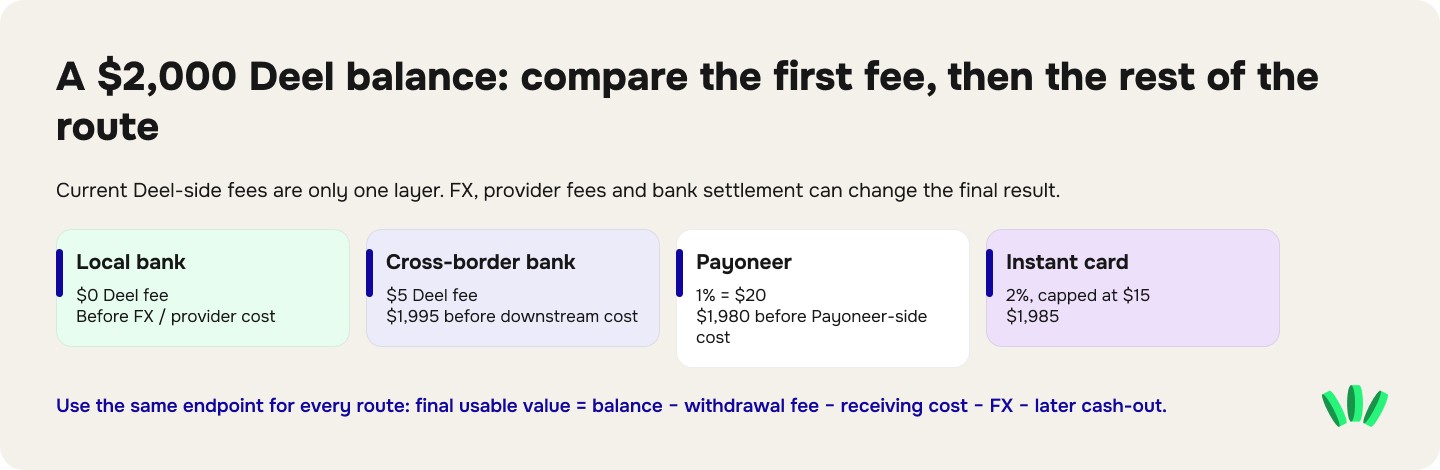
Use a fixed starting balance to see why the first fee alone does not decide the best route. Assume $2,000 is already available in your Deel Balance. This comparison uses current Deel-side withdrawal fees only. It does not invent an exchange rate or assume what another provider or bank will charge.
Route | Starting balance | Deel-side fee | Amount remaining before downstream costs |
Local bank transfer | $2,000 | $0 | $2,000 before FX/provider costs |
Cross-border same-currency bank transfer | $2,000 | $5 | $1,995 |
SWIFT | $2,000 | $5–$10 | $1,990–$1,995 |
Payoneer | $2,000 | 1% = $20 | $1,980 |
Wise, if available | $2,000 | $0 | $2,000 before provider-side costs |
Instant Card Transfer | $2,000 | $15 because the 2% fee hits the cap | $1,985 |
Digital currency | $2,000 | $40 + $1 = $41 | $1,959 |
The local-bank route appears cheapest at the first stage. That still does not prove it gives you the most useful value.
If the full $2,000 is converted to NGN but you need only part of your income in naira, immediate full conversion may not match your use case. If another route preserves USD, compare the cost of that flexibility against its withdrawal fee. A useful calculation is:
Usable value = Deel Balance − withdrawal fee − receiving costs − FX cost − later cash-out cost
For someone who earns recurring foreign income, the freelancer payment-stack guide explains why the receiving route, backup route and post-payment route should be planned together.
Why can a Deel withdrawal still be pending?
Once the money leaves the simple “available balance” stage, several separate problems can delay it.
The beneficiary details do not match
Deel requires the recipient's full name to match the contractor profile. Address mismatches can also cause a withdrawal to be delayed or returned.
The bank details are wrong
An incorrect account number, routing information, bank identifier or beneficiary record can cause the destination bank to reject the payment.
The receiving bank rejects the transaction
A bank can reject a payment even after Deel has sent it. A closed account, unsupported currency or receiving restriction can trigger a return.
The transaction enters additional screening
A receiving bank or payment provider can request more information about the payer, beneficiary or purpose of payment.
For recurring international income, keep your contract, invoices where applicable and payment records together. The walllet.com guide to proof of income and source-of-funds documents explains the records that can help when a payment is reviewed.

External processing takes longer than the ETA
Bank holidays, provider outages and external bank processing can move the expected arrival date.
The payment fails and starts returning
Deel says a failed contractor withdrawal normally returns to the Deel Balance within three to five business days after the failure. A pending payment therefore needs a stage-specific diagnosis. Why freelance payments get held, reviewed or delayed covers the wider distinction between platform processing, compliance review and bank settlement.
What to do when the Deel ETA has passed
Do not start by asking the employer to pay again. First establish whether the employer-side payment, Deel balance, Deel withdrawal or bank settlement is the missing stage.
Open Deel's Withdrawal Tracker or Transaction Tracker.
Confirm the amount, withdrawal date and destination.
Check the beneficiary name, account details, address and currency.
Look for any request for additional information.
Download the available transaction or withdrawal documentation.
If Deel provides a Trace ID, give it to the receiving bank and ask them to locate the transfer.
If the bank says it rejected the payment, monitor the return to your Deel Balance.
If the expected date has passed and neither the bank nor Deel can locate the payment, report the issue through the transaction tracker.
For an international bank transfer, how to trace a missing wire using payment references such as MT103 or UETR explains what those references can prove and when they are useful. A Deel Trace ID is not automatically an MT103 or UETR; use the reference provided for the actual rail involved.
Beneficiary checklist before your next Deel payout
For a recurring payout, verify these before payday rather than after a failure:
Check | What must be correct |
Worker type | Employee vs independent contractor |
Legal name | Must match the receiving account |
Billing address | Must match where Deel requires it |
Account owner | Use an eligible account belonging to you |
Currency | Know whether the account receives NGN, USD or another currency |
Rail | Local transfer, SWIFT or another method |
Minimum | Your withdrawal must meet the route minimum |
Deel fee | Check the live quote before confirmation |
FX | Know where conversion happens |
Receiving-provider cost | Check fees outside Deel |
Final destination | Decide whether you need NGN now or want to retain foreign-currency value |
Evidence | Keep contract, payout record and receiving statement |
Once the route works consistently, avoid changing account details unnecessarily. A recurring payroll or contractor payout is easier to troubleshoot when the same verified route has a known history.
A Deel payment is finished when the money is usable
For a contractor, the meaningful route is: Client payment → Deel Balance → withdrawal method → receiving provider or bank → usable USD or NGN
For an employee: Payroll → employee bank payout → bank credit
“Paid” tells you that something in the payment chain has progressed. The tracker, receiving route and final account tell you whether your money has arrived where you can use it.

