There is no single best Payoneer alternative for every Nigerian freelancer. Grey, Raenest, Cleva, nsave, Hurupay, Chipper Cash and walllet.com support different combinations of direct-client payments, USD accounts, ACH or wire transfers, foreign-currency holding and naira access. The right choice depends on who pays you, which rail they can use and how much usable money remains after the full route.
If a client owes you $1,000, the cheapest-looking app is not necessarily the route that leaves you with the most money.
A provider can charge almost nothing to receive the payment and still become expensive when you convert USD, withdraw to naira or move the balance somewhere else. Another provider may look more expensive at the first step but support the exact payment method your client uses, remove an extra transfer and leave you with more usable money.
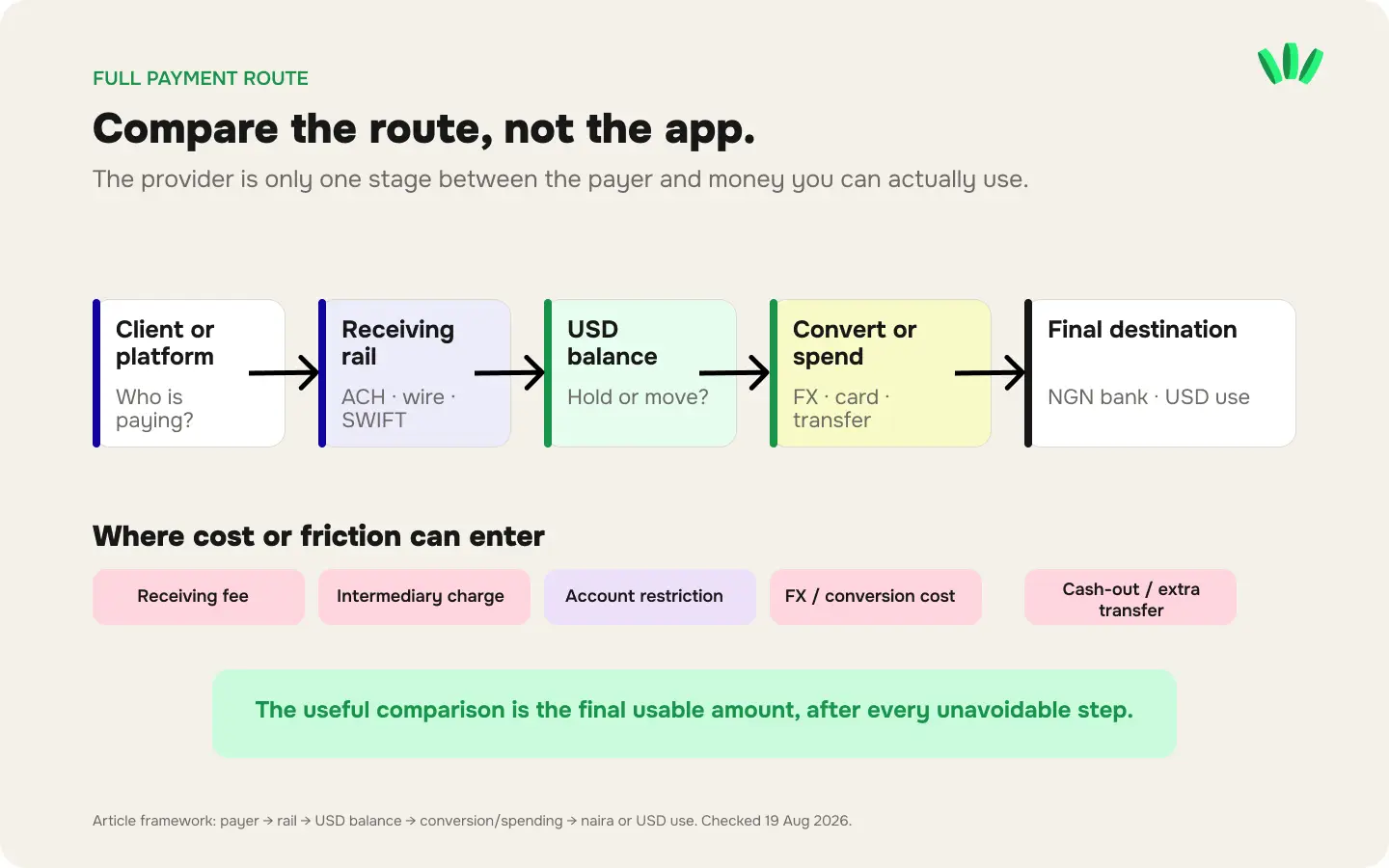
That is the problem with most Payoneer comparisons. They compare apps. A freelancer needs to compare the route:
Client or platform → receiving rail → USD balance → conversion or spending → naira bank account
If you are still deciding whether Payoneer is even the right category of solution for your payment setup, our PayPal vs Payoneer vs stablecoins comparison for freelancers breaks down how the main payment models differ.
Payoneer remains useful, especially when it already sits inside a marketplace or business-payment workflow. Its current pricing also shows why alternatives are worth comparing: receiving through a non-local-currency receiving account can cost 1% with a $1 minimum, US ACH bank-debit payments cost 1%, card-funded client payments can cost up to 3.99% plus $0.49, and some bank withdrawals fall in a 1.2%–4% range. A $29.95 annual account fee can also apply when an account receives less than $6,000 over 12 consecutive months, subject to account type and region.
If PayPal availability is part of the reason you are looking elsewhere, this guide to receiving USD in Nigeria without PayPal compares the wider set of payment routes Nigerian freelancers can use.
That does not make Payoneer “bad.” It means the correct comparison is more specific than:
Which app charges less?
The useful question is:
Which route fits the person paying me and leaves me with the best combination of access, cost, control and reliability?
Disclosure
walllet.com publishes this comparison and is one of the seven alternatives covered below. We apply the same criteria to walllet.com as to the other providers and identify eligibility-dependent or route-dependent features rather than treating walllet.com as automatically better.
What should you compare before replacing Payoneer?
Six checks matter.
1. Can your actual payer use the account?
“Receive USD” is not enough information.
Find out whether the provider accepts money from:
a direct business client;
an individual client using a personal account;
Upwork, Fiverr, Deel or another platform;
your employer;
another account in your own name.
Those routes are not interchangeable.
Cleva, for example, accepts freelance-platform payments and business payments, but personal third-party bank payments have a separate $1,000 daily limit. Chipper Cash distinguishes business, payroll and other payment types and may review supporting evidence before releasing a USD deposit.
The first question should therefore be:
Who is sending my money?
Not:
Which app has the nicest USD-account page?
2. Which payment rail does the client need?
A US client may be able to send ACH.
Another finance team may insist on a domestic wire.
A client outside the US may need SWIFT.
If those terms are already becoming the confusing part of the decision, our guide to how Nigerian freelancers receive payments from US, UK and EU clients explains where ACH, wire, IBAN, SEPA and other routes fit.
Those differences immediately remove some options.
Raenest currently supports USD receipt through ACH, domestic wire and SWIFT. Cleva supports ACH, US domestic wire and FedNow but explicitly says SWIFT transfers from non-US banks are not currently supported. Chipper Cash's Nigerian USD virtual account is narrower: its current documentation says the account supports ACH rather than SWIFT.
A provider can be excellent for a US client and useless for the same freelancer's German client if the required rail is different.
3. Can you keep the money in USD?
For freelancers who earn in dollars but spend in naira, forced conversion changes the economics of the payment.
You may want to cash out only what you need for local expenses while keeping the rest of your income denominated in USD.
That makes the holding stage part of the comparison, not an optional extra.
Grey allows users to receive and keep USD before converting. nsave provides a USD balance alongside ACH details. Chipper credits USD virtual-account receipts to its USD wallet. walllet.com currently states that eligible users can receive supported foreign-currency income and keep their income in USD until they decide to convert.
4. What does the entire route cost?
Do not stop at the receiving fee.
For a freelancer, a better cost model is:
Total route cost = receiving fee + intermediary charges + FX cost + withdrawal/cash-out fee + any extra transfer needed to make the money usable
There can also be fixed account or card charges.
A difference of $9 at the receiving stage tells you very little if one route produces a materially worse conversion quote later.
The useful comparison is the amount that reaches the point where you actually need the money.
5. How do you get naira out?
Receiving USD solves only the first half of the problem.
For a Nigerian freelancer, ask:
Can I convert inside the provider?
Is the rate visible before I confirm?
Is there a separate conversion fee?
Is there a withdrawal fee?
Can I send directly to my Nigerian bank?
Are there limits?
Does the payout route depend on another provider?
Grey, Raenest, Cleva, Chipper Cash and walllet.com all document routes involving Nigerian bank access, but their pricing mechanics differ.
For income that reaches you as stablecoins rather than a bank balance, the USDT and USDC cash-out guide for Nigeria explains the separate conversion, network and bank-credit steps.
6. What happens when the payment does not go normally?
The normal transfer time matters less when a meaningful client payment suddenly goes into review.
Check:
what evidence the provider may request;
whether you get a payment reference;
whether rejected money returns to the sender;
who you contact;
whether the support team can investigate a bank transfer;
whether there are payer-type or source-of-funds restrictions.
Cleva explicitly says deposits can be reviewed and may require invoices, employment evidence or other context. Chipper's USD-account documentation says incoming transactions can remain pending for review and that evidence of the relationship between sender and recipient may be requested.
If payment reviews are one of the reasons you are considering a switch, why freelance payments get held, reviewed or delayed explains where these problems usually happen and what evidence is worth keeping.
This is why the cheapest route on a pricing page may not be the cheapest route when something goes wrong.
Want to see what the full route looks like when receiving, holding, spending and naira cash-out sit in one place? See how walllet.com handles global freelance income from payment to usable money.

Payoneer vs 7 alternatives in Nigeria: quick comparison
Option | Useful for | Direct-client receiving | Main receiving routes | Hold USD | Naira access | Important limitation |
Payoneer | Marketplace and business-payment workflows | Yes, subject to payment method and account eligibility | Receiving accounts, client payment requests, ACH debit, bank transfer; SWIFT support in eligible routes | Yes | Bank withdrawal subject to route | Fees vary materially by payer method, withdrawal route, country and account |
walllet.com | Freelancers wanting receiving, holding, spending and naira access in one workflow | Yes, on supported receiving routes | USD/EUR/GBP routes shown for the account | Yes | Supported naira cash-out | Accounts, rails, fees and availability depend on eligibility and current provider route |
Grey | Multi-currency freelancers receiving from US/UK/EU | Yes | ACH, FedNow, Fedwire plus GBP/EUR routes | Yes | Yes | Different rails carry different fees; payer and transfer rules still matter |
Raenest | Direct clients, platforms and freelancers needing broader USD rails | Yes | ACH, domestic wire, SWIFT | Yes | Yes | Individual third-party payment conditions and review rules need checking |
Cleva | US-centric freelancer and platform payments | Yes | ACH, FedNow, US wire | Yes | Yes | SWIFT from non-US banks is not currently supported |
nsave | US-client ACH payments and multi-currency income | Yes | ACH and SWIFT receiving routes | Yes | Supported local-currency withdrawal | Pricing and payout conditions should be checked for the exact corridor |
Hurupay | Multi-rail international payments | Yes | ACH, wire, SEPA and advertised SWIFT support | Yes | Local bank/mobile-money routes advertised | Public fee and availability information is less detailed than some competitors; verify the live account route |
Chipper Cash | Nigerian users receiving US-origin USD through a narrower route | Yes for supported payment types | ACH virtual account | Yes | USD-to-NGN cash-out | USD virtual account does not support SWIFT; account and maintenance fees apply |
Provider availability, limits and pricing can change. The current account screen should be treated as the final reference before redirecting recurring income.
1. walllet.com: best considered when receiving is only one part of your problem
walllet.com is the most relevant option here when your actual problem is not merely “I need another USD account.”
Its current Nigeria-facing product describes a wider flow: eligible users can receive USD, EUR or GBP through account details in their own name, hold income in USD, use a supported USD card for international spending and access a naira payout route. The exact receiving route, eligibility and account conditions still depend on what is available to the user.
For a deeper look at how the receiving side works, the walllet.com IBAN account guide explains the account details, payment flow and conditions freelancers should understand before giving instructions to a client.
That matters for a freelancer who currently does something like:
Client → Payoneer → another USD app → exchange or conversion service → Nigerian bank → separate dollar card
Every handoff creates another balance, fee, account restriction or support team.
walllet.com's stronger use case is therefore income workflow consolidation, not “another place to receive a dollar payment.”
It may fit when you:
work directly with international clients or remote employers;
want supported USD/EUR/GBP receiving details;
want to keep part of your income in USD;
pay for international work tools;
need a route to naira;
care about seeing the rate and fee before confirming a conversion.
If spending your foreign income online is part of the workflow, the walllet.com virtual dollar card guide covers issuance, eligibility and online-payment use separately.
The limitation is equally important: account details, currencies, rails, card access, cash-out conditions, fees and limits should be checked against the route actually available to your account. walllet.com does not make every client, bank, card merchant or payout route compatible by default.
Best fit: freelancers and remote workers who want to manage several stages of foreign income without building the workflow across several unrelated apps.
2. Grey: strong when your income comes from several countries
Grey is one of the clearest Payoneer alternatives for Nigerians who receive more than USD.
It provides foreign account details for currencies including USD, GBP and EUR and is built around international receiving, holding, conversion and local withdrawal.
For USD deposits, Grey currently lists:
ACH/FedNow: 0.8%, minimum $2 and maximum $10;
Fedwire: $20;
USD-to-NGN conversion: 1%, capped at $6;
NGN withdrawal: ₦35 according to its current Nigeria guide.
That makes Grey relatively easy to model before a payment.
If a US client can send ACH, you know the receiving fee structure. If you later want naira, you can also identify the conversion and withdrawal layers separately.
Grey becomes particularly useful for a freelancer who might have:
one US client paying USD;
a UK agency paying GBP;
an EU client paying EUR.
The limitation is that “Grey supports this currency” does not mean every incoming payer or payment type is accepted without conditions. Third-party and business-payment rules still need to be checked before giving the client account details.
Best fit: freelancers receiving from more than one currency region who want foreign accounts plus a clear local conversion route.
3. Raenest: one of the broader options for USD payment rails
Raenest deserves attention when the sender's payment method is the deciding factor.
Its current receiving documentation lists:
USD ACH: $1 flat;
USD domestic wire: $10 flat;
USD SWIFT: $16 flat before any effect from the sender's chosen SWIFT fee arrangement;
EUR: 0.8%, minimum €1.50 and maximum €10;
GBP: 0.8%, minimum £1.50 and maximum £10.
That broader rail coverage is useful.
A US startup can pay by ACH. A US client that prefers domestic wire can use a different route. A client outside the US may need SWIFT.
Raenest also documents a 0 NGN transfer fee for Nigerian bank-account payouts, while currency conversion itself can have a separately disclosed conversion fee.
The distinction matters.
“Free payout” does not mean the entire USD-to-NGN route is free. You still need the conversion quote.
Raenest also supports payments from clients, companies and platforms. Its account documentation covers ACH, wire and SWIFT receipt.
Best fit: freelancers whose payers do not all use the same USD transfer rail.
4. Cleva: especially relevant for US-origin USD payments
Cleva's current USD receiving stack is heavily US-oriented.
It supports:
ACH;
US domestic wire;
FedNow;
supported stablecoin deposits.
It explicitly states that SWIFT transfers from non-US banks are not currently supported.
That single limitation can decide whether Cleva fits your client base.
If most of your income comes from US companies, payroll systems or platforms, the US-focused rails can work well. If clients regularly pay from outside the US by international SWIFT, you need another route.
Cleva also distinguishes who is paying you. It accepts freelance and payroll platforms, business payments, same-name transfers and some third-party personal payments. Personal third-party bank deposits are currently limited to $1,000 per day, while account tiers control other deposit limits.
Its August 2026 pricing update is also worth checking carefully: Cleva says new ACH, FedNow and stablecoin pricing took effect on 7 August 2026, while Upwork deposits remain $0 and stablecoin deposits now use a $2 flat fee. For current ACH/FedNow quotes, Cleva directs users to its pricing calculator.
Transfers to Nigerian bank accounts are currently listed with a free Cleva transfer fee, although the Nigerian statutory stamp duty can apply to qualifying NGN transfers.
Best fit: freelancers whose client and platform payments originate primarily inside the US banking system.
5. nsave: worth comparing for ACH-heavy freelance income
nsave is another option built directly around people receiving international work income.
For Nigerian freelancers, its documentation describes USD account details that can accept ACH payments from US clients, employers and freelance platforms while allowing the user to hold a USD balance.
Its current pricing page lists:
USD account: free;
USD ACH details: free;
incoming USD through ACH/SWIFT: free;
international USD ACH sending: $0.50;
international USD SWIFT sending: $12.99 on the standard plan;
card issuance: $1.99 on the standard plan.
nsave also documents separate ACH and SWIFT instructions, making it useful when a payer outside the US cannot use domestic ACH.
There is one reason to avoid comparing nsave solely from a single fee claim: different nsave pages currently describe local payout pricing differently. Its main pricing page lists local-currency withdrawal as free, while some Nigeria-specific educational pages refer to a $1 transfer. The current quote in the product should therefore decide the comparison for the exact route.
That discrepancy itself is useful information. Never build a recurring payment route from an old article when a live quote is available.
Best fit: Nigerian freelancers who receive heavily through ACH but also want access to a SWIFT receiving route.
6. Hurupay: broad receiving options, but verify the live route carefully
Hurupay positions itself around freelancers, remote workers and businesses receiving international payments.
Its public product pages advertise USD, EUR and GBP accounts and receiving through combinations of ACH, wire, SEPA and SWIFT. They also list payments from clients and platforms such as Upwork and Deel, plus withdrawal routes to local banks or mobile money.
Nigeria has appeared in Hurupay's supported-country listings, but the public site exposes less precise country-level fee and route documentation than Grey, Raenest or Cleva.
That affects how this option should be evaluated.
Hurupay can belong on the shortlist, but before moving an established client, verify inside the current product:
Nigerian onboarding availability;
the exact receiving account issued to you;
whether the client's payer type is supported;
the fee for the exact transfer rail;
local bank payout availability;
withdrawal and conversion pricing.
A wide feature list is useful only when the exact route you need is live for your account.
Best fit: freelancers who value broader currency and rail options and are willing to verify current Nigeria-specific availability before switching.
7. Chipper Cash: narrower, but useful when ACH is enough
Chipper Cash is a different type of Payoneer alternative because its Nigerian USD virtual-account route is more constrained.
Verified Nigerian users can open a USD virtual account designed for international receiving. Current documentation lists support for business payments, payroll payments and platforms including Upwork, Deel, Payoneer, Gusto and Fiverr.
The current published costs include:
account creation: ₦5,000;
ACH deposit: 0.75%;
wire deposit: $25;
USD virtual-account maintenance: $1.50 per month.
There is an important technical constraint: Chipper's USD virtual account documentation says it does not support SWIFT and identifies ACH as its receiving route for the virtual account.
Incoming funds land in the Chipper USD wallet, and Chipper provides a Nigeria-specific route for converting/cashing USD out to a naira bank account with the applicable rate shown before confirmation.
Chipper also describes a review period for USD-account deposits, with supporting documents potentially required to establish the relationship between payer and recipient.
That makes Chipper a reasonable comparison for a freelancer whose clients can use the supported US banking route, but not a universal replacement for someone receiving international wires from several countries.
Best fit: Nigerian freelancers whose incoming USD is primarily compatible with ACH and who already use Chipper's USD/NGN ecosystem.
Which Payoneer alternative fits your payment setup?
The payer should determine the shortlist.
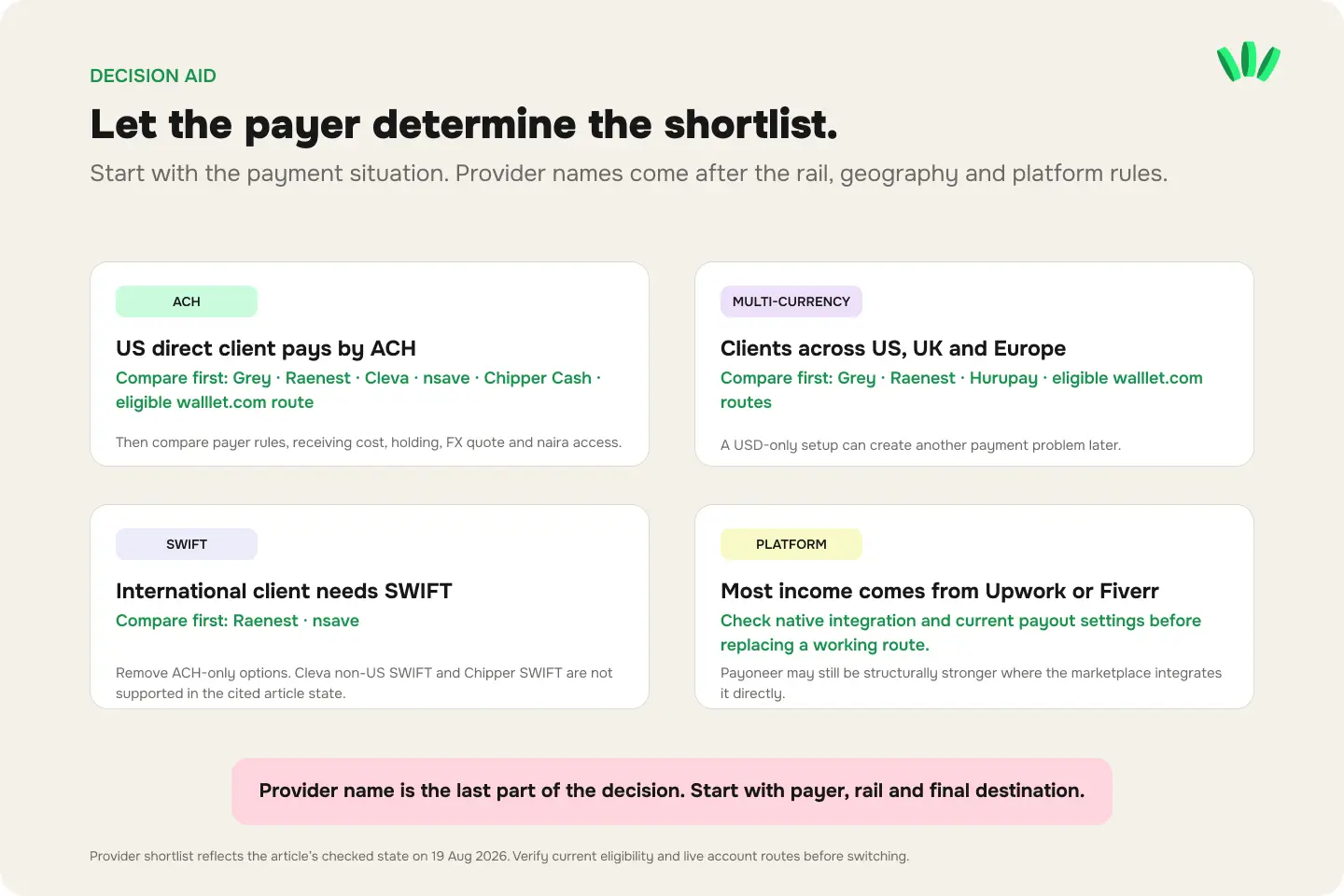
If a US direct client pays you by ACH
Compare:
Grey;
Raenest;
Cleva;
nsave;
Chipper Cash;
walllet.com where the USD receiving route shown in your account fits the sender.
The deciding factors are then receiving cost, payer rules, USD holding, conversion quote and naira access.
If your clients are spread across the US, UK and Europe
A USD-only account may create another payment problem six weeks later.
Grey, Raenest, Hurupay and eligible walllet.com receiving routes are more relevant to compare when multiple currencies matter. walllet.com currently advertises USD, EUR and GBP receiving details for eligible users.
If an international client needs SWIFT
Remove ACH-only options immediately.
Raenest explicitly supports a USD SWIFT receiving route, and nsave documents SWIFT receiving details. Cleva explicitly says non-US SWIFT is currently unsupported, while Chipper's USD virtual account does not provide a SWIFT route.
If most of your income comes from Upwork or Fiverr
Do not assume that “provides US bank details” and “has native platform integration” mean the same thing.
Payoneer still has a structural advantage where a platform already integrates it directly; Payoneer says it works with more than 2,000 marketplaces, platforms and networks.
Some alternatives also advertise compatibility with platform bank payouts. Cleva, for example, documents freelance/payroll platform payments and currently charges $0 on Upwork deposits.
Check the platform's current payout settings before replacing a working route.
If you want to keep part of your income in USD
Compare the holding layer separately from the cash-out layer. A good route lets you decide:
receive $1,000 → keep $700 in USD → convert $300 when local expenses are due
rather than forcing the whole invoice through USD-to-NGN conversion immediately.
If support and payment reviews worry you more than headline fees
Read the provider's deposit policy before the pricing page.
Ask:
Who can pay this account?
What happens after a flagged deposit?
What proof will they request?
Does the sender get the money back after rejection?
Can support trace the specific rail?
Is there a clear payment reference?
For recurring freelance income, these questions can matter more than saving one dollar on an ACH receipt.
Payoneer can still be the right choice
Searching for a Payoneer alternative does not automatically mean you should leave Payoneer.
Payoneer can still be the stronger route when:
a marketplace has native Payoneer integration;
your clients already know how to pay your Payoneer account;
you use several Payoneer balances;
your existing withdrawal route works;
switching introduces more operational risk than the potential fee saving.
Payoneer's receiving accounts cover several currencies, and its client-payment tools support multiple payment methods. Its current pricing also varies by country, account type, currency and payment method, so the price shown inside your own account matters more than a single percentage copied into a comparison article.
A provider switch should solve a specific problem.
If the problem is a 1% receiving charge, calculate whether the new route actually removes it after FX and cash-out.
If the problem is a missing SWIFT route, compare rails.
If the problem is forced conversion, compare holding.
If the problem is poor support during reviews, compare recovery paths.
If the problem is juggling four financial apps, compare the entire money workflow.
The cheapest receiving fee can still produce the worse result
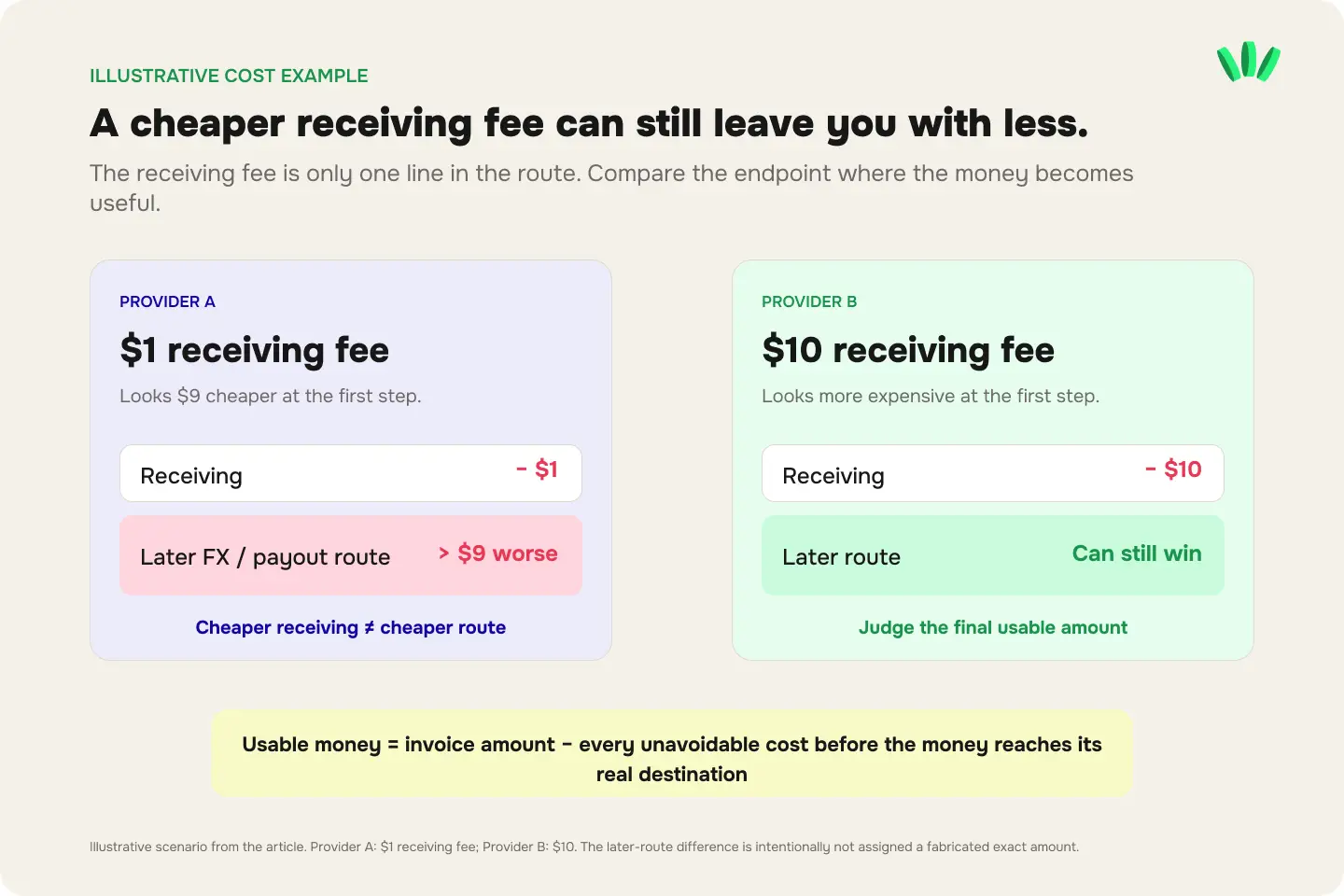
Consider two hypothetical routes for a $1,000 payment.
Provider A charges $1 to receive it.
Provider B charges $10.
Provider A appears $9 cheaper.
But if Provider A's later conversion and payout route leaves you more than $9 worse off, Provider B was cheaper from the perspective that matters: usable money.
The correct calculation is:
Usable money = invoice amount − every unavoidable cost between the payer and the place you actually need the funds
For a Nigerian freelancer, that endpoint might be:
USD available for savings;
a dollar card ready to pay for work software;
naira credited to a bank account;
USD ready for another business payment.
The invoice amount is not the useful comparison.
The final usable amount is.
walllet.com already uses this route-level approach in its guide to receiving payments from US, UK and EU clients and recommends comparing final usable money, timing and documentation rather than only the advertised fee.
Before switching from Payoneer, test the new route
Changing payment details is not the same as changing a music app.
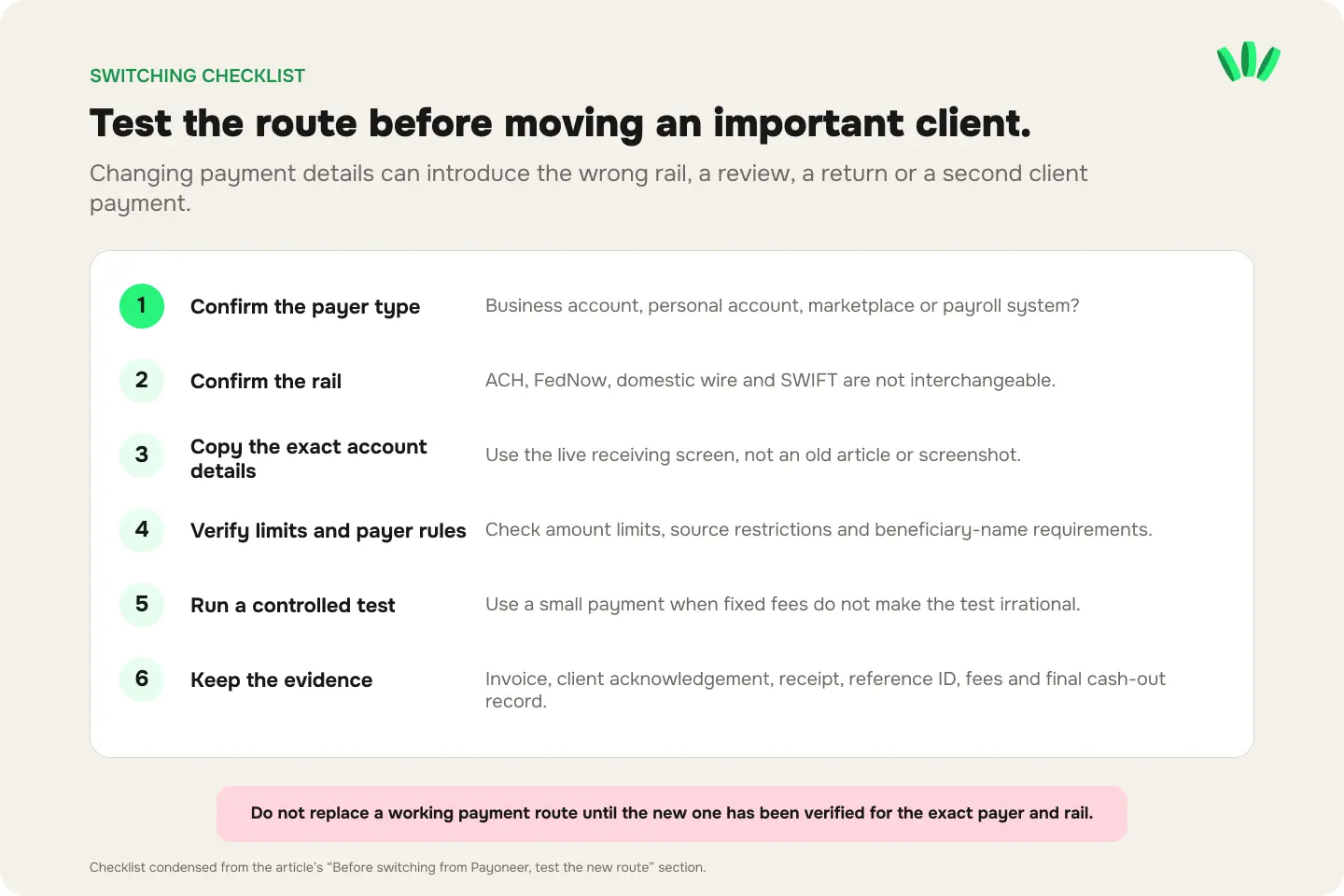
A mistake can put an invoice into the wrong bank rail, create a compliance review or make a client resend money. Before moving an important client:
Confirm the payer type.
Is the money coming from a business bank account, personal account, marketplace or payroll system?Confirm the rail.
ACH, FedNow, domestic wire and SWIFT are not interchangeable.Check the beneficiary details exactly.
Use the name and account instructions shown by the provider.Read the deposit policy.
Check third-party-payment rules, limits and prohibited payment types.Compare the complete quote.
Include receiving, FX, conversion and cash-out.Test the route before moving recurring income where practical.
A successful small payment verifies more than a feature list.Save the evidence.
Keep the invoice, account instructions, payer receipt and payment reference.Do not close your old route immediately.
Keep a working fallback until the replacement has completed a real payment end to end.
A backup route is especially useful for freelancers because one account restriction should not be able to stop every international payment you receive. The same principle appears in walllet.com's payment-risk guidance: understand where the route can fail and maintain enough evidence to trace the payment.
So, what is the best Payoneer alternative in Nigeria?
For a Nigerian freelancer, the answer depends on the payment source.
Grey deserves comparison when multi-currency receiving and a transparent USD-to-naira route matter.
Raenest stands out when you need several USD rails, including ACH, domestic wire and SWIFT.
Cleva is especially relevant for US-origin payments and platforms, but not if non-US SWIFT is essential.
nsave is worth comparing for ACH-heavy USD income with a separate SWIFT option.
Hurupay offers a broad advertised set of global receiving routes, but current Nigeria-specific availability and pricing should be verified before moving recurring income.
Chipper Cash is narrower but relevant when its US receiving route matches the payer.
walllet.com is most relevant when the problem extends beyond receiving money and you want supported receiving, USD holding, spending and naira access connected inside one income-management flow.
Payoneer itself can still win when native marketplace integration removes more friction than switching would save.
The provider name is the last part of the decision.
Start with the payer, the rail and the final destination of the money.

If your goal is to receive global income, keep part of it in dollars, spend online and move what you need to naira without stitching together several separate apps, check the payment routes currently available in walllet.com.
