
The main Wise alternatives to consider in Nigeria are walllet.com, Grey, Raenest, Cleva and Payoneer. The right choice depends on whether you need foreign-currency receiving details, a balance you can hold, online spending or naira withdrawals. As of 1 October 2026, Nigeria is absent from Wise’s published list of countries where residents can hold money. That limitation is separate from an overseas sender using Wise to pay a Nigerian bank account.
A client saying “I’ll pay you with Wise” does not automatically mean you need your own Wise account. You may need a supported bank destination, or receiving details from another provider. The distinction can save you an unnecessary account change.
This guide compares substitutes for the functions Nigerian earners look for in Wise. For the broader starting point, see how to receive USD in Nigeria without PayPal.
Your client using Wise does not mean you need Wise.
If what you actually need is a way to receive global income in Nigeria, check the receiving options available through walllet.com before changing your client’s payment setup. Check how you can receive the payment

Does Wise work in Nigeria in 2026?
Wise can be part of a payment into Nigeria, but that does not establish access to the full Wise account for a Nigerian resident.
Wise’s official residency eligibility list does not include Nigeria. It also says older accounts can have different features from new accounts. A screenshot from someone else’s account is therefore a poor basis for deciding what you can open today.
Residence matters. A Nigerian citizen genuinely living in an eligible country may have different access from someone living in Nigeria. Use your actual residence and documents when applying.

Separately, Wise’s NGN transfer guide describes sending naira to personal and business bank accounts in Nigeria. It requires the recipient’s name, bank code and ten-digit account number. The sender should check the live quote and delivery estimate for their specific corridor.
There are two different decisions here:
What you need | What to check |
|---|---|
A client pays you naira through Wise | Whether the sender’s Wise transfer supports your Nigerian bank destination and payment purpose |
You receive and hold USD, GBP or EUR before converting | A receiving provider available to Nigerian residents, with the currency and rail you need |
A client uses Wise to pay your alternative provider | Whether Wise permits that destination and the receiving provider accepts that sender and transfer type |
If naira is all you need, a supported direct Wise payment may already solve the job. If you want to retain foreign-currency value or pay overseas expenses later, evaluate a receiving account and what happens after the payment arrives.
Which Wise alternatives in Nigeria should you shortlist?
Start with the currency you want to keep and the way your client pays. These five options overlap, but their receiving details and balance behaviour differ.
Alternative | Most useful reason to consider it | USD, GBP and EUR considerations | What to check before choosing |
|---|---|---|---|
walllet.com | Managing overseas income through receiving, holding supported dollar-linked value, card spending and naira cash-out | Advertises receiving details for all three currencies, subject to approval and provider terms; its account page describes settlement into USDC | Your enabled incoming rail, settlement asset, applicable fee and complete payout quote |
Grey | Receiving and managing USD, GBP and EUR through local account details | Documents USD ACH/FedNow/Fedwire, GBP FPS/Bacs/CHAPS and EUR SEPA/SEPA Instant | The rail your payer will use; deposit, conversion and withdrawal costs |
Raenest, formerly Geegpay | Multi-currency receiving and Nigerian bank payouts | Offers USD, GBP and EUR receiving; Nigeria-specific pricing differs from its general USD article | Applicable account pricing, payer restrictions and conversion quote |
Cleva | USD-focused income, including approved platform payouts | Now offers GBP/EUR receiving details too, but those deposits are automatically converted to USD | Whether automatic USD conversion suits you and whether your payer type is permitted |
Payoneer | Business or marketplace payments where the payer already supports Payoneer | Advertises local receiving details including USD, GBP and EUR, subject to eligibility | Available receiving accounts, platform acceptance, withdrawal charges and annual fees |
This is a shortlist by use case, not a speed or reliability ranking. The underlying asset, transfer route and account terms matter more than the number of currencies on a homepage. Use the virtual USD account checklist before moving a recurring payment.
walllet.com for income you need to use after receiving it
walllet.com is worth checking when getting paid is only the first part of the job. A freelancer may want to leave some income dollar-linked, pay for work tools and withdraw the portion needed for local bills.
Its receiving-account product page advertises USD, EUR and GBP details in the user’s name and describes incoming funds landing in a USDC balance. USDC is a dollar-linked stablecoin; it is different from holding a conventional USD bank deposit. For GBP or EUR income, confirm the conversion rate and settlement amount rather than assuming you will retain a separate pound or euro balance.
The attraction is a connected income flow. You can assess receiving, supported balance holding, card access and naira withdrawal together, instead of selecting a receiver first and working out the rest later. Grey, Raenest and Cleva also offer spending or withdrawal tools, so this is a workflow to compare, not an exclusive feature claim.
For eligible accounts, walllet.com’s guide to receiving payments from US, UK and EU clients publishes a $5 account issuance fee and a 1% fee for supported incoming USD. Do not apply that USD percentage to GBP or EUR without checking their terms.
walllet.com is a fintech company, not a bank. Account, card and payment services involve partners. Its Terms of Service distinguish the wallet from third-party financial services. Self-custody of supported crypto assets does not remove compliance checks or restrictions from partner-managed receiving and payout services.
Grey for keeping different foreign-currency balances
Grey deserves a place on the shortlist when retaining pounds or euros matters. Its account guide describes US, UK and EU receiving details, multi-currency functionality and a virtual dollar card.
Specify the payment method when comparing charges. A UK payer using Faster Payments and another using CHAPS can produce very different deposit fees, even when both send GBP. The same applies to a US client choosing ACH or Fedwire.
If you receive EUR and have an upcoming EUR expense, check whether you can make the required payment from that balance. Receiving euros, holding euros and paying a euro invoice are separate capabilities.
Raenest for multi-currency receipts and local payouts
Raenest is another relevant option for Nigerian earners receiving USD, GBP and EUR. Its personal receiving-account setup guide covers the three currencies and the application process.
The pricing needs care. Its Nigeria-specific fee table lists tiered flat USD ACH charges, while another official USD page gives a percentage charge. Confirm the schedule attached to your own account before asking a client to pay.
Also distinguish a free NGN bank transfer from free conversion. Even when a provider charges nothing to send an existing naira balance, converting foreign-currency income can still cost money.
Cleva for income you ultimately want in USD
Cleva now lets approved users request USD, GBP and EUR receiving details. Older descriptions of Cleva as offering only USD receiving details can miss this change.
However, Cleva’s GBP deposit guide says incoming pounds are automatically converted and credited to the USD wallet. Its pricing page describes the same automatic conversion for euro deposits.
That can suit someone who invoices in different currencies but budgets in dollars. It is less suitable if your reason for replacing Wise is to keep GBP or EUR unchanged.
Payer restrictions also differ by currency. Cleva’s deposit policy permits personal-bank third-party USD deposits up to a total of $1,000 daily, while personal-bank third-party GBP/EUR deposits are unsupported. The policy separately identifies supported platform payments. Check how your client’s payment will be classified, especially if they pay through Wise rather than directly from a bank.
Payoneer when the platform or business already uses it
Payoneer can be the practical substitute when a marketplace, employer or business already offers it as a payout method. Its receiving-accounts documentation lists USD, GBP and EUR local details among its supported currencies.
Choose it based on the actual payment workflow available to your account. A platform integration, a payment request and a local bank transfer do not necessarily carry the same fees or sender rules.
Payoneer’s current pricing page lists a $29.95 annual account fee when receipts are below $6,000 or equivalent over twelve consecutive months, with stated plan exceptions. Account-specific terms may differ. It separately lists a $29.95 annual card fee. Receiving money and owning a card are different services; do not combine those charges into one universal fee.
What does it cost to receive a $1,000 payment?
For an ordinary direct-client receipt, the published receiving charges below produce different balances before conversion. These figures are not naira cash-out quotes.
Provider and supported receipt route | Published receiving charge | $100 received | $500 received | $1,000 received |
|---|---|---|---|---|
walllet.com supported USD bank route | 1%; $5 account issuance charged separately | $99 | $495 | $990 |
Grey ACH or FedNow | 0.8%; $2 minimum, $10 maximum | $98 | $496 | $992 |
Raenest ACH, using its Nigeria table | $2 below $500; $4 from $500 | $98 | $496 | $996 |
Cleva ACH or FedNow | 0.8%; $2 minimum, $5 maximum | $98 | $496 | $995 |
Calculated from published schedules checked on 1 October 2026. Assumes the stated gross amount reaches the receiving route and the fee is deducted from it. Excludes sender, platform, intermediary, issuance, FX, conversion and payout charges. Figures assume an approved ordinary receipt, not a special platform exemption.
Grey’s full deposit schedule also lists $20 for Fedwire, 0.8% for EUR SEPA/SEPA Instant and GBP FPS with respective 2-unit minimums and 10-unit maximums, £15 for Bacs and £25 for CHAPS.
Raenest’s Nigeria fee table lists $10 for USD wire, 0.8% for GBP/EUR receipts with respective 1.50-unit minimums and 10-unit maximums, and ₦0 for Nigerian bank payouts. It says conversion is charged separately. Its examples show $1 ACH charges that contradict the table, and its general USD account article states 0.8%, capped at $12. The calculations above use the country-specific table; verify the applicable charge in-app.
Cleva’s published pricing lists a $10 wire deposit fee and no Cleva receiving fee for Upwork deposits. That exemption does not establish that the platform itself charges nothing. Its GBP/EUR deposits attract 0.8%, with a displayed $2 minimum and $10 maximum, and automatic conversion to USD. Ask how the deposit fee and exchange rate apply to the original currency amount.
Payoneer is excluded from the fixed receipt calculations because a single assumed percentage would hide differences between payment methods and account terms.

At $1,000, walllet.com’s published USD receipt fee is $10, Grey’s is $8 and Cleva’s is $5. Raenest’s Nigeria table gives $4, subject to the inconsistency above. walllet.com is therefore not the lowest published receiving-fee option in this example. Its case rests on whether the complete receive-to-use workflow fits your income and expenses.
For a fuller cost breakdown, see what a $1,000 freelance payment really costs.
Which payment details should you send a US, UK or EU client?
The currency label alone is insufficient. Your receiving account must accept the payment rail and payer type your client uses.
Client’s proposed payment | Details normally required | Essential check |
|---|---|---|
USD through US ACH | Exact beneficiary name, ACH routing number and account number | Incoming ACH is enabled and the payer is accepted |
USD through domestic wire | Beneficiary name, wire routing number and account number; bank details as requested | The wire instructions are correct for this account |
GBP through a UK local transfer | Beneficiary name, sort code and account number; reference | FPS, Bacs or CHAPS support and the fee for that rail |
EUR through SEPA | Beneficiary name, IBAN and reference; BIC if requested | EUR SEPA receipts are enabled |
International SWIFT payment | Provider-issued SWIFT instructions, including beneficiary and bank information | That exact currency and incoming international route are accepted |
Copy the provider’s instructions exactly. Do not substitute a wire routing number for an ACH routing number or infer SWIFT support from the presence of a BIC.
A USD account held outside the United States may accept dollars through SWIFT without accepting US domestic ACH. Similarly, an IBAN identifies an account; it does not prove every currency or payment type can reach it. The ACH versus wire guide for Nigerian freelancers explains the difference before you put details on an invoice.
If a client uses Wise, ask them to select the transfer method accepted by your receiving provider. A payment originating in Wise can still be rejected if the destination, sender classification, purpose or currency is unsupported.
How do you compare the final naira amount?
Compare the naira expected to reach your bank for the same starting payment, at roughly the same time. A smaller deposit fee can be outweighed by a different conversion rate or payout charge.
Record these fields for each route:
Gross amount and currency sent by the client.
Any sender or platform deductions before it reaches you.
Receiving fee and net balance credited.
Any automatic currency conversion or settlement into another asset.
Amount you plan to convert.
Executable exchange rate, explicit conversion charges and payout fee.
Final NGN amount, quote expiry and expected delivery.
If all deductions are expressed in the source currency before conversion, the calculation is:
Final NGN = (amount available − source-currency charges) × quoted rate − NGN payout charges.
Providers may apply percentage charges at different stages. Follow the order shown in the quote and avoid counting an embedded cost twice.
A lower receiving fee does not necessarily leave you with more naira.
Check the full walllet.com route from receiving your income to spending it or cashing out, then compare the final amount and fees with the alternatives above. Check my full receive-to-cash-out route

A worked example with illustrative rates
Suppose two approved routes receive the same $1,000 payment. These are teaching figures, not current provider quotes.
Item | Route A | Route B |
|---|---|---|
Gross receipt | $1,000 | $1,000 |
Receiving fee | $5 | $10 |
Balance available | $995 | $990 |
Conversion fee deducted before FX | 1% of $995 = $9.95 | $0 |
Executable rate | ₦1,600 per dollar | ₦1,620 per dollar |
NGN payout charge | ₦0 | ₦500 |
Final bank credit | ₦1,576,080 | ₦1,603,300 |
Route B delivers ₦27,220 more despite charging more to receive the payment. The calculation does not establish which real provider will give the better quote today.
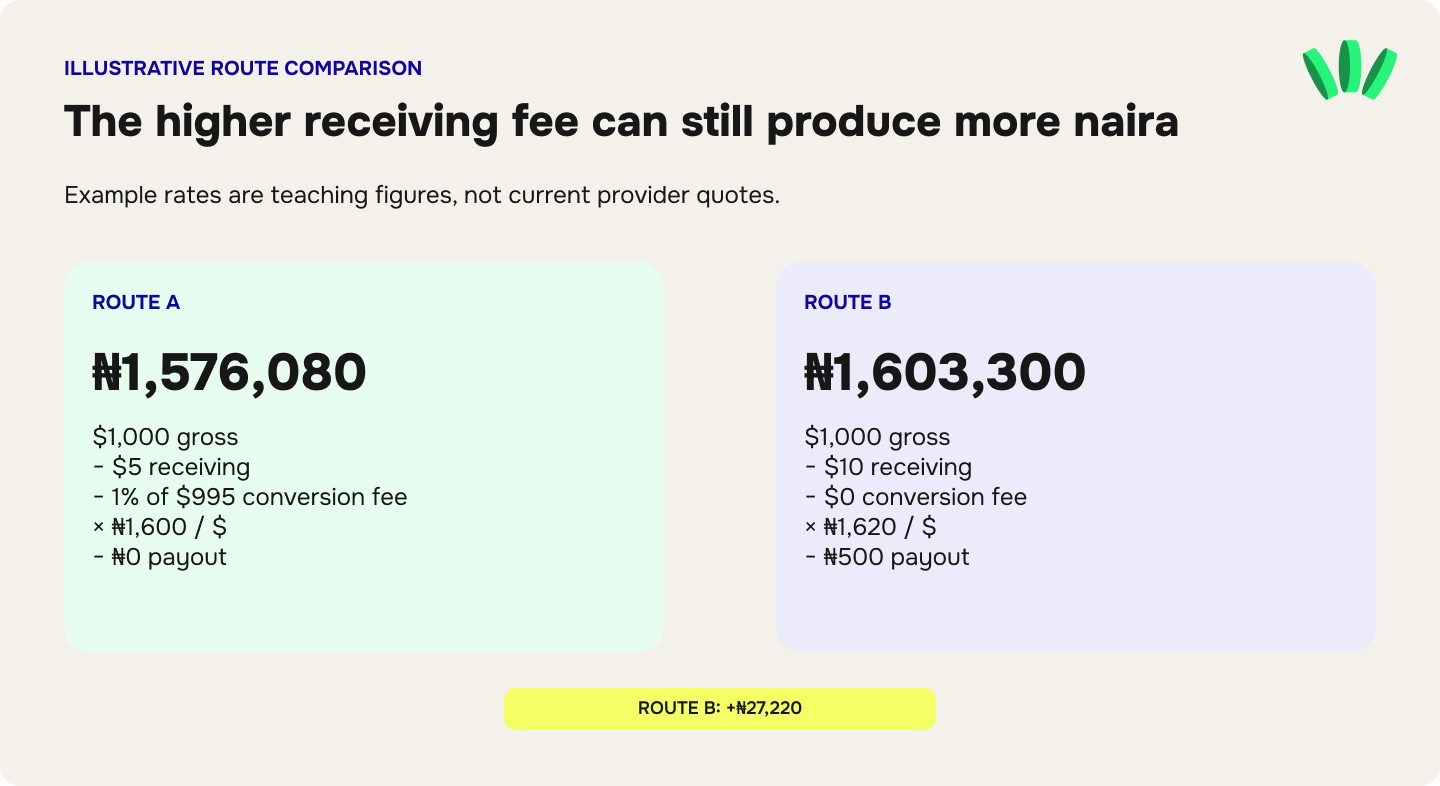
walllet.com’s naira cash-out guide publishes a 0.5% off-ramp fee, separate from the executable exchange rate. Its homepage calculator also displays separate conversion and withdrawal charge fields. Do not treat 0.5% as a universal all-in cost across every receiving and withdrawal route. Check the complete live quote for the balance you hold.
Check walllet.com’s receiving, spending and naira cash-out options for your income.
Should you keep USD, GBP or EUR after getting paid?
Choose the holding currency according to your upcoming expenses and the product’s actual balance structure. Receiving a currency does not always mean retaining it.
For example, a UK client may pay £1,000, but an account that converts every receipt to USD leaves you exposed to a later USD-to-GBP conversion if you need pounds again. That may be acceptable if your main foreign expenses are in dollars. It is an extra step if you are deliberately saving for a GBP obligation.
Grey and Raenest are relevant candidates when separate currency balances matter. Cleva’s current GBP/EUR routes convert to USD. walllet.com’s receiving page describes USDC settlement. Payoneer’s available balances and payment functions depend on the accounts approved for you.
Keeping dollar-linked value can also let you convert only the portion needed for Nigerian expenses. It does not guarantee that your balance will appreciate against naira or remain accessible without interruption.

A stablecoin balance adds issuer, redemption, blockchain and wallet risks. A bank or payment-provider balance has different custody, protection and access rules. Check what asset you own and which entity is responsible for each service.
What if you also need a card for online payments?
Evaluate the card separately from receiving fees. An attractive deposit rate does not tell you what a subscription or international purchase will cost.
Grey, Raenest, Cleva, Payoneer and walllet.com advertise card services, subject to their respective eligibility and availability. Compare issuance, recurring charges, funding fees, payment fees and foreign-currency charges. Check whether a card spends from the balance you hold or requires another conversion first.
Test your important merchant with a modest legitimate purchase. Check recurring billing support and how refunds are credited. A card can work at one merchant and be declined at another because of issuer rules, merchant restrictions or authentication requirements.
For someone replacing Wise because they want one routine for client receipts and work expenses, this is where walllet.com merits a closer look: assess its receiving route, supported dollar-linked balance, card and bank payout as one monthly workflow. Compare that workflow against the same complete journey elsewhere.
How long will receiving and naira withdrawal take?
Track incoming payment, compliance review, balance availability and bank payout separately. The advertised speed of one stage is not the total time from your client pressing send to usable money.
A payment can be delayed by banking hours, holidays, the chosen rail, incorrect details, payer restrictions or an evidence request. Conversion and local payout can add their own waiting time. A weekend bank transfer and an already-available balance withdrawn locally have different starting points.
Before switching, obtain the estimated arrival time for your exact incoming route and ask when the credited balance becomes available to spend or withdraw. Then check the payout estimate separately.
If timing is business-critical, use a route you have tested and maintain enough accessible local funds for expenses that fall due during a delay. The guide to choosing a primary and backup payment route helps you avoid depending on one untested account.
How do you switch from Wise without disrupting client payments?
Move one payment through the replacement before changing every client’s instructions. A completed test should include the incoming receipt and the way you intend to use or withdraw it.
Confirm Nigerian-resident eligibility. Apply using your real identity, address and intended account use. Complete the required verification and wait for receiving details to become active.
Confirm the payer and rail. Tell the provider whether payment comes from a company, an individual, Wise or a marketplace. Check the currency, amount, limits and payment purpose.
Check the beneficiary name. Use the exact name on the approved receiving details. For a platform payout, verify that its name-matching rules accept the account.
Send revised instructions securely. Include the currency, permitted transfer method, exact account details and invoice reference. Confirm sensitive changes through an established contact channel.
Run a permitted small test. Respect deposit minimums and platform rules. Record gross sent, net credited and any deductions.
Test the final use. Withdraw some naira or make the intended supported purchase. Confirm the bank credit or completed payment, not merely a “processing” status.
Move recurring receipts gradually. Update invoices, payroll and approved platform destinations after the route works. Keep a verified backup.
Preserve invoices, contracts, payer details, receipts and conversion records. An account change should not break the evidence connecting your work to your income. The freelancer income and source-of-funds evidence guide explains which records answer different verification questions.
What should you do if a payment is delayed, rejected or returned?
Identify the stage where the payment stopped before requesting another transfer. Sending again while the first payment is unresolved can create a duplicate receipt.
Problem | First check | Evidence to provide through official support |
|---|---|---|
Client says paid, but nothing arrived | Whether it was executed rather than scheduled; destination and rail | Sender receipt, date, amount, reference and transfer identifier |
Payment is under review | Whether the payer, amount or purpose needs additional explanation | Invoice, contract and requested source-of-funds records |
Deposit was rejected | Supported currency, sender classification, beneficiary name and account status | Original instructions and rejection message |
Payment was returned | Original debit, return reference and whether deductions occurred | Sender and recipient transaction records |
NGN withdrawal is pending | Destination account, payout reference and current provider estimate | Withdrawal receipt and transaction ID |
Less money arrived than expected | Each stage’s actual deductions and rate | Gross receipt, fee entries, conversion record and bank credit |
Use the provider’s official channels. A payment receipt helps support trace a transfer; it does not prove the recipient has cleared funds. Remove unrelated private information from documents where permitted, while retaining the fields requested for the review.
Which alternative fits your particular Wise problem?
Choose a replacement for the missing function, then test the rest of the income flow.
Your situation | Sensible shortlist or route | Deciding check |
|---|---|---|
A client wants to use Wise and you need naira immediately | A supported direct Wise-to-Nigerian-bank payment | Sender’s live corridor, permitted purpose and final NGN quote |
You earn in several currencies and want to retain GBP/EUR | Grey, Raenest; Payoneer where the required balances and payments are enabled | Separate currency holding and the ability to make your intended outgoing payment |
You earn abroad, pay for online tools and cash out part of your income | walllet.com alongside the other providers’ complete workflows | Receiving eligibility, settlement asset, card costs and final bank credit |
Your platform already offers Payoneer | Payoneer | Platform-specific charges, account approval and withdrawal economics |
You want GBP/EUR receipts consolidated into USD | Cleva; assess walllet.com’s USDC settlement if that asset fits your needs | Automatic conversion rate, permitted payer and settlement terms |
You require a conventional bank-held foreign-currency account | A Nigerian bank’s domiciliary account, assessed separately | Bank requirements, SWIFT costs and compatibility with the sender |
If you want to expand the shortlist beyond replacing Wise, the broader comparison of freelancer receiving providers covers that separate decision.
Do not replace Wise with another app just because it can receive the payment.
Choose a route that also fits what happens next: holding your income, paying online, converting what you need and cashing out to your Nigerian bank. See if walllet.com fits my whole income flow

