USDT on Base can be useful.
Then comes the part people learn too late: USDT is not one single thing across every network. USDT on Base is different from USDT on Tron, Ethereum, BNB Chain, Arbitrum, or any other chain. Same ticker. Different network. Different route. Different ways to lose money if someone guesses wrong.
If you’re using stablecoins because your local currency is unstable, because a client wants to pay you in crypto, or because you want dollar-like value outside an exchange, this matters. A lot.
If you’re still learning why people use stablecoins in high-inflation countries, read walllet’s guide to stablecoin wallets for inflation. If your main worry is choosing the right chain, start with this guide on the best network to send USDT or USDC.
For this article, we’ll stay focused on one job: how to hold USDT on Base safely without getting trapped by network, gas, approval, or wallet mistakes.
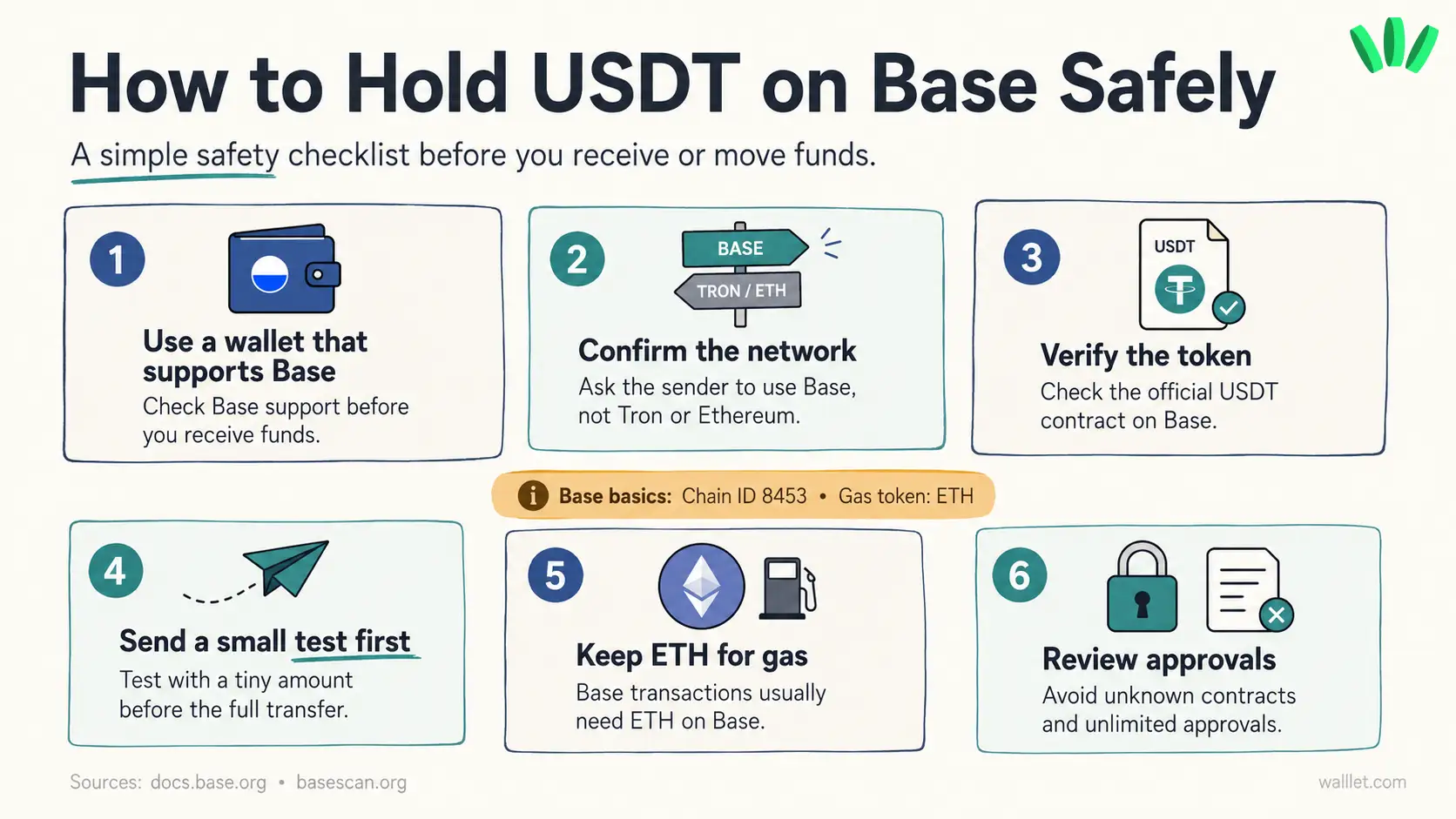
To safely hold USDT on Base, use a wallet that supports Base, confirm the token contract and network before receiving funds, send a small test transfer first, keep a way to pay Base gas, avoid unknown approvals, and never send Base USDT to another network unless you are using a trusted bridge or supported exchange route.
TL;DR
USDT on Base can be a useful way to receive and hold dollar-like value, especially for freelancers and everyday stablecoin users, but it is only safe if the network, token, wallet, and gas setup are correct.
Before receiving USDT on Base, make sure your wallet supports Base, confirm the sender is using the Base network, verify the correct token contract, and ask for a small test transfer first. Do not assume that USDT on Tron, Ethereum, BNB Chain, or another network can be sent to the same route.
Base usually requires ETH on Base for gas, even when you are moving USDT. You should also avoid unknown approvals, fake USDT tokens, random wallet-drainer links, and keeping your full stablecoin balance in one hot wallet.
The safest workflow is simple: confirm the network, test with a small amount, check the token, keep gas ready, separate daily funds from larger balances, and only move more once the first transfer looks right.
What is USDT on Base?
USDT is a dollar-pegged stablecoin issued by Tether. It is designed to track the value of the US dollar. It is still a crypto asset. It is not a bank deposit, not insured cash, and not magically free from risk.
Base is an Ethereum Layer 2 network. Base’s official docs list Base Mainnet with chain ID 8453, ETH as the native currency symbol, and BaseScan as the block explorer. You can check the official network details in the Base documentation.
USDT on Base means USDT that exists on the Base network. As of May 2026, BaseScan lists the contract 0xfde4C96c8593536E31F229EA8f37b2ADa2699bb2 as Bridged Tether USD on Base. You can verify the current token page on .
That contract detail matters.
You need to check three things every time: the token, the network, and the wallet support.
Why people hold USDT on Base
People usually hold USDT on Base because they want stablecoin movement that feels cheaper, faster, and easier to use than Ethereum mainnet.
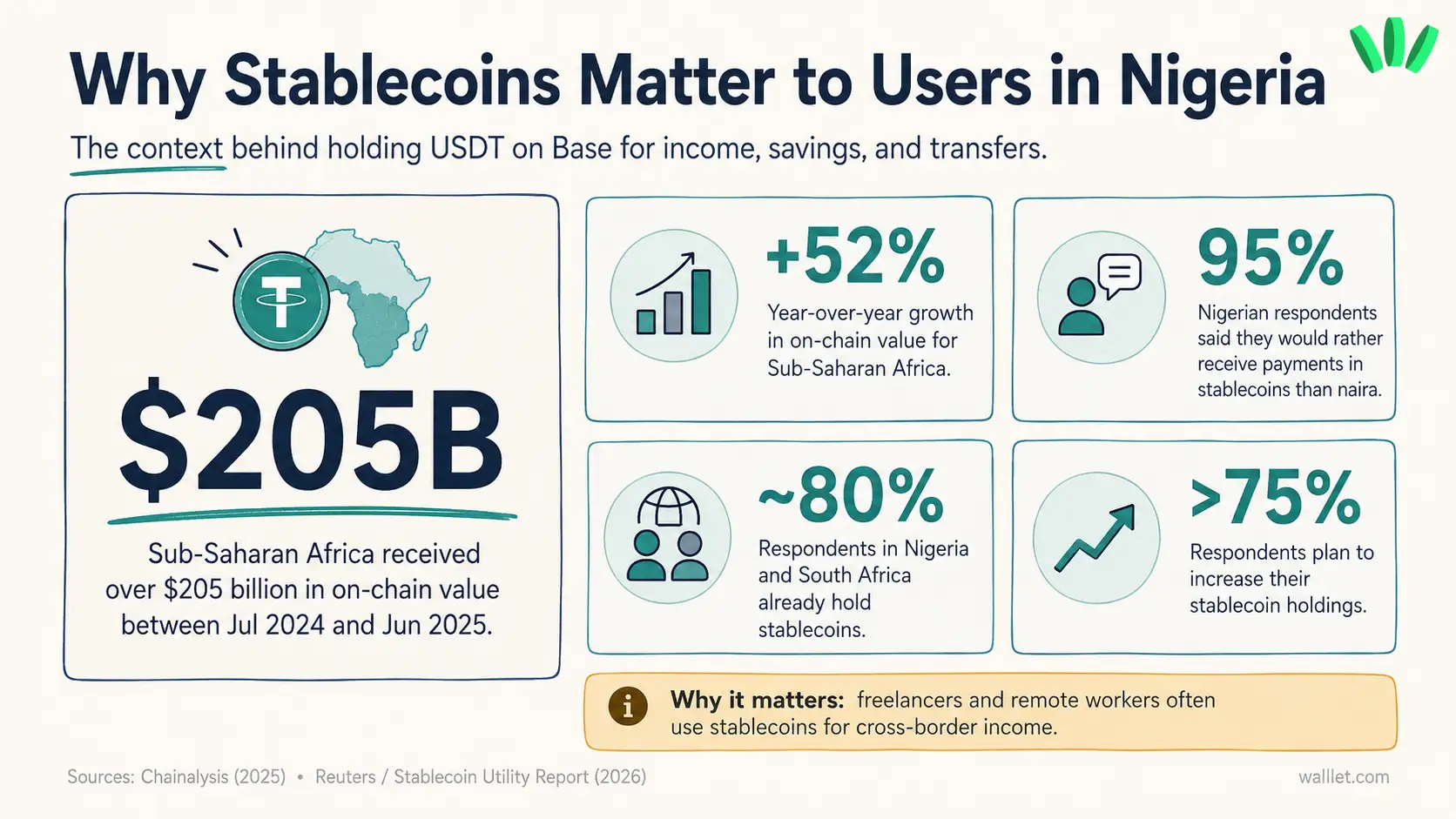
For a freelancer or remote worker, especially in a market like Nigeria, the reason can be even more practical. A client wants to pay in USDT. The freelancer wants dollar-like value. They may not want to keep everything on an exchange. They want access to the money later. For rent. Bills. Savings. Spending. Whatever comes next.
That’s the real use case.
Not “exploring Web3.” Not “engaging with an ecosystem.” Spare us.
Just: Can I receive this money, keep control of it, and not lose it because of one dumb wallet mistake?
If this is about getting paid as a freelancer, walllet has a more specific guide on how to get paid in USDT or USDC as a freelancer. Read that before sending payment instructions to a client.
The safest way to hold USDT on Base
Before you receive or hold USDT on Base, use this as your basic safety check.
Safety check | Why it matters |
Use a wallet that supports Base | If your wallet does not support Base properly, the funds may not show clearly or may be hard to move. |
Confirm the sender is using Base | USDT on Base is not the same route as USDT on Tron, Ethereum, or BNB Chain. |
Verify the token contract | Fake tokens can copy the USDT name or ticker. Check trusted sources. |
Send a small test amount first | A test transfer catches mistakes before the real amount moves. |
Plan for gas | Base transactions usually need ETH on Base for gas. |
Avoid unknown approvals | A bad approval can give a contract permission to move your tokens. |
Keep daily funds separate | A wallet used for everyday transactions should not hold your full balance. |
That’s the whole starting point.
Small test first. Full amount later. Annoying? Slightly. Cheaper than regret? Usually.
Exchange wallet vs self-custody wallet for USDT on Base
You can hold USDT on an exchange or in your own wallet. Different jobs. Different risks. If you’re still deciding between the two, read walllet’s guide to self-custody vs exchange for everyday crypto use. For this article, here’s the short version.
Setup | Who controls the funds? | Main benefit | Main risk | Best for |
Centralized exchange | The exchange | Easy buying, selling, and conversion | Account freezes, withdrawal limits, platform risk | Trading and quick conversion |
Traditional self-custody wallet | You | Direct control | Seed phrase loss, phishing, approval mistakes, gas confusion | More experienced users |
Seedless/passkey-style wallet | You, with simpler access | Control with less seed phrase stress | You still need to confirm supported networks and assets | Everyday stablecoin users |
Hardware wallet | You | Stronger offline storage | Less convenient for frequent use | Larger long-term holdings |
A practical setup may use more than one place.
You might keep conversion funds on an exchange. Everyday stablecoin money in a self-custody wallet. Larger funds somewhere more locked down. No one setup solves every problem. Which is deeply inconvenient, and yet here we are.
How to receive USDT on Base safely
Receiving USDT on Base should feel boring. Boring is good here.
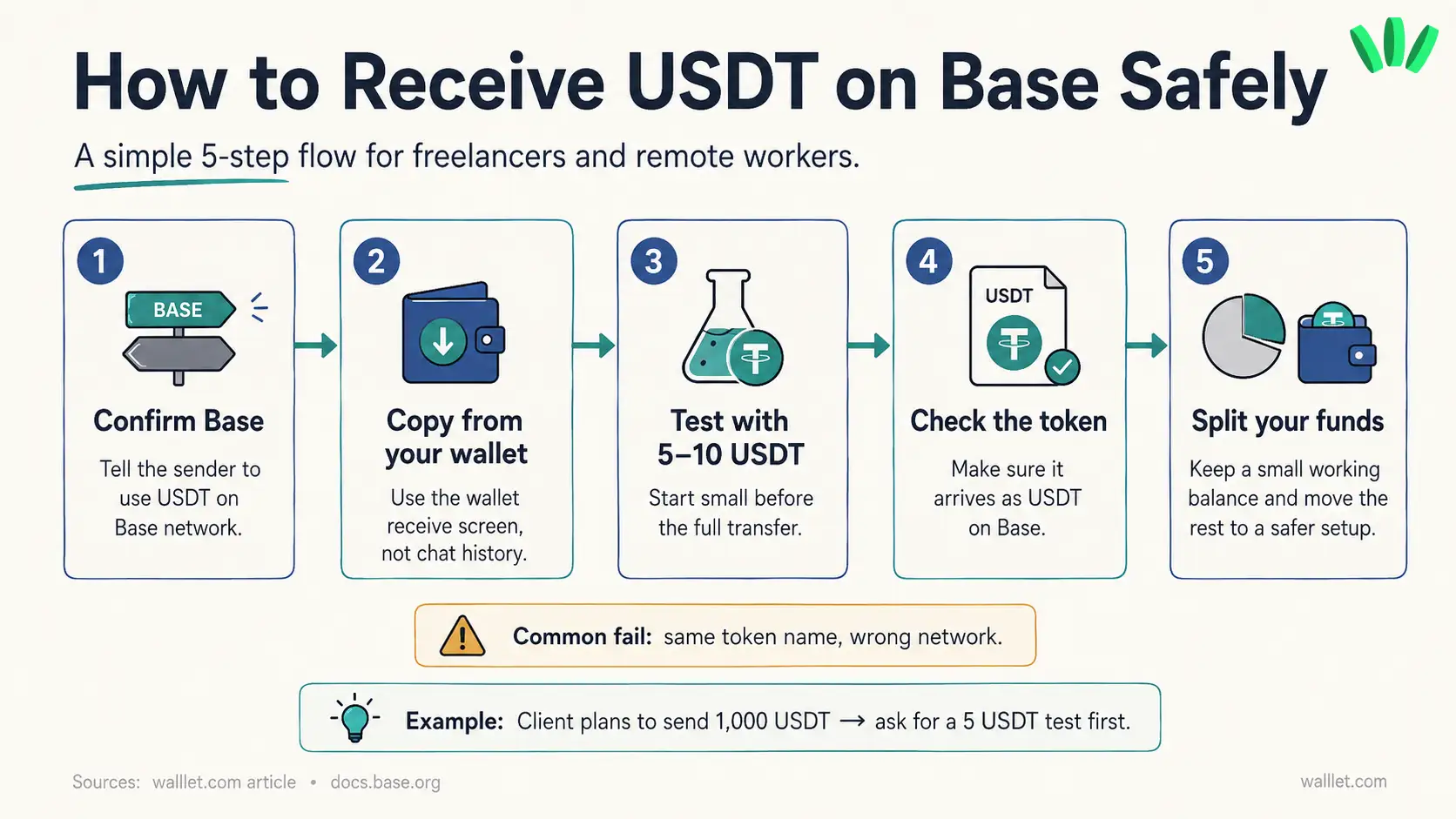
First, confirm the sender can send USDT on Base. Do not just say “send USDT.” Say the full route: “Send USDT on Base network.”
Then copy your address from your actual wallet receive screen. Not from an old chat. Not from a screenshot. Not from transaction history. Address poisoning scams can make fake addresses appear in your wallet history so they look familiar later.
Then ask for a small test transfer.
If a client wants to send 1,000 USDT, ask for 5 or 10 USDT first. Confirm that it arrives in the right wallet, on Base, as the correct token. Then receive the rest.
If the token does not show, check the transaction on BaseScan. Sometimes a wallet interface may not display a token immediately. That does not always mean the money is gone. It does mean you should slow down before importing random token contracts from random websites. That’s how a small confusion becomes a full crypto clown parade.
Common mistakes that can make USDT on Base disappear
Most stablecoin mistakes are not advanced attacks. They are normal user mistakes. Rushed. Tired. Multitasking. Copy-paste and hope.
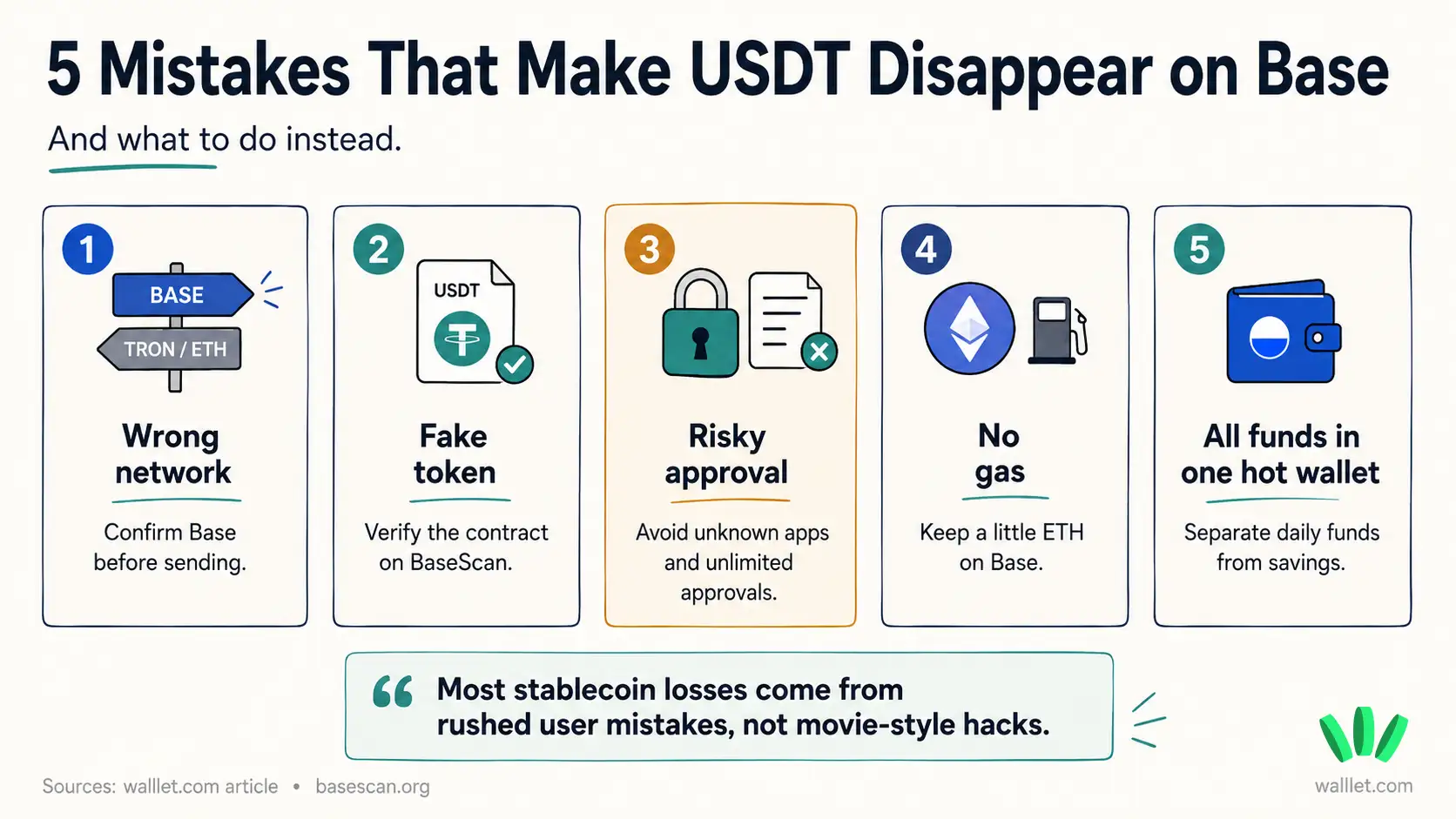
Sending USDT on the wrong network
This is the big one. USDT on Base should go to a wallet or exchange deposit route that supports USDT on Base. If an exchange supports USDT deposits on Tron, that does not mean it supports USDT deposits on Base.
Same asset name. Different path. If you send funds to the wrong network, recovery may be hard, slow, expensive, or impossible. Depends on the wallet, exchange, and chain.
Trusting a fake USDT token
Anyone can create a token with a familiar name. A fake token can appear in your wallet and pretend to be USDT.
Before trusting a token, check the contract from reliable sources. For Base, use BaseScan, your wallet’s verified asset list, or official ecosystem references. If someone sends you a contract address in a Telegram chat and says “bro it’s fine,” that is not due diligence. That is a prequel.
Signing risky approvals
A token approval can give a smart contract permission to move tokens from your wallet. Some approvals are normal. Some are dangerous. Before approving anything, check what app you are using, what it wants permission to do, and whether the approval is limited or unlimited.
If you worry about fake links, wallet-drainers, and urgent “verify your wallet” messages, read walllet’s guide on how to avoid crypto phishing.
Forgetting gas
Base uses ETH for gas. So even if you are sending USDT, you may need a small amount of ETH on Base to move it. Yes, it’s weird. You want to send dollars, the network asks for ETH. Crypto UX really saw normal payments and thought, “What if we added homework?”
Some smart wallet flows can reduce gas friction in supported cases. Still, you should understand the basic rule: moving USDT on Base usually needs gas on Base.
Keeping too much in one hot wallet
A hot wallet is useful for daily movement. It should not automatically become your vault. A safer setup is simple: keep a working balance in your daily wallet, keep larger funds somewhere less exposed, and avoid connecting your main balance to random apps.
For a broader routine, walllet’s guide on crypto wallet security best practices is worth reading before you move meaningful money.
Is USDT on Base safe?
USDT on Base can be useful. It still has risk.
There is issuer risk. USDT depends on Tether and its reserve model.
There is token and bridge risk. As of May 2026, the main USDT on Base is described publicly as bridged USDT. Bridged assets can add extra contract, liquidity, or infrastructure risk.
There is wallet risk. If you sign a malicious approval or connect to a fake app, the wallet may not be able to undo that.
There is user-error risk. Wrong network. Wrong token. Wrong address. Wrong approval. Tiny mistakes, very final consequences.
So don’t ask, “Is USDT on Base completely safe?” Ask this instead: “Which risks can I reduce before I receive or move funds?”
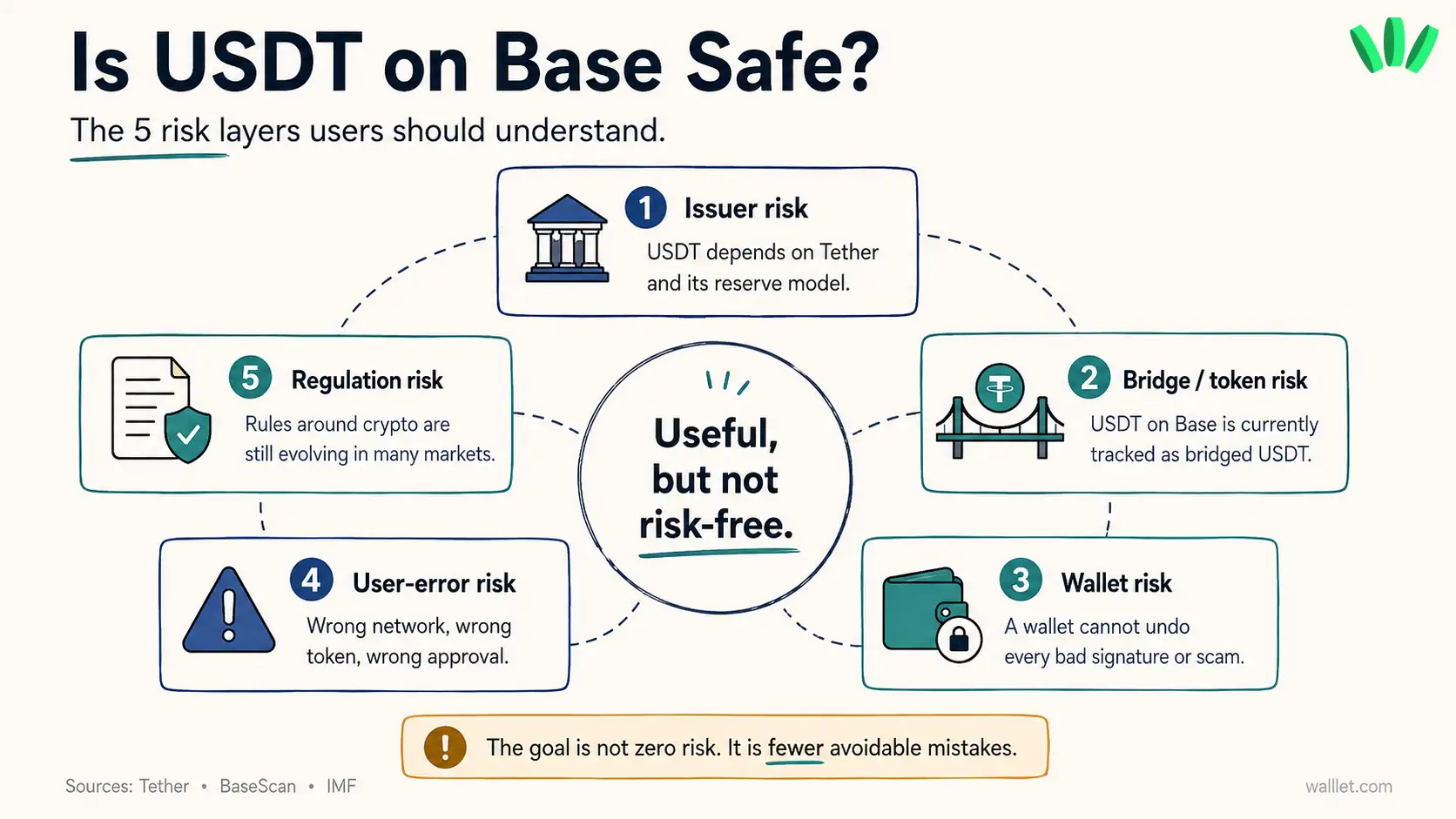
That’s the useful version.
What makes a wallet safer for holding USDT on Base?
A safer wallet for USDT on Base should help with the moments where users usually make mistakes.
The receive screen should make the network clear. The wallet should help you understand what you are signing. Risky approvals should not look like normal transfers. Access should not depend on hiding a seed phrase in a drawer and hoping future-you remembers where it went.
This is where walllet.com’s approach matters.
walllet.com is a self-custodial wallet built to make crypto feel more usable for normal people. It removes seed phrase anxiety from the experience, uses passkeys and biometrics, shows clearer transaction prompts, and warns around suspicious contracts or risky approvals.
For someone holding stablecoins, that matters because the hard part is not just “having a wallet.” The hard part is using that wallet when money is involved and your brain is already doing twelve other things.
Before using any wallet for USDT on Base, check the latest supported networks and assets inside the app. Support matters more than assumptions.
If seed phrases are the part of crypto that makes you hesitate, walllet also has a deeper guide on seedless wallet risks. Useful reading. Especially before you trust any wallet with more than a test amount.
A practical USDT on Base workflow for freelancers
Let’s say a Nigerian freelancer is getting paid 500 USDT by a remote client. They should not just send an address and hope. A better flow:
They confirm the client can send USDT on Base. They open their wallet and check that Base is supported. They copy the address from the wallet. They send payment instructions that include the token, network, address, and test-payment request.
The client sends 5 USDT first.
The freelancer checks: correct wallet, correct network, correct token.
Then the client sends the rest.
After receiving the full amount, the freelancer does not keep everything in one daily wallet. Maybe 100 USDT stays ready for near-term use. The rest goes somewhere less exposed. Fewer app connections. Less risk.
Simple. Still slightly annoying. Much better than panic.
Should you hold USDT on Base or use another network?
Base can make sense if your wallet supports it, your sender can use it, fees are reasonable, and you have a clear path to use, swap, or cash out later.
Another network may make more sense if your exchange, client, local P2P market, or spending route supports that network better.
This is where people get too theoretical.
The best network is the one that works across your actual route: sender, wallet, fees, liquidity, off-ramp, and future use. If one piece breaks, the cheap fee does not help much.
What not to do with USDT on Base
Do not send USDT on Base to a Tron-only deposit route.
Do not assume an exchange supports Base just because it supports USDT.
Do not trust a token only because it says “USDT.”
Do not approve unknown contracts with unlimited spending permission.
Do not keep your entire stablecoin balance in a wallet used for random apps.
Do not ignore gas until the moment you need to move funds.
Do not treat USDT like a risk-free bank account.
Do not move a large amount before testing a small one.
That’s the boring list. The useful one.
If you want to hold USDT on Base safely, don’t start with your full balance. Create a wallet that supports the asset and network you need. Receive a small amount of USDT or USDC first. Confirm the token. Confirm the network. Check how gas works. Review what a normal transaction looks like.
Then decide what amount belongs there.
If you use walllet.com, treat the first transfer as a test. Not a commitment. Test the flow. See if the wallet makes the scary parts clearer. If it does, move more carefully. If something feels off, stop there.
That pause is part of the setup.
