
Ethereum is easiest to understand when you stop thinking of it as “a cryptocurrency” and start seeing it as a shared computer for digital ownership.
Ethereum is a decentralized blockchain network that lets people send value, own digital assets, and use apps without relying on one company, bank, or central server. It works through nodes, validators, smart contracts, and ETH, the network’s native currency used for gas fees and network security. Ethereum powers stablecoins, DeFi, NFTs, Layer 2 networks, smart wallets, and many Web3 apps.
TL;DR
Ethereum is a public blockchain network for digital ownership, payments, apps, and smart contracts. ETH is the native currency of Ethereum. You use it to pay gas fees, and at the network level, ETH helps secure Ethereum through staking.
Smart contracts are programs that run on Ethereum. They make tokens, stablecoins, NFTs, swaps, lending, wallet rules, and many Web3 features possible.
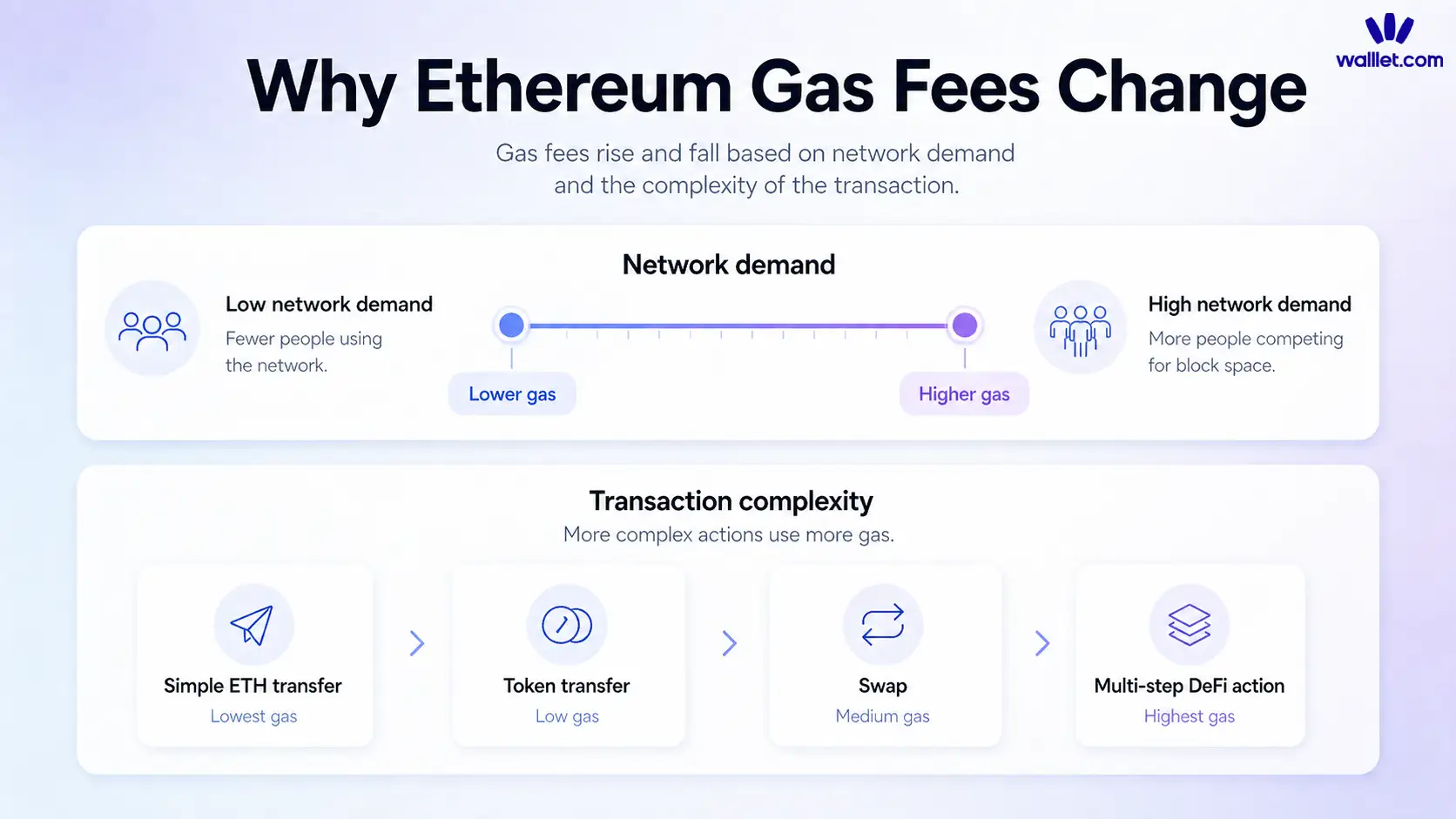
Gas fees are transaction fees. They rise and fall based on network demand, not because a wallet randomly decides the price.
Ethereum can feel complicated because users often deal with networks, fees, approvals, signatures, and recovery phrases. A wallet like walllet.com helps reduce that friction with seedless self-custody, passkeys, biometric-friendly access, clearer transaction prompts, and a more human Web3 experience.
What is Ethereum?
Ethereum is a public blockchain network and software platform. It lets people create and use digital assets, apps, and agreements that can run without one company controlling the whole system. Ethereum.org describes it as a decentralized blockchain network powered by ether, or ETH, and home to applications across DeFi, NFTs, gaming, social media, and stablecoins. That sounds big because Ethereum is big. In plain English, Ethereum is infrastructure for programmable digital ownership.
Bitcoin made it possible to send digital money without a bank. Ethereum took the same basic idea of a public blockchain and added programmable logic.
That programmable logic is what makes Ethereum different. Instead of only recording a simple transfer like “one wallet sent ETH to another wallet,” Ethereum can also run small programs called smart contracts. These programs can handle token swaps, lending, stablecoin transfers, NFT ownership, decentralized exchanges, wallet rules, and more.
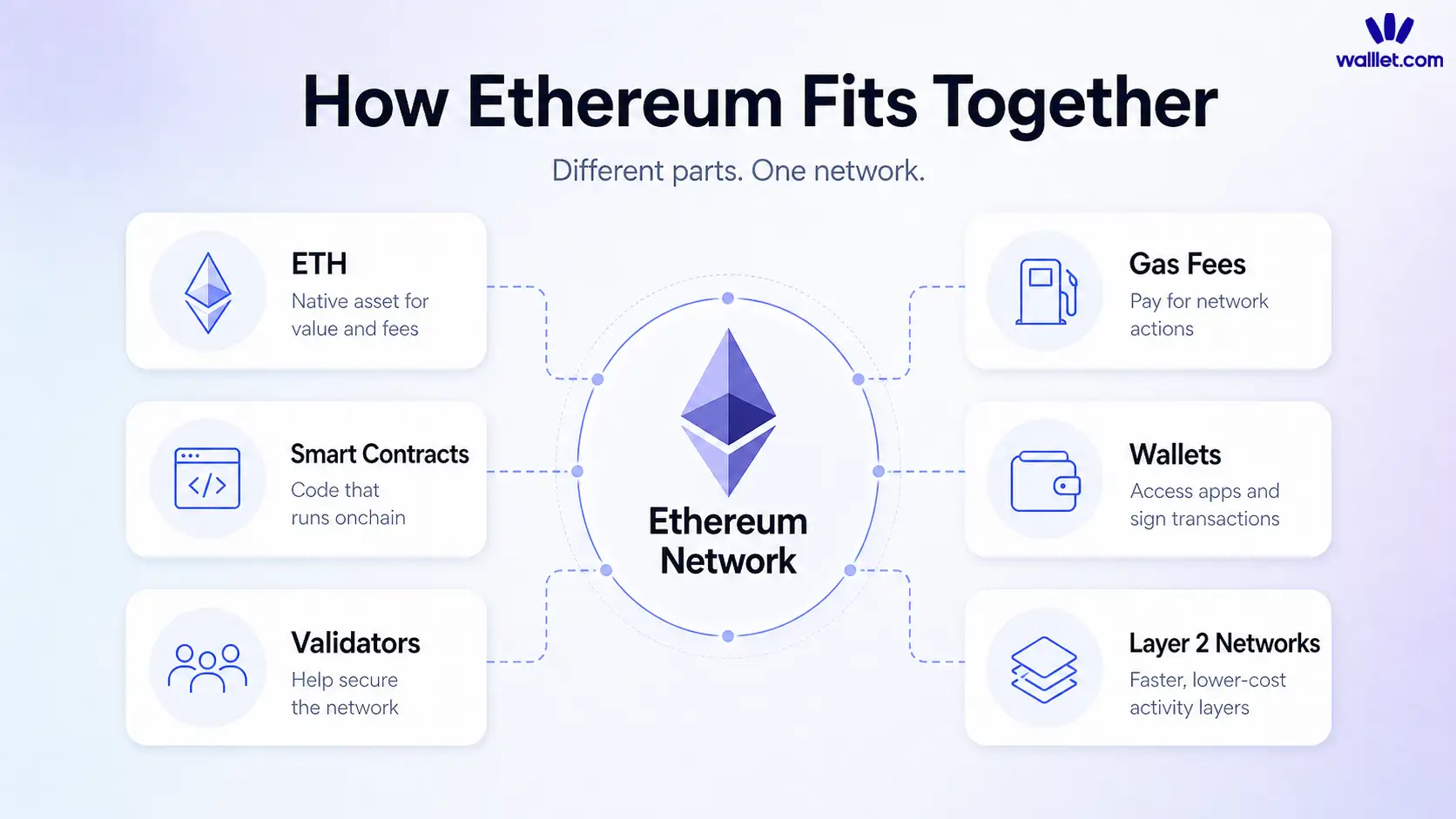
Here is the simple map:
Concept | Plain-English meaning | Why it matters |
Ethereum | A public blockchain network for apps and digital ownership | It is the base layer many Web3 apps are built on |
ETH | Ethereum’s native currency | Used to pay gas fees and help secure the network |
Smart contracts | Programs that run on Ethereum | Power tokens, DeFi, NFTs, swaps, and many Web3 apps |
Gas fees | Fees paid to use the network | They pay for transaction processing and computation |
Validators | Participants that help secure Ethereum | They propose and confirm blocks under proof of stake |
Wallets | Apps for accessing Ethereum | They let users hold assets, sign transactions, and use apps |
Layer 2s | Networks built to scale Ethereum | They make Ethereum activity faster and cheaper for many users |
The key point: Ethereum is not only a cryptocurrency. It is infrastructure.
For a wider beginner view of choosing the right wallet before using networks like Ethereum, read Best Crypto Wallet for Beginners: What to Look for Before You Download Anything.
How does Ethereum work?
Ethereum works through a network of independent computers called nodes. These nodes run Ethereum software, store data, verify transactions, and help the network agree on what has happened.
When you use Ethereum, the flow usually looks like this:
You open a wallet. You choose an action, such as sending ETH, swapping tokens, using a DeFi app, or approving a smart contract. Your wallet asks you to sign the transaction. The transaction is sent to the network. Validators check valid transactions and include them in blocks. Then the blockchain updates balances, ownership records, and smart contract states.
That last phrase, “smart contract states,” sounds technical, but it simply means the current status of an app or asset. A lending app needs to know who deposited what. A stablecoin contract needs to know who owns how many tokens. An NFT contract needs to know which wallet owns each NFT.
Ethereum keeps track of all of that on a shared public ledger.
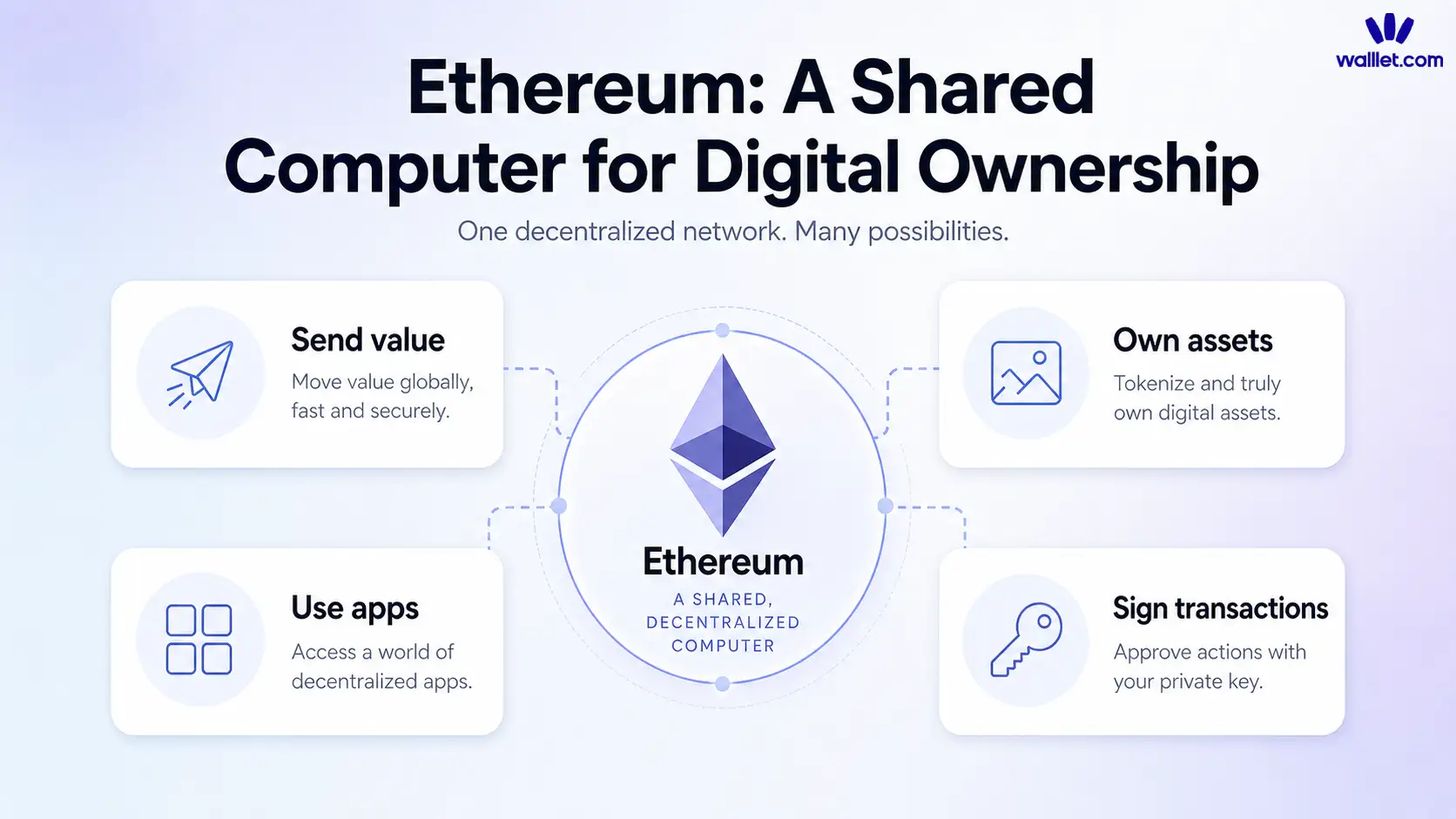
This is why your wallet matters so much. A wallet is the interface between you and Ethereum’s rules. A good wallet helps you understand what you are signing before you approve anything.
What makes Ethereum different from a normal app?
A normal app usually runs on servers controlled by one company. If that company changes the rules, shuts down the app, blocks your account, or loses data, users have limited control.
Ethereum works differently. The network is shared across many independent participants. The code and data are public. Apps can be built on top of shared infrastructure. Users can hold assets in their own wallets instead of relying entirely on a company account.
This is why Ethereum is often described as permissionless. In practical terms, developers can build on it, users can connect to apps, and assets can move across compatible platforms without asking one central gatekeeper for permission.
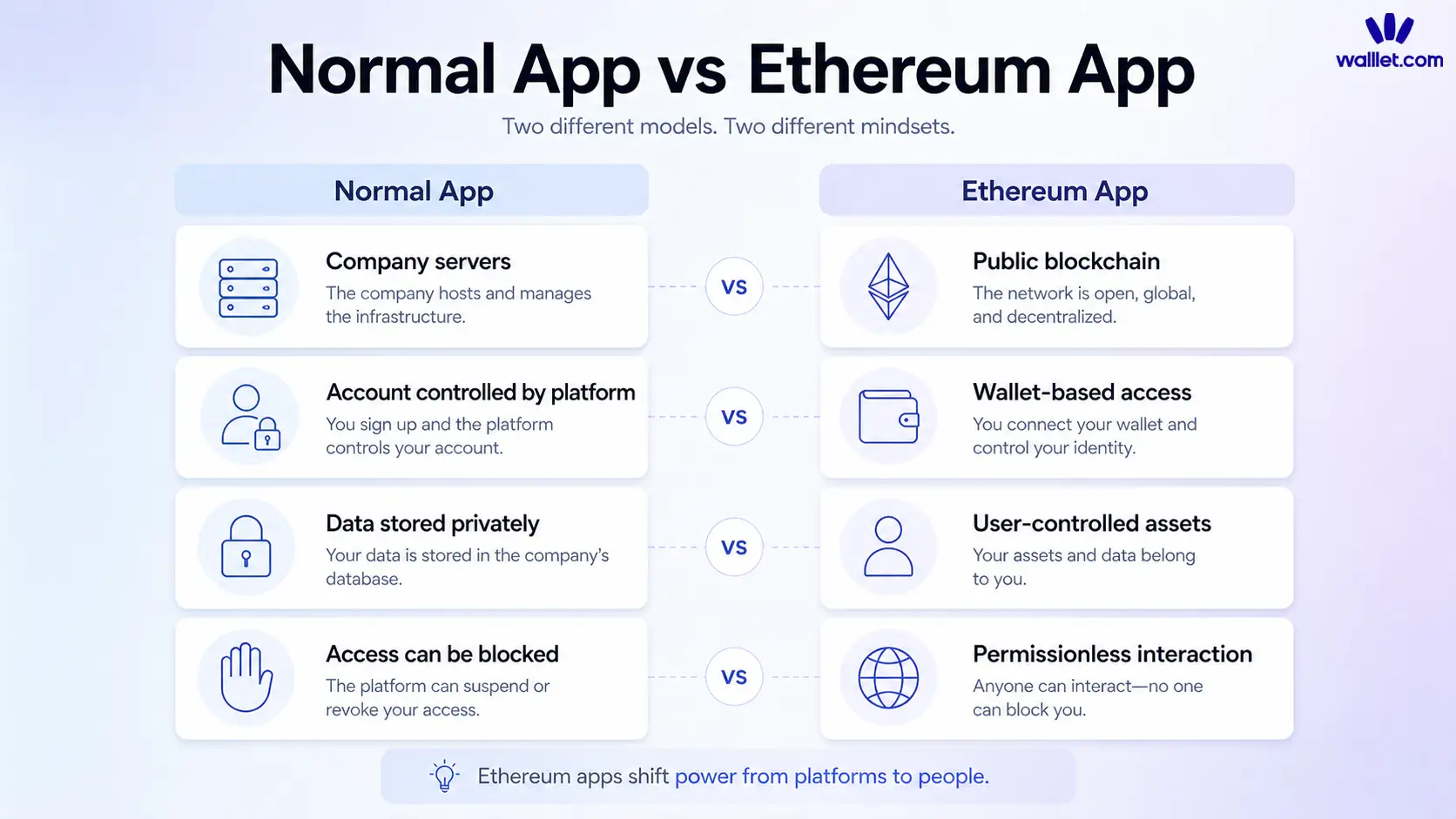
That means the trust model is different. You trust open code, cryptography, wallets, validators, smart contracts, and your own security habits more than you trust a single company database.
For normal users, this is both powerful and slightly inconvenient. Ethereum gives you control, but control without good UX can feel like being handed a spaceship with no cupholder.
That is exactly why wallet design matters.
What is ETH?
ETH, also called ether, is the native currency of Ethereum.
You can hold ETH as an asset, send it to another wallet, use it in apps, and pay Ethereum transaction fees with it. Ethereum gas fees are paid in ETH, and gas prices are commonly quoted in gwei, a tiny denomination of ETH.
ETH also plays a role in Ethereum’s security. Ethereum uses proof of stake, where validators lock up ETH to participate in securing the network. If validators act dishonestly, they can be penalized.
So ETH is not only “the Ethereum coin.” It has several jobs: it pays for transactions, helps secure the network, moves through Ethereum apps, acts as a base asset in DeFi, and serves as the native unit of value on Ethereum Mainnet.
If Ethereum is the network, ETH is the fuel and security asset inside that network.
What are smart contracts?
A smart contract is a program stored on the Ethereum blockchain. It has code, data, and an address. When someone sends a transaction to it, the smart contract can execute according to its rules.
The phrase “smart contract” can sound more legal than it really is. Most smart contracts are more like public automated rules.
A token contract tracks who owns how many tokens. A swap contract helps users trade one asset for another. A lending contract tracks deposits, loans, and collateral. An NFT contract tracks ownership of unique digital items. A wallet contract can add rules for recovery, spending limits, gas handling, or account abstraction.
Smart contracts are the reason Ethereum can support much more than simple payments. They are the little machines inside the bigger machine.
If you are exploring wallets that use smarter recovery and account logic instead of old seed phrase flows, read Best Seedless Wallets in 2026: What to Look For Before You Choose One.
What is gas on Ethereum?
Gas is the fee you pay to use Ethereum. Every action on Ethereum requires computing, storage, and validation. Gas is how the network prices that work.
A simple ETH transfer usually costs less gas than a complex DeFi transaction because it requires less computation. A token swap, NFT mint, or multi-step smart contract interaction usually needs more gas.
Gas fees can feel confusing because they change. They are affected by network demand. When many people are trying to use Ethereum at the same time, fees can rise. When demand is lower, fees can fall.
This is one of the places where beginners often get surprised. They think, “Why do I need ETH if I am sending a stablecoin?”
The answer is simple: on Ethereum Mainnet, ETH is used to pay the network fee, even if the asset being transferred is USDC, USDT, or another token.
Layer 2 networks, smart wallets, account abstraction, and better wallet design can make fees easier to understand and sometimes easier to handle. The important thing is that the user should know what fee is being paid, why it exists, and what action they are approving.
What are Ethereum Layer 2 networks?
Layer 2 networks are scaling networks built around Ethereum. They help make Ethereum activity faster and cheaper by processing transactions outside Ethereum Mainnet while still using Ethereum as a settlement and security layer.
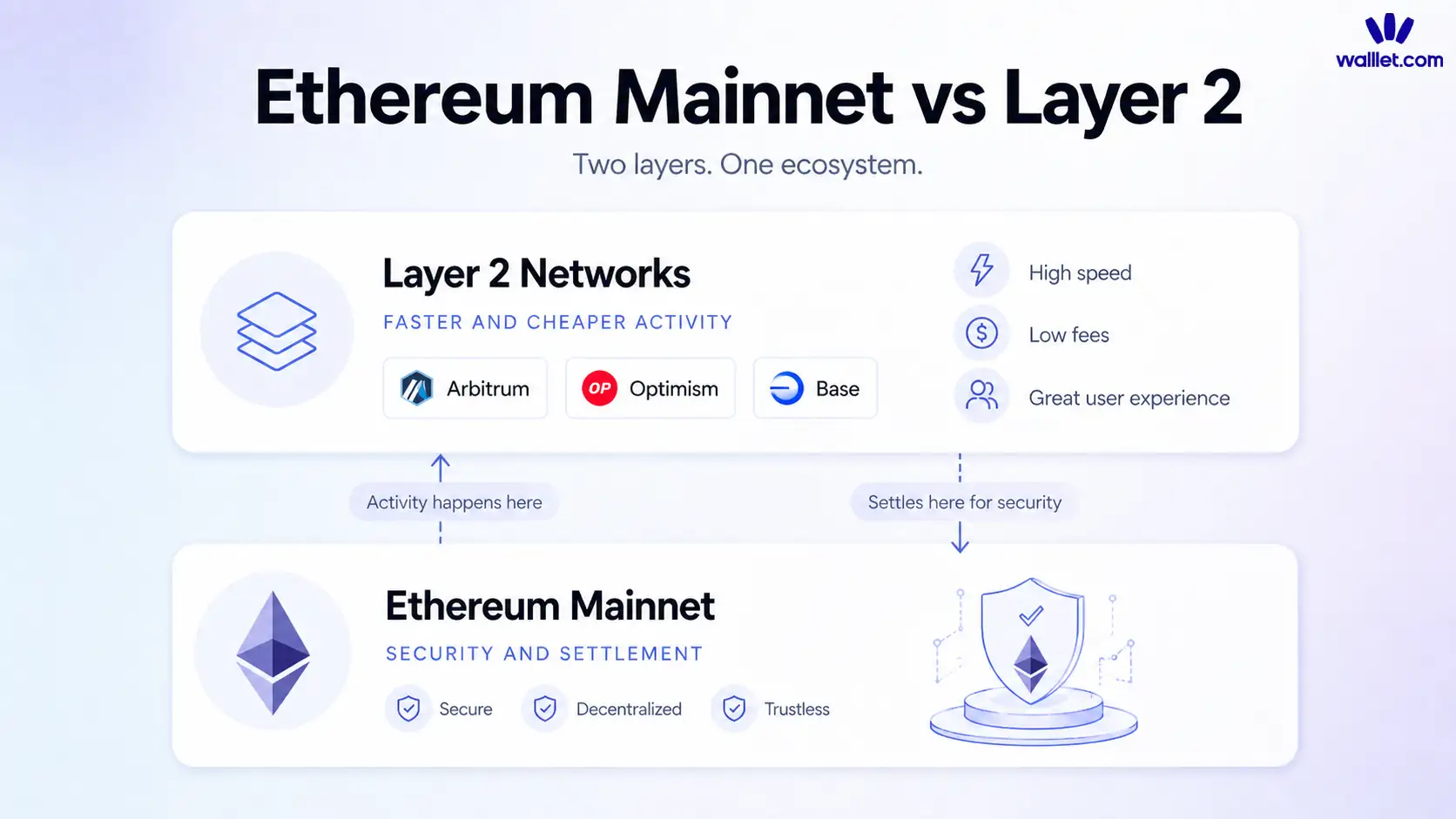
Popular Ethereum Layer 2 networks include Arbitrum, Optimism, Base, and others.
Layer 2s exist because Ethereum Mainnet is valuable, decentralized, and secure, but it can be expensive or slow when demand is high. Layer 2s help more people use Ethereum-based apps without every small transaction competing directly on Mainnet.
For everyday users, this creates a new kind of confusion:
Which network am I on? Do I have funds on Ethereum Mainnet or a Layer 2? Why is my USDC on Arbitrum different from USDC on another network? Do I need ETH for gas, or can fees be handled another way? For a deeper look at when Mainnet makes sense and when Layer 2s are better, read Ethereum vs L2: When to Use Mainnet and When to Move to Layer 2.
What is Ethereum used for?
Ethereum is used for many parts of Web3, including stablecoins, DeFi, NFTs, payments, DAOs, gaming, identity, tokenized assets, and smart wallets.
For most users, the practical use cases are simple: holding and sending ETH or tokens, using stablecoins like USDC or USDT, swapping one crypto asset for another, connecting to decentralized apps, using DeFi protocols, collecting or using NFTs, moving assets across Layer 2 networks, and using smart wallets with better recovery or security features.
Ethereum also matters because many other crypto experiences borrow its standards, tools, and design patterns. Even when users are not directly on Ethereum Mainnet, they may still be using Ethereum-compatible networks, EVM wallets, smart contracts, or token standards inspired by Ethereum.
If your main interest is using crypto more like usable money than portfolio wallpaper, read Best Crypto for Everyday Spending: Stablecoins vs BTC vs ETH.
Is Ethereum the same as Bitcoin?
No. Ethereum and Bitcoin are both public blockchains, but they are designed for different jobs.
Bitcoin is mainly designed as decentralized digital money and a store-of-value network. Ethereum is designed as a programmable blockchain platform for apps, assets, and smart contracts.
Question | Bitcoin | Ethereum |
Main purpose | Digital money and store of value | Programmable blockchain for apps and assets |
Native asset | BTC | ETH |
App layer | More limited | Core part of the ecosystem |
Smart contracts | More limited | Central to how Ethereum works |
Common use cases | Holding, sending, saving BTC | DeFi, stablecoins, NFTs, tokens, apps, wallets |
Security model today | Proof of work | Proof of stake |
Bitcoin is closer to a monetary network. Ethereum is closer to a programmable ownership network.
Do you need a wallet to use Ethereum?
Yes, in most cases. A wallet is how you access Ethereum. Your assets live on the blockchain. Your wallet stores or manages the keys that let you control those assets.
Traditional crypto wallets often ask users to protect a seed phrase. A seed phrase is powerful, but it creates a harsh user experience. Lose it, and recovery can become difficult or impossible. Share it with the wrong person, and your assets can be stolen.
This is one of the biggest reasons many normal people find Ethereum intimidating. The technology may be open and powerful, but the first touchpoint often feels like a security exam.
walllet.com takes a more modern route: self-custodial, seedless, passkey-based access designed to feel closer to everyday sign-in while still keeping users in control. If you want the full product explanation, read What Is walllet? A Complete Guide to the Seedless Smart Wallet.
Using Ethereum without seed phrase stress
Ethereum gives users open access to digital ownership and Web3 apps. But for many people, the hard part is not the idea of Ethereum. The hard part is the experience around keys, networks, fees, signing, recovery, and approvals.
That is where walllet.com becomes relevant to the Ethereum story.
Instead of making users manage a traditional seed phrase, walllet.com is built around seedless self-custody and passkeys. Instead of asking users to decode every raw blockchain action, it focuses on clearer wallet interactions and more human-readable transaction prompts. Instead of treating recovery like a one-mistake disaster, it uses familiar device-level security patterns such as passkeys and biometric-friendly access.
This is about translating Ethereum into an experience normal people can actually use. That distinction matters. A good wallet should make control easier to exercise.
If you are setting up walllet on Android, this guide explains the passkey setup flow: How to Enable Passkeys on Android to Create Your walllet.
Is Ethereum safe for beginners?
Ethereum itself is one of the most established public blockchain networks, but user safety depends on more than the network.
The Ethereum protocol may be decentralized and battle-tested, but a beginner can still make mistakes at the wallet or app level. Signing a bad approval, connecting to a fake app, sending funds on the wrong network, or misunderstanding gas fees can all create problems.
So the better question is not only “Is Ethereum safe?” It is “How do I use Ethereum safely?”
The practical answer is simple: use a wallet that explains transactions clearly, avoid unknown links, double-check the network and recipient address, be careful with token approvals, and never share private keys or recovery information.
If a transaction prompt looks confusing, slow down. Confusion is often the first warning sign.
What should a beginner understand first?
Start with the ideas that actually affect your decisions.
Ethereum is the network. ETH is the native currency. Smart contracts are the programs. Gas is the fee. Wallets are how you access the network. Layer 2s help Ethereum scale. Your signatures matter.
That last one is the most important.
When you use Ethereum, signing is how you approve actions. A wallet is the tool that helps you understand and authorize what happens to your assets.
Once that clicks, Ethereum becomes much less mysterious. It is still technical underneath, but so is online banking, card payments, cloud storage, and Face ID. The point is to use a wallet that lets you make good decisions without needing to read the engine manual every morning.
Use Ethereum without managing a traditional seed phrase. Create your walllet account with seedless self-custody, passkey-based access, biometric-friendly security, and clearer transaction prompts:
