
Seedless wallets can remove one of crypto’s biggest pain points, but only if you understand what replaces the seed phrase.
The best seedless wallet is the one whose recovery model, signing flow, and day-to-day UX you will still trust a month later and it depends less on the slogan and more on the recovery model behind it. For most beginners, the strongest choices combine self-custody, clear recovery, readable signing, and low-friction access, whether that comes through passkeys, MPC, or a hardware-first design.
TL;DR
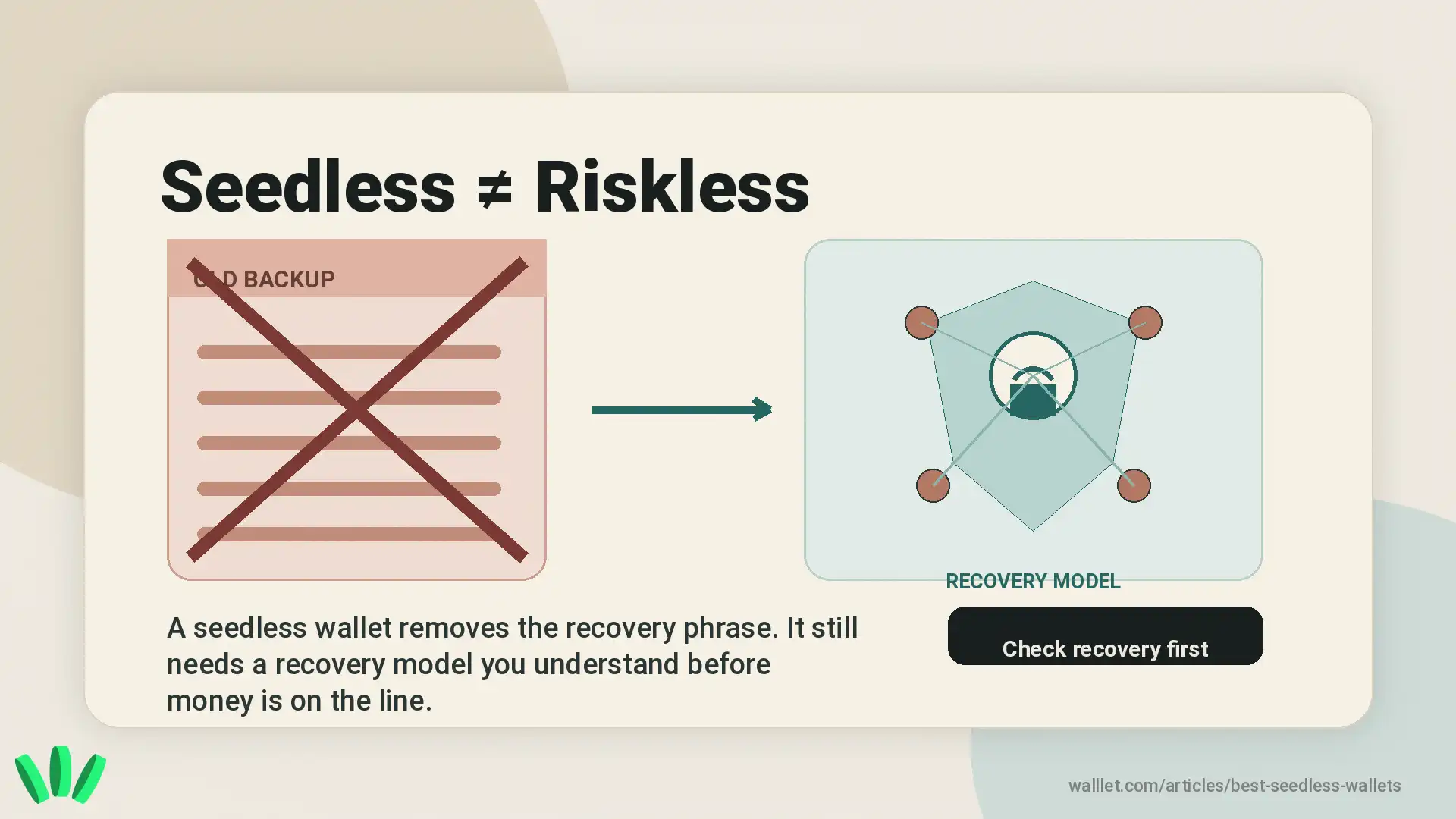
Seedless wallets remove the traditional 12 or 24-word recovery phrase, but they do not remove responsibility.
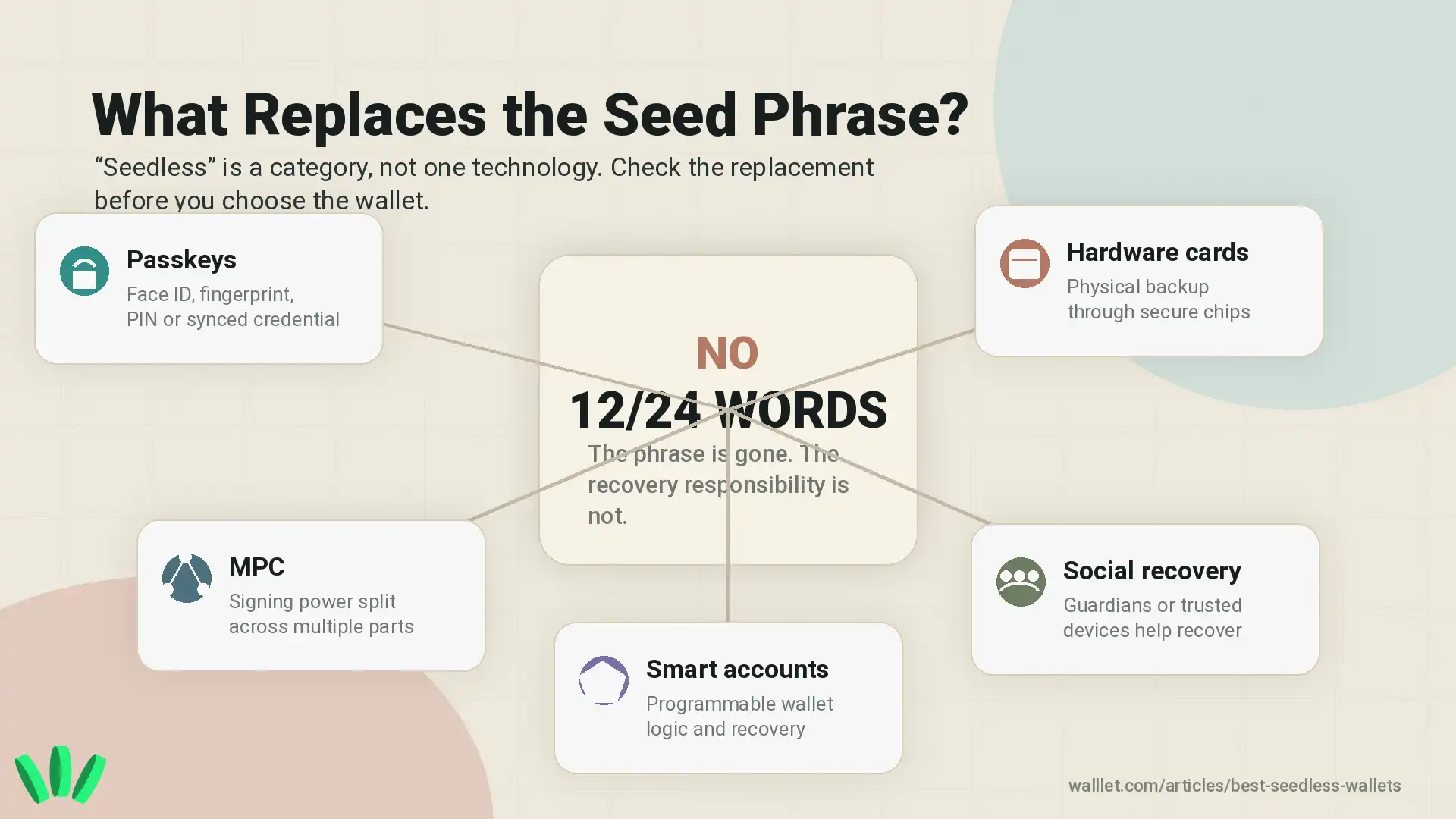
They replace it with another recovery model, such as passkeys, MPC, hardware cards, social recovery, or smart accounts.
For most beginners, the best seedless wallet is the one whose recovery path they can actually understand.
walllet.com is a strong fit for users who want seedless self-custody with passkeys, readable transaction prompts, and simpler smart-wallet UX.
Zengo is strong for MPC recovery.
Tangem is strong for hardware-first storage.
Coinbase Smart Wallet, Core, Argent, and Trust Wallet SWIFT each fit more specific needs.
What is a seedless wallet?
A seedless wallet is a crypto wallet that removes the traditional recovery phrase from setup or daily use. Instead of asking you to write down 12 or 24 words, it uses another way to help you access and recover your wallet.
That replacement matters.
Some seedless wallets use passkeys. Some use MPC, short for multi-party computation. Some use hardware cards. Some use smart accounts or social recovery. They all reduce seed phrase anxiety, but they do not work the same way.
A seedless wallet can be easier and safer for everyday users, but only if you understand what replaces the seed phrase.
Why are seedless wallets becoming popular?
Because seed phrases are easy to mess up.
People lose them. Screenshot them. Store them in email. Type them into fake websites. Forget where they put the paper. Or panic when a wallet asks them to protect 12 words before they even understand what the wallet does. Elegant system, if the goal was terrifying normal people.
Passkeys are one reason the category is growing. The FIDO Alliance describes passkeys as phishing-resistant credentials based on cryptographic key pairs. In plain English: instead of typing a password or handling a seed phrase, you can use device-based authentication like Face ID, fingerprint, PIN, or a synced credential.
Smart wallets are another reason. Ethereum’s account abstraction roadmap explains how smart contract wallets can support more flexible wallet behavior, including better signing flows, gas abstraction, and recovery logic.
That is why seedless wallets are not just a nicer login screen. Done well, they can make crypto feel less fragile.
Best seedless wallets in 2026: quick comparison
Wallet | Seedless model | Best for | Main strength | Main trade-off |
walllet.com | Passkeys + smart wallet UX | Beginners and everyday self-custody users | Seedless access, readable prompts, flexible fees on supported flows | Recovery depends on device and passkey backup setup |
Zengo | MPC recovery | Users who want guided recovery without seed phrases | Mature MPC model, no vulnerable seed phrase positioning | More mediated recovery model |
Tangem | Hardware card backups | Long-term holders who prefer physical control | Secure chip and backup cards | Lose all backups and recovery may be impossible |
Coinbase Smart Wallet | Passkeys + smart wallet | Coinbase/Base users | Smooth app-native onboarding | Recovery model now needs careful reading |
Core | Google/Apple seedless login | Avalanche and multi-chain users | Familiar login and optional MFA | Depends on Web2 account security |
Argent | Social recovery | Users comfortable with guardians | No seed phrase in mobile wallet | Guardian setup must be maintained |
Trust Wallet SWIFT | Passkeys + account abstraction | Trust Wallet users who want easier Web3 access | Biometric passkeys and gas abstraction | Different from Trust Wallet Classic |
MetaMask Smart Accounts | Passkey signer support | Developers and advanced smart-account flows | Passkeys inside smart account tooling | Not a simple seedless MetaMask replacement |
Which seedless wallet is best for beginners?
For most beginners, the best seedless wallet is the one that makes three things clear: access, recovery, and signing.
Access means how you get into the wallet every day. Recovery means what happens if you lose your phone or device access. Signing means what you are approving when you send funds, swap tokens, or connect to an app.
This is where walllet.com has a useful angle for beginners. It is not just trying to remove the seed phrase. It is trying to make self-custody less intimidating overall: passkey-based access, clearer transaction prompts, suspicious approval warnings, and more flexible fee handling on supported flows.
That matters because most beginners are not only afraid of losing a recovery phrase. They are also afraid of clicking the wrong thing, paying gas on the wrong network, or approving something they do not understand.
For broader beginner context, the guide to the best crypto wallet for beginners is a better starting point before choosing a specific seedless wallet.
Seedless access is useful. Seedless access plus clearer transaction context is much more useful.
Is Zengo the best MPC seedless wallet?
Zengo is one of the clearest MPC wallet choices for people who want to avoid seed phrases. Its public materials describe an MPC-based wallet with no vulnerable seed phrase and a 3-factor recovery model.
MPC means the wallet does not rely on one single secret sitting in one place. Instead, signing authority is split across multiple parts. For users, the practical benefit is simple: there is no single seed phrase to lose, expose, or type into a scam page.
Zengo is a strong fit if your main fear is seed phrase failure and you prefer a guided recovery experience.
The trade-off is that MPC recovery is still a system you need to understand. You should know what lives on your device, what gets backed up, and what role the wallet provider plays.
Is Tangem the best hardware seedless wallet?
Tangem is a strong choice if you want seedless storage with a hardware-first mindset. Instead of a paper recovery phrase, Tangem uses physical cards or rings as the control and backup layer.
That feels safer for some users because it is physical. You hold the cards. You protect the backups. You are not relying on a cloud passkey provider or a social recovery setup.
But the trade-off is also physical. If you lose all your backup cards in a seedless setup, you may lose access. Simple. Brutal. Very crypto.
Tangem is best for people who mostly hold crypto and want a cold-wallet feeling without writing down a seed phrase. It may be less convenient for people who move funds often, use DeFi, or want a more app-native experience.
Is Coinbase Smart Wallet really seedless?
Coinbase Smart Wallet is passkey-first, but it needs careful wording.
Coinbase explains that its smart wallet uses passkeys so users do not need to memorize a recovery phrase for normal access. But Coinbase’s current help docs also mention recovery phrase support in some recovery flows.
So the clean answer is: Coinbase Smart Wallet is strong for passkey-based onboarding, especially inside Coinbase and Base flows, but it should not be described as a pure “no recovery phrase ever” wallet.
That does not make it bad. It just means users should read the recovery model before treating it like a fully seedless setup.
Coinbase Smart Wallet is best for people already using Coinbase, Base, or app-native smart wallet flows. It is less obvious as a universal wallet for users who want one self-custody home across everything.
What about Core, Argent, Trust Wallet SWIFT, and MetaMask?
Core is useful if you want seedless login through Google or Apple inside a multi-chain wallet experience. It is especially relevant for users who care about Avalanche and EVM activity. The trade-off is that your Google or Apple account security becomes part of your wallet security.
Argent is important because it uses social recovery. Instead of a seed phrase, recovery can involve guardians, such as trusted people, devices, or other accounts. This is helpful if you like the idea of human or device-based recovery, but it only works well if you choose and maintain guardians properly.
Trust Wallet SWIFT is different from Trust Wallet Classic. Trust Wallet describes SWIFT as a smart contract wallet powered by account abstraction, with biometric passkeys and gas abstraction. That makes it relevant to seedless wallet comparisons, but users need to understand which Trust Wallet mode they are using.
MetaMask should be handled carefully. Regular MetaMask is still widely associated with the classic seed phrase model. MetaMask Smart Accounts and developer tooling now support passkey-based smart account flows, but that is not the same as saying regular MetaMask is now a simple seedless wallet for beginners.
If you are comparing wallet models because you are tired of traditional wallets, this walllet vs MetaMask comparison may help clarify the difference between old wallet UX and newer smart-wallet approaches.
Passkey wallet vs MPC wallet vs hardware seedless wallet
The best model depends on what risk you are trying to reduce.
Model | What replaces the seed phrase? | Best for | Main thing to check |
Passkey wallet | Device or cloud-synced credential | Everyday users who want familiar access | What happens if you lose device or passkey access |
MPC wallet | Split signing authority | Users who want guided recovery | How recovery works and who is involved |
Hardware seedless wallet | Secure chip and backup cards | Long-term holders | What happens if all cards are lost |
Social recovery wallet | Guardians or trusted devices | Users comfortable managing recovery relationships | Whether guardians are reliable and updated |
Smart wallet | Programmable wallet logic | Users who want better UX, gas abstraction, or flexible signing | What parts are actually controlled by the user |
The biggest mistake is choosing based only on the phrase “no seed phrase.”
A passkey wallet may be better for everyday stablecoin use. An MPC wallet may feel safer for guided recovery. A hardware seedless wallet may be better for holding. A social recovery wallet may work if you trust your guardian setup. A smart wallet may help if you care about smoother transactions and gas flexibility.
Security is not only the technology. It is the match between the wallet and your real behavior.
What should freelancers and remote workers care about?
Freelancers and remote workers should care about more than seedless setup. If you receive USDT or USDC from clients, your wallet needs to help you receive funds safely, understand networks, avoid risky approvals, and recover access if your phone breaks.
That is especially important if crypto is not just an investment app for you. If it is part of how you get paid, small mistakes become expensive quickly.
For this use case, walllet.com is relevant because it connects seedless self-custody with practical everyday UX. You can create a wallet without handling a traditional seed phrase, use passkey-based access, and get clearer transaction context before approving actions.
That does not mean you should move everything at once. Please do not turn confidence into a live-fire test. Start small, check the network, confirm recovery, then scale.
How to choose the best seedless wallet
Before choosing a seedless wallet, ask one boring question:
What happens when something goes wrong?
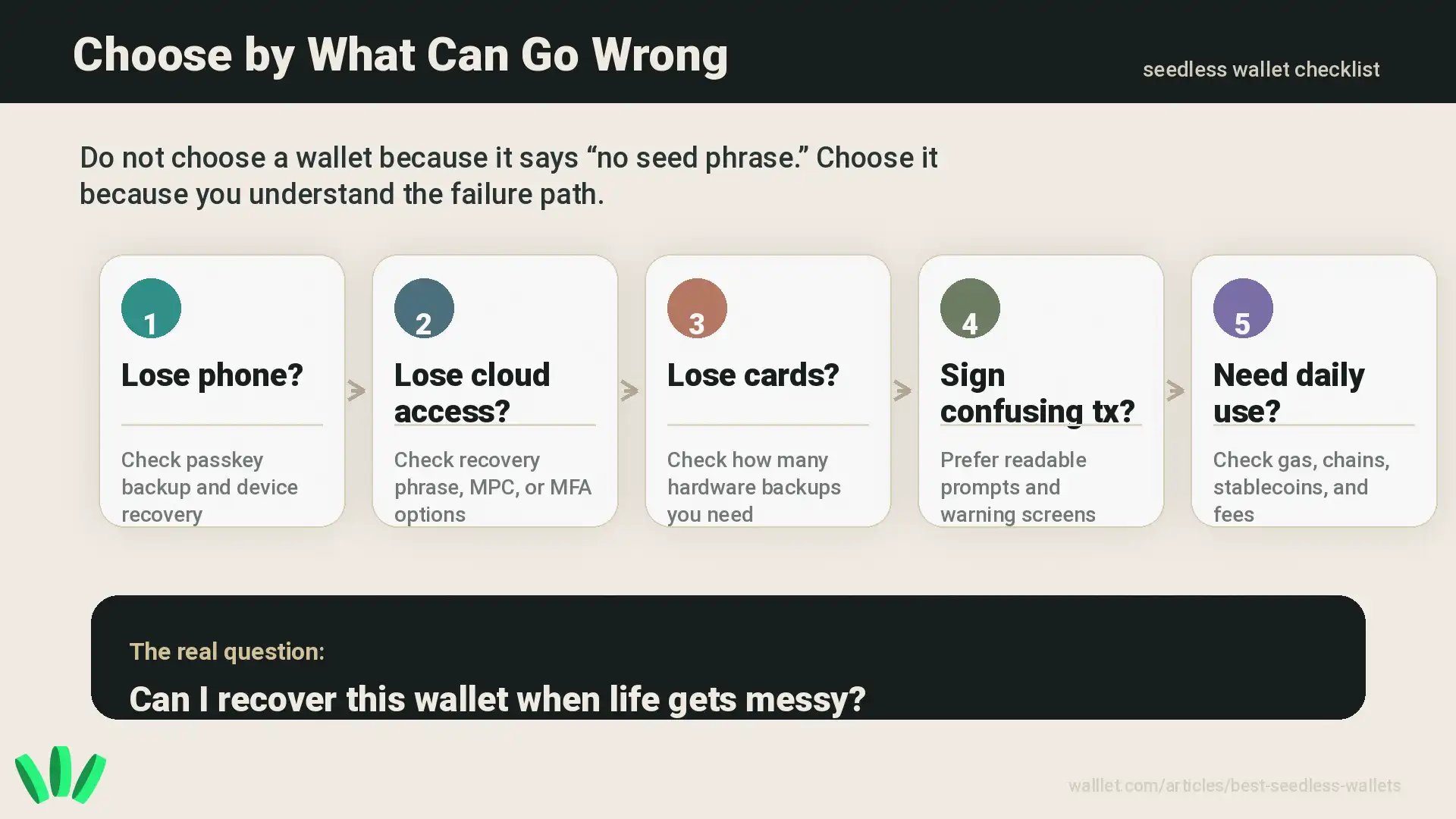
Not when everything works. Not when the onboarding screen looks pretty. When your phone is lost, your account is locked, your backup card is missing, or your cloud access breaks. Use this quick checklist:
Can I explain how I access the wallet?
Can I explain how I recover it?
Do I know what I must protect now?
Does the wallet support the chains and assets I actually use?
Are transaction approvals readable?
Can I test it first with a small amount?
If you cannot answer those, do not move serious funds yet.
If you are planning to move from an exchange to self-custody, use a step-by-step migration guide like how to migrate to walllet.com before sending larger amounts.
Final recommendation
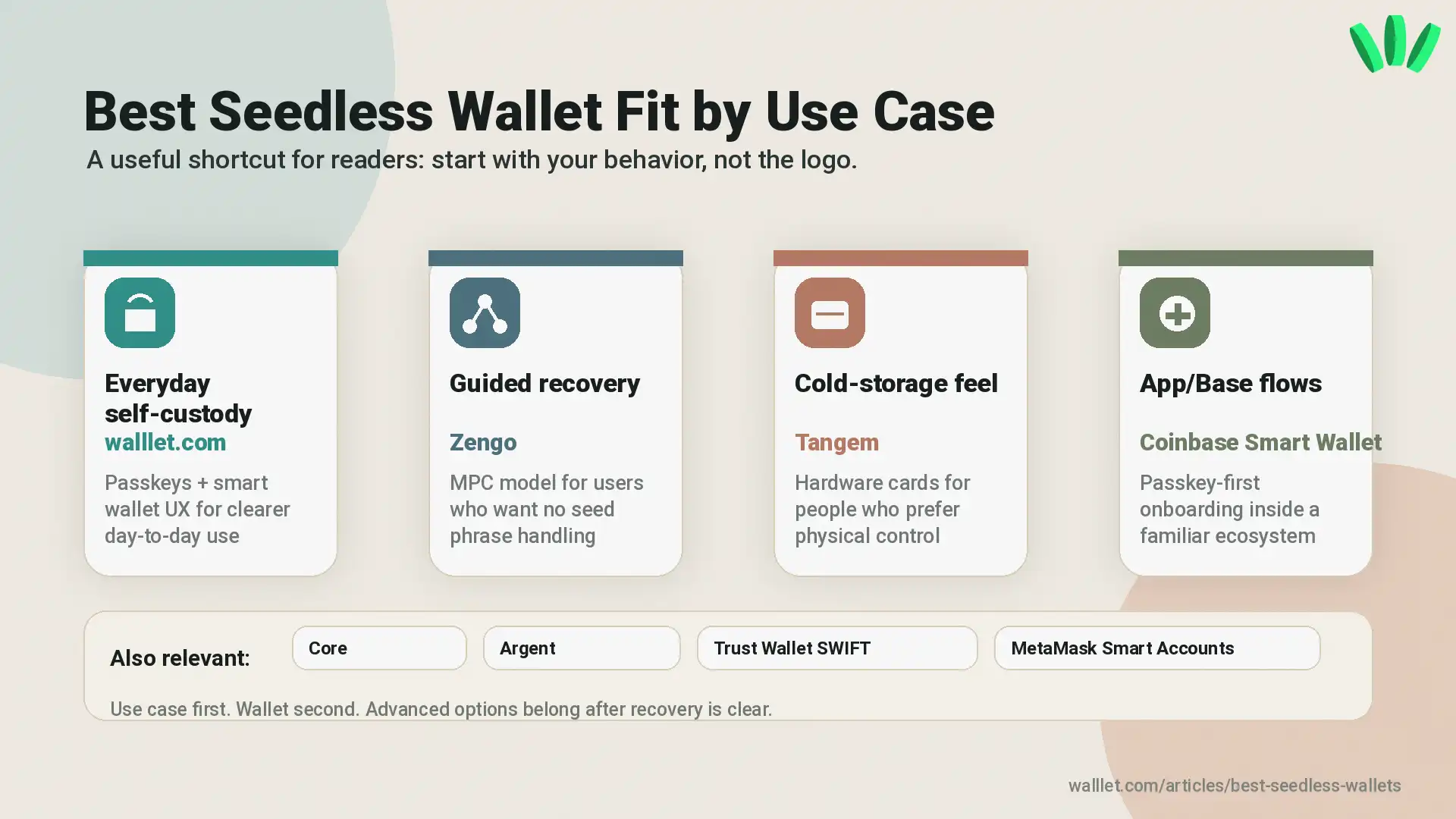
There is no single best seedless wallet for everyone.
Use walllet.com if you want seedless self-custody that feels more like a modern app and less like a recovery phrase exam.
Use Zengo if you want MPC recovery and a guided no-seed experience.
Use Tangem if you want hardware-first seedless storage.
Use Coinbase Smart Wallet if you are already close to Coinbase or Base and want passkey-based smart wallet onboarding.
Use Core if you want Google or Apple login inside a multi-chain wallet.
Use Argent if you like social recovery and understand guardian responsibility.
Use Trust Wallet SWIFT if you are already in the Trust Wallet ecosystem and want a smart wallet option with passkeys.
Use MetaMask Smart Accounts if you are working with advanced smart account flows, not if you just want a simple seedless beginner wallet.
The best seedless wallet is the one whose recovery model you understand before you need it. Try walllet.com if you want seedless self-custody without the old recovery phrase setup.
