You should not need to keep tiny dust piles of ETH, MATIC, and BNB just to move your own money.
TL;DR
Gas abstraction lets you use crypto without always needing the chain’s native gas token first.
Instead of keeping small balances of ETH, MATIC, BNB, or other fee coins everywhere, a wallet or app can handle the gas problem for you. Sometimes the fee is sponsored. Sometimes you pay with a token you already hold, like USDC.
The important part: the blockchain still gets paid in its native token behind the scenes. So before you approve anything, check who pays, what token is used, the total fee, and what you are signing.
Why gas fees feel so annoying
Every onchain action needs a network fee. On Ethereum, that fee is paid in ETH. Ethereum explains gas as the fee required to process transactions and run operations on the network. Other chains usually have their own native gas token too, because apparently one simple payment flow would have been too merciful.
This is fine for experienced crypto users. It is painful for normal people.
You may have USDC in your wallet and still fail to send it because you do not have ETH for gas. You may have funds on one chain and still need a tiny amount of another token just to move them. You are not broke. You are just missing the exact fee coin the network wants.
That is the problem gas abstraction tries to fix.
What is gas abstraction?
Gas abstraction means the wallet or app hides some of the gas-token complexity from the user.
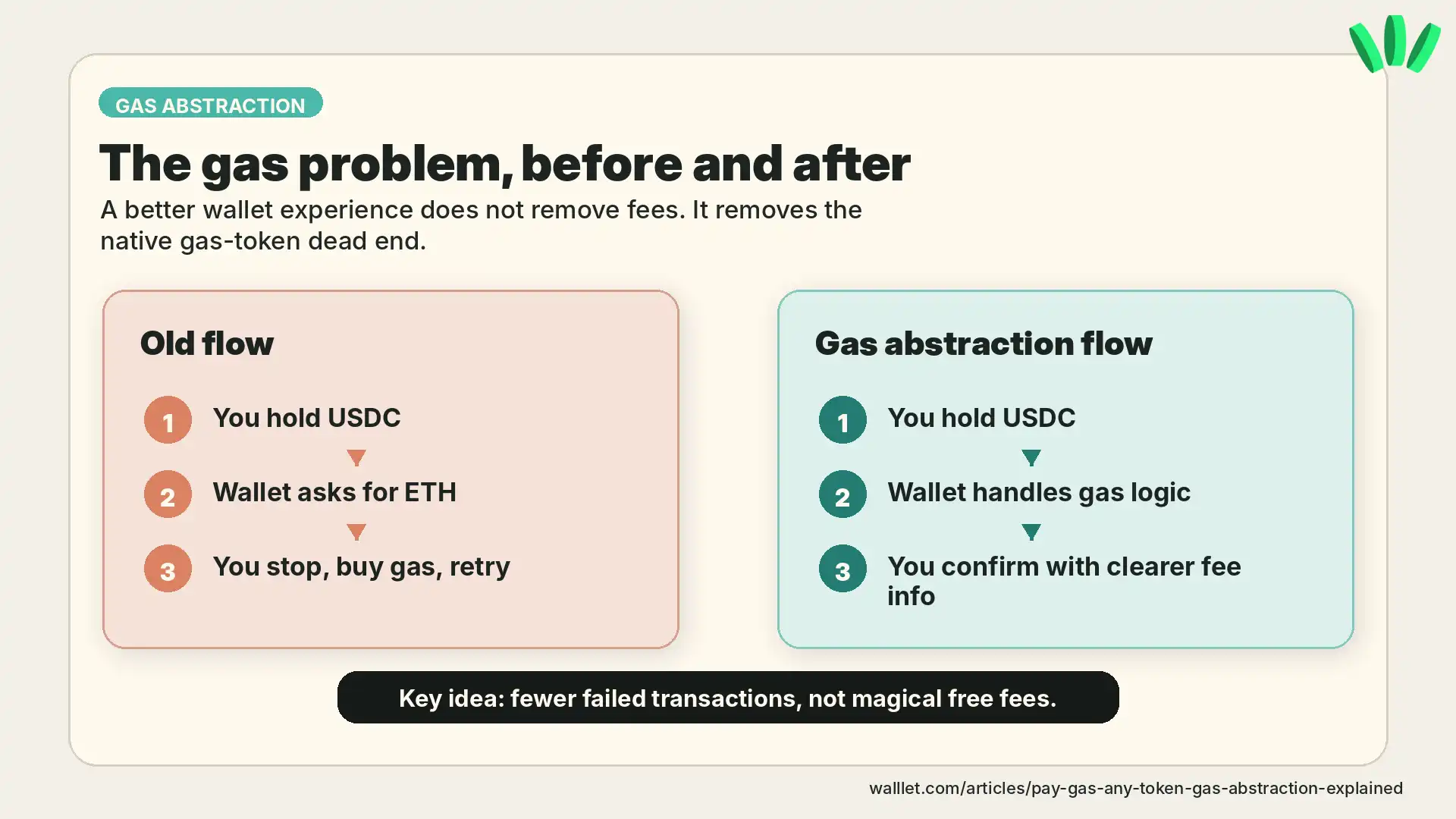
Instead of making you buy and hold the native gas token before every action, the product can handle the fee layer in the background. You may be able to pay fees with a token you already hold, or the app may sponsor the fee for certain actions.
Gas abstraction does not make blockchain fees disappear. It makes the fee experience less painful.
If you want the deeper technical version, walllet’s guide to account abstraction and smart contract wallets explains how smart wallet infrastructure can support features like sponsored gas, bundled actions, and more flexible transaction flows.
Does “pay gas with any token” mean Ethereum accepts USDC as gas?
No.
Ethereum still requires ETH for gas at the protocol level. “Pay gas with USDC” usually means the wallet, app, relayer, or paymaster handles the native gas payment behind the scenes while charging you in another token.
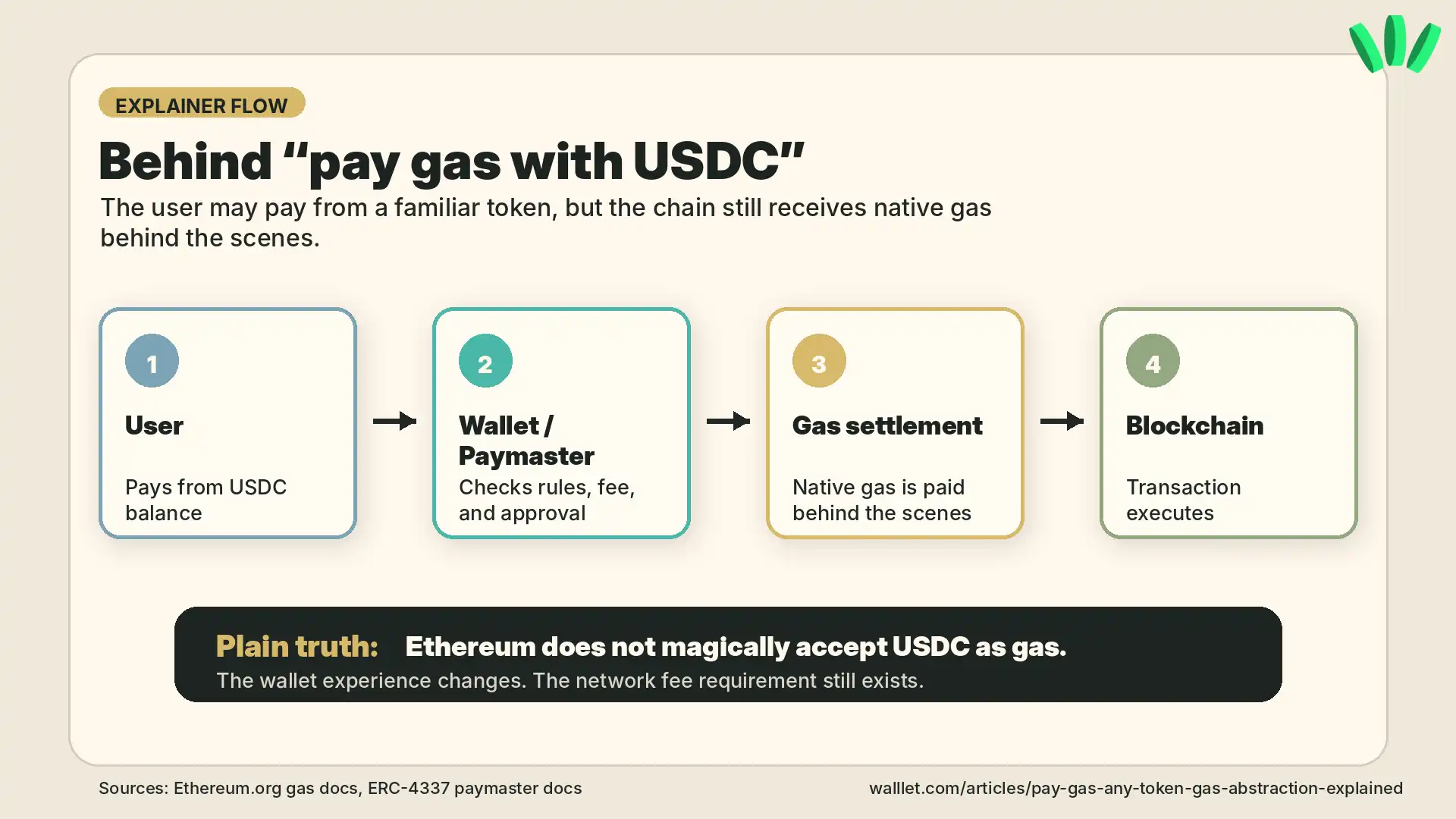
So the user experience may feel like this:
I paid the fee with USDC.
But the backend reality is closer to this:
The system collected value from USDC, then handled the required native gas payment somewhere behind the scenes.
That distinction matters. It keeps the promise honest.
The three common gas abstraction models
Most gas abstraction experiences fall into three practical groups.
1. Sponsored gas
A wallet or dApp pays the gas for you.
This is common during onboarding or for specific actions. For example, an app may cover your first transaction so you can try the product without buying ETH first.
It feels clean because you do not see a fee. But “free” usually comes with limits. The sponsor may only cover certain actions, users, networks, or amounts.
If gas is sponsored, check who is sponsoring it and when that sponsorship stops.
How walllet.com uses gas sponsorship with ZeroDev
ZeroDev's September 2026 walllet.com case study provides a concrete example of sponsored gas in production.
According to ZeroDev, walllet.com integrated its Paymaster infrastructure so selected user actions could have their network fee sponsored rather than forcing a new user to buy a native gas token first.
The important distinction is who pays.
The blockchain network still charges gas. A Paymaster can cover that cost for an eligible UserOperation according to the application's sponsorship policy.
ZeroDev describes zero-fee transactions during walllet.com's initial go-to-market phase. Do not interpret that wording as a permanent guarantee that every walllet.com transaction on every network will always be free.
2. Pay fees with a token you already hold
This is the version most users actually care about.
You have USDC, USDT, or another supported token. Instead of stopping everything because you lack ETH or another gas coin, the wallet lets you pay the fee from the token you already hold.
Behind the scenes, this may involve a paymaster, relayer, smart wallet, token conversion, or service fee. ERC-4337 account abstraction documentation describes paymasters as entities that can sponsor gas or let users pay transaction fees with ERC-20 tokens.
This is useful, especially for stablecoin users. If you receive USDT or USDC, you should not need a small scavenger hunt for ETH before sending your own money. If you use stablecoins often, this guide on holding USDT on Base safely is also worth reading because gas and network mistakes are painfully common.
3. Universal gas across chains
Some wallets try to make multichain activity feel less fragmented.
Instead of asking you to keep a little gas token on every network, the wallet handles routing and fees across supported chains. This can help with swaps, bridges, and transfers where users often get stuck because they do not have gas on the destination chain.
Useful? Yes.
Risk-free? Obviously not. This is crypto. The floor has trapdoors.
The more routing involved, the more important it becomes to check the final screen before signing.
Why gas abstraction matters for real users
Gas abstraction matters because users do not wake up wanting to manage infrastructure. They want to:
Send USDC.
Swap one token for another.
Use a dApp.
Move funds to the right network.
Pay someone.
Receive money and actually use it.
The gas token requirement turns simple actions into chores. It creates failed transactions, leftover dust balances, and confusion across chains.
A good wallet should reduce this friction without hiding the important details.
That is the balance. Easier flow, still clear control.
Curious how this feels in practice? Try a small transaction in walllet.com and watch how the fee and confirmation flow is presented before you rely on it for larger funds.
Can walllet.com help with gas fee friction?
walllet.com is built as a self-custodial smart wallet designed to make everyday crypto use simpler, including reducing gas friction on supported flows.
The useful part is not the technical label. Most people do not care whether the feature is called account abstraction, gas abstraction, a paymaster flow, or “the thing that stops my transaction from failing.” Very reasonable of them.
The real user value is simpler:
If you already hold crypto, the wallet should not block you just because you are missing a tiny amount of the network’s native gas token.
walllet.com also focuses on clearer transaction prompts, passkey-based access, and seedless self-custody. For a broader product overview, this guide explains what walllet.com is and how its seedless smart wallet works.
Gas abstraction fits naturally into that bigger idea: crypto should stay under your control without forcing you to understand every hidden pipe before you can move funds.
What should you check before using gas abstraction?
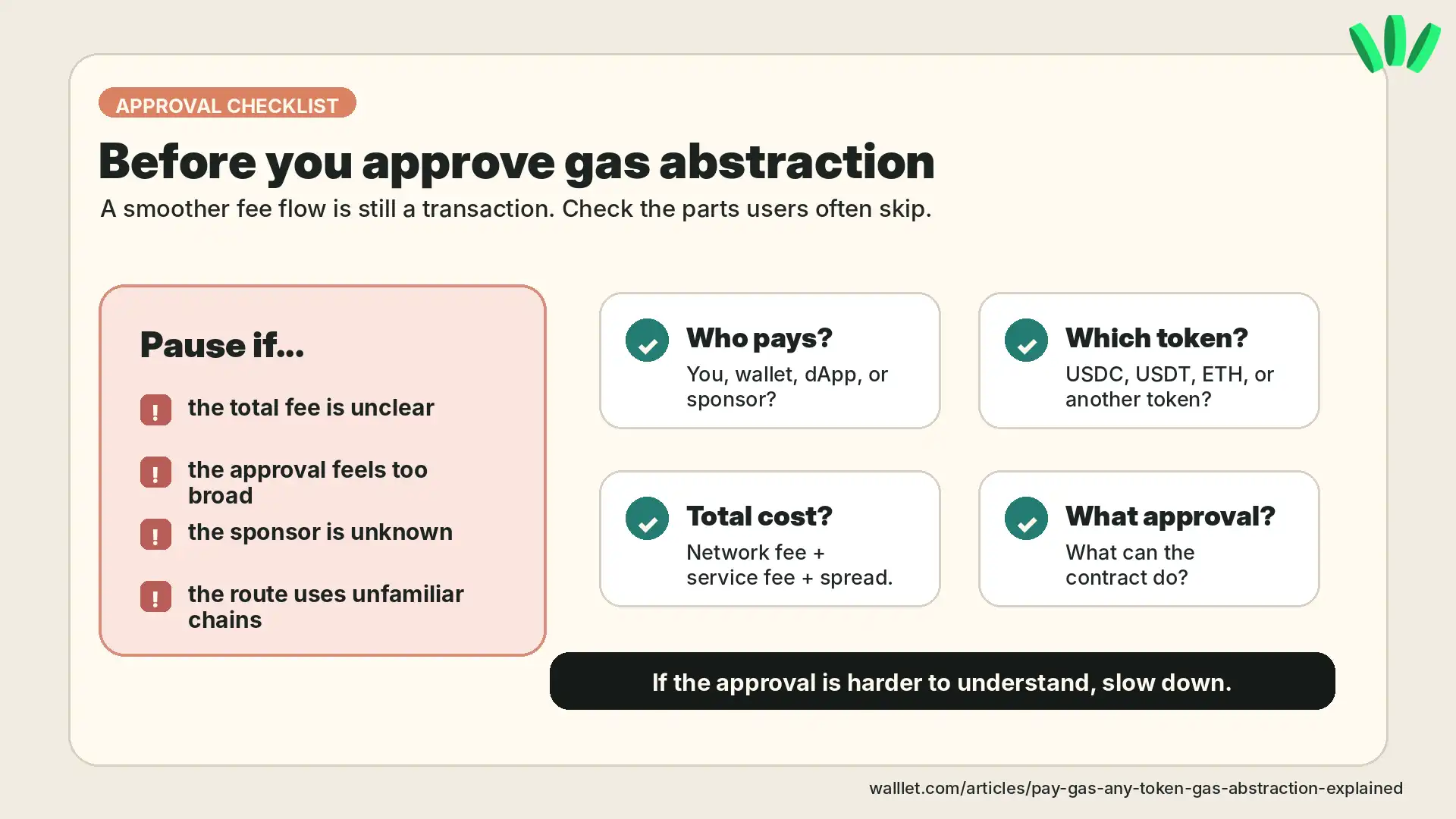
Gas abstraction makes the flow smoother. That does not mean you should approve faster. Before confirming, check four things:
First, check who is paying the gas. Is it you, the wallet, the dApp, or a sponsor?
Second, check the token used for the fee. If the fee comes from USDC, USDT, or another token, make sure you are comfortable spending that token.
Third, check the total cost. Look for the network fee, any service fee, and any conversion spread.
Fourth, check the approval. Some flows may require extra permissions. If you do not understand what the approval allows, pause.
For safer habits around approvals and wallet behavior, walllet’s guide to seedless wallet risks is useful because seedless does not mean careless. Annoying sentence, necessary truth.
Gasless does not always mean free
“Gasless” usually means the user does not pay a visible gas fee at that moment.
It does not mean the chain processed the transaction for free. Someone still pays. The wallet, app, sponsor, or backend service may cover the gas, or the cost may be included somewhere else. Here is the clean way to think about it:
Term | What it usually means | What to check |
Gas abstraction | The wallet reduces gas-token friction | Is the fee clear? |
Sponsored gas | Someone else covers the fee | Who pays and what are the limits? |
Pay gas with USDC | You pay fees from a token you hold | What is the total cost? |
Gasless transaction | No visible gas fee for the user | Is it really sponsored or priced elsewhere? |
Paymaster | A system that helps manage gas payment rules | What does it approve, sponsor, or charge? |
The safest version is not the one that looks magically free. It is the one that explains what is happening before you sign.
When should you avoid gas abstraction?
Avoid gas abstraction when the fee, approval, or sponsor is unclear. Also be careful when:
The wallet does not show the total cost.
You cannot tell which token is being used for fees.
The approval looks broader than the action you expected.
The transaction involves an unfamiliar dApp.
The fee looks unusually high.
The route involves multiple chains and you do not understand the final result.
Gas abstraction should reduce confusion. If it adds confusion, step back.
The bottom line
Gas abstraction is one of the most practical wallet UX improvements in crypto.
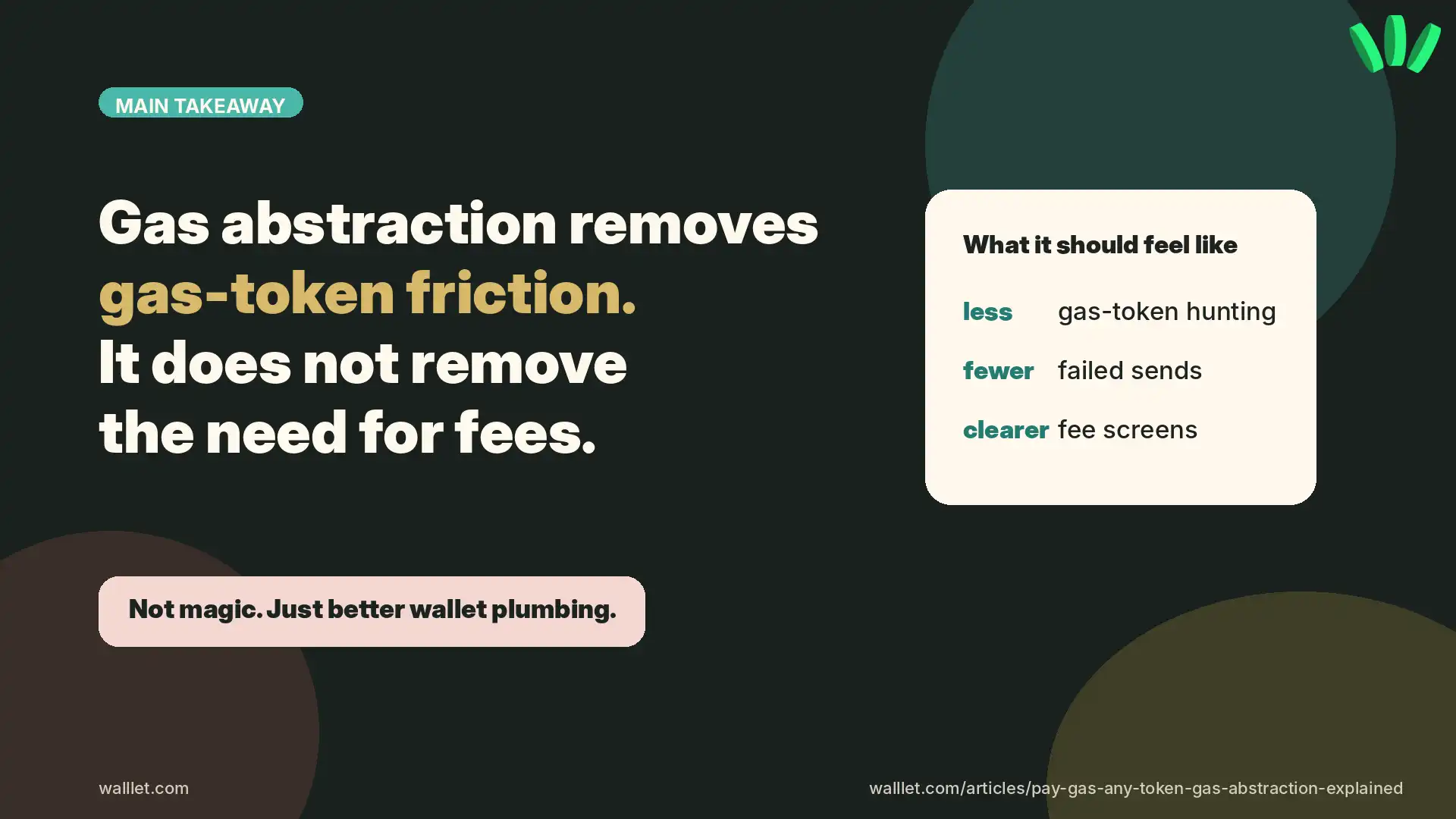
It does not remove network fees. It removes the need for users to constantly manage tiny balances of native gas tokens just to perform basic actions.
For everyday users, that matters. For stablecoin users, it matters even more. If you receive USDC or USDT and still need another token before you can move your funds, the wallet experience is broken in a very avoidable way.
The best version of gas abstraction is simple: fewer failed transactions, clearer fees, fewer dust balances, and no mystery around what you are approving.
Try walllet.com with a small send or swap first. Check how the wallet explains the fee, the token used, and the transaction before you move larger funds.
