Use Ethereum mainnet for gravity. Use an L2 for movement. Ethereum vs L2 comes down to trade-offs. Use Ethereum mainnet when you want the deepest settlement layer, the longest security track record, or you are moving meaningful value. Use an L2 when you want much lower fees, faster confirmations, and a smoother everyday experience for swaps, transfers, and apps.
TL;DR
Ethereum mainnet is still the place for maximum settlement weight, while L2s exist to make Ethereum cheaper, faster, and more usable day to day.
If you mostly send, swap, bridge, or use apps, an L2 is usually the better default.
If you care most about final settlement, conservative trust assumptions, or moving larger value less often, mainnet still earns its place.
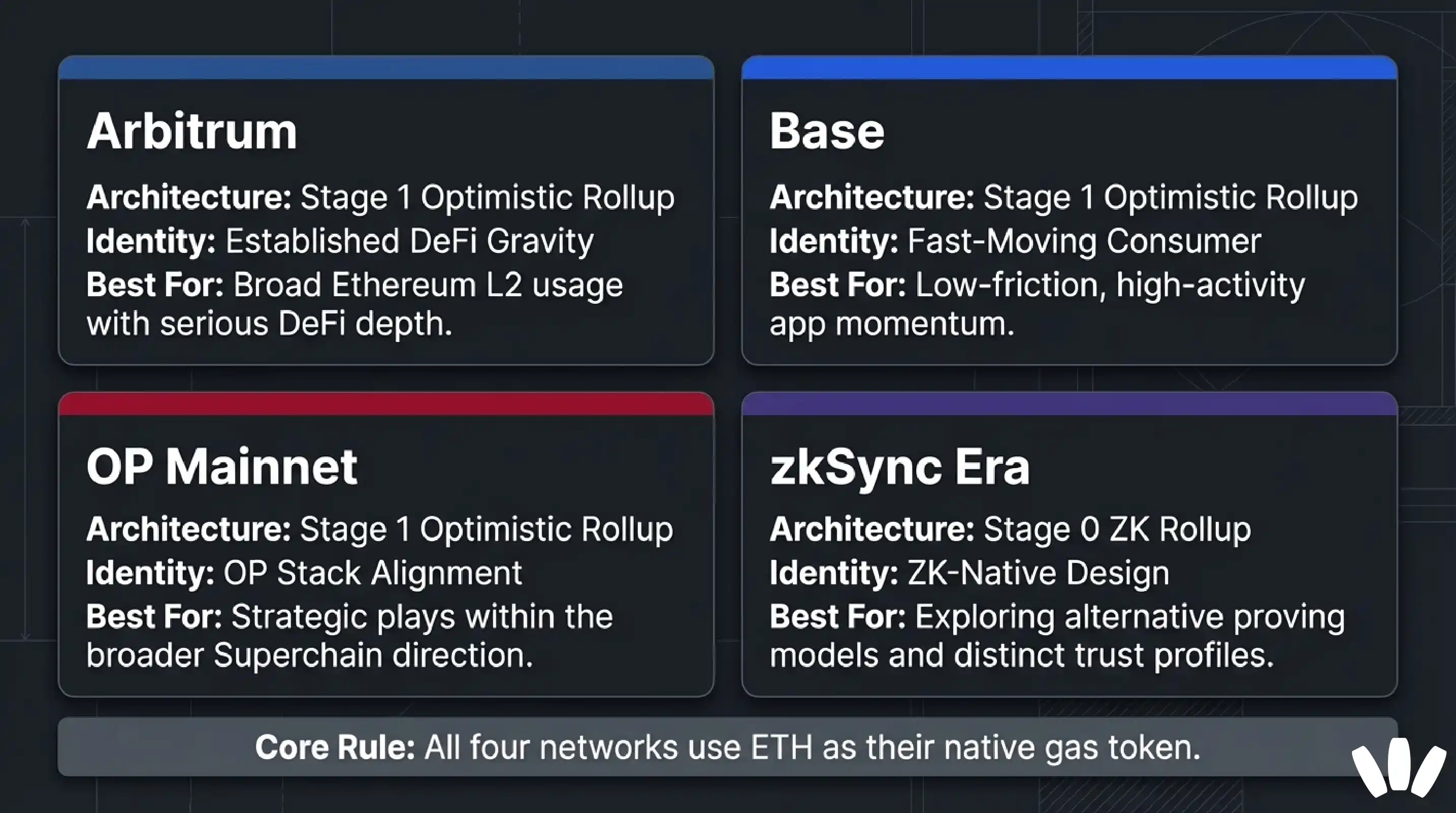
Today’s major Ethereum L2s are not identical either: Arbitrum, Base, and OP Mainnet are currently listed as Stage 1 optimistic rollups, while zkSync Era is listed as a Stage 0 ZK rollup, and all four use ETH as their gas token.
If you are trying to decide between Ethereum mainnet and an L2, you are already asking the right question. The point is not to pick a forever favorite. The point is to use the right rail for the job.
Ethereum’s own documentation now frames the ecosystem as a network of networks: Ethereum as the settlement base, with many L2s built on top to make usage cheaper, faster, and easier. That shift matters because the old habit of doing everything on mainnet is no longer the default for most normal actions. Here is the short version before we go deeper:
If you care most about | Better default | Why |
Maximum settlement weight and the longest battle-tested history | Ethereum mainnet | Fewer moving parts, direct settlement on Ethereum |
Cheap transfers, swaps, and everyday usage | L2 | Lower fees and faster UX |
DeFi-heavy activity with strong current depth | Arbitrum | Mature ecosystem and strong value secured footprint |
Fast-moving consumer and app activity | Base | Very strong current activity and low-friction feel |
OP Stack and Superchain alignment | OP Mainnet | Natural fit if that ecosystem matters to you |
ZK-rollup design and zk-native curiosity | zkSync Era | Different proving model and strong zk angle |
Ethereum describes L2s as execution layers backed by Ethereum settlement, and Arbitrum, Base, and OP Mainnet as Stage 1 optimistic rollups, while zkSync Era is listed as a Stage 0 ZK rollup. All four list ETH as the gas token.
Ethereum vs L2
Ethereum mainnet is the base layer. It is where settlement lives, where the deepest trust assumptions live, and where a lot of the ecosystem still measures finality and seriousness. L2s are separate networks that execute transactions away from mainnet, then post data or proofs back to Ethereum so they can inherit security from it. That is the big trick.
You get cheaper and faster execution without walking away from Ethereum entirely.
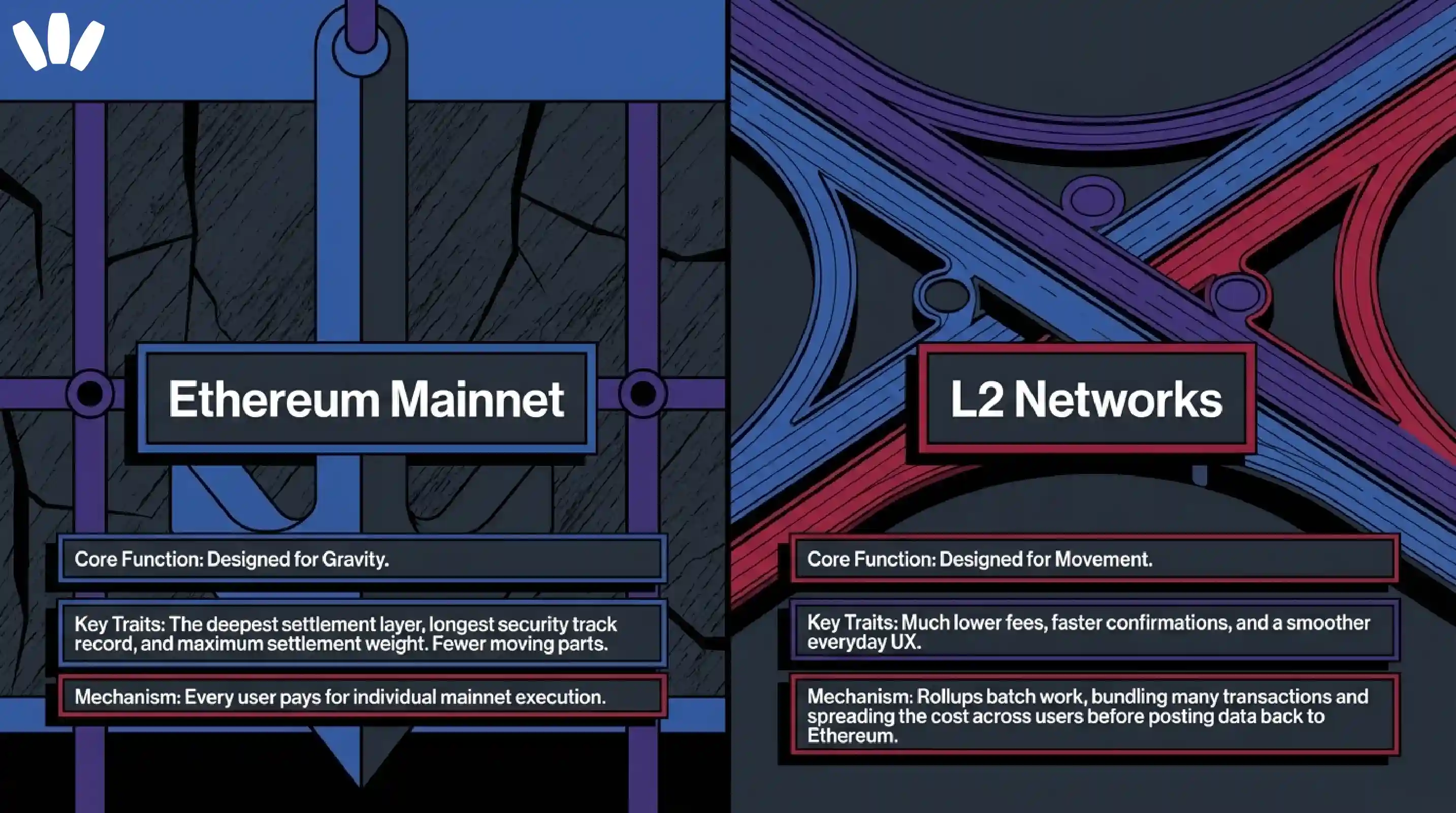
That also explains why the right mental model is not “Ethereum or L2.” It is “Ethereum and L2.” Mainnet is the anchor. L2s are the roads. Once you see it that way, a lot of confusion disappears.
When should I use Ethereum mainnet vs L2?
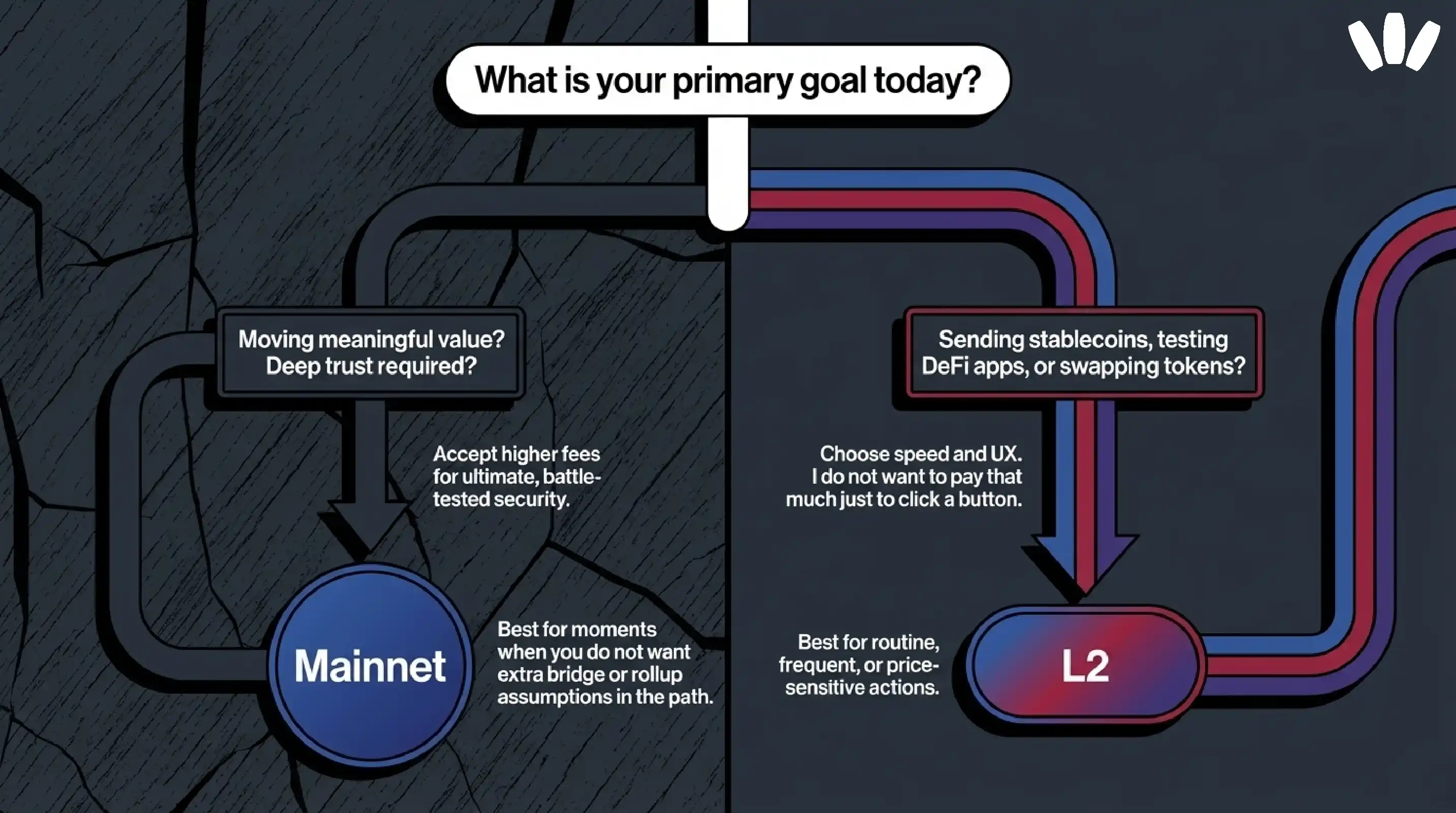
Use Ethereum mainnet when the cost of the transaction is small relative to the value or importance of what you are doing. That usually means larger transfers, actions where you want the deepest possible settlement base, or moments when you simply do not want extra bridge or rollup assumptions in the path.
Use an L2 when the action is routine, frequent, price-sensitive, or UX-sensitive. Sending stablecoins, making smaller swaps, testing an app, interacting with DeFi, or moving around regularly all fit the L2 lane much better. Ethereum’s own L2 overview now explicitly presents these networks as the way to use Ethereum for a fraction of the cost with near-instant transactions.
A simple gut check helps. If your first thought is “I do not want to pay that much just to click a button,” you probably want an L2. If your first thought is “I do not want extra complexity because this move matters,” mainnet is still a valid answer.
Why are L2s cheaper than Ethereum?
Because they batch work.
ًRollups bundle many transactions together, then submit that data back to Ethereum. Instead of every user paying the full cost of mainnet execution one by one, the cost gets spread across many users in the rollup. That is why L2 fees are usually much lower. It is not magic. It is cost-sharing plus off-mainnet execution.
This is also why fee conversations get messy. People say “Ethereum is expensive” as if that ends the story. It does not. The real question is where you are transacting. Ethereum mainnet and Ethereum-backed L2s are not the same fee environment anymore. Ethereum’s own network pages now show a wide gap between average mainnet transaction costs and Ethereum-backed network costs.
Is L2 as safe as Ethereum?
Close enough for many users, but not identical.
L2s inherit security from Ethereum in an ideal design, but also you should consider that L2s are younger, less battle-tested, and come with their own trust assumptions and risks. You could make that practical by learning how each system handles upgrades, operators, withdrawals, and censorship resistance. That is the right way to think about it: not “safe or unsafe,” but “safe with what extra assumptions?”
Mainnet still wins on simplicity of trust. There are fewer layers, fewer moving parts, and fewer things you need to remember in an emergency. L2s win on usability. That is the trade.
If you want the conservative answer, it is this: store bigger conviction positions with more respect for settlement assumptions, then use L2s for the motion layer of your crypto life.
Arbitrum vs Base vs OP Mainnet vs zkSync: which L2 fits which user?
Arbitrum
Arbitrum is the obvious starting point if you care about established DeFi gravity. If your question is “Where do I start if I want a broad Ethereum L2 with serious DeFi weight?” Arbitrum is still one of the cleanest answers.
Base
Base makes a strong case when you care about low-friction, high-activity usage. It is listed as a Stage 1 optimistic rollup using ETH as gas. If your use case feels more like “I want fast, cheap everyday usage and broad app momentum,” Base is a very reasonable default.
OP Mainnet
OP Mainnet is the natural reference point if you care about the OP Stack or the broader Superchain direction. It is listed as a Stage 1 optimistic rollup using ETH as gas, with current withdrawal mechanics that still involve multi-day delays for regular exits back to L1. If ecosystem alignment matters to you, OP Mainnet is more than “just another L2.” It is also a strategic lane.
zkSync Era
zkSync Era is the one to watch if the ZK rollup design itself matters to you. It is listed as a Stage 0 ZK rollup with ETH as gas. That does not mean “bad.” It means the maturity profile and trust model are not identical to the Stage 1 rollups above, and you should treat it as its own category rather than assuming all L2s are interchangeable.
So which one is best for beginners? Usually the one that minimizes confusion for the task in front of you. That often means choosing the chain your app, exchange withdrawal route, or wallet flow already supports cleanly, not the chain with the flashiest discourse.
Do I need to bridge ETH first?
Not always, and this is where many people accidentally create extra work for themselves.
Sometimes the cleanest move is not bridging at all. If a platform or exchange already lets you withdraw directly to the L2 you want, that can be simpler than withdrawing to mainnet first and then bridging again. If you already hold assets on one chain and need to use another, then yes, some form of bridging or cross-chain routing enters the picture.
This is where terminology matters. A bridge moves value from one network to another. A swap changes what asset you hold. A cross-chain swap combines both ideas in one guided route. walllet’s own swap guide explains that difference clearly, and it is exactly why modern wallets try to hide the plumbing while still showing the important numbers.
The practical rule is boring, which is why it works: move in as few steps as possible. Every extra manual step is another place to choose the wrong chain, the wrong token, or the wrong gas assumption.
Gas tokens and WETH: what people get wrong
First, ETH is still the native gas token on Ethereum mainnet, Arbitrum, Base, OP Mainnet, and zkSync Era. That means even when you are on an L2, “Ethereum-style” does not mean “gas disappears.” It means the same gas asset often follows you, but the fee environment changes dramatically.
Second, WETH is not your native gas coin. Ethereum.org’s WETH explainer is very clear here:
WETH is the ERC-20 version of ETH used for token-standard compatibility in apps, while native ETH is what the network accepts for gas by default.
You can hold WETH and still be stuck if you do not have spendable native ETH for fees. This is one reason gas friction still trips people up. You can understand “Ethereum vs L2” intellectually and still hit a wall at the last mile.
Common mistakes when moving funds between Ethereum and L2
The biggest mistake is assuming the same address means the same balance everywhere. walllet’s recent Ethereum wallet and wrong-network recovery articles both hammer this point: many EVM chains use the same 0x-style address format, but the assets still live on separate ledgers. Same address shape, different chain, different reality.
The second mistake is forgetting gas on the destination chain. Native-gas dependency is still one of the most common ways people get stranded mid-flow, especially after bridging or sending tokens cross-chain. walllet’s gas abstraction piece was written around exactly this pain point.
The third mistake is treating withdrawals back to mainnet as instant. They are not always instant, and on some optimistic rollups the regular exit path involves multi-day windows. Regular exits on Base and OP Mainnet becoming available only after multi-day challenge periods and waiting periods. If you might need to move back urgently, that matters.
The fourth mistake is pretending all L2 security is identical. Ethereum.org explicitly warns against that kind of flattening. L2s inherit from Ethereum, yes, but they are also younger systems with different proof models, governance structures, operators, and upgrade paths.
walllet.com fits where Ethereum becomes usable in real life
walllet.com describes itself as a non-custodial smart wallet with hardware-level security, seedless recovery and sync, passkey-based access, and account-abstraction features such as paying gas with any token and other smart-wallet rules. Its privacy policy also says the core wallet does not require your name, username, email address, or phone number, and does not collect seed phrases, private keys, or passkey credentials from users.
That matters because Ethereum vs L2 is a wallet UX question. A lot of the pain people blame on “crypto” is really the pain of network confusion, gas dead ends, ugly approvals, and too many manual hops. walllet’s own EVM wallet blog article already addresses several of those exact failure points through its EVM wallet guide, wrong-network recovery guide, swap/bridge guide, and gas abstraction explainer.
So where does walllet.com fit? Right at the seam where Ethereum becomes usable in real life. If you want to move between mainnet and L2s without dragging a seed phrase, juggling tiny gas balances, or decoding every action like a forensic puzzle, that is the lane walllet is clearly trying to own.
The smartest users will not ask “mainnet or L2?” as if one has to win forever. They will ask a calmer question: “What is the right layer for this exact move?” That is the habit that saves money, reduces errors, and makes Ethereum feel much less like homework.
Use Ethereum for settlement and L2s for everyday movement. Create your walllet.com to swap, transfer, and move across supported EVM networks with less gas and network friction.
