
Grey and walllet.com solve different parts of the international payment problem for Nigerian freelancers.
Grey focuses mainly on receiving foreign payments through banking rails such as ACH, FedNow and Fedwire. walllet.com takes a broader approach by connecting receiving, dollar-linked value storage, online spending and naira cash-out in one workflow.
The right comparison is not only how much money arrives. It is what happens after your payment lands.
There is also an important structural difference. Grey gives eligible Nigerian freelancers US checking account details and a USD balance. walllet.com’s current Terms say its virtual receiving account is for eligible incoming fiat payments and that successfully processed fiat is converted by the applicable provider into a supported stablecoin before it is credited to the walllet wallet.
The two products use different models. Grey follows a traditional account-balance model, while walllet.com is designed around a digital dollar workflow where eligible fiat receipts can move into a supported stablecoin balance.
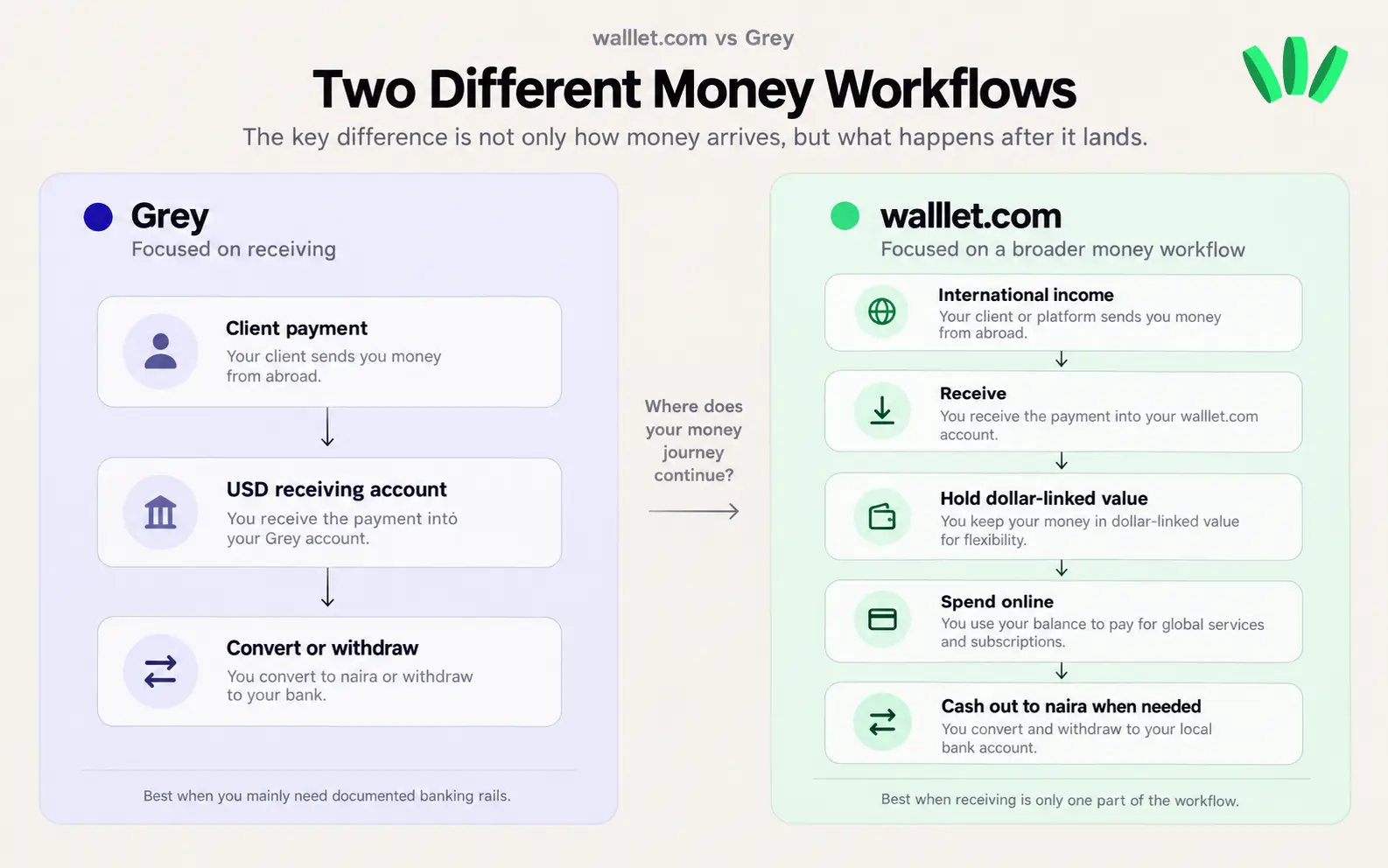
For users who want a traditional bank-style USD balance, Grey’s model may feel more familiar.
For users who want to receive, store dollar-linked value, spend online and manage global income from one wallet experience, walllet.com’s model may fit better.
So the useful walllet vs Grey comparison is not one percentage beside an incoming payment. Compare the route your client can use, what happens after the payment arrives, the conversion quote, the cost of reaching your Nigerian bank account and how you plan to spend the money.
If you are comparing more than these two products, the broader walllet.com vs Grey vs Raenest vs Cleva vs Payoneer comparison separates these same cost layers across five providers.

walllet.com vs Grey at a glance
What you need | Grey | walllet.com |
Receive USD from US clients | ACH/FedNow/Fedwire routes | Supported international receiving routes |
Keep dollar value | USD balance | Dollar-linked wallet balance |
Spend online | Virtual card | Virtual Mastercard |
Receive multiple currencies | USD/GBP/EUR accounts | USD/GBP/EUR receiving options |
Move money to Nigeria | USD→NGN conversion | Off-ramp to naira |
Daily use | Account-focused | Wallet + spending-focused |
What changed in this 2026 comparison?
Grey’s current August 2026 documentation lists a 0.8% fee for incoming USD through ACH and FedNow, with a $2 minimum and $10 maximum. Fedwire deposits cost $20. Grey separately publishes a 0.5% fee, again with a $2 minimum and $10 maximum, for outbound USD payouts by ACH. These are different transactions and should not be combined.
Grey also currently supports Visa virtual cards in Nigeria. The card costs $5 to create and is directly linked to the user’s wallet.
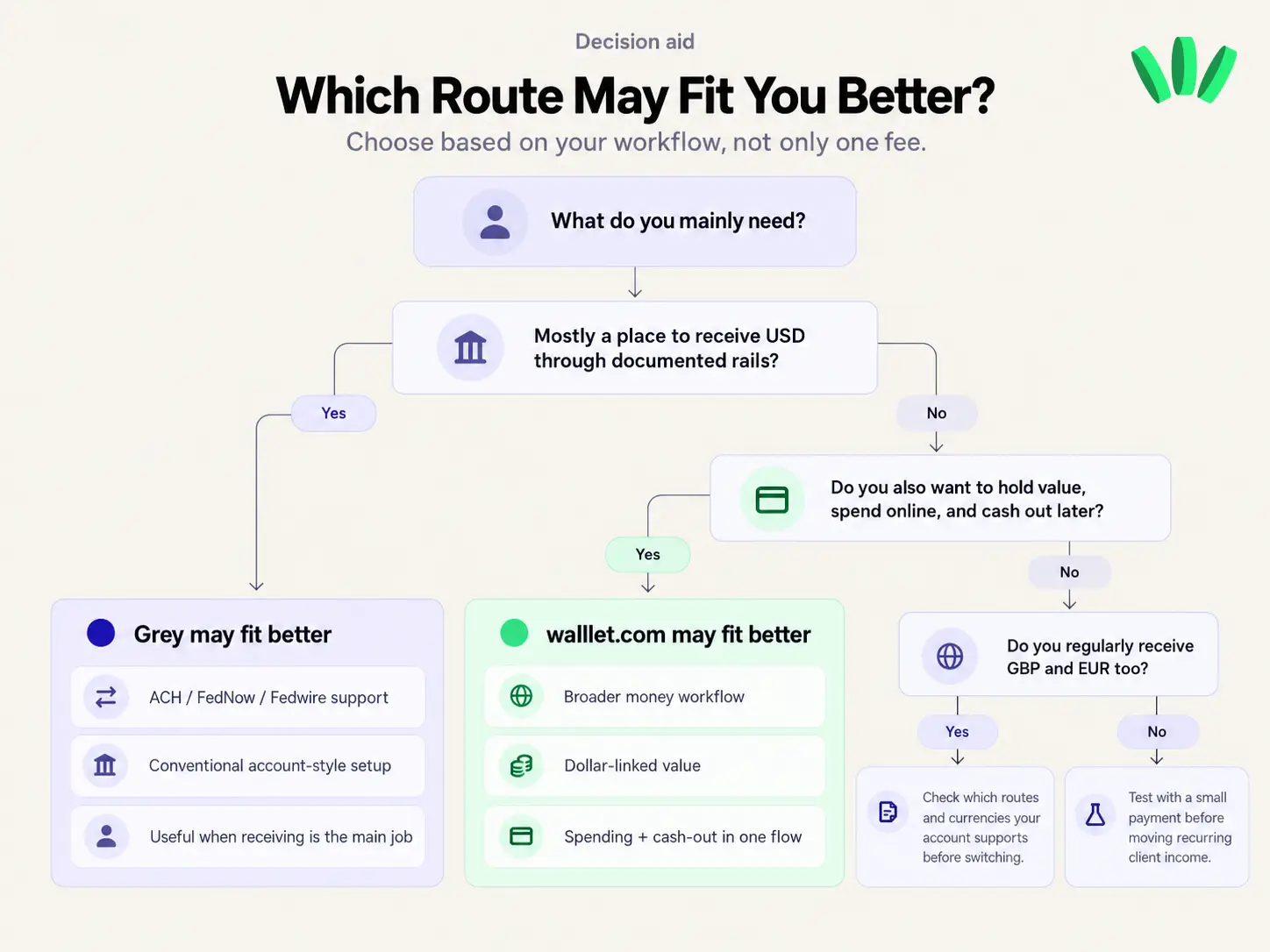
walllet.com currently publishes a $5 Bank Account issuance fee and a 1% fee for incoming USD through its supported bank route. Its Nigeria-facing documentation also lists a 0.5% off-ramp fee, while its Terms make clear that rates, provider fees and other applicable charges displayed at confirmation govern the actual transaction.
Who can use Grey and walllet.com in Nigeria?
Grey currently supports account sign-ups from Nigeria. Nigeria is also on Grey’s eligibility list for US accounts, although Grey says those US accounts are currently issued only to full-time employees and freelancers. Nigerian users are also eligible for Grey UK and EU accounts.
That makes Grey particularly relevant to the audience in this comparison: Nigerian freelancers and remote employees who need foreign receiving details.
walllet.com also currently targets Nigerian freelancers and remote workers. Its public Nigeria documentation describes foreign-currency receiving, dollar-linked holding, a virtual USD card and naira cash-out. Access to a particular receiving account, card or fiat route can still depend on KYC, eligibility and the third-party provider operating that service.
Before moving a recurring client payment, check the feature inside your own account rather than assuming that country-level availability means every route is enabled.
For a wider explanation of what is currently available, see how walllet.com works in Nigeria.
What USD account details do you receive?
This is one of the biggest differences between Grey and walllet.com.
Grey USD account details
Grey’s current documentation describes its US account as a checking account. It can receive:
ACH
FedNow
Fedwire
Grey says the USD account includes an ACH routing number and a Fedwire routing number, alongside the account information required for the transfer. ACH deposits generally take one to two business days, FedNow can arrive in seconds, and Fedwire is generally a same-business-day route.
If your US client specifically requires traditional ACH, FedNow or Fedwire instructions, Grey’s documented banking rails can be useful. However, many freelancers do not only need a place where money arrives. They need a way to keep value, spend internationally and access local currency afterward.
walllet.com receiving details
walllet.com provides eligible users access to foreign-currency receiving details through third-party providers. Its current public documentation describes USD, EUR and GBP receiving options, but the exact currency, rail, payer type, limits and eligibility should be checked against the details displayed for the account.
The more important distinction sits behind the receiving details.
According to walllet.com’s current Terms, its Virtual Account Service is intended for receiving eligible fiat payments. Unless the interface or provider terms state otherwise, the virtual account is not meant to maintain a fiat balance, make outbound bank transfers or provide general banking functions. Once an eligible fiat payment is processed, the applicable third-party provider converts the amount into a supported stablecoin and credits it to the walllet wallet.
That makes the walllet receiving account a payment-entry layer into the wider wallet workflow, rather than a conventional all-purpose USD bank account.
The walllet.com IBAN Account guide explains why an account number or IBAN alone does not tell you which currency, rail or payer type is accepted.
ACH vs FedNow vs Fedwire: what does Grey support?
Grey currently gives Nigerian eligible users unusually specific documentation for US payment rails.
USD receiving method | Grey | Current Grey deposit fee | Published timing |
ACH | Supported | 0.8%, min $2, max $10 | 1–2 business days |
FedNow | Supported | 0.8%, min $2, max $10 | Seconds to minutes |
Fedwire | Supported | $20 flat | Same business day |
SWIFT into the Grey US account | Not listed as a supported US-account rail | N/A | N/A |
Grey says FedNow uses the same 0.8% fee structure as ACH and can settle around the clock where the sender’s bank supports the network. Its US account supports ACH, FedNow and wire transfers.
Do not send an ACH payment using wire instructions or assume the word “bank transfer” tells you which routing number the payer needs.
For walllet.com, the safer rule is different: use the exact payment method displayed for the receiving account rather than assuming that an advertised USD account automatically accepts ACH, FedNow or Fedwire.
If your clients are spread across the US, UK and Europe, this guide to receiving payments from US, UK and EU clients in Nigeria explains how the payer’s country, currency and transfer rail fit together.
walllet.com vs Grey receiving fees
As of September 29, 2026, the most directly comparable published USD receiving figures are:
Cost | Grey | walllet.com |
USD ACH deposit | 0.8%, min $2, max $10 | Exact ACH support should be verified in-account |
USD FedNow deposit | 0.8%, min $2, max $10 | Exact FedNow support should be verified in-account |
USD Fedwire deposit | $20 | Exact Fedwire support should be verified in-account |
Supported USD bank receipt | Depends on rail above | 1% |
Receiving-account issuance | Check current Grey account terms | $5 for the walllet.com Bank Account |
Later USD→NGN conversion/cash-out | Separate step | Separate step |
Grey’s current USD deposit fee schedule was updated in August 2026. walllet.com’s current receiving documentation lists a 1% fee on incoming USD through its supported bank route and a $5 Bank Account issuance fee.
Do not confuse Grey’s 0.8% and 0.5% USD fees
Grey has two current Help Center figures that can look contradictory if the transaction direction is ignored:
Incoming USD deposit
ACH: 0.8%, minimum $2, maximum $10
FedNow: 0.8%, minimum $2, maximum $10
Fedwire: $20
Outgoing USD payout
ACH: 0.5%, minimum $2, maximum $10
Wire: $20
The 0.5% figure is not the current fee for receiving an ACH client payment. It is Grey’s published fee for a USD payout.
That distinction matters whenever you see a Grey Nigeria fees comparison quoting one percentage without saying whether money is entering or leaving the account.
What happens with a $500 payment?
Start with the part that can be compared cleanly: receiving.
$500 incoming payment
Route | Receiving fee | Amount after receiving fee |
Grey ACH/FedNow | 0.8% = $4 | $496 |
walllet.com supported USD bank receipt | 1% = $5 | $495 |
Grey is $1 cheaper at the receiving layer on this $500 example.
That still does not answer what reaches your Nigerian bank.
If the Grey user converts the full $496 from USD to NGN, Grey currently classifies USD→NGN as a 1% conversion with a $6 cap. At $496, that fee is $4.96. Grey then lists a ₦35 NGN bank payout fee. The result is $491.04 of value before applying Grey’s live USD/NGN rate, followed by the ₦35 payout charge.
Using walllet.com’s currently published fee model, the $500 incoming payment becomes $495 after the 1% receiving fee. A 0.5% off-ramp on $495 is $2.475, leaving about $492.53 before the executable USD/NGN conversion rate. walllet.com states that the final rate and transaction information should be reviewed before confirmation.
Those two dollar-equivalent figures still cannot tell you which provider pays more naira because the executable USD/NGN rates can differ.
What happens with a $1,000 payment?
For a $1,000 ACH-style incoming payment:
Route | Published receiving fee | Amount after receiving fee |
Grey ACH/FedNow | 0.8% = $8 | $992 |
walllet.com supported USD bank receipt | 1% = $10 | $990 |
On the first receiving step, Grey is $2 cheaper on a $1,000 ACH-style payment. But this difference is only 0.2% of the invoice value. The more important question is what happens after the money arrives: conversion, spending, card usage and cash-out.
Grey’s current pricing confirms the 0.8% ACH/FedNow fee, subject to the $2 minimum and $10 maximum.
Now follow the payment one step further.
Grey’s USD→NGN conversion fee is 1% capped at $6. On a $992 balance, the percentage would exceed the cap, so the fee is $6. That leaves $986 before the live USD/NGN rate, followed by Grey’s ₦35 NGN payout fee.
For walllet.com, $1,000 minus the 1% receiving fee leaves $990. Applying the currently published 0.5% off-ramp fee to $990 gives $4.95, leaving $985.05 before the executable USD/NGN rate.
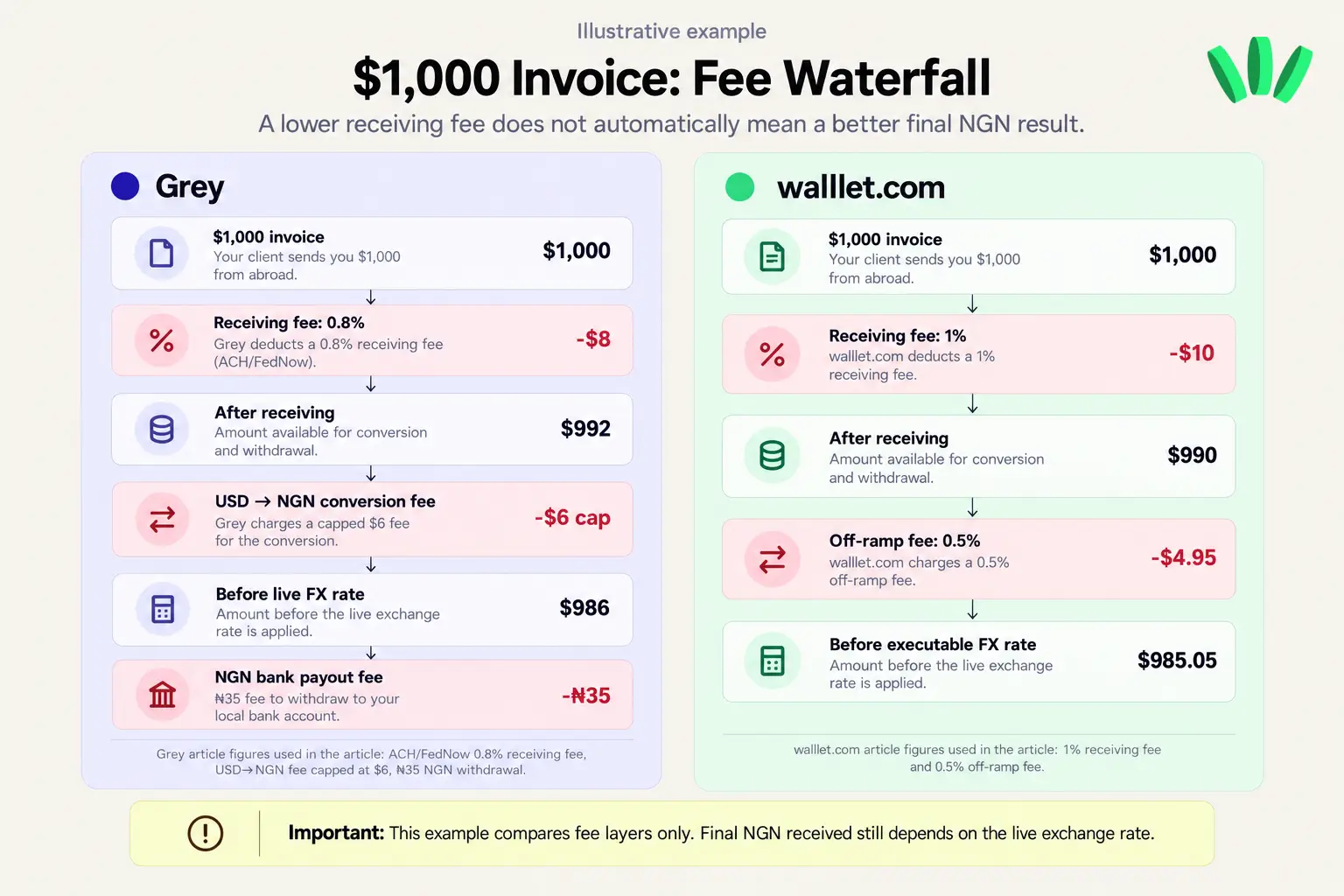
The explicit fee difference is now tiny. The live FX quote can easily matter more than the initial $2 difference in receiving fees.
This is why comparing only “0.8% vs 1%” is incomplete.
Mid-article CTA: If your income moves through more than one step, check the whole route before changing payment instructions. See the receiving, holding, spending and naira cash-out options currently available on walllet.com.
Can you hold USD with Grey and walllet.com?
The phrase “hold USD” describes two different structures here.
Grey
Grey provides a USD balance alongside its US account details. A user can receive USD and keep the money in that balance rather than immediately converting it to naira. Grey also supports GBP and EUR balances.
For someone who specifically wants a provider-managed multi-currency account with USD, GBP and EUR balances, that model is relatively straightforward.
walllet.com
walllet.com describes the user experience as maintaining dollar-linked value, but its Terms explain the settlement layer more precisely.
Fiat received through an eligible virtual account is processed by a third-party provider, converted into a supported stablecoin and then credited to the walllet wallet. walllet.com says it does not itself maintain a fiat balance for that virtual-account receipt.
This distinction matters if your requirement is specifically, “I need a conventional fiat USD balance.”
It matters less if your actual job is, “I get paid globally, want to keep value dollar-linked, spend online and convert to naira when I need local money.”
Grey to naira vs walllet.com naira cash-out
A useful Grey vs walllet comparison separates three numbers:
the conversion fee;
the USD/NGN exchange rate;
the bank payout fee.
Grey USD to NGN
Grey’s current conversion table puts USD→NGN in Group D, with a 1% conversion fee capped at $6. Grey says exchange rates are updated in real time and can be viewed after signing in.
After converting to NGN, Grey currently charges ₦35 per Nigerian bank withdrawal and lists the estimated payout time as instant.
So the public Grey to naira route is:
USD received → receiving fee → USD/NGN conversion quote + conversion fee → NGN balance → ₦35 bank payout
walllet.com to naira
walllet.com’s current Nigeria content lists a 0.5% off-ramp fee and treats the executable USD/NGN exchange rate as a separate part of the quote. The user is expected to review the amount, rate and applicable charges before confirmation.
The route is closer to:
supported dollar-linked balance → review cash-out quote → conversion/off-ramp through provider → Nigerian bank payout
Do not compare Grey’s 1% conversion fee with walllet.com’s 0.5% off-ramp fee in isolation. The final result depends on the rate attached to each transaction and any additional charge shown before confirmation.
A useful comparison is:
Final NGN received ÷ original USD invoice amount
That one number captures more of the route than a homepage fee.
If you are still deciding how the USD should reach you in the first place, receiving USD in Nigeria without PayPal covers the wider set of bank, platform and stablecoin routes.
walllet.com Card vs Grey Card in Nigeria
Both services currently offer virtual USD cards to eligible Nigerian users, but the fee models are different.
Card feature | Grey Visa Card | walllet.com Card |
Card network | Visa | Mastercard |
Available in Nigeria | Yes | Yes for eligible users |
Creation/issuance fee | $5 | $5 |
Monthly card fee | Grey says no maintenance fee | walllet.com currently states no monthly fee |
Funding model | Visa is linked directly to the Grey wallet | Card top-up carries 0.5% |
USD transaction fee | Grey says it does not charge a card transaction fee | 1%, min $1, max $10 |
Non-USD / cross-border use | Cross-border processor fee can be 2% + $0.50 for relevant non-US merchant/processor transactions | 1.5%, min $1, max $10, instead of the 1% USD transaction fee |
Published spending limit | Visa: $10,000 daily, $50,000 monthly | Check current account/card limits |
Merchant restrictions | Yes | Merchant acceptance and restrictions can apply |
For freelancers, the card is often not a separate feature. It is part of the income workflow. A payment account that only receives money solves one problem. A payment wallet that also helps users spend internationally solves the next problem.
walllet.com’s current card guide lists a $5 issuance fee, 0.5% top-up fee, 1% USD transaction fee with a $1 minimum and $10 maximum, and a 1.5% non-USD transaction fee with the same minimum and maximum. The 1.5% non-USD fee replaces the 1% USD fee rather than stacking on top of it. A $0.50 insufficient-balance decline fee is also currently documented.
For someone who spends frequently, these per-purchase rules can matter more over a year than a small difference in the original receiving fee.
What if you receive USD, GBP and EUR?
Grey currently has the more explicit public documentation for a conventional multi-currency receiving setup.
Its current published receiving fees include:
Currency | Grey receiving rail | Published deposit fee |
USD | ACH | 0.8%, min $2, max $10 |
USD | FedNow | 0.8%, min $2, max $10 |
USD | Fedwire | $20 |
EUR | SEPA / SEPA Instant | 0.8%, min €2, max €10 |
GBP | FPS | 0.8%, min £2, max £10 |
GBP | BACS | £15 |
GBP | CHAPS | £25 |
Grey’s full deposit fee schedule publishes these routes and fees, and Nigeria is currently eligible for its UK and EU account products.
walllet.com also currently describes receiving USD, EUR and GBP for eligible users, but the exact currency, incoming rail, fee, limit and payer rules can depend on the account and provider. Its public pricing is currently clearest for the supported USD bank route, where incoming USD carries a 1% receiving fee.
If one client pays from New York, another from London and another from an EU company, Grey’s currently documented rail coverage is easier to map before sending invoices.
Can personal clients and business clients send to both?
Do not treat “USD account” as permission to receive every payment from every sender.
Grey’s current US-account rules say individual third-party deposits must be less than $4,000, while third-party deposits from business accounts have no stated limit in that rule. A third-party deposit means the money comes from someone other than the Grey account holder.
This matters for direct freelance clients. A $1,000 transfer from a client’s personal US bank account and a $10,000 payment from a company’s business account are not the same compliance case.
Grey’s NGN account has a separate rule: bank-transfer deposits must come from an account in the same registered name. Third-party NGN deposits are not accepted and may be returned.
For walllet.com, accepted incoming routes and payer types should be checked against the current receiving instructions. Its Terms warn that payments sent with unsupported, incomplete or outdated account information can be delayed, rejected or returned.
A freelancer should therefore confirm four things before putting either account on an invoice:
sender type;
payment rail;
currency;
amount or applicable limit.
What happens if a payment is pending or fails?
This is one of the sections worth reading before a problem happens.
Grey
Grey says ACH normally takes one to two business days. Its ACH/FedNow/Wire guide advises contacting support when a payment is outside the expected arrival window and providing details such as the amount, sender and transaction reference. Returned ACH payments can go back to the sender within one to three business days.
A deposit can also move into pending verification. Grey may ask for the purpose of the payment, the relationship with the sender and supporting evidence. Depending on the payment, documents can include a transfer receipt, invoice, contract or proof of work. Grey says supporting-document submissions receive a status response within 72 hours, while its pending-balance guide gives a review range of 24 to 72 working hours.
Grey’s in-app chat is its primary published support channel.
walllet.com
walllet.com’s Terms say incoming payments can be delayed, rejected or returned because of sender-bank issues, intermediary institutions, payment networks, compliance checks, technical systems or decisions by the third-party provider. A “pending,” “initiated” or “received” status does not necessarily mean final settlement has occurred.
Verification can also require personal details, identity documents, a selfie and, in some cases, address or source-of-funds information. An “Under Review” status means that a final approval or rejection has not yet been made.
For either provider, keep the invoice, agreement, payment receipt and sender details for meaningful freelance or salary payments. They are much more useful during a review than trying to reconstruct the transaction after support asks for evidence.
When Grey makes more sense
Grey can fit your workflow more closely when your main requirement is a clearly documented banking rail. That includes cases where:
a US client specifically asks for ACH details;
the sender can use FedNow and you want a documented instant-payment route;
a company specifically needs Fedwire instructions;
you regularly receive USD, GBP and EUR;
you want a provider-managed multi-currency balance;
you want published incoming-payment limits and rail-specific fees before changing an invoice;
your workflow depends on platforms that can pay into compatible US account details.
Grey’s current documentation is particularly strong at answering the operational question a client or finance department asks: “Which bank rail should we use?”
When walllet.com makes more sense
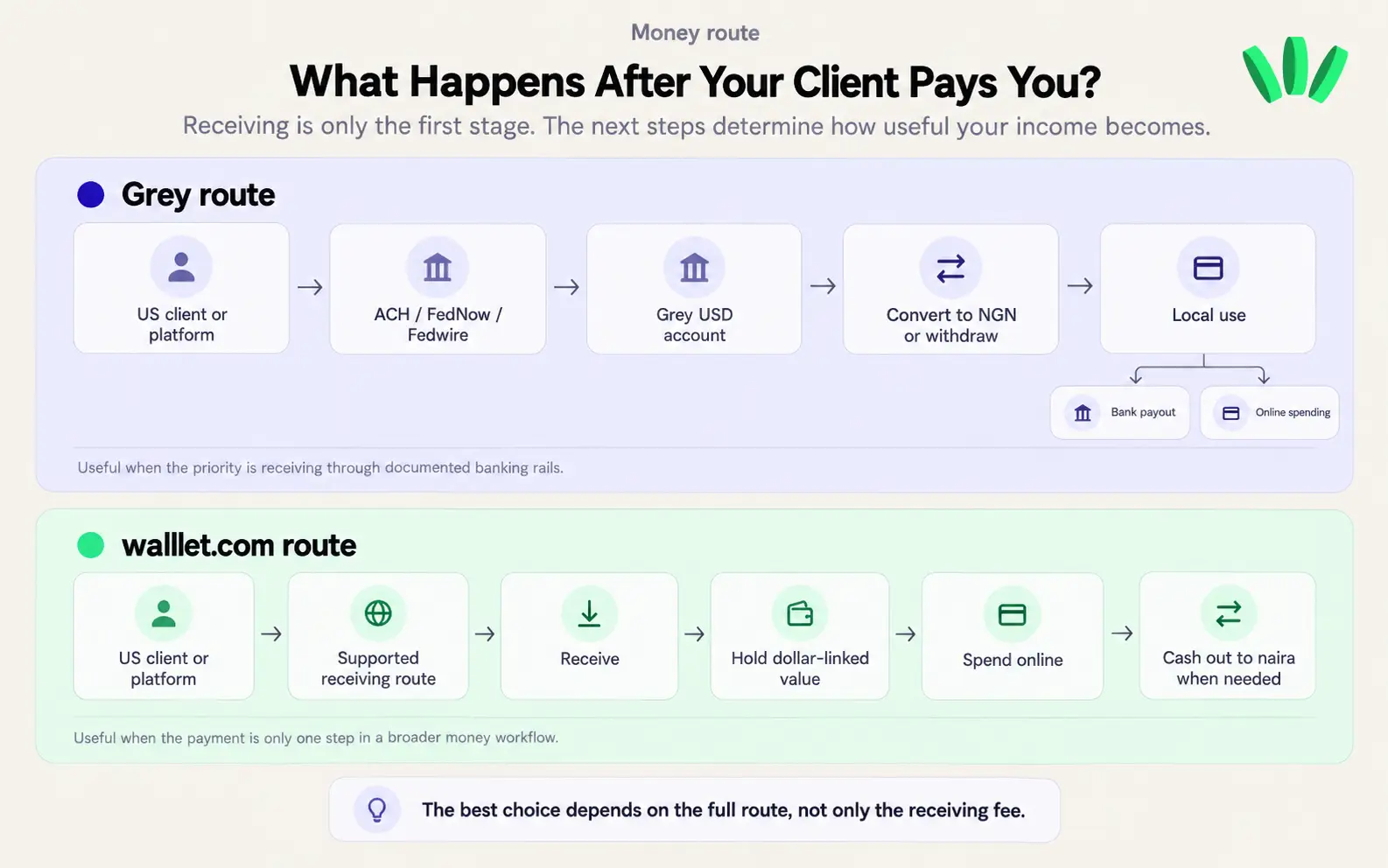
walllet.com may fit better if your main goal is managing your income after receiving it. For example:
You receive international freelance income and want more than a receiving account.
You spend part of your earnings on online services, subscriptions or international purchases.
You prefer keeping dollar-linked value instead of immediately converting everything to naira.
You want receiving, spending and cash-out connected in one experience.
You work globally and want your money workflow to feel closer to a digital financial account than a single-purpose receiving account.
That can be relevant if your workflow looks more like:
get paid → keep part dollar-linked → spend part online → cash out only what you need in naira
rather than:
get paid → hold a conventional fiat USD balance
The trade-off is that you need to pay more attention to the exact receiving route, third-party-provider terms and the distinction between a fiat receiving account and the stablecoin-backed wallet balance. Grey is optimized around receiving money. walllet.com is optimized around what freelancers actually do with money after receiving it.
If neither Grey nor walllet.com matches the payer or platform you use, the Payoneer alternatives available to Nigerian freelancers compare other routes without assuming one provider fits every client.
If you only need a place to receive a payment, compare the receiving fees. If you manage income from international clients, the bigger question is what happens after payment arrives. walllet.com is built for the complete journey: receive supported global income, keep dollar-linked value, spend online and cash out when needed.
