Yes, usually the same 0x wallet address can be valid across EVM chains like Ethereum, Base, and Arbitrum, as long as your wallet supports those networks. What changes is the blockchain underneath it, so balances, token visibility, gas, and transaction history stay separate on each chain. Here is a clear guide to why Ethereum, Base, and Arbitrum can show the same wallet address but different balances, and how to avoid wrong-network mistakes.
TL;DR
The same 0x wallet address is often valid across EVM chains like Ethereum, Base, Arbitrum, Optimism, and Polygon, but that does not mean your assets are shared across them.
Each chain keeps its own ledger, so the balance on Ethereum is separate from the balance on Base, even when the address looks identical.
If you sent funds on the wrong EVM network to your own wallet, recovery is often possible by switching to the correct chain, checking the token, and moving it properly.
walllet.com is built to make self-custody feel less fragile, with passkeys, biometrics, clearer transaction prompts, and less network confusion in everyday use.
If you have ever copied a wallet address, switched from Ethereum to Base, and felt your brain do a tiny reboot because the address still looked the same, you are not imagining things. This is one of the most common pieces of crypto confusion, especially for newer users. The address matches. The balance does not. So what gives?
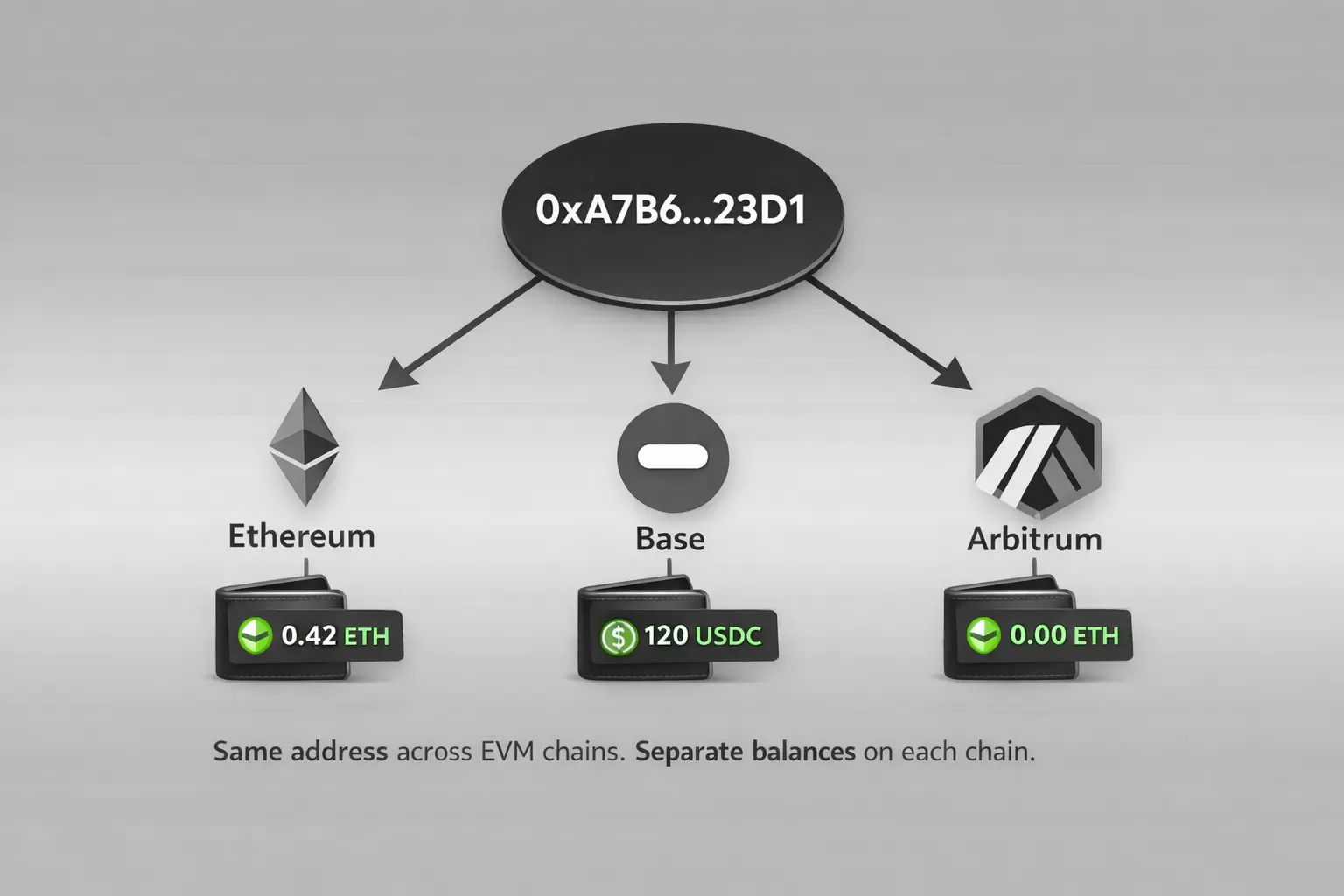
The short version is simple: same address, different chain state.
That sounds technical, but the idea is actually pretty human. Think of the address as an identifier that can exist across multiple EVM-compatible networks. The identifier may stay familiar. The records attached to it do not. Ethereum keeps its own ledger. Base keeps its own ledger. Arbitrum keeps its own ledger. So the address can match while the balances, tokens, approvals, and history remain separate.
Question | Short answer |
Is the same 0x address valid on multiple EVM chains? | Usually yes, for supported EVM networks and supported wallet setups. |
Does the same balance appear on every chain? | No. Each chain tracks assets separately. |
Can I use the same address on Ethereum, Base, and Arbitrum? | Often yes, but you still need the right network selected. |
Can I receive funds on that same address across chains? | Usually yes for your own self-custody EVM wallet, but the sender must choose the correct network. |
If I picked the wrong EVM network, are my funds gone? | Not always. If it is your own address and you control it, recovery is often possible. |
Does this logic apply to exchanges too? | Not safely by default. Exchange deposit support depends on the platform and the exact network they support. |
Is the same wallet address valid on every EVM chain?
Usually, yes. That is why your Ethereum address can often also appear as your Base address, Arbitrum address, Optimism address, or Polygon address. EVM-compatible networks share the Ethereum-style 0x address format, and wallet systems built for those chains commonly reuse the same underlying address identity across supported networks.
But “valid” needs a little nuance.
A matching address does not mean every wallet supports every EVM chain automatically. Some wallets support many networks out of the box. Some require network setup. Some smart-wallet architectures may handle cross-chain support in more opinionated ways. So the practical answer is not “always.” It is “usually, on supported EVM networks, inside a wallet that actually supports them.”
That distinction matters because people often confuse three separate ideas:
A shared address format.
A wallet that supports a specific chain.
Assets that actually live on that chain.
Those are related, but they are not the same thing.
Why is the address the same but the balance different?
Because the chain is the ledger, not the address.
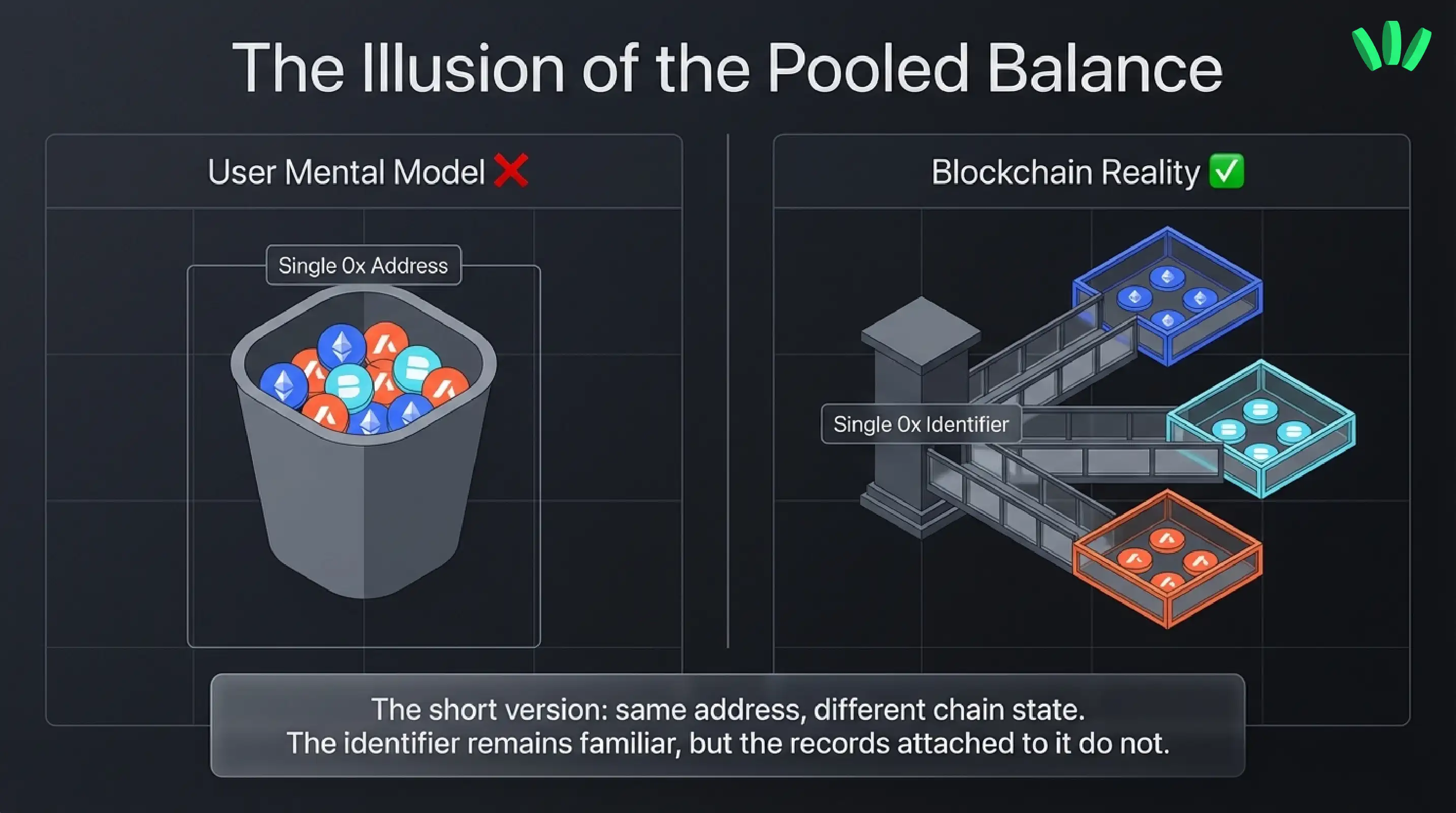
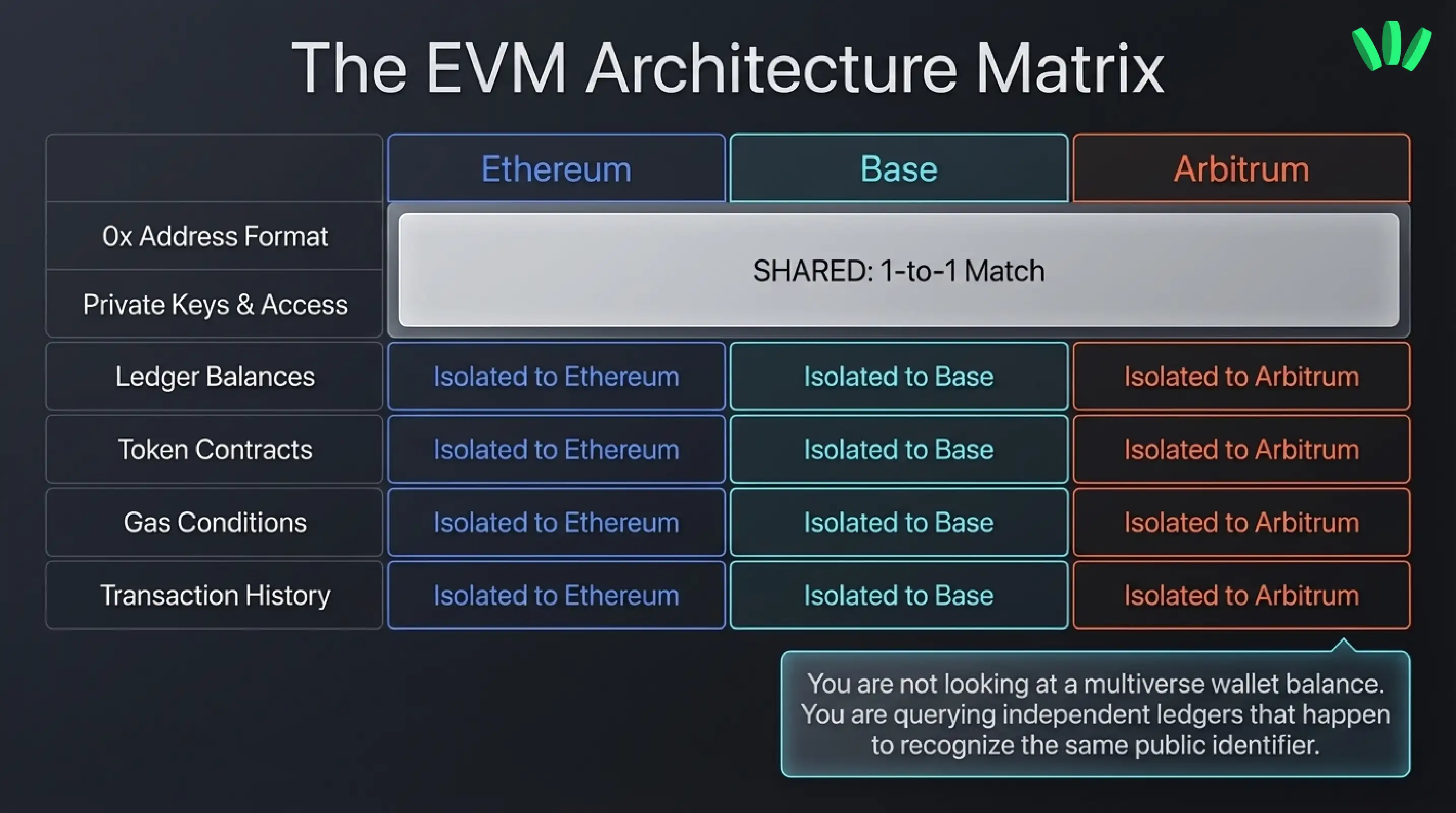
This is the heart of the whole topic. Your public address may look identical on Ethereum and Base, but Ethereum is not Base. Base is not Arbitrum. Each network stores balances, token contracts, transaction history, and approvals in its own environment. So when you check the same 0x address on two different chains, you are querying two different records.
That is why someone can say, “My address is the same on Base and Ethereum, but my ETH is missing,” when nothing is actually missing. The funds may simply exist on the chain they used, while the wallet is currently showing another one.
Related: Ethereum Wallet: How to Send & Receive ETH and ERC-20 Tokens Safely (Step-by-Step)
This gets even messier with familiar token names. USDC on Ethereum and USDC on Base can both sit under the same 0x address format, but they are still separate on-chain assets in separate chain contexts. If assets need to move from Ethereum to Base, that is a bridge or cross-chain movement problem, not an address problem. Base’s own documentation treats bridging as a distinct action for moving assets between Ethereum and Base.
A good rule to remember is this:
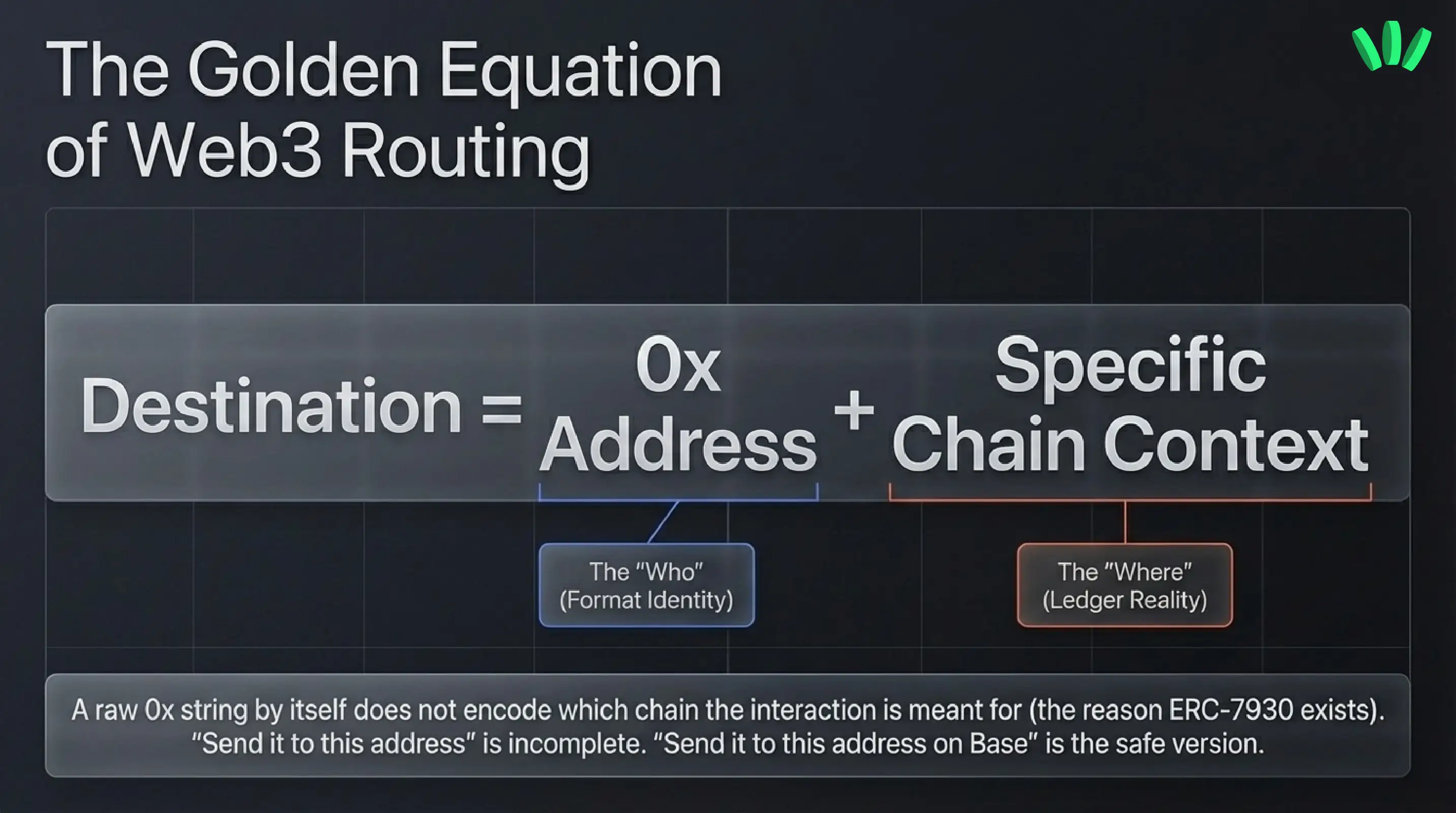
The chain name is part of the destination.
Not in the text string of the address itself, but in the real-world meaning of where funds are supposed to go.
Can I use the same 0x address on Base, Arbitrum, and Ethereum?
For your own supported self-custody EVM wallet, often yes.
That is why many people move around the EVM ecosystem without creating a brand-new wallet for each chain. The address feels portable. The wallet identity feels continuous. That is part of what makes EVM networks convenient in the first place.
Still, a few things change every time you switch chains:
The balance you see.
The token contracts you interact with.
The explorer you should check.
The gas conditions for that chain.
The dApps and liquidity on that network.
So yes, your 0x address may stay the same across Ethereum, Base, and Arbitrum. But you are not looking at one giant pooled balance. You are looking at one address identity across multiple independent ledgers.
Can I receive funds on the same address across chains?
Usually yes, if it is your own self-custody EVM wallet and the wallet supports that chain.
That is the practical upside of shared EVM address behavior. You do not need a separate “Base address” string and a separate “Ethereum address” string in the way many beginners expect. The same 0x address can often receive funds on different EVM chains. The catch is that the sender must choose the right network, and you must later check that same network to see the funds.
Your public wallet address is safe to share. Ethereum’s wallet guide explains that clearly. But in EVM land, the address alone is not enough context. You should also specify the chain. “Send it to this address” is incomplete. “Send it to this address on Base” is the safer version.
That is also why newer standards work is trying to make chain-specific address representation clearer. ERC-7930 exists because a raw address string by itself does not encode which chain the interaction is meant for, and that ambiguity creates real operational risk.
What happens if you choose the wrong network?
That depends on who controls the destination.
If you sent funds on the wrong EVM network to your own self-custody address, the situation is often fixable. In many cases, the assets are sitting at your address on the other EVM chain. You are just not viewing the correct network yet. Recovery usually means checking the transaction on the right explorer, switching to the correct chain in your wallet, making the token visible if needed, and then moving it properly with the correct gas token or a bridge.
Related: Self-Custody vs Exchange for Everyday Crypto Use: Which One Makes More Sense?
If you sent funds to an exchange deposit address using a network the exchange does not support for that asset, things get shakier. A matching 0x address does not guarantee the platform will credit the deposit. Recovery depends on the exchange’s custody setup, policies, and willingness to help. That is why “same address” logic is safest inside your own wallet, not as a blanket assumption everywhere.
If you want the calmest troubleshooting order, use this:
First, check the transaction hash on the block explorer for the network that was actually used.
Second, confirm whether the recipient address is yours.
Third, switch your wallet to that same chain and look for the asset there.
Fourth, if it is visible, decide whether you should leave it there, bridge it, or move it elsewhere correctly.
One more thing: if the funds are on-chain at your address, do not panic-click random “recovery” services or strangers in DMs. That is where a bad day turns into a worse one.
Are assets separate even with the same address?
Yes. Completely separate.
This is worth stating plainly because it is the part people half-understand and then trip over later. Same address does not create a shared multiverse wallet balance. It does not teleport assets from one EVM chain to another. It does not sync your holdings automatically. It does not make bridging unnecessary.
What it does is reduce the mental overhead of managing identity across EVM-compatible chains. That is useful. But the moment money moves, the chain still decides where that money lives.
So if someone asks, “Can I use the same 0x address on Base and Ethereum?” the best honest answer is:
“Yes, often. But you still need to care deeply about which chain you are using.”
walllet reduce the number of times you end up confused
This is exactly the kind of topic where wallet design matters more than people think.
walllet.com is not trying to win by making crypto feel more ceremonial. Its whole product direction is the opposite. The site and terms describe a self-custodial smart wallet that uses passkeys, biometrics, on-device key protection, and ERC-4337 account abstraction instead of forcing users through the usual seed phrase maze. walllet’s public materials also emphasize clearer transaction prompts, safer signing context, multi-chain use, and warnings around suspicious approvals or risky actions.
If you use the wrong network, the chain still matters. If you send to the wrong destination, no wallet can wave a wand and undo it.
What a better wallet can do is reduce the number of times you end up confused in the first place.
If a wallet reduces seed phrase friction, makes access feel modern through passkeys and biometrics, explains approvals more clearly, and handles multi-chain flows with fewer blind spots, it lowers the odds that “same address, different network” becomes an expensive mistake. That is where walllet.com becomes relevant!
For beginners, that matters a lot. For experienced users, it still matters. Crypto mistakes are rarely caused by lack of raw intelligence. More often, they happen because the interface leaves too much unsaid at the exact moment you need clarity.
The simple rule worth keeping
Treat the network like part of the address.
Not literally in the 0x string, but in your decision-making. When you send, receive, bridge, or troubleshoot, do not stop at “Does the address match?” Ask the better question: “Which chain am I actually using?”
That one habit clears up most of the confusion around same wallet addresses on EVM chains.
And if you want a wallet that is built around making those moments less brittle, walllet.com is worth a look. It keeps self-custody intact, drops the seed phrase burden, and tries to make multi-chain crypto feel more like a product a real person would want to use, not a puzzle box with financial consequences. Try walllet.com if you want a self-custodial wallet that makes multi-chain crypto easier to understand, with passkeys, biometrics, and clearer transaction prompts that reduce the usual seed phrase and wrong-network friction.
