An EVM wallet lets you hold and use crypto across Ethereum-compatible networks like Ethereum, Base, Polygon, Arbitrum, Optimism, and BNB Smart Chain. One wallet address can often work across these chains, but your assets still stay on the specific network where they were sent.
TL;DR
An EVM wallet is a crypto wallet that works with Ethereum-compatible chains and apps.
Most EVM wallets use addresses that start with 0x.
You can often use the same wallet address across Ethereum, Base, Polygon, Arbitrum, Optimism, and other EVM chains.
Same address does not mean same balance. Your assets still live on separate networks.
Solana is not natively EVM-compatible.
A good EVM wallet should make networks, approvals, recovery, and transaction details easier to understand. Because apparently crypto decided that “send money” needed six hidden traps.
Skip the seed phrase. Keep control.
Meet a self-custodial smart wallet built for a simpler EVM experience, with passkeys, biometrics, and no 12-word backup ritual.
What is an EVM wallet?
An EVM wallet is a crypto wallet that can connect to the Ethereum Virtual Machine, or EVM. In normal words, it helps you use Ethereum-style chains, tokens, smart contracts, and decentralized apps.
The Ethereum documentation explains the EVM as the environment that handles Ethereum’s state, transactions, and smart contract execution. For users, the useful part is simpler: if a chain works like Ethereum, an EVM wallet can usually understand it.
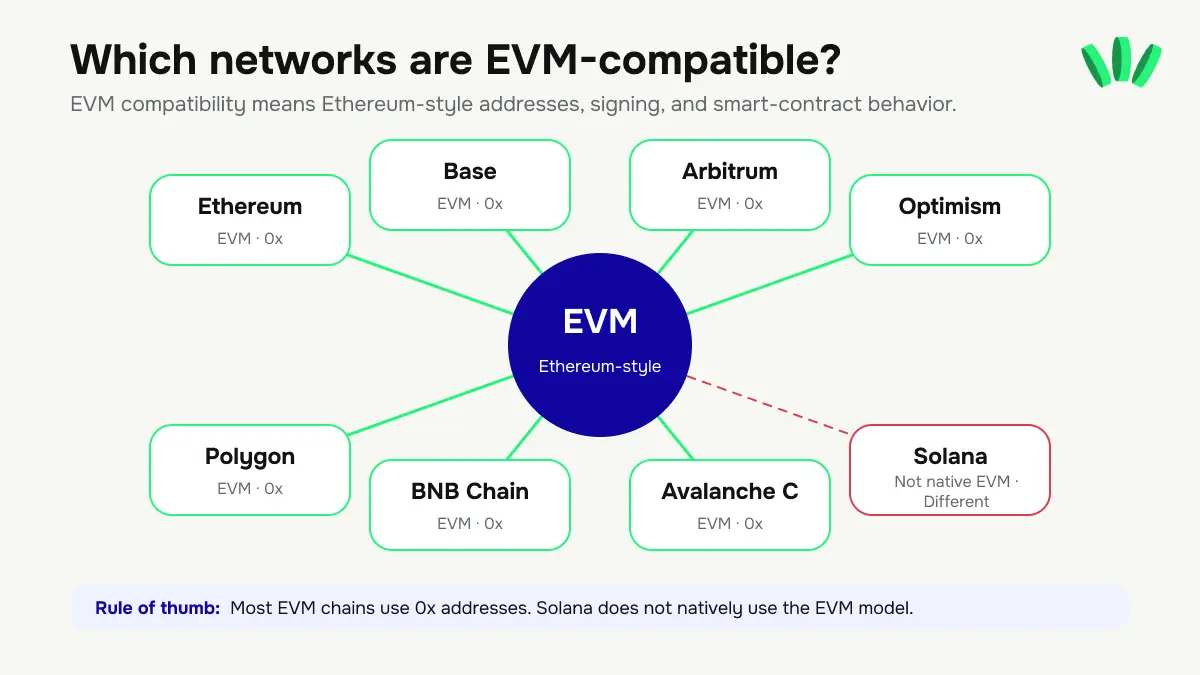
That includes networks like Ethereum, Base, Polygon, Arbitrum, Optimism, Avalanche C-Chain, BNB Smart Chain, and other Ethereum-compatible chains.
If you are still choosing your first wallet, this guide on the best crypto wallet for beginners is a useful next read. Start there before drowning in chain names. Truly, a humane option.
What does EVM mean in crypto?
EVM stands for Ethereum Virtual Machine. It is the system that lets smart contracts run on Ethereum.
Smart contracts power things like swaps, token approvals, NFT mints, bridges, lending apps, and many DeFi actions. Other chains copied or adapted Ethereum’s model so developers could build apps with familiar tools and users could connect with familiar wallets.
That is why EVM compatibility matters. It means a wallet, token, app, or network can work inside the Ethereum-style ecosystem.
What makes a wallet an EVM wallet?
A wallet is an EVM wallet when it can manage Ethereum-style addresses, sign EVM transactions, and connect to EVM-compatible apps. Most EVM wallets can:
Feature | What it means for you |
Use 0x addresses | Your wallet address usually starts with 0x |
Connect to dApps | You can use Ethereum-style apps |
Sign transactions | You can approve swaps, transfers, mints, and contract actions |
Support tokens | You can hold common Ethereum-style tokens |
Switch networks | You can move between supported EVM chains inside one wallet |
So an EVM wallet is not just for holding ETH. It is the thing you use to interact with the Ethereum-style app world.
If you want the wallet architecture side of this, read this guide on what makes a crypto wallet smart. That one explains why some wallets can do more than basic private-key signing.
Which chains are EVM-compatible?
Ethereum is the original EVM chain. Many other chains and Layer 2 networks are EVM-compatible, which means they use Ethereum-style wallet behavior and smart contract logic.
Network | EVM-compatible? | Address format | Same EVM wallet usually works? |
Ethereum | Yes | 0x | Yes |
Base | Yes | 0x | Yes |
Polygon PoS | Yes | 0x | Yes |
Arbitrum | Yes | 0x | Yes |
Optimism | Yes | 0x | Yes |
Avalanche C-Chain | Yes | 0x | Yes |
BNB Smart Chain | Yes | 0x | Yes |
Fantom | Yes | 0x | Yes |
Solana | No, not natively | Different format | No |
Some of these are Layer 2 networks built around Ethereum. If that part is fuzzy, this guide to Ethereum Layer 2 networks will help. The short version:
EVM-compatible chains feel similar inside a wallet, but they are still separate networks.
Can the same EVM wallet address work across multiple chains?
Yes. Often.
Many EVM chains use the same 0x address format, so your wallet address can look the same on Ethereum, Base, Polygon, Arbitrum, Optimism, and BNB Smart Chain.
This is useful. Also dangerous if you misunderstand it.
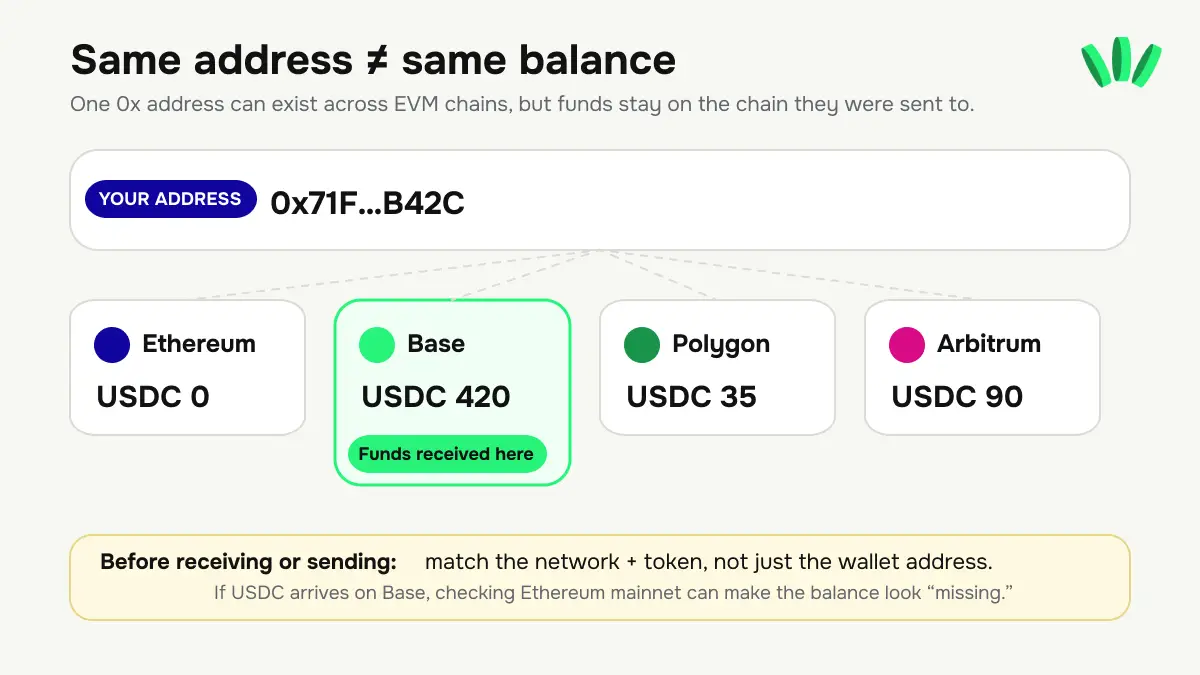
Your address can be the same while your balances are different. If someone sends USDC to your address on Base, you need to check Base. If they send it on Polygon, check Polygon. Looking only at Ethereum mainnet may make it look like the funds disappeared.
They probably did not. You are just looking at the wrong network. A classic crypto prank, apparently designed by people allergic to clarity.
Important: same address, different chain, different balance.
For stablecoin users, especially freelancers receiving USDT or USDC, this matters a lot. This guide on getting paid in USDT or USDC as a freelancer explains the network-checking part in a more payment-focused way.
Curious what this feels like without the usual wallet setup drama?
You can explore walllet.com and see how a seedless smart wallet handles crypto access, recovery, and everyday wallet use.

Is Solana an EVM chain?
No. Solana is not natively an EVM chain.
Solana uses a different technical environment from Ethereum. Some projects create EVM compatibility around Solana, but that does not make Solana itself an EVM chain.
So if you have a Solana wallet, do not assume it works like an EVM wallet. Different address model. Different apps. Different signing flow. Different ways to get confused, because variety is important, apparently.
What can you do with an EVM wallet?
You can use an EVM wallet to hold tokens, connect to Ethereum-compatible apps, sign transactions, swap assets, mint NFTs, bridge tokens, and use DeFi.
Most people use EVM wallets for everyday actions like receiving USDT or USDC, swapping tokens, using Layer 2 networks, connecting to Web3 apps, or managing assets across Ethereum-compatible chains.
If stablecoins are your main use case, this guide to USDC, USDT, and DAI is worth reading before you treat every dollar token as the same thing. They are not.
What do beginners usually get wrong about EVM wallets?
The biggest mistake is thinking the wallet address tells the whole story.
It does not.
Your EVM wallet address may look identical across several chains, but the network still matters. Always check the chain before receiving, sending, swapping, or bridging assets.
Another common mistake: thinking every EVM wallet supports every EVM chain automatically. EVM compatibility makes support easier, but the wallet still needs to support the network clearly in its app.
Then there is the approval problem. Connecting to a dApp does not mean the app is safe. Signing an approval can give a smart contract permission to move tokens. Sometimes limited. Sometimes too broad. Sometimes the kind of thing you regret at 2 a.m.
So the beginner checklist is simple:
Check the network. Read the approval. Start small. Do not use your main wallet for random apps. Keep recovery access safe.
That is enough to avoid a shocking number of avoidable mistakes. Humanity survives another paragraph.
What is the difference between an EVM wallet and a smart wallet?
An EVM wallet describes where the wallet can work. A smart wallet describes how the wallet is built.
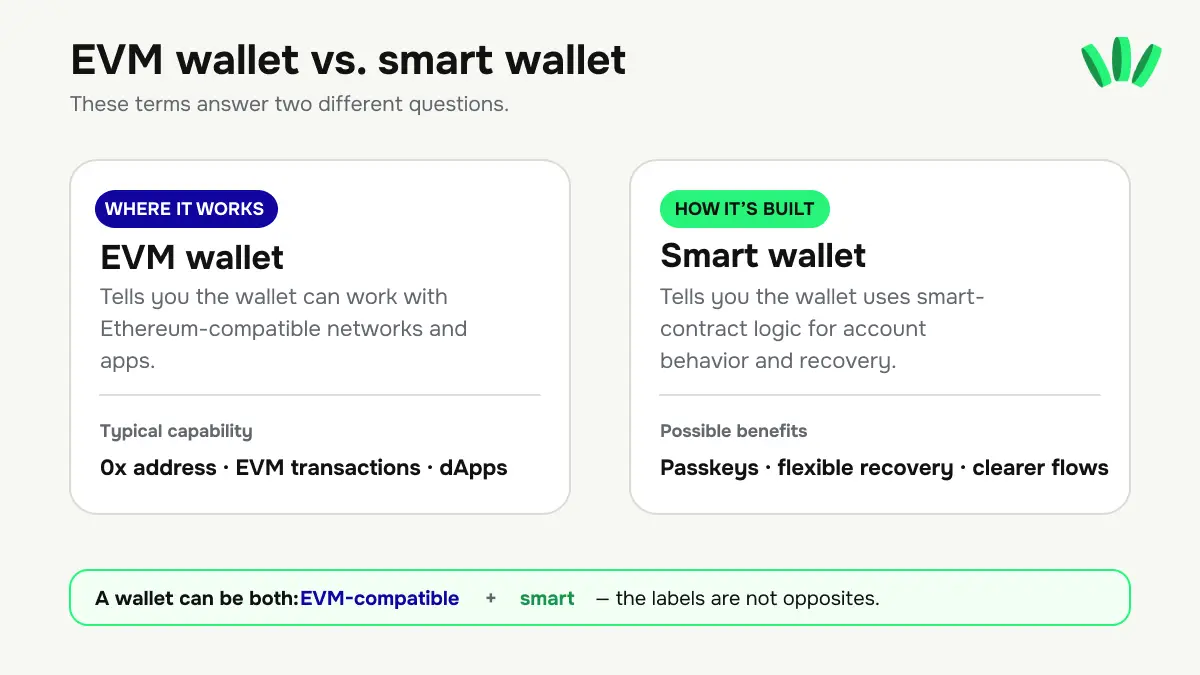
A traditional EVM wallet is usually controlled by a private key or seed phrase. A smart wallet can use smart contract logic to support features like flexible recovery, different signing methods, gas-related improvements, and clearer user flows.
EIP-4337 is one important standard in this area. It helps smart contract accounts work without forcing users to rely only on the classic externally owned account model.
Term | What it tells you |
EVM wallet | The wallet works with Ethereum-compatible chains |
Smart wallet | The wallet uses smart contract logic |
Traditional wallet | The wallet usually depends on a private key or seed phrase |
Seedless wallet | The wallet avoids the usual seed phrase backup flow |
If you want the login and recovery side, read this guide on passkey wallets. That is where seedless access starts making more practical sense.
How should you choose an EVM wallet?
Choose an EVM wallet based on the chains you use, the apps you trust, and how clearly the wallet explains what you are signing. A good EVM wallet should make these things obvious:
Which network you are on.
Which token you are using.
What action you are approving.
How recovery works.
Whether you are signing a harmless connection or giving a contract permission.
How much risk sits behind the button you are about to tap.
That last one matters. A lot.
A wallet can support many chains and still be painful to use. Beginners do not need more buttons. They need fewer moments where one wrong tap becomes an expensive lesson.
Can walllet.com make EVM wallet use less confusing?
Yes, that is the point walllet.com is trying to solve: how do you keep control of your crypto without dealing with the scariest parts of traditional wallet setup?
walllet.com is a self-custodial smart wallet built around passkeys, biometrics, seedless recovery, and clearer transaction flows. For EVM users, that matters in a few specific moments.
When you are setting up a wallet and do not want to manage a seed phrase.
When you are checking what a transaction is asking you to approve.
When you are using Ethereum-style apps and need the wallet experience to feel understandable.
When you want control, but not the usual “write these 12 words somewhere safe forever” ritual. Very normal industry behavior. Totally fine.
This does not remove every crypto risk. You still need to check networks, avoid suspicious apps, and start with small amounts when trying something new.
Still, wallet design matters. A clearer wallet can reduce mistakes before they happen.
How can you use an EVM wallet more safely?
Use your EVM wallet like each action has context. Because it does.
Before receiving funds, confirm the network and token with the sender. Before swapping, check the asset, chain, and fee. Before connecting to a dApp, ask whether you actually trust it. Before approving a token, read what permission you are giving.
For larger holdings, avoid using the same wallet everywhere. Keep daily-use funds separate from long-term funds. Test new apps with small amounts. Revoke old approvals when you do not need them.
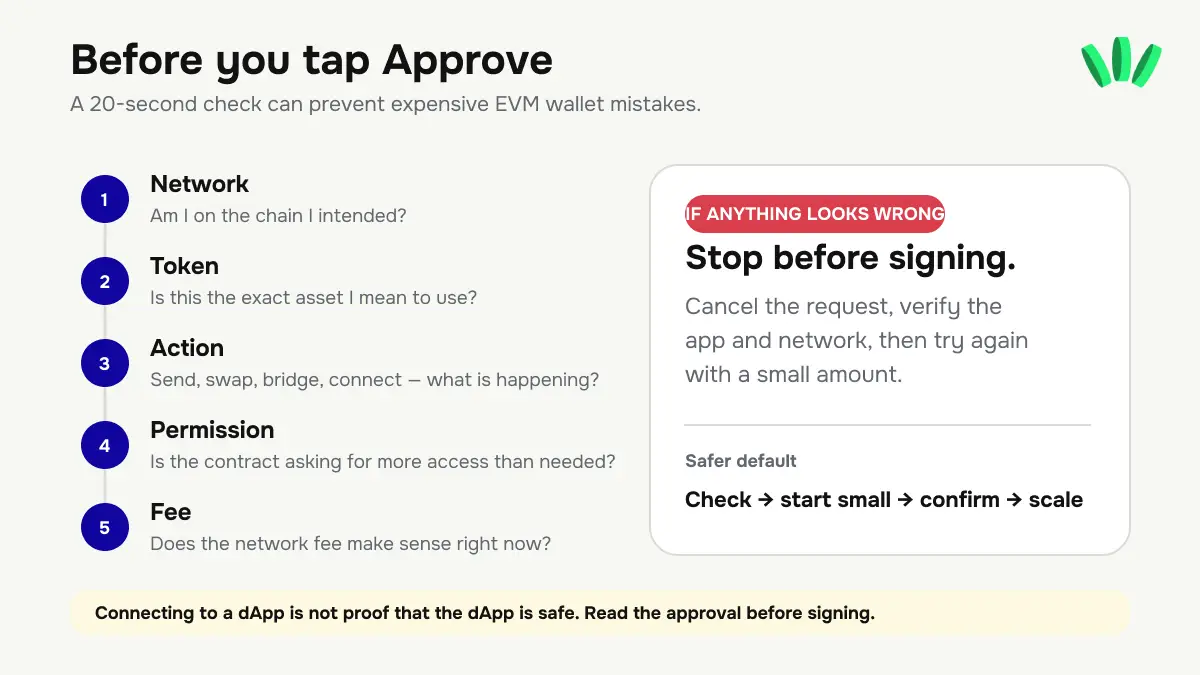
Boring advice. Useful advice. The annoying kind.
Final thoughts
An EVM wallet is your access point to Ethereum-compatible chains and apps.
It can help you use Ethereum, Base, Polygon, Arbitrum, Optimism, BNB Smart Chain, Avalanche C-Chain, and similar networks from one wallet interface.
The part to remember: same address does not mean same balance. The network still matters. Every time.
If you want an EVM wallet experience with seedless access, clearer recovery, and less beginner friction, walllet.com is built for that kind of user.
EVM is complicated enough. Your wallet doesn’t have to be.
Get the control of self-custody without the seed phrase, confusing recovery flow, or usual wallet setup drama.
