
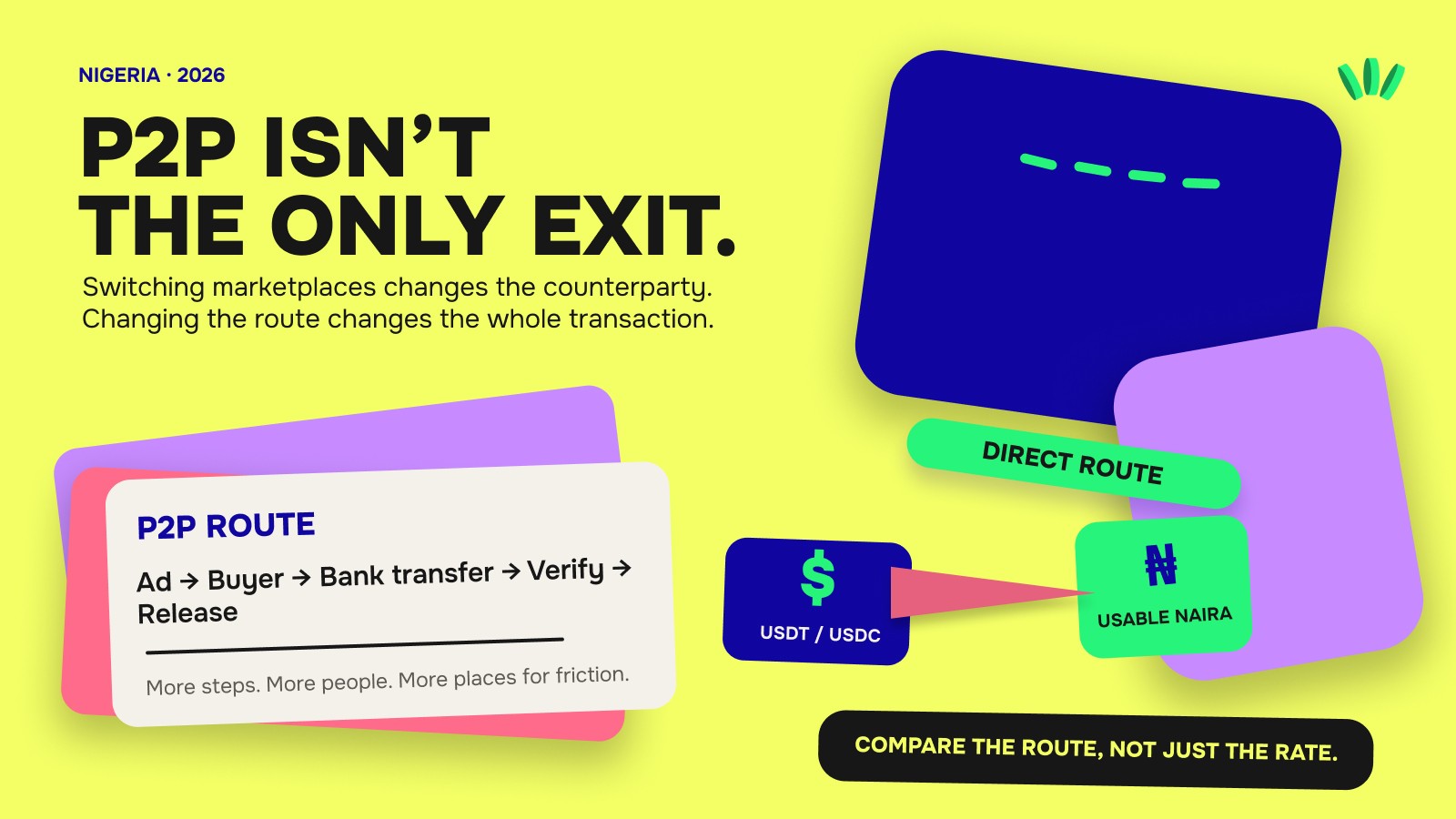
If you are looking for the best P2P alternative in Nigeria, you have two choices: move to another P2P marketplace such as Bybit, Bitget or MEXC, or stop relying on P2P for the naira side of the transaction. The better route depends on what you actually need to do with your money.
That distinction matters.
If your only goal is to trade crypto against naira, another P2P platform may be enough. If you are a Nigerian freelancer or remote worker trying to turn foreign income or stablecoins into money you can actually hold, spend and cash out, replacing Binance with another marketplace may solve only one step of the problem.
The best P2P alternatives in Nigeria at a glance
Option | Type | Another person handles the P2P side? | Strongest fit | Main trade-off |
Bybit P2P | P2P marketplace | Yes | Users who want a familiar Binance-style P2P flow | Counterparty and dispute risk remain |
Bitget P2P | P2P marketplace | Yes | Users comparing NGN ads and merchants | Still depends on another P2P participant |
MEXC P2P | P2P marketplace | Yes | Existing MEXC users who want NGN P2P | Liquidity and merchant quality can vary |
Quidax | Direct exchange route | No P2P marketplace | Users who prefer a local exchange model | P2P was discontinued in January 2026 |
Busha | Exchange/direct payout route | Not required for direct routes | Users who want crypto-to-NGN bank payout options | Custodial and provider-dependent |
walllet.com | Global-income money route | No user-to-user P2P required for supported cash-out routes | Freelancers and remote workers managing foreign income | Availability depends on current account, provider and supported route |
The important difference is in the third column.
Switching from Binance P2P to Bybit P2P changes the marketplace. It does not change the underlying model. You still choose an offer, interact with another participant and verify the fiat side before the crypto is released.
A direct off-ramp changes the model itself.
If you already hold USDT or USDC and your immediate problem is getting naira into a Nigerian bank account, the walllet.com guide to cashing out USDT or USDC to naira in Nigeria covers the full cash-out workflow, including network checks, quotes, fees and bank-credit verification.
What changed in 2026?
As of August 2026, Bybit's official documentation still contains a specific NGN P2P fee schedule, Bitget lists Nigeria and NGN among its supported P2P markets, and MEXC documentation includes NGN among its African P2P markets. Quidax took the opposite direction: it discontinued its P2P marketplace on January 23, 2026 while keeping its other buy, sell, deposit and withdrawal services available.
That makes the market more interesting than another “top P2P exchanges” list suggests. Some alternatives replace Binance P2P. Others replace P2P.

Why did Nigerians need a Binance P2P alternative in the first place?
Binance removed NGN from its P2P market in March 2024 during a wider dispute between the company and Nigerian authorities. Reuters reported at the time that Nigerian regulators were increasing scrutiny of cryptocurrency activity and that Binance had stopped naira transactions.
For users who had built a familiar routine around Binance, the obvious response was to search for another exchange.
That explains queries such as:
Binance P2P alternative in Nigeria
Bybit P2P Nigeria
best P2P app in Nigeria
USDT to naira P2P
how to sell USDT in Nigeria
crypto to naira
how to cash out crypto without P2P
But these queries often hide several different problems.
A trader may want the best available USDT/NGN offer.
A freelancer paid in USDT may want enough naira for rent while keeping the rest of the month's income dollar-linked.
A remote worker may want to receive money from a foreign employer, convert only what is needed and pay for international tools without running the entire salary through P2P.
Those people should not automatically choose the same product.
The broader issue is especially relevant for globally paid Nigerians. If you are deciding how the money should arrive before you even reach the cash-out stage, the guide to receiving USD in Nigeria without PayPal compares bank-transfer, payment-platform and stablecoin routes.
1. Bybit P2P: the closest replacement if you want to keep using P2P
For someone who liked the mechanics of Binance P2P, Bybit is one of the most obvious replacements.
Bybit defines its P2P product as a marketplace where users buy and sell directly with other users. Bybit facilitates the transaction, but it does not provide the buy and sell offers itself. Identity verification is required for P2P trading.
Its current documentation has a dedicated NGN fee section and lists NGN trading pairs including USDT, USDC, ETH and BTC. Fees depend on whether you are a maker or taker and, for advertisers, their level.
That makes Bybit relevant if you want:
a familiar ad-and-order interface;
the ability to compare different P2P offers;
multiple supported crypto assets;
control over which advertiser you trade with.
The trade-off is simple: Bybit changes the venue, not the P2P dependency.
You still need to inspect the order, payment method and counterparty. You still need to verify actual receipt of naira rather than trusting an alert or screenshot. And if the trade becomes disputed, you are dealing with a P2P dispute process.
For an experienced P2P user, that may be acceptable. For someone who simply wants usable naira from this month's freelance income, it may be more workflow than necessary.
2. Bitget P2P: another active NGN marketplace
Bitget is another direct answer to “what can I use instead of Binance P2P?”
Bitget's current documentation lists NGN as a supported P2P currency. Its P2P system works in the usual marketplace model: individual users provide the offers, while the platform facilitates the trade and uses escrow for the crypto side.
Bitget also updated its NGN P2P fee structure in February 2026, so anyone comparing it with Bybit should check the latest maker/taker fee shown by Bitget rather than relying on an old comparison article.
There is another reason to treat the advertised rate carefully.
In April 2026, Bitget published a specific enforcement notice for its NGN market covering price manipulation, off-platform negotiation and merchants attempting to add conditions or extra fees outside the listed offer.
That does not mean the marketplace is unusable. It shows why the visible price alone is a poor way to judge a P2P route. The real questions are:
Who is paying you?
What conditions are attached to the ad?
What happens if the fiat payment does not match the agreed transaction?
What will actually be left after every stage is complete?
3. MEXC P2P: worth checking if you already use MEXC
MEXC added Nigerian naira to its P2P offering in September 2025. Its current merchant documentation still includes NGN among its African P2P markets.
This makes MEXC another viable marketplace to check, particularly if your crypto is already there.
That last point matters more than many comparison articles admit.
Suppose one marketplace has a marginally better P2P quote, but you must first withdraw your USDT from another platform, pay a network or withdrawal cost, wait for confirmation and then make the trade.
A slightly worse quote on the platform where the money already sits may leave you with more naira.
The useful comparison is therefore:
Final usable NGN = starting value − transfer costs − conversion cost − payout costs − any other required charges
Not: Which ad has the biggest NGN number beside USDT?
If your stablecoins arrive from a client rather than an exchange, confirm the token and network before anything moves. The guide to getting paid in USDT or USDC as a Nigerian freelancer explains the receiving side, including network agreement, payment verification and transaction records.
4. Quidax: an alternative precisely because it stopped doing P2P
Quidax is the most useful example of why “P2P alternative” and “alternative P2P marketplace” are different searches.
Quidax officially discontinued its P2P marketplace on January 23, 2026. P2P ads, orders and chat stopped, while other Quidax services such as buying, selling, deposits and withdrawals continued.
In other words, Quidax did not disappear. The P2P layer did. For a user whose actual job is:
I have crypto and I need another form of value.
that can be a perfectly different product model.
The Nigerian SEC's fintech directory currently lists Quidax Technologies Limited and Busha Digital Limited as Digital Assets Exchanges in its Accelerated Regulatory Incubation Program. The same SEC page is useful for checking an operator's current status rather than relying on a logo or regulatory claim copied from an old article.
Do not translate that into “every transaction is safe.” It is not what regulatory status means.
You still need to check the current route, quote, withdrawal conditions, KYC requirements, limits and support process before moving money.
5. Busha: direct crypto-to-NGN routes without making P2P the main event
Busha is useful in this comparison because its infrastructure supports direct crypto and fiat movement rather than requiring every user to find a P2P advertiser.
Current Busha documentation describes Nigerian bank-account payouts and a route from a Busha crypto wallet to an external bank account. Its developer documentation also describes quotes where a crypto source such as USDT can be converted toward an NGN payout.
The practical difference is the workflow.
A standard P2P transaction looks roughly like this:
Choose advertiser → create order → counterparty sends NGN → verify bank receipt → release crypto
A direct provider route is closer to:
Choose amount → receive quote → confirm conversion → provider processes NGN payout
Neither model is automatically superior.
P2P gives you a marketplace in which you can inspect and select offers.
A direct route removes the need to coordinate that specific fiat leg with another retail user.
Which one is better depends on what you value.
The biggest mistake: replacing Binance P2P without asking why you needed P2P
This is where most “best P2P alternatives in Nigeria” articles stop too early.
They replace:
Binance
with:
Bybit / Bitget / MEXC / another marketplace
But the more useful question is: What job was P2P doing for you?
If the answer is “I actively trade between crypto and naira and want to choose my counterparties,” another P2P platform makes sense.
If the answer is “my foreign client paid me in USDT and I need ₦300,000 for expenses,” your problem is cash-out.
If the answer is “I earn $1,500 every month and I need to keep some value dollar-linked, convert some to naira and use some for international expenses,” your problem is income management.
Those are different jobs.
walllet.com's audience research repeatedly points to the wider income route as the real pain: receiving foreign income, keeping part of it dollar-linked, understanding rates and fees, paying for work tools, cashing out and getting support when something goes wrong.
That is why comparing only the P2P screen misses a large part of the decision.

P2P vs direct cash-out: what actually changes?
Question | P2P marketplace | Direct cash-out route |
Who provides the fiat side? | Another user or merchant | Platform/provider route |
Do you select a counterparty? | Usually yes | Usually no |
Is crypto escrow commonly involved? | Yes | Usually not in the same form |
Can prices vary by advertiser? | Yes | You normally receive a platform quote |
Can a buyer/seller dispute occur? | Yes | Provider review/support replaces the P2P dispute |
What must you verify? | Counterparty, payment receipt, order conditions, rate | Provider, quote, fees, eligibility, payout destination |
Best fit | Users who specifically want a P2P marketplace | Users who mainly want conversion and payout |
Main dependency | Counterparty + platform | Provider + banking/payment rails |
Neither column is “risk-free.”
It is simply a different risk model.
Escrow can protect the crypto side of a P2P order. It cannot make a fake bank alert real. It cannot guarantee the payment came from a source your bank will be comfortable with. It cannot remove every account review or dispute.
A direct provider removes the retail counterparty from that step, but now you depend more directly on the provider's availability, quote, compliance process and payout infrastructure.
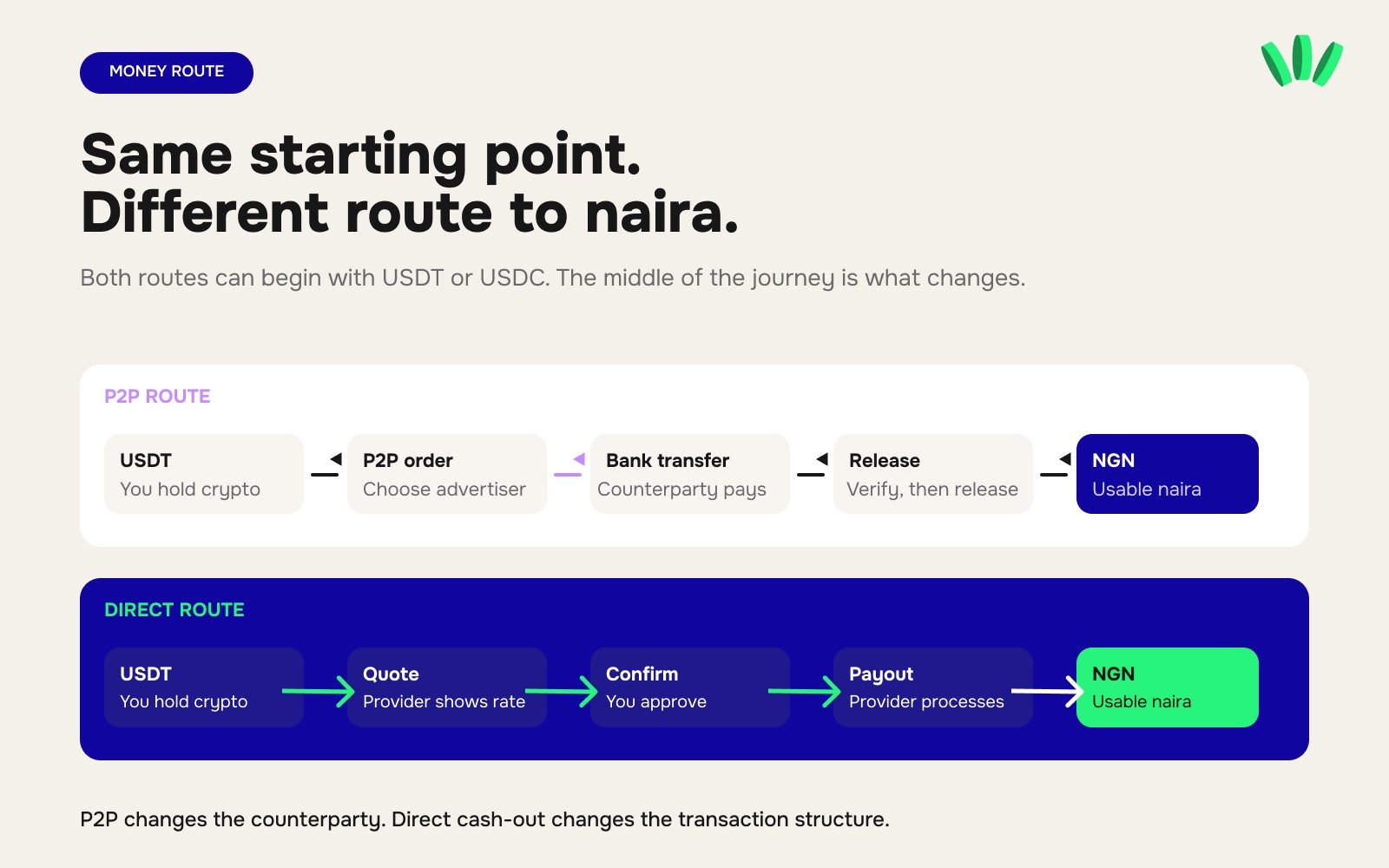
That is the comparison worth making.
The highest P2P rate can still leave you with less money
Imagine you have $1,000 worth of USDT.
Marketplace A appears to offer the best USDT-to-naira rate.
Marketplace B is slightly lower.
A direct cash-out route is lower again.
It is tempting to pick Marketplace A immediately.
Now add the rest of the route.
Did you pay to move USDT there?
Did your exchange charge a withdrawal fee?
Did you choose a more expensive network?
Did the P2P advertiser add a condition you cannot meet?
Are you converting all the money because the platform gives you no reason to keep it there?
Is another withdrawal required after the trade?
How long until the naira is actually usable?
The number that matters is not the first rate you see. It is the amount that survives the whole route.
The same principle applies when choosing how an international client should pay you. The walllet.com guide to receiving payments from US, UK and EU clients in Nigeria separates the receiving method from the later holding, conversion and withdrawal decision.
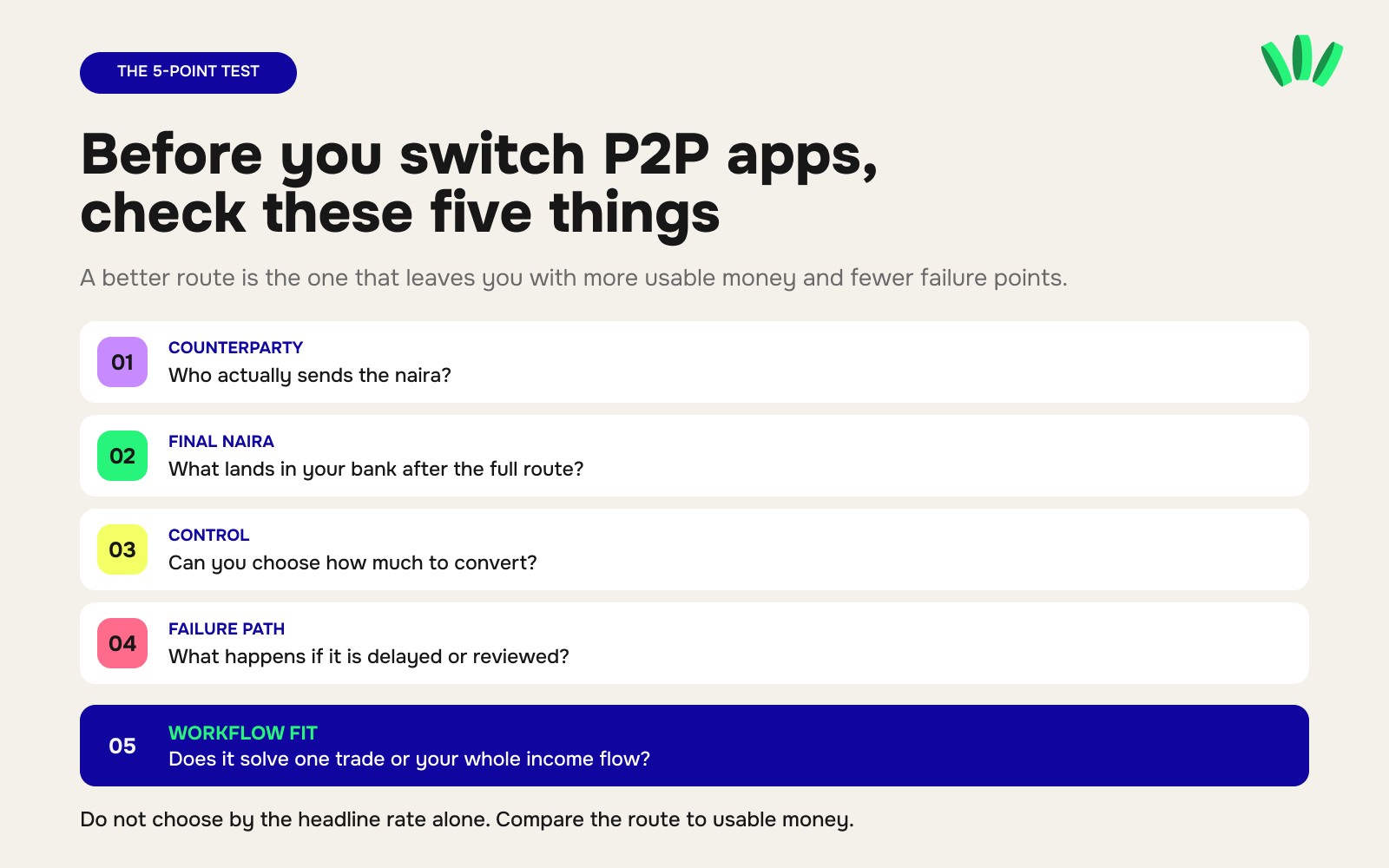
Before choosing any P2P alternative, run this five-point test
A useful P2P comparison should answer five questions.
1. Who sends the naira?
This is one of the biggest structural differences between routes.
On P2P, the bank transfer usually comes from another marketplace participant.
On a direct route, the payout runs through the provider's supported payment infrastructure.
Know which model you are entering before you move the crypto.
2. What finally reaches your bank account?
Do not stop at “zero P2P fee.” Check:
the executable conversion rate;
exchange or service costs;
blockchain withdrawal costs;
deposit costs where applicable;
payout fees;
the final NGN amount.
A zero-fee transaction can still have a worse final result.
3. Can you keep some income dollar-linked?
This matters much more for freelancers and remote workers than for a trader trying to close one position.
If you receive $2,000 but need only the naira equivalent of $600 this month, forcing the whole balance through a P2P order may be a poor fit.
A more useful workflow lets you decide how much to convert and how much to leave dollar-linked, subject to the product and route available to you.
4. What happens when something goes wrong?
Every financial route eventually gets tested by a bad day.
Check:
whether the platform has an appeal process;
what evidence it asks for;
whether you can see transaction status;
how account reviews work;
what support channel is official;
whether there is a clear escalation path.
If a platform explains only the happy path, you do not yet understand the product.
5. Does it solve the whole job or one transaction?
This is the question most comparison tables miss.
A P2P marketplace can be excellent at matching a buyer and seller.
That does not automatically make it a good way to receive a salary from a US company, keep part of your income dollar-linked, manage documentation, pay for online tools and cash out only when necessary.
Judge the product against your actual money flow.
Where walllet.com is different from a P2P marketplace
walllet.com is not trying to become another board of USDT/NGN advertisements.
Its intended use is broader: help people who earn globally manage the route from receiving foreign income to holding dollar-linked value and using or converting it through supported routes.
That matters for a specific type of user.
Take a Nigerian product designer who earns $1,500 from a US client.
She needs ₦400,000 for local expenses.
She wants to keep part of the rest dollar-linked.
She also pays for international software. Her job is:
Get paid, keep control of my income and convert only what I need.
For eligible receiving routes, walllet.com also provides a separate bank-transfer receiving layer. The walllet.com IBAN account guide explains how those receiving details differ from the self-custody wallet layer and why eligibility, supported currencies, rails, fees and review rules need to be checked for the individual account.
Where a cash-out route is currently available to an eligible walllet.com account, the intended flow is:
Receive supported income or stablecoins → hold → choose what to convert → review rate and costs → confirm → receive supported NGN payout
Specific receiving accounts, currencies, stablecoins, networks, cash-out routes, limits and timing depend on current availability, account eligibility and providers. walllet.com should be judged by what the current product shows before you move money, not by an old screenshot or marketing claim.
That product direction follows walllet.com's Nigeria strategy: compete on the full income flow, clearer total cost, control and fewer disconnected tools rather than trying to win a “cheapest P2P trade” contest.
If you move USDT from a P2P exchange, check the network before the rate
One mistake can wipe out every small saving you made by finding a better P2P quote.
USDT is not one universal transfer route.
USDT can exist on different blockchain networks. The sending platform and receiving product need to support the exact same network.
Before transferring stablecoins from Bybit, Bitget, MEXC or another exchange, check the live receiving screen first.
The walllet.com supported chains and assets guide explains why matching the token symbol is not enough and why the receive screen should be treated as the current source of truth.
For a new route or meaningful amount, a small test transfer can be cheaper than discovering a network mistake after the main transaction.
Which P2P alternative should you choose?
There is no useful universal winner.
Use the job to choose the route.
Choose a P2P marketplace such as Bybit, Bitget or MEXC if you specifically want P2P, understand how escrow and order disputes work, are comfortable checking counterparties and want to compare marketplace offers.
Consider a direct exchange or cash-out route if your main job is converting crypto to naira and you would rather receive a provider quote than coordinate the fiat side with another retail user.
Consider a broader income-management route such as walllet.com if you earn from outside Nigeria and P2P is only one awkward step inside a much bigger process of receiving, holding, converting and using foreign income.
The label matters less than the complete route.
What should Nigerian freelancers check before relying on P2P?
If client payments are part of your income, use a stricter standard than someone making an occasional crypto trade.

Keep the invoice or payment record.
Confirm the exact token and network before a stablecoin payment.
Know where the money will sit after it arrives.
Know what happens if the payment or account is reviewed.
Know the amount you expect to receive after every cost.
Keep a backup route before your primary route fails, not after.
Your payment system is part of your freelance business infrastructure.
Treat it that way.
Is P2P safe in Nigeria?
P2P platforms can reduce some transaction risks with identity verification, escrow, merchant controls and dispute procedures. They do not eliminate all counterparty, bank-transfer, fraud or account-review risks.
Never release crypto because someone sent a screenshot or payment alert.
Verify the actual credit through your bank.
Keep conversations inside the platform when the platform requires it.
Do not accept an off-platform change in price or payment terms simply because the advertiser says it will make the transaction faster.
And do not confuse a strong completion rate with a guarantee about your specific trade.
Can you sell USDT for naira without P2P?
Yes.
P2P is one way to move between crypto and naira, not the definition of cash-out.
Depending on the service currently available to you, alternatives can include:
a centralised exchange with a direct sell/withdrawal route;
an integrated crypto-to-bank off-ramp;
a provider-generated conversion and payout quote;
a broader global-income app with a supported NGN cash-out route.
The important checks remain the same: asset, network, quote, total cost, eligibility, destination bank account, transaction records and support.
Is Bybit P2P available for NGN in Nigeria?
As of August 2026, Bybit's official help documentation includes an NGN P2P fee schedule and lists NGN pairs involving USDT, USDC, ETH and BTC. Availability, advertisers, payment methods and individual account access can change, so check the current P2P screen before transferring funds.
Is Bitget P2P available for Nigerian naira?
Bitget currently lists Nigeria and NGN among its supported P2P markets. It has also published Nigeria-specific P2P merchant and fee updates in 2026. Check the current NGN order book and applicable fee before starting a transaction rather than relying on a historical comparison.
Is MEXC P2P available in Nigeria?
MEXC introduced NGN support for its P2P marketplace in 2025, and its 2026 merchant documentation continues to include NGN among supported African P2P markets. Current liquidity, payment methods and account availability should still be checked directly before moving funds.
Can walllet.com replace Binance P2P?
walllet.com is not a P2P marketplace, so it is not a like-for-like Binance P2P replacement.
For a Nigerian freelancer or remote worker, that can be the point.
If your actual problem is receiving foreign income, keeping part of it dollar-linked and converting supported balances to naira when needed, an integrated income route may fit better than repeatedly finding another P2P buyer.
Where a walllet.com cash-out route is available to your account, check the supported asset, network, complete quote, limits and bank payout details before confirming. Specific services depend on current availability, eligibility and providers.
Stop asking only, “Which P2P app has the best rate?”
Ask five better questions:
Who is on the other side of this transaction?
What amount actually reaches my bank?
What happens to the money I do not want to convert?
What happens if the transaction fails or gets reviewed?
How many different services do I need before my income becomes usable?
For a trader, the best answer may still be another P2P marketplace. For a Nigerian freelancer living in naira but earning globally, the better answer may be a completely different money flow.

