There is no single “best” Ethereum Layer 2 network for every user.
The better network depends on what you are doing: sending stablecoins, trading, using DeFi, interacting with a specific app, bridging back to Ethereum or simply minimizing transaction cost.
A useful comparison should look at:
security and proof model
data availability
transaction cost
confirmation versus settlement
bridge and withdrawal path
wallet and exchange support
liquidity and application availability
The cheapest transaction is not automatically the safest or most practical route.
Before we compare them, one quick note: if you are new to wallets, networks, gas, and seed phrases, start with this guide to the best crypto wallet for beginners. Chain choice matters, but the wallet you use is where most of the confusion actually happens. Naturally. Because crypto saw a simple problem and gave it six dropdown menus.
What is an Ethereum Layer 2 network?
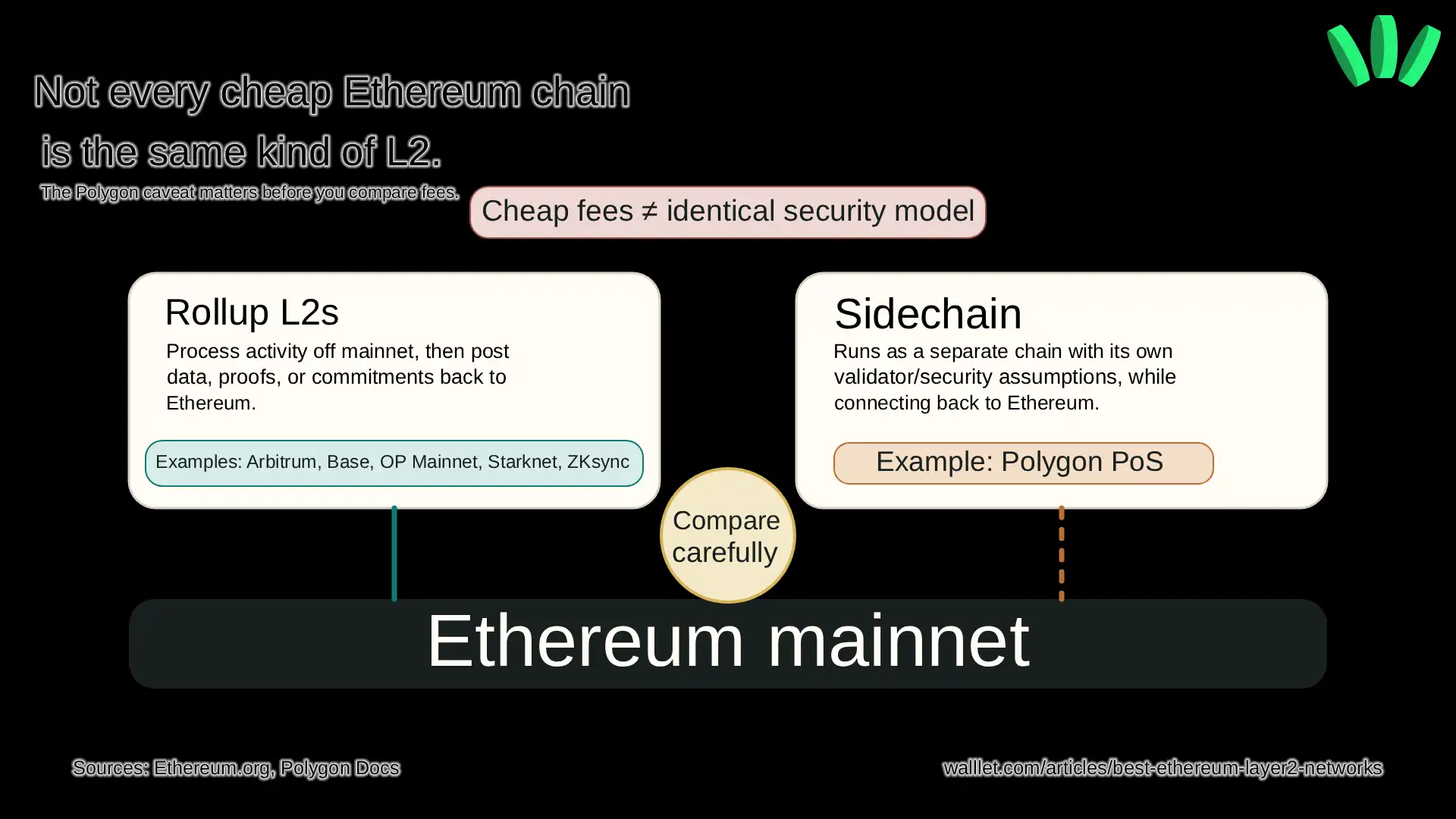
An Ethereum Layer 2 network is a scaling network built to make Ethereum-based activity faster and cheaper. It processes transactions away from Ethereum mainnet, then connects back to Ethereum through data, proofs, or smart contracts. The goal is simple: users get lower fees and faster transactions, while apps still stay connected to the Ethereum ecosystem. The main types you will see are:
Type | Simple explanation | Examples |
Optimistic rollups | Assume transactions are valid unless challenged | Arbitrum, Base, OP Mainnet |
ZK rollups | Use validity proofs to prove transactions are correct | Starknet, ZKsync Era |
Sidechains | Separate chains connected to Ethereum, with different security assumptions | Polygon PoS |
Ethereum’s own documentation explains that optimistic rollups rely on fraud proofs and a challenge period, while ZK rollups use validity proofs to verify state changes. That difference matters. It affects security assumptions, withdrawals, finality, and how the network feels when you bridge assets back to Ethereum.
How We Compare Ethereum L2s
Do not rank L2s using transaction fees or TVL alone. For each network, ask:
How are invalid state transitions challenged or proven?
Where is transaction data made available?
How mature is the network’s security architecture?
How does the canonical path back to Ethereum work?
Does the wallet, exchange or application you need support it?
Will using the network force you to bridge later?
Security configurations can change, so architecture and risk-stage claims should always be date-stamped.
What is the best Ethereum Layer 2 network in 2026?
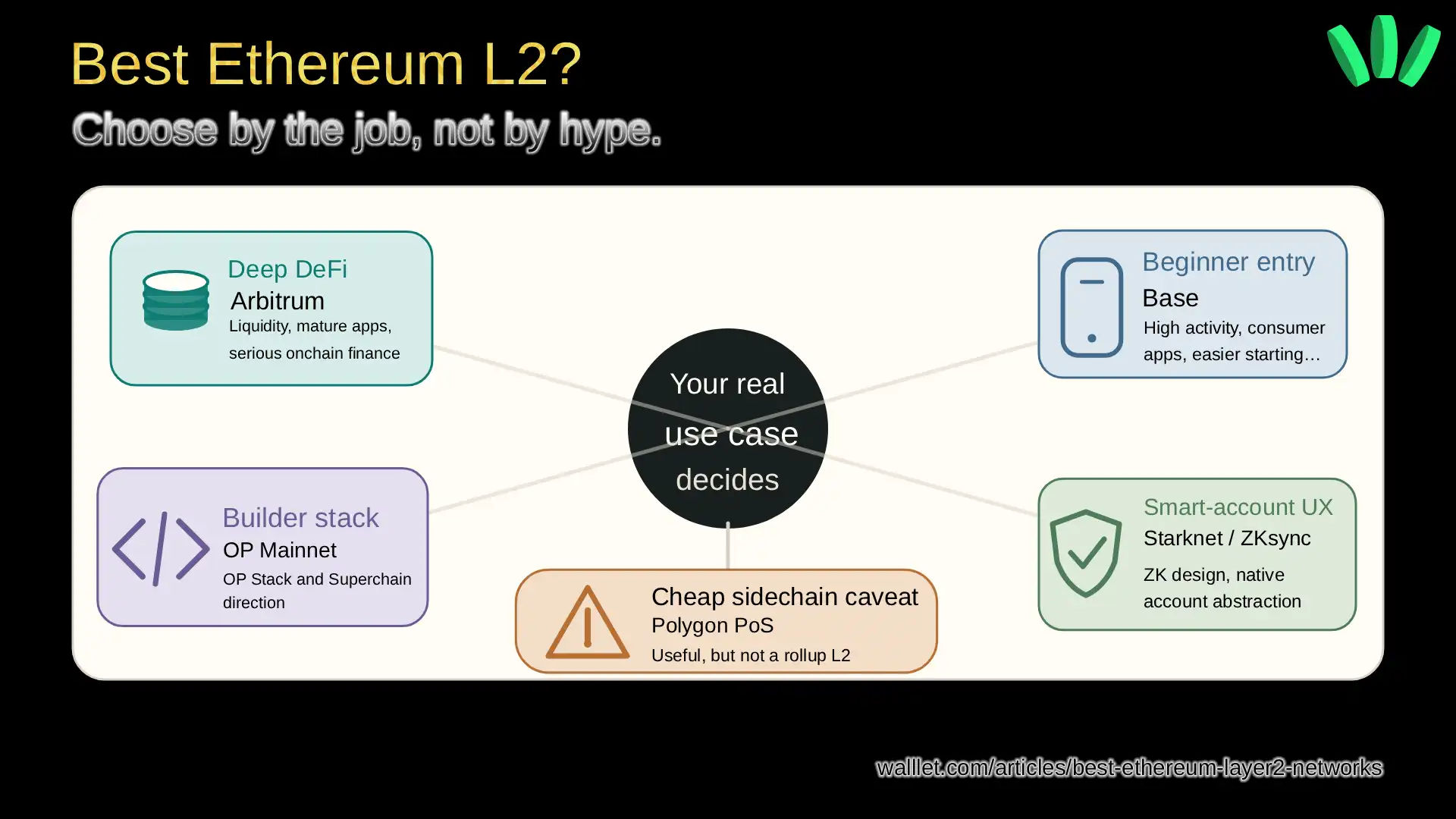
For most users, the best Ethereum Layer 2 network is either Arbitrum or Base.
Arbitrum is the best all-around L2 for DeFi. It has deep liquidity, a mature app ecosystem, and strong traction among users who care about trading, lending, liquidity pools, and more advanced onchain activity.
Base is the best L2 for many beginners and consumer-style use cases. It has high activity, low-cost transactions, Coinbase backing, and a product direction built around onboarding, payments, social apps, and everyday onchain use.
So the short version is:
If you want... | Start with... |
Deep DeFi and liquidity | Arbitrum |
Beginner-friendly everyday use | Base |
Consumer apps and payments | Base |
Builder infrastructure | OP Mainnet |
ZK-native account design | Starknet |
EVM-adjacent ZK smart accounts | ZKsync |
Cheap Ethereum-adjacent activity | Polygon PoS, with the sidechain caveat |
How should you compare Ethereum L2 networks?
Most people compare L2s by fees first. That is understandable, but incomplete.
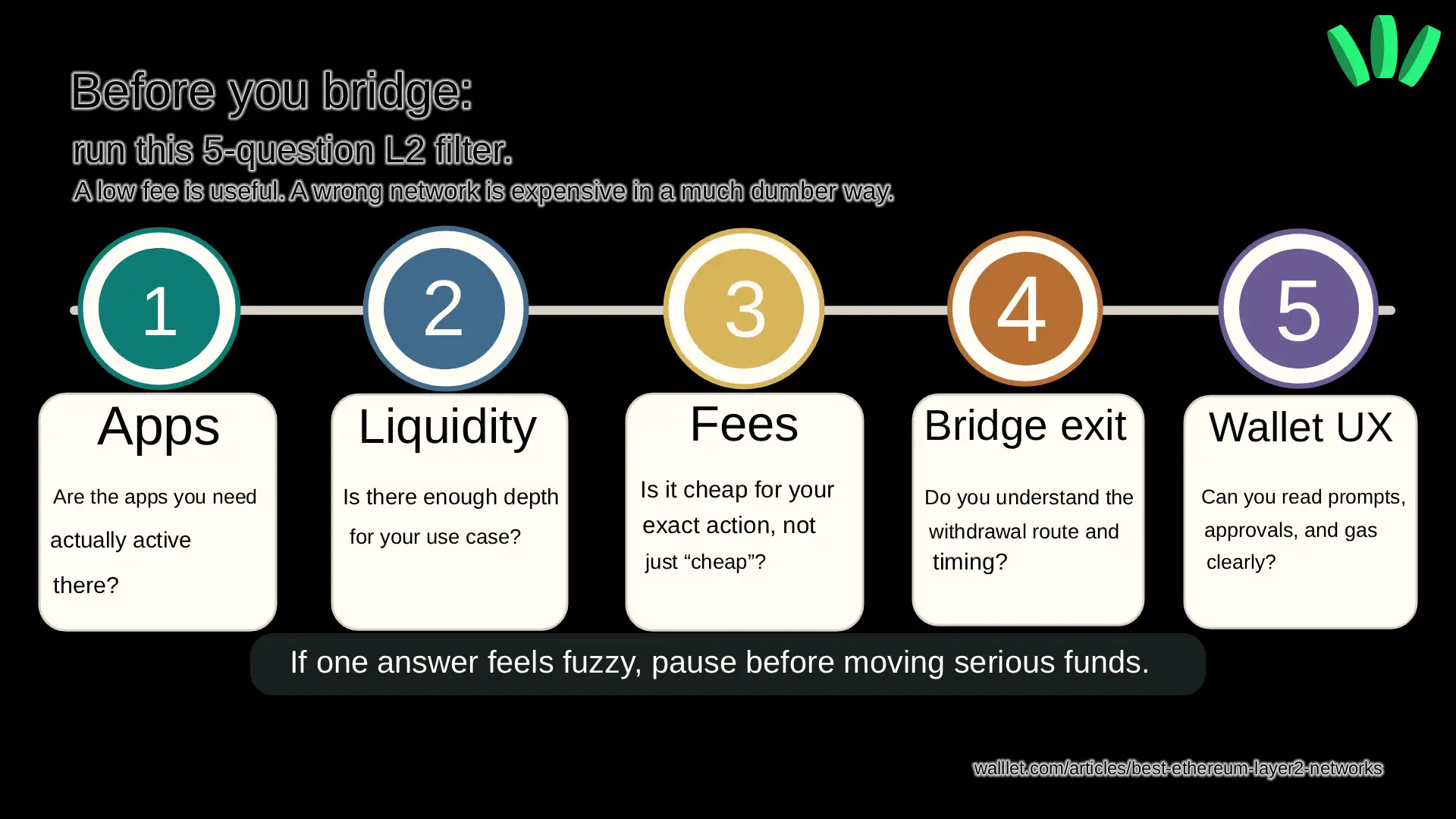
A network can be cheap and still be the wrong choice if the apps you need are somewhere else, the liquidity is thin, the bridge route is awkward, or your wallet makes every approval feel like defusing a toaster. A better way to compare Ethereum L2s is to ask five questions.
First, which apps do you actually want to use? If your DeFi protocol, game, social app, or stablecoin route is not active on that chain, low fees will not help much.
Second, how much real activity does the network have? High activity can show that users are actually doing things there, not just farming a temporary incentive.
Third, how much liquidity or value is in the ecosystem? For DeFi, this matters a lot. A mature ecosystem usually means better integrations and deeper markets.
Fourth, what are the withdrawal and bridge realities? Optimistic rollups can be fast for normal transactions, but standard withdrawals back to Ethereum may involve a challenge period.
Fifth, what does the wallet experience feel like? This one gets ignored too often. A good L2 with confusing wallet prompts, unclear approvals, and painful gas handling can still feel bad for normal users.
Curious what Ethereum L2s feel like when the wallet experience is less fragile? Explore walllet.com with a small amount and see how clearer self-custody feels.
Which Ethereum L2 is best for DeFi?
Arbitrum is the best Ethereum L2 for DeFi in 2026.
The reason is not mystery or vibes. DeFi needs liquidity, mature apps, integrations, active users, and enough ecosystem depth that you are not stuck in a beautiful ghost town. Arbitrum has one of the strongest DeFi ecosystems among Ethereum L2s, which makes it the better default for trading, lending, liquidity pools, and more serious onchain strategies.
Base is also growing quickly, especially because activity is high and more consumer apps are bringing users onchain. But if your main search is “best L2 for DeFi,” Arbitrum is still the cleaner answer.
The catch is withdrawal timing. Arbitrum is an optimistic rollup, so standard withdrawals back to Ethereum can involve a challenge period. This does not mean every Arbitrum transaction is slow. Normal activity inside the L2 can feel fast. The delay matters when you move assets back to Ethereum through canonical paths.
Which Ethereum L2 is best for beginners?
Base is the best Ethereum L2 for many beginners.
It has three useful advantages: strong activity, Coinbase incubation, and a mainstream-friendly product direction. Base also describes itself around fast, low-cost transactions and consumer-scale use, which fits beginners better than networks that require more technical context from day one.
For a beginner, the best L2 is not only the cheapest one. It is the one where you can find useful apps, understand what you are signing, and avoid getting lost between bridges, gas tokens, network names, and fake support accounts.
That is also why wallet choice matters. If the wallet feels confusing, the chain being “fast” does not save the experience.
If seed phrases are the part that makes crypto feel scary, this guide to the best seedless wallets explains the tradeoff clearly. Seedless does not mean careless. It means access and recovery work differently.
Which Ethereum L2 is cheapest?
There is no permanent cheapest Ethereum L2.
Fees change. Apps charge differently. Bridges route differently. A simple transfer is not the same as a swap, a mint, a contract approval, or a bridge transaction.
Base is one of the strongest options for cheap everyday onchain activity. Polygon PoS is also known for very low transaction costs, but it needs careful wording:
Polygon PoS is an EVM-compatible sidechain for Ethereum, not a rollup L2 like Arbitrum, Base, OP Mainnet, Starknet, or ZKsync.
Polygon zkEVM is the more direct L2 comparison point, but it now carries a major caveat: Polygon says the zkEVM Mainnet Beta sequencer was sunset on July 1, 2026, and users with eligible wallet balances need to claim migrated assets on Ethereum.
So if you are asking “which L2 is cheapest?”, a better version of the question is:
Which network is cheap enough, active enough, supported by the apps I need, and safe enough for the amount I want to move?
That question is less fun for headlines. It is much better for your money.
Arbitrum vs Base vs OP Mainnet vs ZKsync vs Starknet vs Polygon
Here is the cleaner comparison.
Network | Best for | Why it stands out | What to watch |
Arbitrum | DeFi and liquidity | Mature ecosystem, strong DeFi usage, deep app support | Standard optimistic withdrawal timing |
Base | Beginners and consumer apps | High activity, low-cost usage, Coinbase-backed onboarding | Not always the deepest DeFi option |
OP Mainnet | Builders and Superchain direction | OP Stack and Superchain ecosystem | More useful for builders than casual users |
ZKsync Era | Smart accounts and ZK UX | Native account abstraction and paymasters | Smaller current footprint than top optimistic L2s |
Starknet | ZK-native architecture | Native account abstraction and smart-contract accounts | Different stack, steeper learning curve |
Polygon PoS | Cheap Ethereum-adjacent activity | Low fees, strong payment/stablecoin direction | It is a sidechain, not a rollup L2 |
Polygon zkEVM | ZK Ethereum scaling history | Direct ZK EVM comparison point | Mainnet Beta sequencer sunset caveat |
Why OP Mainnet matters
OP Mainnet is not always the first answer for casual users, but it matters a lot for builders.
The reason is the OP Stack. Optimism describes the OP Stack as a modular set of software components for creating Layer 2 blockchains. That matters if you are not only choosing a chain to use, but thinking about how chains are built, connected, upgraded, and operated.
For users, OP Mainnet is a solid Ethereum L2.
For builders, it is part of a bigger Superchain story.
Why Starknet and ZKsync matter
Starknet and ZKsync are not always the easiest default picks for a beginner, but they matter because of account abstraction and ZK design.
Starknet documentation says accounts on Starknet use native account abstraction, with accounts represented onchain in a way that allows more flexible logic. ZKsync also describes native account abstraction through smart accounts and paymasters.
In plain English, this can make wallets more flexible over time. Think custom authorization, spending limits, sponsored transactions, session keys, and other UX improvements that normal users should not have to understand before benefiting from them.
The tradeoff is adoption and complexity. Arbitrum and Base are easier answers for most users today. Starknet and ZKsync are more interesting when you care about where wallet UX and ZK infrastructure are heading.
If you want the wallet side of that explained in simpler language, read this smart crypto wallet guide.
Which wallet makes Ethereum L2s easier to use?
The wallet makes Ethereum L2s easier to use when it helps you understand access, gas, networks, approvals, and transaction prompts before money moves.
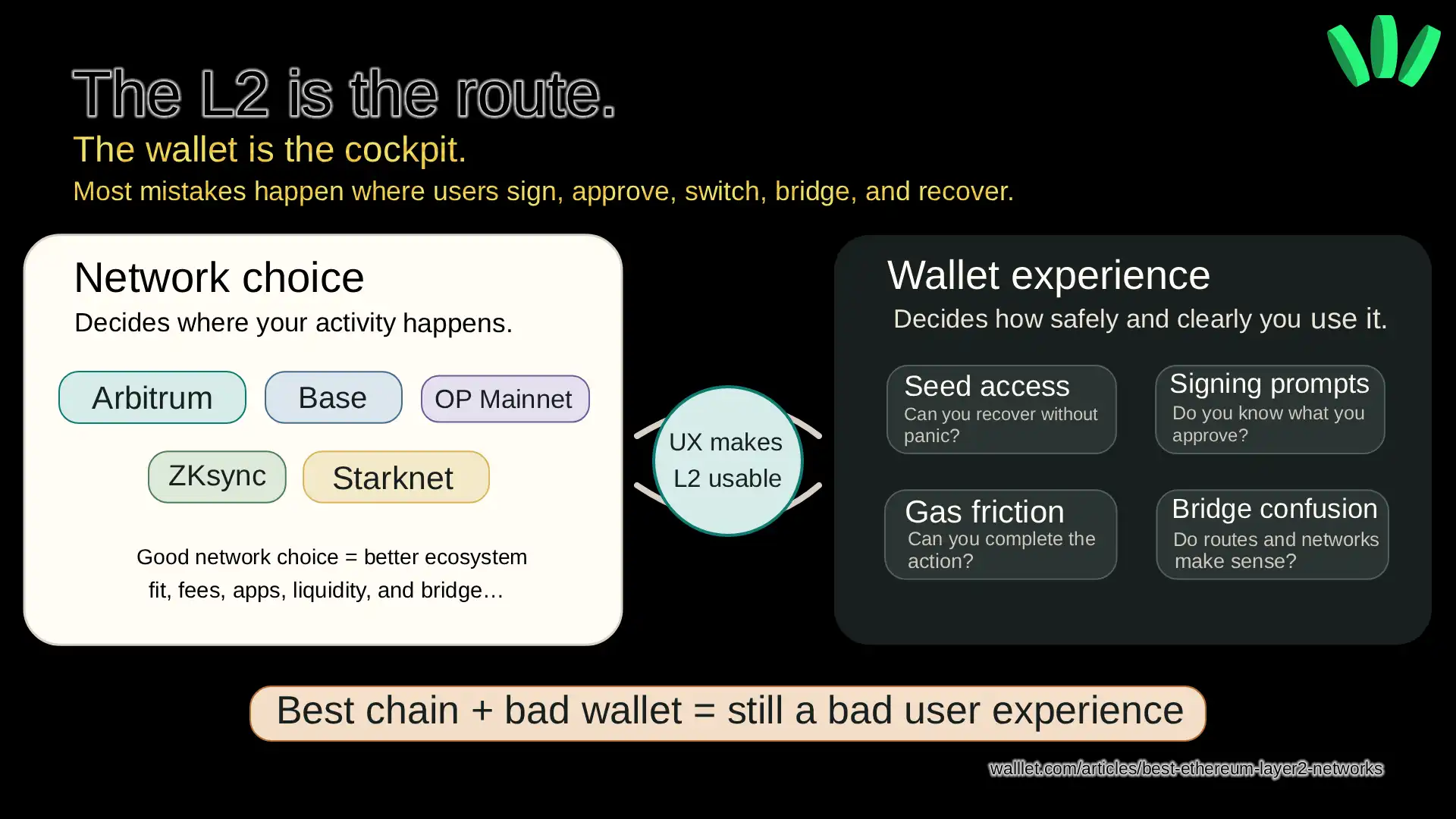
A lot of L2 guides compare networks as if people interact with chains directly. They do not. Users experience L2s through wallets, bridges, dApps, token lists, signatures, approvals, and network switching. That is where mistakes happen.
walllet.com is relevant here because it is a self-custodial crypto wallet built around seedless access, passkeys, biometrics, clearer transaction prompts, and smart-wallet UX. It does not make every L2 risk disappear. No wallet should claim that. But it can make the user experience less brittle.
The best L2 gets you to the right ecosystem. The right wallet helps you use that ecosystem with less confusion.
That difference matters if you are moving stablecoins, trying DeFi for the first time, or simply trying to understand what you are signing before you tap approve.
What do people get wrong about Ethereum L2s?
People usually make four mistakes.
They treat cheap fees as the whole decision. Fees matter, but they are only one part of the job.
They confuse normal transaction speed with withdrawal timing. Optimistic rollups can be fast for everyday L2 transactions, while withdrawals back to Ethereum through standard bridge routes may take longer.
They assume the most active chain is best for everything. Base’s activity is important, but Arbitrum’s DeFi depth is also important. Different metrics answer different questions.
They treat wallet choice as secondary. It is not. Your wallet is where you read the transaction, approve the action, manage access, switch chains, and recover from problems. That is not a side detail. That is the actual user experience.
Fast Confirmation Is Not the Same as Ethereum Finality
A transaction can appear confirmed quickly inside an L2 while settlement and withdrawal to Ethereum follow a different process.
Keep these concepts separate:
L2 confirmation: when the L2 sequencer/network shows the transaction as accepted.
L2 proof or challenge process: how the network demonstrates or challenges the validity of state transitions.
Ethereum settlement: when the relevant state commitment and proof/challenge process reaches the required Ethereum-level state.
Withdrawal availability: when assets can be used on the destination after the chosen bridge process.
Do not publish a single “transaction takes X seconds” figure as though it describes all four.
Fees: Compare the Exact Action
L2 fees are dynamic.
Instead of declaring one network the cheapest, compare the same action at the same time:
simple ETH transfer
ERC-20 transfer
token swap
smart-contract interaction
bridge deposit
bridge withdrawal
A network that is cheaper for a simple transfer may not be cheaper for a complex contract interaction.
The fee that matters is the quote for the action the reader actually needs to perform.
Bridge Risk Is Part of the Network Decision
If you receive assets on an L2 but later need them on Ethereum or another network, the bridge becomes part of the route.
Before choosing an L2, check:
whether a bridge is required later; whether you are using the canonical bridge or another bridge; the withdrawal process; the bridge fee; the asset representation on the destination; whether the final receiving platform supports that exact asset/network combination.
A cheap L2 transfer followed by an unnecessary bridge can be worse than using the final supported network from the start.
Which L2 Is Better for Which Use Case?
For stablecoin payments
Choose the network supported by both the sender and receiver and verify that the exact stablecoin is issuer-supported or otherwise accepted by the receiving platform.
For DeFi
Start with the application and liquidity you need. The best network is often determined by where the protocol actually operates.
For consumer apps
If the app already abstracts network selection and supports one L2, using its supported network usually creates less friction than manually bridging to another.
For moving assets back to Ethereum
Compare the canonical withdrawal mechanism and expected exit conditions before depositing—not after you decide to leave.
For developers
Compare EVM compatibility, tooling, account model, proof architecture, data availability, interoperability requirements and the ecosystem where users already exist.
So, which Ethereum L2 should you choose?
Choose based on the job.
If you want DeFi depth, start with Arbitrum.
If you are new and want a simpler starting point, start with Base.
If you are building or care about the Superchain, look at OP Mainnet.
If you care about ZK-native account design, look at Starknet.
If you want EVM-adjacent ZK smart-account UX, look at ZKsync.
If you want cheap Ethereum-adjacent transfers, Polygon PoS can make sense, but remember the sidechain caveat.
Then choose a wallet that makes the chain easier to use, not harder. Because the network may be fast and cheap, but if your wallet makes every approval look like a tax form written by a haunted router, the experience still fails.
Ready to test Ethereum L2s without starting with seed phrase stress and confusing signing flows?Create your walllet.com wallet, try a small amount first, and see how clearer self-custody feels.
