If ETH is the native asset, WETH is the version built to plug into ERC-20-based DeFi plumbing.
WETH is wrapped ETH: a 1:1 ERC-20 version of ether that exists so ETH can work inside token-based DeFi systems, DEX routes, and smart contracts that expect ERC-20 assets. It is not a different asset class, but you usually still need native ETH, not WETH, to pay gas.
TL;DR
WETH and ETH are designed to track 1:1 in value.
ETH is Ethereum’s native asset. WETH is the ERC-20 wrapper.
You usually see WETH in DEXs, liquidity pools, NFT offers, and other DeFi flows.
Holding WETH does not usually replace the need for native ETH for gas.
In practice, most confusion comes from mixing up wrapping, swapping, and bridging.
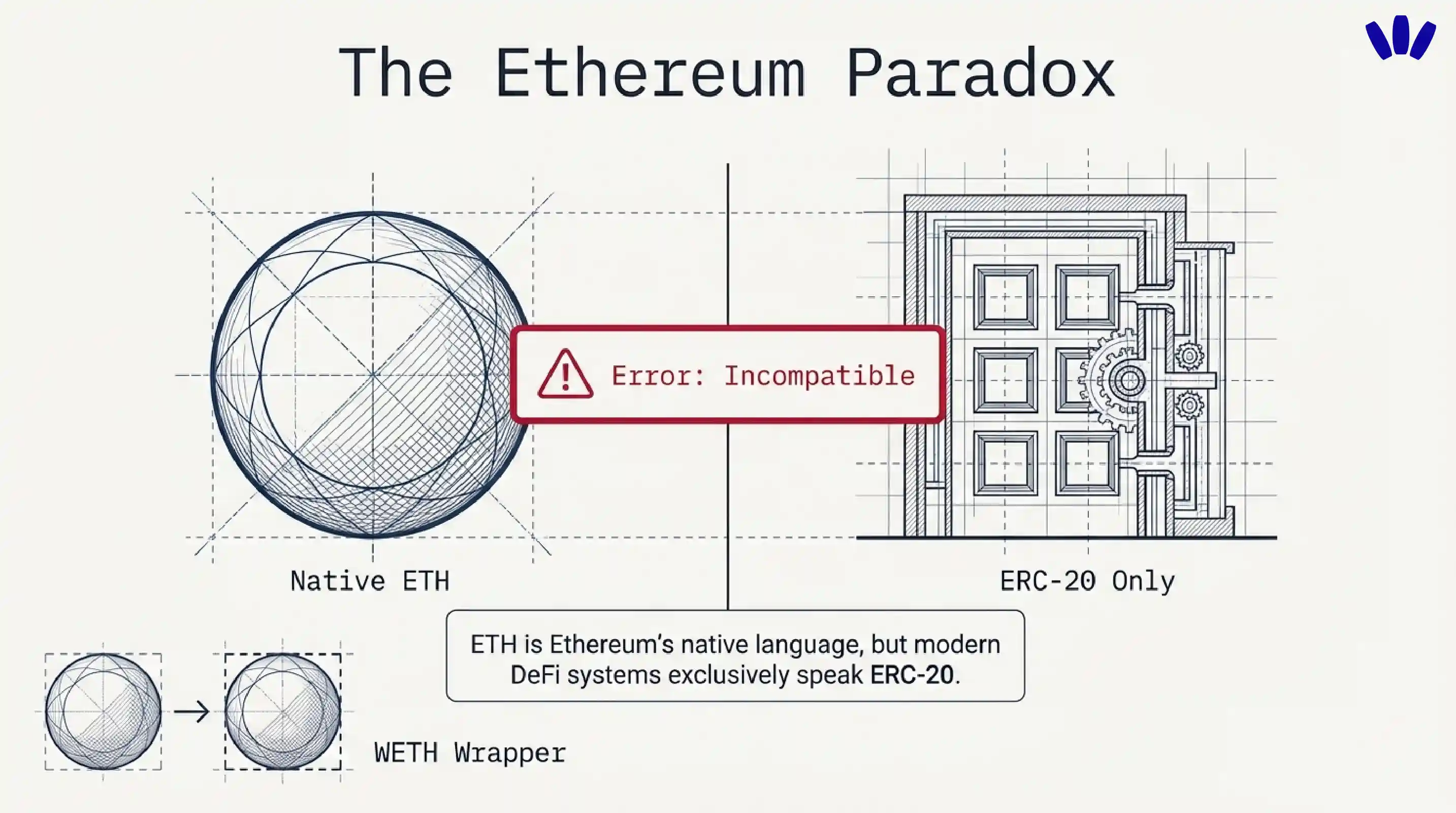
Most people first meet WETH at the worst possible moment. You are halfway through a swap, a bridge, or an app prompt, and suddenly you are staring at two nearly identical tickers: ETH and WETH. It feels like crypto invented a duplicate just to be annoying. It did not. WETH exists because many smart contract systems are built to handle ERC-20 tokens, while native ETH is not itself an ERC-20 token.
Here is the short version before we go deeper:
Question | ETH | WETH | What matters in practice |
What is it? | Ethereum’s native asset | ERC-20 representation of ETH | Same economic value, different technical format |
What is it used for? | Gas, payments, native Ethereum actions | DEX pairs, liquidity, lending, NFT offers, DeFi flows | You may touch both in one session |
Can it usually pay gas? | Yes | Usually no | Biggest beginner trap |
How do you convert? | Already native | Wrap or unwrap 1:1 | This is not a price bet |
Do you always need it? | No | No | Only when the app or route expects ERC-20 compatibility |
This summary reflects ethereum.org’s explanations of ETH and WETH, Uniswap’s explanation of why many DEX flows use WETH, Arbitrum’s note that ETH pays gas on Arbitrum, and walllet.com’s own swap and gas abstraction content.
What is WETH?
WETH stands for Wrapped Ether, or wrapped ETH. Ethereum.org defines it as:
a smart-contract-based version of ETH that lets you deposit ETH and receive the same amount of WETH in ERC-20 form.
When you unwrap it, the process reverses: the WETH is burned and the corresponding ETH is released back to you. That means WETH is not a separate coin in the usual sense. It is ETH represented in a format that token-based apps can handle more easily. If you think of ETH as Ethereum’s native language, WETH is ETH wearing the uniform that many DeFi systems require at the door.
ETH vs WETH: are they the same thing?
Economically, they are meant to track 1:1. Technically, they are not identical.
ETH is the native cryptocurrency that powers Ethereum and pays transaction fees. ETH is the asset used for gas, staking, and payments across the network. WETH, by contrast, is the ERC-20 representation of ETH, created so ETH can behave like other Ethereum-based tokens inside smart contracts and token-based app logic.
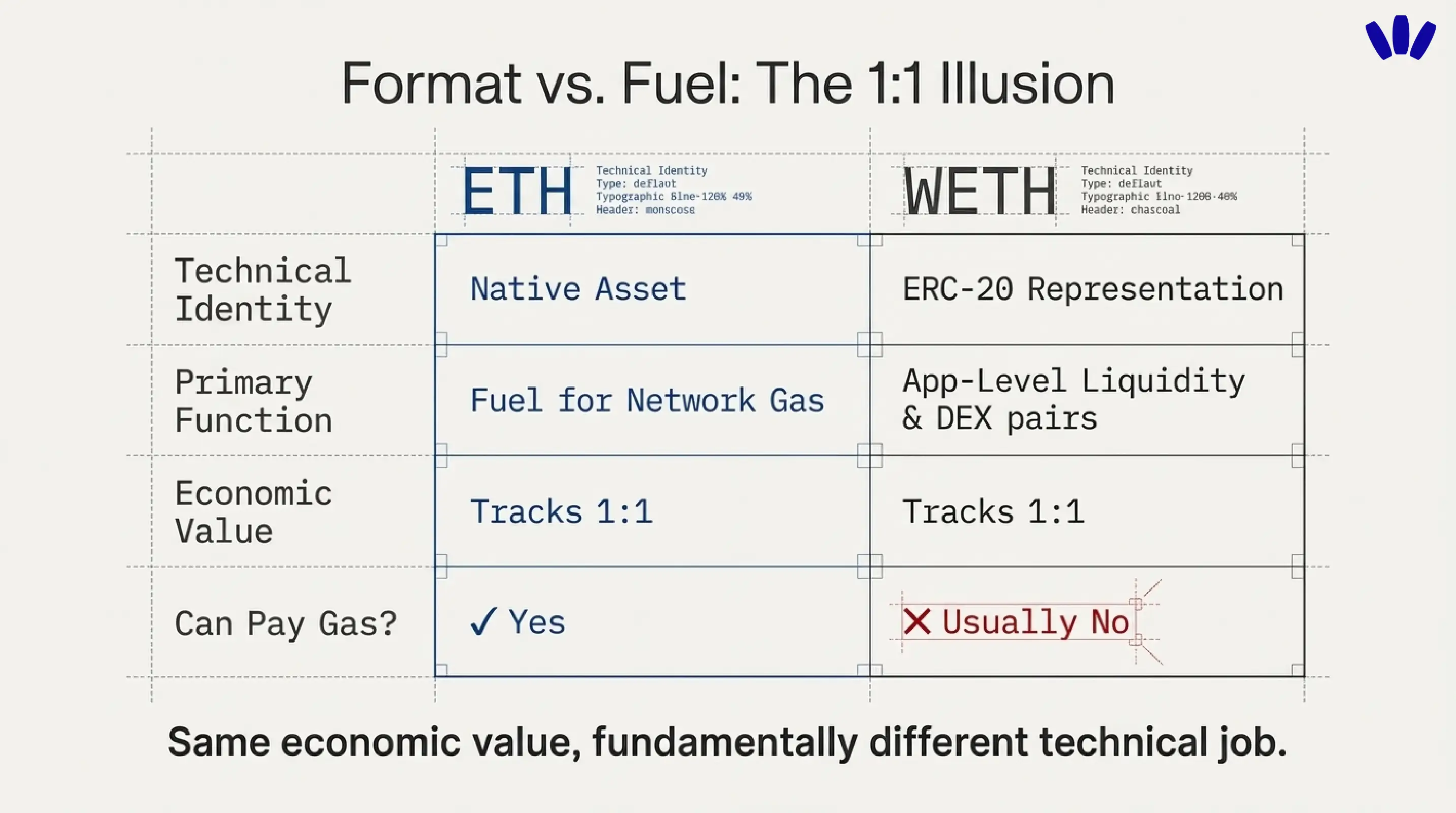
So when someone asks, “Is WETH the same as ETH?” the practical answer is: same value target, different format, different job. If you only remember one sentence, make it that one.
Why WETH exists
The short answer is compatibility.
Ethereum’s ecosystem is full of apps and protocols built around ERC-20 token rules. Uniswap’s documentation explains this very plainly: ETH was not built as an ERC-20 token, so ETH-to-ERC-20 pairs in Uniswap V2 had to be represented through WETH instead. Many ETH swaps involve converting to WETH during the flow because swappable tokens on those systems need ERC-20 compatibility.
That is the real reason WETH exists. Not because ETH was broken. Not because WETH is “better money.” Because DeFi infrastructure likes standardized token behavior, and native ETH predates that standard.
Where you usually see WETH
WETH in swaps and routing
If you use decentralized swaps, you will run into WETH sooner or later. walllet.com’s own swap guide explains that routes are not always direct, and that the best path can hop through liquid assets such as USDC, ETH, or WETH. That is why a user who only wanted “swap A for B” can suddenly see WETH in the middle of the route.
This is also why many users never need to manually think about WETH until something looks unfamiliar. In a well-designed product, the wrapping and unwrapping can stay backstage while the user just sees the intended outcome. The same point from the protocol side:
end users can often be kept unaware of the implementation detail because the system wraps and unwraps around the interaction.
WETH in DeFi, liquidity, and marketplaces
Ethereum.org lists common WETH use cases across decentralized exchanges, lending platforms, and NFT marketplaces. Its ETH guide specifically names trading pairs on Uniswap, collateral use on Aave, and NFT marketplace activity as common contexts where WETH appears. WETH is also used for certain offer flows and is minted when a user sends ETH to the WETH contract.
So if you see WETH, it usually means you are in a part of crypto where token-standard compatibility matters more than the distinction between native and wrapped assets.
WETH on L2s and cross-chain flows
WETH also shows up on Ethereum-compatible networks and L2 ecosystems. walllet.com’s EVM wallet guide notes that EVM-compatible chains such as Arbitrum, Optimism, and Base often use the same address format, while assets still live separately on each chain. That is one reason users get confused: the address can look familiar while the network context is completely different.
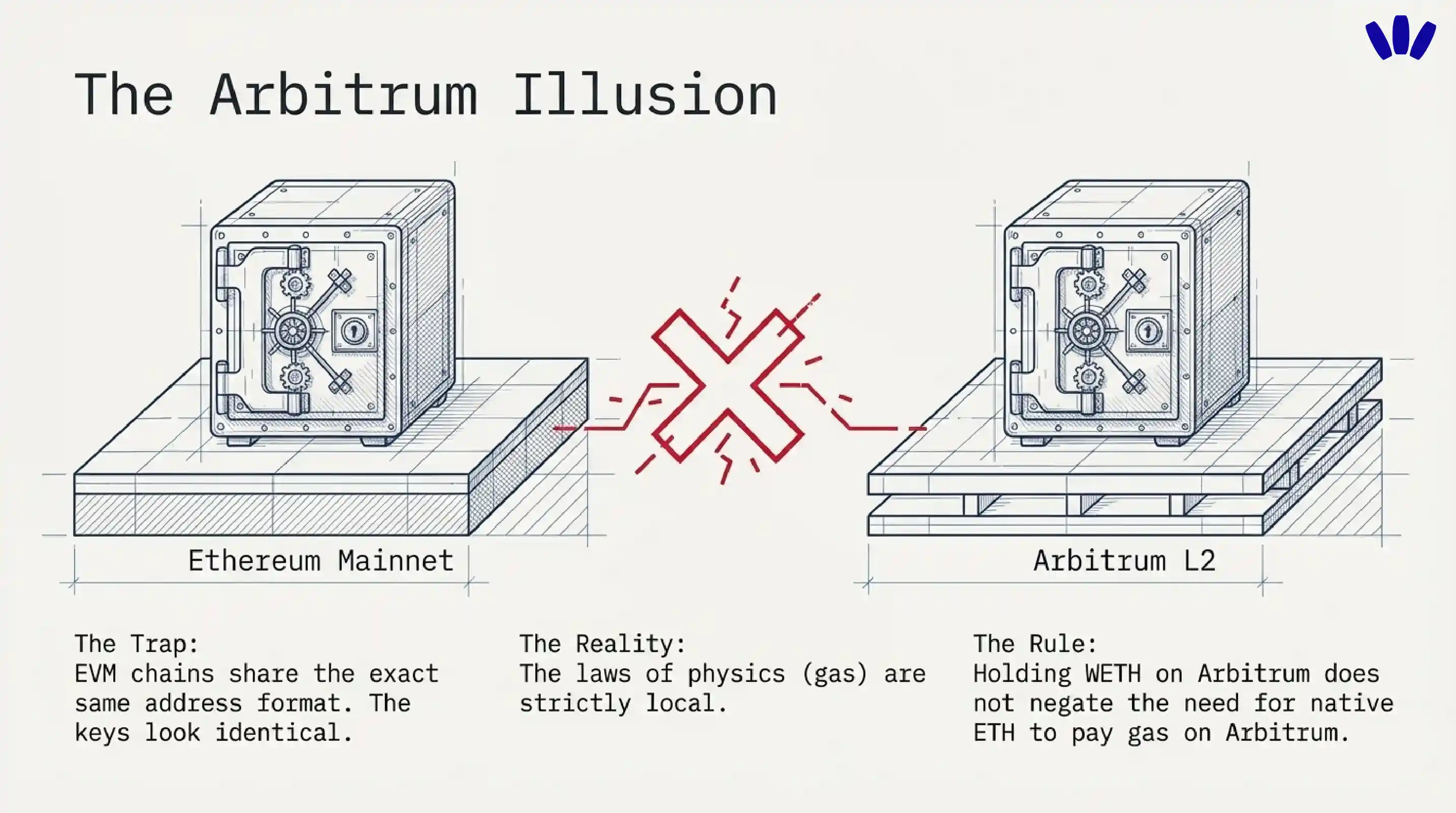
If you bridge to Arbitrum, the Arbitrum docs say you can bridge ETH or ERC-20 tokens, and they also say ETH is still the currency used to pay gas on Arbitrum. So yes, you may see WETH inside routes or protocols on Arbitrum, but that does not mean WETH replaces ETH as the gas asset there.
Do I still need ETH for gas if I have WETH?
Usually, yes.
Ethereum.org is explicit about this on its WETH page:
even after wrapping, you still need native ETH to pay gas fees. ETH is the asset used to pay gas there as well.
This is the part that trips people most often. They hold value in the “right” asset for a swap or DeFi position, but not in the native asset needed to move it. walllet.com’s own content was clearly written to attack that exact pain point. Its swap guide says supported swap flows do not require users to hold the network’s native gas token, and its gas abstraction article frames the whole problem as removing chores that have nothing to do with the user’s real goal.
So the clean mental model is this: WETH may be the asset an app wants, but native ETH is usually still the fuel the chain wants, unless the wallet or app abstracts that layer away for you.
How wrapping and unwrapping ETH works
At a high level, the process is simpler than the jargon makes it sound.
You start with native ETH.
You send that ETH into a wrapper contract or an interface that uses the wrapper contract.
The contract issues the same amount of WETH to your wallet.
To reverse it, you redeem WETH, the WETH is burned, and the equivalent ETH is released back to you.
The key thing here is that wrapping is a format conversion, not a speculative trade. You are not trying to “beat the market.” You are converting native ETH into the ERC-20 form some app flow expects. In many products, especially swap interfaces, this can happen automatically inside the transaction path.
Wrap vs swap vs bridge
This is where a lot of unnecessary confusion starts.
Wrapping changes the format of the asset while staying economically tied to the same value. ETH becomes WETH. Unwrapping reverses it.
Swapping changes what asset you end up holding. ETH to USDC is a swap. WETH to another token is a swap.
Bridging changes where your value lives. Arbitrum’s bridge docs describe bridging as moving ETH or ERC-20 tokens from one chain context to another.
a swap changes what you own, while a bridge changes where that value lives.
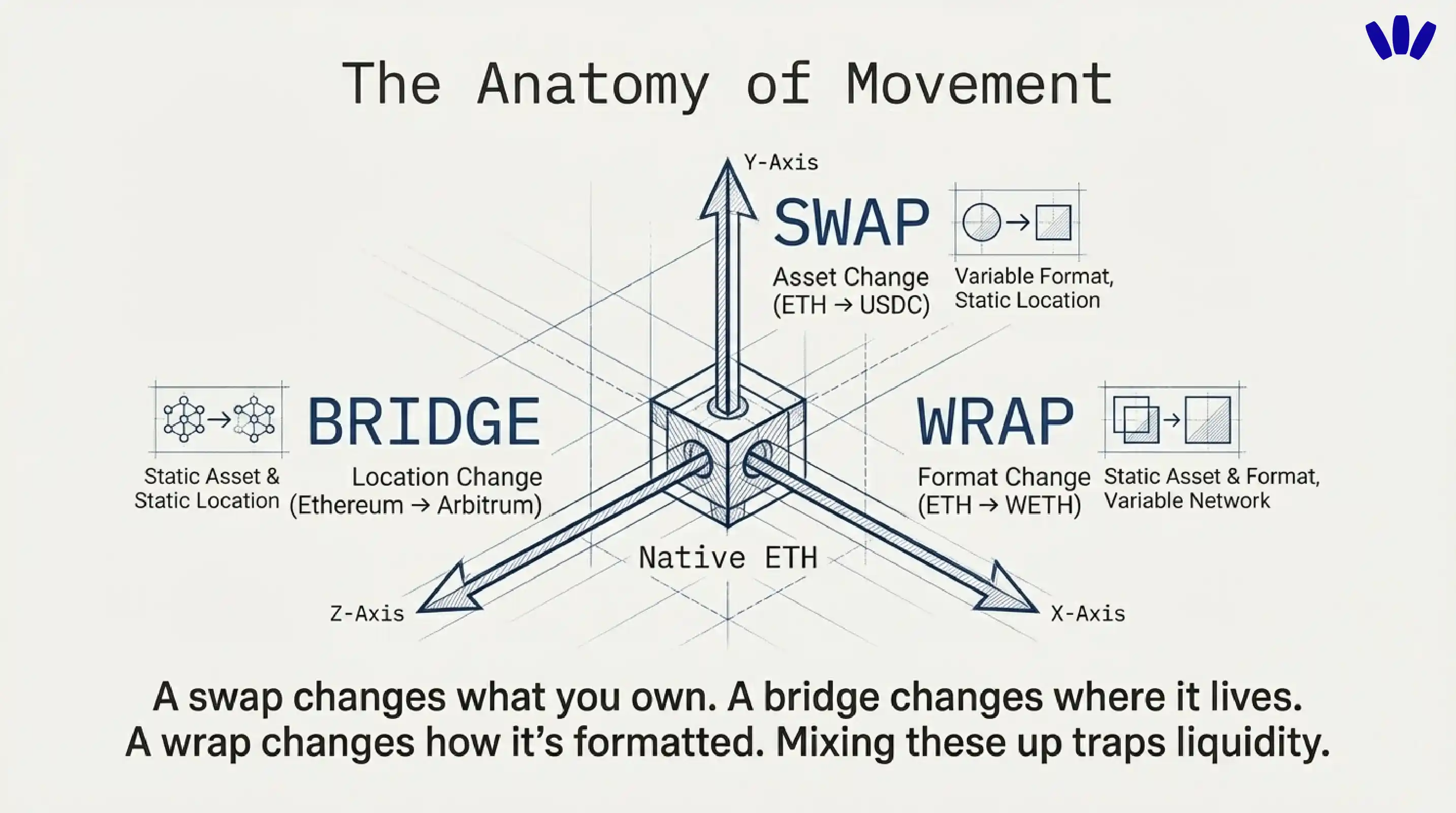
That means “wrap ETH” and “bridge ETH” are not interchangeable instructions. One is a same-ecosystem format change. The other is a network movement. When users mix those up, they often end up with the right value in the wrong place, or the right token on the wrong chain.
Common mistakes people make with WETH
The first mistake is thinking WETH is what you need for gas. Usually it is not. You need native ETH for gas on Ethereum and on Arbitrum, unless the app or wallet handles gas abstraction for that flow.
The second mistake is wrapping when you actually needed to swap or bridge. If the real goal is to move value to another chain or end up in a different token, wrapping alone does not solve that. walllet.com’s swap guide is useful here because it separates wrap-adjacent confusion from swap and bridge logic instead of flattening everything into the word “trade.”
The third mistake is forgetting network context. walllet.com’s EVM wallet guide explains that EVM chains often share the same address format, but assets still live separately on each chain. Its wrong-network recovery guide also points out that many “missing funds” cases are really “wrong chain view” cases.
The fourth mistake is treating WETH like a mysterious red flag. In most cases, it is just infrastructure. The real question is not “Why does WETH exist?” anymore. It is “Why did this app surface it to me here?” Once you ask that, the screen usually becomes much easier to interpret.
walllet makes WETH feel less cryptic
WETH is hard because many products reveal it only after they have already overloaded the user with routing, gas, networks, and contract prompts.
That is where walllet becomes relevant. walllet.com describes itself as a non-custodial smart wallet with hardware-level security, passkey-based access, and seedless recovery. It also frames the walllet as a product built to reduce friction around swaps, gas, and transaction clarity rather than simply exposing raw crypto plumbing and calling that “power user friendly.”
walllet’s users can pay transaction fees with any token they own and presents activity in a more understandable format. It supports swap flows sponsor network fees and do not require users to hold native gas tokens just to complete the route. For a topic like WETH, that matters. Because WETH confusion usually appears in the exact moments where route clarity, gas handling, and transaction legibility matter most.
So the best way to think about walllet.com here is “a wallet that tries to make the moments where WETH appears feel less cryptic.” That is a much stronger fit for this topic, and it is why this page belongs naturally inside walllet’s content ecosystem.
If you want the practical version, keep this rule in your head: use ETH when the chain needs native ETH, use WETH when the app or route expects ERC-20 compatibility, and do not confuse wrapping with swapping or bridging. If you want a wallet experience that reduces the amount of mental juggling around those decisions, walllet.com is worth exploring. Try walllet.com to move through ETH, WETH, swaps, and bridges with less guesswork and a more human self-custody flow.
