If BTC is native Bitcoin, WBTC is the version built to move through Ethereum-style DeFi.
WBTC, or Wrapped Bitcoin, is a tokenized version of Bitcoin designed to work in Ethereum-style smart contract environments. It is intended to be backed 1:1 by BTC reserves and is mainly used when people want Bitcoin exposure inside DeFi, swaps, lending, and token-based app flows that native BTC does not support directly.
WBTC, or Wrapped Bitcoin, is a token version of Bitcoin used in Ethereum-style apps and DeFi. It is designed to be backed 1:1 by BTC, so people can use Bitcoin exposure in swaps, lending, collateral, and other smart contract flows where native BTC does not work directly.
TL;DR
WBTC is Bitcoin represented as a token, usually for Ethereum-style ecosystems.
Native BTC is used on the Bitcoin network. WBTC is used in DeFi apps, DEXs, lending protocols, and other token-based tools.
WBTC is designed to track BTC 1:1, but it adds extra trust layers: custody, reserves, governance, and smart contracts.
If you hold WBTC on Ethereum, you usually still need ETH for gas unless your wallet or app abstracts that away.
Use BTC when you want native Bitcoin. Use WBTC when you need Bitcoin exposure inside smart contract apps.
What Is WBTC? Wrapped Bitcoin Explained Simply
Most people first see WBTC in the middle of something else.
You are trying to swap, lend, bridge, provide liquidity, or use a DeFi app. Then suddenly you see “WBTC” where you expected plain Bitcoin. Annoying? Yes. Mysterious? Not really.
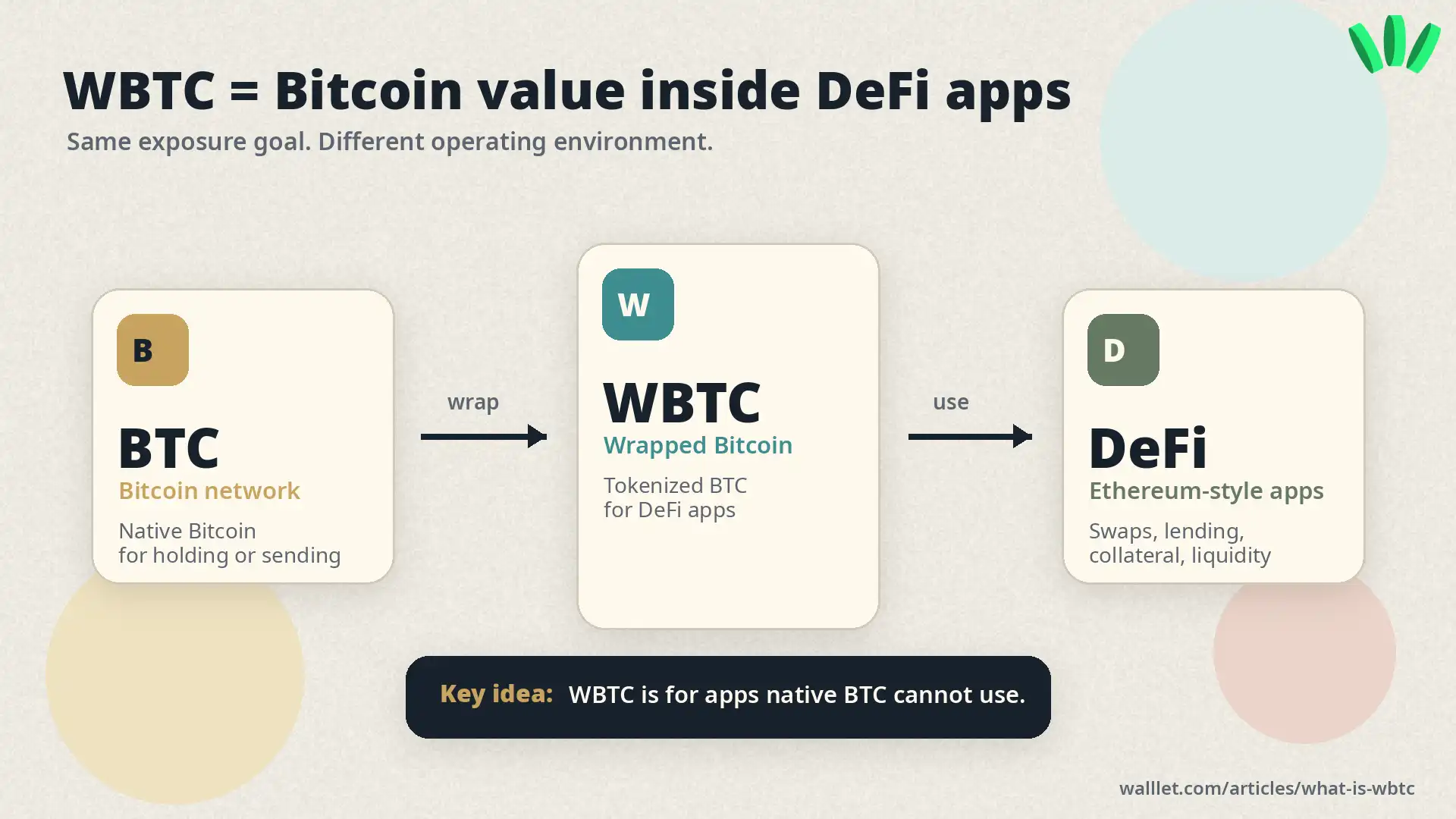
WBTC stands for Wrapped Bitcoin. It is a tokenized version of Bitcoin made for Ethereum-style ecosystems.
Native BTC works on the Bitcoin network. WBTC works inside smart contract environments where apps expect tokens, approvals, gas fees, and wallet signatures.
If you are new to Ethereum-style chains, this guide on what an EVM wallet is is useful before going deeper. It explains why many chains and apps use the same general wallet logic.
Is WBTC the Same as BTC?
WBTC is designed to follow the value of BTC, but using it feels different.
BTC is the native asset of the Bitcoin network. You use it to hold, send, and receive Bitcoin on Bitcoin’s own chain.
WBTC is a token that represents Bitcoin inside other ecosystems. The WBTC Network says WBTC is backed 1:1 by BTC and provides transparency tools around reserves and mint-burn activity. Here is the clean version:
Question | BTC | WBTC |
What is it? | Native Bitcoin | Tokenized Bitcoin |
Where is it used? | Bitcoin network | Ethereum-style apps and DeFi |
Main use | Holding or sending BTC | Swaps, lending, collateral, liquidity |
Fee asset | BTC network fee | Usually the chain’s native gas token |
Main trade-off | Simpler native custody | More DeFi utility, more trust assumptions |
WBTC gives you Bitcoin exposure in places where native BTC cannot easily go. That usefulness comes with extra things to check.
Why Does WBTC Exist?
WBTC exists because Bitcoin and Ethereum-style apps do different jobs.
Bitcoin is built around its own network and native asset. DeFi apps are usually built around tokens, smart contracts, and programmable transactions. Native BTC does not plug into those apps directly.
WBTC solves that compatibility problem.
It lets people use Bitcoin exposure in places like decentralized exchanges, lending protocols, liquidity pools, and collateral systems. So if you want to use Bitcoin value inside DeFi, WBTC can be useful.
If your goal is simply to hold Bitcoin, receive Bitcoin, or send Bitcoin on the Bitcoin network, BTC is the cleaner choice.
How Does WBTC Work?
The basic idea is simple: BTC is held in reserve, and WBTC is issued against it.
When WBTC is created, BTC should be backing it. When WBTC is redeemed or burned, WBTC supply should decrease. This is why proof of reserves and mint-burn records matter.
For a normal user, the important part is this:
WBTC depends on more than your wallet. It also depends on reserve backing, custodians, token contracts, and the apps you use it with.
That does not make WBTC useless. It just means you should understand what you are holding.
Crypto loves turning one asset into five user questions. Naturally.
Do You Need ETH to Move WBTC?
On Ethereum, usually yes.
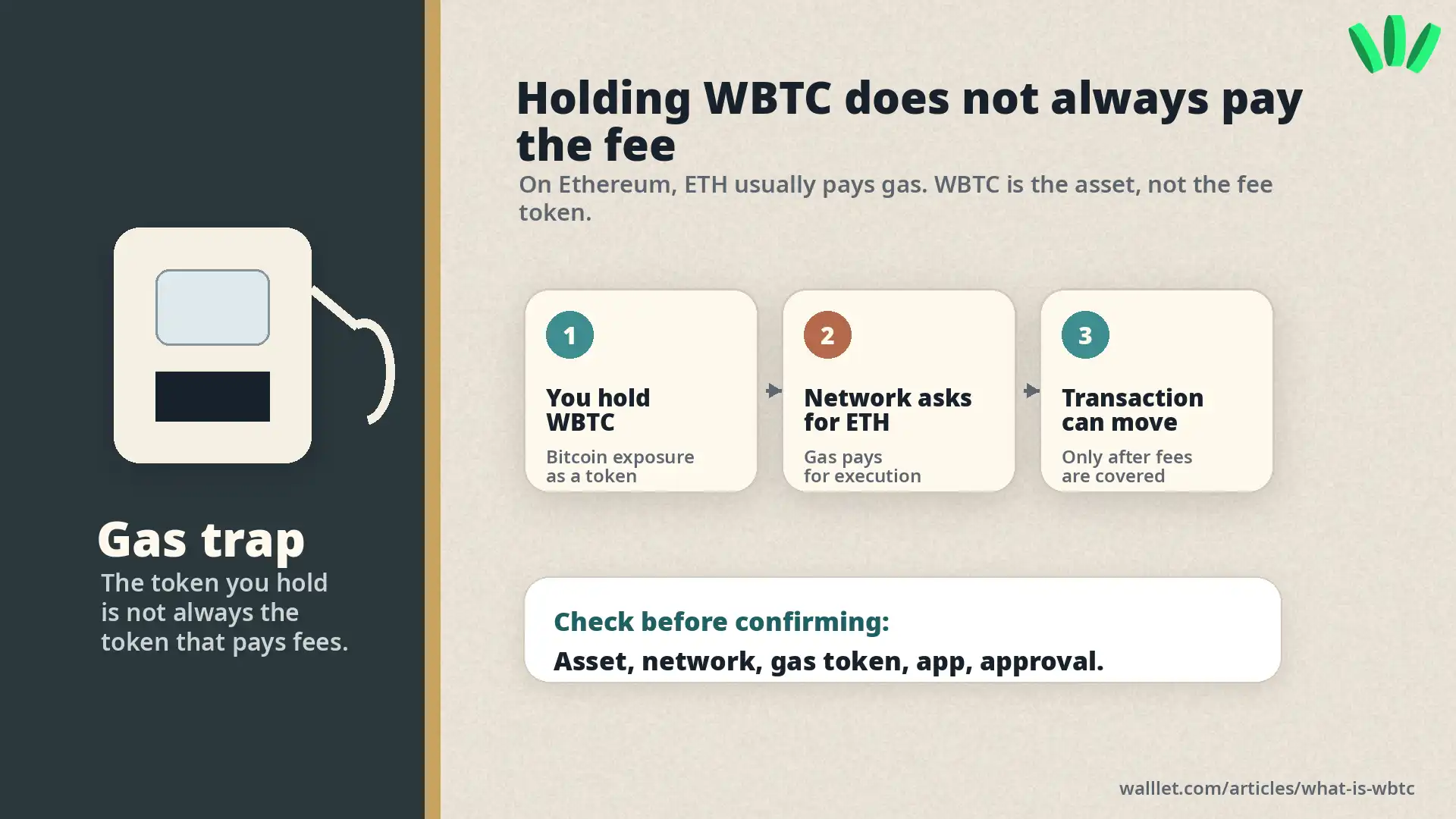
WBTC may be the token you want to move, but ETH is usually needed to pay gas. Ethereum’s official documentation explains that gas fees are paid in ETH and cover the cost of processing transactions and smart contract activity on the network: Ethereum gas and fees.
This is one of the easiest places to get stuck.
You may have WBTC in your wallet and still be unable to move it because you do not have enough ETH for gas. The same problem can happen on other chains too. The token you hold and the token needed for network fees are often different.
If this sounds painfully familiar, read walllet’s guide to gas abstraction and paying gas with different tokens. It explains why some wallets and apps try to hide the native gas token problem from users.
Curious how this feels in a wallet built around clearer prompts and fewer gas dead ends? See how walllet.com handles crypto across chains
Where Do People Use WBTC?
WBTC usually appears in DeFi and Ethereum-style wallet flows. You may see it when you:
Swap tokens on a decentralized exchange.
Use Bitcoin exposure as collateral.
Borrow or lend through a DeFi protocol.
Provide liquidity.
Move assets through a bridge or cross-chain route.
Receive a tokenized version of Bitcoin instead of native BTC.
If your next step is actually swapping into WBTC, read this guide on how to buy WBTC with USDT before confirming anything. The details matter: network, token contract, slippage, gas, approval, and the asset you receive.
Is WBTC Risky?
Yes. The risk is different from native BTC. With BTC, your main concerns are usually wallet security, private key control, transaction accuracy, and network fees. With WBTC, you add more layers:
Risk | What it means |
Reserve risk | WBTC depends on BTC backing remaining valid |
Custody risk | The underlying BTC is held through a custodian model |
Smart contract risk | WBTC moves through token contracts and DeFi apps |
Approval risk | You may approve contracts that can move your tokens |
Network risk | Sending or using WBTC on the wrong network can create problems |
Gas risk | You may need another token, like ETH, just to move it |
The biggest mistake is treating WBTC like normal BTC in every situation. It is not. It is useful, but it has a different trust model.
If you are worried you sent something through the wrong chain, walllet’s guide on crypto sent on the wrong network explains what to check first and when recovery may be possible.
What Should You Check Before Using WBTC?
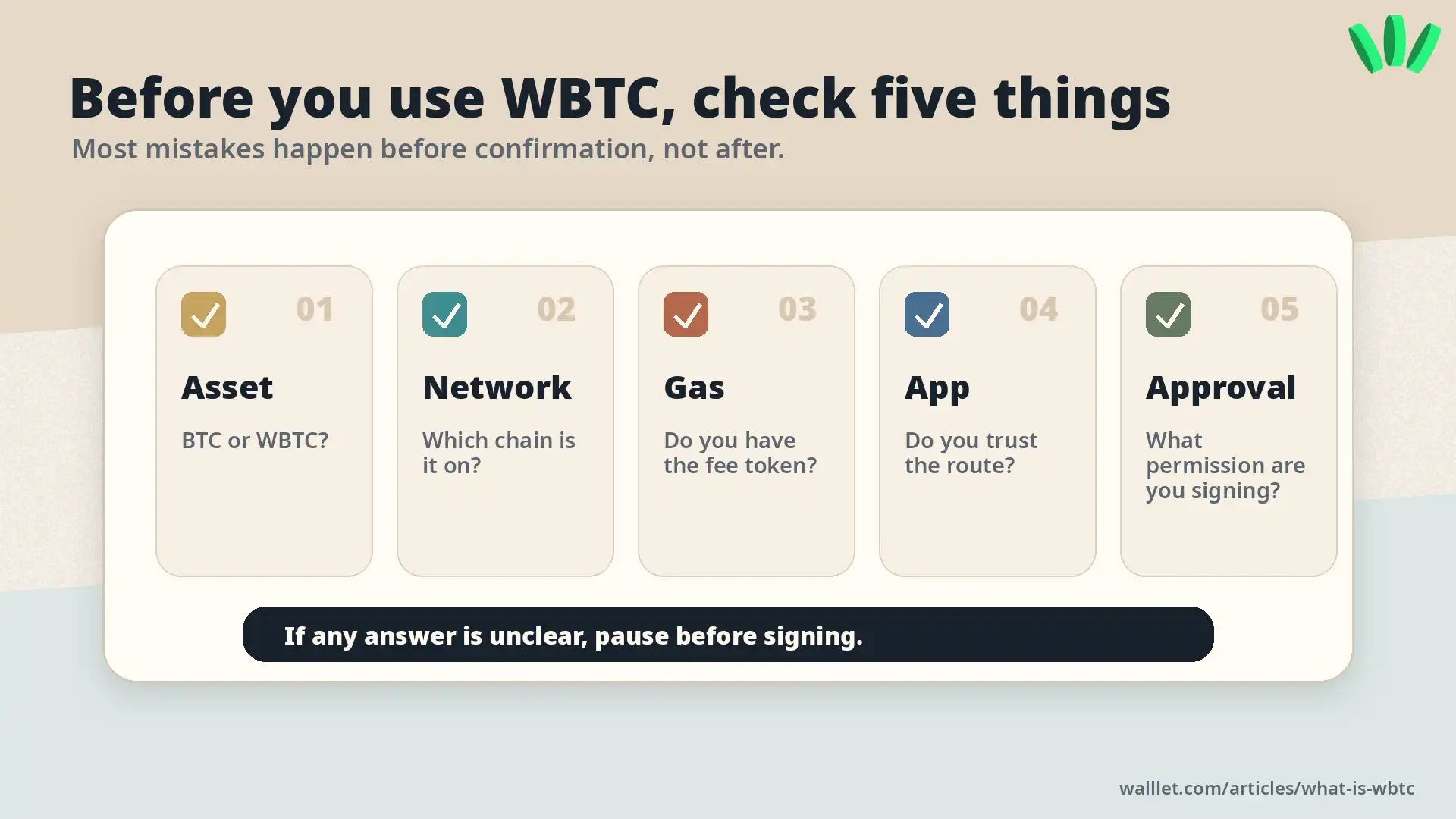
Before you swap, receive, bridge, lend, or approve WBTC, slow down and check the basics.
First, check the asset. Are you receiving BTC or WBTC?
Second, check the network. WBTC can exist on different chains, and your wallet view may not show the full story clearly.
Third, check gas. Do you have the native gas token needed to move or use it?
Fourth, check the app or contract. A token can be real while the app asking for approval is still risky.
Fifth, check the approval. Do you understand what permission you are giving?
If something feels off, check the transaction on a block explorer. This guide on how to read a crypto transaction on a block explorer is a good starting point.
When Should You Use BTC or WBTC?
Use BTC when you want native Bitcoin. That means holding Bitcoin, receiving Bitcoin, sending Bitcoin on the Bitcoin network, or avoiding extra tokenized-asset assumptions.
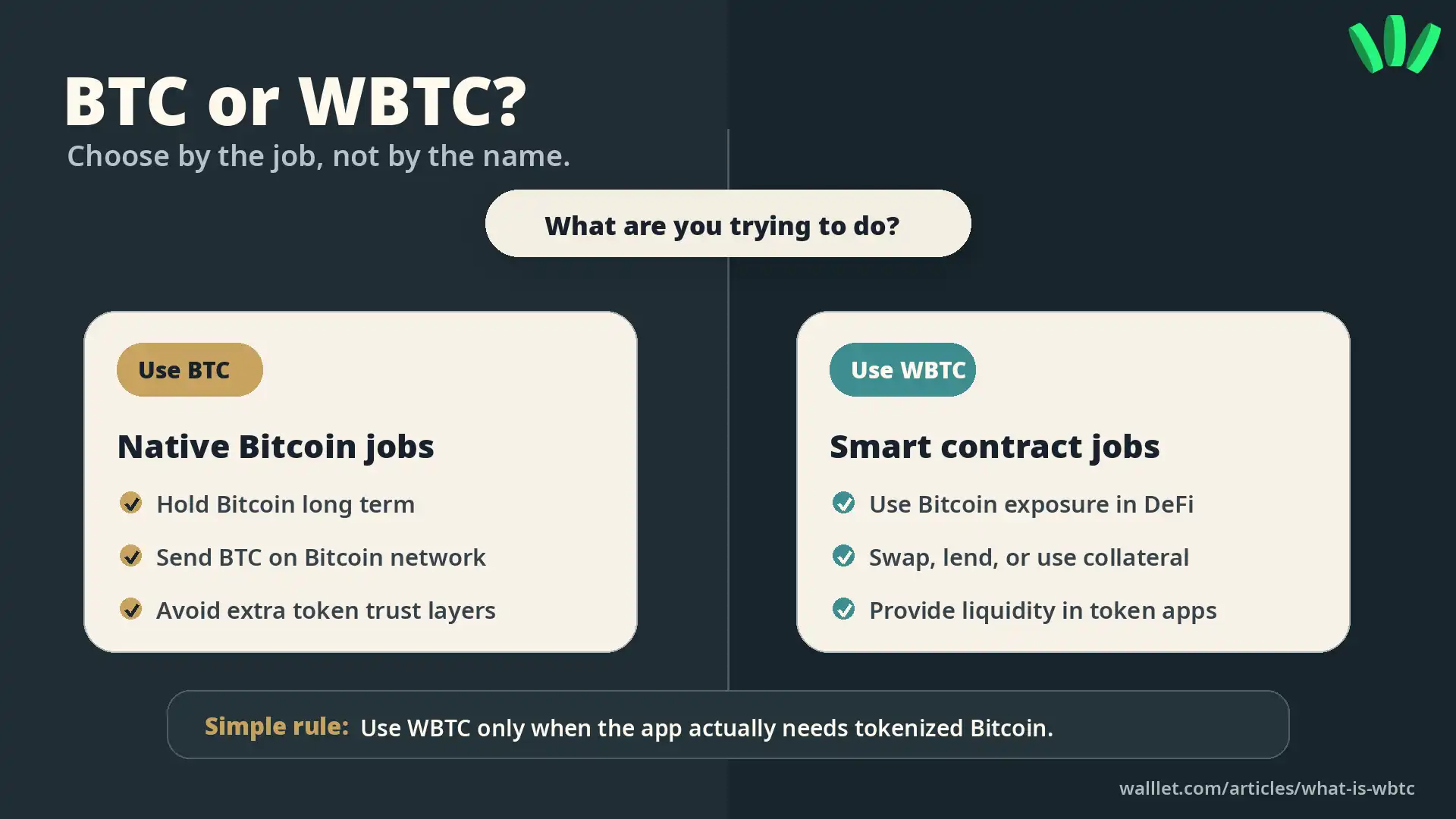
Use WBTC when you need Bitcoin exposure inside smart contract apps. That means DeFi, DEX swaps, lending, collateral, liquidity pools, or Ethereum-style wallet flows. Avoid WBTC when you do not understand why an app is asking for it, what chain it is on, what gas token you need, or what approval you are signing. A simple rule:
Your goal | Better fit |
Hold Bitcoin long term | BTC |
Send Bitcoin on the Bitcoin network | BTC |
Use Bitcoin exposure in DeFi | WBTC |
Provide liquidity with Bitcoin exposure | WBTC |
Avoid custodian and token contract assumptions | BTC |
Swap USDT into Bitcoin-like exposure in an EVM app | WBTC may fit |
WBTC is useful when the job needs tokenized Bitcoin. It is unnecessary when native Bitcoin already does the job.
Can a Wallet Make WBTC Less Confusing?
Yes, to a point.
A wallet cannot remove the trust model behind WBTC. It cannot make tokenized Bitcoin identical to native BTC. It also cannot magically make every app safe, because apparently blockchains still require users to read things before clicking. But a better wallet can reduce the mistakes around WBTC.
The confusing parts are usually not the definition. They are the moment before confirmation: Which network is this? What token am I receiving? What pays gas? What am I approving? Is this a swap, bridge, or transfer?
walllet.com is built around those moments. It is a self-custodial smart wallet designed to make crypto easier to use without seed phrase stress, with clearer transaction prompts, passkey-based access, and gas flexibility on supported flows.
That matters for WBTC because the user’s real problem is rarely “I need a longer definition.” The real problem is: I need to understand what I am about to sign. Before using WBTC, check the asset, network, gas token, app, and approval. Then start small.
Create your walllet.com and test crypto across chains with clearer prompts
