The hard part is not choosing a wallet without a seed phrase. It is choosing which kind of seedless wallet you actually trust.
walllet and ZenGo are both seedless crypto wallets, but they use different security models. ZenGo uses MPC and 3-factor recovery. walllet uses passkeys, biometrics, and smart-wallet design to make self-custody easier for everyday Web3 use.
TL;DR
walllet and ZenGo both remove the traditional seed phrase, but they do not work the same way.
ZenGo is built around MPC, where wallet control is split into cryptographic shares. walllet.com is built around passkeys, biometrics, and smart-wallet UX.
ZenGo may fit users who want a mature MPC wallet with guided recovery. walllet.com may be a better fit for users who want seedless self-custody that feels easier for everyday Web3 actions, clearer transaction approvals, and less gas-fee friction where supported.
You probably do not want to write twelve recovery words on paper, hide them somewhere, and hope your future self never loses them.
A seed phrase can protect your funds, but it also creates a new fear: if you lose it, expose it, photograph it, or type it into the wrong place, your wallet can become a very expensive lesson. That is why seedless wallets matter. If you are still comparing the broader category, this guide to the best seedless crypto wallets gives useful context. But this article focuses on one narrower question: walllet vs ZenGo, which one fits you better?
walllet vs ZenGo at a glance
Category | walllet | ZenGo |
Wallet type | Seedless smart wallet | Seedless MPC wallet |
Seed phrase required | No traditional seed phrase | No traditional seed phrase |
Main security model | Passkeys, biometrics, device-secured access, smart-wallet logic | MPC, or multi-party computation |
Recovery approach | Passkey-based recovery flow, depending on device and platform setup | 3-factor recovery model |
Best known for | Simpler Web3 use, human-readable transactions, passkey-based onboarding | MPC security, guided recovery, beginner-friendly wallet experience |
Web3 experience | Designed around smart-wallet UX and clearer transaction flows | Supports Web3 access, swaps, buying, selling, and asset management |
Gas experience | Built to reduce gas friction on supported flows | Standard wallet fee experience depends on network and transaction |
Best for | Users who want seedless self-custody with simpler everyday Web3 use | Users who specifically want an MPC wallet with guided recovery |
Main tradeoff | Newer wallet model, so users should check current supported chains and flows | Strong recovery model, but still depends on ZenGo’s MPC infrastructure |
Both wallets are trying to remove one of crypto’s oldest pain points: seed phrase management. The difference is the path they take.
Before comparing the details, it helps to remember what a wallet actually does. A crypto wallet helps you access, control, and approve activity for assets onchain. If that still feels fuzzy, start with what a crypto wallet is before choosing between wallet models.
What is the biggest difference between walllet and ZenGo?
Both walllet.com and ZenGo are seedless. The real difference is how each wallet removes the seed phrase.
ZenGo is an MPC wallet. MPC stands for multi-party computation. In simple terms, the wallet does not rely on one normal private key sitting in one place. Instead, signing power is split into separate cryptographic parts. ZenGo uses two independently created secret shares: a Personal Share stored on the user’s device and a Remote Share secured on ZenGo’s servers. Together, those shares help create signed transactions without exposing a traditional seed phrase. You can read ZenGo’s own explanation on its security model.
walllet.com uses a different model. It is a seedless smart wallet built around passkeys, biometrics, and account abstraction. A passkey is not just a nicer password. Passkeys use public key cryptography and are designed for phishing-resistant sign-in, according to the FIDO Alliance. In wallet UX, that means a user can access and recover their wallet through device-native authentication instead of manually managing a recovery phrase.
A simple way to think about it:
ZenGo asks: “How can we remove the seed phrase by splitting wallet control?”
walllet.com asks: “How can we remove the seed phrase and make wallet use feel closer to a modern mobile app?”
That second question matters because a wallet is not only a vault. It is also the screen you use when you send money, connect to apps, approve transactions, switch networks, and try not to make a mistake.
Is ZenGo safer than walllet.com?
The honest answer is that they protect users in different ways.
ZenGo’s strongest security argument is its MPC model. By replacing the usual seed phrase with separate cryptographic shares, it removes the single paper backup that many users lose, leak, or store badly. It also puts a lot of emphasis on 3-factor recovery.
walllet’s security argument is different. It focuses on passkeys, biometrics, smart-wallet design, and clearer transaction prompts. For more context on this category, the passkey wallet explainer breaks down why passkeys matter for crypto wallets and how they reduce seed phrase anxiety.
For a beginner, this distinction is important. A seedless wallet can reduce seed phrase risk, but it does not remove every risk. You can still approve a bad transaction. You can still send funds to the wrong address. You can still use the wrong network. You can still be tricked by a fake app or malicious website.
That is where wallet design matters. A safer wallet is not only the one with strong cryptography. It is also the one that helps users avoid rushed, confused, or blind decisions. If safety is your main concern, this guide on how to tell if a crypto wallet is safe is a useful next read.
What happens if you lose your phone?
This is one of the most important questions to ask before using any seedless wallet.
With ZenGo, recovery is a major part of the product story. The wallet is built around 3-factor recovery, which is meant to help users regain access if they move to a new device.
With walllet, the recovery experience is tied to passkeys and the device or platform account where the passkey is stored. That may feel more familiar to users who already use Face ID, fingerprint unlock, Apple Passwords, Google Password Manager, or similar passkey-based flows.
The practical point is simple: before you move serious funds into any wallet, test recovery with a small amount first.
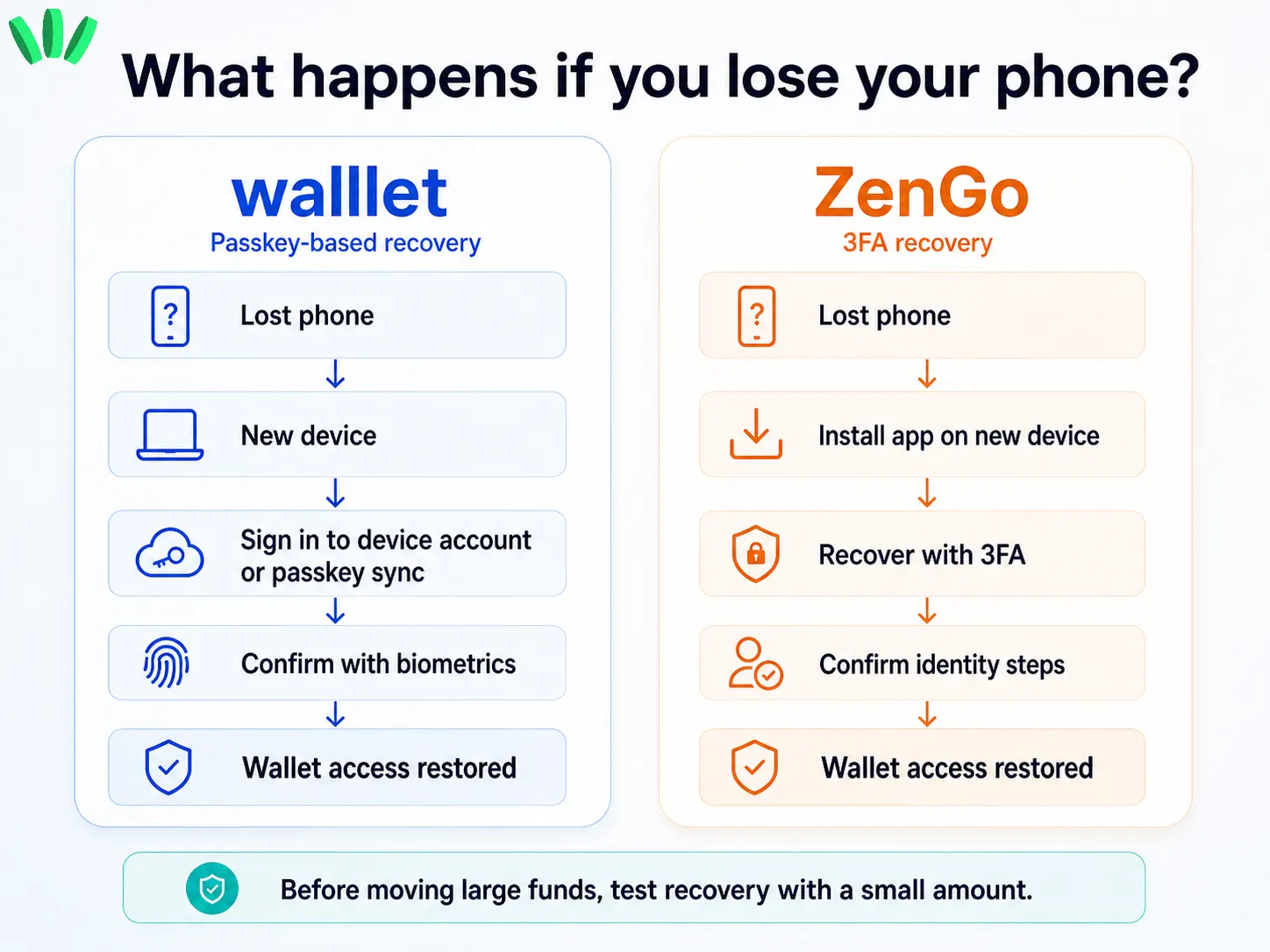
Create the wallet. Add a small balance. Understand what happens if your phone is lost, replaced, wiped, or locked out. This matters more than a shiny feature table.
Is walllet.com or ZenGo easier for beginners?
ZenGo removes the seed phrase and packages recovery in a guided way. For users whose main fear is “What if I lose my recovery phrase?”, ZenGo speaks directly to that concern.
walllet.com is aimed at a slightly different beginner: someone who does not only want to hold crypto, but also wants to use Web3 without feeling dropped into a control panel from a spaceship.
That difference shows up in the questions a new user actually asks:
“Can I set this up without panic?”
“Will I understand what I am signing?”
“Can I use crypto without needing five browser tabs open?”
“Will I need to buy another token just to pay gas?
For those everyday moments, walllet has the stronger angle because it is built around smart-wallet usability, not only wallet recovery. If your main question is broader than ZenGo, this guide to choosing the best crypto wallet for beginners explains what first-time users should actually check before downloading anything.
Why does account abstraction matter in this comparison?
Account abstraction is one of those crypto terms that sounds more complicated than the problem it solves.
A normal crypto wallet often acts like a raw key. It signs transactions, and the user has to deal with many of the rough edges: gas tokens, confusing approvals, network switching, and rigid transaction rules.
A smart wallet can add more logic around the account. That can support better wallet experiences, such as clearer signing, more flexible authentication, recovery improvements, and gas handling options on supported flows.
This does not mean every smart wallet automatically supports every feature on every chain. It means the wallet architecture gives more room to improve the user experience.
For the walllet.co vs ZenGo decision, this is important. ZenGo’s core story is MPC security. walllet’s core story is seedless self-custody plus smart-wallet UX.
Is walllet a good ZenGo alternative for passkey-based self-custody?
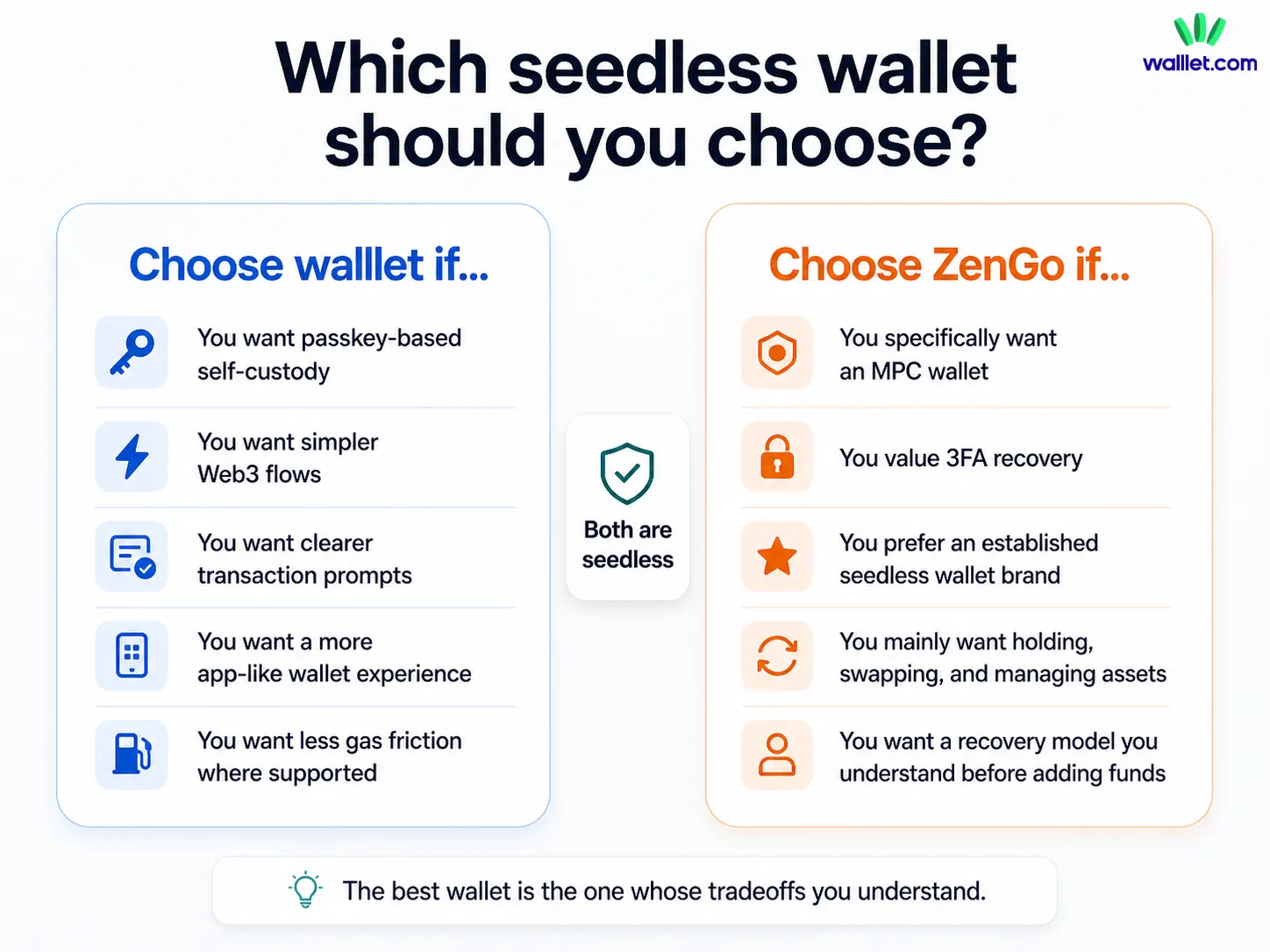
Yes, walllet is a strong ZenGo alternative if your priority is not only removing the seed phrase, but also making everyday Web3 actions easier to understand.
ZenGo is the better-known name for MPC-based seedless self-custody. It is a good fit if you specifically want MPC, 3-factor recovery, and a wallet with a long consumer track record.
walllet.com is the stronger fit if your priority is passkey-based access, biometric setup, clearer transaction prompts, and a smart-wallet experience that reduces friction when using crypto rather than only storing it. For a deeper product-level explanation, read what walllet.com is and how it fits into the newer category of seedless smart wallets.
The decision is not about which wallet has the louder security claim. It is about which wallet model matches your actual use case. If you mostly want to hold and recover assets, ZenGo makes sense. If you want to use crypto across apps, chains, swaps, stablecoins, and everyday Web3 flows, walllet may feel more natural.
Which wallet is better for Web3 and DeFi?
If your main goal is to buy, sell, hold, and recover your wallet easily, ZenGo has a mature consumer wallet story and a recovery-first brand position.
If your goal is to use crypto across apps, chains, and everyday Web3 flows, walllet.com has the more natural positioning.
The difference becomes clearer in a real scenario. Imagine you want to try a DeFi app. A traditional wallet may show you a technical signing request that feels like a legal contract written by a vending machine. You may not know what permission you are granting, how much risk there is, or whether the app is asking for more access than needed.
A wallet built around human-readable transactions can help by showing the action, asset, amount, network, and approval in clearer language. That does not make every transaction safe. It makes the decision less blind.
For everyday Web3, that is a serious advantage.
Which wallet supports more assets and networks?
This section should always be checked close to publication because wallet support changes often.
The useful question is not “Which wallet supports the biggest number?” The useful question is: Does this wallet support the chains, assets, and actions you actually use?
A wallet that supports hundreds of assets you never touch is less useful than a wallet that handles your daily stablecoin, your main network, your common swaps, and your approval flows clearly.
For most users, the practical checklist is:
Check whether the wallet supports your main chain.
Check whether it supports the assets you actually hold.
Check whether it explains network fees clearly.
Check whether recovery makes sense before you deposit more than a test amount.
Use asset count as a filter, not as the final decision.
Do seedless wallets remove gas fees?
No. Seedless wallets do not magically remove blockchain network fees.
Gas fees come from the network, not from the seed phrase. If you use Ethereum, Arbitrum, Polygon, Base, Optimism, BNB Chain, or another network, transaction costs still depend on that network’s rules and current activity.
What a smart wallet can do is reduce gas friction. For example, supported smart-wallet flows may allow more flexible fee handling, fee sponsorship, or payment with a token the user already has.
This is one area where walllet’s smart-wallet model can be useful. The value is not “gas disappears forever.” The value is that the wallet can make fee handling less confusing where supported.
That distinction matters. Any wallet promising effortless crypto everywhere, with no tradeoffs, deserves a raised eyebrow. Try walllet.com if you want a seedless smart wallet with passkeys, biometric setup, and clearer everyday Web3 transactions.
Final verdict
The best wallet is not the one with the longest feature list. It is the one whose failure modes you understand.
If you want an MPC wallet with guided recovery, ZenGo remains a strong option. If you want seedless self-custody that feels more like a modern mobile app and less like a private-key management exercise, walllet.com is the better wallet to try first.
