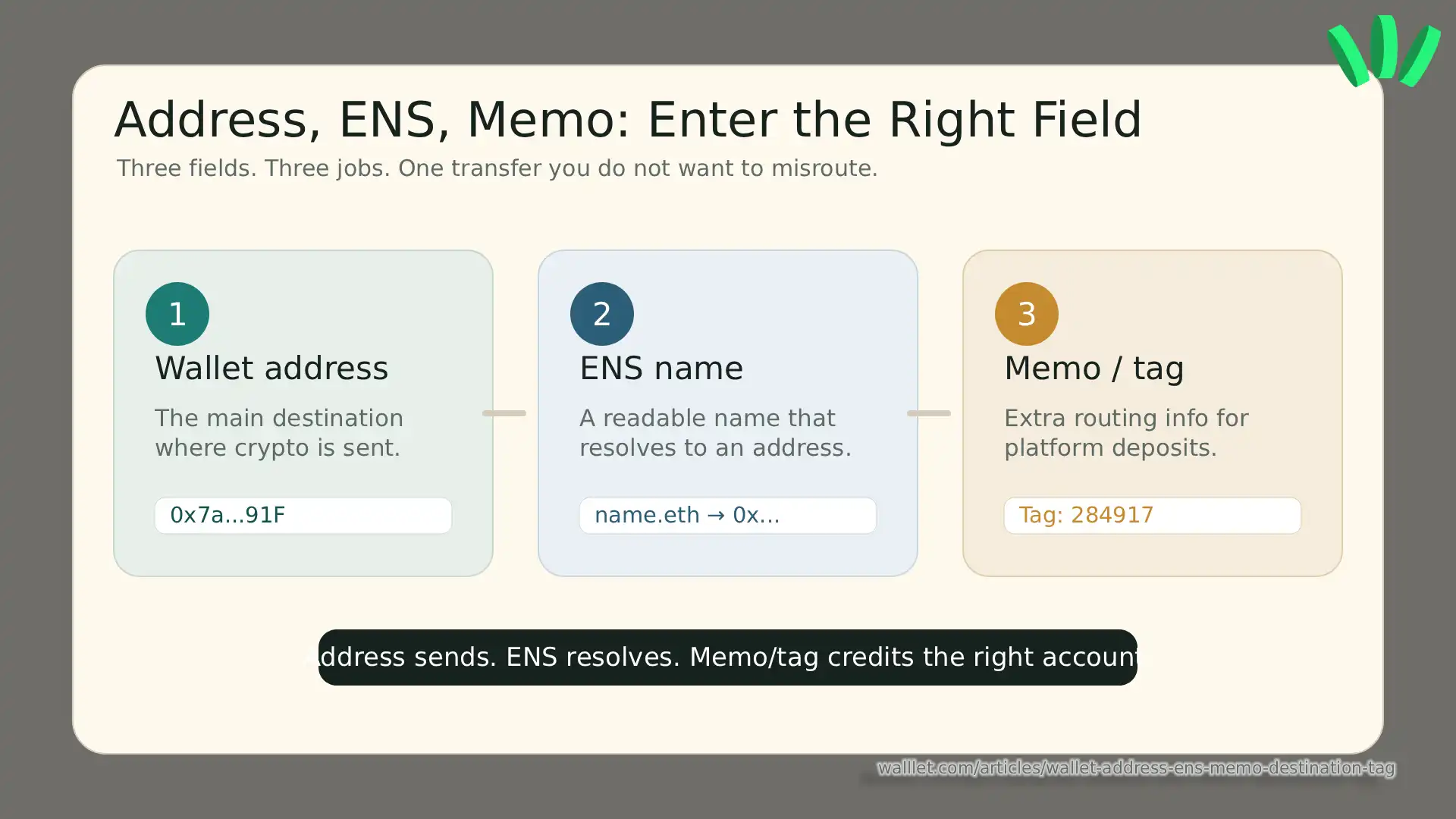
A wallet address is the main destination for a crypto transfer. ENS is a readable name that points to an address. A memo or destination tag is extra routing information, mostly used by exchanges and platforms with shared deposit addresses. Self-custody transfers usually need only the address. Exchange deposits may need both the address and memo/tag.
TL;DR
Wallet address: the main place you send crypto to.
ENS: a readable name like
name.eththat resolves to a wallet address.Memo or destination tag: an extra field some platforms use to credit the right user.
Private wallet transfers usually need only an address.
Exchange deposits may require both address and memo/tag.
When unsure, check the receiving screen and send a small test amount first.
Why crypto transfers ask for different destination fields
Crypto transfers feel confusing because different services ask for different things at the worst possible moment.
One wallet asks for an address. Another app accepts an ENS name. An exchange deposit page asks for an address and then quietly adds a memo, tag, or note under it. Naturally, people assume these are all versions of the same thing.
They are not.
The simple rule is this: the address is the destination. ENS is a readable shortcut to a destination. A memo or destination tag helps a platform route the deposit after it arrives.
If you are sending crypto for the first time, this guide pairs well with walllet’s practical guide on how to send and receive ETH and ERC-20 tokens safely, especially if the transfer involves Ethereum, USDC, USDT, or another token on an EVM network.
What is a wallet address?
A wallet address is the public destination people use to send you crypto. It is usually a long string of letters and numbers. You can share it. It is not your private key.
Your wallet address receives funds. Your private key or signing credential controls funds. Mixing those up is where bad security habits start.
A wallet address only works safely when it matches the right asset, network, and receiving instructions. A correct-looking address on the wrong network can still cause a failed, delayed, or hard-to-recover transfer.
For example, if someone says “send USDC,” that is not enough. You still need to know whether they want it on Ethereum, Base, Arbitrum, Polygon, or another supported network.
Does one wallet have one address?
Not always. A wallet can have different addresses for different networks or assets. Some platforms also rotate deposit addresses or show older addresses in your account history.
So when someone says “send it to my wallet,” what they really mean is:
Send the right asset to the right address on the right network.
Small sentence. Large consequences. Crypto, naturally, made the small sentence expensive.
What is ENS?
ENS, or Ethereum Name Service, lets a readable name like alice.eth point to blockchain records such as wallet addresses. The official ENS documentation describes forward resolution as going from a name to an address.
In plain English: ENS is like a contact name for crypto.
You type or paste alice.eth, and the wallet resolves that name into the address underneath. This makes transfers easier to read, but it does not remove the address from the process.
Is ENS the same as a wallet address?
No.
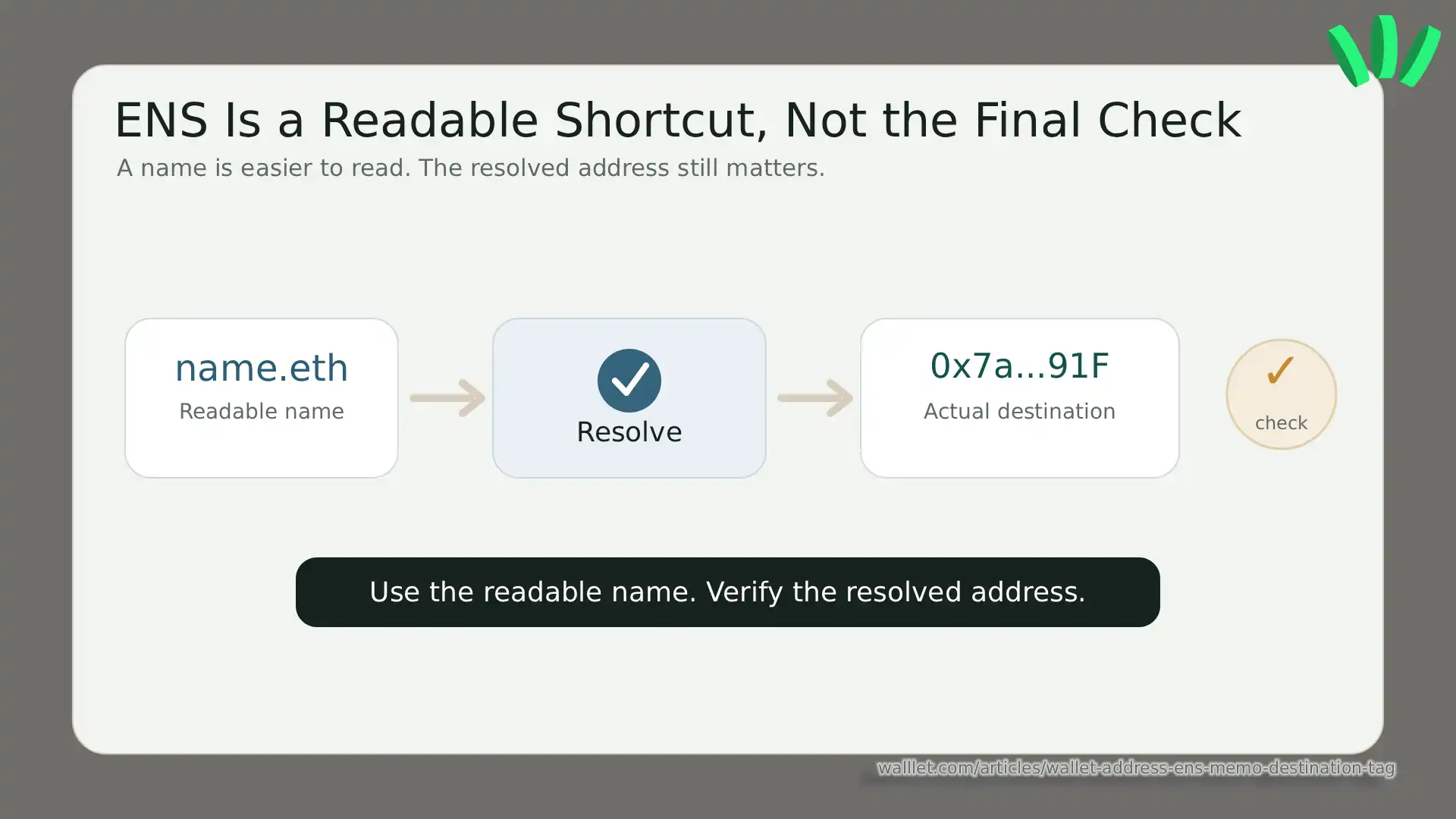
ENS points to a wallet address. It does not replace the address at the transaction level. Before sending a meaningful amount to an ENS name, check what address it resolves to. This matters because a readable name can feel trustworthy even when you have not verified the actual destination.
Useful habit: if a wallet shows the resolved address, compare it with what the recipient expects before sending.
What is a memo or destination tag?
A memo or destination tag is extra information attached to a transfer. It helps the receiving platform know which internal account should get credited.
This is common with exchanges and services that use shared deposit addresses. In that setup, the address gets funds to the platform, and the memo or tag tells the platform which user the funds belong to. Think of it like this:
Field | Simple meaning |
Wallet address | The building address |
Memo or destination tag | The apartment number |
If the package reaches the building without the apartment number, it may arrive, but the platform may not know where to credit it.
Is a memo the same as a destination tag?
For most users, yes.
They are different labels for similar routing information. Some platforms say memo. Some say destination tag. Some may say tag, note, or payment ID. The label matters less than the instruction on the receiving screen. If the platform shows a memo or tag, treat it as required unless the platform clearly says it is optional.
When do you need only an address?
You usually need only a wallet address when sending crypto to a private self-custody wallet.
That means the receiving address belongs to the person or wallet receiving the funds. In that case, there usually is no shared exchange account behind the scenes and no extra memo/tag needed.
This is the normal case when sending to a self-custody wallet like walllet.com. You still need to check the asset, network, and address, but you usually do not need an exchange-style memo or tag.
When do you need address plus memo or destination tag?
You may need both when sending to an exchange or another platform deposit page. If the deposit page gives you:
Address:
...Memo/tag:...
then use both. Do not paste only the address because “it looks like the main thing.” It is the main thing, but the memo/tag may be what tells the platform the deposit is yours. Here is the safer pattern:
Sending to | Usually needed |
Your own self-custody wallet | Address |
Another person’s self-custody wallet | Address |
Exchange deposit page | Address plus memo/tag if shown |
ENS name | ENS name, after checking the resolved address |
New destination | Small test transfer first |
Want to see what a calmer transfer flow feels like before moving anything serious? Try a small test transfer in walllet and pay attention to what the send screen asks you to confirm.
What happens if you forget a memo or destination tag?
If the memo or destination tag was required, your funds may reach the platform’s address but fail to appear in your account.
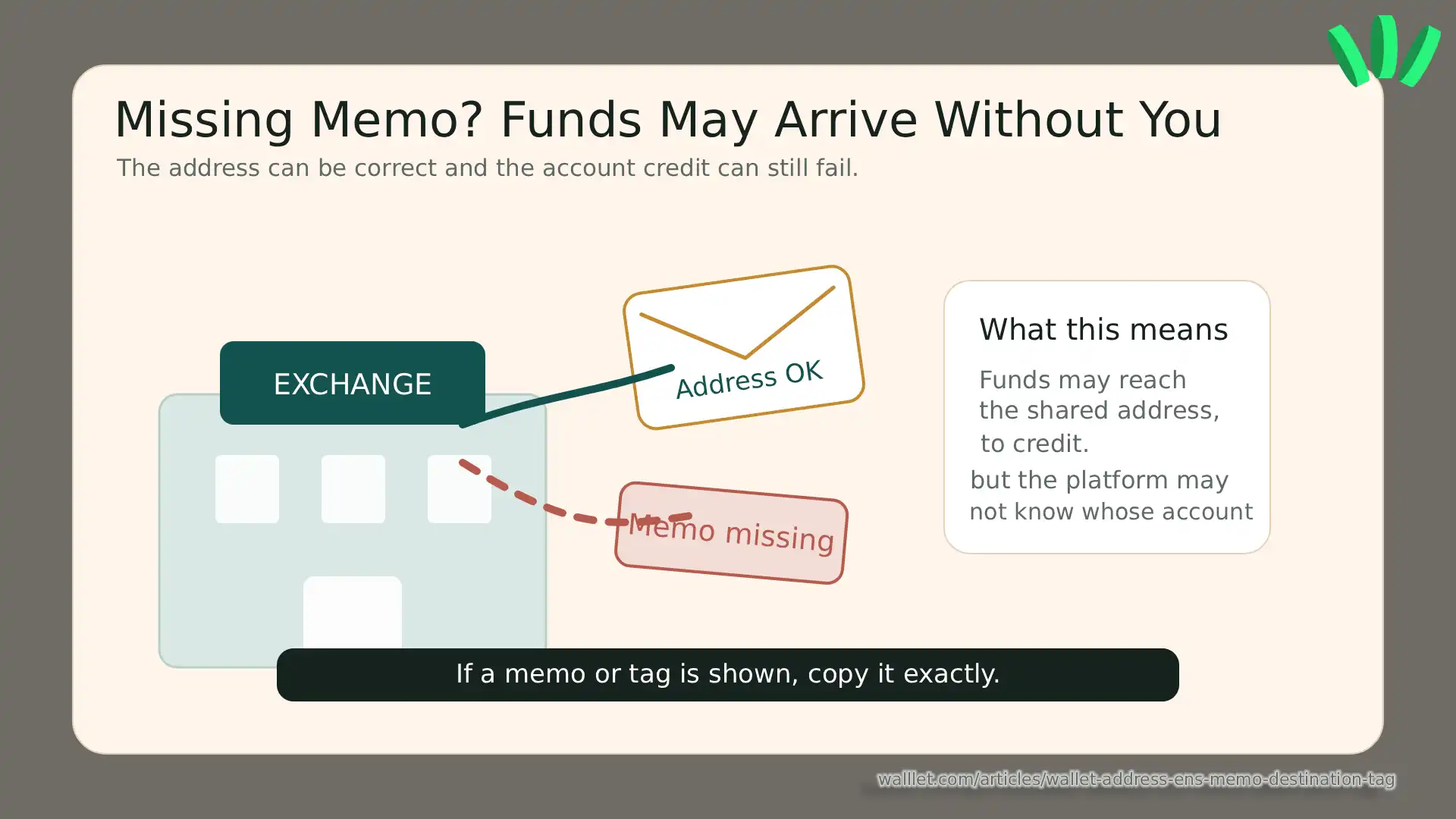
That does not always mean the funds vanished. Sometimes the receiving service can trace the payment with the transaction hash. Sometimes recovery is slow, manual, expensive, or not possible. If this happens:
Save the transaction hash.
Take a screenshot of the deposit instructions.
Contact the receiving platform’s support.
Do not send more funds until you understand what went wrong.
The best fix is prevention: if a memo or tag is shown, copy it exactly.
What are the most common transfer mistakes?
Most transfer mistakes come from moving too fast.
Mistake | What goes wrong | Safer habit |
Wrong address | Funds go to the wrong destination | Copy from the current receive screen |
Wrong network | Funds may not show where expected | Match asset and network together |
Missing memo/tag | Exchange may not credit your account | Copy both address and memo/tag |
Fake ENS or lookalike name | You trust the wrong readable name | Check the resolved address |
Copying from history | You may copy a poisoned address | Use verified sources, not old history |
No test transfer | You risk the full amount first | Send a small amount first |
Address poisoning is worth a pause here. Attackers can place fake lookalike addresses inside your wallet history and wait for you to copy the wrong one later. walllet.cm has a full guide on address poisoning scams, but the short version is simple: do not copy addresses blindly from transaction history.
How can a wallet make transfers less confusing?
A wallet cannot remove every rule from crypto. It cannot magically know every exchange’s deposit policy. It cannot make irreversible transactions reversible just because someone had a bad Tuesday. But it can make the send flow clearer.
walllet.com is a self-custodial crypto wallet designed to make everyday crypto actions easier to understand. It uses passkeys and biometrics for access, avoids seed phrase friction, and focuses on clearer transaction prompts so users can better understand what they are approving.
That matters here because many transfer mistakes happen before the transaction is signed. The user is not hacked. They are confused, rushed, or staring at a deposit screen that does a terrible job explaining itself.
A better wallet helps by making users slow down at the right moment:
Check the recipient.
Check the network.
Check what you are approving.
Use a small test transfer when the destination is new.
If you are still choosing your first wallet, walllet’s guide to the best crypto wallet for beginners explains what to look for before you trust an app with real funds.
Final checklist before sending crypto
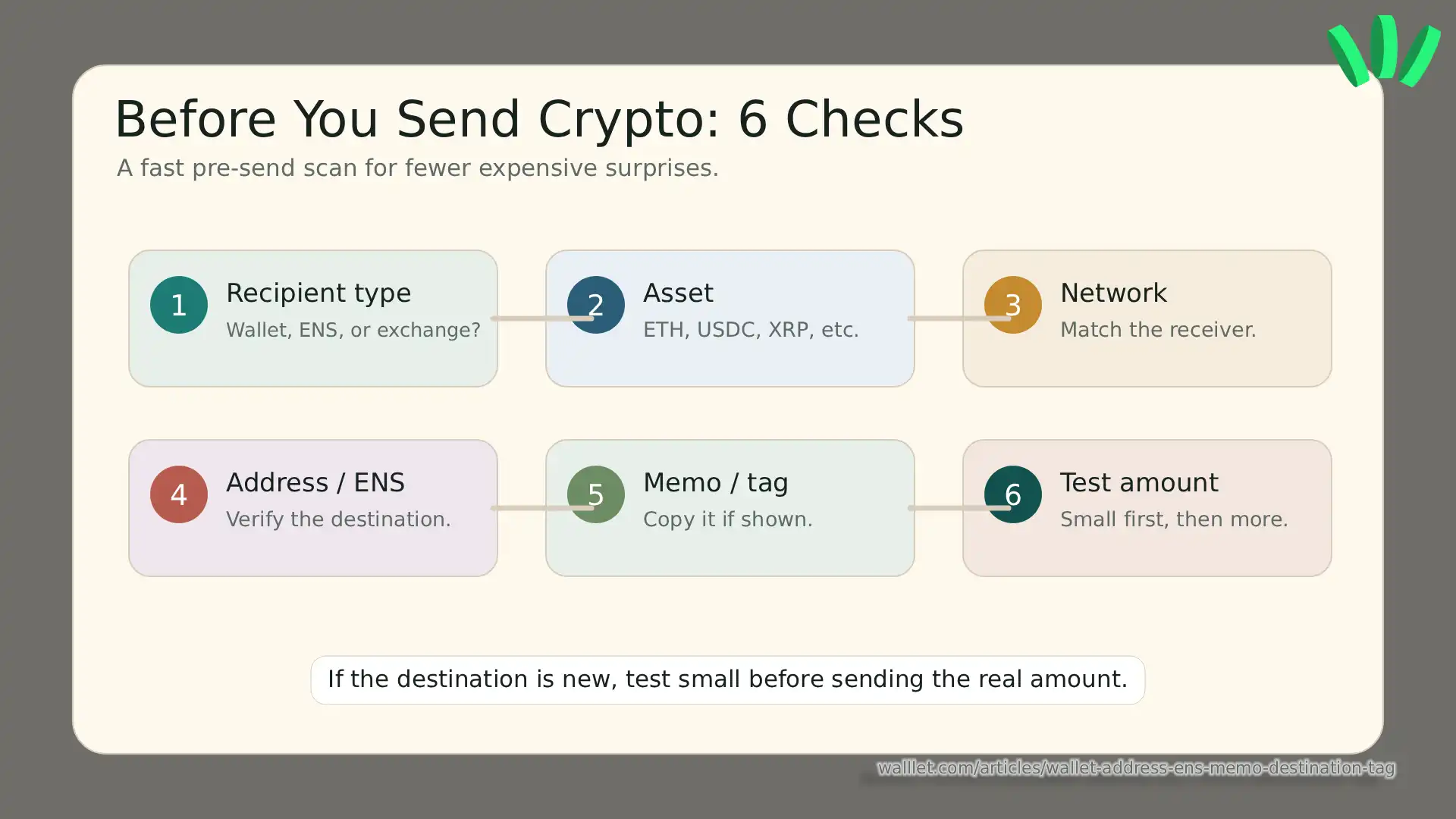
Before you tap send, ask yourself:
Am I sending to a wallet address, an ENS name, or an exchange deposit page?
If it is ENS, did I check the resolved address?
If it is an exchange, did it show a memo, tag, note, or payment ID?
Am I using the correct network?
Did I copy from the current receiving screen, not old history?
Should I send a small test amount first?
For a new recipient or meaningful amount, do the boring thing first: send a tiny test transfer, wait for it to arrive, then send the rest.
Boring is good here. Exciting crypto transfers usually mean someone is about to learn a very expensive lesson.
Start with a small test transfer in wallet.com. You keep self-custody, avoid seed phrase friction, and get a clearer view of what you are approving before you send.
