Swapping crypto without a centralized exchange sounds simple.
Open a wallet. Pick a token. Press swap. Done.
Except crypto loves hiding the hard parts behind tiny buttons. The token may be fake. The network may be wrong. The approval may be too broad. The gas fee may be higher than expected. The route may involve contracts you don’t recognize. Lovely little obstacle course, because apparently moving your own money needed side quests.
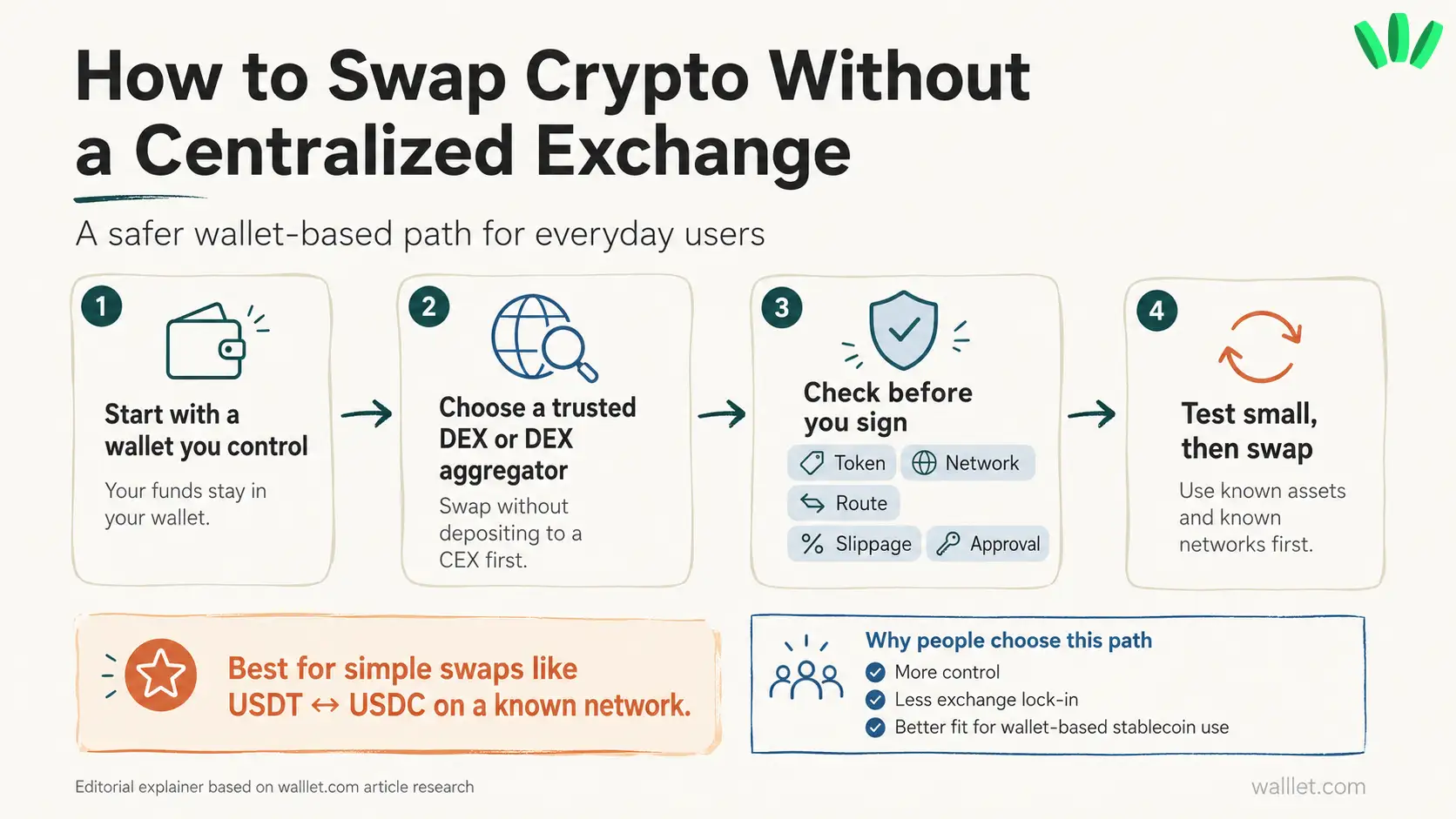
The safer way is to swap from a wallet you control using a trusted DEX, DEX aggregator, or wallet-based swap flow. That means you don’t deposit your funds into a centralized exchange first. You keep custody, review the transaction, and sign from your own wallet.
Still, control comes with responsibility. Before you confirm a swap, you need to check the token, network, route, slippage, gas fee, and approval.
For a deeper breakdown of routing, liquidity, price impact, and approvals, read walllet’s guide to what a DEX aggregator is. If you’re still unclear on the difference between swapping and bridging, start with walllet’s swap and bridge guide.
TL;DR
To swap crypto without a centralized exchange, use a wallet you control and swap through a trusted DEX, DEX aggregator, or wallet-based swap flow.
The main benefit is custody: your funds stay in your wallet until you sign the transaction. You don’t need to deposit crypto into an exchange account first.
The risky part is the signing moment. Before confirming, check the token, network, route, slippage, gas fee, price impact, and approval.
For beginners, the safer path is simple: start with known assets like USDT or USDC, stay on one network when possible, use official links, and test with a small amount first.
A wallet like walllet.com can make this easier by reducing seed phrase anxiety, making transaction details clearer, and warning around suspicious contracts or risky approvals. Still, no wallet can make every swap risk-free.
What does it mean to swap crypto without a centralized exchange?
A centralized exchange, or CEX, is a platform where you create an account, deposit funds, and trade inside that platform’s system. Think Binance, Coinbase, OKX, Kraken, and similar apps.
When your crypto is on a centralized exchange, the exchange handles custody behind the scenes. You see a balance. The platform controls the wallet infrastructure. You rely on it for withdrawals, trading, account access, and support.
Swapping crypto without a centralized exchange means your funds stay in your wallet until you sign the swap. A decentralized swap usually happens through smart contracts.
You keep the crypto in your wallet.
You choose what to swap.
You review the details.
You sign the transaction.
The new token returns to your wallet.
That’s the point. You don’t hand custody to an exchange just to make the trade. If your real question is “should I use an exchange or a wallet for everyday crypto?”, walllet has a separate guide on self-custody vs exchanges for everyday crypto use.
CEX vs DEX vs DEX aggregator vs wallet swap
Method | Who holds your funds before the swap? | Best for | Main risk | Beginner fit |
Centralized exchange | The exchange | Fiat cash-out, large trades, advanced tools | Withdrawal delays, account restrictions, custody risk | Easiest |
DEX | Your wallet | Direct onchain swaps | Fake tokens, low liquidity, slippage, contract risk | Medium |
DEX aggregator | Your wallet | Finding better routes across DEXs | Complex routes, approval risk, bridge risk | Medium |
Wallet swap | Your wallet | Simpler wallet-based swapping | Still depends on route, liquidity, fees, and approvals | Usually easiest decentralized option |
The main difference is custody.
With a CEX, you trade inside someone else’s system. With a wallet-based swap, you trade from your own wallet.
That sounds better. Often, it is. Still messy. If you approve the wrong contract or swap the wrong token, nobody can simply “undo” the blockchain for you. Tragic design choice, very popular industry-wide.
Why people avoid centralized exchanges
People use centralized exchanges because they are convenient. That part is real. They can offer fiat deposits, bank withdrawals, deep liquidity, customer support, tax reports, and simple trading screens. For many users, that’s useful.
The problem is dependency.
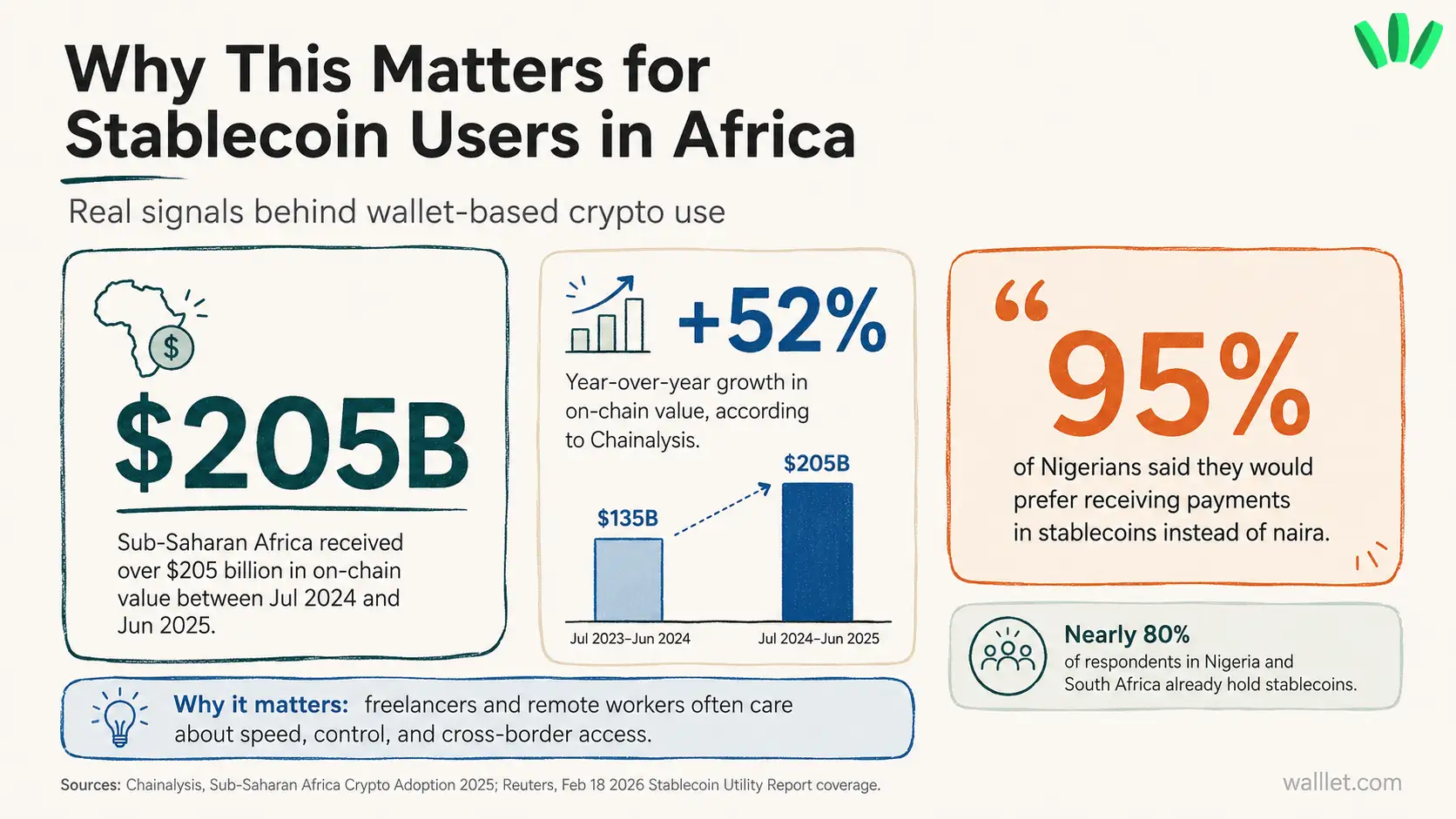
If your crypto sits on an exchange, you may face withdrawal delays, extra verification, regional restrictions, frozen accounts, policy changes, or platform downtime. For freelancers and remote workers, this can become a real issue. If you receive international income in USDT or USDC, you may want to hold and move your money without depending on one platform every time.
This matters in markets where stablecoins are already practical tools. Chainalysis has reported strong retail crypto activity across Sub-Saharan Africa, with Nigeria playing a major role in regional crypto adoption. Read the Chainalysis Sub-Saharan Africa crypto adoption report for the wider context.
If you’re getting paid in stablecoins, walllet’s guide on receiving USDT or USDC as a freelancer is a better next read than another random “top exchange” list. Those lists multiply like weeds. Less useful. More affiliate links. Humanity persists.
Are decentralized swaps safer?
Sometimes. A decentralized swap can be safer for custody because you don’t deposit funds into an exchange first.
But decentralized does not mean safe by default. Here’s where people get into trouble:
Risk | What it means | What to do |
Fake token | A scam token copies a real token’s name or symbol | Check the contract address before swapping |
Bad approval | A contract asks for more access than needed | Review the approval before signing |
Wrong network | Your token is on a different chain than expected | Confirm the exact network first |
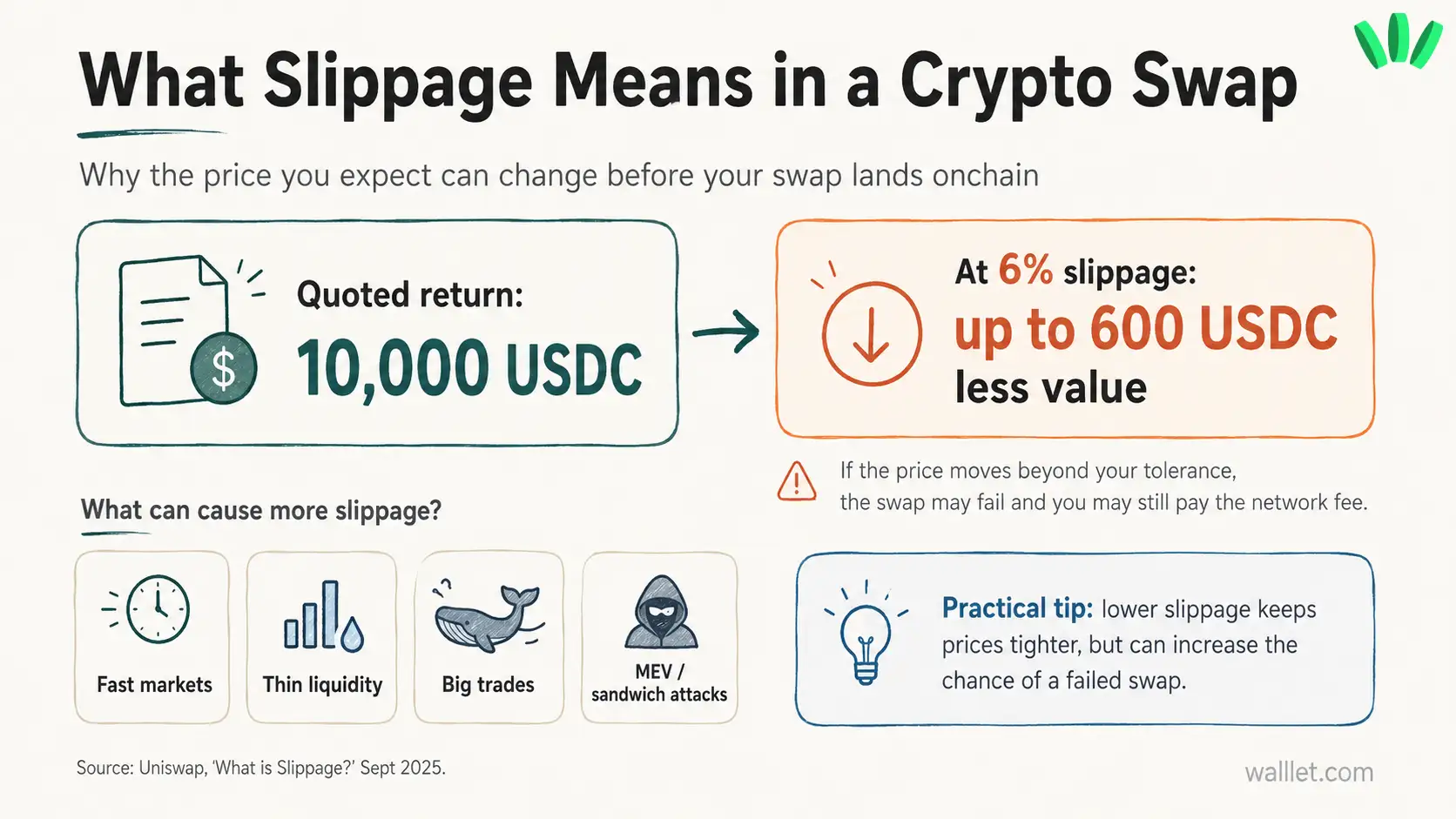
High slippage | You receive less than expected | Check slippage and price impact |
Low liquidity | The pool cannot handle your swap well | Avoid thin or unknown tokens |
Gas problem | You need the chain’s gas token to complete the swap | Check gas before confirming |
Cross-chain route | The swap also involves a bridge | Use extra caution |
The token check is especially important. Before swapping anything unfamiliar, read walllet’s guide on how to verify a token contract address. And slippage matters more than people think. Uniswap’s guide to slippage in crypto swaps explains why the price you expect and the price you actually get can differ while the transaction is pending.
Tiny detail. Large consequences. Crypto’s favorite genre.
Same-chain swap vs cross-chain swap
A same-chain swap means you exchange one token for another on the same blockchain network.
Example: USDT to USDC on the same network.
A cross-chain swap means the transaction moves value between networks.
Example: USDT on one chain to USDC on another chain.
Cross-chain swaps can be useful, but they add more moving parts. Bridges. Extra contracts. More waiting. More ways to get confused.
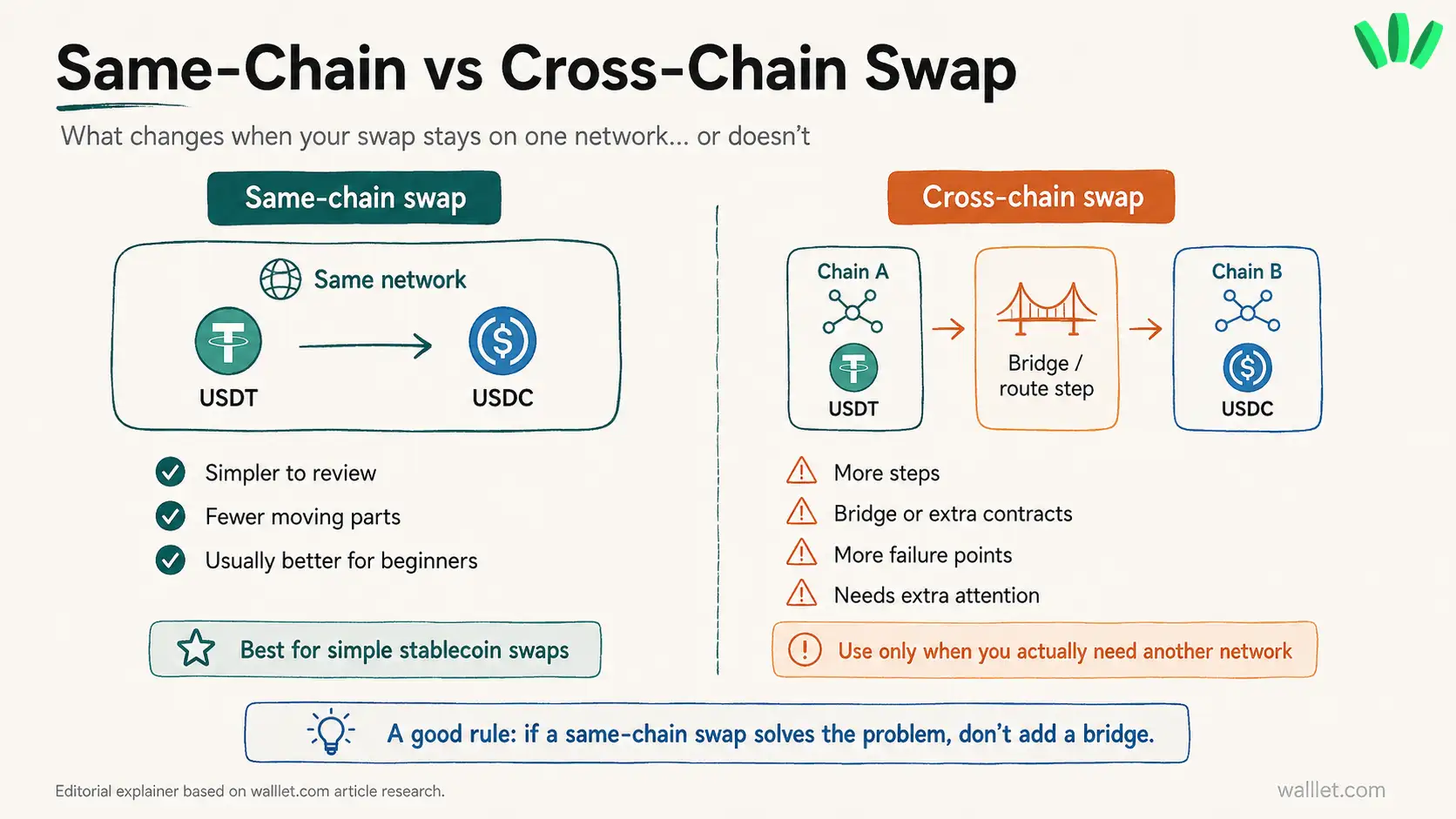
For beginners, same-chain swaps are easier to understand and easier to check. If you only need USDT to USDC on the same network, don’t add a bridge for entertainment. Crypto already has enough buttons.
If your main confusion is stablecoin choice, read walllet’s guide to USDC vs USDT vs DAI.
What to check before you swap from your wallet
Before you confirm a wallet-based swap, pause for a few seconds. Check these:
Token: Is this the real token or a copycat?
Network: Are you on the right chain?
Route: Does the path make sense?
Slippage: Are you comfortable with the possible difference?
Price impact: Is the trade size too large for available liquidity?
Gas fee: Do you have enough gas to complete the swap?
Approval: What exactly are you allowing the contract to do?
Test amount: Can you try a smaller swap first?
The approval step deserves extra attention.
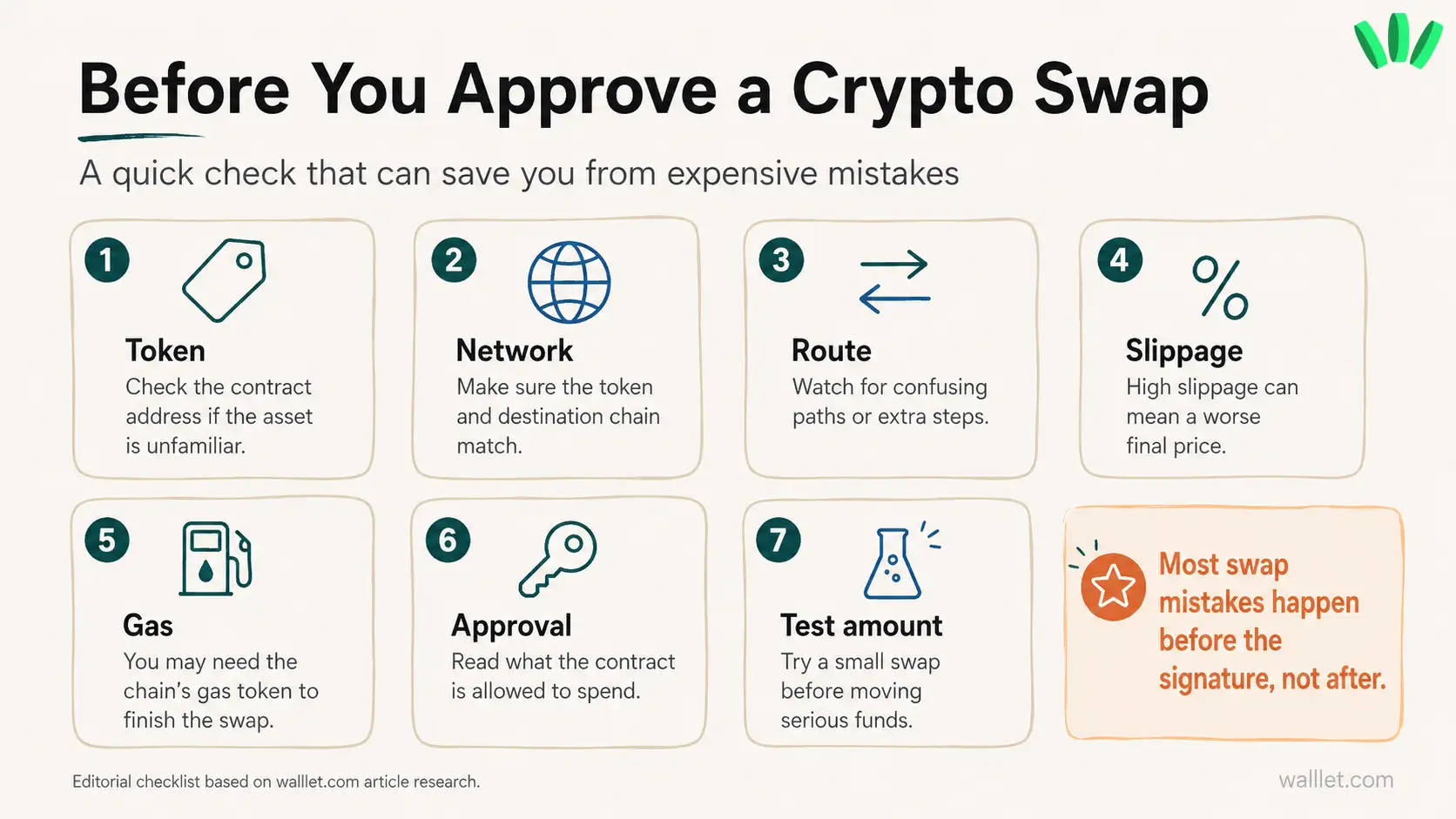
A token approval gives a smart contract permission to spend a token from your wallet. Some approvals are normal. Some are dangerous. If an approval looks unlimited, unfamiliar, or unrelated to what you’re trying to do, slow down.
Gas can also get annoying fast. If you’ve ever had the right asset but the wrong gas token, congratulations, you have met one of crypto’s dumbest UX problems. walllet explains this better in its article on gas abstraction and paying gas with different tokens.
Example: a freelancer swaps stablecoins without using a CEX
Imagine a freelance designer in Nigeria gets paid in USDT for a client project.
They don’t want to keep everything on a centralized exchange. They want control. They also want flexibility. Maybe they want to swap part of that USDT into USDC, keep some funds stable, and later use some crypto for spending. A safer flow could look like this:
They receive USDT in a wallet they control.
They confirm the exact network.
They check whether USDT to USDC is supported on that network.
They review output amount, slippage, and gas.
They check the approval.
They test with a small amount.
Then maybe a larger swap.
The point is not that every freelancer needs a DEX for every move. The point is that wallet-based swaps give users another path when they don’t want all their income sitting inside one exchange account.
How a safer wallet helps when swapping without a CEX
A big part of swap anxiety comes from the wallet experience itself. Seed phrases. Approval popups. Gas warnings. Contract addresses. Network names. Messages that look like they were translated from machine language into slightly more polite machine language.
That’s exactly where a wallet can help.
walllet.com is designed for users who want self-custody without the old wallet panic. It removes seed phrase anxiety from setup, supports passkey-based access, helps make transaction details easier to understand, and warns around suspicious contracts or risky approvals. For swaps, that matters because the most important moment is often the moment before signing.
What are you swapping?
Which network are you using?
What are you approving?
Does anything look risky?
A wallet cannot make every swap safe. It cannot make fake tokens real. It cannot reverse a bad transaction. It cannot promise the best route every time. But it can make the decision screen less blind. That’s the useful part.
When a centralized exchange still makes sense
There are times when a centralized exchange is still useful. If you need fiat cash-out to a local bank account, a centralized exchange may be simpler. If you’re making a large trade, you may need deeper liquidity. If you need account statements, tax records, advanced order types, or customer support, a CEX may still be the practical option.
This is where users usually end up with a mixed setup.
Exchange for some jobs.
Wallet for others.
Small wallet-based swaps when control matters.
CEX when fiat rails or support matter.
A little untidy. Real life usually is.
Best beginner path
If you’re new to swapping crypto without a centralized exchange, don’t start with a large cross-chain swap into an obscure token. Start smaller.
Use known assets. Stay on one network when possible. Use official links. Avoid tokens promoted in random DMs. Read the approval before signing. Test with a small amount first.
Also, don’t use one wallet for everything. Keeping daily-use funds separate from long-term holdings is basic wallet hygiene. walllet covers this in its guide on crypto wallet security best practices.
The first goal is simple: learn the flow without putting serious funds at risk.
So, what’s the best way to swap without a centralized exchange?
For most people, the safest practical path is:
Use a wallet you control.
Use a trusted DEX, DEX aggregator, or wallet swap flow.
Stick to known tokens and networks.
Check the details before signing.
Start with a small amount.
That gives you the main benefit: you can swap without handing custody to a centralized exchange. Still, every method has friction. CEXs can be easier. DEXs give more control. Wallet swaps can simplify the experience, but they still depend on liquidity, routes, gas, and approvals.
So the better question may be:
How much control do you want, and how much responsibility are you ready to handle?
That answer changes as you learn.
Ready to try wallet-based crypto without handing control to an exchange? Create your walllet.com, move a small amount first, and learn how swapping from your own wallet feels before you rely on it for larger funds.
Start small. Check everything. Then decide what belongs in your wallet and what still belongs on an exchange.
