The best swap is not always on the screen you started from. It is in the route underneath it.
A DEX aggregator is a DeFi tool that scans multiple decentralized exchanges and routes your swap through the most efficient path instead of using only one venue. That matters because your final result depends on liquidity, price impact, gas, slippage, and approvals, not just the headline rate you see first.
TL;DR
A DEX uses its own pools. A DEX aggregator searches across many venues to find a better route.
Good routing can reduce price impact and improve execution, especially when liquidity is fragmented.
Your true cost is not just token price. Gas, slippage, approvals, and MEV exposure also matter.
A complicated route is not automatically bad. Sometimes it is how the aggregator avoids a worse fill on one shallow pool.
walllet already educates users on swaps, bridges, gas abstraction, and passkey-based self-custody, which makes route-heavy flows easier to understand.
If you have ever opened a swap screen and thought, “Why is this trade bouncing through three tokens and two protocols just to get me from A to B?”, you are asking exactly the right question.
A DEX aggregator is the routing layer that tries to answer that for you. Instead of sending your trade to one decentralized exchange and hoping for the best, it scans multiple liquidity sources, compares paths, and picks the route that looks strongest on total execution. That can mean a better rate, lower price impact, or a route that simply has a better chance of filling cleanly.
Question | Direct DEX | DEX Aggregator | What it means for you |
Where does liquidity come from? | One protocol’s own pools | Multiple DEXs and liquidity sources | Aggregators can see more of the market |
How is the route chosen? | Usually inside one venue | Smart routing across venues, pools, and hops | Better odds of improved execution |
Can it split one swap across routes? | Sometimes limited or protocol-specific | Yes, often a core feature | Helps reduce price impact on bigger trades |
Is the top quoted rate the whole story? | No | No | Gas, slippage, MEV, and approvals still matter |
Is it always the best choice? | No | No | The right tool depends on trade size, pair, route complexity, and user goals |
What is a DEX aggregator?
A DEX aggregator is a protocol or app that searches multiple decentralized exchanges for the best way to execute your swap. Instead of trading only against one pool on one DEX, it looks across available liquidity and calculates a route that aims to improve execution. That route may use one pool, several pools, several hops, or a combination of venues.
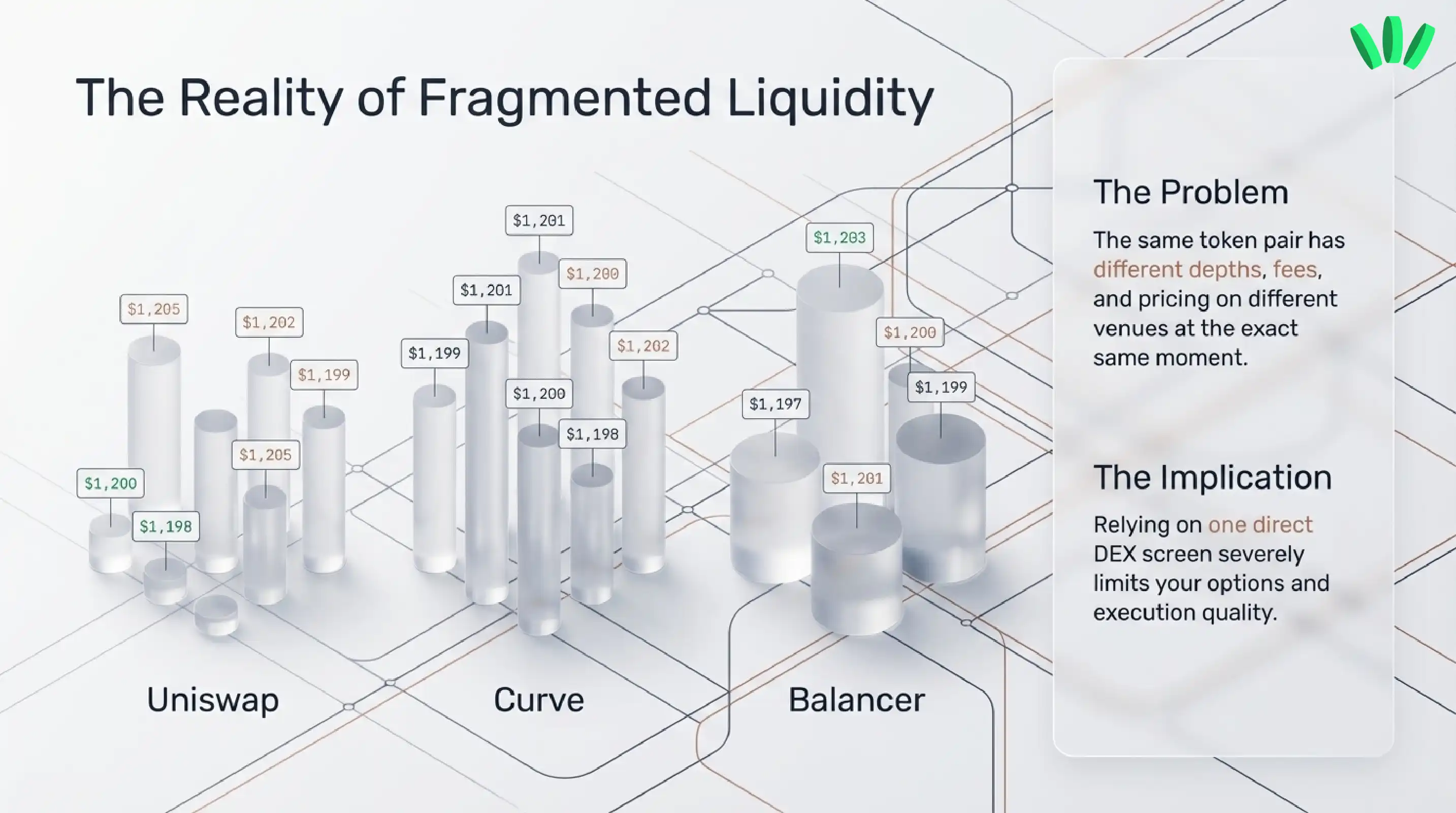
The key idea is simple:
DeFi liquidity is fragmented. The same token pair can have different depth, fees, and pricing on different venues at the same moment. A DEX aggregator exists to do the comparison work for you. ُThis is described as algorithmically finding the most efficient routes, and bringing fragmented liquidity together so users can get a better overall price.
So when someone asks, “What is a DEX aggregator in crypto?”, the shortest useful answer is this: it is a swap optimizer. Not magic, not a guarantee, and not always the right tool, but a routing engine built to improve trade execution in a fragmented market.
Related: Why Did My Swap Fail? 9 Reasons and Fixes
DEX vs DEX aggregator: what is the difference?
A DEX is the venue. A DEX aggregator is the route planner above the venues.
If you swap directly on Uniswap, you are accessing Uniswap’s available paths and liquidity. If you use an aggregator, you are asking a separate routing layer to compare venues and decide whether Uniswap, Balancer, Curve, 0x-powered liquidity, or a split across several sources gives you a better result.
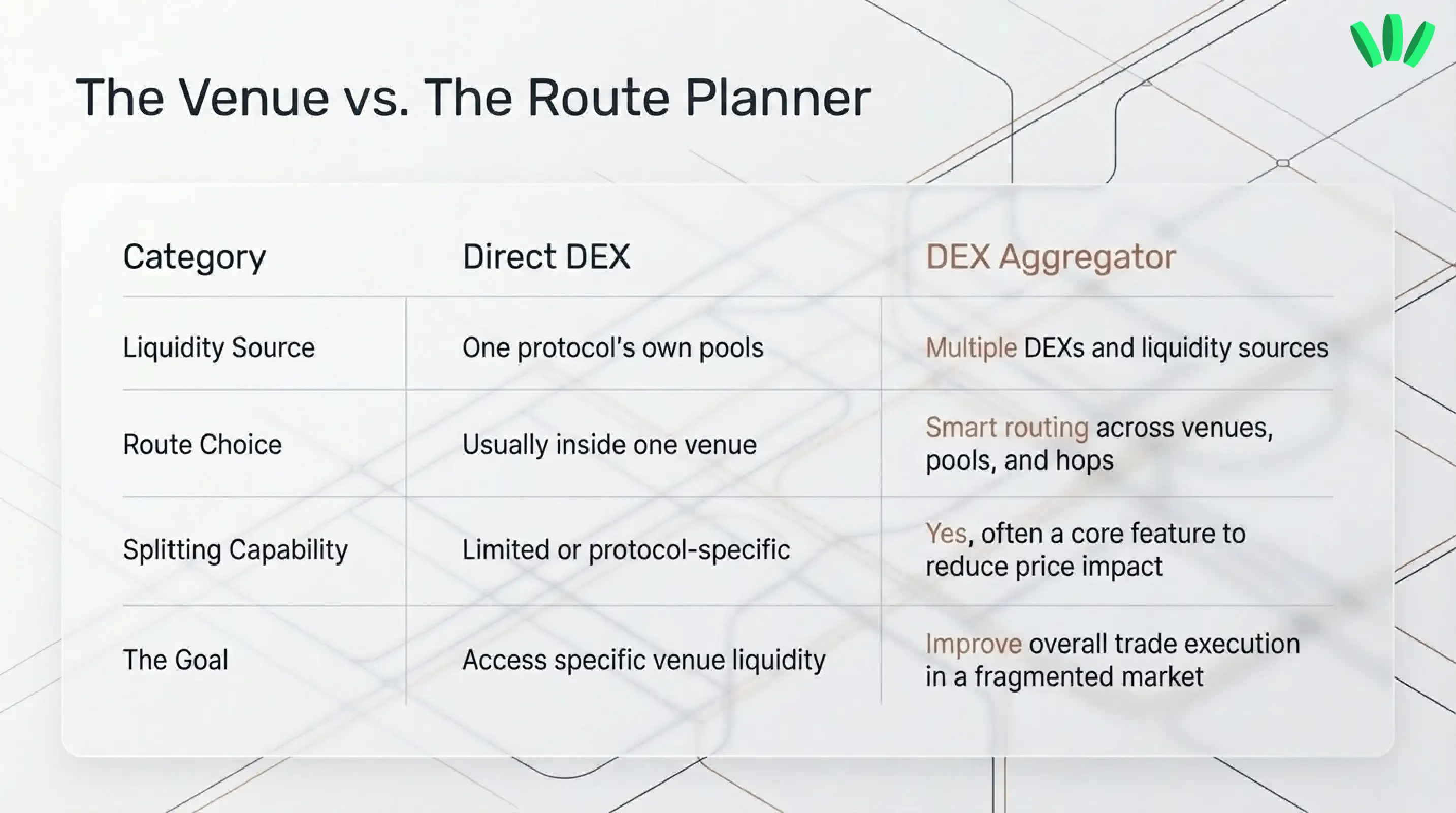
That distinction matters because many users casually compare “1inch vs Uniswap” as if they are the same kind of tool. They are not. Uniswap is a DEX. 1inch is an aggregator that may route through Uniswap if Uniswap is part of the best path. So the real comparison is not “which brand is better?” It is “do I want one venue, or do I want a router to search across venues for me?”
A DEX is where liquidity lives. An aggregator is how you shop that liquidity more intelligently.
How does routing work in a DEX aggregator?
Under the hood, the aggregator is trying to answer one question:
What route gives the best overall execution right now?
Smart routing can weigh liquidity depth, fee tiers, price impact, and gas costs. Routing can use multiple hops to reach a stronger final outcome than a simple single-pool swap.
Single-route, multi-route, and multi-hop
A single-route swap is the clean version. One venue, one path, done.
A multi-route swap splits the order across multiple pools or venues. For example: part of the trade goes through one source, another part through a second source, because the combined result is better than forcing the whole swap through one pool.
A multi-hop swap changes the path, not just the venue. Instead of token A going straight to token B, the route may pass through an intermediate asset because that path has deeper liquidity or better pricing. Some swaps include intermediary steps to maximize output.
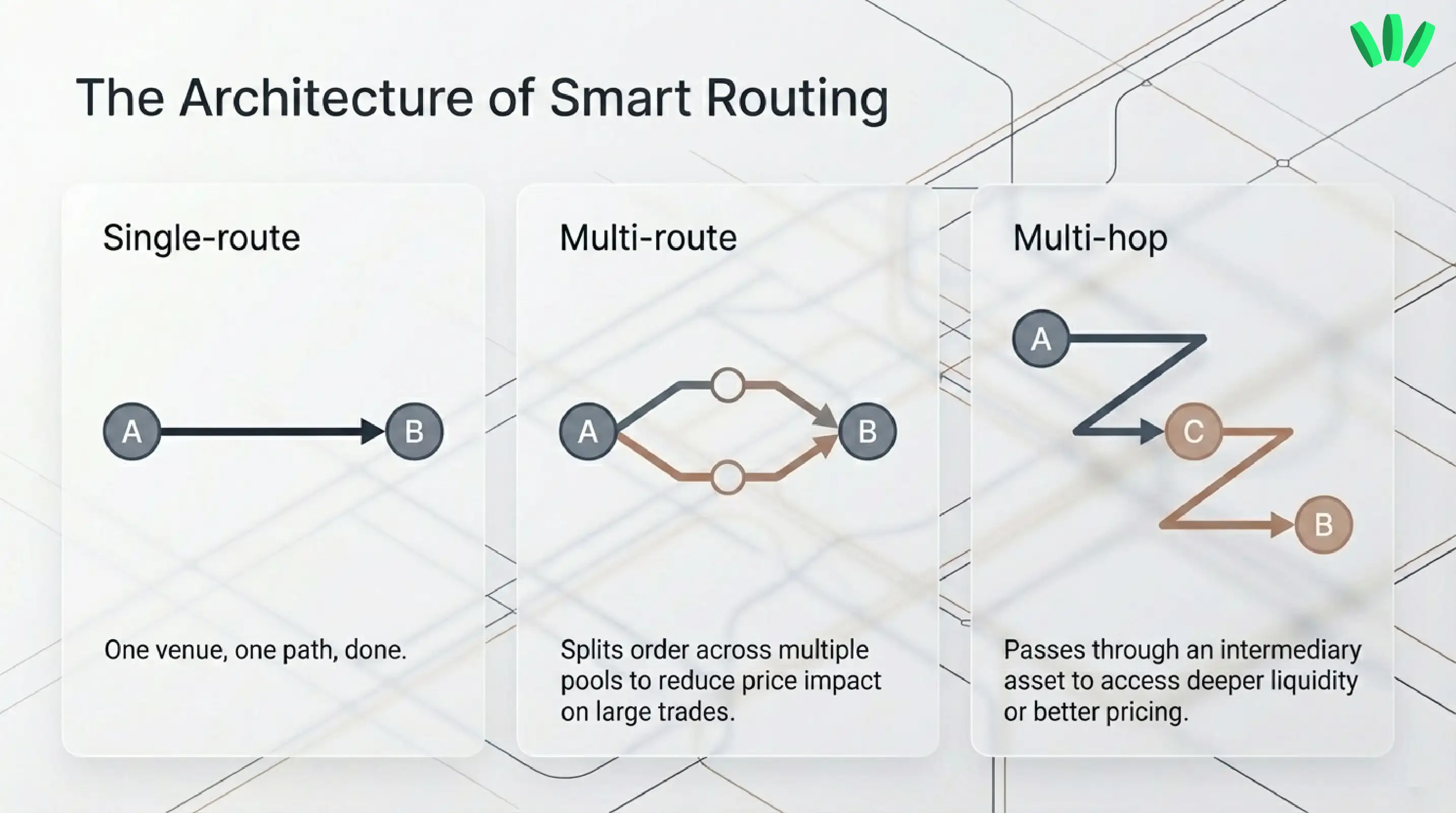
This is why routes can look messy. They are not always designed to look elegant. They are designed to produce a better result.
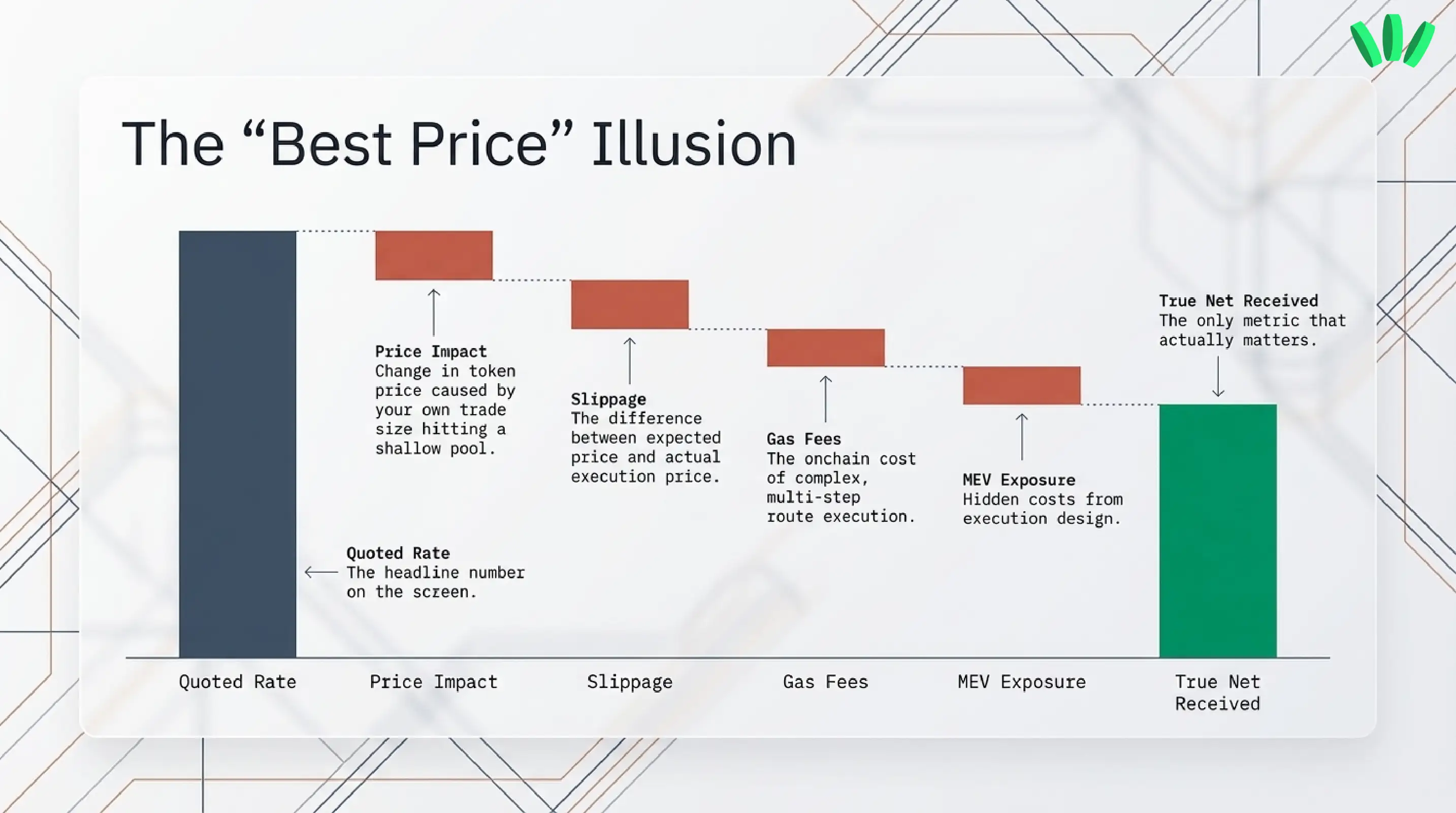
What affects your final swap rate?
Searchers often frame this as “best price,” but your real outcome is more like “best total execution.”
Price impact vs slippage
These are related, but they are not the same. Price impact is the change in token price caused by your own trade, while slippage is the difference between the price you expected and the price you actually receive after execution. That distinction is worth understanding because an aggregator can help with one and still not eliminate the other.
If your trade is large relative to available liquidity, price impact can bite hard. Aggregators help by splitting or rerouting the order so you are not hitting one shallow pool with the full size all at once. That is one of their biggest practical advantages.
Gas and route complexity
A route can improve token output but still be a worse trade after gas. This is where reality gets slippery. More steps can mean more onchain work. That is why serious routers try to optimize for the net result, not just the raw quote. This is also why “best route” is contextual. A route that makes sense for a bigger trade may not make sense for a very small one.
MEV exposure
Some aggregators also differentiate on execution style, not just routing breadth. That does not mean every aggregator gives equal protection. It means execution design is part of the product, not just a background technical detail.
Approvals and token allowances
This is the part many users ignore until something goes wrong.
Before many swaps can happen, you need to approve a token for spending by a smart contract. Token approval is the permission for a dapp to access and move a specific token from your wallet, and could be the first step before the actual swap. In practice, your route quality means very little if you approve the wrong contract, grant a risky allowance, or do not understand what you are signing.
Why does my swap route look so complicated?
Because the market is complicated, even when the interface tries to hide it.
A route can become complex for innocent reasons. Maybe direct liquidity is thin. Maybe one fee tier is better for part of the size and another venue is better for the rest. Maybe an intermediate token creates a stronger path than a direct pool. Sometimes multiple hops are the optimal outcome, not a bug.
That said, complexity is not automatically a virtue either. If a route is too hard to understand, you should slow down. Good crypto UX does not hide the important parts. It reduces the mental tax without turning you blind. You should still be able to see what asset you are sending, what asset you are receiving, what the minimum received is, what contract is requesting approval, and what fees are attached to the flow.
This is one reason the “routing explainer” angle matters more than yet another “top 10 DEXs” post. Users do not just need more names. They need better legibility.
When a DEX aggregator is not the best option
Aggregators are useful. They are not sacred.
If you want to use a specific venue for a specific reason, direct is cleaner. If you are doing a simple swap in a deep, highly liquid pool and the route is already obvious, using a direct DEX may be simpler emotionally and operationally. If you need a token or chain the aggregator does not support well, routing breadth is irrelevant. And if route complexity adds enough gas or friction to wipe out the quote improvement, the “better route” was not actually better for you.
Sometimes an aggregator is the sharper tool. Sometimes a direct DEX is the cleaner one. The right question is not which brand wins in the abstract. It is which workflow gives you the best total outcome for this specific trade.
What people get wrong about DEX aggregators
The first mistake is assuming aggregators always get the best price. They aim for the best execution across the liquidity they can see, at that moment, according to their routing logic. That is strong. It is not the same as a universal guarantee. Coverage, gas assumptions, timing, and execution design all matter.
The second mistake is obsessing over the displayed token output while ignoring the approval risk. A beautiful quote can still be wrapped in a permission request you should not sign blindly.
The third mistake is reading route complexity as danger by default. Sometimes the route looks complex because the market is fragmented and the router is doing its job. The real danger sign is not “this has two hops.” It is “I do not understand what asset I am approving, what contract is asking, or what minimum outcome I am accepting.”
walllet helps you understand & feel more human
walllet’s existing swap guide explains the difference between swaps, bridges, and cross-chain swap flows. Its gas abstraction article tackles the classic “I have the token, but not the gas coin” problem. Its product positioning centers on seedless, passkey-based self-custody, and the live site describes walllet as a non-custodial Web3 wallet built to reduce friction with gas flexibility and human-readable transaction prompts. Its privacy policy also states that the core wallet does not require name, email, or phone number, and that walllet does not collect seed phrases, private keys, or passkey credentials.
A route-heavy swap flow becomes less intimidating when the wallet helps you understand what is happening instead of burying you in crypto plumbing. If you want to see swap routes, gas logic, and transaction context in a wallet that tries to feel more human, not more punishing, explore a swap flow in walllet.com.
There is also a trust angle. walllet’s terms clearly position the product as non-custodial wallet software, and the privacy policy emphasizes data minimization and no mandatory personal-registration layer for core use. For readers learning about aggregators, that matters. Route intelligence is helpful, but custody, clarity, and approval hygiene still matter more than a flashy quote.
The practical takeaway
A DEX aggregator is not just “a better DEX.” It is a smarter search-and-routing layer for fragmented liquidity.

Use that lens and a lot of confusing swap screens suddenly make more sense. The route matters because your outcome depends on more than one price box. It depends on where liquidity sits, how your order moves through it, what approvals you grant, what gas the route requires, and how much clarity the wallet gives you before you sign.
walllet makes routing understandable. That is a much stronger promise. And for real users, it is the promise that actually matters.
If your next swap route looks busier than expected, do not just ask “what rate am I getting?” Ask the better question: “what path is my money taking, and do I understand it?” Then choose the wallet that helps you answer that before you approve anything. Create your walllet and compare your next swap with passkey-based self-custody, clearer prompts, and less friction around the route itself.
