
Blockchain is the record system behind crypto, but your wallet is how you actually use it. If you send assets, receive tokens, check balances, connect to apps, or approve transactions, a blockchain is working in the background. You do not need to become a blockchain engineer to use crypto safely. You only need to understand what the blockchain records, what your wallet controls, and which mistakes can cost you money.
If you are still learning the basics, start with this guide to what a crypto wallet actually does. It explains the most important beginner idea: your crypto is not sitting inside the wallet app. Your wallet is the tool that helps you control assets recorded on a blockchain.

A blockchain is a shared digital record that stores transactions across many computers instead of one central server. In crypto, it shows who owns what, which transactions happened, and whether transfers are valid. A crypto wallet does not hold the blockchain. It helps you access and control assets recorded on it.
TL;DR
A blockchain is the record-keeping system behind crypto.
Your wallet does not store coins like a physical wallet. It helps you control assets recorded on a blockchain.
Blockchain makes digital ownership possible without one bank, app, or company controlling the full record.
Blockchain security is not the whole safety story. Wallet design, transaction clarity, network choice, and recovery matter just as much for real users.
What Is a Blockchain in Simple Words?
A blockchain is a shared record of transactions.
Think of it as a digital ledger that many computers keep together. When someone sends crypto, that action is written into the ledger. Before the new entry is accepted, the network checks whether it follows the rules.
The “block” part means transactions are grouped together. The “chain” part means each new group connects to the one before it. That is why it is called a blockchain.
NIST describes blockchain technology as a tamper-evident, tamper-resistant digital ledger shared across a distributed network. That technical definition matters, but for wallet users the practical meaning is simpler: blockchain is the place where crypto activity is recorded and verified.
Why Does Blockchain Matter for Crypto Wallet Users?
For crypto wallet users, blockchain matters because it is where ownership is recorded.
Your wallet helps you interact with the blockchain, but the blockchain keeps the transaction history and asset records. This is one of the most misunderstood ideas in crypto.
Your crypto is not usually “inside” your wallet in the same way cash is inside a physical wallet. Instead, your assets are recorded on a blockchain, and your wallet gives you a way to access and manage them.
That means your wallet is more like a secure control panel than a storage box.
When you open a crypto wallet, you are usually looking at information pulled from one or more blockchains. When you send crypto, the wallet creates a transaction and asks the blockchain network to confirm it.
If you want to understand the difference between accounts, addresses, and keys, this guide to Web3 accounts, wallet addresses, and private keys is a useful next read.
Blockchain vs Crypto Wallet: What Is the Difference?
Concept | Simple meaning | Example |
Blockchain | The shared record of transactions | Bitcoin, Ethereum, Arbitrum |
Cryptocurrency | A digital asset recorded on a blockchain | BTC, ETH, USDC |
Crypto wallet | The tool used to access and manage crypto | A mobile wallet app |
Wallet address | A public destination for receiving crypto | An Ethereum address |
Private key or signing method | The secret or credential that controls access | Seed phrase, passkey, smart account logic |
Passkey wallet | A wallet that uses passkeys instead of asking users to manage seed phrases manually | A seedless wallet experience |
A helpful way to think about it:
The blockchain records what exists. The wallet helps you control what is yours.
This is why wallet choice matters. The blockchain may be technically strong, but a confusing wallet can still lead users into wrong-network transfers, risky approvals, phishing links, or lost recovery access. For first-time users, the safest choice is often the wallet that makes each step easier to understand. This beginner crypto wallet checklist explains what to look for before downloading anything.

How Does Blockchain Work?
Most blockchains follow the same basic pattern.
Someone creates a transaction. For example, you send crypto from your wallet to another address. Your wallet prepares the request and asks you to approve it.
The transaction is shared with the network. Computers on the network check whether it follows the rules, such as whether the sender has enough funds and whether the signature is valid.
Valid transactions are grouped into a block. Ethereum.org explains that blocks are batches of transactions linked to previous blocks through cryptographic hashes. This linking is what makes old transaction history difficult to secretly alter.
Once the block is added, the transaction becomes part of the blockchain’s shared history. On major public blockchains, confirmed transactions are usually difficult or impossible for a normal user to reverse.
That is why approval screens matter. When a wallet asks you to confirm a transaction, it is not just a casual app popup. It may be the last moment before the action becomes part of the record.
What Happens When You Send Crypto From a Wallet?
When you send crypto, your wallet does not physically move coins from one place to another. It creates a transaction request.
Transaction detail | What it means |
Asset | The crypto you are sending |
Amount | How much you want to send |
Recipient address | Where the crypto should go |
Network | Which blockchain the transaction uses |
Fee | The cost paid to process the transaction |
Signature | Proof that the wallet owner approved the transaction |
After you approve the transaction, the blockchain network checks it. If the transaction is valid, it becomes part of the blockchain record.
This is why checking transaction details matters so much. A confirmed blockchain transaction is usually final. If you send funds to the wrong address, approve a malicious contract, or use the wrong network, the blockchain may faithfully record the mistake instead of fixing it for you.

Is Blockchain the Same as Bitcoin?
No. Blockchain and Bitcoin are related, but they are not the same thing. Bitcoin is a cryptocurrency. Blockchain is the technology that records Bitcoin transactions.
Term | Meaning |
Blockchain | The record-keeping system |
Bitcoin | A cryptocurrency that uses blockchain |
Ethereum | A blockchain that supports ETH, tokens, smart contracts, and apps |
Crypto wallet | The app or tool used to access blockchain assets |
Bitcoin made blockchain famous, but blockchains can support much more than Bitcoin. Ethereum, for example, supports tokens, smart contracts, NFTs, DeFi apps, stablecoins, and other onchain tools.
Blockchain is the record system. Bitcoin is one asset and one network that uses that kind of record system.
What Is Blockchain Used for in Crypto?
In crypto, blockchain is used to record and verify activity.
Use case | What blockchain records |
Crypto payments | Who sent what to whom |
Token balances | Which address owns which assets |
Smart contracts | Rules that run automatically |
NFTs | Ownership of unique digital items |
DeFi apps | Lending, swapping, staking, and liquidity activity |
Stablecoins | Tokenized dollars and other assets |
Identity systems | Proofs, credentials, and permissions |
For wallet users, the most common uses are simple: holding assets, receiving tokens, sending crypto, connecting to apps, approving transactions, and checking balances.
The more apps you use, the more important approvals become. A payment is one thing. A smart contract permission can be broader. Before trusting a contract, read this guide on how to read a smart contract before you trust it.
What Is a Blockchain Network?
A blockchain network is the group of computers that keeps the blockchain running. These computers are often called nodes. They help store, check, and share the blockchain’s records.
Some networks are public, which means anyone can view transactions and participate according to the rules. Bitcoin and Ethereum are examples of public blockchain networks.
Some networks are private or permissioned, which means access is limited to approved participants. These are more common in business or enterprise settings.
For most crypto wallet users, public blockchains are the ones they interact with most often.
Type | Who can use it? | Common use |
Public blockchain | Open to anyone | Crypto, DeFi, NFTs, stablecoins |
Private blockchain | Limited to approved users | Company or institutional systems |
Permissioned blockchain | Access controlled by rules or members | Enterprise networks, consortia |
Layer 2 network | Built to scale another blockchain | Faster, cheaper crypto transactions |
For everyday crypto users, public blockchains and Layer 2 networks are usually the most relevant. Layer 2 networks can make transactions faster and cheaper while still connecting to a larger blockchain ecosystem.
Why Blockchain Matters for Ownership
Blockchain matters because it changes who controls the record.
In a traditional financial system, a bank or payment company keeps the main record. If you send money, the bank updates its database.
In crypto, the blockchain network keeps the record. Your wallet gives you access to the assets connected to your address.
This is why crypto often talks about self-custody.
Self-custody means you control access to your assets instead of relying completely on an exchange or custodian. That control is powerful, but it also means wallet safety becomes very important.
A good wallet should not only give you control. It should help you understand what you are controlling.
Is Blockchain Safe?
Blockchain itself is designed to be difficult to tamper with, especially on large, well-established networks. But that does not mean every crypto experience is safe.
Many losses happen because of what users approve, where they connect their wallet, which address they send to, which network they choose, or how they manage access.
Blockchain can protect the record. It cannot always protect you from a bad decision, scam website, fake token, wrong address, or confusing wallet interface.
That is why wallet design matters. A safer crypto experience is not only about cryptography. It is also about whether the next user action is understandable.
Mistake | Why it matters | Safer habit |
Sending to the wrong address | Transactions are usually irreversible | Double-check the address |
Using the wrong network | Assets may not arrive where expected | Confirm the network first |
Approving unknown contracts | Some approvals can be risky | Read permissions before approving |
Trusting fake tokens | Scam tokens can mislead users | Ignore unknown assets |
Clicking fake wallet links | Phishing can steal access | Use official sources only |
Losing recovery access | You may lose control of assets | Choose a wallet with clear recovery design |
The safest crypto experience is not just about the blockchain being secure. It is about making the user’s next action clear enough to trust.
What Does a Crypto Wallet Actually Do?
A crypto wallet helps you interact with blockchains. It lets you create or access an account, view balances, receive assets, send crypto, connect to apps, review transactions, sign approvals, manage networks, and protect access.
Traditional wallets often use seed phrases. A seed phrase is a group of words that can recover a wallet. It is powerful, but it can also be stressful for everyday users. If someone steals it, they can control the wallet. If the user loses it, recovery can become difficult or impossible.
Seedless wallets try to make this easier by removing the need for users to manually store a seed phrase.
A passkey wallet takes that idea further by using familiar device-based authentication, such as Face ID, fingerprint, PIN, or secure device login flows. The goal is not to make blockchain disappear. The goal is to make the experience around blockchain easier to understand and safer to use.
That matters because many crypto mistakes happen at the wallet layer, not the blockchain layer.
How walllet.com Helps You Use Blockchain Safely Without Seed Phrases
Blockchain gives users control, but the wallet decides how understandable that control feels.
walllet.com is designed around a seedless, passkey-based wallet experience. Instead of asking users to manually guard a seed phrase from day one, it uses passkeys and biometric authentication to make access feel closer to a modern app while still keeping the self-custody model.
The practical benefit is not only easier login. It is less seed phrase stress, clearer transaction review, and a wallet experience built around reducing everyday user mistakes.
That matters because the hardest part of blockchain for normal users is rarely the technical record system itself. It is the moment they have to answer questions like:
Am I on the right network?
Am I approving a payment or a broad permission?
Is this address correct?
Can I recover access if I lose my phone?
Does this transaction look suspicious?
walllet.com’s role is to make those moments less cryptic. Its seedless setup, passkey-based access, human-readable prompts, and smart-wallet design all point toward the same idea: blockchain should stay powerful, but the user experience should feel much less fragile.
For the smart-wallet layer behind this shift, read Account Abstraction and Smart Contract Wallets.
Blockchain Terms Beginners Should Know
Term | Simple explanation |
Block | A group of transactions |
Chain | The linked history of blocks |
Node | A computer that helps run the network |
Transaction | An action recorded on the blockchain |
Wallet address | A public destination for sending or receiving crypto |
Private key | Secret access that controls crypto assets |
Seed phrase | A recovery phrase used by many traditional wallets |
Passkey | A modern login method that can simplify secure access |
Smart contract | Code that runs on a blockchain |
Gas fee | A network fee paid to process a transaction |
Confirmation | The point when a transaction is accepted by the network |
The most important term here is not the most technical one. It is transaction. Every time you send, swap, approve, or connect, you may be creating an action that the blockchain can record.
Before You Approve a Blockchain Transaction
Before confirming a transaction in any crypto wallet, pause for ten seconds and check the basics.
Do you recognize the app or website? Are you using the correct network? Is the recipient address correct? Is the asset and amount correct? Do you understand the fee? Do you understand what permission you are approving?
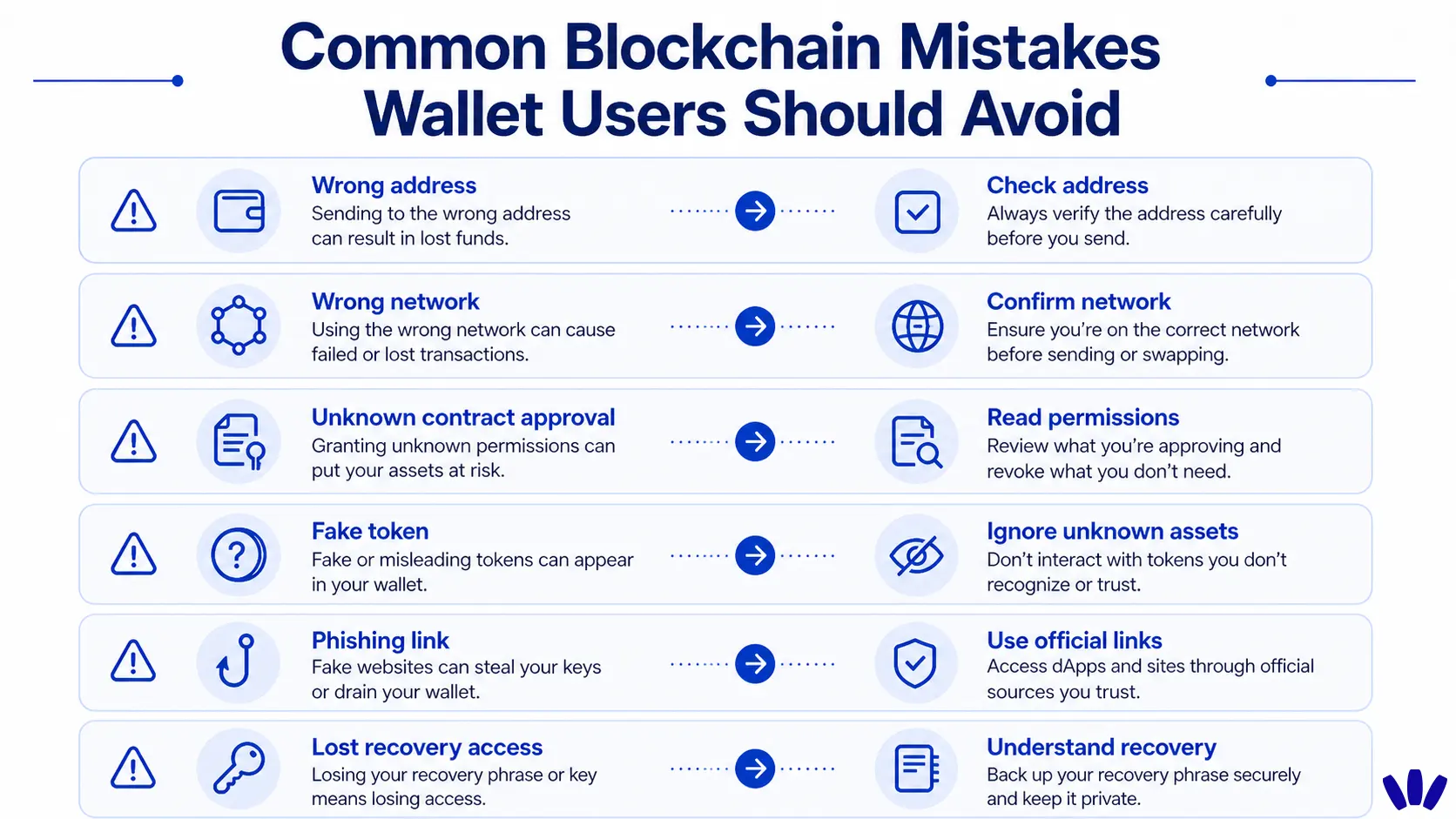
If something feels rushed, confusing, or suspicious, pause before approving. In crypto, slowing down for ten seconds can save you from a very expensive mistake.
Final Thoughts
Blockchain is the record system behind crypto. It lets people verify ownership, transfer value, and use digital assets without depending on one central company to control the entire database.
But for users, the blockchain is only half the story.
The wallet is where blockchain becomes personal. It is where you check balances, approve transactions, connect to apps, and protect access to your assets.
So when you ask “What is a blockchain?”, the practical answer is this:
A blockchain records crypto activity. Your wallet helps you use it. A better wallet makes that experience clearer, safer, and easier to trust.
Ready to use crypto without wrestling with seed phrases?
Download walllet.com and try the app.
Related reading
Crypto and Web3: Wallets, Networks and Security Explained
Crypto Flash Crash vs Price Glitch: What Wallet Users Should Know
Why Do L2 Withdrawals Take 7 Days? A Simple Guide to Bridge Delays
