When a Nigerian freelancer receives a $500 or $1,000 payment from an international client, the real question is:
How much money reaches you, where can you keep it, how can you use it, and what happens when you need naira?
walllet.com and Payoneer solve overlapping problems, but they are designed around different payment journeys. Payoneer is widely used for marketplace payouts, business payments, and receiving money from companies that already support its payment infrastructure. walllet.com focuses on helping global earners manage international income through receiving, holding, spending, converting, and accessing funds.
The right choice depends on your payment route, your clients, and what you want to do after the USD arrives.
Compare | walllet.com | Payoneer |
Main use case | Managing global income, USD access, spending and cash-out routes | Receiving payments from marketplaces, platforms and businesses |
Best fit | Freelancers and remote workers who want more control after receiving money | Users whose clients or platforms already support Payoneer |
USD receiving | Supported receiving routes depending on eligibility | Receiving accounts and payment workflows depending on eligibility |
USD holding | Available subject to current product eligibility | Available |
Card access | USD card route subject to availability and eligibility | Payoneer Card where eligible |
Nigeria access | Depends on supported account features | Depends on account eligibility and available routes |
Main comparison point | Full money journey after receiving payment | Payment acceptance and withdrawal workflow |
Disclosure
walllet.com publishes this comparison and is one of the products covered. This article compares both services using the same criteria and separates published fees from account-specific costs, eligibility requirements, and variable charges.
Before moving a recurring client, compare the complete payment route, not only one advertised fee. Check how receiving, USD holding, spending, conversion, and cash-out options work for your walllet.com account.

The short answer: walllet.com vs Payoneer
There is no universal winner between walllet.com and Payoneer for Nigerian freelancers. Payoneer can make sense when your client, marketplace, or platform already works with Payoneer and you need a familiar receiving route.
walllet.com can make sense when your goal goes beyond receiving money and includes managing USD income, spending internationally, converting funds, and accessing local currency. The decision depends on the complete route:
Client → payment method → receiving fee → USD balance → spending or conversion → FX rate → final usable money
A receiving fee alone does not show the real cost of getting paid.

Can Nigerian freelancers use walllet.com and Payoneer?
Both platforms depend on account availability, eligibility requirements, and supported payment routes. Before changing payment details with a client, freelancer, or marketplace, check:
Can the payer send money through this route?
Does the account support the currency you need?
What fees apply when receiving?
What happens when you convert USD to naira?
Can you keep part of your income in USD?
How quickly can you access your money?
A payment account is only useful if it fits the entire journey of your income. For freelancers, this often starts with the way clients pay. If you work through platforms such as Upwork, the available withdrawal methods can affect which service fits your workflow. See more about Upwork withdrawal methods in Nigeria.
Receiving USD: where the real comparison starts
Many comparisons stop at “Can I receive USD?” That is only the first step. A freelancer receiving international income usually cares about:
Can a US client pay directly?
Can a platform send earnings?
Does the payment arrive as USD?
Can the balance stay in USD?
What happens when money needs to become naira?
Payoneer is often connected with marketplace and business payment workflows. For example, a platform may already offer Payoneer as a withdrawal option.
walllet.com is positioned around the broader income management journey: receiving international money, keeping value in USD or supported digital dollars, spending online, and converting when needed.
For people comparing multiple fintech options, the complete route matters more than the name of the app.
You can also compare the broader landscape in:
compare the full money route across major payment apps → walllet.com vs Grey vs Raenest vs Cleva vs Payoneer: Compare the Full Money Route in 2026 | walllet.com
Payoneer fees vs walllet.com fees
Fees are one of the first things freelancers compare, but the structure matters. Payoneer fees depend on the payment route. According to Payoneer's published pricing:
Receiving from another Payoneer customer: free
Receiving account in a non-local currency: 1%, minimum $1
US ACH debit: 1%
Card-funded payments: up to 3.99% + $0.49
Annual account fee: $29.95 in certain situations
Annual Payoneer Card fee: $29.95
walllet.com currently publishes:
Receiving account issuance: $5
Incoming USD bank receipt: 1%
Off-ramp fee: 0.5%
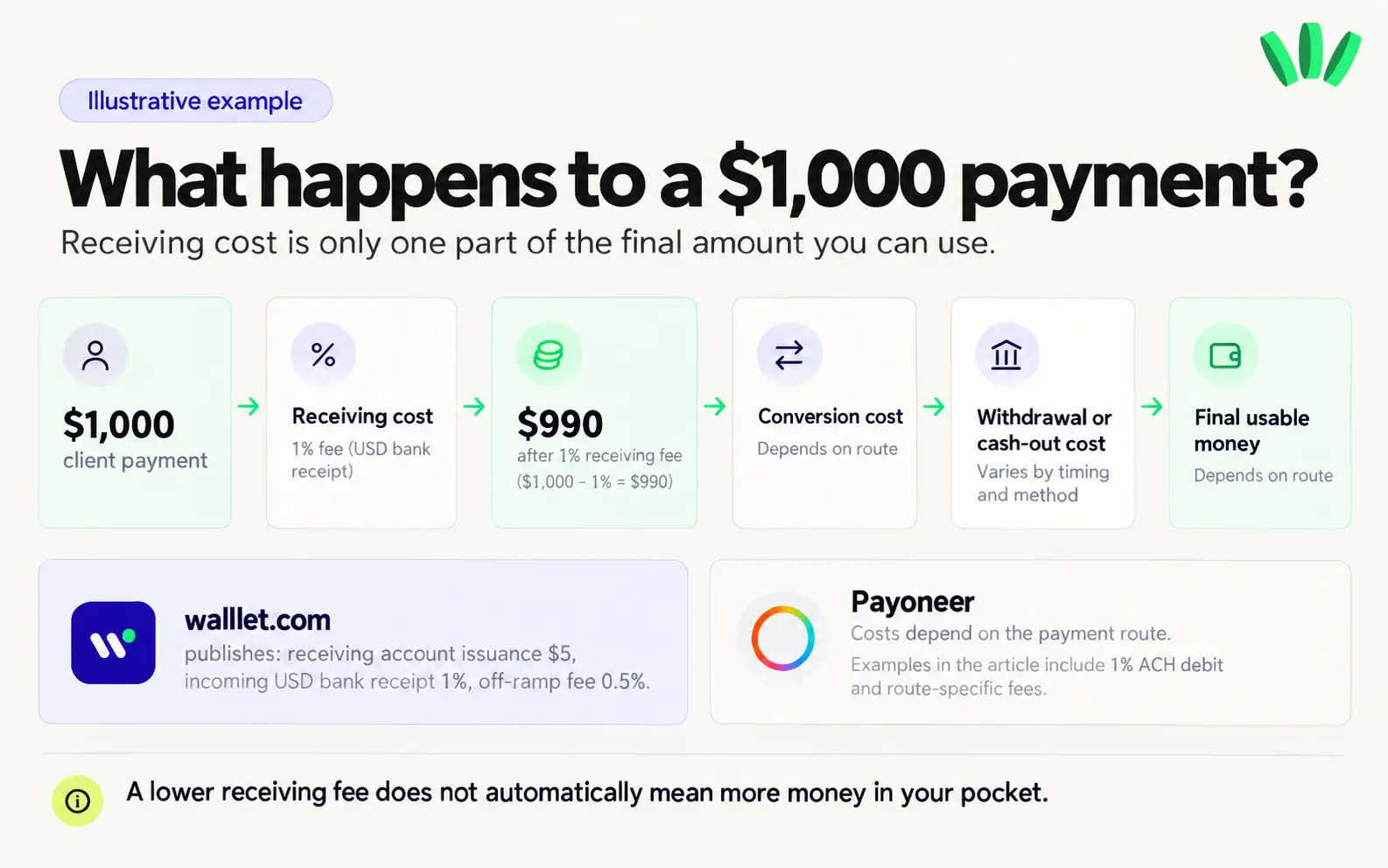
However, the final amount received in naira depends on the conversion route and exchange rate available at the time. A lower receiving fee does not automatically mean more money in your pocket. The important calculation is:
Payment received − receiving costs − conversion costs − withdrawal costs = usable money
Example: receiving $1,000
Assume a $1,000 payment arrives through a route where walllet.com's published receiving fee applies.
$1,000 − 1% receiving fee = $990
This is only the receiving stage. The final naira amount depends on:
conversion rate
off-ramp cost
withdrawal method
timing
The same principle applies to Payoneer. A single percentage cannot represent every Payoneer payment because the final cost depends on the specific route.
Can clients pay walllet.com or Payoneer through ACH, wire, or marketplaces?
The payment method your client uses can decide which option works better. A freelancer receiving money from a US company may have a different need from someone earning through a marketplace. Common payment routes include:
Marketplace payments
Many freelancers start with platforms that already connect payments to specific providers. If your marketplace supports Payoneer withdrawals, using Payoneer may require fewer changes to your workflow. However, freelancers who receive payments from multiple sources often need a broader setup:
marketplace income
direct client payments
recurring contractor payments
international subscriptions
business expenses
In this situation, the question changes from: “Can I receive money?” To: “How do I manage my global income after receiving it?”
For freelancers working with direct clients, understanding invoice and payment options can prevent payment delays. Learn more about how to invoice a US client from Nigeria.
ACH payments
ACH is commonly used for US-based payments. Whether ACH is available depends on the provider, account type, eligibility, and payment direction. A freelancer should confirm:
whether the payer can send ACH
whether the receiving details match the required payment format
whether business or personal payments are supported
A payment method that works for one client may not work for another.
Wire transfers
Wire transfers can be useful for larger business payments, but they may involve:
sender fees
receiving fees
intermediary bank charges
longer processing times
Always compare the complete route, not only the advertised receiving feature.
Can you keep USD with walllet.com or Payoneer?
Holding USD can be important for Nigerian freelancers because converting every payment immediately may expose income to exchange-rate changes. The main questions are:
Can I keep my balance in USD?
Can I spend internationally?
Can I decide when to convert?
Can I separate receiving money from cash-out?
Payoneer allows eligible users to maintain balances in supported currencies. walllet.com focuses on the workflow after receiving international income, including holding value, spending, converting, and accessing funds.
For users comparing payment apps, this is where the difference between a receiving account and a complete money-management tool becomes important. If you want to understand the different ways Nigerians receive international payments, see:
How to Receive USD in Nigeria Without PayPal in 2026 | walllet.com
walllet.com Card vs Payoneer Card in Nigeria
A card changes the way freelancers use their income. Instead of:
Client payment → withdrawal → bank account → separate card
some users prefer:
Client payment → USD balance → card spending
The important comparison points are:
Feature | walllet.com | Payoneer |
Card availability | Depends on current product eligibility | Available where eligible |
Purpose | Spending from managed USD income | Spending from Payoneer balance |
International purchases | Supported route depends on availability | Supported where card is available |
Physical card | Product availability dependent | Availability dependent |
A card is useful when freelancers need to pay for:
software subscriptions
online services
travel expenses
international purchases
business tools
The card itself is only one part of the decision. The bigger question is where the money comes from and how easily it gets there.
Which is better for Upwork and other marketplaces?
There is no single answer because marketplace support changes over time. For a freelancer who earns mostly through platforms:
Payoneer may fit naturally if the platform already supports Payoneer withdrawals.
For a freelancer who receives money from multiple sources:
Upwork
direct clients
agencies
international companies
the ability to manage the entire income flow may matter more.
Before switching payment details, test one payment cycle:
Receive a small payment.
Confirm arrival time.
Check all fees.
Test conversion or withdrawal.
Keep the previous route available until the new one works reliably.
What happens if a payment is delayed, rejected, or held?
Payment problems are usually caused by the route, not only the provider.
Common causes include:
incorrect receiving details
unsupported payment type
compliance checks
sender restrictions
account verification requirements
mismatched currencies
Before moving a recurring client, check:
What exact payment method will they use?
Is the payer a company or individual?
Is the payment recurring?
What documents may be required?
What happens if a transfer fails?
A reliable payment setup is one that works when something goes wrong, not only when everything goes perfectly.

When Payoneer may make more sense
Payoneer may fit better when:
your marketplace already supports Payoneer
clients are familiar with Payoneer payments
you mainly need a receiving solution
changing payment details would create unnecessary friction
For many freelancers, familiarity on the payer side is an important factor.
When walllet.com may make more sense
walllet.com may fit better when:
you want to manage more of the money journey in one place
you receive global income and want USD access
you want options beyond receiving only
you spend internationally
you need a route between digital dollars and local spending
The choice depends on your actual workflow.
A freelancer receiving one marketplace payout every month may have different priorities from a remote worker receiving payments from several international clients.
Before moving a recurring client from Payoneer to walllet.com
Use this checklist:
Confirm the payment route
Ask:
Can this client pay my new account?
Which method will they use?
Are there sender-side restrictions?
Compare the complete cost
Calculate:
receiving fee
conversion cost
withdrawal cost
FX rate
Test before switching fully
Do not change a major recurring payment until the new route has successfully completed a test payment.
Manage your global income with more control
Receiving money is only one part of getting paid internationally. If your goal is to receive global income, hold value in USD, spend online, convert funds, and access money in Nigeria, explore the current routes available with walllet.com.

