While Tether Wallet offers an official home for USDT, walllet.com provides a more modern, seedless, and human-readable experience for the broader Web3 world.
The choice between walllet.com and Tether Wallet depends on your focus. Tether Wallet is a specialized tool for Tether ecosystem assets like USDT and XAU₮ using a cloud-synced encryption model. walllet.com is a modern, self-custodial smart wallet that uses passkeys and biometrics to remove seed phrases entirely, offering a more intuitive experience for a wider range of tokens and chains.
TL;DR
walllet.com is best for users who want seedless, self-custodial security via FaceID/TouchID and human-readable transactions across multiple chains.
Tether Wallet is ideal for those strictly within the Tether ecosystem who prefer username-based transfers and a cloud-encrypted recovery system.
Choosing the right home for your stablecoins and Web3 assets
Deciding where to store your USDT often leads to a choice between the "official" route and the "modern" route. As stablecoins become the backbone of daily digital transactions, the gap between technical tools and user-friendly apps is widening.
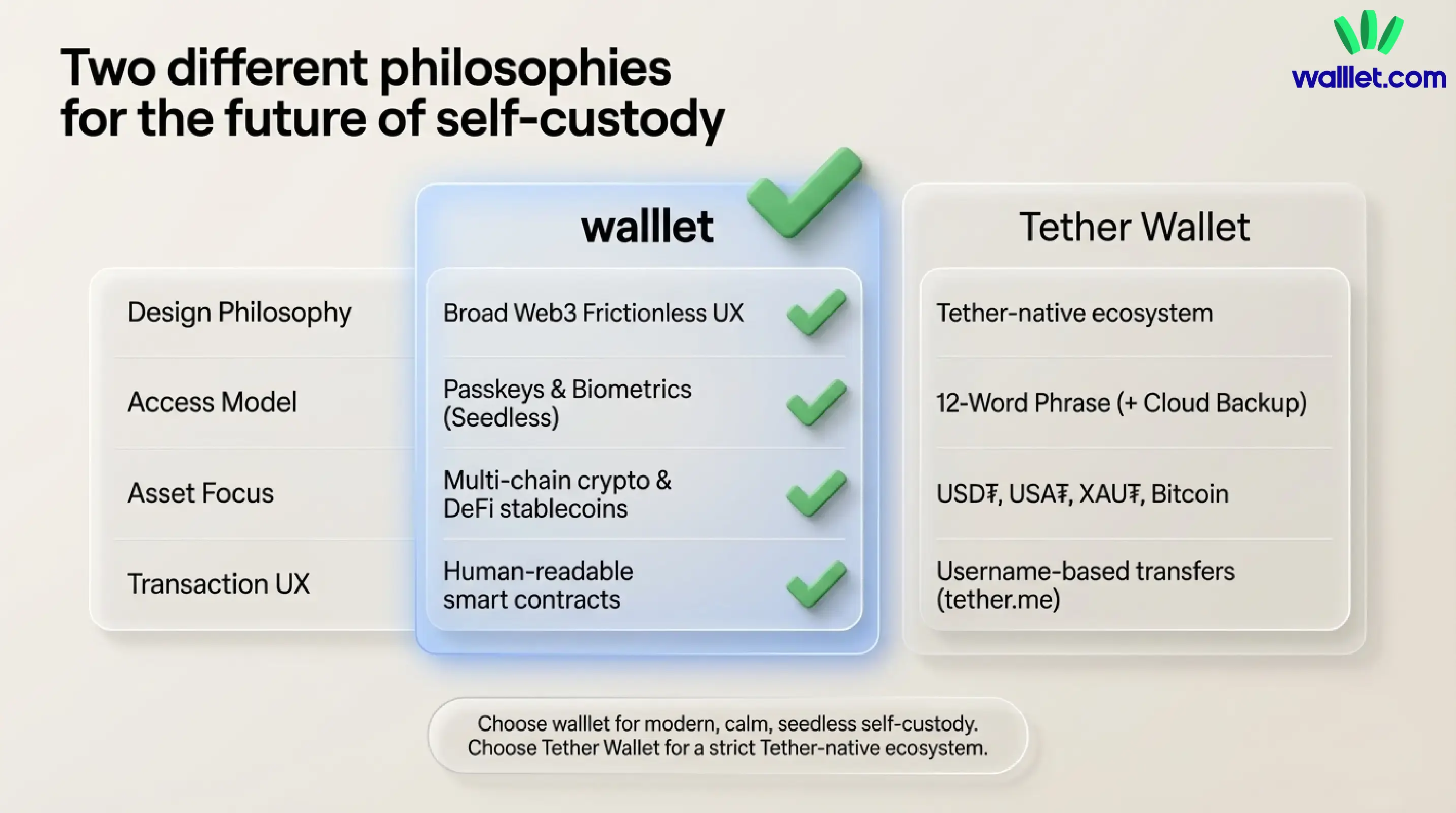
Tether Wallet (wallet.tether.io) represents the established ecosystem for the world’s most popular stablecoin. walllet.com, however, represents a new generation of smart wallets designed to fix the friction points that have kept crypto from going mainstream. In this article we will compare walllet.com and Tether Wallet (wallet.tether.io) and discover which offers better security, seedless recovery, and ease of use for managing USDT and other digital assets.
Comparison at a Glance
Feature | walllet.com | Tether Wallet (wallet.tether.io) |
Custody Model | Self-custodial (Smart Contract) | Self-custodial (Split-key encryption) |
Login Method | Passkeys (FaceID, Fingerprint) | Password & Username (@name) |
Seed Phrases | None (Truly seedless) | None (Cloud-synced encryption) |
Security Layer | Biometric Hardware (FIDO) | 2FA & Cloud Storage (iCloud/GDrive) |
Transaction Clarity | Human-readable summaries | Standard blockchain logs |
Chain Support | Multi-chain (Ethereum, L2s, etc.) | Tether-supported networks (USDT, XAU₮) |
Gas Fees | Flexible (Pay in stablecoins) | Automatic in the token sent |
The Security Showdown: Passkeys vs. Cloud Encryption
The biggest difference between these two is how they protect your money.
Tether Wallet uses a split-key approach. It generates an encryption key on your device, encrypts your wallet data, and then stores that data on Tether’s servers while the key itself is backed up to your personal cloud (like iCloud or Google Drive). You need both to get back in. It is a solid middle ground, but it still relies on traditional passwords and cloud security.
walllet.com takes a different path by leveraging the hardware already in your phone or laptop. By using passkeys, walllet.com replaces passwords and seed phrases with biometric authentication. When you sign a transaction, you are using the same secure enclave that protects your banking apps. There is no "secret key" for a hacker to phish because the credential never leaves your device. It is a simpler, faster, and more robust way to handle self-custody.
Related: Custodial vs Non-Custodial Wallets Explained: Which One Should You Actually Use?
Transaction Clarity: Knowing What You Sign
If you have ever been intimidated by a long string of hex codes or a "Sign Message" prompt that looks like gibberish, you are not alone. This is where walllet.com aims to change the experience.
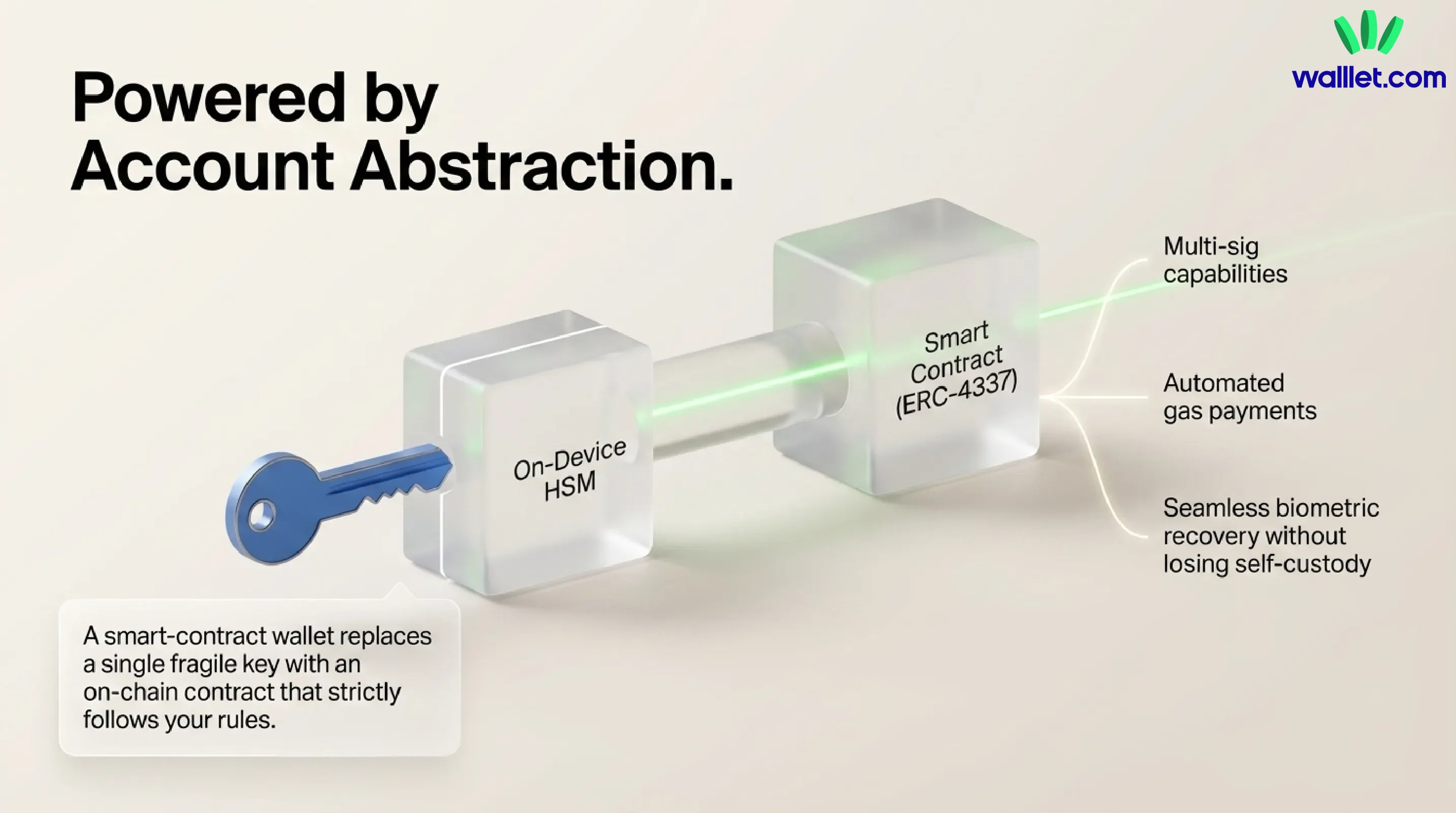
Most wallets, including the official Tether Wallet, show you the raw data of a transaction. walllet.com uses account abstraction to translate those technical details into plain English. Instead of seeing a complex contract interaction, you see a clear summary: "You are sending 100 USDT to Sarah."
This clarity is more than just a convenience; it is a security feature. When you can actually read what you are signing, you are much less likely to fall for malicious smart contract scams.
Ecosystem and Utility
Tether Wallet is built primarily for the Tether ecosystem. It is excellent for sending USDT, USA₮, or XAU₮ (Tether Gold) using simple usernames like @yourname. If your entire digital life revolves around Tether-issued assets, it is a streamlined tool.
walllet.com is built for the broader Web3 world. It is designed for people who want to hold USDT but also want to explore decentralized finance (DeFi), collect NFTs, or swap between hundreds of different tokens across various blockchains.
One standout feature of walllet.com is gas flexibility. In traditional wallets, you often need to hold a specific "gas token" (like ETH) just to move your USDT. walllet.com allows for more flexible fee handling, often letting you pay for the transaction using the token you are already sending.
Which One Should You Use? walllet.com or Tether Wallet?
You should choose Tether Wallet if:
You primarily hold and send Tether-branded assets.
You prefer using a username system for transfers.
You are comfortable with your wallet recovery being tied to your iCloud or Google Drive account.
You should choose walllet.com if:
You want a truly seedless experience that starts and ends with your biometrics.
You want to avoid the "gas token" headache and pay fees more naturally.
You value human-readable transaction prompts that explain exactly what is happening.
You want one wallet that handles your USDT alongside the rest of the Web3 ecosystem.
Ready to experience the future of USDT? Create your seedless walllet.com account in seconds.
